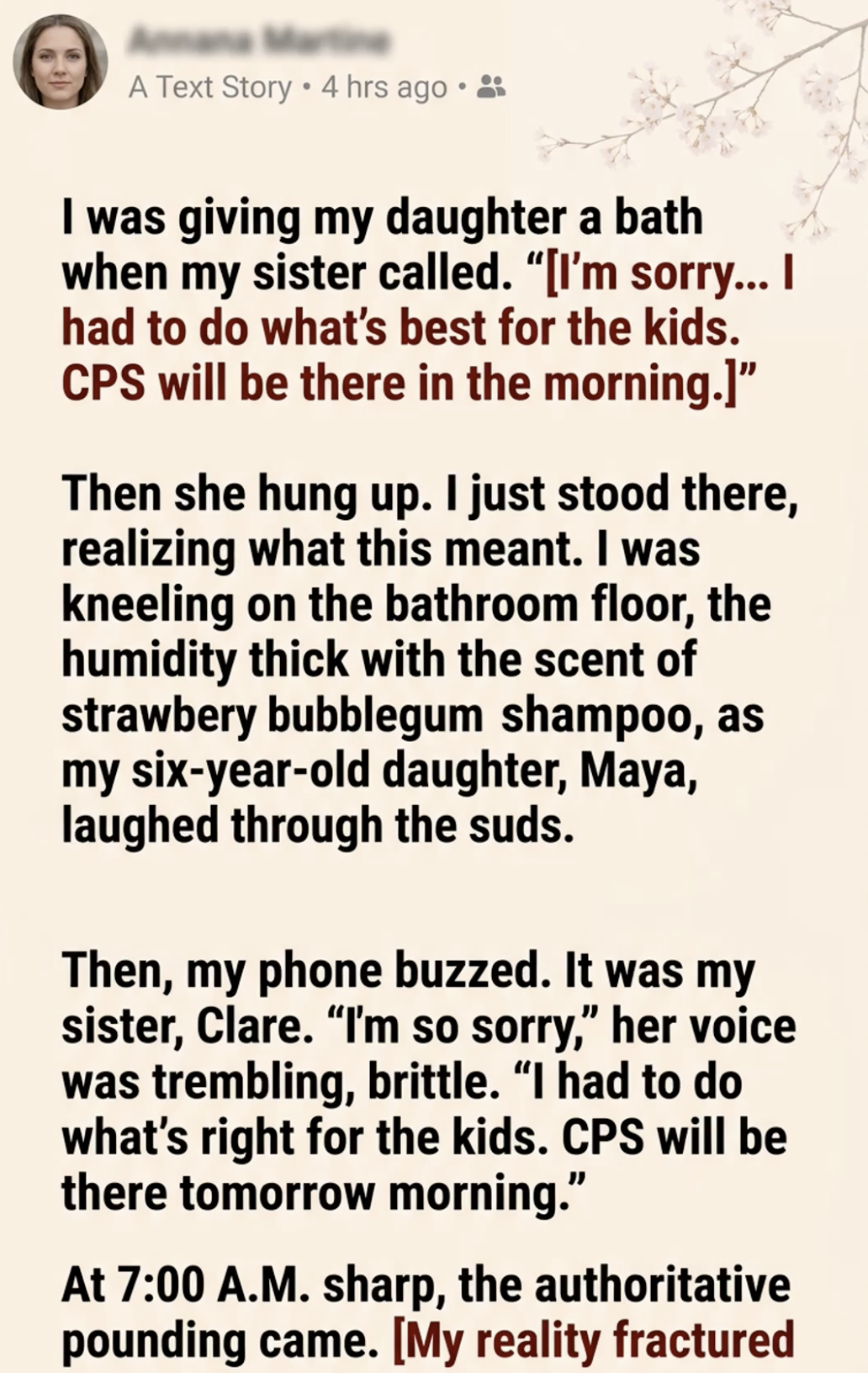
At exactly 7:00 a.m., someone pounded on my front door so hard that the picture frames in the hallway rattled.
I was already awake.
I hadn’t slept more than twenty minutes at a time since my sister, Clare, called the night before and told me Child Protective Services would be coming for my six-year-old daughter.
My hands were shaking so badly that I nearly dropped my phone.
Maya stood behind me in her pajamas, clutching her favorite stuffed rabbit.
“Mommy, who’s at the door?”
I turned toward her and forced myself to smile.
“Just some people who need to talk to Mommy, sweetheart. Go sit on the couch for me, okay?”
She nodded, but she didn’t move.
Then the pounding came again.
When I opened the door, two CPS investigators stood on the porch beside two uniformed police officers. One investigator held a folder. The other carried a tablet.
“Are you Claire Bennett?” the woman asked.
“Yes.”
“We’re here regarding a report about the safety and welfare of your daughter, Maya. We have authorization to enter and conduct an assessment.”
My mouth went dry.
“Who made the report?”
“We can’t discuss every detail of the report at the door. We need to speak with you and see Maya.”
I stepped aside.
The officers entered first, followed by the investigators.
Maya pressed herself against my leg.
One investigator knelt to speak to her gently while the other asked me questions about our home, her school, her medical care, and the people who regularly spent time with us.
I answered everything.
Yes, Maya had her own bedroom.
Yes, she attended school regularly.
Yes, she had a pediatrician.
No, there had been no recent injuries, medical emergencies, or incidents involving anyone in our home.
But the questions kept coming.
And as I watched one investigator write notes while the other examined the kitchen and living areas, I felt something inside me beginning to crack.
My sister had done this.
Clare, the person who had held Maya in the hospital after she was born. Clare, who had promised to be the aunt Maya could always count on. Clare, who had sat at my kitchen table only four days earlier, drinking coffee and telling me how much she loved being part of our little family.
The same woman who had whispered into my phone the night before:
“I’m so sorry. I had to do what’s best for the kids. CPS will be there in the morning.”
At first, I had thought she was threatening me.
Now I understood that she had already made the call.
What I didn’t understand was why.
Because whatever Clare believed she was protecting the children from, she had never once asked me whether it was true.
And by the time the investigators finished their initial assessment, I would begin to realize that the report wasn’t simply about Maya.
It was about a secret my sister had been desperate to keep hidden.
To understand how we got there, I have to explain what my family looked like before that morning.
Clare was three years older than me. Growing up, she was the responsible one, the daughter who remembered birthdays, organized family gatherings, and knew exactly what to say when our mother was upset.
I was the quieter one.
I worked hard, kept a small circle of friends, and preferred solving problems privately rather than turning them into family discussions.
When Maya was born, Clare became unusually involved in our lives.
She brought meals, helped me arrange childcare when I returned to work, and offered to watch Maya on occasional weekends. She was the first person I called when Maya took her first steps, and she cried harder than I did when Maya started kindergarten.
I trusted her.
Perhaps too much.
Clare had two children of her own, Noah, who was eight, and Lily, who was five. Her husband, Scott, worked in construction management and traveled frequently. She often said she was exhausted from handling everything at home.
I understood.
We were sisters, and we had both learned that motherhood could be beautiful and overwhelming at the same time.
Whenever Clare needed help, I tried to be there.
I took Noah and Lily for sleepovers when Scott was away. I picked them up from school when Clare had appointments. I bought extra groceries when she mentioned money was tight.
And when she told me she was struggling, I listened.
But over the previous two months, something about Clare had changed.
She began asking strange questions about my finances.
Had I received a bonus at work?
Was Maya’s father paying child support regularly?
Did I have savings set aside?
At first, I didn’t think much of it. My former husband and I had separated amicably, and although raising Maya alone was expensive, I managed our household responsibly.
Then Clare started making comments that unsettled me.
“You’re lucky you can afford that place on your own,” she said one afternoon while looking around my living room.
“I budget carefully,” I replied.
She nodded, but her expression remained distant.
Another time, she asked whether I had life insurance and who would care for Maya if something happened to me.
I told her I had named a trusted friend as Maya’s temporary guardian in my estate documents, with the appropriate legal arrangements to be reviewed as she grew older.
Clare’s face changed.
“You wouldn’t even consider family?”
“I would consider whoever was best prepared to care for her.”
“I’m her aunt.”
“I know.”
She stared at me for a long moment before changing the subject.
I should have paid more attention to that conversation.
Instead, I assumed she was hurt that I hadn’t automatically chosen her.
I didn’t yet realize that Clare had begun imagining a future in which she would have control over decisions that belonged to me.
The first time I noticed something was seriously wrong happened on a Sunday afternoon.
Clare had brought the children over for lunch. Maya was playing in her room with Lily, while Noah sat at the kitchen counter building a model airplane.
Clare was unusually quiet.
When I asked whether everything was okay, she smiled too quickly.
“Of course. Why wouldn’t it be?”
“You seem distracted.”
She glanced toward the hallway.
Then she asked, “Has Maya said anything about wanting to live somewhere else?”
I stared at her.
“What?”
“Kids say things sometimes. Maybe she wants a bigger house, or more children around.”
“Maya likes her home.”
Clare shrugged.
“I was just asking.”
I let the conversation drop, but I couldn’t stop thinking about it.
That evening, while I was putting Maya to bed, she asked whether Aunt Clare was angry with me.
I sat on the edge of her mattress.
“Why would you think that, sweetheart?”
Maya twisted the corner of her blanket.
“Aunt Clare said grown-ups might have to make some changes soon.”
My stomach tightened.
“What kind of changes?”
“She didn’t say.”
I kissed Maya’s forehead and told her she didn’t need to worry about grown-up conversations.
But after she fell asleep, I sat at the kitchen table for nearly an hour, trying to understand what Clare was planning.
The next morning, I called her.
She didn’t answer.
I sent a message asking whether we could talk.
She replied three hours later.
Everything is fine. Please stop worrying.
I wanted to believe her.
Then, two days later, she arrived at my house without warning.
She said she needed to borrow a folder of family documents our mother had given me after she downsized. I found it in a cupboard and handed it to her.
As she flipped through the papers, I noticed her pause over a document containing information about my apartment lease and emergency contacts.
“Why do you have this?” she asked.
“Because it’s my folder.”
She laughed nervously.
“Right. Of course.”
She left less than ten minutes later.
That was the last ordinary conversation we had before the call.
The CPS investigators remained in my house for nearly two hours.
They were professional, but I could feel my life being reduced to a list of questions and observations.
They asked whether Maya had ever been left alone, whether she had missed school, whether she had access to food, and whether anyone in the household had threatened or harmed her.
I answered carefully.
I didn’t want my anger at Clare to interfere with the assessment.
At one point, an investigator asked whether my sister had recently expressed concerns about Maya’s safety.
I hesitated.
“She hasn’t told me she believes Maya is being harmed,” I said. “She hasn’t described any specific incident. But she called me last night and said CPS would be here this morning.”
The investigator looked up.
“She told you in advance?”
“Yes.”
“Did she explain why?”
“No. She said she had to do what was best for the kids.”
The investigator made a note.
I asked whether Maya was going to be taken away.
The woman paused before answering.
“Our immediate responsibility is to assess the information we’ve received and determine whether there is evidence of a safety concern. We haven’t made that determination yet.”
It wasn’t the reassurance I wanted, but it was an honest answer.
I nodded and tried to keep breathing.
The investigators spoke with Maya in an age-appropriate way. One of them asked about her daily routine, her school, and the people she felt safe with.
Maya told them about her teacher, her stuffed rabbit, and the pancakes we made on Saturday mornings.
Then she said something that made both investigators look at each other.
“Mommy said I should always tell the truth, even if someone gets mad.”
The woman smiled gently.
“That’s good advice.”
Maya looked down at her rabbit.
“Aunt Clare said I shouldn’t tell Mommy everything.”
My heart stopped.
The investigator didn’t react dramatically.
She simply asked Maya what she meant.
Maya said that Clare had recently been asking her questions when they were alone. Questions about whether Mommy ever left her home alone, whether there were times she didn’t have dinner, and whether she was ever frightened at night.
Maya told her aunt that none of those things happened.
According to Maya, Clare had responded by telling her that sometimes children didn’t understand what was best for them.
I felt sick.
The investigator thanked Maya for being honest and moved on to other questions without suggesting what she should say.
When they finished, Maya came straight to me.
“Am I in trouble?”
I knelt and held her shoulders.
“No, baby. You have done absolutely nothing wrong.”
“Is Aunt Clare mad at me?”
I pulled her into my arms.
“I don’t know, sweetheart. But you never have to hide the truth to make an adult happy. Not even someone you love.”
She buried her face against my shoulder.
I held her until her breathing slowed.
For the first time that morning, I stopped worrying about whether Clare had damaged my reputation.
I worried about what she might have said to my daughter when nobody else was listening.
Before leaving, the investigators explained that the assessment would continue. They might need to contact Maya’s school, her pediatrician, and other people familiar with her care.
They did not tell me the case was closed, and they did not promise that no further action would be taken.
I appreciated that they were doing their jobs.
I also knew I needed to protect Maya emotionally while the process continued.
After they left, I called my attorney, Rebecca.
She advised me to preserve every message from Clare, write down the sequence of events while it was fresh, and avoid confronting my sister in anger.
“If you believe she has made a false report, let the investigation establish what happened,” Rebecca said. “Don’t threaten her or try to pressure her into changing anything. And if there are any existing custody or guardianship documents, let’s review them.”
I spent the afternoon gathering the messages.
There was the text in which Clare asked about my emergency contacts.
There was the message asking whether I had considered naming her as Maya’s guardian.
And there was the final call, recorded in my memory so clearly that I could still hear the tremor in her voice.
I wrote down the exact words as best I could.
Then I opened my email and found a message Clare had sent me two weeks earlier.
The subject line read: Something we need to discuss.
I had never opened the attachment because she had later told me it was a mistake.
Now I downloaded it.
Inside was a draft document titled Family Care Plan.
It listed Maya, Noah, and Lily.
It included proposed emergency arrangements, information about our homes, and a section about temporary caregiving.
Most of the document was incomplete.
But near the bottom, I found a paragraph that made my hands go cold.
It suggested that if one household were deemed unsuitable, the children should be placed with another trusted family member.
Clare’s name appeared beside the proposed caregiver section.
I stared at the screen.
It was not proof of a crime, and it did not establish why she had contacted CPS.
But it was evidence that she had been thinking about caregiving arrangements involving my daughter before the report was made.
I sent the document to Rebecca.
Then I called my former husband, Ethan.
He answered on the second ring.
“Claire? Is Maya okay?”
I explained what had happened.
For several seconds, he said nothing.
Then he asked, “Has Clare been talking to you about guardianship?”
I sat up straighter.
“Yes. Why?”
Ethan exhaled slowly.
“Because she called me last week.”
My stomach tightened.
“What did she want?”
“She asked whether I would be willing to sign something saying you were overwhelmed and needed more support with Maya.”
I felt a rush of anger so sharp that I had to put the phone down for a moment.
“Did you sign anything?”
“Absolutely not. I asked her why she needed it. She said she was worried about the children, but she wouldn’t explain what had happened.”
“Why didn’t you tell me?”
“I thought it was a family misunderstanding. I didn’t want to make things worse without knowing what she was doing.”
I closed my eyes.
Clare had approached my former husband, asked my daughter questions, examined documents in my home, and drafted a plan that included herself as a potential caregiver.
And she had done all of it without once speaking honestly to me.
“Ethan,” I said, “please send Rebecca everything you have from Clare.”
“I will.”
After we hung up, I sat very still.
The report had not come out of nowhere.
My sister had been laying groundwork.
I just didn’t know why.
Two days later, Rebecca called.
“There’s something else you need to know,” she said. “Your former husband forwarded me the messages Clare sent him. One of them mentions a disagreement involving her children.”
I opened the email Rebecca had sent me.
The messages showed that Clare had recently been in conflict with Scott, her husband. They had been arguing about money, childcare, and whether he would continue traveling for work.
In one message, Clare wrote that she could no longer manage all three children when their schedules became complicated.
In another, she said she needed a stable family arrangement before things got worse.
Then came a message sent the evening before she called me.
If Claire’s household is reviewed, they’ll have to look at the whole family situation. Maybe then people will finally see that my plan makes more sense.
I read it three times.
The words did not prove her entire motive, but they suggested that she had viewed the CPS report as a way to advance a plan of her own.
I forwarded the messages to Rebecca.
She told me not to draw conclusions before the investigation was complete.
“Let the investigators assess the report and the supporting information,” she said. “Your job is to cooperate, keep Maya’s routine stable, and avoid turning this into a public family battle.”
So that’s what I did.
I continued taking Maya to school.
I attended her parent-teacher meeting.
I made her favorite pasta for dinner and read her the same bedtime story three nights in a row because she said it made her feel safe.
I did not tell her that her aunt might have lied.
I did not ask her to repeat what she had told the investigators.
And I did not use her as a messenger between adults.
I wanted her to know that no matter what happened next, she was not responsible for fixing it.
A week later, CPS contacted me again.
The investigator asked to schedule a follow-up visit and explained that they had spoken with Maya’s school and pediatrician.
Her teacher had confirmed that Maya attended regularly, appeared appropriately cared for, and had not displayed any concerning changes that she had observed.
Her pediatrician had provided the relevant records through the appropriate process.
The investigator said she still needed to complete the assessment, but the information gathered so far had not supported several of the allegations described in the report.
I sat down heavily.
“So what happens now?”
“We’ll finish reviewing the information and document our findings. If you have additional material relevant to the report, please provide it through the proper channel.”
I sent the messages, the draft care plan, and Ethan’s account through Rebecca.
I did not demand that CPS punish Clare.
I simply wanted the record to reflect what had happened.
During the follow-up visit, Maya seemed more relaxed. She showed the investigator her drawings and talked about a class project she was excited to finish.
Afterward, the investigator asked to speak with me privately.
“I want to be clear,” she said. “A report being unsupported doesn’t automatically mean the person who made it acted maliciously. We have to distinguish between what can be substantiated and what we can reasonably establish about someone’s intentions.”
I appreciated her honesty.
“Of course,” I said. “I just want my daughter to be safe.”
“That’s our goal as well.”
For the first time since the pounding on my door, I felt that someone was looking at the situation as a whole rather than through Clare’s version of it.
Still, the hardest conversation was ahead.
Clare called me that evening.
I watched her name flash across my screen for nearly a minute before answering.
“Claire,” she began, “we need to talk.”
“Yes, we do.”
Her voice sounded different now. The trembling apology from the night of the call was gone.
“You’ve made this into something it doesn’t need to be.”
I gripped the phone.
“You called CPS on me without telling me what you were concerned about. You questioned Maya when I wasn’t there. You contacted Ethan about my ability to parent her. What exactly did you expect me to do?”
“I was worried about the children.”
“Then you could have spoken to me.”
“You wouldn’t have listened.”
“You never tried.”
She exhaled sharply.
“You have no idea what I’ve been dealing with.”
“Then tell me.”
For several seconds, she said nothing.
Then she began to cry.
“Scott and I are having problems,” she admitted. “He’s talking about changing the children’s living arrangements. I don’t know what he’s going to do, and I can’t keep managing everything alone.”
I felt a complicated wave of emotion.
I loved my sister. I knew she was struggling. I knew what it felt like to fear losing control of your life while trying to keep your children safe.
But her pain did not explain why she had brought my daughter into the middle of it.
“Why did you involve Maya?” I asked.
“I thought if CPS looked at everything, they might help us work out a family arrangement.”
“What family arrangement?”
“You have a stable home. You have savings. You have a good job. I thought we could help each other.”
I stared at the wall.
“You thought I should take responsibility for your children?”
“Not like that. Not permanently. I thought maybe we could share more of the care.”
“Then why did you tell CPS I was unsafe?”
“I didn’t say you were a bad mother!”
“Clare, the investigators came to my house with police officers. They asked whether Maya was being harmed. She was frightened. She thought she was in trouble.”
Clare started crying harder.
“I never wanted to scare her.”
“But you did.”
The silence that followed was long and painful.
Finally, she said, “I thought if they looked at your situation, they’d understand that all of us needed help.”
I closed my eyes.
There it was.
Not a misunderstanding.
Not a concern she had tried and failed to explain.
She had used an investigation into my daughter’s safety as a way to force a larger family problem into the open, believing that the result might make her preferred caregiving plan possible.
I took a breath.
“You don’t get to decide that my daughter should become part of your solution.”
“I was desperate.”
“I understand that you’re desperate. But being desperate doesn’t make what you did acceptable.”
She begged me not to tell the rest of the family.
I looked toward Maya’s bedroom, where the night-light glowed beneath the door.
“I won’t lie for you,” I said. “Rebecca has the documents, and CPS has the information you gave me. They will decide what happens next.”
“You’re my sister.”
“And Maya is your niece.”
Clare began to sob.
I wanted to comfort her. The instinct was so familiar that I almost gave in.
But I had spent years believing that loving someone meant protecting them from the consequences of their own choices.
I couldn’t keep teaching that lesson to my daughter.
“I hope you get the help you need,” I told Clare. “But for now, you cannot be alone with Maya. We need space, and any future contact will have to be safe and appropriate for her.”
Then I ended the call.
I cried afterward.
Not because I regretted what I had said, but because I was finally accepting that the sister I loved could also be someone I needed to protect my child from.
The CPS assessment concluded several weeks later.
The agency documented its findings and informed me that the allegations it had investigated were not substantiated by the available evidence. The case was closed, with no finding that Maya needed to be removed from my care.
I kept the documentation with my family records.
I did not post about Clare online.
I did not send the report to every relative who had ever doubted me.
I simply returned to my life.
Maya returned to her normal routine, although for a while she became nervous whenever someone knocked unexpectedly at the door.
We worked through that fear gently.
I told her she could always ask questions, that she had done nothing wrong, and that adults were responsible for handling adult problems.
Her school counselor helped us find age-appropriate ways to talk about the experience without making it more frightening than it needed to be.
Eventually, Maya stopped checking the hallway every time the doorbell rang.
That small change meant more to me than any official letter.
Clare’s situation with Scott remained complicated. They sought help with their own family arrangements, and the adults involved had to work through those issues separately.
I did not agree to become the automatic caregiver for Noah and Lily, but I continued to care about them. When appropriate arrangements were made for the children to see me, I kept those visits focused on them rather than on their parents’ conflict.
I never asked them to explain what Clare had told them.
They were children.
They deserved to be children.
Months later, Clare sent me a letter.
She wrote that she had felt overwhelmed and afraid. She admitted that she had convinced herself the CPS report would force everyone to take her concerns seriously.
She said she had not fully considered what the investigation would mean for Maya.
She apologized for the fear she had caused.
I read the letter twice.
Then I placed it in a drawer.
I wasn’t ready to forgive her, and I wasn’t obligated to decide immediately whether our relationship could be repaired.
An apology could be a beginning.
It could not erase the morning two officers stood in my hallway while my daughter clung to me, wondering whether she was about to lose her home.
For a long time, I had believed that family meant giving people the benefit of the doubt, even when their behavior hurt me.
Now I understood that family also required boundaries.
I could hope Clare recovered from her own crisis without allowing her to make Maya part of it again.
I could care about my sister without giving her unrestricted access to my daughter.
And I could forgive someday, if I chose, without pretending what happened had been harmless.
One Saturday morning, several months after the investigation ended, Maya and I were making pancakes.
She stood on a chair beside the counter, carefully stirring the batter while I measured the milk.
“Mommy?” she asked.
“What’s up, sweetheart?”
“Is Aunt Clare still mad at us?”
I set down the measuring cup.
“I don’t know exactly how Aunt Clare feels. But what happened wasn’t your fault, and you never have to make grown-ups happy by hiding the truth.”
Maya considered that.
Then she looked down at the bowl.
“Can we make the little pancakes with chocolate chips?”
I smiled.
“Of course.”
She returned to stirring, and a moment later, she began singing to herself.
I watched her for a while.
The morning sunlight spilled across the kitchen floor. The house smelled like warm batter and vanilla. There were dishes in the sink and a stack of laundry waiting upstairs.
It was an ordinary morning.
And that was everything.
Clare had called CPS believing she could force our family into the arrangement she thought was best.
Instead, the investigation exposed the fact that she had been making plans involving my daughter without my knowledge, and it forced me to confront a painful truth about our relationship.
Love did not mean unquestioning trust.
Being a good sister did not require me to surrender my judgment.
And protecting my child did not make me cruel.
Sometimes, the hardest boundary is the one you have to set with someone who once helped you raise the person you’re trying to protect.
I still hope my sister finds peace.
I still hope her children grow up knowing they are loved.
But I will never again confuse being related to someone with being safe enough to trust them without question.
That morning, the pounding on my door made me feel as though my entire world was falling apart.
In the end, it forced me to rebuild something stronger.
A home where my daughter could tell the truth without fear.
A family in which boundaries were not betrayals.
And a life in which love was no longer measured by how much harm I was willing to endure in silence.