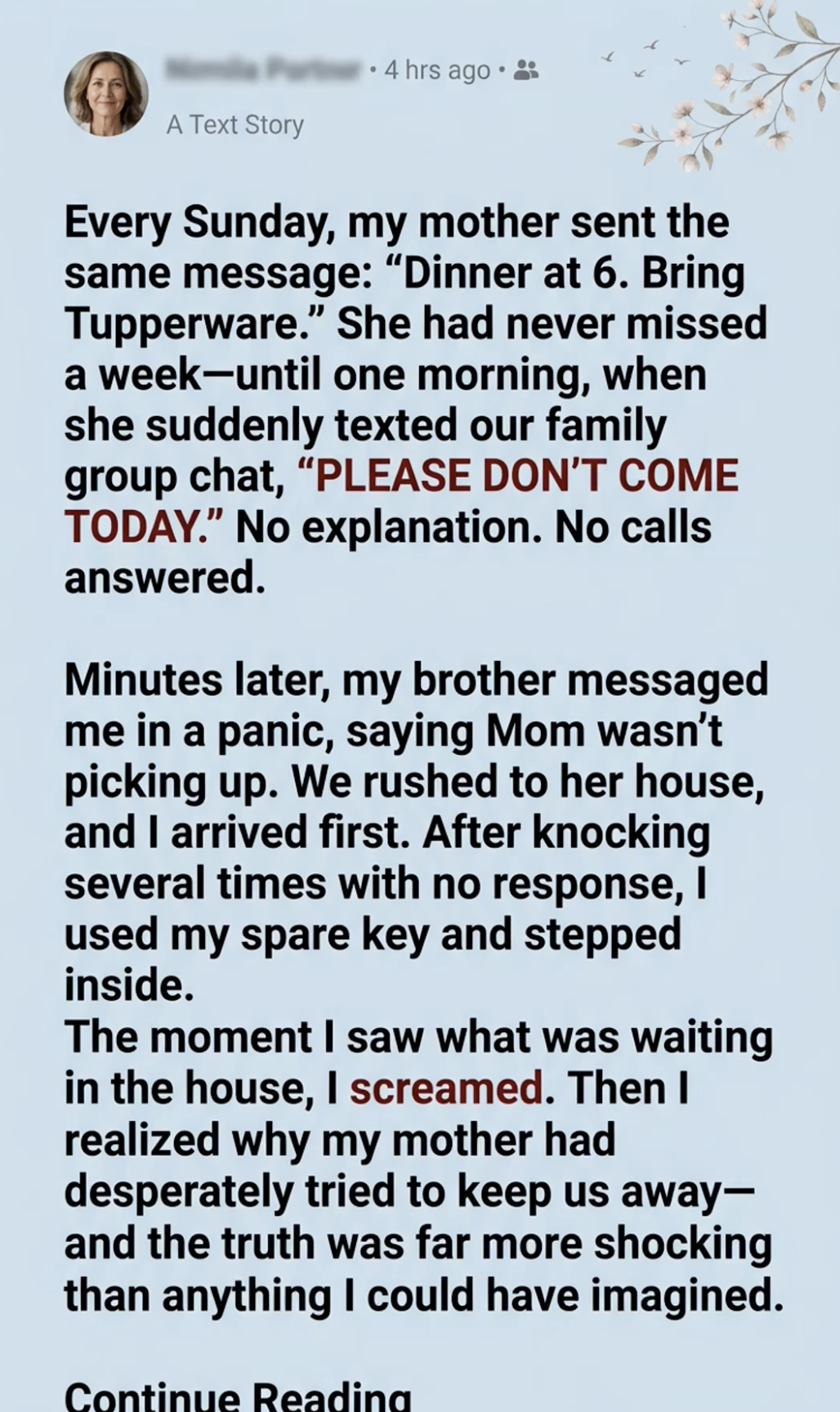
Every Sunday, my mother sent the same message: “Dinner at 6. Bring Tupperware.”
It had become such a familiar part of our lives that none of us ever questioned it. No matter how busy we were, no matter what arguments had happened during the week, Sunday dinner was sacred.
My mother, Margaret Wilson, had been cooking for our family for as long as I could remember. Roast chicken, mashed potatoes, green beans, and her famous apple pie filled her kitchen with the kind of warmth that made you forget your problems for a while.
My older brother, Daniel, usually arrived first. I came next with my husband and our two children. Our younger sister, Rachel, often showed up late, claiming she had been stuck in traffic.
Mom always pretended to be annoyed.
“You people would starve without me,” she would say, packing leftovers into our containers before we even finished eating.
We laughed every time.
That was our family.
Or at least, that was the family I thought we were.
Then came the Sunday morning that changed everything.
At 8:17 a.m., our family group chat lit up with a message from Mom.
“PLEASE DON’T COME TODAY.”
No greeting. No explanation. Just those four words in capital letters.
I stared at my phone, waiting for another message to follow.
Nothing came.
I called her immediately.
Straight to voicemail.
I tried again.
The same result.
I texted, “Mom, what happened? Are you okay?”
No response.
At first, I wondered whether she had finally decided she needed a break from feeding all of us. Honestly, I couldn’t blame her. She was seventy-two, lived alone, and still insisted on doing everything herself.
But then Daniel messaged the group.
“Has anyone heard from Mom? I’ve called her three times. She’s not answering.”
Rachel responded almost immediately.
“She texted me last night asking whether I was coming early. This is weird.”
Daniel called me directly.
“I’m going over there,” he said. “Something’s wrong.”
“I’ll meet you there.”
I grabbed my keys, told my husband where I was going, and drove toward Mom’s house.
The entire way, I kept calling her.
Nothing.
When I pulled into her driveway, Daniel’s car wasn’t there yet. Mom’s curtains were closed, and her front porch looked exactly as it always did. A small ceramic rabbit sat beside the door, and her potted geraniums were beginning to bloom.
Everything looked normal.
That somehow made me more nervous.
I knocked.
“Mom? It’s me!”
No answer.
I knocked harder.
“Mom, please open the door!”
Silence.
I walked around to the side window and peered inside, but the curtains blocked my view.
My hands were shaking when I took the spare key from my purse.
Mom had given it to me years ago, after she slipped on the back steps and couldn’t reach her phone. She had told me to keep it somewhere safe.
I never imagined I’d use it like this.
The lock turned.
I pushed the door open.
“Mom?”
The first thing I noticed was the smell.
Not food. Not the familiar scent of her lavender candles.
It was the sharp smell of disinfectant, mixed with something metallic.
Then I saw the living room.
Every photograph had been taken off the walls. The family pictures, the school portraits of her grandchildren, even the framed photograph of my father that had hung above the fireplace for twenty-five years.
The walls were bare.
The furniture had been pushed toward the edges of the room, leaving the center completely empty.
And on the floor, surrounded by cardboard boxes, sat my mother.
She was wearing her blue housecoat and holding a thick folder against her chest. Her gray hair was uncombed, and her face looked so pale that, for one terrifying second, I thought she was dead.
But she was breathing.
She looked up at me.
Then she began to cry.
“Emily,” she whispered. “I told you not to come.”
I rushed toward her and dropped to my knees.
“Mom! What happened? Are you hurt?”
She shook her head, clutching the folder tighter.
“You weren’t supposed to see this.”
“See what?”
Her eyes moved toward the hallway.
I followed her gaze.
The door to my father’s old study stood open.
That room had been locked since his death eleven years earlier. Mom always said she couldn’t bear to sort through his things, so she kept it closed.
Now the door was wide open.
Inside, the desk drawers had been removed. Filing cabinets stood open, and stacks of documents covered the floor. A large metal box sat on the desk, its lid hanging crookedly.
I looked back at Mom.
“Did someone break in?”
“No,” she whispered.
“Then who did this?”
She closed her eyes.
“I did.”
I stared at her, unable to understand.
Before I could ask another question, a car door slammed outside.
Daniel had arrived.
He rushed through the front door, shouting Mom’s name. When he saw the room, he stopped so abruptly that his keys slipped from his hand.
“What the hell happened here?”
Mom started sobbing harder.
“Please,” she begged. “Both of you, sit down.”
Neither of us moved.
Daniel crouched beside her.
“Mom, are you sick? Is someone threatening you? Did somebody steal something?”
She shook her head.
“It’s worse than that.”
She placed the folder on the coffee table.
For several seconds, none of us spoke.
Then she looked directly at Daniel.
“Your father didn’t die the way I told you.”
The words seemed to drain all the air from the room.
My father, Thomas Wilson, had died eleven years earlier after collapsing at work. We had been told it was a sudden heart attack. He was sixty-four, and although he had high blood pressure, none of us had expected him to die so suddenly.
Mom had always described that day the same way.
Dad had gone to work. He had called her during lunch. Then, shortly after three, a colleague phoned to say he had collapsed. By the time she reached the hospital, he was gone.
We had mourned him, buried him, and slowly learned how to live without him.
“What are you talking about?” Daniel asked.
Mom opened the folder.
Inside were bank statements, letters from attorneys, insurance documents, and a photograph of Dad standing outside a building I didn’t recognize.
At the top of the first page was a date.
Three days before his death.
“I found these last month,” Mom said. “They were hidden behind a panel in his desk. I had been looking for the deed to the house because someone contacted me about the property taxes.”
She took a shaky breath.
“I thought the papers were old business records. But when I started reading them, I realized your father had been hiding something from all of us.”
Daniel picked up the first document.
His eyes moved across the page.
Then he looked at Mom.
“This says Dad had another bank account.”
“Yes.”
“How much money was in it?”
Mom hesitated.
“Almost eight hundred thousand dollars.”
I felt my stomach drop.
My father had worked as an accountant for a manufacturing company. He had been careful with money, but we had never believed he was wealthy. After his death, Mom had told us that the life insurance and his retirement savings were enough to keep her comfortable, but not enough to leave much behind.
We had accepted that.
Now I was staring at evidence of an account none of us knew existed.
“Where did the money come from?” I asked.
Mom shook her head.
“I don’t know all of it. Some came from investments. Some came from the sale of a property. But the account had been emptied just before your father died.”
“Emptied by whom?” Daniel demanded.
Mom’s eyes filled with tears again.
“Your father transferred the money to someone.”
She slid another page across the table.
There was a name on it.
Not Mom’s.
Not mine.
Not Daniel’s.
It was the name of our younger sister, Rachel.
For a moment, I couldn’t even process what I was seeing.
Rachel was thirty-six years old. She had struggled financially for years, moving between jobs and relationships. Mom had often helped her with rent, car payments, and unexpected expenses. Daniel and I had occasionally complained that Rachel received more help than the rest of us.
Mom always defended her.
“She needs a little extra support,” she would say.
Now I understood that there had been something else going on.
“Why would Dad transfer that much money to Rachel?” I asked.
Mom shook her head.
“I don’t know. I asked her about it, but she denied knowing anything about the account.”
Daniel stood up.
“Then we call her right now.”
“No!” Mom cried.
We both turned toward her.
She was gripping the edge of the couch so tightly that her knuckles had turned white.
“Please don’t call Rachel yet.”
“Why not?” Daniel asked. “You just showed us proof that Dad gave her nearly eight hundred thousand dollars, and now you’re asking us to pretend we didn’t see it?”
“Because the money isn’t the worst part.”
Mom reached into the folder and removed a letter.
The paper was yellowed, and the envelope had been opened and carefully resealed. My father’s handwriting appeared across the front.
It was addressed to Mom.
She had never seen it before.
“I found this behind the desk panel, too,” she said. “It was sealed inside a plastic sleeve. I think your father wanted me to find it someday, but I don’t know why he hid it so carefully.”
She handed it to me.
My fingers trembled as I opened the letter.
Margaret,
If you’re reading this, I have either run out of time or failed to find the courage to tell you the truth myself.
There is something about Rachel that you need to understand. I know you’ve always believed she is our daughter, and I have spent my life trying to protect that belief. But the truth is more complicated than either of us ever imagined.
I stopped reading.
Daniel leaned over my shoulder.
“What does it say?”
I continued.
Twenty-eight years ago, before Emily was born, I discovered that a child had been switched at the hospital following a medical emergency. I was told the matter had been corrected. I believed it was over.
Several months ago, I received information suggesting that the child we brought home as Rachel may not be biologically related to us. I hired a private investigator, and what he found frightened me.
The money I transferred was meant to protect her future. I was afraid that if the truth came out without warning, she would lose the only family she had ever known.
I wanted to tell you. I wanted to tell all of you. But I needed proof, and I was running out of time.
Please forgive me for keeping this from you.
Thomas.
I lowered the letter.
Daniel looked as though someone had struck him.
“A hospital switched two babies?” he said. “And Dad knew?”
Mom nodded slowly.
“I found a second envelope with the letter. It contained the investigator’s report. There were names, hospital records, and a request for a DNA test.”
“Did Dad ever get the test?” I asked.
“I don’t know. The report was incomplete.”
I looked toward the bare walls, the boxes, and the open study.
“Then why did you tell us not to come today?”
Mom pressed her hands over her face.
“Because someone came here yesterday.”
The room fell silent.
She explained that a woman had arrived at the house late Saturday afternoon. She was in her early sixties, dressed neatly, with a gray coat and a folder under her arm.
The woman introduced herself as Patricia Miller.
She said she had grown up believing she was the biological daughter of a couple who had died years earlier. After recently obtaining medical records, she had discovered that her birth had been connected to the same hospital incident mentioned in my father’s report.
She had been searching for her biological family.
And she believed Rachel might be her sister.
Mom said Patricia had brought a DNA test report and copies of the hospital records. The results showed a strong biological relationship between Patricia and Rachel.
Patricia had not come asking for money.
She had come asking questions.
She wanted to know why my father had sent Rachel money. She wanted to understand why someone had apparently tried to correct the hospital’s records decades earlier, only for the investigation to disappear.
And she wanted to know whether our family had been told the truth.
Mom had spent the night searching through Dad’s study, desperate to understand what he had discovered.
At dawn, she sent the message telling us not to come.
“I didn’t want you to find all of this,” she whispered. “I was afraid you’d think your father had betrayed us. I was afraid you’d blame Rachel. And I was afraid that if I brought everyone together before I understood what happened, we would destroy one another.”
I sat down heavily.
“Where is Patricia now?”
“She left last night. She gave me her phone number and said she would wait for me to call.”
“Did she say anything else?”
Mom looked at me.
“She said she had spent most of her life wondering why she never felt that she belonged anywhere. She said she wasn’t coming to take anyone away from us. She only wanted the truth.”
For the first time that morning, my anger softened into something else.
I imagined a woman who had grown up with questions she couldn’t answer, only to discover that the people she had believed were her parents might not have been her biological family.
I thought about Rachel, who had always felt different from Daniel and me. She had different coloring, a different temperament, and a lifelong fear of being abandoned. We had teased her about being the family rebel, never imagining that there might be a reason she felt so disconnected.
But there was still one question I couldn’t ignore.
“What happened to Dad?” I asked quietly. “Why did he die three days after transferring the money?”
Mom looked down at the floor.
“I don’t know.”
“Did the investigator find anything suspicious?”
She handed me another page.
It was a brief report documenting a meeting between my father and the investigator. The meeting had taken place two days before Dad’s death.
At the bottom, someone had written a note in blue ink.
Subject believes the original hospital records were altered. Advises family to preserve all correspondence. Further investigation pending.
The report didn’t prove that Dad’s death had anything to do with the hospital records or the money. His death certificate still listed a heart attack as the cause.
But the timing raised questions that deserved careful answers.
Daniel called the attorney whose name appeared on the report. We left a message, explaining that we had found documents connected to a matter he had apparently handled for our father.
Then we called Rachel.
She answered cheerfully.
“Hey! Are we still doing dinner at six? Mom said not to come, but I figured she’d probably changed her mind.”
Daniel looked at me before responding.
“Rachel, we need you to come to Mom’s house.”
“Why? What’s going on?”
“It’s about Dad.”
The cheerfulness disappeared from her voice.
“What about Dad?”
“Please, Rachel. Just come.”
She arrived forty minutes later.
When she walked into the living room and saw the boxes, the open study, and the papers spread across the coffee table, she stopped.
Then she noticed the photograph of Patricia.
“Who’s that?” she asked.
Mom stood up slowly.
“Rachel, sweetheart, sit down.”
Rachel didn’t move.
Instead, she looked at the document in my hand.
“Where did you get that?”
The question was so immediate, so specific, that I felt the last pieces of the puzzle shift into place.
“You recognize it?” I asked.
Her face crumpled.
She sat down and began to cry.
“I never wanted you to find out this way.”
Daniel stared at her.
“You knew?”
Rachel shook her head.
“Not everything. Dad told me a few months before he died that there was a chance I wasn’t his biological daughter. He said he was trying to find out what had happened at the hospital.”
“Why didn’t you tell us?” I asked.
“Because I was terrified. He told me he would explain everything when he had proof. Then he died.”
She covered her face.
“After the funeral, I found a letter in my apartment. Dad had left it for me. He said he loved me, no matter what the investigation revealed. He said he had transferred money into an account for me because he wanted to make sure I would be safe if the truth changed my life.”
“Eight hundred thousand dollars?” Daniel asked.
Rachel nodded.
“But I never received it. The account was managed through a trust, and after Dad died, the attorney told me the transfer was being reviewed. I thought the money had been frozen. I didn’t know Mom had found the records.”
“Where is the letter?” I asked.
Rachel reached into her handbag and pulled out a small envelope.
She had carried it with her for eleven years.
Inside was a short handwritten note from Dad.
Rachel,
Nothing about the truth can change the years I spent being your father. I chose you every day, and I will always love you. If you ever learn that your beginning was different from what you believed, remember that your life is not a mistake. You are loved, and you always will be.
I read the letter twice.
Then I handed it to Mom.
She pressed the paper to her chest and wept.
For a long time, nobody spoke.
Finally, Rachel looked at the photograph of Patricia again.
“Is she really my sister?”
“We don’t know the whole story yet,” I said. “But we can find out.”
We called Patricia that afternoon.
She answered after two rings.
When Rachel introduced herself, Patricia went silent.
Then she began to cry.
“I never thought you would call,” she whispered.
Rachel wiped her cheeks.
“I don’t know what any of this means. I don’t know who I’m supposed to be now.”
Patricia’s voice softened.
“You don’t have to decide today. I don’t want to replace anyone in your life. I just want the chance to know you.”
They agreed to meet the following weekend at a quiet café halfway between their homes.
Mom asked to come, but Rachel requested that the first meeting be just the two of them. Mom accepted the decision, though I could see how much it hurt her.
The following weeks were filled with difficult conversations, medical appointments, and legal meetings. With everyone’s consent, additional DNA testing confirmed that Patricia and Rachel were biological sisters. The hospital records showed that a serious emergency had occurred around the time of their births, but the surviving documentation was incomplete, and we could not establish exactly who had made the original mistake or why the records had been altered.
We also learned that my father had been trying to arrange a meeting between the two women before he died. His investigator had identified Patricia’s family, but he had never received the final confirmation he wanted.
The money remained a separate legal matter. The attorney helped us establish what had happened to the trust and why the transfer had never been completed. Some questions about the original account could not be answered with certainty, but we finally understood why Dad had tried to protect Rachel’s future.
He had never intended to buy her silence.
He had wanted to make sure she would be safe when her world changed.
And it had changed.
Rachel and Patricia did not become inseparable overnight. Their first few meetings were awkward, filled with cautious questions and long pauses. They compared childhood memories, photographs, and family stories, trying to understand how two lives had been shaped by the same mistake.
Eventually, they discovered that they shared more than DNA. They both loved old movies, hated thunderstorms, and had a habit of humming while cooking.
The first time Patricia came to Sunday dinner, she stood nervously in Mom’s doorway holding a covered dish.
Mom stared at her for several seconds.
Then she began to cry.
“I don’t know what to call you,” she admitted.
Patricia set the dish on the counter.
“You can call me Patricia.”
Mom nodded, wiping her eyes.
“Would you like some apple pie?”
Patricia smiled through her tears.
“I would love some.”
That evening, there were five of us around the table instead of the four Mom had expected for so many years. We talked about Dad, the old house, and the things we remembered differently. Sometimes the conversation became painful. Sometimes we laughed until we cried.
But no one pretended that the past had been simple.
After dinner, Mom brought out the Tupperware.
For the first time, Patricia received a container of leftovers, too.
As we were leaving, Mom caught my hand.
“I’m sorry I sent that message,” she said. “I thought keeping everyone away would protect you.”
I hugged her.
“I know you were scared. But you don’t have to carry this alone anymore.”
She looked toward the kitchen, where Rachel and Patricia were packing the last pieces of pie.
“Your father spent so many years trying to find the truth,” she whispered. “I wish he could have seen this.”
“So do I.”
The next Sunday, Mom sent her usual message.
“Dinner at 6. Bring Tupperware.”
This time, she added a second line.
“And tell Patricia she’s welcome.”
I stared at the screen for a long time before smiling.
Our family had spent eleven years living with a mystery that no one knew how to solve. When the truth finally emerged, it did not erase our grief, explain every unanswered question, or turn strangers into lifelong siblings overnight.
But it gave us something we had been missing.
The chance to stop protecting the past and begin building a more honest future.
I still think about that morning when I used my spare key and walked into Mom’s house. I thought I was about to discover a tragedy. Instead, I found the beginning of a truth that had waited decades to be heard.
My mother had canceled Sunday dinner because she was afraid the secret would destroy us.
She was wrong about one thing.
The truth did not destroy the love in our family.
It showed us that love had survived even when the truth was missing.
And sometimes, the most important thing a family can do is open the door, pull up another chair, and make room for the person who has been missing all along.