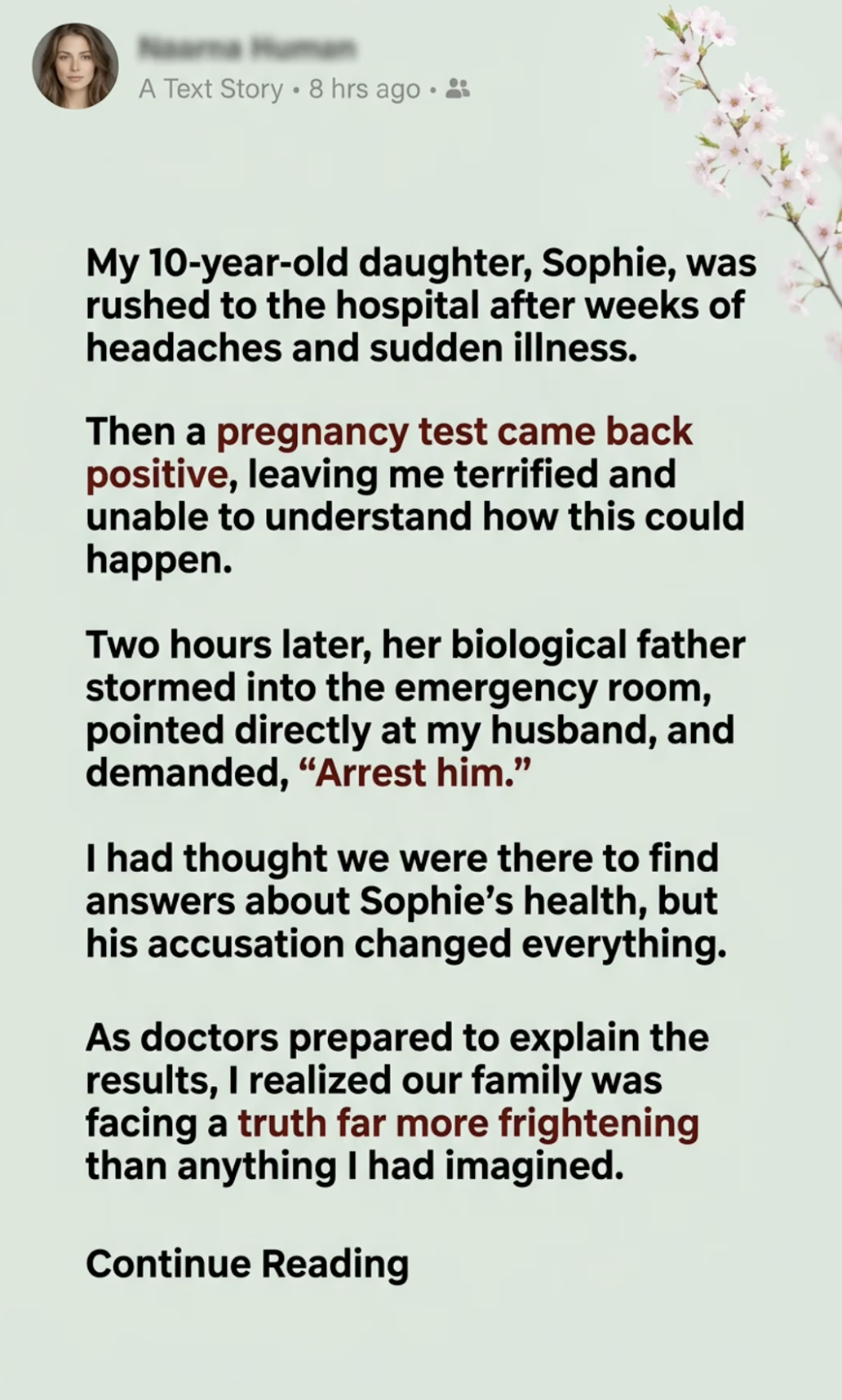
I knew something was terribly wrong with my daughter long before the ambulance arrived.
Sophie was ten years old, a bright, funny child who loved drawing horses, collecting tiny stuffed animals, and asking questions that sometimes left me scrambling for answers. She had always been energetic. Even on rainy days, she could turn our living room into an imaginary kingdom, making her dolls the queens and her stuffed animals the royal guards.
But over the previous few weeks, she had changed.
She complained of headaches. Sometimes she felt nauseated in the mornings. She grew unusually tired and occasionally clutched her stomach as if a sharp pain had caught her off guard.
At first, I thought it was a virus. When the symptoms continued, I took her to our family doctor, who recommended further tests if she didn’t improve.
I watched her carefully, convinced that a mother would eventually recognize the answer.
Instead, the answer arrived in the most frightening way imaginable.
That afternoon, Sophie collapsed in our kitchen.
I heard the glass fall before I heard her body hit the floor. When I rushed in, she was pale, trembling, and barely able to answer me.
“Sophie? Sweetheart, look at me.”
Her eyes opened, but she seemed confused. She whispered that her head hurt and that she felt sick.
I called emergency services with shaking hands.
By the time the ambulance arrived, I had already imagined every possible medical emergency a mother could fear. I held her hand during the ride, repeating that she would be okay, even though I was terrified myself.
My husband, Mark, followed us to the hospital.
He had been Sophie’s stepfather for six years. He had helped with homework, attended school performances, and sat beside her bed during childhood fevers. He wasn’t her biological father, but he had been part of her daily life since she was four.
Sophie loved him.
And until that afternoon, I had never questioned whether she was safe with him.
At the hospital, nurses took her blood pressure, checked her blood sugar, and drew blood for several tests. A doctor asked me questions about her symptoms, medications, recent illnesses, and medical history.
Then another nurse returned and asked whether Sophie had started menstruating.
I stared at her, confused.
“No,” I answered. “She’s only ten.”
The nurse exchanged a brief glance with the doctor.
They explained that, because of certain symptoms and the need to rule out several medical possibilities, they had ordered additional testing. One of those tests was a pregnancy test.
I almost laughed because the suggestion seemed so impossible.
Then the doctor returned.
Her expression had changed.
“Mrs. Carter, we need to speak with you privately.”
My stomach tightened.
Mark stood beside me as the doctor led us into a small consultation room. She closed the door and folded her hands in front of her.
“The pregnancy test came back positive,” she said carefully. “We are repeating the test to confirm the result, and we need to evaluate Sophie immediately.”
For several seconds, I couldn’t understand the words.
Positive.
Pregnancy.
My ten-year-old daughter.
“No,” I whispered. “There must be a mistake.”
The doctor explained that an initial result needed confirmation and that Sophie would undergo additional testing. She also made it clear that the immediate priority was my daughter’s health, safety, and emotional well-being.
I could barely hear anything beyond the pounding in my ears.
Mark sat down heavily.
“What does that mean?” he asked.
The doctor didn’t speculate. She explained that a confirmed pregnancy in a child this young required urgent specialist care and a safeguarding assessment. The medical team would need to establish what had happened without making assumptions or putting words into Sophie’s mouth.
I wanted to run back to my daughter and wrap her in my arms.
Instead, I stood frozen beside the chair.
Then the emergency room doors opened with a bang.
David, Sophie’s biological father, came striding into the department.
He and I had divorced when Sophie was four. Our relationship had been bitter at first, but we had eventually established a workable arrangement. He lived across town, saw Sophie regularly, and had always been fiercely protective of her.
I had called him from the ambulance because I believed he deserved to know that his daughter was seriously ill.
I hadn’t expected him to arrive looking like a man preparing for a fight.
He spotted Mark immediately.
His face turned red.
He walked straight toward us, pointed at my husband, and shouted, “Arrest him.”
Every conversation around us seemed to stop.
“David, what are you talking about?” I demanded.
He didn’t look at me.
“Don’t pretend you don’t know,” he snapped at Mark. “I want the police here right now.”
Mark rose slowly from his chair.
“I don’t know what you think happened,” he said. “But this is a hospital. Sophie is the one who needs us.”
David stepped closer.
“You stay away from my daughter.”
Hospital security approached when David’s voice grew louder. A nurse asked everyone to calm down, reminding us that Sophie was receiving medical care only a short distance away.
I grabbed David’s arm.
“Stop it! You came here because Sophie is sick. What is going on?”
He finally turned toward me.
His eyes were filled with anger, but beneath it I saw something else.
Fear.
“I spoke to her school counselor this morning,” he said. “She called me because Sophie had asked to speak with someone privately. She told me there were things Sophie had been frightened to talk about.”
My mouth went dry.
“What things?”
David looked toward Mark again.
“I don’t know everything. That’s why I want the police here.”
Mark shook his head, looking stunned.
“This is an accusation you can’t take back,” he said.
“And if I’m right, neither can what happened to my daughter.”
I felt as if the floor had tilted beneath me.
I had known David could be impulsive. He could become angry quickly, especially when he thought someone was threatening Sophie. But I had never heard him speak with such certainty about Mark.
“Did Sophie tell you Mark hurt her?” I asked.
David hesitated.
“No. Not directly.”
“Then why are you pointing at him?”
“Because the counselor said Sophie was afraid of someone close to the family.”
The words struck me harder than the positive test.
Someone close to the family.
I looked at Mark, searching his face for something that might explain David’s accusation. He looked pale and shaken, but I knew fear could make anyone look that way. His expression could not prove innocence, just as David’s anger could not prove guilt.
I needed facts.
A hospital social worker arrived and asked us to separate so the medical team could focus on Sophie. David continued demanding police involvement, while Mark insisted he had done nothing wrong.
I stood between them, feeling as if both men were pulling me toward different versions of a reality I couldn’t yet understand.
Then a doctor came out of Sophie’s room.
“Her repeat test is also positive,” she told me. “We need to speak with you about the next steps.”
My knees weakened.
She explained that the team was arranging an urgent evaluation by pediatric specialists. They would assess Sophie’s condition, determine whether she had any immediate complications, and ensure she was protected from further harm.
The hospital also had safeguarding procedures for situations involving possible sexual abuse of a child. The appropriate authorities would be contacted, and trained professionals would conduct any necessary interviews.
I asked whether I could see Sophie.
“Of course,” the doctor said. “She needs you to remain calm and reassure her that she is not in trouble.”
Those words gave me something to hold on to.
Sophie was not in trouble.
Whatever had happened, whatever we learned, she had done nothing wrong.
I entered her room alone.
She was lying beneath a white blanket, her small hands resting on top of it. Her eyes moved toward me as soon as I approached.
“Mom?”
I sat beside her and took her hand.
“I’m here, sweetheart.”
“Am I sick?”
The question nearly broke me.
“The doctors are trying to figure out what’s happening. They’re going to take care of you.”
She looked down at her hands.
“Are you angry with me?”
I felt tears spill down my face.
“No. Never. You haven’t done anything wrong.”
Her lips trembled.
“I was scared to tell you.”
I leaned closer, keeping my voice gentle.
“You can tell me anything, Sophie. You don’t have to protect me from the truth.”
She stared at the blanket for a long time.
Then she whispered, “I thought you wouldn’t believe me.”
My heart seemed to stop.
I didn’t ask her to explain. I didn’t suggest names or offer possibilities. I remembered what the social worker had said: let trained professionals speak with her, and don’t pressure her for details.
Instead, I held her hand.
“I’m listening,” I told her. “And you don’t have to tell me everything all at once.”
A nurse entered to check Sophie’s vital signs. I moved aside, but I kept my eyes on my daughter.
For the first time that day, I understood that the most important question wasn’t how the pregnancy test could have become positive.
It was whether Sophie had been frightened into silence.
And whether the adults responsible for protecting her had recognized her fear.
An hour later, the hospital’s pediatric specialist arrived with the social worker. They explained that they would carry out further examinations and testing, while an appropriately trained professional would speak with Sophie in a safe, child-centered way.
They also explained that a pregnancy in a ten-year-old was medically serious and that they would assess her immediate health needs, including any risks of internal injury or other complications.
I asked whether the pregnancy itself could explain her headaches.
The specialist said the headaches could have several causes and required their own evaluation. They would not assume that every symptom had a single explanation.
I appreciated her honesty.
I needed someone to tell me what they knew, what they didn’t know, and what they were doing to protect my daughter.
Then a police officer arrived.
David immediately approached him and repeated his demand that Mark be arrested. The officer listened, asked questions, and spoke separately with the hospital staff.
Mark was asked to remain available while the allegation was assessed. He was not allowed into Sophie’s room.
I watched from the hallway as the two men stood on opposite sides of the waiting area.
One was the man I had once promised to love forever.
The other was the father of my child.
Neither could give me the answer I needed.
When the social worker returned, she asked me to sit down.
“Sophie has indicated that something happened that made her feel unsafe,” she said. “We are taking that seriously. We need to let the trained investigators establish the details without repeatedly questioning her.”
I covered my mouth.
“Did she identify someone?”
The social worker paused.
“She has not made a complete disclosure to the team yet. We cannot responsibly tell you that we know who is responsible. The investigation must be allowed to proceed.”
I nodded, although the uncertainty felt unbearable.
David heard enough to understand that the hospital was treating the situation as a serious safeguarding concern. He sat down and buried his face in his hands.
For the first time since he arrived, he stopped shouting.
I sat beside him, but I couldn’t comfort him.
I was a mother trying to understand how her child had reached a point where she was afraid to speak.
And I was a wife trying to understand whether the man beside me had hidden something monstrous—or whether a terrible accusation was being made before the facts were known.
That night, I didn’t go home.
I stayed at the hospital while Sophie underwent further evaluation. Specialists assessed her condition, and the medical team developed a plan for her ongoing care. The hospital’s safeguarding staff coordinated with the authorities, and arrangements were made to ensure she would not be left alone with anyone who might pose a risk.
Mark was not permitted to visit her while the allegation was being investigated.
He sent one message.
I love Sophie. I would never hurt her. Please let the truth come out.
I read it twice.
I didn’t answer.
I wasn’t ready to make promises or decisions based on a text message. My responsibility was to Sophie, and that meant allowing the investigation to establish what had happened.
Near midnight, David returned from speaking with the officer.
He looked older than he had that afternoon.
“I should have noticed,” he said quietly.
I turned toward him.
“What do you mean?”
“She’d been quieter lately. I thought it was because she was growing up. I didn’t ask enough questions.”
“Neither did I,” I admitted.
For a moment, we sat in silence.
Then David said, “I came here ready to blame Mark because I was afraid. I still want Sophie protected. But I know the police have to find out what actually happened.”
It was the first reasonable thing he had said since arriving.
I took a slow breath.
“We can’t make this about winning against each other,” I told him. “Sophie needs both of us to put her first.”
He nodded.
The next morning, the pediatric team gave us an update. Sophie’s condition was stable, but she needed continued medical care and close follow-up. The specialists would explain her options in an age-appropriate way, with her safety, health, and wishes treated with care.
The investigation was continuing.
There was no dramatic confession. No instant answer that made every frightening detail suddenly fall into place.
There were interviews, careful examinations, records to review, and difficult questions that required evidence rather than assumptions.
I learned that protecting a child sometimes meant resisting the urge to demand an immediate explanation.
It meant believing her feelings, listening without judgment, and letting qualified professionals determine what the evidence could establish.
Most of all, it meant making sure she understood that none of this was her fault.
When I finally returned to Sophie’s bedside, she was awake and drawing on a sheet of paper.
She had drawn a little house with three windows, a yellow sun, and a garden filled with flowers.
I sat beside her.
“That’s beautiful, sweetheart.”
She handed me the drawing.
“Can we stay somewhere else for a while when I get better?”
The question hurt more than anything I had heard that day.
“Yes,” I said carefully. “We’ll make sure you have a place where you feel safe.”
She studied my face, searching for a promise she could trust.
“Even if people get angry?”
“Even then.”
She leaned against me.
I held her for a long time, understanding that whatever the investigation revealed, our family would never return to the life we had known before that hospital visit.
Some relationships might survive. Others might not.
Some truths would be painful, and some answers might take time.
But one thing was already certain.
Sophie would never again have to believe that keeping a secret was the price of being loved.
In the weeks that followed, we arranged counseling with a professional experienced in helping children recover from traumatic experiences. David and I learned how to support Sophie without pressuring her for details. We followed the medical team’s recommendations and kept her daily life as calm and predictable as possible.
I also began to understand how easily a family could confuse appearances with safety.
Mark had been a loving stepfather in many ways. That history was real, but it could not replace an investigation or settle an allegation. If he had done something wrong, the years we had shared would not excuse it. If the evidence pointed elsewhere, we would have to face that truth too.
I stopped trying to decide the outcome before the facts were established.
Instead, I concentrated on the things I could control: keeping Sophie safe, attending her appointments, listening when she wanted to talk, and reminding her that she had done nothing to deserve what had happened.
Months later, I would remember that afternoon not as the day David stormed into the emergency room and shouted for Mark to be arrested, but as the day I finally understood what my daughter needed most.
She didn’t need adults fighting over who was right.
She didn’t need anyone to force a confession or invent an answer to ease their own fear.
She needed protection, patience, and people who would listen.
The investigation would have to establish the truth, no matter how painful it proved to be.
My marriage might survive, or it might not. David and I might disagree about many things, but we could no longer afford to let those disagreements stand between Sophie and the care she deserved.
I had arrived at the hospital believing we were searching for the cause of my daughter’s headaches.
By the time the sun rose the following morning, I understood that we were facing something much bigger: a crisis that demanded courage, careful investigation, and a willingness to put a child’s safety above every adult’s pride.
I couldn’t undo the weeks Sophie had spent feeling unwell or the fear that had kept her silent.
But I could change what happened next.
I could make sure she was heard.
I could make sure she was protected.
And I could make sure she never had to wonder whether her mother would choose the truth—or the comfort of pretending nothing was wrong.
Whatever the investigation ultimately revealed, I knew one thing with absolute certainty.
Sophie would never face it alone.