The first thing I noticed was the silence.
Not the ordinary quiet of a restaurant after the dinner rush, when waiters clear tables and the last few customers finish their wine. This silence felt different. It was the kind that settled over a room when everyone seemed to know something terrible had happened, but nobody wanted to be the first to say it aloud.
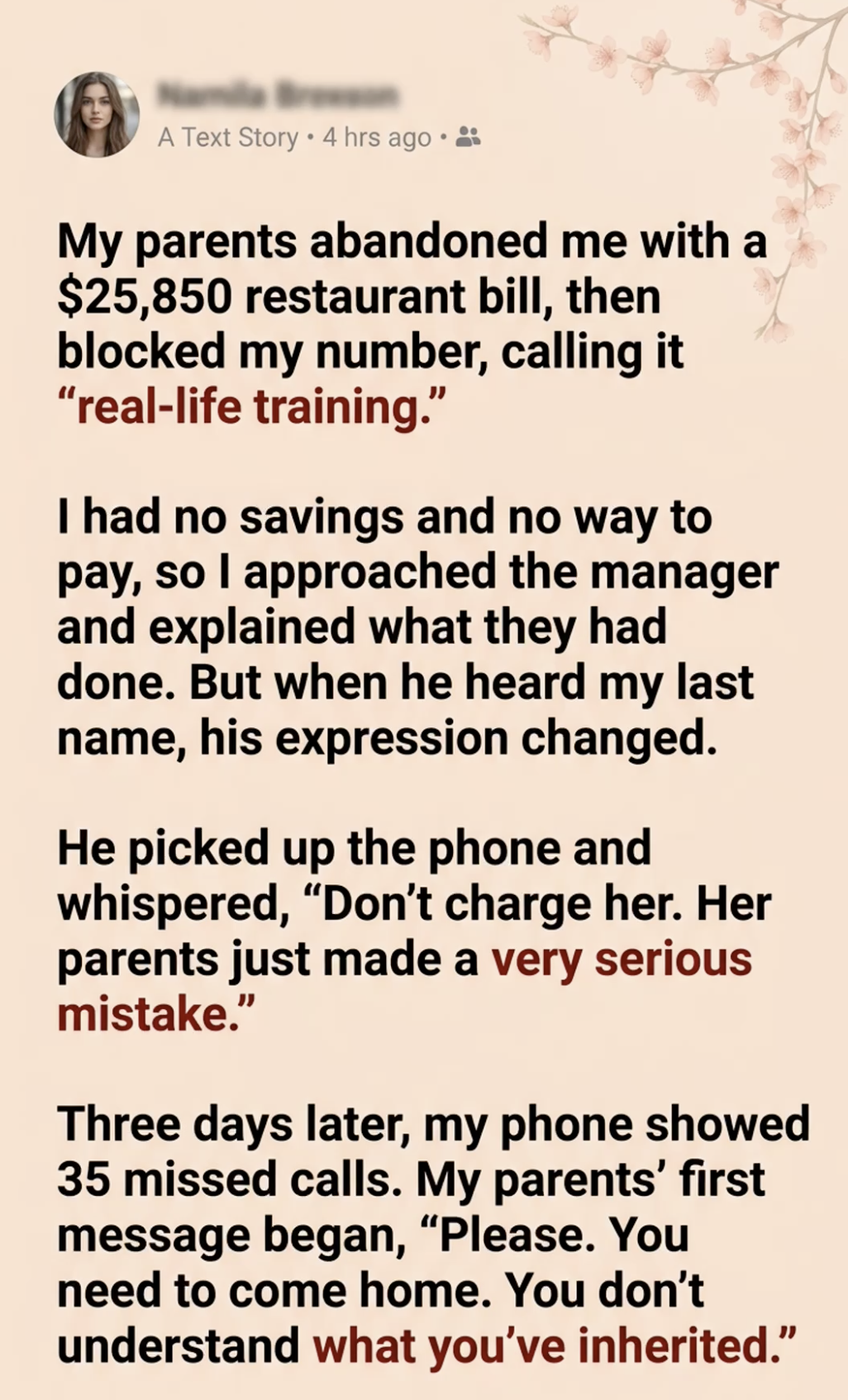
I sat alone at a table beneath a crystal chandelier, staring at a bill for $25,850.
Twenty-five thousand, eight hundred and fifty dollars.
My parents had invited me to dinner at the most expensive restaurant in the city. My father, Richard, had called it a celebration. My mother, Eleanor, said it was time for our family to reconnect.
I was twenty-seven years old, working as a junior graphic designer, and earning just enough to cover my rent, groceries, and student loan payments. I had $186 in my checking account.
I had told them that the restaurant sounded expensive.
My father had laughed.
“Don’t worry about money tonight, Claire. You’re our daughter. Let us take care of everything.”
I should have known better than to believe him.
Dinner began pleasantly enough. My parents sat on either side of me, ordering appetizers, premium steaks, rare wine, and bottles of champagne that cost more than my monthly rent. My older brother, Daniel, arrived late and immediately ordered the most expensive item on the menu.
Every time I glanced at the prices, my mother smiled as though she had noticed.
“Stop worrying,” she said. “This is a special occasion.”
“What exactly are we celebrating?” I asked.
My father raised his glass.
“Family.”
Everyone drank except me.
Something about the way he said that word made my stomach tighten.
Halfway through dinner, my father began asking about my job. He wanted to know how much I earned, whether I had received a promotion, and how much money I had saved.
When I answered honestly, he shook his head.
“At your age, you should be doing better.”
“I pay my own bills,” I replied quietly.
“Barely,” Daniel muttered.
My mother gave him an approving smile.
I swallowed my anger and looked down at my plate. I had spent most of my childhood trying to earn my father’s approval. No matter how hard I worked, there was always another standard I had failed to meet.
When dessert arrived, my father leaned back in his chair.
“Claire, we have something important to discuss.”
I looked up.
He reached into his jacket and placed a folded document on the table.
“What is that?”
“An opportunity,” he said.
My mother clasped her hands together. “Your father thinks you’re finally ready to learn how the real world works.”
I unfolded the paper. It was a proposal for a small business venture, full of unfamiliar figures and legal language. My father’s name appeared at the top.
“I don’t understand,” I said.
“It’s a business arrangement,” he replied. “You’ll understand when you’re older.”
“I’m twenty-seven.”
“Then stop behaving like a child.”
Daniel chuckled into his wineglass.
I pushed the document away.
“I don’t want to sign anything tonight. I need time to read it.”
My father’s expression hardened.
“That’s exactly your problem. You always expect someone to rescue you, but the moment we give you an opportunity, you become frightened.”
“I didn’t ask you for an opportunity.”
For the first time that evening, nobody spoke.
Then my father smiled.
It wasn’t a kind smile.
“Fine,” he said. “Perhaps a little practical experience will teach you something.”
He stood, adjusted his jacket, and nodded to my mother and brother.
All three of them rose from their seats.
I stared at them.
“Where are you going?”
“Home,” my mother answered.
“What about the bill?”
My father looked at the waiter approaching our table.
“That’s yours, Claire.”
I laughed because I genuinely thought he was joking.
He wasn’t.
“You invited me here,” I said. “You told me not to worry about the money.”
“Life doesn’t care what people promise you,” he replied. “Consider this real-life training.”
Then he walked away.
My mother followed without looking back. Daniel paused just long enough to smirk at me before joining them.
I grabbed my phone and called my father.
Blocked.
I called my mother.
Blocked.
Daniel’s number went straight to voicemail.
I tried again, thinking perhaps there had been some mistake. But the result was the same.
Three people had left me with a bill I couldn’t pay and then deliberately cut off every way I could reach them.
The waiter returned, carrying a small card reader.
“Will you be paying by card or cash?”
I could barely speak.
“I’m sorry. I need to explain something.”
His expression softened when he saw my face.
I told him what had happened. I showed him the call logs and the messages I had sent before realizing my parents had blocked me. I explained that I had not ordered most of the food or drinks and that I had never agreed to pay for the meal.
He listened, then asked me to wait while he called the manager.
A few minutes later, a tall man in a charcoal suit approached. His name tag read Thomas Bennett — General Manager.
He pulled up a chair.
“Miss, I’m Thomas. Tell me what happened.”
So I told him everything again.
He listened without interrupting. When I finished, he asked for my identification so he could document the incident.
I handed it over.
He glanced at the card.
Then he looked at my face.
Then back at the card.
Something changed in his expression so suddenly that I noticed it immediately.
“Your last name is Whitmore?” he asked.
“Yes.”
He stared at me for several seconds.
“Are you related to a man named Samuel Whitmore?”
My heart stumbled.
“He was my grandfather.”
Thomas slowly set my identification on the table.
“Please wait here.”
He walked toward the office behind the reception desk, took out his phone, and made a call. I couldn’t hear the person on the other end, but I watched Thomas’s posture change. His shoulders straightened, and his expression became serious.
He spoke in a low voice.
“Yes, sir. It’s the Whitmore granddaughter.”
A pause.
“No, sir. She hasn’t been charged.”
Another pause.
“I understand. I’ll take care of it immediately.”
He ended the call and returned to my table.
Then he did something I will never forget.
He took the bill from my hands, folded it carefully, and said, “Miss Whitmore, you will not be paying this tonight.”
I blinked at him.
“What?”
“You heard me. You owe nothing for this meal.”
“But the bill—”
“Will be handled by the restaurant.”
I looked at the enormous number printed at the bottom of the page.
“Why? You don’t even know me.”
Thomas pulled out the chair across from me and sat down.
“Your grandfather was a very important man to this establishment. More importantly, he made certain arrangements years ago that were never meant to become public knowledge. When I heard your last name, I realized something about tonight that your parents apparently didn’t consider.”
“What arrangements?”
He glanced toward the office.
“I’m not the person who should explain them. But I can tell you this: your parents have made a very serious mistake.”
A chill moved through me.
“What kind of mistake?”
Thomas looked directly into my eyes.
“The kind that cannot be corrected simply by apologizing.”
He arranged a car to take me home and gave me his direct number in case anyone contacted me about the incident. Before I left, he assured me that the restaurant would document everything, including the fact that I had objected to the charges and had not authorized the meal.
I thanked him, though I was still too stunned to understand what had happened.
Outside, the city lights blurred through my tears.
I had spent my entire life believing that my family considered me a disappointment. My father had always treated money like a weapon and affection like a reward I had to earn. My mother had learned to remain silent whenever he was cruel. My brother had learned to laugh along.
But that night, for the first time, someone who barely knew me had stood up for me.
And somehow, my grandfather was involved.
Samuel Whitmore had died when I was sixteen. He had been the only person in my family who seemed to enjoy my company without asking what I could do for him. He taught me how to bake bread, took me to the public library on rainy afternoons, and always asked what I thought before telling me what he believed.
My father had disliked that.
“He spoils you,” he used to say.
My grandfather would simply smile.
“No, Richard. I listen to her. There’s a difference.”
After he died, the family rarely spoke about him. My father handled the estate, my mother handled the funeral arrangements, and I was told there was nothing left for me.
I had never questioned it.
Now, sitting in the back of a car, I wondered what else I had been told that wasn’t true.
Three days passed before I received the first call.
Then another.
Then twelve more.
By the end of the third day, my phone showed thirty-five missed calls from my parents, my brother, and numbers I didn’t recognize.
The first voicemail was from my mother.
“Claire, sweetheart, please call us. We need to talk.”
The second was from my father.
“Stop ignoring us. This has gotten out of hand.”
The third was from Daniel.
“You need to answer. Dad says you know something, and we need to sort this out before it becomes a bigger problem.”
I listened to all of them without responding.
Then a message arrived from my mother.
Please. You need to come home. You don’t understand what you’ve inherited.
I read it three times.
Inherited?
I called Thomas Bennett.
He answered on the second ring.
“Miss Whitmore. I was wondering when you might call.”
“What’s happening? My parents are calling nonstop. My mother says I’ve inherited something.”
There was a brief silence.
“Have they told you about your grandfather’s estate?”
“They told me there was nothing for me.”
Thomas exhaled slowly.
“Then I believe you should speak with his attorney. I’ll give you the number. He has been trying to reach you.”
I wrote down the number with shaking fingers.
The attorney’s name was Margaret Ellis. When I called her office, her assistant scheduled an appointment for the following morning.
I barely slept that night.
The next day, I arrived at a quiet office on the twenty-third floor of a downtown building. Ms. Ellis greeted me warmly and led me into a conference room. A thick folder lay on the table, along with several documents bearing my grandfather’s signature.
She offered me coffee.
I declined.
“I need to know what’s going on,” I said.
“Of course.” She opened the folder. “Your grandfather revised his estate plan several times before his death. His final will and accompanying trust documents were executed properly, witnessed, and reviewed by independent counsel.”
She slid a document toward me.
“Your grandfather left you a substantial inheritance.”
I stared at the page.
“How substantial?”
“Approximately eighteen million dollars in assets at the time of his death, subject to the trust’s terms, taxes, expenses, and subsequent changes in value.”
For a moment, the room seemed to tilt.
“That’s impossible.”
“It isn’t. Your grandfather built a successful commercial property portfolio over several decades. Some of those properties have appreciated considerably.”
I pressed my hands against my knees.
“Why didn’t anyone tell me?”
Ms. Ellis’s expression grew grave.
“Because your father was not the beneficiary of that portion of the estate. You were.”
She explained that my grandfather had placed the assets in a trust specifically for me. My father had been appointed to manage certain family affairs, but he had never been given unrestricted authority over my inheritance. The trust named an independent fiduciary to supervise the assets and required that I receive full information about my rights when I reached the specified age.
My grandfather had also left a personal letter to be delivered to me when I became an adult.
Ms. Ellis placed it on the table.
The handwriting was unmistakable.
My eyes filled before I even opened it.
My dear Claire,
If you are reading this, you have reached the age when you should be able to make your own decisions. I hope you have learned that being kind does not mean allowing others to decide what your life is worth.
I have watched you grow up in a house where people sometimes confuse control with love. I cannot change the choices your parents make, and I will not ask you to hate them. But I want you to have the freedom to choose your own path.
The money I leave you is not a reward for pleasing anyone. It is not payment for loyalty, and it is not a tool for keeping the family together. It is yours because I trust you to learn, to make mistakes, to grow, and to live without fear that someone can take everything away from you.
Never sign away your freedom simply because someone tells you that you owe them.
With all my love,
Grandpa Sam.
I cried then.
Not because of the money.
I cried because the one person who had understood me had apparently anticipated the very thing I had spent my life trying to escape.
Ms. Ellis gave me time to compose myself before continuing.
“There is another matter,” she said.
My stomach tightened.
“What matter?”
“Your father contacted our office several months ago. He asked whether he could make changes to the trust’s management and whether you could be required to sign documents transferring certain interests to a family business.”
“Did you let him?”
“Absolutely not. He had no authority to make those changes. We informed him that any transfer would require your informed consent and would be subject to the trust documents.”
I remembered the folded proposal on the restaurant table.
The unfamiliar figures.
My father’s insistence that I sign.
Suddenly, dinner made sense in a way I wished it didn’t.
“Was that what the restaurant dinner was about?” I whispered.
“I can’t know what motivated your father that evening,” Ms. Ellis replied carefully. “But if he was trying to pressure you into signing documents, you should not sign anything without independent legal advice.”
She explained that my grandfather’s trust had recently reached a stage where I was entitled to greater control over its administration. A formal notice had been sent to the family because several management responsibilities were about to change. My father had received a copy.
He knew.
He knew my inheritance was real. He knew his control over certain assets was ending. And he knew I had not yet been fully informed.
The restaurant dinner hadn’t been a lesson about responsibility.
It had been an attempt to make me feel small enough to obey.
The $25,850 bill suddenly seemed less like a cruel prank and more like part of a pattern.
I asked Ms. Ellis to arrange an independent review of every document my father had sent me. I also asked her to ensure that no one could access my inheritance without my written authorization.
She agreed.
Before I left, she handed me a copy of my grandfather’s letter.
“Your grandfather was very clear about one thing,” she said. “He wanted you to have a choice.”
For the first time in my life, I realized that I did.
I didn’t return my parents’ calls that day.
Instead, I went home, made a simple dinner, and sat at my kitchen table with my grandfather’s letter beside me.
For years, I had measured my worth by how little trouble I caused. I paid my own bills, accepted criticism without arguing, and apologized even when I had done nothing wrong. I had convinced myself that if I were patient enough, successful enough, or generous enough, my family would eventually treat me with kindness.
But my grandfather had left me something more important than money.
He had left me permission to stop begging.
Two days later, I agreed to meet my parents in a conference room at Ms. Ellis’s office. I insisted that she be present and that no documents be brought for me to sign.
My mother arrived first, wearing a pale blue dress and the expression she used when she wanted people to believe she was frightened rather than angry.
My father walked in behind her.
He looked exhausted.
Daniel followed, avoiding my eyes.
Nobody hugged me.
My father sat down and immediately began speaking.
“Claire, there has been a misunderstanding.”
I looked at him.
“You left me with a bill for twenty-five thousand, eight hundred and fifty dollars.”
He rubbed his forehead.
“We were trying to teach you a lesson.”
“By abandoning me at a restaurant?”
“You needed to learn that actions have consequences.”
“What action did I take?”
He opened his mouth, then closed it.
My mother reached for my hand.
“Sweetheart, we never meant for you to be frightened.”
I moved my hand away.
“You blocked my number.”
“We were upset,” she said.
“You left me with a bill I couldn’t pay and then refused to answer me.”
My father leaned forward.
“Can we please stop focusing on one dinner? We have a much bigger issue to discuss.”
There it was.
Not an apology.
Not concern for what he had done.
An inconvenience.
Ms. Ellis opened her folder.
“Mr. Whitmore, Claire has asked that this meeting remain focused on the circumstances surrounding the restaurant incident and the proposed business documents. Any discussion of the trust must comply with its governing terms.”
My father stiffened.
“I understand how the trust works.”
“Then you understand that Claire is entitled to independent advice and is under no obligation to sign the documents you presented to her.”
He looked at me.
“Your grandfather intended this money to benefit the family.”
“No,” I said quietly. “He intended it to give me a future.”
My father’s jaw tightened.
“You wouldn’t even have this opportunity if it weren’t for us.”
“I know you raised me. I know you paid for things when I was a child. But that doesn’t mean you own me.”
My mother began to cry.
Daniel finally spoke.
“Claire, look, maybe dinner went too far. But Dad was under a lot of pressure. The family company has obligations. We thought you could help.”
“By signing something I didn’t understand?”
“We would have explained it.”
“After I signed?”
He looked down.
That silence told me more than his words could have.
My father pushed his chair back.
“This is ridiculous. We’re your parents. We should be able to trust each other.”
I felt the old instinct rising inside me: apologize, soften my words, make the room comfortable again.
Then I remembered my grandfather’s letter.
Never sign away your freedom simply because someone tells you that you owe them.
I took a slow breath.
“Trust goes both ways. You asked me to trust you at dinner. Then you left me alone with a bill I couldn’t pay. You blocked me because you wanted me to feel powerless. And now you’re asking me to trust you with my inheritance.”
My voice trembled, but I continued.
“I won’t do that.”
My father stared at me as though I had become a stranger.
My mother whispered, “What happens to the family now?”
I looked at her sadly.
“That depends on whether we’re going to be a family or whether I’m only valuable when I can give you something.”
Nobody answered.
Ms. Ellis explained that the trust would continue according to its terms, with independent oversight and transparent accounting. No one in the room could change that arrangement by applying pressure to me. Any legitimate proposal would have to be reviewed by counsel and approved through the proper process.
My father left first.
Daniel followed him.
My mother lingered by the door.
“Your father is scared,” she whispered. “He thinks everything he’s built is going to fall apart.”
I looked at her.
“Did you know what he planned to do at dinner?”
She stared at the floor.
“I knew he wanted to discuss the business.”
“Did you know he was going to leave me with the bill?”
Her silence was answer enough.
I waited, hoping she would say she was sorry.
Instead, she said, “You have to understand how difficult things have been for us.”
I nodded slowly.
“I do understand. But I can’t keep being the person who pays for everyone’s difficulties.”
She left without another word.
In the weeks that followed, Ms. Ellis and the trust’s independent fiduciary reviewed the estate’s records and my father’s proposed business arrangement. I did not make any accusations I couldn’t substantiate, and I refused to let anger dictate my decisions. I simply required proper documentation, independent advice, and accountability.
The review revealed serious conflicts of interest in the proposed arrangement. It was not a simple transfer that would have benefited everyone equally. The documents would have given the family business access to assets that were supposed to be protected for my future, while placing much of the risk on me.
The arrangement was stopped before I signed anything.
My father was furious.
He sent long messages explaining how much he had sacrificed, how much pressure he faced, and how ungrateful I had become. He accused the attorneys of turning me against my own family.
I didn’t answer every message.
I answered only what needed to be answered, and I kept the rest.
My inheritance was not a lottery ticket. It was a responsibility, just as my grandfather had intended. I hired a financial adviser who had no connection to my family, built a careful plan for taxes and long-term investments, and kept working at my design job.
I moved into a slightly larger apartment with a room I could use as a studio. I paid off my student loans, established an emergency fund, and began taking evening classes in business design.
For the first time, I made decisions without wondering how my father would judge them.
Months later, my mother asked to meet me for coffee.
I agreed, choosing a small café near my apartment.
She arrived alone.
For a while, we talked about ordinary things. The weather. Her garden. A cousin who had recently gotten married. Then she put down her cup and looked at me.
“I owe you an apology.”
I waited.
“I knew your father wanted to pressure you about the business. I told myself he wouldn’t go too far. When he decided to leave you at the restaurant, I should have stopped him.”
Her eyes filled with tears.
“I was afraid of him being angry with me. So I let him hurt you instead.”
It was the first honest thing she had said to me in years.
I didn’t rush to comfort her.
“Why did you block me?”
She lowered her head.
“Your father told us not to answer. He said you would call him back once you realized how serious the situation was.”
“So you wanted me to panic.”
“Yes.”
The word hung between us.
I had imagined this conversation many times. In some versions, I shouted. In others, I forgave her immediately. In the most hopeful versions, she explained everything in a way that made the past hurt less.
But the truth was painfully simple.
She had known I was frightened and had chosen not to help me.
“I love you, Mom,” I said at last. “But I need you to understand that loving someone doesn’t erase what you’ve done to them.”
She nodded through her tears.
“I know.”
“I won’t lend money to the family business. I won’t sign documents without my own attorney. And I won’t accept being punished whenever I say no.”
“I understand.”
“And if you want a relationship with me, it has to be one where we can talk honestly—even when Dad doesn’t like what I say.”
She looked at me for a long time.
“I don’t know if I can change everything overnight.”
“I don’t expect you to. But I need to see that you are trying.”
We finished our coffee quietly.
It wasn’t a perfect reconciliation. It wasn’t the ending I would have chosen as a child.
But it was a beginning built on the truth.
My father didn’t apologize for the restaurant incident for nearly a year.
When he finally contacted me, his message was short.
I should not have left you with that bill. I was wrong.
I read it several times.
I wanted to believe it meant everything would be different. But an apology was only a first step. I replied that I appreciated him acknowledging what he had done and that any future relationship would have to be built on respect.
He didn’t respond for two weeks.
Then he asked whether we could meet.
I agreed to a short meeting in a public place. He arrived without Daniel and without any documents.
For once, he didn’t begin by telling me what I had done wrong.
“I thought I was teaching you to be strong,” he said.
I looked at him.
“Being strong doesn’t mean being abandoned by the people who are supposed to protect you.”
He nodded slowly.
“I understand that now.”
“Do you?”
He looked out the window.
“I don’t know. I’m trying to.”
It wasn’t enough to repair everything. It wasn’t even enough to restore my trust.
But for the first time, he wasn’t demanding that I pretend nothing had happened.
I decided to give him the chance to prove that his words meant something.
Our relationship changed gradually. I stopped sharing every financial detail with my parents. I stopped saying yes out of fear. I stopped treating every disagreement as a disaster that I had to prevent.
Some family members called me selfish. Others said I should have forgiven my father sooner because he was getting older.
I learned that people who benefit from your silence often call your boundaries cruelty.
I no longer argued with all of them.
I simply lived differently.
One year after that dinner, I returned to the restaurant.
Thomas Bennett recognized me immediately.
“Miss Whitmore,” he said with a warm smile. “It’s good to see you again.”
“I wanted to thank you properly.”
“You don’t owe me anything.”
“I know. That’s why I wanted to.”
I gave the restaurant a framed photograph of my grandfather. It was an old picture of him standing outside the building on the evening it first opened. Thomas told me the staff would display it in a private hallway where employees could see it.
Then he brought me to the same table where I had sat alone with the impossible bill.
I ordered a modest dinner and ate slowly.
I didn’t need to spend a fortune to prove I belonged there. I didn’t need to make anyone regret underestimating me. I didn’t need to turn my inheritance into a weapon against my family.
My grandfather had given me the means to build a life.
What I did with that life was up to me.
As I prepared to leave, Thomas approached with a small envelope.
“We found this among some of the documents your grandfather left with the restaurant’s original records,” he said. “It was addressed to you. The attorney confirmed it was appropriate to give it to you.”
Inside was a short note in my grandfather’s handwriting.
Claire,
If you ever find yourself in a room where people make you feel small, remember that their opinion is not a measurement of your worth.
You do not have to become cruel to protect yourself. You do not have to become rich to deserve respect. And you do not have to surrender your peace to prove that you love your family.
Build a life that feels like your own.
I folded the note and held it against my chest.
For years, I had thought my inheritance was the money my grandfather left behind.
Now I understood that it was only one part of what he had given me.
He had left me the chance to live without fear. The freedom to say no. The ability to choose who could stand beside me and who would have to remain at a distance.
My parents had tried to teach me a lesson that night.
They wanted me to believe that the world was unforgiving, that I was powerless, and that the only way to survive was to submit to people who claimed to know better.
Instead, I learned something they had never intended to teach me.
I learned that real strength is not measured by how much humiliation you can endure.
It is measured by whether you can stand up afterward, protect your dignity, and refuse to pass the hurt on to someone else.
I left the restaurant that evening with my grandfather’s note in my bag and my own name on the door of a future I was finally free to build.
The $25,850 bill had never been the real cost of that dinner.
The real cost was the years I had spent believing that love had to be earned through obedience.
And the greatest inheritance was the day I finally stopped believing it.