The elderly woman answered on the third ring.
“Hello?”
My sister’s husband, David, sat frozen across from me. Eleven people had gathered in my parents’ living room that afternoon, all convinced they were there to save me from myself. My mother clutched a printed bank statement. My father sat with his arms folded. My sister, Melissa, had prepared a list of my supposed financial failures.
And David, who worked as a bank manager, had brought the documents that started the entire confrontation.
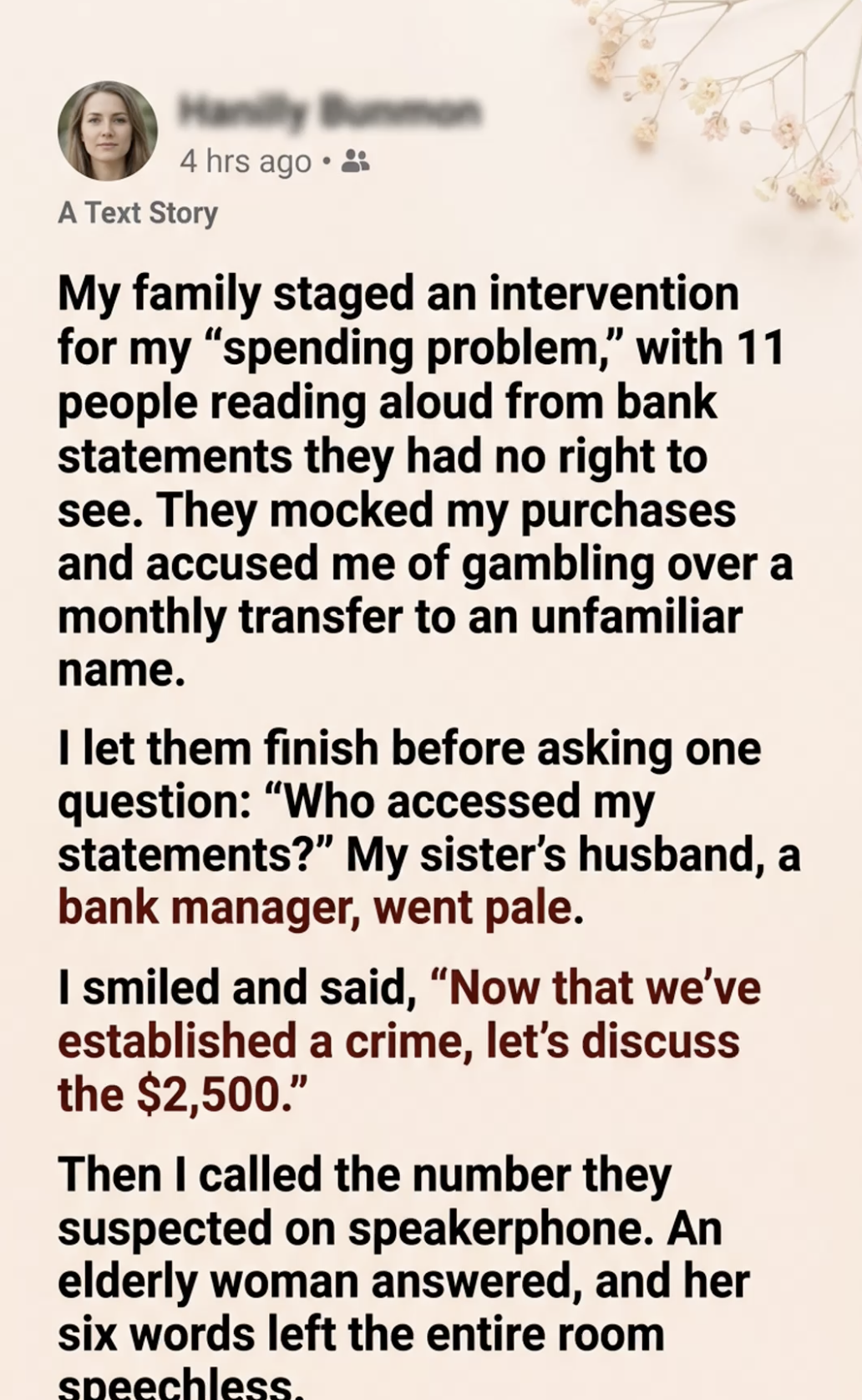
For nearly an hour, they had read aloud from my private financial records, mocking purchases, questioning restaurant bills, and accusing me of hiding a gambling addiction.
The accusation that had upset them most was a monthly transfer of $2,500 to a name none of them recognized.
They had decided it was proof that I was sending money to a stranger, losing it at a casino, or supporting someone who was taking advantage of me.
I had let them finish.
Now I held my phone against the table, the call on speaker.
“Mrs. Whitaker?” I asked gently.
“Yes, dear.”
“It’s Eleanor Bennett. I’m sorry to call unexpectedly, but I have a few people here who have some questions about the money I’ve been sending you.”
The room went silent.
The woman took a breath.
Then she said six words that changed everything.
“Your mother promised you’d never know.”
My mother’s hand dropped into her lap.
David went so pale that even my father noticed.
And I finally understood that the intervention had never been about my spending.
It had been about a secret my family desperately wanted to keep buried.
My name is Eleanor Bennett. I was sixty-three years old, recently retired from a career in public accounting, and until that afternoon, I had believed that my family respected me.
I had no gambling problem. I had no secret shopping addiction. I had no unpaid loans or hidden debts.
I lived in a modest house, drove a seven-year-old sedan, and kept my expenses low. My retirement savings were healthy, my mortgage was nearly paid off, and I had spent decades learning that money was easier to protect when emotions didn’t control decisions.
I wasn’t wealthy enough to be careless, but I was comfortable enough to help someone who needed it.
That was why I had been transferring $2,500 every month for almost three years.
The recipient was an elderly woman named Ruth Whitaker.
Ruth had once been my mother’s closest friend.
When I was a child, Ruth lived two houses away from us. She brought homemade apple pies to our kitchen, attended my school plays, and sat beside my bed when I had pneumonia because my mother was working late.
She never had children of her own. Her husband, Samuel, died when I was twenty, and Ruth spent the following years working as a nurse in a small community hospital.
When I was thirty, she moved to another state to be closer to her younger sister. We lost touch gradually, as people sometimes do when life becomes busy.
Then, nearly three years ago, I received a letter.
It was written in shaky handwriting and contained a simple request.
Ruth’s sister had died. Ruth’s savings had been consumed by medical expenses, and she was facing the possibility of losing her small apartment. She didn’t want to ask my mother for help because the two women had fallen out years earlier.
She had remembered that I once told her I would never forget her kindness.
I called her that evening.
We spoke for nearly two hours.
By the end of the conversation, I had decided to help.
I arranged a monthly transfer of $2,500 to cover her housing costs, medications, groceries, and occasional home assistance. I also asked a local attorney to help me establish a simple written arrangement so that the payments would be documented and Ruth wouldn’t have to worry about unexpected complications.
It wasn’t charity I wanted to advertise.
It was a private promise to someone who had once been there for me.
I never told my family because Ruth had asked me not to involve my mother. She was embarrassed about her circumstances and didn’t want their old disagreement reopened.
I respected her wishes.
For thirty-three months, the payments continued quietly.
Then my family discovered them.
Or rather, someone discovered them and decided to turn them into evidence against me.
The intervention began on a Sunday afternoon.
My mother, Patricia, called that morning and said she wanted the family to have lunch together. She sounded unusually warm, even excited.
“Everyone will be there,” she told me. “Your sister, David, your father, the cousins. We haven’t all sat together in ages.”
I was pleased.
Since retiring, I had found that family gatherings could be complicated. My sister Melissa believed I was too independent, my father thought I should have retired earlier, and my mother had a habit of turning ordinary conversations into evaluations of everyone’s choices.
Still, I loved them.
I brought a lemon cake to my parents’ house.
When I walked into the living room, I immediately knew something was wrong.
Eleven people were seated in a semicircle. My father stood beside the fireplace. Melissa had a folder on her lap. David was sitting at the end of the sofa with a stack of papers.
No one had prepared lunch.
My mother pointed toward an empty chair.
“Sit down, Eleanor.”
I set the cake on the side table.
“What’s going on?”
My father cleared his throat.
“We’re worried about you.”
“About what?”
Melissa opened her folder.
“Your spending.”
I almost laughed.
“My spending?”
David placed the papers on the coffee table.
“We’ve noticed some troubling patterns in your accounts.”
I stared at him.
“How would you know anything about my accounts?”
He avoided my eyes.
“That’s not the point right now.”
It was very much the point, but I decided to listen.
Melissa began reading from a bank statement. She described grocery purchases, a new washing machine, restaurant bills, and a transfer to my savings account. Every ordinary expense was presented as if it were evidence of a hidden disorder.
My father interrupted to criticize a vacation I had taken two years earlier.
My mother complained that I had bought a new sofa without asking anyone for advice.
One of my cousins suggested that retirement had left me bored and vulnerable.
Then Melissa reached the monthly transfer.
“Two thousand five hundred dollars,” she announced. “Every month. To someone called Ruth Whitaker.”
She looked around the room as though she had just uncovered a criminal conspiracy.
“Who is Ruth Whitaker?”
I said nothing.
David leaned forward.
“This is a significant amount of money. It could be gambling. It could be a scam. It could be someone manipulating you.”
“Or it could be something you don’t understand,” I replied.
Melissa shook her head.
“Why would you send a stranger that much money?”
“She isn’t a stranger.”
“Then who is she?”
I looked at David.
“Before I answer that, I’d like to know how you obtained these statements.”
His expression hardened.
“Eleanor, don’t deflect.”
“I’m not deflecting. These are private records. I didn’t give them to you.”
My mother spoke quickly.
“We’re family. We have a right to worry.”
“Worrying about me doesn’t give you a right to my bank statements.”
My father waved his hand dismissively.
“Let’s not get hung up on technicalities. We need to talk about the money.”
I could hardly believe what I was hearing.
Eleven adults had gathered to accuse me of financial irresponsibility, yet nobody seemed concerned about how my private information had been obtained.
I decided to let them continue.
Sometimes people reveal more when they believe nobody is challenging them.
Melissa described a plan to have me surrender control of certain financial decisions. My father suggested that David could help manage my accounts. My mother said I should be grateful that everyone cared enough to intervene.
David finally spoke with the authority of someone accustomed to being obeyed.
“If you can’t explain these transfers, we may need to contact the bank’s fraud department.”
I looked at him.
“That’s an interesting suggestion.”
He mistook my calmness for fear.
“I’m serious, Eleanor. Two thousand five hundred dollars a month adds up. Over three years, that’s ninety thousand dollars. That’s not a trivial amount.”
He was correct about the arithmetic.
He was wrong about everything else.
I placed my handbag on the floor and folded my hands.
“Thank you for your concern,” I said. “I have one question before we continue.”
My father sighed.
“Go ahead.”
“Who accessed my bank statements?”
Nobody answered.
I looked directly at David.
“Who?”
He shifted in his seat.
“I obtained information that was relevant to protecting the family.”
“From whom?”
“That’s not something we need to discuss here.”
“Actually, it is.”
My sister’s face began to change.
David glanced at her, then at my mother.
That was when I understood that he hadn’t acted alone.
I smiled faintly.
“Now that we’ve established that someone obtained my private financial records without my permission, let’s discuss the $2,500.”
Then I called Ruth.
When Ruth said, “Your mother promised you’d never know,” I felt as though someone had opened a door into a room I had been warned never to enter.
I kept my voice gentle.
“What did my mother promise you, Ruth?”
There was a long silence.
Then Ruth began to cry.
“Oh, Eleanor. I’m so sorry.”
My mother stood abruptly.
“Hang up the phone.”
I looked at her.
“No.”
“Eleanor, this is a family matter.”
“Then perhaps you should have treated it like one before bringing eleven people into this room to read my bank statements.”
Ruth’s voice trembled through the speaker.
“Your mother told me that if I ever contacted you, it would destroy your relationship with her. She said you would blame me for something that happened years ago.”
I felt a coldness spread through my chest.
“What happened years ago?”
My mother took a step toward the table.
“Ruth, please. Don’t.”
The elderly woman inhaled shakily.
“Your mother and I made a promise when you were young. I helped her when she was in trouble, and she said she would repay me when she could. But when the time came, she refused to acknowledge the debt. We argued, and I left town.”
My father stood.
“That’s enough.”
But Ruth continued.
“Years later, when I was struggling, I reached out to your mother. I didn’t ask for money at first. I just wanted to speak to her. She told me she couldn’t help me and that I should never contact you.”
I stared at my mother.
“Why?”
My mother looked down.
Ruth’s next words came slowly.
“Because the money I gave her all those years ago was supposed to be for your future.”
The room fell silent.
I remembered my childhood in fragments: my parents arguing behind closed doors, my mother crying at the kitchen table, my father insisting that everything was under control. I remembered being told that the family had gone through a difficult period and that I shouldn’t ask questions.
I had been twelve years old when my father lost his business.
For years afterward, my parents said they had rebuilt everything through hard work.
But Ruth was telling a different story.
“What money?” I asked.
Ruth swallowed.
“Your mother was in trouble financially when you were a little girl. She came to me because she was afraid your father would leave her. I had recently received an inheritance from my aunt. I gave her the money to keep the house and pay some urgent bills. She promised that it would be repaid.”
My mother began shaking her head.
“I was going to repay it.”
“When?” Ruth asked softly. “After all these years?”
My father turned toward my mother.
“Patricia, what is she talking about?”
My mother didn’t answer.
Ruth continued.
“I didn’t want to take you to court. I didn’t want to hurt you. You were a child, and I loved you. I told your mother she could repay me whenever she was able. But after your father recovered financially, she stopped speaking to me.”
I felt sick.
“How much did you lend her?”
Ruth told me the original amount.
It was substantial, especially for that time. Adjusted for the years that had passed, it was more than enough to explain why she had spent so much of her retirement struggling to stay afloat.
I looked at my mother.
“Is it true?”
She pressed her lips together.
“I was young. Your father and I were in a terrible situation. We had bills, debts, and you to take care of.”
“Did Ruth lend you the money?”
“Yes,” she whispered.
“Did you repay her?”
My mother said nothing.
That silence was the answer.
I turned back toward the phone.
“Ruth, I’m sorry. I didn’t know.”
“I know, dear. You weren’t responsible for what happened. I never wanted you to feel guilty.”
“Why didn’t you tell me?”
“Because I promised your mother I wouldn’t. And because I didn’t want you caught between us.”
I closed my eyes.
The $2,500 transfers suddenly felt very small compared with the years of shame and silence that had surrounded them.
I had been helping Ruth because she had once helped me. Now I learned that she had also helped my family when they needed it most—and had been punished for asking them to remember.
I opened my eyes.
“Ruth, please don’t worry about the money I’ve been sending. It will continue as we agreed. And I want to make sure you have everything you need.”
She began crying harder.
“Thank you, sweetheart.”
My mother reached toward the phone.
“Ruth, please. We can settle this privately.”
I moved it away.
“No, Mom. You’ve had years to settle it privately.”
Then I ended the call.
For several seconds, nobody moved.
My father was the first to speak.
“Patricia, is there any truth to this?”
My mother stared at the carpet.
“I didn’t want to bring up the past.”
“That isn’t what I asked.”
She began explaining that she had intended to repay Ruth, that circumstances had changed, and that the two women had disagreed about the terms.
But each explanation raised another question.
Why had she never told me?
Why had she allowed me to believe Ruth was a stranger?
Why had she encouraged an intervention over my supposed spending problem while concealing a debt that had remained unresolved for decades?
And why had David obtained my private financial information?
I turned to him.
“We haven’t finished our first question.”
He swallowed.
“I didn’t hack into anything.”
“I didn’t say you did. I asked who accessed my statements.”
He glanced at Melissa.
She looked away.
Finally, he admitted that he had used his position at the bank to obtain information about my account without my authorization. He claimed he had been worried about me and had wanted to confirm the monthly transfer before the family intervened.
He insisted that he hadn’t intended to harm me.
I listened without interrupting.
When he finished, I asked, “Did you have permission from me?”
“No.”
“Did you have a legitimate business reason to access my records?”
He hesitated.
“No.”
“Then you understand why this is serious.”
He nodded, looking suddenly much less like a confident bank manager and much more like a man who had made a decision he could not explain away.
I told him that I would be contacting the bank’s privacy and compliance department. I would provide the information I had learned and let them determine what had happened and what action was appropriate.
David’s face drained of color.
“Eleanor, please. I have a family to support.”
“So do I,” I replied. “And I have a right to expect that my private financial information will be protected.”
Melissa began crying.
“Are you really going to report him? He’s my husband.”
I looked at her.
“If someone accessed your private statements without permission, would you want the bank to ignore it because the person was related to you?”
She didn’t answer.
My father stood and began pacing.
“This has gone too far. We came here because we were worried about Eleanor, and now we’re being treated like criminals.”
“No,” I said. “You came here with my private financial records, accused me of gambling, and discussed taking control of my finances. When I asked how you obtained the information, nobody wanted to answer.”
I turned toward my mother.
“You knew exactly who Ruth was. You knew why I was helping her. Instead of telling the truth, you let everyone accuse me of being irresponsible.”
My mother finally looked up.
“I was afraid.”
“Of what?”
“That you would think less of me.”
I felt an ache deeper than anger.
“Mom, you let me think Ruth was a stranger. You let me think you had never owed her anything. And today you watched eleven people humiliate me over the very payments that were helping someone you had once hurt.”
She covered her face.
“I never meant for this to happen.”
“Intentions don’t erase consequences.”
I picked up my handbag.
“I will not surrender control of my finances. I will not allow anyone to access my records without permission. And I will not apologize for helping someone who once helped us.”
My father stepped into my path.
“Where are you going?”
“Home.”
“We haven’t finished this conversation.”
I looked at him calmly.
“Yes, we have.”
Then I walked out.
The following week was difficult.
David’s bank began a formal review after I submitted my complaint. I provided dates, messages, and the circumstances under which the statements had been presented to me. I did not demand that he lose his job or tell the bank what punishment to impose. I asked only that the access be investigated properly.
The bank confirmed that my records had been accessed without appropriate authorization. Its compliance team handled the matter under its policies and applicable privacy rules.
David was placed on leave while the review continued. Later, he was dismissed for violating the bank’s information-access requirements.
Melissa blamed me.
She sent a message saying that I had destroyed her marriage and damaged her children’s future.
I read it twice before responding.
I did not make David access my records. I reported what happened because it was wrong. I hope you and the children will be okay, but I will not accept responsibility for a decision I did not make.
She didn’t reply.
My father called several times, usually to tell me that I should have handled things within the family.
I asked him one question each time.
“Would you have told me the truth if I hadn’t called Ruth?”
He never gave me a direct answer.
My mother eventually wrote me a long letter. She explained the financial crisis she and my father had faced when I was young. She described her shame, her fear of losing the house, and her belief that Ruth’s help had been a temporary arrangement that could be forgotten once life improved.
But she also admitted that she had chosen silence because acknowledging the debt would have meant acknowledging the person she had wronged.
I didn’t excuse her.
I did, however, begin to understand the fear that had driven her decisions.
Understanding someone is not the same as agreeing with them. It simply allows you to see the whole person instead of only the harm they caused.
I wrote back that I was willing to speak with her, but I needed honesty and time.
Then I called Ruth again.
We spoke every Sunday after that.
Sometimes we talked about the past. Sometimes we discussed her garden, the books she was reading, or the neighbor who kept bringing her too many tomatoes.
I arranged for an independent adviser to review her housing expenses and benefits. I made sure the monthly transfers were documented and protected, and I asked Ruth whether she wanted help recovering anything from the old debt.
She thought about it for a long time.
“No, dear,” she said. “I don’t want to spend the rest of my life fighting about money. I want peace.”
“Are you sure?”
“Yes. But I would like your mother to acknowledge what happened.”
I promised I would not pressure her to do anything she didn’t want.
The next time my mother and I spoke, I told her Ruth was not seeking legal action or demanding that the old debt be repaid.
My mother began crying with relief.
I stopped her gently.
“Don’t mistake her kindness for proof that nothing happened.”
She was quiet.
“Ruth helped you when you needed help. She waited for years. And she asked for nothing more than honesty. You can still give her that.”
For the first time, my mother didn’t defend herself.
“I know,” she whispered.
Three months later, I visited Ruth.
She lived in a small, bright apartment overlooking a public garden. When she opened the door, she was wearing a yellow cardigan and holding a wooden spoon.
“I was making soup,” she said. “You’re just in time.”
I hugged her carefully.
She felt smaller than I remembered, but her smile was the same one I had known as a child.
We spent the afternoon talking. She showed me photographs from the years we had lost touch, including one of me at thirteen, standing in her kitchen with flour on my nose.
“I remember that day,” I said. “You were teaching me to make apple pie.”
“You insisted on adding too much cinnamon.”
“I still do.”
We laughed.
Then Ruth grew quiet.
“Eleanor, I need you to understand something. I never helped your mother because I expected to own a part of your life. I helped because she was frightened, and you were a little girl who deserved a safe home.”
“I know.”
“And I never wanted you to repay me out of guilt.”
“I know that, too.”
She took my hands.
“Then let the money be what it is. A kindness. Not a chain.”
I felt tears gathering in my eyes.
For years, my family had treated money as a measure of loyalty, a tool for control, and a reason to judge other people’s choices.
Ruth had treated it as a way to help someone survive a difficult season.
That difference explained more about our family than all eleven speeches at the intervention.
Before I left, I gave her a small envelope. Inside was a photograph of us in her kitchen, along with a handwritten note.
You were there for me when I was a child. I’m grateful I can be here for you now.
She held the photograph close to her chest.
Then she hugged me.
“Your grandfather would have been proud of you,” she said.
I smiled through my tears.
“My grandfather?”
She nodded.
“Your grandfather knew what happened. He wanted your parents to repay me, but he didn’t want you caught in the middle. He told me that one day you would understand.”
I sat back slowly.
My grandfather had died when I was in my twenties. I remembered him as a quiet man who rarely interfered in family arguments. I had never known he had tried to help Ruth.
“What did he do?”
“He spoke to your father. He urged him to make things right. Your father promised he would.”
I looked out the window at the garden below.
The past seemed to stretch further back than I had imagined. This wasn’t one forgotten debt or one family intervention. It was a pattern of promises, silence, and people being expected to carry the consequences of other people’s choices.
But I could choose what happened next.
I could continue helping Ruth without allowing the help to become a source of shame.
I could love my family without handing them control of my life.
And I could insist that trust be earned rather than demanded.
Six months after the intervention, my mother asked whether she could visit me.
I agreed.
She arrived carrying a small box of old photographs. We sat at my kitchen table while she placed them one by one between us.
There were pictures of my childhood home, my school graduation, family holidays, and birthdays I had almost forgotten.
At the bottom of the box was a photograph of Ruth standing beside my mother in the garden of our old house. They were both young, smiling at the camera, their arms around each other.
My mother touched the photograph.
“We were like sisters,” she said.
“What happened?”
She took a long breath.
“I let embarrassment become resentment. Then I let resentment become an excuse not to make things right.”
I waited.
“I was wrong to let everyone accuse you. I was wrong to hide the truth about Ruth. And I was wrong to allow David to access your statements.”
It was the first time she had acknowledged all three things without adding a justification.
“I’m sorry, Eleanor.”
I believed that she meant it.
But I also knew an apology could not restore trust instantly.
“Thank you for saying that,” I replied. “I need you to understand that our relationship won’t go back to the way it was before.”
She nodded.
“I understand.”
“I love you, Mom. But my finances are private. My decisions are mine. And if you are worried about me in the future, you can ask me a question instead of gathering a room full of people to judge me.”
She wiped her eyes.
“You’re right.”
We sat together for a while, looking at the old photographs.
There was no dramatic embrace, no sudden promise that everything would be perfect. There was only an honest conversation that should have happened years earlier.
Sometimes that is what repair looks like.
Not a return to the past, but a decision to stop repeating it.
On the anniversary of the intervention, I made a donation to a local organization that helps older adults protect themselves from financial exploitation. I asked that the money support practical education about banking privacy, recognizing scams, and maintaining financial independence.
I didn’t tell my family about the donation.
It wasn’t meant to punish anyone. It was simply something I believed mattered.
I continued my monthly transfers to Ruth. She was doing well, and we had become close again in a way I hadn’t expected. I visited when I could, called every Sunday, and sometimes sent her photographs of flowers from my garden.
As for David, I heard through Melissa that he had found work elsewhere after the bank’s review. I didn’t celebrate his difficulties, and I didn’t interfere in his efforts to rebuild his career. What happened was the consequence of his own decisions.
Melissa and I eventually began speaking again, though our relationship remained strained. She apologized for participating in the intervention without asking me how I felt or questioning where the statements had come from.
I accepted her apology slowly.
My father never fully admitted his role in what had happened. I stopped trying to force him to understand. We spoke occasionally, politely, and I kept our conversations away from my finances.
I had finally learned that not every relationship could be repaired on my timetable.
But every relationship could have boundaries.
One Sunday afternoon, Ruth called while I was watering the flowers outside my house.
“I have something to tell you,” she said.
“What is it?”
“I finally bought a new armchair.”
I laughed.
“That’s wonderful. What happened to the old one?”
“It collapsed under me last week.”
“Ruth!”
“Don’t worry, dear. I landed on a cushion.”
We laughed until neither of us could speak.
After we hung up, I stood in the garden for a long time, listening to the birds in the trees.
I thought about the eleven people in my parents’ living room, reading aloud from documents they had no right to see. I thought about my mother’s frightened expression, David’s sudden silence, and the six words Ruth had spoken that afternoon.
Your mother promised you’d never know.
Those words had exposed a secret, but they had also revealed something I needed to learn.
Privacy is not proof of guilt. Generosity is not evidence of weakness. And having the means to help someone does not give anyone else the right to demand an explanation.
My family had gathered to convince me that I could no longer be trusted with my own money.
Instead, they had forced me to discover who could no longer be trusted with my confidence.
I still loved them.
But I no longer confused love with access, concern with control, or family loyalty with silence.
The $2,500 had never been a gambling loss.
It had been a promise kept.
And the greatest lesson I took from that terrible afternoon was not about money at all.
It was that the people who truly care about you will ask whether you’re okay before they decide what is wrong with you.
Everyone else may demand your statements, question your choices, and call it love.
You are still allowed to ask them who gave them the right.