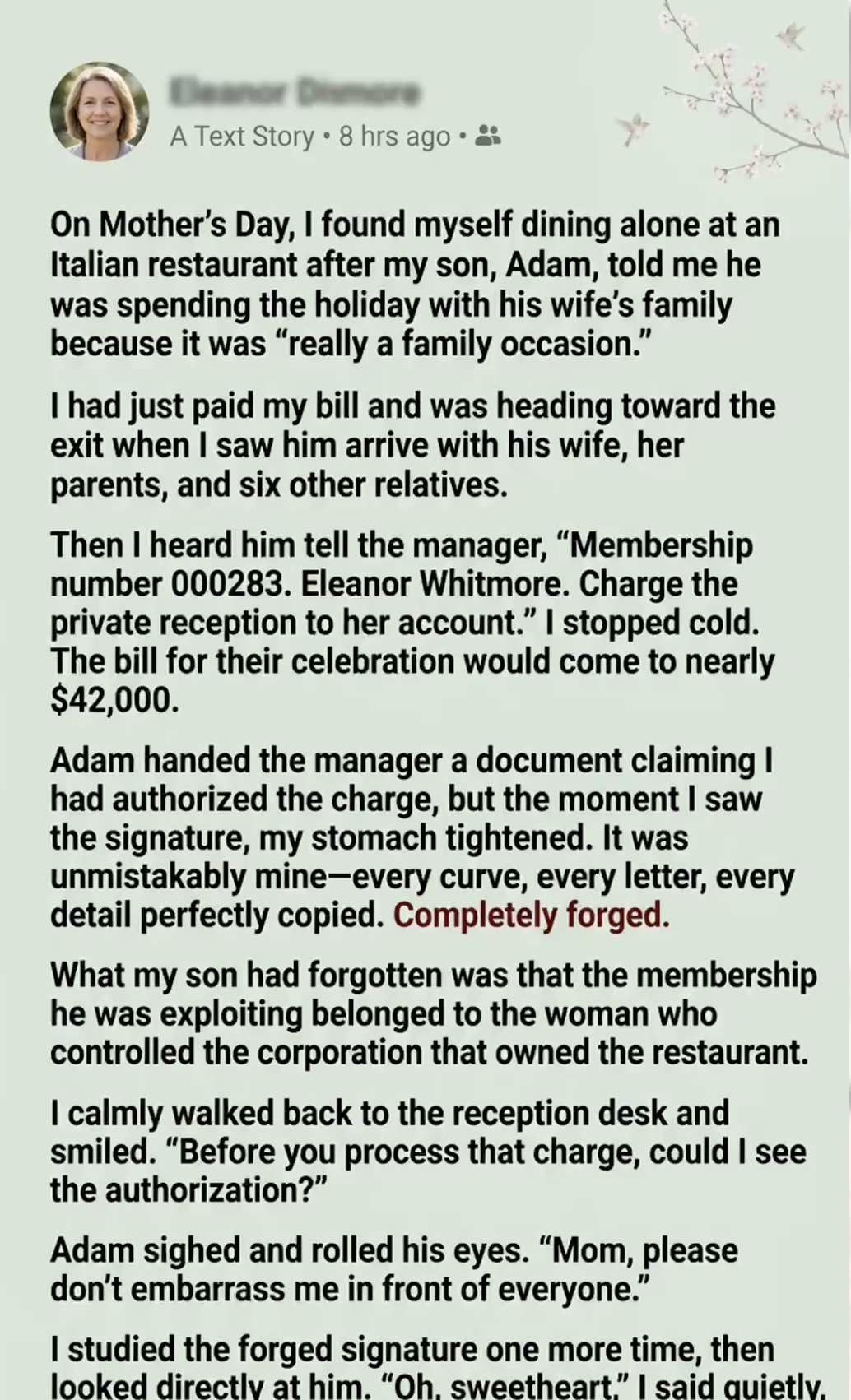
I stood at the reception desk, holding the authorization form between my fingers, and watched my son Adam smile at the manager as though he had already won.
He had no idea that his Mother’s Day celebration was about to become the most expensive mistake of his life.
“Mom, please,” Adam muttered, lowering his voice. “This isn’t the time.”
I looked at the signature again.
My name was written perfectly. The sweeping E, the small loop in the W, and the final stroke of Whitmore were all there. Whoever had copied it had studied my handwriting carefully.
But the signature was a forgery.
And the document attached to it was even worse.
It claimed that I had personally authorized a private reception costing $41,860, including premium wines, a custom menu, and a private dining suite for Adam’s wife’s family.
I turned to the manager.
“Has this charge already been processed?”
“Not yet, Mrs. Whitmore,” he replied. “We were waiting for final verification because the amount exceeds the account’s standard authorization threshold.”
“Good. Then please place the charge on hold.”
Adam let out an irritated laugh.
“It’s fine. My mother is just being difficult. She knows this membership is for family use.”
The manager glanced at him.
“Sir, the membership holder must authorize charges of this size.”
Adam’s wife, Vanessa, shifted uncomfortably in her chair. Her mother, Patricia, stopped examining the wine list. Her father, Robert, looked up from his phone.
For the first time, the entire table was listening.
I folded the document carefully.
“Adam, would you mind explaining why you submitted an authorization bearing my signature when I never approved this event?”
His expression hardened.
“I told you. It’s a family celebration.”
“Yes,” I replied. “And you specifically told me you wouldn’t be spending Mother’s Day with me because it was a family occasion.”
His cheeks flushed.
“That isn’t what I meant.”
“Then perhaps you can explain it to the restaurant’s compliance officer.”
The manager immediately reached for the telephone.
Adam’s smile disappeared.
“Mom, don’t do this.”
I looked at my son—the boy I had raised, the young man whose education I had paid for, the adult I had repeatedly rescued from the consequences of his own decisions.
For years, I had mistaken helping him for loving him.
I would not make that mistake again.
“I’m not doing anything to you, Adam,” I said quietly. “I’m simply refusing to let you do this to me.”
And that was when the restaurant’s general manager walked into the lobby, saw me holding the document, and asked the question that made my son turn completely pale.
“Mrs. Whitmore, would you like us to notify the corporate office?”
Adam stared at me.
“Corporate office?”
I met his eyes.
“Yes, sweetheart. Corporate office.”
Because there was one important detail he had never bothered to understand.
I wasn’t merely a wealthy member of the restaurant.
I was the controlling shareholder of the corporation that owned it.
And the people who managed that corporation took financial misconduct very seriously.
To understand why Adam believed he could get away with something so reckless, you would have to understand the kind of mother I had been.
My name is Eleanor Whitmore. I was sixty-eight years old that Mother’s Day, and I had spent most of my adult life building a business that began with a small commercial property and grew into a hospitality and real estate group with investments across several states.
My late husband, Charles, had helped me during the early years. When he died unexpectedly, our son Adam was still in college.
I could have stepped away from the business.
Instead, I worked harder.
I wanted Adam to have choices I had never enjoyed when I was young. I wanted him to attend the best schools, travel, build a career, and never feel trapped by financial hardship.
He grew up in a beautiful home, attended private schools, and graduated from a respected university without student debt.
When he wanted to start a consulting firm, I provided the initial capital.
When his first business struggled, I helped him restructure it.
When he wanted to buy a home, I helped him with the down payment.
When he married Vanessa, I paid for a generous portion of the wedding.
I never expected him to repay me dollar for dollar.
I only hoped he would grow into a man who understood gratitude, responsibility, and the difference between being supported and being entitled.
For a while, I believed he had.
Then Vanessa entered his life.
I want to be fair. Vanessa wasn’t responsible for every decision Adam made, and I couldn’t honestly say she had always treated me badly. In the beginning, she was polite, attentive, and appreciative.
But after they married, the relationship began to change.
Adam stopped calling unless he needed something.
Family dinners were repeatedly postponed.
Invitations arrived only when I was expected to pay for an event.
If I declined a request, he would become distant until I offered another kind of help.
Vanessa rarely confronted me directly. Instead, she would say things like, “Adam worries about you being alone,” or, “You have so much money, Eleanor. You shouldn’t have to think about little expenses.”
The implication was always the same.
Because I had money, my money belonged to everyone.
I tried to ignore the pattern.
I told myself that modern families were complicated. I told myself Adam was busy. I told myself that adult children sometimes needed time to find their own way.
Most painfully, I told myself that if I kept being generous, eventually he would remember that I was his mother, not his personal financial institution.
Then Mother’s Day arrived.
A week earlier, I had called Adam to ask whether he wanted to have lunch with me.
“I’ll check with Vanessa,” he said.
Two days later, he called back.
“Mom, we’re going to spend Mother’s Day with Vanessa’s parents. It’s really a family occasion.”
I remember the silence that followed his words.
I had been standing beside my kitchen window, looking at the garden Charles and I had planted decades earlier.
“Of course,” I replied. “Have a lovely day.”
I didn’t argue.
I didn’t remind him that I was his mother, too.
I didn’t mention that I had already made a reservation at an Italian restaurant we both used to enjoy.
I simply went to lunch alone.
The restaurant was beautiful, with white tablecloths, polished silverware, and tall windows overlooking the city. I ordered a modest meal and enjoyed the quiet.
For most of the afternoon, I managed to convince myself that I was perfectly content.
Then I saw Adam walk through the entrance with Vanessa, her parents, and six other relatives.
He had told me he was spending Mother’s Day with family.
Apparently, he had meant everyone except me.
I was preparing to leave when I heard him give the manager my membership number and instruct him to charge the entire reception to my account.
That was the moment the hurt became something else.
It became clarity.
The corporate compliance officer arrived twenty minutes later.
Her name was Melissa Grant. She had worked with our group for eleven years and was known for being thorough, discreet, and unwilling to make assumptions before examining the evidence.
She greeted me respectfully, then asked the manager to provide the original authorization, the reservation details, and the records associated with the membership account.
Adam stood beside the reception desk, his arms folded.
“This is completely unnecessary,” he said. “My mother knows who I am.”
Melissa didn’t respond to the provocation.
“Mr. Whitmore, did you submit this document?”
“Yes.”
“Did your mother sign it in your presence?”
Adam hesitated.
“She gave me permission.”
I looked at him.
“No, I did not.”
He turned toward me sharply.
“Mom, don’t make this worse.”
Melissa continued.
“Do you have any written communication showing that Mrs. Whitmore approved the charge?”
Adam reached into his jacket and pulled out his phone.
“I can show you messages.”
He scrolled through a series of conversations, then held up the screen.
“See? She has paid for family events before.”
Melissa examined the messages.
“They establish that your mother has paid for other events,” she said. “They do not establish that she authorized this charge.”
Adam’s face reddened.
“It’s a family membership!”
“It’s a private membership account,” Melissa replied. “The account holder’s authorization requirements still apply.”
Vanessa finally stood.
“Eleanor, surely you aren’t going to let this become a legal matter. We were trying to give everyone a lovely Mother’s Day.”
I looked at her.
“Whose Mother’s Day?”
She blinked.
“What?”
“You organized a celebration for your mother. That’s perfectly reasonable. But you used my account without permission, and someone copied my signature to make it appear that I had approved a bill approaching forty-two thousand dollars.”
Vanessa looked toward Adam.
“I thought you had discussed it with her.”
Adam immediately turned on her.
“Don’t start.”
That small exchange told me more than either of them intended.
They had not discussed the charge with me.
They had discussed how to use my membership.
Robert, Vanessa’s father, cleared his throat.
“Perhaps this is all a misunderstanding. Eleanor, you can afford the bill, can’t you?”
I looked at him for a long moment.
Then I asked, “If I can afford it, does that mean someone else is entitled to forge my signature?”
He looked away.
No one answered.
Melissa placed the authorization on a nearby counter.
“Mrs. Whitmore, we can preserve the original document and restrict any further charges while the matter is reviewed. Would you like us to proceed?”
“Yes.”
Adam stepped toward me.
“Mom, you can’t be serious.”
“I am.”
“You’re going to destroy my reputation over a dinner?”
“No, Adam. You placed your reputation at risk when you submitted a document you knew I hadn’t signed.”
He shook his head in disbelief.
“You’re my mother.”
“And that is precisely why I hoped you would never treat me this way.”
For a moment, his expression changed.
I saw something resembling shame.
Then it disappeared beneath anger.
“You’ve always used your money to control me!”
The accusation struck me harder than I expected.
I had spent decades trying not to control Adam. I had offered help, made introductions, paid bills, and opened doors because I wanted him to succeed.
But I had also allowed my generosity to become a substitute for honest conversations.
Whenever he behaved badly, I softened the consequences.
Whenever he demanded too much, I told myself he was going through a difficult period.
I had helped create a situation in which he believed my boundaries were negotiable.
That didn’t excuse what he had done.
But I finally understood that I needed to change my part in the pattern, too.
“I have never required you to accept my help,” I said. “And you have never been entitled to take it without asking.”
Melissa quietly requested that the restaurant suspend the proposed charge and secure the records.
Then she turned to Adam.
“Until the review is complete, you cannot use this membership account to authorize charges. Any future access will require the account holder’s express approval.”
Adam stared at her.
“You can’t do that.”
“I can enforce the account’s terms,” she replied. “And your mother has asked us to place the charge on hold.”
He looked at me as though I had betrayed him.
But for the first time, I refused to rescue him from the feeling.
The investigation took several weeks.
I did not demand that anyone punish Adam simply because I was his mother.
I wanted the facts established, the financial exposure prevented, and the restaurant’s procedures followed.
Melissa worked with the company’s legal and compliance teams to examine the document, verify the account records, and preserve the relevant communications.
The restaurant did not process the $41,860 charge.
Instead, it issued a written notice explaining that the authorization was disputed and that no payment would be taken from my account without valid approval.
The document was referred to the appropriate legal advisers, who explained the available options and the importance of preserving the original evidence.
I was advised not to contact the other guests about the matter or make public accusations while the review was underway.
I followed that advice.
Adam, however, seemed convinced that if he could get me alone, he could make the entire matter disappear.
He called repeatedly.
At first, he was angry.
“You’ve made me look like a criminal.”
Then he became sentimental.
“Mom, remember when Dad used to take us to that restaurant? He would never have wanted us fighting like this.”
Finally, he became threatening.
“If you keep pushing this, don’t expect me to visit you again.”
That last message hurt more than I wanted to admit.
For years, I had feared losing my relationship with my son. That fear had made me tolerate behavior I would never have accepted from a business partner or even a casual acquaintance.
I had believed that if I said no too often, Adam would disappear from my life.
Now he was threatening to disappear because I had said no once.
I saved the message and put my phone away.
I wasn’t going to bargain with my own dignity.
A few days later, Vanessa called.
“Eleanor, can we talk privately?”
I agreed to meet her at a café, provided the conversation remained calm.
She arrived alone and looked exhausted.
“Adam is furious,” she said.
“I imagine he is.”
“He says you’re trying to ruin him.”
“I have not made any public accusations. The company is reviewing a document submitted to charge my account. That’s what happens when an authorization is disputed.”
She stirred her coffee.
“I didn’t know he had copied your signature.”
I studied her face.
“Did you know he planned to charge the event to my membership?”
She was silent for several seconds.
Then she nodded.
“He told me you had agreed.”
“Did you see the authorization?”
“No.”
“Did you ask me whether I had approved it?”
She lowered her eyes.
“No.”
I took a slow breath.
“Vanessa, you don’t have to defend every decision Adam makes. But you do have to decide whether you are willing to accept responsibility for your own choices.”
She began to cry.
“I didn’t want my mother to have a disappointing Mother’s Day.”
“I understand wanting to make your mother happy. I really do. But you could have organized a dinner within your budget. You could have asked me whether I wanted to contribute. You could have chosen a smaller celebration.”
She wiped her face.
“Adam said you wouldn’t mind.”
“And you believed him because it was convenient.”
She did not deny it.
For the first time, I saw her not as the person who had taken my son away from me, but as an adult who had helped create a problem and now had to decide what to do about it.
“I am sorry,” she whispered.
I believed she was sorry.
But an apology was only a beginning.
“Then tell the truth when the company asks you questions,” I said. “And don’t use my account again without my permission.”
She nodded.
Whether she would follow through was up to her.
The most difficult conversation came a week later, when Adam arrived at my house.
He had not called first.
I found him standing on the front porch, holding an old photograph of himself as a child.
He looked tired.
“Can I come in?”
I hesitated, then stepped aside.
We sat in the living room where Charles used to read the newspaper every morning.
Adam placed the photograph on the coffee table.
“Do you remember this?”
I looked at it.
Adam was eight years old, sitting on Charles’s shoulders at the beach. His face was bright with laughter, and one hand held a plastic bucket filled with shells.
“Of course I remember.”
“You and Dad did everything for me.”
“Yes,” I said. “We did.”
He rubbed his palms against his trousers.
“I don’t understand how things got so bad between us.”
I waited.
“I know I shouldn’t have used the membership without asking. I know the signature was wrong. But I didn’t think you’d actually let this become such a big deal.”
There it was again.
He understood that the document was wrong.
What he still struggled to understand was why I had refused to protect him from the consequences.
“Adam,” I said, “when you were eight, you needed me to make decisions for you. When you were eighteen, you needed me to help you become independent. When you were thirty, you needed me to trust you to make your own choices.”
He looked up.
“But somewhere along the way, I started believing that loving you meant preventing you from experiencing the consequences of your decisions.”
I paused.
“And you started believing that because I could afford to help you, I had to.”
He looked down at the photograph.
“I never thought of it that way.”
“I know.”
“Are you saying this is your fault?”
“No. I am saying I allowed a pattern to continue for too long. You are responsible for forging the authorization. I am responsible for deciding what I will no longer accept.”
He was quiet.
Then he asked, “What do you want me to do?”
The question surprised me.
For the first time, he wasn’t asking how to make the problem disappear.
He was asking what accountability might look like.
“I want you to tell the truth,” I said. “I want you to cooperate with the review. I want you to stop using my money or my accounts without my permission. And I want you to understand that our relationship cannot be built on the assumption that I will always rescue you.”
His eyes filled with tears.
“Are you cutting me out of your life?”
“No.”
I leaned forward.
“I am giving you a chance to have a relationship with me that is honest. But I will not buy that relationship by pretending your choices don’t matter.”
He covered his face with his hands.
For a long time, neither of us spoke.
Then he whispered, “I’m sorry, Mom.”
I wanted to embrace him immediately.
Every instinct I had as a mother urged me to comfort him, tell him that everything would be fine, and promise to help him fix the mess.
But I had learned that comfort without accountability could become another form of avoidance.
So I said, “I hope you mean that. Now you have to show me.”
He nodded.
When he left, he took the childhood photograph with him.
I watched him walk down the path and wondered whether this was the beginning of a better relationship or simply another moment of regret.
I couldn’t decide that for him.
I could only decide what I would allow.
The company’s review eventually reached its conclusion.
The evidence established that the authorization had not come from me. The disputed charge was formally rejected, and the restaurant documented the incident under its financial-control procedures.
Because the document appeared to have been deliberately falsified, the company’s legal advisers explained the possible consequences and the appropriate avenues for reporting it. I allowed the process to proceed through the proper channels rather than using my position to demand a particular outcome.
I did not ask the company to give Adam special treatment.
I also did not ask it to punish him more harshly because he was my son.
I wanted the same process that would apply if the person involved had been a stranger.
Adam eventually acknowledged that he had submitted the authorization without my consent. He provided a written statement and cooperated with the review.
The matter had consequences for him, including legal expenses, damage to his reputation among the people who knew what had happened, and the loss of access to the private membership account.
The $41,860 dinner was never charged to me.
Adam and Vanessa had to address the costs of their celebration themselves, according to the arrangements they made with the restaurant.
For the first time in his adult life, my son had to solve a serious problem without assuming that I would write a check to make it disappear.
It was not easy for him.
But it was necessary.
Mother’s Day came around again the following year.
I didn’t make a reservation at the Italian restaurant.
Instead, I bought fresh flowers, prepared a simple lunch, and invited a few friends who had become part of my life during the months when I was learning how to stop measuring my worth by my son’s attention.
At noon, the doorbell rang.
Adam stood outside holding a small bouquet of yellow roses.
He was alone.
“Happy Mother’s Day,” he said.
I stepped back to let him in.
“Thank you.”
He looked around the house.
“Are you expecting anyone?”
“A few friends are coming for lunch.”
He nodded.
“I wasn’t sure whether you’d want me here.”
I studied him.
“Why did you come?”
He looked at the flowers in his hands.
“Because you’re my mother. And because I wanted to see you without asking for anything.”
The words were simple.
They were also the first thing he had said in a long time that did not come with a hidden request.
I took the flowers and placed them in a vase.
We sat at the kitchen table and talked.
Not about money.
Not about the restaurant.
Not about his problems or Vanessa’s family.
We talked about Charles, about Adam’s childhood, and about the garden that had grown wild while I was busy building my company.
At one point, Adam looked at me and said, “I know one lunch doesn’t fix everything.”
“No,” I agreed. “It doesn’t.”
“But I want to do better.”
I looked at my son.
I could not know whether he would keep that promise. Trust was no longer something I would hand over simply because I wanted to believe in him.
But I could recognize a beginning when I saw one.
“Then start with honesty,” I said. “And keep choosing it, even when it’s uncomfortable.”
He nodded.
When my friends arrived, Adam helped set the table. He didn’t offer to put the meal on my account. He didn’t ask me to pay for anything. When it was time to leave, he thanked me for lunch and offered to return the following weekend to help with the garden.
I told him I would appreciate the help.
Then I watched him walk to his car.
I felt something I had not felt in a long time.
Hope.
Not the desperate hope that I could love my son into becoming the person I wanted him to be.
A quieter hope that he might finally be learning to become that person himself.
That evening, I returned to the Italian restaurant.
I wanted to thank Melissa and the manager for handling the incident professionally. I also wanted to enjoy the place again without remembering it only as the setting for my son’s betrayal.
The manager greeted me at the entrance.
“Mrs. Whitmore, it’s wonderful to see you.”
“Thank you. I was hoping for a quiet table by the window.”
He led me to one.
As I sat down, I remembered the woman I had been a year earlier: hurt, embarrassed, and frightened that standing up for myself might cost me my son.
I had believed that a good mother was supposed to forgive everything.
I had believed that refusing a request was a failure of love.
I had believed that my sacrifices would eventually be enough to make Adam appreciate me.
Now I understood that love was not measured by how much I allowed someone to take from me.
I could love my son and still demand honesty.
I could forgive him without pretending he had done nothing wrong.
I could help him when help was appropriate without assuming responsibility for every problem he created.
And I could be a mother without surrendering my dignity.
When the waiter brought my dinner, I raised my glass toward the empty chair across from me.
“To Charles,” I whispered. “And to learning when love needs boundaries.”
Outside, the city lights began to shine.
I was still a mother.
I was still a businesswoman.
I was still the woman who had spent decades building something meaningful.
But I was no longer willing to make myself smaller simply to keep someone else comfortable.
Adam had thought the worst thing that could happen to him was losing access to my money.
What he eventually learned was that money had never been the most valuable thing I offered him.
It was trust.
And trust, unlike a restaurant bill, could not simply be transferred to someone else’s account.
It had to be earned.
This time, I was willing to let my son earn it.