When I was five years old, I believed my father could fix almost anything.
If my toy broke, he would kneel beside me and repair it. If I scraped my knee, he would carry me to the bathroom and clean the wound. And whenever thunder shook the windows at night, he would sit on the edge of my bed and tell me that storms never lasted forever.
Then my parents divorced.
At first, my father, Daniel, promised nothing would change. He said I would still see him every other weekend, that we would still get ice cream together, and that he would still be there for my school events.
I believed every word.
For a little while, he kept his promise.
He picked me up on Saturday mornings, took me to the park, and let me choose the movie when we stayed inside. Sometimes, he would buy me a small toy and tell me not to mention it to my mother because he wanted it to be a surprise.
Those weekends were the happiest part of my life after the divorce.
Then came the accident.
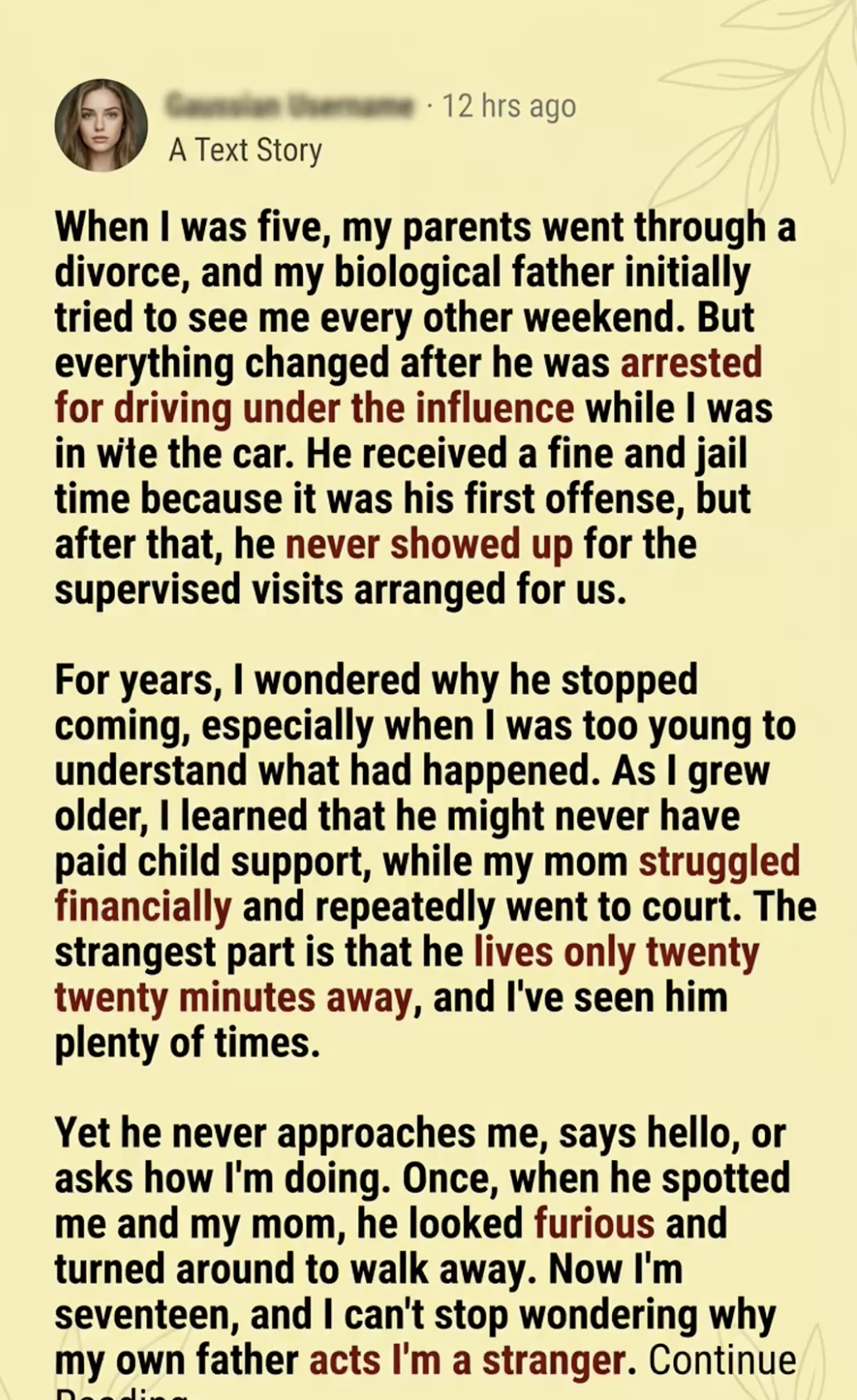
One afternoon, my father was driving me home when he was arrested for driving under the influence. I was in the car with him. I remember the flashing lights, the unfamiliar voices, and the fear that filled my chest when I realized something was seriously wrong.
I was too young to understand everything, but I understood that my father had done something dangerous.
Afterward, the court ordered supervised visits. My mother explained that the arrangement was meant to keep me safe while my father dealt with the consequences of his actions.
I thought he would come anyway.
I waited for the first visit with my favorite stuffed animal tucked beneath my arm. My mother had packed snacks and helped me choose the shirt he liked best.
He never arrived.
The next time, I waited again.
He didn’t come that weekend, either.
Eventually, the visits stopped being something I could count on. My mother stopped promising that he might arrive and began telling me gently that we would make other plans.
I didn’t understand why he had stopped coming.
I wondered whether he was sick, whether he had forgotten me, or whether I had done something wrong. Sometimes, I imagined that he would show up unexpectedly, apologize for missing everything, and take me for ice cream as if no time had passed.
But he never did.
As I grew older, I learned that the problems between my parents had not ended with their divorce. My mother struggled financially, and there were repeated court proceedings over child support. I heard arguments about missed payments, paperwork, and legal appointments.
My mother never spoke cruelly about my father in front of me. When I asked why he didn’t visit, she usually said, “That’s something your dad has to answer for himself.”
I hated that answer.
It felt as if she knew something she wasn’t telling me.
By the time I turned twelve, I had stopped asking.
By fifteen, I had convinced myself that I didn’t care.
But I did care.
I cared every time I saw another kid being picked up by their father after school. I cared when Father’s Day projects came home from class. I cared when other people complained about their dads being embarrassing, strict, or overprotective.
At least those fathers were there.
Mine lived about twenty minutes away.
I knew that because I had overheard my mother discussing his address with her lawyer. Once I looked it up on a map, I realized how close he was. He wasn’t living in another country or working on a distant ship. He wasn’t so far away that visiting would have required expensive flights or weeks of planning.
He was close enough to drive to my school in less time than it took me to finish a television episode.
And he still didn’t come.
I began seeing him around town when I was older.
The first time, I was fourteen and shopping with my mother at a grocery store. I recognized him near the frozen food section. He looked older than I remembered, with more gray in his hair and lines around his mouth.
For a moment, I thought he would smile.
Instead, he looked at me, stiffened, and turned down another aisle.
I stood there holding a carton of milk, unable to move.
My mother noticed.
“Was that your father?” she asked quietly.
I nodded.
She placed a hand on my shoulder, but neither of us followed him.
The second time, I saw him in a parking lot. I was walking toward our car when he stepped out of a nearby store. Our eyes met.
He looked furious.
I couldn’t understand why. I hadn’t approached him or said anything. I was simply standing there with my mother.
He turned around and walked back toward the store.
That night, I lay awake wondering what kind of person could look at his own child with anger instead of affection.
I had spent years imagining that he didn’t recognize me anymore.
Now I wondered whether he recognized me perfectly well and simply wished he didn’t have to.
When I turned seventeen, the questions became impossible to ignore.
My birthday passed without a message from him. No card. No call. Nothing.
That evening, while my mother washed dishes, I finally asked the question I had carried for most of my life.
“Mom, what did I do to make Dad hate me?”
She stopped washing.
For several seconds, the only sound in the kitchen was the water running into the sink.
Then she turned it off.
“Oh, sweetheart,” she whispered. “You didn’t do anything.”
“Then why does he act like I’m a stranger? He lives twenty minutes away. I’ve seen him so many times, and he won’t even say hello.”
My mother leaned against the counter.
“I wish I could give you an answer that would make this hurt less.”
“Did he ever try to pay child support?”
Her expression changed.
I immediately regretted asking, but I couldn’t stop myself.
“I heard you talking about court when I was younger. I know you struggled. I know there were problems. Did he ever try?”
My mother took a slow breath.
“There were payments he was ordered to make that never arrived. We went back to court more than once. I tried to get the situation resolved, but it was difficult.”
“So he didn’t just stop visiting me. He stopped helping you take care of me, too?”
She looked down at the floor.
“That’s how it turned out.”
I felt a strange mixture of anger and relief.
For years, I had wondered whether I wasn’t lovable enough for my father to want me around. Now I was beginning to understand that his absence had involved choices he made as an adult.
Still, one question remained.
“Why does he look angry when he sees me?”
My mother didn’t answer immediately.
Then she said, “There are things about your father’s life after the divorce that I don’t fully understand. But I think you deserve the chance to hear his side, if he’s willing to tell it.”
I almost laughed.
“He’s had twelve years to tell it.”
“I know.”
That night, I made a decision.
I would stop waiting for my father to come looking for me.
If I wanted answers, I would have to ask for them myself.
The next morning, I searched for his phone number. It took less than ten minutes to find an old number saved in a family contact list my mother had kept.
I stared at it for nearly an hour.
I wrote several messages and deleted them all. I imagined him ignoring me, blocking me, or replying with something cruel.
Finally, I typed the simplest thing I could think of.
Hi, Dad. It’s me. I’m seventeen now. I’ve seen you around town a few times, and I have questions about why you stopped visiting me. If you’re willing to talk, I’d like to meet somewhere public. I don’t want to argue. I just want to understand.
I pressed send before I could change my mind.
Then I put my phone on the desk and walked away.
He didn’t reply that day.
Or the next.
On the third evening, I received a message from an unfamiliar number.
I got your message. I don’t know if meeting is a good idea. But if you really want answers, I’ll meet you Saturday at 2 p.m. at the coffee shop on Maple Street.
I read it several times.
My father had answered.
I showed my mother.
She read the message without saying anything for a while. Then she asked, “Do you want me to come with you?”
I shook my head.
“I think I need to do this myself.”
She nodded, although I could tell she was worried.
“Then promise me you’ll leave if you feel uncomfortable. You don’t owe him anything just because he’s your father.”
“I promise.”
Saturday arrived far too slowly.
I changed clothes three times, then finally settled on jeans and a plain sweater. I didn’t want to look as if I had spent the morning preparing to meet a man who might not even remember my favorite color.
My mother drove me to the coffee shop and waited until I went inside.
My father was already sitting near the window.
For a moment, I barely recognized him. He had lost weight, his hair was almost completely gray, and his hands looked rougher than I remembered. But when he lifted his eyes, I saw the same face I had known as a child.
He stood awkwardly.
“Hi,” he said.
“Hi.”
Neither of us knew whether to hug.
So we didn’t.
I sat across from him, and he pushed a cup of hot chocolate toward me.
“I remembered you used to like this,” he said.
The words nearly broke me.
He remembered.
For twelve years, I had imagined that I had disappeared from his mind. Yet he remembered something as small as my favorite drink.
I wrapped my hands around the cup.
“Why didn’t you come to the visits?”
He looked down.
“I was ashamed.”
I waited for him to explain.
“After the arrest, I had to face what I’d done. I put you in danger. I knew that. I knew I could have hurt you, and I hated myself for it.”
“But the visits were supervised. You would have been safe.”
“Yes.”
“Then why didn’t you come?”
He rubbed his hands together.
“Because I was angry with your mother. I thought she was trying to punish me by making the visits supervised. I told myself the arrangement was unfair. I told myself I needed time to get my life together.”
He swallowed.
“And then one missed visit became two. Then I felt ashamed to show up after letting you down. I kept thinking I’d call next week, or come next month, or wait until I had something better to say.”
“So you just kept waiting?”
“Yes.”
I stared at him.
“You were the adult.”
“I know.”
“You could have called. You could have written a letter. You could have come to court and asked for help. You could have done anything.”
He nodded, his eyes wet.
“I know.”
I wanted him to defend himself. I wanted him to offer some explanation that would make the twelve years seem less terrible.
Instead, he sat there and admitted that he had been wrong.
It was not enough to repair the damage, but it was the first honest answer I had ever received from him.
“What about child support?” I asked.
He looked as if he had expected the question.
“I didn’t pay what I was supposed to pay for a long time.”
“Why?”
“At first, I was working irregular jobs and had debts. Then I got a steady job, but I had already fallen behind. I was embarrassed by how much I owed. Instead of dealing with it, I avoided the letters and the court notices.”
“So you made it harder for Mom to take care of me because you were embarrassed?”
He closed his eyes briefly.
“Yes.”
I felt my anger rise, but beneath it was something more painful.
I had spent years blaming myself for problems that had never been mine to solve.
“I used to think you stopped coming because I wasn’t a good enough son.”
His face crumpled.
“No. Never think that. You were a child. You deserved a father who showed up, and I failed you.”
For a moment, I couldn’t speak.
I had imagined hearing those words for years, but I hadn’t expected them to hurt so much when they finally came.
Then I asked the question that had followed me through every encounter in town.
“Why do you look so angry when you see me?”
My father went completely still.
He stared at his cup for so long that I thought he might refuse to answer.
Finally, he said, “Because I see what I’ve lost.”
I didn’t understand.
“When I see you with your mother, I remember the life I could have had if I’d made better choices. I see how much you’ve grown, and I realize I wasn’t there. I get angry at myself, but I don’t know how to handle it. Sometimes, I let that anger show on my face.”
“Then you walk away.”
“Yes.”
“Do you understand how that makes me feel?”
He nodded slowly.
“I can only imagine.”
“No, you can’t. You don’t know what it’s like to see your own father and wonder if he hates you. You don’t know what it’s like to spend every Father’s Day pretending you don’t care. You don’t know what it’s like to wonder whether you did something wrong when you were five years old.”
He began to cry.
I had never seen my father cry before.
For a moment, I felt sorry for him. Then I remembered that feeling sorry for him did not erase what he had done.
“I’m not telling you this so you’ll forgive me,” he said. “You don’t owe me forgiveness. I just want you to know that none of it was your fault.”
I looked out the window.
People walked past the coffee shop carrying shopping bags and talking on their phones. Their lives continued as if mine hadn’t just been turned upside down.
I had wanted an answer.
Now I had one, and it was painfully ordinary.
My father had not disappeared because of some secret flaw in me. He had disappeared because he was ashamed, angry, and unwilling to face the consequences of his own decisions.
He had chosen avoidance over responsibility, again and again, until the distance between us became a habit.
“There’s something else,” he said quietly.
I turned back.
“After the divorce, I told myself your mother was keeping you from me. I convinced myself that if I waited long enough, things would become easier. I even told some people that I wasn’t allowed to see you.”
My stomach tightened.
“But the visits were arranged by the court.”
“I know. I could have attended them. I could have followed the rules and worked to rebuild trust. Instead, I used the situation as an excuse.”
He reached into his coat pocket and took out a folded sheet of paper.
“I wrote you letters over the years.”
I stared at it.
“What?”
“Birthdays. Christmas. The first day I heard you had started high school. I wrote them, but I never sent them.”
“Why not?”
“Because I was afraid you would answer and I’d have to explain everything. Or that you wouldn’t answer, and I’d have to accept that you’d given up on me.”
He placed the letter on the table but didn’t push it toward me.
“I kept telling myself I’d send them when I was ready. I never was.”
I didn’t take the letter.
“You could have sent one anyway.”
“Yes.”
“You could have let me decide whether I wanted to answer.”
“Yes.”
“You made every decision for me without asking what I wanted.”
He nodded.
“You’re right.”
I sat in silence, trying to decide whether I wanted to hear anything else.
Part of me wanted to leave. Another part wanted to ask a hundred questions about the years I had missed. I wanted to know whether he had remembered my birthdays, whether he had ever driven past my school, whether he had ever looked at an old photograph and wished he had done things differently.
But I was tired of trying to build a relationship from guesses.
So I asked one final question.
“Do you want to be my father now, or do you just want me to make you feel less guilty?”
He looked startled.
Then he put the folded letter back into his pocket.
“That’s a fair question,” he said. “I don’t know if I deserve another chance. But if you are willing, I want to try to become someone you can trust. Not because I want you to tell me everything is okay. Because you deserved better than what I gave you.”
I studied his face.
For the first time, I saw him not as the father I had spent years imagining, but as a flawed man who had made choices that hurt me.
That did not make him less responsible.
It made the truth clearer.
“I can’t promise we’ll have a relationship,” I said. “I can’t promise I’ll forgive you. And I don’t want you showing up at my school or trying to surprise me.”
“I understand.”
“If we do this, it has to be slowly. You have to keep your promises. If you say you’ll call, you call. If you say you’ll meet me, you show up. And if you can’t, you tell me instead of disappearing.”
He nodded.
“I can do that.”
“Don’t promise it unless you mean it.”
“I mean it.”
I wasn’t sure whether I believed him.
But I was willing to let his future actions answer the question.
We talked for another twenty minutes. He told me about his job, his apartment, and the ordinary details of his life. I learned that he had been sober for several years and that he attended a support group for people recovering from alcohol misuse.
I was glad he had made those changes. I also understood that becoming healthier did not automatically make him a good father.
Before we left, he asked whether he could call me the following Sunday.
I considered it.
“Yes,” I said. “But don’t call because you think you have to. Call because you want to talk to me.”
“I will.”
When I walked outside, my mother was waiting in the car.
She didn’t ask me what had happened until we were halfway home.
“Are you okay?”
I watched the streets pass through the window.
“I think so.”
“Did he explain why he stopped coming?”
I told her what he had said. I told her about the shame, the missed visits, the child support, and the letters he had written but never sent.
My mother listened quietly.
When I finished, she pulled into a parking space and turned toward me.
“I’m sorry you had to carry those questions for so long.”
“Did you ever think he’d come back?”
“Yes,” she admitted. “For years, I thought he might wake up one morning and realize how much time had passed. I hoped he would find a way to be part of your life.”
“Why didn’t you tell me more about the court cases?”
“Because I didn’t want you to feel as if you had to choose between us. I wanted you to have the chance to love your father without feeling responsible for his mistakes.”
I reached over and hugged her.
She held me tightly.
“I know you tried,” I whispered.
“I tried to protect you,” she said. “But I know that didn’t make the questions go away.”
“No,” I said. “It didn’t.”
That night, I thought about my father for a long time.
I had expected the truth to give me a clear choice: forgive him or reject him. Instead, it left me with something harder.
I could understand why he had avoided me without deciding that his reasons were acceptable. I could acknowledge that he had struggled without pretending his struggles were more important than my childhood. And I could consider a relationship with him without promising that everything would be forgiven.
The following Sunday, my phone rang at exactly six o’clock.
It was my father.
For a moment, I simply stared at his name on the screen.
Then I answered.
“Hey,” he said awkwardly. “I said I’d call.”
“You did.”
“How was your week?”
It was an ordinary question, almost painfully ordinary.
But it was the first time in twelve years that my father had asked me about my life and followed through on his word.
I told him about school, an upcoming exam, and a friend who had been making me laugh all week. He listened without interrupting. When I finished, he asked questions and remembered the answers.
We spoke for fifteen minutes.
Before hanging up, he asked whether I would be comfortable meeting again in a couple of weeks.
I said yes.
Over the next several months, we met occasionally at the same coffee shop. Some conversations were easy. Others were uncomfortable. There were moments when I became angry about something he said, and moments when he struggled to hear how his absence had affected me.
We did not pretend that we were suddenly a happy family.
He began paying the child support he owed under the arrangements that applied to his circumstances, and he worked with the appropriate authorities to address the unresolved financial obligations. He also continued his recovery work and accepted that rebuilding trust would take time.
Most importantly, he kept showing up.
When he couldn’t meet, he told me in advance. When he promised to call, he called. He didn’t demand that I introduce him to my friends or invite him into every part of my life. He let me decide how quickly I wanted to move.
I noticed the difference.
I also noticed that I was still angry sometimes.
On my eighteenth birthday, he sent a card with a short handwritten message.
You deserved a father who was there for you. I cannot change the years I missed, but I am grateful you gave me the chance to begin making better choices. I will keep trying, whether forgiveness comes quickly, slowly, or not at all.
I read it twice.
Then I placed it in the drawer where I kept the important things from my childhood.
I didn’t put it there because everything was fixed.
I put it there because it was the first birthday card from him that had arrived on time.
A few weeks later, I saw him in town again. I was walking with my mother when he came out of a pharmacy across the street.
For a brief moment, the old fear returned. I remembered being fourteen in the grocery store, watching him turn away. I remembered the parking lot, the furious expression, and the years I spent wondering what was wrong with me.
This time, he didn’t walk away.
He crossed the street, stopped a respectful distance from us, and said hello.
My mother greeted him politely. I looked at him and waited to see whether the anger would return to his face.
It didn’t.
He asked how my classes were going. I told him they were fine. We spoke for a few minutes, and then he said he had to leave.
Before he went, he looked at me.
“I’m glad I got to see you,” he said.
I believed that he meant it.
After he left, my mother slipped her arm through mine.
“How do you feel?” she asked.
I thought about it.
“Sad,” I said. “But not the way I used to be.”
She nodded.
“I think I understand.”
I no longer believed that my father’s choices were a reflection of my worth. I no longer waited by the window for a car that might never arrive. And I no longer imagined that a single apology could erase twelve years of hurt.
I still don’t know what our relationship will look like in another five years. We may grow closer. We may remain cautious. There may be setbacks, and there will certainly be things we still need to talk about.
But I have stopped measuring my worth by whether my father chooses to be present.
I was five years old when he disappeared from my life. I was a child who deserved safety, consistency, and love. His failure to provide those things was never my fault.
That is the truth I wish someone had told me years ago.
Sometimes, a parent stays away because they are struggling. Sometimes, they are ashamed of what they have done. Sometimes, they tell themselves that leaving is easier than facing the damage they have caused.
But a child’s job is not to rescue a parent from guilt.
A child’s job is to grow, learn, and become their own person.
My father may always regret the years he missed. I may always feel the ache of the birthdays, school events, and ordinary afternoons he never shared with me.
We cannot recover those years.
What we can do is decide what happens next.
And for the first time in my life, that decision belongs to me, too.