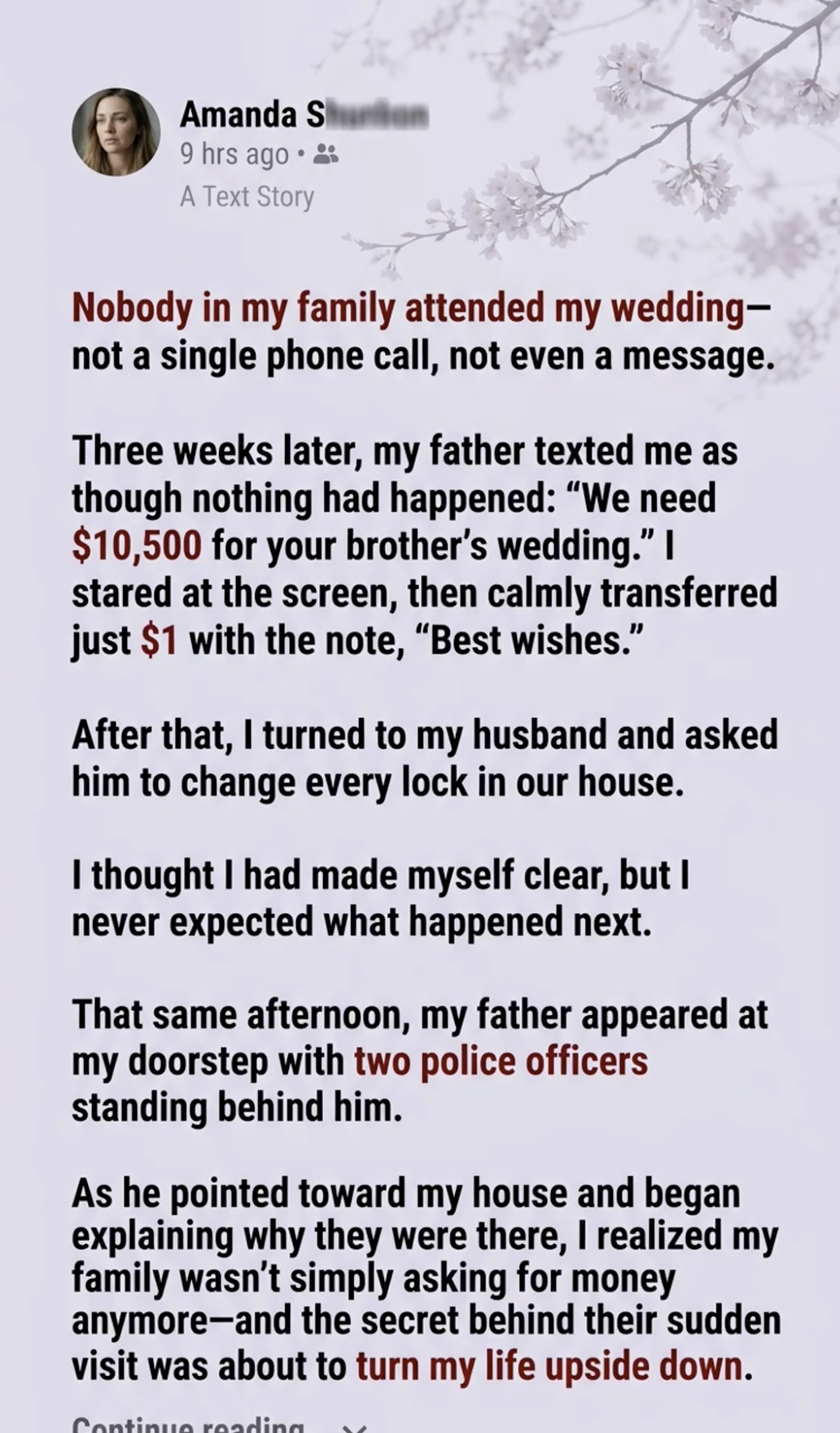
Nobody in my family attended my wedding.
Not my father. Not my mother. Not even my younger brother, Ethan, who had once promised that he would be the first person on the dance floor when I finally got married.
There were no congratulations, no phone calls, and not even a simple text wishing me happiness.
I stood at the entrance of the small garden where my husband, Daniel, and I exchanged our vows, holding a bouquet of white roses while I watched the empty chairs reserved for my family.
I had left six seats in the front row.
Six.
My father, Richard, and my mother, Margaret, had their names printed on two elegant cards. My brother and his fiancée had two more. The remaining seats were for my grandmother and my aunt.
Every chair remained empty.
At first, I told myself there had been an emergency. Perhaps someone was ill. Perhaps their car had broken down. Perhaps my father had finally realized how cruel he had been during the months leading up to the wedding and was trying to find a way to apologize.
I kept checking my phone.
Nothing.
When the ceremony began, I walked down the aisle with my uncle James, the only person from my extended family who had agreed to attend. He held my arm firmly and whispered, “You don’t have to keep looking back, sweetheart. Today is about the people who chose to be here.”
I tried to smile.
But when I reached Daniel, I couldn’t stop the tears from falling.
He gently wiped one away with his thumb.
“Whatever happens after today,” he whispered, “you won’t have to face it alone.”
I believed him.
At the time, I didn’t understand how much I would need that promise.
The Daughter Who Was Always Expected to Give
My name is Claire Bennett, and for most of my thirty-two years, I had believed that being a good daughter meant making my family happy, even when it cost me my own happiness.
My father had a particular way of making requests sound like obligations.
When my brother needed money for his first car, Dad told me that family helped family.
When my mother wanted to renovate the kitchen, she reminded me how much she had sacrificed raising me.
When Ethan lost his job after spending months partying instead of looking for work, Dad called me and said, “Your brother is going through a difficult time. You have a stable career. Surely you can help him get back on his feet.”
I had a good job as a financial analyst. I worked long hours, saved carefully, and avoided the expensive habits my friends sometimes indulged in.
I wasn’t wealthy, but I was responsible.
And in my family, responsibility had become a reason to take from me.
I paid my brother’s overdue rent twice. I covered my mother’s medical bills when her insurance reimbursement was delayed. I even lent my father $18,000 when he claimed his small construction business was about to collapse.
He promised to repay me within six months.
Five years later, I hadn’t received a single dollar.
Whenever I asked about the loan, he acted offended.
“How can you keep bringing up money with your own father?” he would demand.
I eventually stopped asking.
I told myself that helping my parents was part of being a daughter. I convinced myself that one day they would recognize my sacrifices and treat me with the same consideration I gave them.
Then I met Daniel.
He was an architect who had recently left a large firm to start his own business. He was patient, thoughtful, and refreshingly honest. When he asked about my family, I described them in generous terms.
I told him my father was demanding because he worried too much. I said my mother was emotionally sensitive. I described Ethan as immature but good-hearted.
Daniel listened without interrupting.
Then he asked one question that stayed with me.
“Claire, when was the last time someone in your family helped you without expecting something in return?”
I laughed because I thought he was joking.
He wasn’t.
I couldn’t answer.
Daniel never demanded that I cut off my family. He simply encouraged me to notice how I felt after every interaction with them.
Eventually, I noticed.
I felt anxious whenever my phone rang unexpectedly. I felt guilty whenever I spent money on myself. I felt selfish whenever I said no.
And I felt strangely peaceful whenever I went a few days without speaking to them.
That realization frightened me more than I wanted to admit.
The Wedding Invitation That Changed Everything
Daniel proposed to me on a quiet Sunday morning in the small apartment where we had spent our first year together.
There was no extravagant ring or elaborate celebration. He made breakfast, placed a little box beside my coffee, and asked whether I wanted to build a life with him.
I said yes before he finished the question.
When I told my parents, my mother congratulated me, but her expression quickly changed.
“Have you decided how much you’re spending on the wedding?” she asked.
I explained that Daniel and I planned to keep it small. We would pay for everything ourselves, with no financial assistance needed from either family.
Dad seemed disappointed.
“Small weddings are fine,” he said, “but you have to think about appearances. People will talk if we don’t do this properly.”
I assumed he was concerned about the guest list.
I was wrong.
Two weeks later, he called me with a proposal.
Ethan and his fiancée, Lauren, were planning their own wedding for the following year. They wanted a beautiful venue, a large reception, and an expensive honeymoon.
My father wanted me to contribute $25,000 toward their wedding expenses.
“Your brother deserves a wonderful beginning,” he explained. “You and Daniel both have good jobs. You can afford it.”
I was stunned.
“Dad, Daniel and I are saving for our own future. We have a mortgage to plan for, and we want to start a family eventually.”
He sighed as if I had disappointed him.
“Your brother is different. He needs more support than you do.”
“Why does he need more support?”
“Because he’s the younger one.”
I waited for him to laugh.
He didn’t.
I reminded him that I had already lent him $18,000 years earlier. I also reminded him that I had paid several of Ethan’s bills.
Dad’s voice turned cold.
“So now you’re keeping score?”
“No,” I replied. “I’m trying to explain that I can’t keep giving money I need for my own life.”
He ended the call without saying goodbye.
For the next several weeks, my mother sent messages about how much family unity mattered. Ethan posted photographs of expensive wedding venues and complained online about how difficult it was to plan a wedding without enough money.
No one asked about my wedding preparations.
No one asked whether I needed help.
I nevertheless sent my parents an invitation. I even called my mother to make sure she had received it.
She said she had.
“Are you coming?” I asked.
“We’ll see,” she replied.
“Mom, it’s my wedding.”
“I know, Claire. But your father is upset, and you know how stubborn he can be.”
I felt something inside me sink.
“Are you saying you won’t come because I refused to pay for Ethan’s wedding?”
“I didn’t say that.”
“You didn’t have to.”
She hung up.
I spent the next month hoping she would change her mind.
She never did.
The Empty Chairs
On our wedding day, I wore a simple ivory dress. Daniel wore a navy suit, and we held the ceremony in a garden overlooking a small lake.
There were only thirty-eight guests.
They were Daniel’s family, a handful of close friends, two colleagues from my office, and Uncle James.
My aunt Patricia had promised to attend, but she sent a message the night before saying that my father had told her not to come if she wanted to remain welcome in the family.
She apologized repeatedly.
I told her I understood, although the truth was that I didn’t.
How could a wedding invitation become a test of loyalty?
During the reception, Daniel’s mother, Helen, approached me with a small envelope.
Inside was a handwritten letter.
She explained that she had written it the night before her own wedding, when she had been terrified about whether she was making the right choice.
At the bottom, she had added one sentence just for me.
You are not responsible for making everyone happy. You are responsible for building a life you can live with.
I read it twice before folding it carefully and putting it in my purse.
That evening, Daniel and I danced beneath strings of warm lights. Our friends cheered. Someone spilled champagne. My uncle told an embarrassing story about me as a child.
For a few hours, I felt happy.
But every time my phone vibrated, my heart jumped.
Perhaps my mother would call.
Perhaps Dad would send a message.
Perhaps Ethan would apologize.
At midnight, there was still nothing.
When we returned to our hotel room, I sat on the edge of the bed and finally allowed myself to cry.
Daniel wrapped his arms around me.
“You can love them,” he said softly, “without pretending they haven’t hurt you.”
I pressed my face against his shoulder.
For the first time, I considered the possibility that I might never receive the apology I had spent my entire life waiting for.
Three weeks later, I received a message that confirmed just how little my wedding had meant to them.
The $15,000 Message
I was sitting at my desk at work when my phone buzzed.
It was my father.
His message contained only two sentences.
We need $15,000 for Ethan’s wedding. Transfer it by Friday so we can secure the venue.
I read it several times.
There was no mention of my wedding.
No apology for missing it.
No explanation for why my parents had ignored one of the most important days of my life.
He hadn’t even asked how I was doing.
He had simply returned to the familiar business of requesting money.
I felt a strange calm settle over me.
For years, I had written long explanations whenever I refused a request. I described my expenses, my plans, and the reasons I needed to protect my savings. I tried to make every refusal sound gentle enough that nobody could accuse me of being selfish.
This time, I didn’t explain anything.
I opened my banking app.
I transferred exactly $1 to my father.
In the payment note, I wrote:
Best wishes.
Then I put my phone facedown and returned to work.
About ten minutes later, it began vibrating repeatedly.
Dad called three times.
Then my mother called twice.
Finally, a message from Ethan appeared.
Are you seriously doing this? Dad says you sent him one dollar.
I didn’t respond.
Another message arrived.
You’re embarrassing the whole family.
I stared at that sentence for a long time.
Not once had any of them expressed embarrassment about leaving six empty chairs at my wedding.
But one dollar had apparently become a family emergency.
That evening, I showed Daniel the messages.
He read them carefully before looking at me.
“What do you want to do?” he asked.
I thought about the money I had lent my father. I thought about the years of guilt, the missed birthdays when I had been working to cover someone else’s bills, and the wedding day when my own parents had chosen not to show up.
“I want to stop living as though they have a claim on everything I earn.”
Daniel nodded.
“Then we need to make sure our home and finances are protected.”
We had recently purchased a modest house together. It wasn’t luxurious, but it was ours. We had spent months comparing mortgage rates, negotiating the purchase, and saving for the down payment.
The property was registered in both our names.
We had worked hard for it, and neither of us wanted our family conflict to spill into our home.
The next morning, Daniel contacted a licensed locksmith and arranged to have our exterior locks changed. We also reviewed our account security, updated passwords, and checked which relatives had spare keys.
I had given my parents a spare key several years earlier, when I lived alone in an apartment across town.
I had never formally asked for it back.
Daniel and I agreed that changing the locks was a reasonable precaution.
We had no idea that, before the day was over, my father would arrive with two police officers.
My Father Arrived With the Police
It was a little after two in the afternoon when the doorbell rang.
I was working from home. Daniel had gone to a meeting and wasn’t expected back for another hour.
I looked through the front window and felt my stomach tighten.
My father stood on the porch.
Two uniformed police officers stood behind him.
Dad was wearing his best charcoal suit. His face was red, and he was gesturing toward our front door as though he were explaining something urgent.
For a moment, I considered not answering.
Then one of the officers knocked and identified himself.
I opened the door but kept the security chain engaged.
“Claire,” Dad said sharply, “finally.”
I looked at the officers.
“Is there a problem?”
One officer introduced himself as Officer Miller. His partner, Officer Davis, stood a few steps behind him holding a small notebook.
“Your father contacted us regarding a property dispute,” Officer Miller explained. “He says you may be in possession of property that belongs to him and that access has been denied.”
I stared at my father.
“What property?”
Dad stepped forward.
“My house key, for starters. And the documents you took from my office.”
I almost laughed.
“I don’t have any documents from your office.”
“You know exactly what I’m talking about.”
“No, Dad. I don’t.”
He turned toward the officers.
“She has been refusing to return things that belong to our family. I believe she’s trying to keep property that was supposed to be held for her brother.”
The officer raised a hand.
“Sir, let’s establish the facts first.”
I opened the door wider, though I didn’t invite anyone inside.
“This is my house. My husband and I bought it together. My father doesn’t live here, and he has no permission to enter.”
Officer Miller nodded.
“Do you have identification showing your residence?”
I fetched my driver’s license and a copy of our property documents from a folder in the hallway.
He examined them and returned them.
“Thank you. Your father also alleges that you have withheld a set of financial records connected to a family account.”
I felt my pulse quicken.
“What family account?”
Dad’s expression changed.
For the first time since he arrived, he looked less angry than nervous.
“Don’t pretend you don’t know,” he said.
“I genuinely don’t.”
Officer Davis asked my father to explain the alleged account and identify the documents he believed I possessed.
Dad hesitated.
Then he said something that made the entire situation feel much more serious.
“Her name is on the account. She was supposed to manage it for the family. Now she’s refusing to cooperate because she’s angry about the wedding.”
I looked at him in disbelief.
“My name is on what account?”
Neither officer answered immediately.
Officer Miller explained that they were there to assess a reported dispute, not to decide ownership of a bank account or force entry into a private home. They had no warrant, and they were not suggesting that I had committed a crime.
He asked whether I would be willing to clarify the matter.
I agreed.
But I insisted that Daniel be present before I discussed anything involving financial records.
I called him.
He answered on the second ring.
“Claire? What’s wrong?”
“My father is here with two police officers. He says I took financial documents and that I control some family account.”
There was a pause.
“Don’t argue with him,” Daniel said. “I’ll be home as soon as I can. Ask the officers what specific property he says you took, and don’t sign anything.”
I repeated his advice to Officer Miller.
The officer nodded.
“That is sensible. We’ll wait a few minutes while you contact your husband.”
My father looked furious.
“This is ridiculous. She’s making this more complicated than it needs to be.”
I met his eyes.
“You brought the police to my house, Dad. You made it complicated.”
For once, he had no immediate answer.
The Secret Account
Daniel arrived twenty-five minutes later.
He greeted the officers respectfully, introduced himself, and asked my father to explain his allegations again.
This time, Dad’s story became more specific.
He claimed that years earlier, my grandmother, Eleanor Bennett, had established a family savings account. The account was intended to help preserve money for future family needs, including education, housing, and emergencies.
According to him, I had been named as the account’s administrator because I was the most financially responsible member of the family.
He insisted that I had access to the records and had promised to help manage the money.
I listened in disbelief.
My grandmother had died six years earlier.
She had been the one person in my family who treated me with affection without making me earn it. She used to invite me to her house on Sunday afternoons, serve me tea, and ask about my dreams.
When I was twenty-four, she had encouraged me to start saving for a home.
“Money can give you choices,” she once told me. “But only if you know whose money it is.”
I had no memory of managing a family account.
“I never agreed to administer any account,” I said. “And I’ve never taken financial records from my father’s office.”
Dad shook his head.
“Your grandmother discussed it with you. You were there.”
“I visited Grandma all the time. That doesn’t mean I agreed to manage an account.”
Officer Miller asked whether my father had documentation supporting his claim.
Dad reached into his briefcase and pulled out a folded photocopy.
It was a page from an old financial document.
I could barely read the faded print, but I recognized my grandmother’s name.
Below it was a reference to a savings account and a note stating that I had been identified as a potential successor contact.
The document did not say I owned the money.
It did not say I had stolen anything.
And it certainly did not establish that my father had a right to enter my home.
Daniel studied the page.
“This document needs to be reviewed by the bank or a qualified attorney,” he said. “It doesn’t establish what Mr. Bennett is claiming.”
Officer Miller agreed.
Then he asked my father a question.
“Do you have evidence that your daughter currently possesses the account records?”
Dad’s jaw tightened.
“She must have them.”
“Why?”
“Because I found out she was listed on the account.”
“How did you find that out?”
Dad glanced at me.
Then he looked away.
“I received a letter.”
“From whom?”
“The bank.”
Officer Davis asked whether he had brought the letter.
Dad said he hadn’t.
The officers explained that they could document the dispute, but they could not determine ownership from an incomplete photocopy or force me to hand over documents I did not possess.
They also made it clear that a civil disagreement about an account was not, by itself, proof of criminal wrongdoing.
My father was visibly frustrated.
As the officers prepared to leave, he turned toward me.
“You have no idea what you’ve done.”
I stood in the doorway.
“Then explain it.”
He opened his mouth.
Closed it.
And walked away.
The officers left shortly afterward.
But the matter didn’t end there.
In fact, that visit was only the beginning.
The Letter My Grandmother Left Behind
That evening, Daniel and I sat at the kitchen table with a notebook between us.
We wrote down everything my father had said, including the name of the alleged account, the document he had shown us, and the officers’ explanation of what they could and could not do.
Daniel suggested that I contact the bank named on the photocopy through its official customer-service channels.
I did so the next morning.
After verifying my identity, the bank explained that it could not disclose account information without the proper documentation. It also advised me to submit a written inquiry explaining my connection to the deceased account holder.
I followed its instructions.
Three days later, I received a letter asking me to provide a copy of my identification and a certified copy of my grandmother’s death certificate, along with any estate documents I might have.
I had none.
My parents had handled most of the arrangements after Grandma died. I had attended the funeral, helped sort her belongings, and accepted a few sentimental items. I had assumed that her financial affairs had been handled properly.
I had never questioned it.
Now I wondered whether I should have.
I called Uncle James.
He listened quietly while I described the police visit.
When I mentioned the old account, he became silent.
“Claire,” he finally said, “there’s something your grandmother told me before she died.”
My heart began pounding.
“What?”
“She was worried about the way your father handled money. She didn’t want you to be dragged into his debts or pressured into giving up anything that belonged to you.”
I gripped the phone.
“Why didn’t you tell me?”
“Because I didn’t know what had happened to the account. Your grandmother told me that she’d made arrangements through a lawyer, but she asked me not to interfere unless you came to me with a problem.”
I closed my eyes.
“Do you know the lawyer’s name?”
“I believe it was Margaret Collins. She had an office near the courthouse. I can look through my old papers.”
The next morning, Uncle James called me back.
He had found a letter from the lawyer’s office dated several months before my grandmother’s death.
The letter confirmed that an estate-planning appointment had taken place.
It did not disclose the details of the arrangements, but it gave us the firm’s contact information.
Daniel and I scheduled a consultation.
At the meeting, Attorney Collins reviewed the photocopy my father had shown the police. She explained that the document appeared to be an outdated account record, not proof that I owned or controlled the money.
She then asked whether my grandmother had ever given me a sealed envelope or a personal letter.
I thought for a moment.
Then I remembered something I had almost forgotten.
When Grandma died, my mother had handed me a small wooden box containing photographs, a silver necklace, and a bundle of letters tied with blue ribbon.
I had stored the box in a closet and hadn’t opened it in years.
That evening, Daniel helped me retrieve it.
The necklace was still there.
So were the photographs.
And beneath the letters, I found a cream-colored envelope with my name written in my grandmother’s unmistakable handwriting.
On the front, she had written:
For Claire. Please read this when you are ready to make your own decisions.
My hands trembled as I opened it.
Inside was a letter dated four months before her death.
It began with words I would never forget.
My dearest Claire, if you are reading this, I hope you have found the courage to build a life that belongs to you. I have always known how easily you are persuaded to carry burdens that were never yours.
I stopped reading and pressed the letter against my chest.
Daniel put a hand over mine.
“Take your time,” he whispered.
I continued.
Grandma explained that she had created a small trust using part of her savings. Its purpose was to preserve money for specific beneficiaries and to prevent anyone from using the funds for unrelated expenses.
She had not wanted the money to become a source of conflict.
She had also wanted me to understand that I was not responsible for rescuing every adult in the family.
At the end of the letter, she mentioned the name of her attorney and a sealed copy of the trust instructions.
The letter did not tell me the current balance, and it did not establish that I was entitled to every dollar.
But it gave Attorney Collins enough information to begin tracing the records.
For the first time since my father’s visit, I felt that I was finally moving toward the truth.
Then Attorney Collins made a discovery that changed everything.
The Money Was Never My Father’s
A week later, Attorney Collins contacted us with an update.
The bank had located records associated with my grandmother’s estate. Some information remained confidential, and additional documents were needed before the beneficiaries and current balance could be confirmed.
However, one fact was already clear.
The account had been established as part of a trust arrangement.
My father had not been the sole owner.
And he had not been given unrestricted authority to use the money.
The trust had been designed to preserve assets for designated beneficiaries, with distributions governed by written terms.
My grandmother had appointed a professional fiduciary to oversee the arrangement. The fiduciary’s records showed that my father had once requested information about the trust but had not been authorized to withdraw money for his personal use.
Attorney Collins advised us that the precise ownership, beneficiary rights, and available balance would need to be established from the full trust instrument and account history.
Then she showed me a section of the documents.
My name appeared among the designated beneficiaries.
So did Ethan’s.
But the terms were not equal in the way my father had led me to believe.
My grandmother had set aside a portion specifically for my future housing and education. Ethan’s share was structured differently, with distributions tied to particular milestones and the trustee’s review.
Neither of us had unrestricted access to the entire fund.
More importantly, the money was not intended to pay for a lavish wedding, my father’s business expenses, or anyone else’s personal debts.
My grandmother had created the trust to protect the future of her grandchildren.
She had anticipated that family pressure might eventually threaten that purpose.
I read the relevant paragraph three times.
“Does Dad know about this?” I asked.
Attorney Collins chose her words carefully.
“He appears to know that a trust exists. We cannot yet establish what he understands about its terms. What we can say is that he does not have the authority to demand that you transfer trust assets to him.”
I thought about the police officers standing behind my father.
I thought about the way he had pointed toward my house and told them I was withholding family property.
He hadn’t been confused about a missing set of keys.
He had been trying to make me surrender control of a financial matter he could no longer manage on his own terms.
But there was still one unanswered question.
Why had he suddenly become so desperate to access the trust?
The answer arrived two days later.
And it was far worse than I had expected.
The Debt My Father Tried to Hide
Uncle James called me on a Friday evening.
He sounded uneasy.
“Claire, I think you need to know what’s happening with your father’s business.”
I sat down.
“What happened?”
“His construction company has been struggling for a while. He borrowed money to cover operating expenses, and some of the projects he expected to finish have been delayed.”
I already knew the company had experienced difficulties. Dad had complained about rising material costs and unreliable contractors.
But Uncle James told me the situation had become more serious.
My father had personally guaranteed several business loans. When the company failed to meet its obligations, creditors began demanding payment from him.
He had also borrowed money from acquaintances, telling them that he expected to receive funds from a family investment.
That investment, Uncle James suspected, was the trust.
“Did he tell people the money belonged to him?” I asked.
“I don’t know exactly what he said. But I heard him arguing with your mother about it. He believed your grandmother had left enough money to solve all his problems.”
I felt sick.
My grandmother had saved for decades. She had worked as a school administrator, lived modestly, and carefully invested what she could.
She had never been wealthy in the way people imagined.
But she had been disciplined.
She knew what it meant to work for every dollar.
And she had tried to preserve a little security for her grandchildren.
Now my father was treating that security as though it were a rescue fund for his business.
“Why didn’t he just tell me?” I asked.
Uncle James sighed.
“Because he knew you would ask questions. And because you might say no.”
That evening, Daniel and I sat together on the sofa.
I couldn’t stop thinking about the money I had already given my father.
The $18,000 loan.
The rent payments for Ethan.
The bills I had covered when my mother insisted that the family was in trouble.
How much of my life had been shaped by financial emergencies that might have been avoided if my family had simply accepted responsibility for its own decisions?
Daniel took my hand.
“You can be compassionate without becoming responsible for their debts.”
“I know,” I said.
But knowing something and living by it were two different things.
I still worried about my parents. I still remembered the good moments from my childhood. I remembered my mother brushing my hair before school and my father teaching me to ride a bicycle.
Those memories were real.
So was the hurt.
I didn’t have to erase one to acknowledge the other.
The next morning, my father called.
I let it go to voicemail.
He left a message telling me that I was destroying the family over a misunderstanding.
Then he sent a text.
Your grandmother would be ashamed of you.
I read it once.
For the first time, I didn’t feel the urge to defend myself.
I saved the message and sent it to Attorney Collins.
Then I turned off my phone and went for a walk with Daniel.
My Mother Finally Told the Truth
Three days later, my mother appeared at our house.
She came alone.
I watched her through the window for several seconds before opening the door.
She looked exhausted. Her eyes were swollen, and she held her purse tightly against her chest.
“Can I come in?” she asked.
I hesitated.
Then I stepped aside.
We sat in the living room. Daniel remained nearby, giving us privacy without leaving me feeling alone.
For several minutes, my mother said nothing.
Finally, she looked at me.
“Your father shouldn’t have brought the police.”
“No,” I replied. “He shouldn’t have.”
“He thought he could convince you to cooperate if you understood how serious things had become.”
“Cooperate with what, Mom? Giving him money that isn’t his?”
She flinched.
I waited.
My mother looked down at her hands.
“When your grandmother died, your father was already having financial problems. He was afraid of losing the business. He said that if we could access the trust, we could stabilize everything and repay the money later.”
“Did Grandma authorize that?”
“No.”
“Did the trustee authorize it?”
My mother shook her head.
“Then why did you let him tell me I was withholding family property?”
Tears filled her eyes.
“Because I was afraid.”
“Of what?”
“Of losing the house. Of losing everything we’d built. Your father kept telling me that one more payment would fix the business, that one more contract would turn things around. I wanted to believe him.”
I stared at her.
“Did you know he was going to bring the police?”
She nodded slowly.
“I knew he was going to confront you. I didn’t know exactly what he would say.”
The betrayal hurt more than I expected.
“You knew my wedding was important to me. You knew how much it hurt when nobody came. And three weeks later, you helped him demand money from me.”
“I know.”
“Why didn’t you call me? Why didn’t you apologize?”
My mother began to cry.
“Because I didn’t know how to face you. Your father said you were being selfish. He said you’d changed since you met Daniel. He said you thought you were better than us.”
“And you believed him?”
She looked up at me.
“Sometimes. It was easier than admitting he was wrong.”
For a moment, neither of us spoke.
Then she said something I had never heard her say before.
“I let him make you responsible for keeping the family together because you were the one person I knew would try.”
I felt tears sting my eyes.
It was the closest thing to an honest explanation I had ever received.
But it didn’t erase what she had done.
“Mom, I love you. But I can’t keep being the person everyone turns to when they don’t want to face the consequences of their choices.”
She nodded.
“I understand.”
“Do you?”
“I think I’m beginning to.”
She reached into her purse and pulled out a folded document.
It was a letter from my father’s business lender, demanding payment under the terms of a loan guarantee.
The letter was not addressed to me, and I had no legal obligation to resolve the debt. My mother had brought it because she wanted me to understand why my father had become so desperate.
I read the first page and handed it back.
“I am sorry you’re both going through this,” I said. “But I won’t use Grandma’s trust to pay his creditors.”
My mother wiped her cheeks.
“I wasn’t going to ask you to.”
I looked at her.
For the first time, I believed she might be telling the truth.
Before she left, she stood near the doorway and turned back.
“Claire, I should have come to your wedding.”
My throat tightened.
“Yes,” I said. “You should have.”
She nodded, accepting the answer without trying to defend herself.
Then she left.
It wasn’t forgiveness.
But it was the first honest conversation we’d had in years.
The Family Meeting
Two weeks later, Attorney Collins arranged a meeting with the trust’s professional administrator.
My father attended with his own lawyer. My mother came as an observer, and Uncle James accompanied me for support.
Ethan was also there.
He looked uncomfortable, which was unusual. He normally walked into a room as though the world had been waiting for him.
The administrator explained the trust’s purpose and reviewed the available records. Because the trust involved several accounts and investment holdings, the final figures would require additional reconciliation. No one was permitted to treat the funds as personal property simply because they were related to the original account holder.
The administrator also confirmed that my father had no authority to redirect my designated share toward his business debts.
My father leaned forward.
“This is ridiculous. We’re family. The money is sitting there while my company is collapsing.”
The administrator replied calmly.
“The assets are held under a legal arrangement. Their use is governed by its terms, not by the preferences of individual relatives.”
Dad turned toward me.
“Are you really going to sit there and watch your own father lose everything?”
I took a breath.
“I don’t want you to lose your home or your business. But I will not surrender money that Grandma intended to protect.”
“You have a good job. You have Daniel. You have a house. You don’t need it as much as I do.”
I stared at him.
“That money wasn’t created to reward whoever is in the most trouble. Grandma made specific arrangements for a reason.”
“Your brother needs help too,” Dad snapped.
Ethan shifted in his chair.
For the first time, he spoke.
“Dad, I don’t think Claire should have to pay for my wedding.”
Everyone turned toward him.
My father looked furious.
“You stay out of this.”
“No,” Ethan replied quietly. “I’m tired of being used as the reason everyone argues.”
He looked at me.
“I should have come to your wedding. I knew you were hurt, and I still stayed home because Dad told me you were trying to embarrass him. I thought if I supported him, everything would work out.”
He swallowed.
“I’m sorry.”
I wasn’t ready to embrace him or tell him everything was fine.
But I appreciated the apology.
“Thank you,” I said. “I wish you had made a different choice.”
“So do I.”
The meeting continued for another hour.
The administrator explained that any claims against the trust would need to be evaluated according to the governing documents. My father’s creditors would have to pursue whatever remedies they had against him and his business through the appropriate legal channels.
No one could simply take the trust money to cover his debts.
The meeting ended without my father getting what he wanted.
As we walked outside, he approached me.
“You’ve changed,” he said.
I looked at him.
“Yes, Dad. I have.”
“You used to care about this family.”
“I still care. But caring doesn’t mean doing whatever you demand.”
He shook his head and walked away.
I watched him go, feeling both relieved and sad.
I had spent years hoping that if I explained myself carefully enough, he would finally understand.
Now I was beginning to accept that understanding wasn’t something I could force.
The Wedding My Brother Almost Lost
A month later, Ethan called me.
He sounded different from the brother who had sent me angry messages after my one-dollar transfer.
“Claire, can we talk?”
I agreed to meet him at a coffee shop near my office.
He arrived early and had already ordered my usual drink.
For a moment, the gesture reminded me of the brother who used to save me the last piece of birthday cake when we were children.
Then he sat down and folded his hands.
“Lauren and I are changing our wedding plans,” he said.
“Why?”
“We can’t afford the venue Dad promised to help pay for. He thought he could use money from Grandma’s trust, but now he knows he can’t.”
I waited.
“We’re going to have a smaller wedding. Just close family and friends. Lauren says she’d rather start our marriage without debt than spend money we don’t have.”
“That sounds sensible.”
He smiled faintly.
“That’s what she said.”
Then he became serious.
“I need to tell you something. When Dad asked you for the money, I knew he had already asked you for help several times before. I didn’t know how much, but I knew it wasn’t fair.”
“Then why did you support him?”
“Because I’ve spent my whole life believing that if Dad gets angry, everyone has to fix it. I thought if you paid, he’d calm down and we’d all move on.”
I looked at him.
“And what happened instead?”
He gave a short, humorless laugh.
“Everything got worse.”
He apologized again for missing my wedding.
This time, I could hear genuine regret in his voice.
I didn’t promise that things would return to how they had been. They shouldn’t return to how they had been.
Instead, I told him that I wanted a relationship with him, but not one built on guilt, financial demands, or choosing sides.
He agreed.
Before we left, he asked a question that surprised me.
“Would you come to our wedding if we invited you?”
I thought about the empty chairs at my own ceremony.
Then I answered honestly.
“If you invite me because you want me there, not because you need something from me, I’ll consider it.”
He nodded.
“That’s fair.”
For the first time, I felt that my brother was beginning to understand the difference between family and obligation.
The Final Documents
Several months passed before the trust administrator completed the review.
The records established the trust’s assets, its beneficiaries, and the rules governing distributions. My grandmother had left specific instructions regarding my share, and the administrator confirmed that I was entitled to receive distributions under those terms.
The final amount was substantial enough to strengthen my long-term financial security, but it was not the unlimited fortune my father had imagined. The assets had been invested conservatively, and the available funds were divided according to the trust’s provisions.
I did not announce the amount to my family.
I didn’t post about it online.
I didn’t buy a luxury car or move into a larger house.
Daniel and I met with a financial adviser and developed a plan that reflected the purpose of the money: stability, future family needs, and careful long-term planning.
I also made sure that the documents were properly reviewed and that the money remained separate from my father’s business troubles.
The trust had done what my grandmother intended.
It had given me choices.
It had not given me the responsibility to solve everyone’s problems.
Meanwhile, my father’s business continued to struggle. He eventually sold some equipment and closed one division to reduce costs. He negotiated with creditors through his own advisers and began restructuring the remaining business.
It was difficult for him.
But it was his responsibility.
For the first time in years, I did not send money simply because he was upset.
I did not rush to rescue him when he complained.
I did not apologize for maintaining boundaries.
I could feel compassion for his situation without pretending that his decisions had no consequences.
That distinction changed my life.
The Apology I Never Expected
Nearly a year after my wedding, my father called and asked whether he could visit.
I almost refused.
Then I remembered how long I had waited for my family to acknowledge what had happened.
I agreed to meet him at a public café.
He arrived alone.
He looked older than I remembered, and he seemed uncertain about where to sit. For once, he didn’t begin the conversation by telling me what he needed.
He ordered coffee and stared at the cup for several minutes.
Then he said, “I owe you an apology.”
I remained silent.
“I shouldn’t have brought the police to your house. I shouldn’t have made accusations without proof. And I shouldn’t have demanded money for Ethan’s wedding after refusing to attend yours.”
I felt my chest tighten.
He continued.
“I told myself you were being selfish because you wouldn’t help me. It was easier than admitting that I had made mistakes and was frightened about what would happen next.”
He looked at me.
“I was wrong.”
I had imagined this moment countless times.
In some versions, I shouted at him. In others, I cried and asked why he had never loved me enough to show up when I needed him.
But sitting across from him, I realized I didn’t want to punish him.
I wanted to know whether the apology would lead to anything different.
“Dad,” I said, “I needed you at my wedding. Not because I needed your money or your approval, but because you’re my father. I wanted you there.”
His eyes filled with tears.
“I know.”
“And when you didn’t come, I realized that I couldn’t keep organizing my life around the hope that one day you’d treat me differently.”
He nodded slowly.
“I understand that now.”
“Do you understand why I changed the locks?”
He looked down.
“Yes.”
“Do you understand why I won’t lend you more money?”
“Yes.”
“And do you understand that I can love you without agreeing to every demand you make?”
He took a long breath.
“I’m trying to.”
That was not a perfect apology.
It didn’t erase the empty chairs or the police visit. It didn’t repay the $18,000 I had lent him years earlier. It didn’t restore the trust I had lost.
But it was honest enough for me to consider a cautious beginning.
We talked for another hour.
Before he left, he asked whether he could visit Daniel and me sometime.
I told him that he could, provided he respected our home and our boundaries.
He agreed.
I didn’t hug him.
Not because I wanted to hurt him, but because I wasn’t ready.
Healing, I was learning, did not have to happen on anyone else’s schedule.
A Different Kind of Family
A few months later, Ethan and Lauren held their wedding in a small restaurant garden.
There were no extravagant decorations, no luxury cars, and no expensive honeymoon funded by someone else’s savings.
They had invited me and Daniel.
When we arrived, Ethan came over and hugged me.
“I’m glad you came,” he said.
“So am I.”
My mother was there too.
She approached me cautiously and apologized once more for missing my wedding. This time, she didn’t explain my father’s anger or tell me how difficult things had been for her.
She simply said she was sorry.
I accepted her apology.
We still had work to do. Trust could not be rebuilt in a single conversation, especially after years of hurt.
But she had begun calling me just to talk. Sometimes she asked about my work or what Daniel and I were cooking for dinner. Sometimes we discussed ordinary things that had nothing to do with money.
Those small conversations mattered more than she probably realized.
My father attended the wedding as well.
He didn’t ask me for money.
He didn’t mention the trust.
He even helped carry chairs after the ceremony.
It was a modest improvement, not a miraculous transformation. I remained careful about what I shared with him, and Daniel and I kept our financial arrangements private.
But I no longer measured my worth by how pleased my father seemed with me.
I no longer believed that being a good daughter required me to sacrifice my peace.
And I no longer confused guilt with love.
One evening, months after Ethan’s wedding, Daniel and I sat on the back porch of our house. The sun was setting, and the garden lights had just come on.
I thought about my grandmother’s letter.
You are not responsible for making everyone happy. You are responsible for building a life you can live with.
I finally understood what she meant.
The money she had left was helpful, but it wasn’t the greatest gift.
Her greatest gift was the reminder that I was allowed to have a future that belonged to me.
My family had once treated my generosity as an endless resource. When I finally said no, they called me selfish. When I protected my home, they tried to turn a personal dispute into a police matter. When I refused to surrender money that wasn’t theirs, they accused me of abandoning them.
But I had not abandoned my family.
I had stopped abandoning myself.
The one-dollar transfer had never been about humiliating my father. It had been my first small refusal to participate in a pattern that had controlled me for years.
And changing the locks had not been an act of revenge.
It had been a declaration that my home, my marriage, and my future deserved to be protected.
I still loved my parents. I still hoped my brother would build a good life. I still treasured the happy memories from my childhood.
But I no longer believed that love required me to ignore the truth.
Sometimes, the hardest thing a person can do is stop rescuing the people who keep hurting them.
Sometimes, the most important boundary is the one that finally allows you to breathe.
And sometimes, the family you spend your life trying to please teaches you the lesson you need most: you can forgive people without handing them the keys to your life.
That night, Daniel reached for my hand.
“Are you okay?” he asked.
I looked around our home—the place my father had once pointed at while telling police officers that I was hiding something from him.
For the first time in a long while, I felt completely at peace.
“Yes,” I said. “I really am.”
And I meant it.