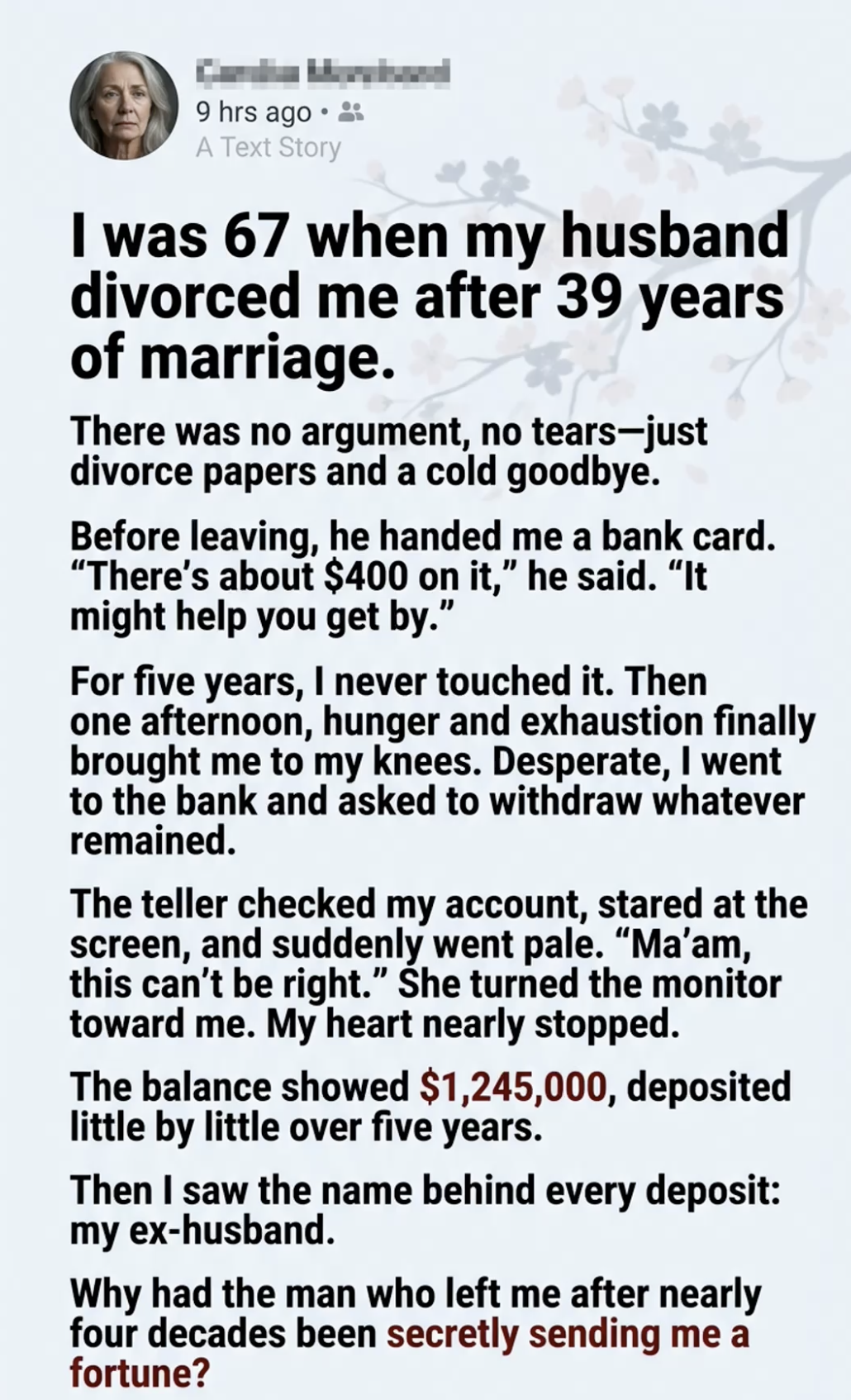
My name is Margaret Ellis, and I was sixty-seven years old when my husband, Robert, ended our thirty-nine-year marriage with less emotion than most people showed when canceling a dinner reservation.
There was no shouting. No argument. No dramatic confession about another woman. He didn’t even look angry.
He simply placed a folder of divorce papers on our kitchen table, sat across from me, and said, “I think it’s time we stopped pretending this marriage is working.”
I stared at him, waiting for him to explain what he meant.
We had been married for thirty-nine years. We had raised a daughter, paid off a mortgage, buried parents, celebrated birthdays, survived financial troubles, and spent countless evenings sitting across from each other at the same kitchen table.
We had built an entire life together.
And now he was speaking as though we had merely outgrown a shared apartment.
“Robert, what’s happening?” I asked. “Have you met someone else?”
“No.”
“Have I done something?”
“No, Margaret.”
“Then why?”
He looked down at the papers.
“I don’t want to discuss it anymore.”
Those words hurt more than I expected. Not because they answered my questions, but because they made it clear that he had already decided my questions didn’t matter.
I signed the papers three weeks later.
I told myself I was doing it because I wanted to keep my dignity. The truth was that I was exhausted from trying to persuade a man who had shared my bed for nearly four decades to tell me why he no longer wanted me beside him.
The morning Robert left, he carried two suitcases to his car. He had already arranged a place to live, transferred his personal belongings, and taken care of the paperwork.
He seemed prepared for everything except the possibility that I might cry.
I stood beside the front door, watching him put his final suitcase in the trunk.
“Is there anything else you want to say to me?” I asked.
He paused.
For one brief moment, I thought he might turn around and tell me that the divorce was a mistake.
Instead, he reached into his wallet and handed me a bank card.
“There should be about four hundred dollars on it,” he said. “It might help you get by.”
I looked at the card, then at him.
“Four hundred dollars?”
“It’s better than nothing.”
I wanted to ask him whether thirty-nine years together had truly come down to four hundred dollars. I wanted to remind him that I had stood beside him when his business was struggling, when his father was dying, and when he had spent six months recovering from surgery.
But the words stayed trapped in my throat.
Robert opened the car door.
“Take care of yourself, Margaret.”
Then he drove away.
I remained on the porch until his car disappeared around the corner.
That evening, I sat alone in our living room and listened to the clock ticking on the wall. I could hear the refrigerator humming in the kitchen and the occasional car passing outside.
Everything was exactly where it had always been.
Except Robert was gone.
And I had no idea why.
The five years I never touched the card
I moved out of our house two months later.
The house had too many memories, and the mortgage and maintenance were more than I could comfortably afford on my own. After the sale, I rented a small apartment on the edge of town.
It had one bedroom, a narrow kitchen, and a window that looked out over a parking lot. The heating system rattled at night, and the bathroom faucet leaked unless I turned it just right.
But it was mine.
I found part-time work cleaning offices in the mornings. A neighbor paid me to watch her grandson twice a week, and I occasionally helped an elderly woman down the hall with her shopping.
I learned how to stretch a grocery budget until every dollar seemed to have a job.
Meat became an occasional luxury. I stopped buying magazines and new clothes. When my winter coat began to wear thin at the elbows, I sewed patches inside the sleeves rather than replacing it.
I never touched Robert’s bank card.
I kept it in a drawer beside my old wedding ring, although I rarely opened that drawer.
Part of me was angry that he had offered me so little. Another part was too proud to accept anything from him.
I wanted to prove that I could survive without his money.
More than that, I wanted to prove that I could survive without his love.
Our daughter, Emily, tried to help.
She was thirty-five when we divorced and lived about two hours away with her husband and two children. She called every weekend, asking whether I needed anything.
“I’m fine,” I always told her.
“Mom, you don’t have to pretend with me.”
“I’m not pretending. I’m adjusting.”
She never pushed too hard, but I knew she worried.
She also struggled with her father’s decision. Robert had refused to explain the divorce to her, telling her only that it was a personal matter between him and me.
Emily had been close to both of us, and she hated being caught in the middle.
For a while, she tried to persuade us to talk.
“Dad says he wants you to be happy,” she told me once.
I nearly laughed.
“Then he should have had the courtesy to tell me why he was leaving.”
“He won’t talk about it.”
“Neither will I, Emily. Not anymore.”
Eventually, she stopped asking.
Life settled into a routine that was quiet, lonely, and increasingly difficult.
By the time I turned seventy-two, my savings were nearly gone. My rent had increased twice, and my part-time cleaning work had become harder on my knees and back.
I began skipping meals when money ran short.
At first, I told myself I wasn’t hungry. Later, I started drinking tea to quiet the ache in my stomach.
I didn’t tell Emily how bad things had become. She had children, a mortgage, and responsibilities of her own. I couldn’t bear the thought of becoming another burden in her life.
Then, one cold afternoon in November, I opened my kitchen cupboard and found half a loaf of stale bread, a nearly empty jar of peanut butter, and a tin of soup that had passed its best-before date several months earlier.
I sat down at the table.
My hands were trembling.
I hadn’t eaten a proper meal since the day before, and I felt light-headed whenever I stood up.
For the first time in five years, I thought about the bank card.
I remembered Robert handing it to me with that cold, dismissive expression.
There should be about four hundred dollars on it.
I had never checked.
Perhaps there was still something left. Perhaps the account had been closed. Perhaps the money had been spent through some fee I didn’t understand.
But I needed food, and pride had become an expensive luxury.
I took the card from the drawer, put on my coat, and walked to the bank.
I had no idea that the next twenty minutes would change everything.
“Ma’am, this can’t be right.”
The bank was warm, quiet, and nearly empty.
I joined the line behind a young man depositing a check. When my turn came, I approached a teller with dark hair and a kind smile.
Her name tag read Sophie.
“Good afternoon,” she said. “How can I help you?”
I placed the card on the counter.
“I’d like to withdraw whatever money is left in this account.”
She asked for my identification and entered the account information into her computer.
For a few seconds, she continued typing.
Then she stopped.
She leaned closer to the screen, clicked something, and stared at the numbers.
Her smile disappeared.
“Is there a problem?” I asked.
She didn’t answer immediately.
Instead, she looked at my identification, then back at the monitor.
“Ma’am, could you please wait a moment?”
My stomach tightened.
“Has the account been closed?”
“No. That’s not it.”
She called her supervisor over and quietly explained something. The supervisor examined the screen, asked Sophie to open the transaction history, and read through several lines.
Then she looked at me.
“Mrs. Ellis, would you mind coming to the customer service desk? We need to verify a few details before we discuss the account.”
I followed her, my heart pounding.
I had begun to fear that Robert had somehow left me with a debt rather than money. Perhaps the account had been overdrawn. Perhaps there was a legal problem.
The supervisor invited me to sit.
“I’m sorry for the confusion,” she said. “We just want to make sure we understand the account correctly.”
She turned the monitor toward me.
I stared at the screen.
The balance was so large that I thought I was reading it incorrectly.
$1,245,000.00
I blinked.
Then I leaned closer.
One million, two hundred and forty-five thousand dollars.
“No,” I whispered. “That’s impossible.”
The supervisor spoke gently.
“The account balance is correct, subject to the bank’s normal verification procedures.”
“But I was told there was only about four hundred dollars in this account.”
“When the card was issued, that may have been the original balance. The transaction history shows repeated deposits over the past five years.”
I gripped the edge of the desk.
“Who made them?”
The supervisor opened the account records.
“Most of the deposits came from an account registered to a Robert Ellis.”
My husband.
My ex-husband.
I felt as though the room had tilted beneath me.
“Robert?” I repeated.
“Yes, ma’am.”
She printed a summary of the deposits and handed it to me.
The first transfer had arrived three days after our divorce was finalized.
It was for $2,500.
The following month, another $2,500 appeared.
Then came deposits of $5,000, $7,500, $12,000, and amounts that grew larger as the years passed.
There were payments around Christmas. Deposits near my birthday. Transfers that arrived on the same date each month.
Some were small enough to look like ordinary support payments.
Others were so large that I struggled to understand why he had never mentioned them.
The final page showed a transfer of $75,000 just four months earlier.
I covered my mouth with my hand.
For five years, I had believed Robert had walked away from our marriage and left me to fend for myself.
For five years, I had worried about grocery bills, heating costs, and whether I could afford to replace my broken glasses.
And all that time, he had been sending me money.
Not hundreds of dollars.
Not a few thousand.
A fortune.
“Why?” I whispered.
The supervisor shook her head.
“I can’t tell you why he made the deposits. We can confirm the source of the transfers, but we don’t know his personal intentions.”
I looked down at the printed statements.
There was one detail I couldn’t stop staring at.
Every deposit carried the same description:
M. ELLIS — FUTURE SECURITY.
Robert had written that himself.
I folded the statements carefully and placed them inside my handbag.
“Can I withdraw some money today?”
“Of course. We can help you access the funds once we’ve completed the necessary checks.”
I withdrew enough to cover my immediate expenses and left the bank with the statements pressed against my chest.
Outside, the wind cut through my coat.
I barely noticed.
All I could think about was the man who had left me standing on our porch with a bank card and four hundred dollars.
Why had he secretly given me a fortune?
Why had he allowed me to believe I had been abandoned?
And why had he never called?
The name I couldn’t escape
That night, I spread the bank statements across my kitchen table.
I made a list of every deposit, adding the amounts with a calculator. The total matched the bank’s balance.
There had been no mistake.
The money was real.
I studied the dates and tried to find a pattern.
The deposits had begun almost immediately after our divorce. At first, they were regular and modest. During the second year, they became larger. In the third and fourth years, they increased again.
It looked less like a random act of generosity and more like a plan.
But what kind of plan required a man to send his ex-wife more than a million dollars without speaking to her?
I opened the drawer where I kept our old photographs.
There was one from our twenty-fifth wedding anniversary. Robert stood beside me near a lake, his arm around my waist. I was laughing, and he was looking at me rather than the camera.
I remembered that day clearly.
We had taken the afternoon off work, packed sandwiches, and driven to the lake where we had spent part of our honeymoon. Robert had brought a thermos of coffee and a small box containing a silver necklace.
He had told me that after twenty-five years, he would still choose me.
I had believed him.
I had believed him when he said he would love me when we were old, when our hair turned gray, and when our children had families of their own.
Then, at sixty-seven, I watched him leave.
I put the photograph down.
A terrible thought crossed my mind.
What if he had been having an affair?
What if he had wanted a new life and was paying me off to make sure I wouldn’t challenge him?
But the bank records didn’t look like a man trying to settle a debt and forget it. The payments had continued for five years, and the amounts had increased.
There was something else.
Something he hadn’t told me.
The next morning, I called Emily.
“Mom? It’s early. Are you all right?”
“I need you to listen to something without interrupting.”
She grew quiet.
I told her what I had discovered.
When I finished, she didn’t speak for so long that I thought the call had dropped.
“Emily?”
“I’m here.”
“Did you know about this?”
“No,” she said quickly. “I swear I didn’t know about the amount.”
“But did your father tell you he was sending me money?”
She hesitated.
“He told me he was making arrangements to help you financially. That was before the divorce was final. He asked me not to tell you because he said it would only make things more difficult.”
I felt anger rise in my chest.
“He told you not to tell me?”
“He said you needed a clean break.”
“A clean break?” I repeated. “I was eating soup out of a tin that had expired months ago.”
“Mom, I didn’t know you were struggling.”
“I didn’t want you to worry.”
She began to cry.
“I should have asked more questions.”
“No, sweetheart. This isn’t your fault.”
I took a breath.
“Did he tell you why he wanted the divorce?”
“No. He said he couldn’t explain it.”
“Did he ever mention another woman?”
“No. I asked him that myself. He said there was nobody else.”
I stared at the statements on my table.
“Do you know where he lives?”
“Yes. He moved to a small town outside Cedar Falls. I have his address.”
“Can you send it to me?”
“Are you going to see him?”
“I don’t know what I’m going to do,” I admitted. “But I need to hear the truth from him.”
Emily was quiet for a moment.
“Mom, there’s something else.”
My heart began to race.
“What?”
“About a year before the divorce, Dad started acting strangely. He would forget appointments and repeat things he’d already told me. Once, he called me by his sister’s name. When I corrected him, he got so upset that he told me not to mention it again.”
I closed my eyes.
I remembered those moments, too.
Robert forgetting where he had parked the car.
Robert standing in the kitchen with a cup of coffee, asking whether he had already taken his morning medication.
Robert becoming frustrated when he couldn’t remember the name of a restaurant we had visited dozens of times.
I had thought he was stressed.
He had insisted that he was simply tired.
“Why didn’t you tell me?” I asked.
“I thought you knew. You were married to him.”
“I thought he was just getting older.”
We both fell silent.
Before we ended the call, Emily sent me his address.
I stared at it for a long time.
Then I bought a bus ticket.
The house with the blue shutters
Robert’s new home was nearly three hundred miles away.
I left early on a Monday morning, carrying a small suitcase and the bank statements in my handbag. During the journey, I rehearsed everything I wanted to say.
I would ask why he had divorced me.
I would ask why he had lied about the money.
I would ask whether he had been ill, whether he had another woman, and whether he had ever understood what his silence had done to me.
Most of all, I would ask why he had decided that I was better off without him.
The bus arrived shortly after noon.
I took a taxi to a quiet street lined with small houses and bare trees. Robert’s house stood near the end of the road. It had faded blue shutters, a narrow porch, and a garden that appeared to have been neglected for some time.
I paid the driver and stood outside the gate.
For five years, I had imagined seeing Robert again.
Sometimes I pictured myself shouting at him. Sometimes I imagined turning away without saying a word. Occasionally, in my loneliest moments, I imagined him opening the door, taking me into his arms, and telling me that the divorce had been a terrible mistake.
The reality was much quieter.
Through the front window, I saw a man moving slowly across the living room.
His hair had turned almost completely white. His shoulders were rounded, and he used the back of a chair to steady himself as he walked.
I barely recognized him.
I opened the gate and approached the door.
Then I knocked.
The footsteps inside stopped.
After several seconds, the door opened.
Robert stood before me.
His face went pale.
“Margaret?”
I held his gaze.
“Hello, Robert.”
He looked as though he had seen a ghost.
“What are you doing here?”
“I went to the bank.”
He gripped the doorframe.
For a moment, neither of us spoke.
Then he stepped back and opened the door wider.
“Come inside.”
“No,” I said.
He stopped.
“I didn’t come all this way to exchange polite greetings. I want answers.”
His eyes dropped to the handbag on my shoulder.
“You found the money.”
“I found $1,245,000.”
He closed his eyes.
“I see.”
“You see?” My voice rose. “That’s all you have to say?”
“No.”
“Then explain it to me.”
He looked older than I had ever seen him. His hands trembled slightly, and there were deep lines around his mouth that I didn’t remember.
But I wasn’t ready to feel sorry for him.
“You left me with a bank card and told me there was four hundred dollars on it,” I said. “You let me believe you didn’t care whether I survived. You never called me, never asked how I was doing, and never explained why you wanted a divorce.”
My voice broke.
“Do you have any idea what those five years were like for me?”
Robert lowered his head.
“Yes,” he whispered. “Or at least, I think I do now.”
“You don’t get to decide what I can bear anymore. You did that once already.”
“I know.”
“Then tell me the truth.”
He stepped aside.
This time, I walked in.
The secret he had hidden from everyone
Robert’s living room was clean but sparse. There were a few books on the shelves, a small television, and a medication organizer on the coffee table.
A stack of appointment cards lay beside a notebook.
I noticed the notebook immediately because Robert had always hated writing things down. He used to remember telephone numbers, birthdays, and every detail of a business meeting without taking notes.
Now, several pages were filled with careful handwriting.
I sat on the sofa.
Robert lowered himself into a chair across from me.
“Before I tell you anything else,” he said, “I need you to know that I never stopped loving you.”
I looked away.
“Don’t begin with that.”
He swallowed.
“All right.”
He folded his hands, then unfolded them again.
“About six years ago, I started having trouble remembering things. At first, it was small. I misplaced my keys. I forgot appointments. I repeated stories without realizing I’d already told them.”
I remembered those things.
He continued.
“Then I made mistakes at work. I forgot details that I had handled a hundred times before. One day, I couldn’t remember the route home from a place I’d visited for years.”
He rubbed his forehead.
“I was frightened, Margaret. I went to a doctor, and the tests showed that something wasn’t right. They wanted more evaluations. They told me I would need regular monitoring.”
“Were you diagnosed with something?”
“Eventually, I was told I had a progressive condition affecting my memory and thinking. The doctors explained that it could change over time, but they couldn’t tell me exactly how quickly.”
I stared at him.
“Why didn’t you tell me?”
He took a shaky breath.
“Because I was ashamed.”
“Of being ill?”
“Of losing control. Of needing help. Of becoming someone you had to look after.”
I felt a sudden, sharp ache in my chest.
“Robert, we were married for thirty-nine years.”
“I know.”
“I looked after you when you had surgery. I stayed awake when you had pneumonia. I worked extra hours when your business was struggling. You think I would have walked away because you were ill?”
“No.”
“Then why?”
He looked at me, and I saw tears gathering in his eyes.
“Because I watched what happened to my mother when my father became ill. She spent years caring for him. She stopped seeing friends. She stopped doing the things she loved. Everything in her life became about keeping him safe.”
He paused.
“When I started forgetting things, I became convinced the same thing would happen to you. I imagined you spending your seventies caring for me, worrying about whether I had taken my medication, wondering whether I could be left alone.”
“You imagined all of that without asking me what I wanted.”
“Yes.”
“You decided that my future would be miserable.”
“Yes.”
“And you decided that leaving me would be kinder than telling me the truth.”
His face crumpled.
“Yes.”
For several seconds, I couldn’t speak.
I had imagined dozens of explanations for the divorce. I had wondered whether Robert had become bored with me, whether he had found someone younger, or whether he had decided that the life we shared was no longer exciting enough.
I had never imagined that he had left because he was afraid of becoming a burden.
It was an explanation.
But it wasn’t an excuse.
“You should have trusted me,” I said.
“I should have.”
“You should have let me decide whether I wanted to stay.”
“I know.”
“You took thirty-nine years of marriage and treated me as though I were a stranger who couldn’t be trusted with the truth.”
He bowed his head.
“I thought I was protecting you.”
“You weren’t protecting me, Robert. You were protecting yourself from having to watch me choose you.”
He looked up sharply.
I continued, my voice trembling.
“If I had chosen to leave because I couldn’t handle your illness, that would have been my decision. If I had chosen to stay, that would have been my decision, too. But you never gave me the chance.”
He covered his face with his hands.
“I know that now.”
I watched him cry.
For years, I had imagined that if Robert ever showed remorse, I would feel satisfied. I thought an apology would somehow restore the dignity I had lost when he walked away.
Instead, I felt grief.
Grief for the woman I had been at sixty-seven, standing in the doorway while her husband drove away.
Grief for the years I had spent wondering what was wrong with me.
Grief for the conversations we could have had if he had trusted me enough to speak.
And grief for the future we might have built together if fear had not made our decisions for us.
Why he sent me $1,245,000
After a while, Robert reached for the notebook on the coffee table.
“I knew I couldn’t ask you to stay,” he said. “Not after what I’d done. But I also knew I couldn’t leave you without financial security.”
I looked at him.
“Then why tell me there was only four hundred dollars on the card?”
“That was the original balance. I had arranged for the other transfers to begin after the divorce.”
“Why not tell me?”
“Because I thought if you knew I was sending money, you would feel obligated to speak to me. I didn’t want you to feel that you owed me anything.”
I let out a bitter laugh.
“You thought silence was generous?”
“No. I thought it was the only thing I could still give you without asking anything in return.”
“You could have given me the truth.”
He nodded.
“Yes. I should have.”
Robert explained that he had spent years saving and investing. After the divorce, he sold some investments and arranged a series of transfers into the account he had given me. The amounts increased as he reorganized his finances and moved more of his savings into the account.
He had consulted a financial professional to help structure the transfers, and he had kept records of every payment.
He showed me the notebook.
Inside were dates, amounts, and brief notes.
December — make sure Margaret has enough for winter.
March — transfer additional savings.
July — increase monthly deposit.
The words made my throat tighten.
On one page, he had written:
She should never have to choose between food and medicine.
I closed the notebook.
“Did you ever think that I might have needed more than money?”
He looked at me for a long time.
“Yes.”
“Did you ever think I might have needed my husband?”
His eyes filled again.
“Every day.”
“Then why didn’t you call?”
“Because every time I picked up the telephone, I imagined having to explain what I had done. I imagined you asking me to come home, and I didn’t know whether I could bear to tell you that I couldn’t give you the life you deserved.”
“You didn’t know that. You never gave us a chance to find out.”
“I know.”
He took a breath.
“There was another reason I kept putting it off. My condition was changing. Some days I could think clearly, and other days I struggled to remember what I had planned to say. I became afraid that if I called you, I might confuse you or frighten you. So I told myself I would call when I was feeling better.”
“And then?”
“And then another month passed. Then another year. Eventually, I had allowed so much time to pass that I didn’t know how to begin.”
I stared at the bank statements in my lap.
He had been sending me money instead of sending me a message.
He had paid for my security while denying me the dignity of knowing why.
“Robert,” I said quietly, “I was hungry.”
He looked up.
“There were days when I skipped meals. I was too embarrassed to tell Emily how badly I was struggling. I wore the same shoes until the soles began to split. I worried about the heating bill every winter.”
His face drained of color.
“I didn’t know.”
“You didn’t ask.”
“I thought the transfers would be enough.”
“They weren’t. Not because the money wasn’t enough. Because you left me alone with questions you could have answered.”
He lowered his head.
“I am so sorry.”
I had waited five years to hear those words.
But an apology could not restore the birthdays he had missed, the holidays we had spent apart, or the years in which I might have helped him face his illness.
I looked at the man across from me.
“I don’t know whether I can forgive you,” I said.
He nodded slowly.
“You don’t have to.”
“And I won’t promise to come back into your life in the way you might want.”
“I understand.”
“I need you to stop deciding what is best for me.”
“I will.”
I watched him carefully.
“Do you mean that?”
“Yes, Margaret. I do.”
For the first time since I had arrived, he wasn’t trying to persuade me that his choices had been right.
He was simply admitting that they had been his choices—and that I had paid the price.
The letter he never intended me to read
Before I left, Robert asked me to wait.
“There is something else I want you to see.”
He walked slowly to a small desk in the corner of the living room. He opened a drawer and removed a sealed envelope.
My name was written on the front.
The handwriting was his, though the letters were less steady than I remembered.
“I wrote this before the divorce,” he said. “I never sent it.”
I took the envelope.
“Why?”
“Because I couldn’t decide whether giving it to you would make things harder.”
I looked at him.
“You really did make every decision for both of us, didn’t you?”
He gave a sad, almost embarrassed smile.
“Yes. I suppose I did.”
I opened the envelope.
Inside was a letter dated six weeks before he had handed me the divorce papers.
My dearest Margaret,
I have spent thirty-nine years believing that loving you meant being strong enough to protect you from everything. Now I am frightened because there are things I cannot protect either of us from.
I am forgetting things. I am afraid of what that means. I am afraid of becoming a man who cannot remember the places we have been or the stories we have told each other.
Most of all, I am afraid that one day you will look at me and see only a responsibility.
You have given me more than I ever deserved. I don’t know how to ask you to stay beside me when I cannot promise that I will remain the man you married.
I know you would tell me that we should face this together. I can almost hear you saying it. But I am so afraid that I cannot bear to hear the words aloud.
If I leave, I will make sure you are financially secure. It is not what you deserve, but it is the only thing I know how to arrange without asking you to sacrifice more of your life.
I wish I were brave enough to let you choose.
I love you.
Robert
By the time I finished reading, tears were running down my face.
I held the letter in both hands.
“You knew,” I whispered. “You knew I would have wanted to stay.”
He nodded.
“I did.”
“And you left anyway.”
“Yes.”
I folded the letter carefully.
For a moment, I wanted to tear it into pieces. I wanted to tell him that his fear had been selfish, that his idea of protection had been cruel, and that no amount of money could make up for what he had done.
But I couldn’t bring myself to destroy it.
The letter showed me something I had not understood before: Robert had been frightened long before he walked out the door. He had been fighting a private battle while I believed we were simply growing distant.
That knowledge didn’t excuse his silence.
But it changed the shape of my anger.
I stood.
“I need to go home.”
Robert rose slowly from his chair.
“Will I see you again?”
I looked at him.
“I don’t know.”
He nodded.
“That’s fair.”
I walked to the door.
Just before I stepped outside, he said my name.
“Margaret?”
I turned.
“I am sorry I didn’t let you choose.”
For the first time that day, I believed he understood what he had taken from me.
I didn’t embrace him. I didn’t promise to return.
I simply nodded and walked out into the cold afternoon.
Learning to live with the truth
When I returned home, I felt as though I had spent the day walking through a life I had never known existed.
I placed Robert’s letter in the drawer beside my wedding photograph.
Then I made myself a cup of tea and sat by the window.
I had the money. I had the explanation. I had finally heard the apology I had wanted for five years.
But I was not suddenly happy.
The truth had brought relief, but it had also brought grief. I now understood why Robert had left, yet I could not stop thinking about how differently things might have gone if he had trusted me.
Perhaps we would have remained married.
Perhaps we would have learned to manage his illness together.
Perhaps there would have been difficult days, painful conversations, and decisions neither of us wanted to make.
But those would have been our days, our conversations, and our decisions.
He had denied us the chance to face them together.
The next morning, I called a financial adviser and arranged a meeting. I also contacted an attorney to review the account and make sure I understood my rights and any obligations associated with the money.
I was determined not to make decisions out of panic or gratitude.
The money was in my name, and the bank had confirmed that the deposits were properly recorded. After reviewing the account, the professionals helped me organize my finances and plan for the years ahead.
I paid off the debts that had kept me awake at night. I moved into a comfortable apartment with a little garden and enough room for Emily and the children to stay overnight. I replaced my worn-out shoes and bought a proper winter coat.
Then I did something I hadn’t done in years.
I bought myself a new set of paints.
When I was young, I had loved painting landscapes. After Emily was born, life became busy, and my paints were packed away in a cupboard. There was always something more important to do: work, bills, meals, housework, family obligations.
I had told myself I would return to painting when I had more time.
But the time never came.
Now, with no one else deciding how I should spend my days, I enrolled in a weekly art class at the community center.
The first morning, I was nervous. Most of the other students were younger than I was, and I worried that I would be hopelessly out of practice.
Then an elderly woman sitting beside me leaned over and said, “Don’t worry. Nobody here knows what they’re doing.”
I laughed so hard that I nearly dropped my brush.
For the first time in a long while, I felt like myself again.
I painted gardens, old houses, and the trees outside my apartment. I made mistakes, learned new techniques, and discovered that I could spend an entire afternoon doing something simply because it brought me joy.
The money gave me security.
The freedom gave me something more.
It gave me back the chance to decide who I wanted to be.
The conversation with our daughter
A few weeks after I returned from visiting Robert, Emily came to see me.
She arrived carrying groceries, although I had told her not to bring anything.
We sat at the kitchen table, and I showed her the letter.
She read it slowly, then covered her mouth.
“He was really that frightened,” she whispered.
“Yes.”
“Why couldn’t he tell us?”
“I think he believed telling us would make everything real.”
Emily wiped her eyes.
“I remember him forgetting things when I was a child. He always made jokes about it. He’d walk into the kitchen and ask what he’d come for, then laugh and say he was losing his mind.”
She shook her head.
“I never thought he was scared.”
“Neither did I. Not until it was too late.”
Emily reached across the table and took my hand.
“Mom, I’m sorry I didn’t realize how hard things were for you.”
I squeezed her fingers.
“You were trying to build your own life. I didn’t want you worrying about me.”
“You shouldn’t have had to manage everything alone.”
“No,” I said. “I shouldn’t have.”
We sat quietly for a while.
Then Emily asked the question I had been asking myself.
“Do you think you’ll ever forgive him?”
I looked out the window.
A small bird was hopping along the garden wall, searching for crumbs.
“I don’t know,” I said honestly. “I can understand why he was afraid. I can feel sorry for what he’s going through. But understanding doesn’t erase what he did.”
She nodded.
“I still love him,” she admitted. “He’s my father. But I’m angry with him, too.”
“That’s allowed.”
She smiled sadly.
“I suppose we’re both learning that.”
Before she left, Emily asked whether she could visit her father more regularly. She wanted to help him arrange practical support and make sure he had people checking on him.
I told her I thought that was a good idea, but I also reminded her that she wasn’t responsible for fixing his life.
“He made choices, sweetheart,” I said. “You can love him without carrying every consequence for him.”
She hugged me.
“I think I’m learning that from you.”
After she left, I sat for a long time thinking about the family we had become.
We were no longer the family that gathered around the same table every Sunday. We could not return to the days when Robert and I shared a home and believed our future would unfold exactly as we had imagined.
But we could still choose honesty.
We could still care for one another without pretending that the past had never happened.
And perhaps that was enough to begin with.
The final visit
Nearly a year after I discovered the money, Robert called me.
His voice was slower than I remembered, but he sounded calm.
“Margaret, I was wondering whether you might have lunch with me sometime.”
I looked at the calendar on my wall.
For a moment, I considered saying no.
I had built a life that no longer depended on his presence. I was comfortable in my apartment, enjoying my painting class, and spending more time with friends. I no longer woke in the middle of the night wondering why he had left.
But I also knew that I didn’t want the rest of my life to be defined by anger.
“All right,” I said. “We can have lunch.”
We met at a small restaurant near the park, halfway between our towns.
Robert arrived with a cane and moved slowly toward the table. He looked frailer than he had during my first visit, but his expression brightened when he saw me.
“You look well,” he said.
“I feel better.”
He nodded.
“I’m glad.”
We talked about Emily and the grandchildren. He asked about my painting class, and I showed him a photograph of a landscape I had finished the previous week.
He studied it carefully.
“You always had an eye for colors,” he said.
I smiled.
“You used to tell me that my paintings looked like muddy puddles.”
He laughed.
“I was wrong.”
“Yes, you were.”
For a moment, the years seemed to fall away. I could almost hear the familiar rhythm of our old conversations, the gentle teasing that had once made ordinary evenings feel special.
Then the silence returned, and we both remembered where we were.
Robert reached into his coat pocket and took out a small envelope.
“I brought something for you.”
Inside was a photograph of us on our wedding day.
We were young. His tie was crooked, and my veil had slipped to one side. I was laughing at something outside the frame, and Robert was looking at me as though I were the only person in the room.
On the back, he had written a sentence.
Thirty-nine years was the greatest gift of my life. I am sorry I let fear decide how they would end.
I read it twice.
“Thank you,” I said quietly.
He looked at me.
“I don’t expect you to come back. I don’t expect you to forgive me just because I’ve apologized. I only wanted you to know that I understand now.”
“Understand what?”
“That I took away your choice. I thought I was saving you from suffering, but I made you suffer in a different way.”
I folded the photograph back into the envelope.
“Yes,” I said. “You did.”
He nodded.
“I wish I could change it.”
“So do I.”
We finished our lunch slowly. Before we left, Robert asked whether I would be willing to speak with him occasionally.
“I can do that,” I said. “But I need us to be honest. If something changes with your health, I don’t want you hiding it from everyone. And I won’t promise to become your caregiver. You need the right support, and I need to keep living my life.”
“I understand.”
“I mean it, Robert.”
“I know.”
We stood outside the restaurant.
He looked at me with the same expression he had worn on the day he left our house: a mixture of love, fear, and regret.
But this time, I wasn’t waiting for him to decide what happened next.
I stepped forward and gave him a brief hug.
It wasn’t a promise to return to our marriage.
It wasn’t an agreement that everything was forgiven.
It was simply a way of acknowledging that the man standing before me had once been my home—and that I could remember the good without denying the hurt.
When I stepped back, he was crying.
“So am I,” I admitted.
Then we said goodbye.
I watched him walk toward his car, slowly and carefully, before turning toward the taxi waiting for me.
I went home alone.
But I no longer felt abandoned.
What the money could never buy
Today, I am seventy-three years old.
I still live in my apartment with the small garden. I paint three or four times a week, and one of my pictures hangs in the community center where I first took classes. Emily visits with the children, and we have begun a new tradition of Sunday lunches.
Robert and I speak from time to time. Some conversations are easy. Others are difficult. His memory and thinking have continued to change, and he has support from people trained to help him manage his condition.
I care about what happens to him.
But I no longer confuse caring with sacrificing every part of myself.
The money he sent has given me a comfortable future. I no longer worry about buying groceries or paying for medicine. I have enough to handle unexpected expenses and enough freedom to enjoy the years ahead.
Still, I sometimes think about the woman I was at sixty-seven.
She stood on the porch, holding a bank card, wondering how a man could share thirty-nine years of his life with someone and then leave without offering a single honest explanation.
She believed that if she could understand what she had done wrong, perhaps the pain would make sense.
She didn’t know that she hadn’t done anything wrong.
She didn’t know that her husband was frightened, that he had made a terrible decision, or that he would spend the next five years trying to provide for her from a distance.
And she didn’t know that the card she placed in a drawer would one day lead her to the truth.
If I could speak to that woman now, I would tell her something I wish I had understood sooner.
You can love someone deeply and still be hurt by their choices.
You can understand someone’s fear without accepting the harm it causes.
You can forgive a person without returning to the life you shared.
And you can begin again at seventy-two, seventy-three, or any age when the future still belongs to you.
Robert believed that money would protect me from the hardship of losing him. He thought he could arrange my security quietly, then disappear before I had to watch his health change.
He was wrong about what I needed.
I needed the truth. I needed the chance to choose. I needed to know that the life we had built together mattered enough for him to trust me with the difficult parts.
The $1,245,000 changed my financial future.
But the real turning point came when I finally understood that his decision to leave was not a measure of my worth.
For five years, I believed my husband had abandoned me because I was no longer worth staying for.
The truth was that he had been afraid of what staying might require.
That fear was real. So was the love he had felt for me. But neither could undo the damage caused by his silence.
I cannot recover the years we lost. I cannot return to the morning he drove away and ask him to tell me the truth.
What I can do is live the years I have left without allowing that unanswered goodbye to define me.
I keep the bank card in a small box beside our wedding photograph. Sometimes I take it out and remember the day I discovered the money. I remember the teller’s pale face, the impossible balance on the screen, and the name behind every deposit.
Robert Ellis.
The man who had left me with almost nothing had spent five years trying to make sure I would never be without money.
It was a strange, imperfect act of love.
But love, I learned, is not only about what someone gives you. It is also about whether they trust you enough to let you choose what to do with it.
And if there is one thing I know now, it is this:
I can be grateful for what Robert gave me without pretending that what he took from me didn’t matter.
He gave me financial security.
I gave myself back my life.