Nine years ago, my husband walked out of our home with a suitcase in one hand and a promise he never intended to keep.
“I need some time to figure out my life,” Michael told me.
Our daughters, Emily and Sophie, were only four and six years old. Emily stood beside the staircase clutching her favorite stuffed rabbit, while Sophie sat on the living room rug, coloring a picture she had made for her father.
Neither girl understood why he was leaving.
I did.
At least, I thought I did.
Michael had spent months complaining about his responsibilities. He resented the mortgage, the grocery bills, the school expenses, and the fact that having children meant he could no longer live as though he were a single man.
He wanted freedom.
And when he finally walked out, he took it.
What he left behind was a wife who had no idea how she would pay the next month’s bills and two little girls who kept asking when Daddy would come home.
“He’ll call soon,” I told them the first night.
I said it because I didn’t know what else to say.
Michael didn’t call the next day.
Or the next week.
Eventually, his occasional messages became excuses. He was looking for work. He was staying with a friend. He needed to get himself settled. He would send money when he could.
But the money never came.
Not for school uniforms.
Not for doctor’s appointments.
Not for birthdays or Christmas.
Not even when Emily developed a serious ear infection and I had to borrow money from my older sister to cover the medical bills.
I tried contacting him about child support. Sometimes he ignored my messages. Other times he accused me of being unreasonable.
“You have a job,” he once texted. “You can manage.”
I stared at those words for a long time.
I had a job, yes. I worked as an administrative coordinator at a small insurance company. My salary covered our rent, utilities, food, transportation, and the endless expenses that came with raising two children.
But managing was not the same as thriving.
I learned to stretch every dollar. I bought groceries according to what was on sale. I repaired the girls’ clothes instead of replacing them. I skipped meals occasionally so they could have seconds.
I worked overtime whenever it was available, then came home to help with homework, prepare dinner, and tuck my daughters into bed.
When they were sick, I stayed awake beside them.
When they were frightened, I held them.
When they needed someone to attend school events, I rearranged my schedule.
I was the person who showed up.
Michael was the person who disappeared.
For the first few years, I kept hoping he would change. I thought perhaps seeing his daughters grow up would awaken something in him. Maybe one day he would realize what he had lost.
But the girls gradually stopped asking when he was coming home.
They stopped setting aside drawings for him.
They stopped expecting birthday cards.
And eventually, I stopped making excuses for him.
I never told them their father was a monster. I wanted them to form their own understanding of the world. I simply answered their questions honestly, in ways their young hearts could handle.
When Sophie asked why other children’s fathers attended school concerts, I told her that every family was different.
When Emily asked whether her father had forgotten her birthday, I hugged her and said, “His choices are not a reflection of how lovable you are.”
I repeated that sentence so often that it eventually became something I needed to hear myself.
Because the truth was that Michael’s departure had wounded me, too.
Not because I wanted him back, but because I had once believed that marriage meant facing life’s difficulties together.
He had abandoned that promise.
I had to learn how to keep mine alone.
Over the years, I rebuilt our lives piece by piece.
I found a smaller apartment closer to the girls’ school. I worked toward a promotion. I started saving a little money each month, even when it meant postponing things I wanted.
My father, Robert, helped whenever he could.
He never made me feel ashamed of needing assistance. Sometimes he brought groceries. Sometimes he picked the girls up from school. When my car broke down, he helped me pay for the repairs.
But his greatest gift was not money.
It was consistency.
He came to Emily’s school performances, even when he had to sit in the back because he arrived late from work. He taught Sophie how to ride a bicycle and patiently ran beside her until she stopped wobbling.
He showed the girls how to plant tomatoes in his backyard, how to change a flat tire, and how to recognize people who kept their promises.
One evening, when Emily was twelve, she asked him why he always made time for us.
Dad smiled.
“Because loving people isn’t just about saying the words, sweetheart. It’s about showing up when they need you.”
I watched him from the kitchen window, my throat tightening.
My daughters had lost a father who chose to leave.
But they had a grandfather who chose to stay.
I will always be grateful for that.
Then, last year, Dad became ill.
At first, he dismissed his symptoms as ordinary exhaustion. He was stubborn about doctors and insisted he still had plenty of time to finish the projects he had started around his house.
But eventually, the appointments became more frequent, and the conversations grew more serious.
I drove him to medical appointments whenever I could. The girls visited him after school and brought him drawings. He tried to remain cheerful, but I could see how tired he was becoming.
One afternoon, while I sat beside his hospital bed, he took my hand.
“I worry about you,” he said.
I shook my head.
“Dad, you don’t need to worry about me.”
He gave me a look that told me he knew I was lying.
“You’ve carried so much for so long.”
I squeezed his hand.
“We’re okay. The girls are doing well. You helped me get us here.”
He looked toward the window.
“I wish I could have done more.”
“You did more than enough.”
He was quiet for a moment.
Then he said, “Promise me you’ll keep protecting yourself. You have a good heart, Claire. Don’t let people convince you that having a good heart means letting them take advantage of you.”
I didn’t know then how important those words would become.
Dad passed away several weeks later.
The grief was unlike anything I had experienced. Even though I knew he was ill, nothing could prepare me for the silence he left behind.
I missed his phone calls, his dry humor, and the way he always asked whether the girls were eating enough.
At the funeral, Emily held my hand. Sophie leaned against my shoulder.
We cried together.
We told stories about him.
And we promised each other that we would keep his memory alive.
A few weeks later, his attorney contacted me about the estate.
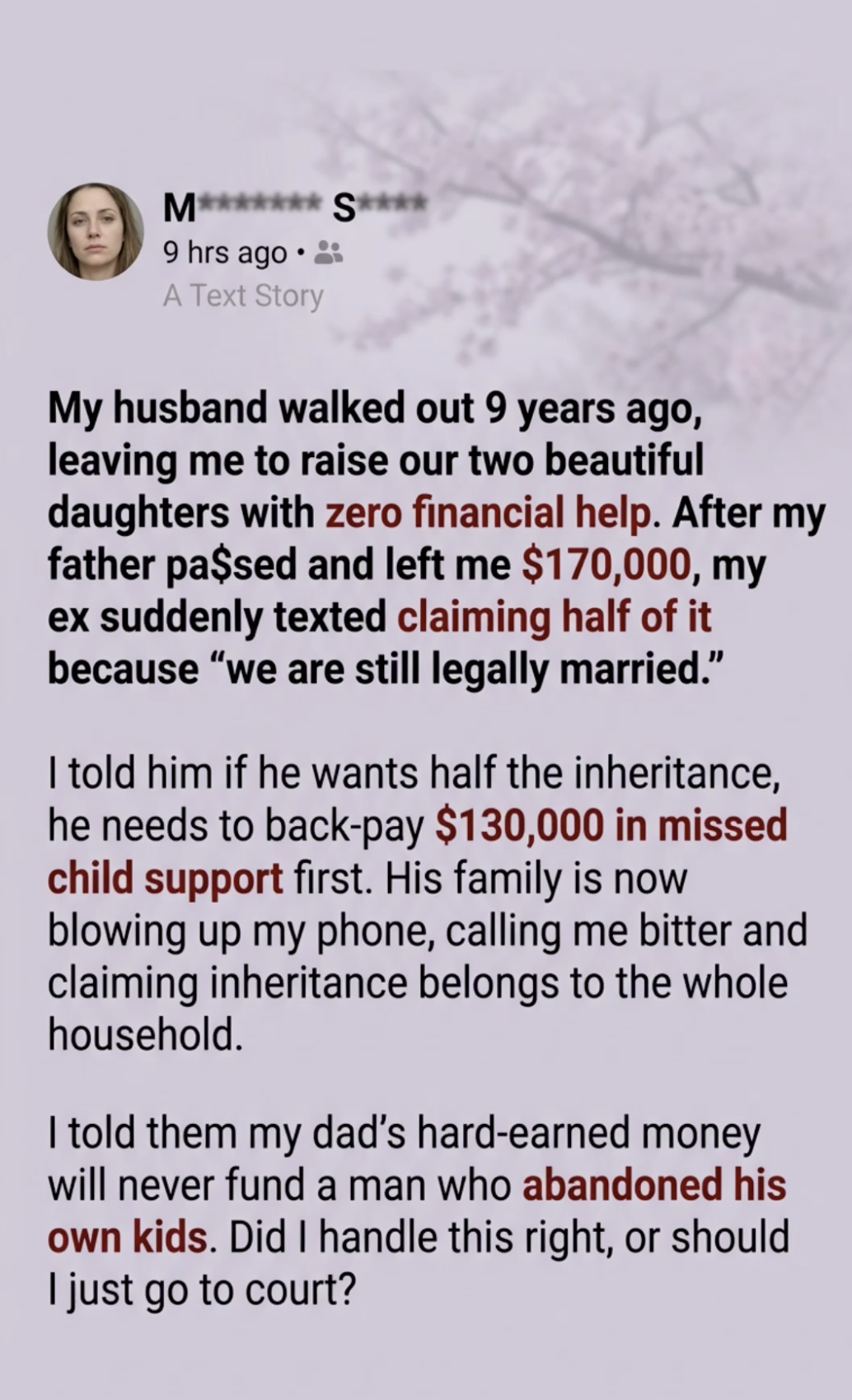
My father had left me $170,000.
It wasn’t a fortune to everyone, but to us, it represented years of security I had never been able to build while raising my daughters alone.
The money came from Dad’s savings, investments, and the proceeds of a property he had sold years earlier. He had lived carefully, worked hard, and saved steadily throughout his life.
He wanted me to have a chance to breathe.
A chance to help the girls with their education.
A chance to buy a modest home someday instead of worrying about rent increases.
A chance to stop living as though one unexpected bill could destroy everything.
When the attorney explained the inheritance, I cried.
Not because I was suddenly wealthy, but because my father had thought about our future even when he knew he would not be here to see it.
I decided to take my time.
I wouldn’t make any large purchases immediately. I wanted professional advice about protecting the inheritance and understanding how it should be handled given my unresolved marriage.
I also knew I needed to address the legal situation with Michael.
We had been separated for nine years, but we had never finalized a divorce.
Life had become so complicated that I had repeatedly postponed it. Between raising the girls, working, and caring for Dad, I had never found the time or money to navigate the process properly.
I regretted that now.
But I had no idea just how urgently I would need legal advice.
Three days after the inheritance paperwork was completed, my phone lit up with a message from Michael.
For the first time in months, he had contacted me.
I heard about your father. Sorry for your loss.
I stared at the screen, surprised that he even knew Dad had died.
Then another message arrived.
I also heard you inherited $170,000.
My stomach tightened.
A third message followed.
Since we’re still legally married, I’m entitled to half. We should discuss how to divide it.
I read the message twice.
Nine years.
Nine years without sending a single regular child-support payment.
Nine years of birthdays he missed, school expenses he ignored, and emergencies he left me to handle.
And now, within days of my father’s funeral, he had appeared to claim a share of the money Dad had worked his entire life to save.
I felt a cold anger settle over me.
I typed a response, deleted it, and started again.
Finally, I wrote:
You abandoned our daughters nine years ago and provided no regular financial support. Before demanding money from my father’s estate, you need to address the child support you never paid. My records show that the unpaid amount may be around $130,000, subject to the court’s determination. If you believe you have a claim to the inheritance, we can let the lawyers and the court determine both issues.
I sent the message.
Michael called immediately.
I let it ring once before answering.
“What the hell is that supposed to mean?” he demanded.
“It means what I wrote.”
“You can’t just decide I owe you $130,000!”
“I didn’t decide that on my own. The amount reflects the support that was never paid over the years. The exact legal amount needs to be established properly.”
“You’re trying to punish me!”
I closed my eyes.
“Michael, you haven’t asked about your daughters in months. You haven’t asked whether they’re healthy, how they’re doing in school, or what they need. You contacted me because you heard about my inheritance.”
“That’s not fair.”
“What would be fair is for you to take responsibility for the children you helped bring into this world.”
He scoffed.
“We’re still married, Claire. That money isn’t just yours.”
“My father left it to me.”
“And I’m your husband!”
I almost laughed at the absurdity.
When he wanted freedom, he had walked away from the responsibilities of marriage and fatherhood. Now that he believed there was money to be claimed, he suddenly remembered the legal relationship he had ignored for nine years.
“Then let’s settle the marriage legally,” I said. “You can make whatever claims you believe you have, and I will present the records of your absence and unpaid support.”
“You wouldn’t dare take me to court.”
“I’m no longer afraid of dealing with this.”
He hung up.
I sat at the kitchen table, my hands trembling slightly.
I wasn’t proud of the anger I felt, but I was no longer willing to swallow it simply to keep him comfortable.
That evening, I told my daughters that their father had contacted me.
They were older now. Emily was fifteen, and Sophie was thirteen. They understood more about the world than I sometimes wanted them to.
Emily looked up from her homework.
“Is he coming back?”
“No,” I said gently. “He’s asking about Grandpa’s inheritance.”
Sophie’s face fell.
“Does he want money?”
I nodded.
Neither girl spoke for a moment.
Then Emily closed her notebook.
“He didn’t want to help when we needed him, but now he wants Grandpa’s money?”
Her words cut deeper than anything Michael had said.
I reached across the table and held her hand.
“I know it feels unfair.”
“It is unfair,” she said.
She was right.
But I also knew that anger alone would not protect us. I needed to make decisions carefully, with the law on our side rather than relying on what felt morally obvious.
The following morning, I contacted a family-law attorney.
I brought every document I could find: old messages from Michael, records of the expenses I had covered, evidence of my attempts to obtain support, and the estate paperwork showing that Dad had left the inheritance to me.
The attorney listened without interrupting.
When I finished, she explained that the situation had two separate legal questions.
First, Michael’s possible claim to the inheritance would depend on the law governing our marriage, the rules concerning inherited property, whether the money had been kept separate, and other facts specific to our circumstances. Being legally married did not automatically settle every question about ownership.
Second, the unpaid child support would need to be established through the appropriate legal process. The amount could depend on existing orders, applicable law, the children’s circumstances, and whether any payments had been made.
“The two issues may be related to the overall divorce,” she told me, “but you should not assume that one automatically cancels out the other. We need to determine your rights before you agree to anything.”
I nodded.
“So I shouldn’t offer him half, and I shouldn’t simply subtract the child support myself?”
“Correct. Don’t transfer any money or sign an agreement until we’ve reviewed the situation. We can pursue the support claim and respond to any inheritance claim through the proper channels.”
For the first time since Michael’s message, I felt some of the pressure lift.
I did not need to settle nine years of neglect in a single text exchange.
I needed to protect my daughters, preserve the evidence, and let the legal process determine what each person was entitled to.
The attorney also recommended that I keep the inheritance in a separate account, retain all estate records, and avoid mixing the money with joint assets while the matter was unresolved.
I followed her advice.
I didn’t spend the inheritance impulsively. I didn’t transfer money to Michael. I didn’t try to hide assets or manipulate the records.
I documented everything.
And then Michael’s family began calling.
His mother was the first.
“Claire, I heard what you’re doing to Michael,” she said without greeting me.
“What exactly do you think I’m doing?”
“Demanding money from him when he is going through a difficult time. Your father left you a substantial inheritance. You should be grateful and share it with the family.”
I stared out the kitchen window.
“Which family are you talking about? Michael hasn’t supported his own daughters for nine years.”
“That was between you and him.”
“No. It was about his responsibility to Emily and Sophie.”
She sighed impatiently.
“Children need more than money. You had a job. You managed.”
“Yes, I managed. That doesn’t erase his responsibility.”
“You’ve always been bitter about the separation.”
I felt the old instinct to defend myself rising inside me.
For years, I had tried to convince Michael’s family that I wasn’t the difficult woman they imagined. I had explained why I needed help, why the girls deserved support, and why I couldn’t keep pretending that their son had done nothing wrong.
It had never changed anything.
So this time, I didn’t argue.
“My father’s money will be handled according to the law,” I said. “If Michael believes he has a legal claim, he can speak to my attorney.”
Then I ended the call.
His sister called next.
She accused me of using the children to punish her brother.
His cousin sent a message saying I should remember that marriage meant sharing everything.
One of his aunts wrote that I was dishonoring my father’s memory by refusing to help a man who had once been my husband.
That message hurt more than I expected.
My father had spent his life helping people. He had taught me to be generous, patient, and fair.
But I knew he had also believed in accountability.
He had watched me struggle after Michael left. He had seen the girls cry when their father failed to appear. He had helped pay bills that should never have been mine alone to carry.
I could almost hear Dad’s voice reminding me that kindness did not require surrendering my judgment.
I didn’t reply to the messages.
Instead, I saved them and forwarded them to my attorney.
A week later, Michael sent another text.
My family says you’re willing to drag everyone through court rather than do the right thing.
I replied:
The right thing is to resolve the legal issues fairly. I will not negotiate through family pressure. Please contact my attorney.
He responded with a string of angry messages.
He said I was vindictive.
He said I had changed.
He said that if I really cared about our daughters, I would stop trying to ruin his life.
That last message made me put my phone down.
I had spent nine years caring about our daughters.
I had cared when they needed shoes for school. I had cared when they were sick. I had cared when they asked why their father didn’t visit.
I had cared when I worked late and returned home exhausted, knowing I still needed to help with homework and prepare lunch for the next day.
Michael had not been the one carrying those responsibilities.
And he would not get to rewrite our history simply because I had finally found the resources to protect our future.
The legal process took time.
My attorney requested the relevant financial records and reviewed the circumstances surrounding the inheritance. We gathered evidence of my father’s intention to leave the money to me, along with documentation concerning my separation from Michael.
We also reviewed the history of child support and any available records showing the expenses I had paid for the girls.
The amount of $130,000 was not treated as a number I could simply declare final. My attorney explained that we would need to establish what was legally owed, what could be recovered, and what procedures applied in our jurisdiction.
I was prepared for that.
I wasn’t asking for a shortcut.
I wanted a fair determination.
During that time, Michael’s family continued to pressure me. They suggested that I should give him a portion of the inheritance simply to make the conflict disappear.
For a moment, I considered it.
Not because I believed he deserved the money, but because I was exhausted.
I wanted to grieve my father without checking my phone every hour. I wanted to help Emily prepare for her exams and take Sophie shopping for a school event. I wanted to plan our future without feeling as though every decision would trigger another accusation.
Then Emily came into my room one evening and sat beside me.
“Mom, are you worried about the money?”
I hesitated.
“A little.”
“Because Dad wants some?”
I nodded.
She looked down at her hands.
“I don’t want you to give him money just because he’s making you feel bad.”
I brushed a strand of hair away from her face.
“I’m trying to do what is fair.”
“I know. But Grandpa saved that money for us, didn’t he?”
I thought about Dad’s final conversations with me, about the way he had worried over our future and urged me to protect myself.
“He left it to me,” I said. “And I want to use it wisely so I can give you and Sophie more stability.”
Emily leaned against my shoulder.
“Then do that. Don’t let him make you feel guilty for taking care of us.”
I held her close.
In that moment, I realized how much my daughters had learned from the past nine years. They had watched me make difficult decisions, and they had seen that love could mean showing up even when life was exhausting.
I wanted them to learn something else, too.
That standing up for yourself did not mean becoming cruel.
It meant knowing the difference between being fair and being pressured.
A few months later, Michael’s attorney formally raised his claim concerning the inheritance. My attorney responded and pursued the child-support matter through the appropriate legal process.
There was no instant victory. No judge immediately handed me a check for the entire amount. The issues required evidence, legal arguments, and careful consideration of the applicable law.
But something important had changed.
Michael could no longer demand money by text and expect me to surrender.
His family could call me bitter, selfish, or vindictive, but their opinions did not determine my legal rights.
And I no longer had to defend every decision to people who had never helped me carry the burden.
The matter was eventually addressed through legal negotiations and the formal divorce process. The final financial outcome depended on the evidence and the applicable law, not on Michael’s assertion that marriage automatically entitled him to half of everything.
The child-support issue was also dealt with through the proper procedures rather than through a private exchange of threats.
I kept following my attorney’s advice, protecting the inheritance, and focusing on my daughters.
When the dust finally began to settle, I used part of the money to establish an emergency fund and set aside savings for Emily’s and Sophie’s education. I also began planning for a modest home where the girls could have their own rooms and a place to return to when they were older.
I didn’t buy an expensive car.
I didn’t take a luxury vacation.
I didn’t use the money to prove anything to Michael or his family.
I used it to build the security my father had wanted me to have.
One afternoon, I visited Dad’s grave with the girls.
We brought flowers and sat together beneath the trees. Sophie told him about a science project she had completed, while Emily talked about her plans for college.
I listened to them, smiling through my tears.
When they finished, I rested my hand on the cool stone.
“I’m trying to do right by them, Dad,” I whispered.
I thought of the years he had helped us, the quiet sacrifices he had made, and the advice he had given me near the end of his life.
Don’t let people convince you that having a good heart means letting them take advantage of you.
I finally understood the full meaning of those words.
I could be compassionate without giving Michael money he might not be entitled to.
I could respect the law without abandoning my daughters’ interests.
I could acknowledge that our marriage had once mattered without pretending that he had fulfilled his responsibilities.
And I could grieve my father without allowing his hard-earned savings to become the price of keeping the peace.
On the drive home, Sophie asked whether we would ever have to worry about money again.
I looked at her in the rearview mirror.
“I can’t promise we’ll never have difficult times,” I said. “But I can promise that we’ll make decisions carefully, and we won’t let anyone pressure us into giving up what we need to be safe.”
Emily smiled from the passenger seat.
“Grandpa would like that.”
I swallowed the lump in my throat.
“I think he would.”
Nine years earlier, Michael had walked away believing that he could leave all the difficult parts of fatherhood behind and start a new life without looking back.
For nine years, I had carried the responsibilities he abandoned.
Now, when he finally saw an opportunity to benefit from my father’s hard work, he remembered that we were still legally married.
But legal marriage was not a magic phrase that erased nine years of choices.
It did not make his absence disappear.
It did not turn my father’s intentions into something he could decide for himself.
And it did not mean I had to settle the matter according to his demands.
I wasn’t interested in revenge.
I wanted a fair outcome, a secure future for my daughters, and the chance to move forward without carrying the same burden forever.
So I chose the court process over family pressure.
I chose documentation over arguments.
And I chose to protect the inheritance my father had left me while allowing the law to determine what belonged to whom.
Because the money was never simply $170,000.
It was the result of my father’s decades of work, careful choices, and love for his family.
It was his final attempt to give us something he knew we needed.
And I intended to honor that gift—not by handing it over to the man who had abandoned his children, and not by making decisions out of anger, but by using it responsibly and standing firm in the face of pressure.
Michael could call me bitter.
His family could call me selfish.
They were free to have their opinions.
But I knew what the past nine years had cost me, and I knew what my father had wanted for his granddaughters.
I had spent too long struggling to keep everyone else comfortable.
This time, I would do what was fair, follow the law, and protect the future I had worked so hard to build.
And I would no longer apologize for that.