For twenty-five years, my wife’s brother had treated me like a man who had stolen something that belonged to him.
His name was Richard, and from the day I married his younger sister, Laura, he seemed convinced that I had taken her away from the family.
He never said it exactly that way when other people were listening. He preferred smaller weapons.
At Thanksgiving, he would ask whether I was still working at the same ordinary job, then laugh as if my answer confirmed something embarrassing.
At Christmas, he would tell stories about men Laura had dated before me, conveniently leaving out the fact that none of those relationships had lasted.
At family birthdays, he would introduce me to new people as “Laura’s husband,” then add, “The one who got lucky.”
I learned to smile.
I learned to change the subject.
And I learned that arguing with Richard only gave him another opportunity to humiliate me.
Laura always noticed. Sometimes she squeezed my hand under the table. Sometimes she told him to stop. But Richard had a way of turning every objection into a joke.
“Relax, little sister. I’m just teasing him.”
Then he’d look at me.
“He’s a good sport, isn’t he?”
For years, I let him believe that I was.
I did it for Laura. She loved her family, and after her mother died, her father, Arthur, and her brother became the two people she felt most responsible for keeping close.
I never wanted her to feel she had to choose between her husband and the family she had grown up with.
So I tolerated Richard’s comments, even when they crossed the line.
I tolerated them when he mocked my modest salary, when he questioned my decisions, and when he suggested that Laura could have married someone more successful.
I tolerated them because I believed that love was sometimes the decision to let an insult pass without allowing it to become a fight.
But there was one evening I would never forget.
Our twenty-fifth wedding anniversary.
Laura had planned a beautiful dinner at a restaurant overlooking the river. We invited our children, several close friends, and the relatives who had remained part of our lives through the years.
The table was decorated with white flowers and small candles. Laura wore a dark blue dress, and when she entered the room, I remembered the woman I had first met twenty-seven years earlier.
She had been standing in a bookstore, trying to reach a novel on the highest shelf. I offered to help, and she laughed when I handed her the wrong book.
We spent the next two hours talking over coffee.
By the time I drove her home, I knew I wanted to see her again.
By the time I proposed, I knew I wanted to build a life with her.
And twenty-five years later, sitting beside her at that anniversary dinner, I still felt fortunate that she had said yes.
Our children gave a short toast. Laura’s eyes filled with tears as our daughter described the way her parents still held hands while watching television. Our son joked that we had somehow managed to stay married longer than most of his friends had stayed in their first apartments.
Everyone laughed.
For a while, the evening was perfect.
Then Richard stood up.
He had already had several glasses of wine, and the familiar confidence had returned to his face.
“Well,” he announced, raising his glass, “twenty-five years. That’s quite an achievement.”
Everyone lifted their glasses.
Richard looked at Laura.
“Although, if we’re being honest, I think my sister deserves a medal for putting up with you for that long.”
A few people laughed nervously.
I smiled politely.
Richard wasn’t finished.
“Let’s face it. Laura was always the sensible one in our family. She had plenty of options, but she settled for the first guy who asked.”
The laughter died.
I felt Laura’s hand tighten around mine.
For a second, I considered doing what I had done a hundred times before. I could smile, make a joke, and let the evening move on.
It was our anniversary. I didn’t want an argument.
But Richard looked directly at me, waiting for the familiar reaction.
He expected me to lower my eyes.
He expected me to accept the insult because challenging him would make me look insecure.
I drew a breath.
Then Laura stood up.
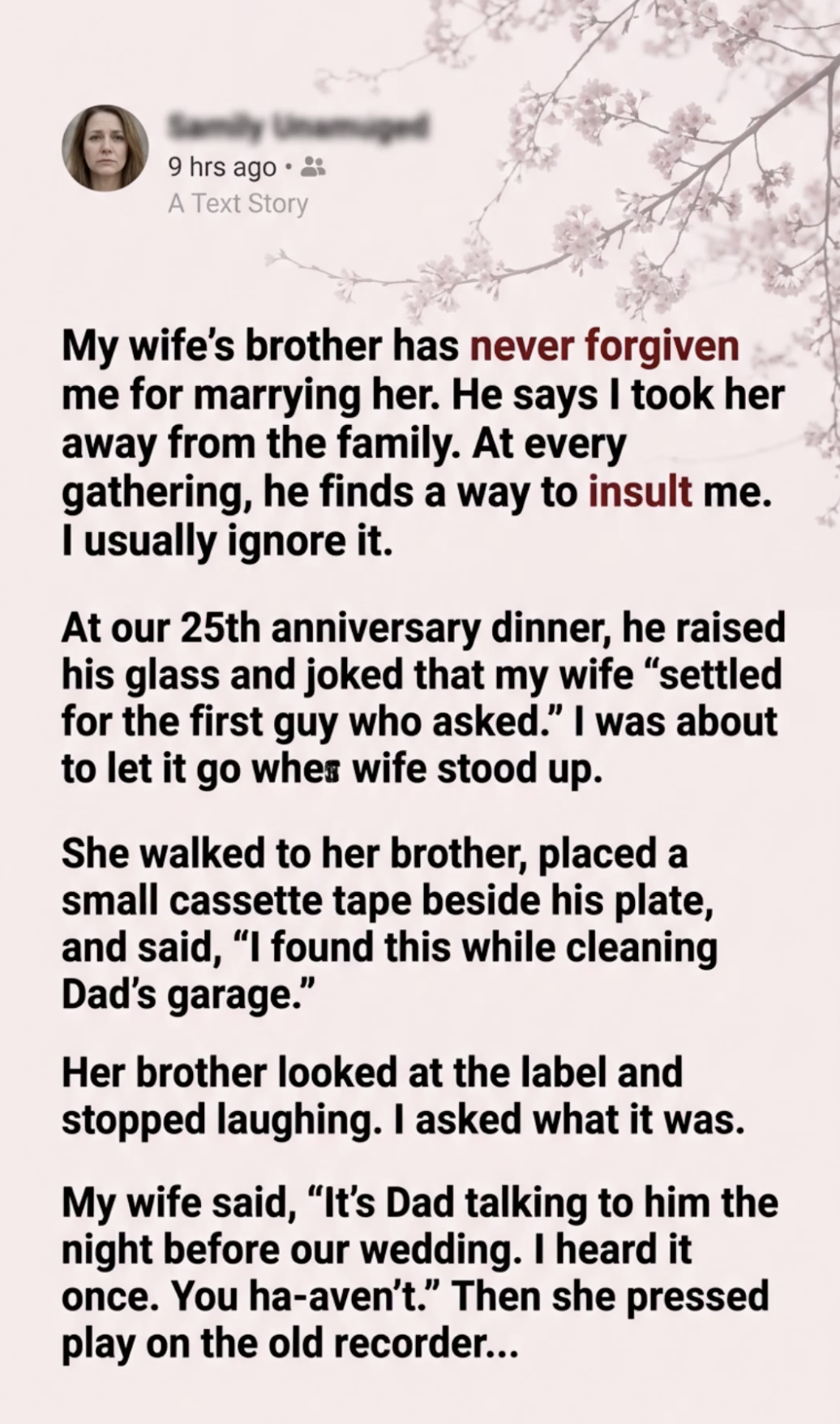
She didn’t raise her voice. She didn’t tell him he was being cruel. She simply picked up her handbag, opened it, and removed a small plastic cassette case.
She walked around the table and stopped beside Richard’s chair.
Then she placed the cassette beside his plate.
“I found this while cleaning Dad’s garage,” she said.
Richard glanced down.
The moment he read the handwritten label, his smile vanished.
It happened so quickly that I almost missed it.
His shoulders stiffened. His fingers stopped moving around his glass. The color seemed to drain from his face.
I looked at the label.
“Richard — The Night Before Laura’s Wedding.”
I stared at it.
“What is that?” I asked.
Laura looked at me.
“It’s Dad talking to Richard the night before our wedding.”
Richard pushed his chair back slightly.
“Laura, don’t.”
Her voice remained calm.
“I heard it once. You haven’t.”
Then she took a small cassette recorder from her bag.
She placed it beside the tape, inserted the cassette, and pressed PLAY.
At first, there was only a hiss of static.
Then a man’s voice filled the quiet room.
Our father-in-law.
Arthur Bennett had died eight years earlier, but I recognized his voice immediately. It was deep and slightly rough, with a softness that always appeared when he spoke to his children.
“Richard, sit down. We need to talk before your sister gets married tomorrow.”
A younger Richard answered.
“What’s this about, Dad?”
Arthur sighed.
“It’s about the way you’ve been treating Daniel.”
I felt my stomach tighten.
The recording continued.
“You’ve made your feelings about him very clear. You don’t like him. You don’t think he’s successful enough. You don’t think he’s good enough for Laura.”
Richard’s voice came through the speaker, younger but unmistakable.
“I’m trying to protect her.”
“No,” Arthur replied. “You’re trying to control her.”
Richard shifted in his chair.
At the table, nobody moved.
Arthur continued.
“Your sister is twenty-six years old. She has a good head on her shoulders. She knows what she wants. She has chosen a man who respects her, who listens to her, and who treats her with kindness. What exactly are you protecting her from?”
Richard’s recorded voice became sharper.
“He’s taking her away from us. Everything changes when she marries him. She won’t be around as much. She’ll have her own life.”
There it was.
The truth Richard had never admitted in front of the family.
He wasn’t angry because I had mistreated Laura.
He was angry because she had chosen a life that no longer revolved around him.
Arthur’s voice softened.
“Of course she’ll have her own life. That’s what children are supposed to do. We raise them so they can leave the nest, not so we can keep them tied to it forever.”
Richard said nothing.
Then Arthur spoke again.
“I need you to hear something, son. Your sister loves this man. She has looked happier in the last year than I’ve seen her in a long time. If you love her, you’ll stop making her feel guilty for that.”
A long silence followed.
Then Richard muttered, “You don’t know what he’s really like.”
“Then tell me.”
Richard hesitated.
“I just don’t trust him.”
“Because he has done something wrong?”
“No.”
“Because he has lied to her?”
“No.”
“Because he has been unkind to her?”
Richard’s voice grew quieter.
“No.”
Arthur let out a tired breath.
“Then perhaps the problem isn’t Daniel.”
I felt Laura’s fingers brush against my shoulder.
She had heard this recording before. She had carried its weight alone, perhaps for years.
But I had never heard it.
And Richard was sitting across from us, listening to his own younger voice expose the resentment he had hidden behind decades of jokes.
The recording continued.
“Your mother and I didn’t raise you to believe that loving someone gives you ownership over them,” Arthur said. “Laura is not your possession. She is your sister. You are allowed to miss her. You’re allowed to feel sad that things will change. But you are not allowed to punish her for growing up.”
Richard’s recorded voice cracked with anger.
“So I’m just supposed to smile and pretend I like him?”
“No,” Arthur answered. “You’re supposed to behave like a man who loves his sister more than he loves being right.”
A few people at the table lowered their eyes.
Arthur continued.
“Tomorrow, you’ll stand beside her at that wedding. I want you to do it with an open heart. You don’t have to become Daniel’s best friend overnight. You don’t even have to agree with every decision they make. But you do have to respect her choice.”
The recording went quiet for several seconds.
Then Richard asked a question that changed the expression on Laura’s face.
“What if he hurts her?”
Arthur answered without hesitation.
“Then you help her. You don’t spend the next twenty-five years trying to make him feel small just in case you turn out to be right.”
The room was so silent I could hear the faint hum of the restaurant’s air conditioning.
Then came Arthur’s final words.
“And one more thing, Richard. If you spend your life trying to prove that your sister made the wrong choice, you may eventually succeed at something much worse. You may make her regret that she ever tried to keep you in her life.”
The tape clicked.
The recording ended.
Nobody spoke.
Richard stared at the cassette as if it had become something dangerous.
I looked at my wife.
Her eyes were wet, but she was standing straight, her shoulders relaxed.
“Why didn’t you ever tell me about this?” I whispered.
She turned toward me.
“Because Dad asked me not to use it as a weapon. He wanted Richard to come to his own understanding. He hoped that, eventually, he would accept us.”
She paused.
“I thought he would.”
I looked back at Richard.
For twenty-five years, I had wondered what I had done to earn his contempt. I had questioned whether I should have tried harder to befriend him, whether I had been too quiet, too ordinary, too unwilling to compete with him.
I had accepted his insults because I thought perhaps there was something I needed to prove.
Now I understood.
There had never been anything I could prove.
Richard’s resentment had started before I had the chance to become the person he claimed to dislike. He had seen my marriage as the loss of something he believed belonged to him.
I wasn’t the cause of his fear.
I had simply become the target of it.
Richard finally looked up.
“You had no right to play that,” he said.
Laura regarded him quietly.
“You’ve spent twenty-five years insulting my husband in front of the people I love. You just told everyone that I settled for him. You don’t get to call this a private matter now.”
“I was joking.”
“No,” she said. “You were trying to humiliate him. Again.”
Richard’s face reddened.
“You’re making me look like a terrible person.”
Laura shook her head.
“I’m not making you look like anything. I played a recording of a conversation you had with Dad. Your own words did the rest.”
He looked around the table, searching for someone to rescue him.
Nobody did.
Our son, Michael, was the first to speak.
“Uncle Richard, Dad has never done anything but respect you. Even when you insulted him, he tried to keep the peace because Mom loves you.”
Our daughter, Sophie, nodded.
“We’ve heard the jokes our entire lives. You always act like Dad owes you an apology for marrying Mom.”
Richard opened his mouth.
Then he closed it.
I felt an unexpected ache in my chest.
My children had noticed more than I realized. They had seen the moments I dismissed, the comments I laughed away, and the times I changed the subject because I didn’t want Laura caught between her husband and her brother.
I had thought I was protecting my family by staying quiet.
Perhaps I had also taught them that disrespect was something a person had to endure to keep the peace.
I stood up.
“Richard, can I say something?”
He looked at me reluctantly.
“Go ahead.”
“I’ve spent twenty-five years trying not to turn your dislike of me into a problem for Laura. I’ve listened to the jokes. I’ve let the comments pass. I’ve told myself that if I stayed patient long enough, you’d eventually see that I wasn’t trying to take your sister away from you.”
I paused.
“But I need you to understand something. I never took Laura away from you. She chose to marry me. She chose to build a home with me. She chose to raise our children with me. And she has continued choosing to keep you in her life, even when you’ve made that difficult.”
Richard stared at the table.
“I never asked her to choose between us,” he muttered.
“Maybe not in those words. But every time you insulted me, you asked her to tolerate your behavior or risk upsetting you. Every time you called our marriage a mistake, you made her defend a decision she had every right to make.”
He rubbed his forehead.
“I didn’t mean it that way.”
“Maybe you didn’t understand what you were doing. But it still hurt.”
I looked at Laura.
“She deserves to enjoy her family without having to manage the tension between us. And I deserve to sit at my own anniversary dinner without being called trash, a fool, or a man who got lucky.”
I took a breath.
“I’m not asking you to love me. I’m not asking you to agree with every decision I make. But if you want to remain part of our lives, I need you to treat me with basic respect.”
Richard’s eyes were glossy.
For the first time I could remember, he had no quick insult ready.
He looked at the cassette again.
Then he whispered, “Dad really said all that?”
Laura nodded.
“Every word.”
Richard leaned back in his chair and covered his face with both hands.
For a long moment, nobody spoke.
Then he began to cry.
It wasn’t dramatic. He didn’t make a speech or ask everyone to comfort him. His shoulders simply shook as he sat there, overwhelmed by something he had spent decades refusing to face.
Laura moved toward him, then stopped.
I knew she wanted to comfort her brother. She had loved him long before I entered her life, and despite everything, she still loved him now.
But she didn’t rush to rescue him from the consequences of his own behavior.
Instead, she returned to her seat.
Richard eventually wiped his eyes.
“I was angry when you got married,” he said to Laura. “I know that sounds ridiculous now, but I felt like everything was changing. Mom was gone, and Dad was getting older. You were the person I could always count on.”
Laura’s expression softened.
“I was still your sister, Richard.”
“I know.”
“You could have called me. You could have told me you were afraid of losing me. Instead, you made Daniel pay for it.”
Richard looked at me.
“I thought if I kept pointing out everything wrong with him, you’d eventually see it too.”
“And did I?” Laura asked.
He shook his head.
“No.”
She waited.
“I was wrong,” he said.
The words were quiet, but they were the first honest ones I had heard from him in years.
“I’m sorry, Laura.”
She nodded, tears sliding down her cheeks.
Then Richard turned toward me.
“I don’t know how to make up for twenty-five years of this.”
“You can’t change the past,” I replied. “But you can decide what happens next.”
He swallowed.
“I’m sorry, Daniel.”
I studied his face.
Part of me wanted to accept the apology immediately. Another part remembered every family gathering, every insult, every occasion when I had driven home wondering why someone I had tried so hard to accommodate seemed determined to dislike me.
I wasn’t ready to pretend those memories had disappeared.
“Thank you for saying that,” I told him. “I hope you mean it. But I’ll need to see it in how you treat us from now on.”
He nodded.
“I understand.”
For the rest of the evening, the dinner changed.
The tension that had filled the room began to loosen. Our friends cautiously returned to conversation. Michael ordered another round of coffee, and Sophie took her mother’s hand.
Richard didn’t make another joke about me.
He didn’t try to explain away his behavior or blame the wine.
He sat quietly for a while, looking older than he had when he arrived.
Eventually, he asked Laura if he could speak with her privately.
They stepped outside onto the restaurant’s terrace.
I watched them through the glass doors. They stood beside the railing, talking quietly beneath the lights. At one point, Laura wiped her eyes. Richard reached toward her, hesitated, then gently touched her shoulder.
I didn’t know what they were saying.
For the first time in twenty-five years, I didn’t feel the need to monitor the conversation or prepare myself for the next insult.
When they returned, Laura looked calmer.
Richard approached me.
“I know I haven’t earned your trust,” he said. “I’m not going to ask you to forget everything. But I want to try to do better.”
I nodded.
“Then start with the next family gathering.”
He managed a small, embarrassed smile.
“Fair enough.”
Before we left the restaurant, Laura slipped the cassette back into its case.
I touched her arm.
“Are you glad you played it?”
She considered the question.
“I wish we hadn’t needed it. I wish Richard had listened to Dad the first time. But I couldn’t keep pretending that his behavior was harmless just because he called it a joke.”
She looked at me.
“And I didn’t want our twenty-fifth anniversary to end with you swallowing another insult so everyone else could be comfortable.”
I took her hand.
“You didn’t have to do that for me.”
“Yes,” she said gently. “I did. Not because you can’t stand up for yourself, but because I should have stood up more clearly beside you.”
I kissed her forehead.
We drove home beneath a clear night sky, the city lights sliding past the windows.
At home, Laura placed the cassette on the kitchen counter.
I looked at the label again.
“Do you think Dad knew this would happen?”
She smiled sadly.
“Dad always hoped Richard would grow up enough to understand that love isn’t ownership.”
I thought about Arthur. He had been a quiet man, not especially fond of grand speeches. He believed in fixing things before they broke and apologizing when he was wrong. He had never treated his children as though their lives were possessions he could control.
I wished he could have been at our anniversary dinner.
I wished he could have seen his son finally listen to the lesson he had tried to teach him all those years ago.
But I also understood something else.
The recording hadn’t changed Richard by itself.
It had simply removed the excuses he had been hiding behind.
What he did next would be his own choice.
Over the following months, he began making small changes.
At our daughter’s birthday dinner, he asked about my work without turning the conversation into a competition. At Thanksgiving, he complimented the meal and helped clear the table. When he disagreed with me about something, he said so without making a personal attack.
The first time he caught himself making an old joke, he stopped halfway through and apologized.
It wasn’t perfect.
Sometimes he slipped back into his old habits. Sometimes the room grew tense, and Laura had to remind him that a boundary was a boundary, not an invitation to negotiate.
But when he was corrected, he began listening.
Our relationship didn’t become a close friendship overnight. We were two men with a long history of resentment and misunderstanding, and trust took time.
Still, there was progress.
A year after our anniversary, Richard invited us to his house for dinner.
When I arrived, he met me at the door.
“I made lasagna,” he announced. “Laura says it’s better than yours, but I told her I’d let you judge.”
I laughed.
“That’s a dangerous challenge.”
He smiled.
“Apparently, I’m trying to learn.”
We ate dinner, talked about our children, and spent the evening watching an old movie. For the first time in decades, I left his house without replaying the conversation in my head, searching for the hidden insult.
On the drive home, Laura rested her hand on mine.
“That felt different,” she said.
“It did.”
“Do you think he’ll keep changing?”
“I hope so.”
She leaned back against the seat.
“So do I.”
I glanced at the small cassette case resting in the center console. Laura had brought it along because Richard had asked if he could listen to it again sometime.
We had agreed to make him a copy.
The original would remain with Laura, not as a weapon, but as a reminder of what her father had wanted for his family.
I thought about the final words Arthur had spoken on that recording.
You’re supposed to behave like a man who loves his sister more than he loves being right.
For twenty-five years, Richard had tried to prove that I was the wrong man for his sister. In doing so, he had nearly destroyed the relationship he was trying to protect.
But now, at last, he was learning that loving someone meant allowing them to make their own choices—and respecting the people they chose to love.
Our twenty-fifth anniversary had begun with an insult.
It ended with a truth that had been waiting on an old cassette for decades.
I never needed Richard to admit that I was the best husband in the world. I never needed him to become my closest friend.
All I had ever wanted was the chance to be Laura’s husband without being treated like an enemy.
And when I thought about the man I had been at the beginning of our marriage, the one who believed he could earn respect simply by enduring disrespect, I finally understood something I wished I had learned sooner.
Patience can preserve a relationship, but silence cannot repair one when someone keeps using it as permission to hurt you.
Sometimes love requires you to let an insult pass.
Sometimes it requires you to speak.
And sometimes, the kindest thing you can do for a family is stop pretending that everything is fine.
On our twenty-sixth anniversary, Laura and I returned to the same restaurant.
We sat at the same table, ordered the same dessert, and laughed about how our son had once tried to convince us that twenty-five years of marriage qualified us for a museum exhibit.
Richard joined us that evening.
When it was time for a toast, he stood and raised his glass.
“I want to say something,” he began.
I braced myself out of habit, then caught Laura smiling at me.
Richard looked directly at us.
“Twenty-six years ago, my sister married a man I didn’t think was good enough for her. I spent far too long trying to prove I was right. I was wrong, and I’m sorry.”
He lifted his glass higher.
“To Laura and Daniel. May you have many more years together—and may I finally be wise enough to enjoy them without getting in the way.”
This time, everyone laughed.
Including me.
I raised my glass.
“To family,” I said.
And for the first time in a very long time, I meant every word.