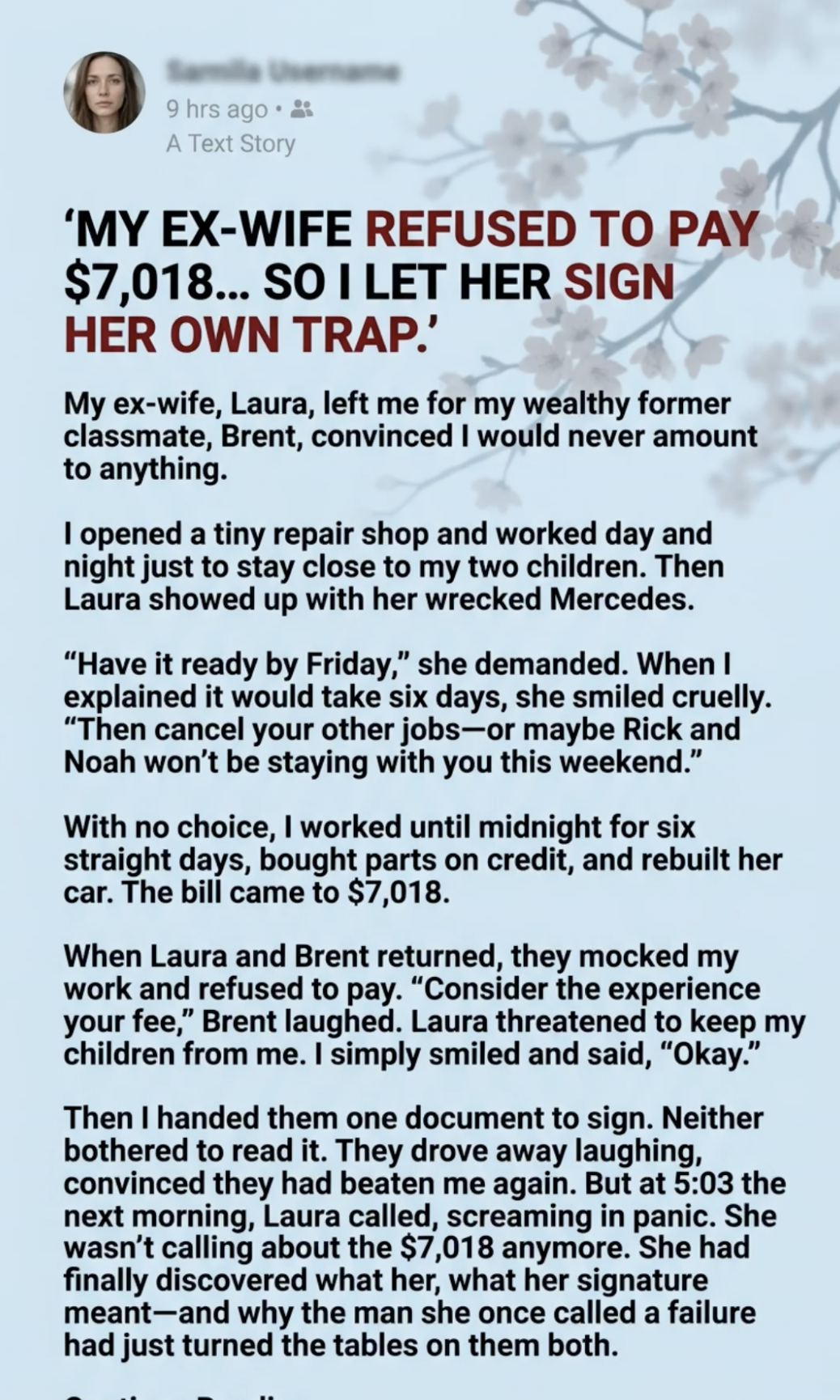
My ex-wife called me at 5:03 on a Tuesday morning, screaming so loudly that I had to pull the phone away from my ear.
“WHAT DID YOU DO, DANIEL? WHAT DID YOU MAKE ME SIGN?”
I was sitting at my kitchen table with a cup of black coffee, watching the sunrise creep over the rooftops.
For the first time in seven years, I smiled when I heard her voice.
“Good morning, Laura.”
“DON’T YOU DARE SAY GOOD MORNING TO ME! BRENT’S LAWYER JUST CALLED! THEY SAID THE DOCUMENT IS LEGALLY BINDING!”
I took a slow sip of coffee.
“Yes,” I said calmly. “It is.”
She began crying.
And that was when I knew she had finally read the last page.
But to understand why my ex-wife was screaming before dawn, you need to understand what happened six days earlier, when she drove her wrecked Mercedes into my little repair shop and treated me like the worthless man she had always believed I was.
My name is Daniel Bennett. I’m forty-two years old, divorced, and the owner of Bennett Auto Repair, a two-bay garage on the edge of town.
I don’t own a mansion.
I don’t drive a luxury car.
I don’t have a yacht, a vacation house, or a closet full of expensive watches.
What I have is a business I built with my own hands, a small house I can afford without borrowing money, and two children who still run toward me when I pick them up for the weekend.
Their names are Rick and Noah.
Rick is twelve. Noah is nine.
They are the best things that ever happened to me.
And they are the reason I survived the day Laura walked out of our marriage.
Seven years earlier, Laura had left me for Brent Caldwell, a former classmate of mine who had grown wealthy through commercial real estate.
Brent had the kind of confidence that came from never having to worry about the price of anything. He wore tailored suits, drove expensive cars, and talked about people as if they were investments he had either made or rejected.
When Laura first introduced us, he shook my hand and looked around our modest home.
“So, Daniel,” he said, “what exactly do you do?”
“I work in automotive repair.”
He smiled.
“Still fixing cars? I thought you were going to do something bigger with your life.”
Laura laughed.
Not loudly.
Not nervously.
She laughed as though he had said something clever.
I remember looking at her and waiting for her to defend me.
She didn’t.
A few months later, she told me she was leaving.
She said she had outgrown our marriage. She said she wanted a man who could provide a better future. She said I had become comfortable with mediocrity.
Then she packed her clothes, took the jewelry I had given her, and moved into Brent’s enormous house on the other side of town.
Before she left, she stood in our kitchen and said something I would remember for years.
“You’ll always be a small-time mechanic, Daniel. I don’t want our boys growing up thinking that’s what success looks like.”
I didn’t argue.
I didn’t beg.
I signed the divorce papers, fought for a fair parenting arrangement, and focused on keeping my children close.
The first year was brutal.
I rented a smaller place. I worked on cars until my hands ached. I learned how to manage inventory, negotiate with suppliers, and keep my business alive through months when customers could barely afford repairs.
There were nights I ate instant noodles because I needed every spare dollar for rent and the boys’ expenses.
But I never missed a scheduled weekend with my children.
Not once.
When Rick had a school performance, I was there.
When Noah broke his arm falling off a bicycle, I sat beside him in the emergency room until he fell asleep.
When they wanted to learn how to change a tire, I taught them in my garage, letting them make mistakes until they understood why patience mattered more than strength.
I never told them their mother had abandoned us.
I never asked them to take sides.
I wanted them to grow up knowing that a person could be disappointed without becoming cruel.
Meanwhile, Laura and Brent seemed to be living the life she had always wanted.
They traveled. They bought a larger house. Brent upgraded his Mercedes every few years, and Laura posted photographs of dinners, designer handbags, and expensive holidays.
Whenever I saw her at school events, she looked at my work clothes as though I had arrived from another planet.
Sometimes she asked whether I was still renting.
Sometimes she asked whether my business was finally making enough money to support me.
And sometimes, when she was especially pleased with herself, she reminded me that Brent had achieved more in one year than I would achieve in my entire life.
I stopped responding.
My life wasn’t glamorous, but it was mine.
My shop slowly grew. I hired two mechanics, built relationships with local businesses, and earned a reputation for honest work.
I began specializing in difficult engine and transmission repairs that larger shops often refused.
I didn’t get rich overnight.
I simply kept showing up.
By the sixth year, the shop was profitable enough that I could save money, pay my employees well, and stop worrying every month about whether the bills would swallow everything I earned.
I also became more careful about contracts.
One of my longtime customers was a retired attorney named Harold Pierce. He owned an old pickup truck that he insisted on maintaining long after his friends told him to buy something newer.
Harold often sat in the waiting area while I worked, drinking coffee and asking questions about the business.
One afternoon, he watched me argue with a supplier about a disputed invoice.
“You’re good at fixing mechanical problems,” he said. “But you need to learn how to protect yourself from people who think your time has no value.”
He taught me how to document work orders, obtain written authorization for repairs, explain storage policies, and use clear contracts that complied with local law.
He also taught me something that became one of my most important business rules.
“Never let an angry customer turn a business transaction into a personal contest,” he said. “Write everything down. Keep the records. Let the facts do the talking.”
I followed that advice.
It would matter more than I could have imagined.
Then, one rainy Monday morning, Laura drove into my shop.
I recognized the Mercedes before I recognized her.
The front bumper was badly damaged. One headlight was shattered, the hood had been bent upward, and the engine made a terrible grinding sound when she tried to move the car into the bay.
Laura stepped out wearing sunglasses, a cream-colored coat, and the expression of someone who had been inconvenienced by the existence of other people.
Brent climbed out of the passenger seat, talking on his phone.
Neither of them greeted me.
Laura tossed her keys onto my counter.
“I need this fixed by Friday.”
I looked at the damage.
“That’s going to be difficult.”
She removed her sunglasses.
“Excuse me?”
“The front assembly is damaged, and I need to inspect the cooling system and engine mounts before I can give you a reliable estimate. Some of the parts may have to be ordered. Six days is the earliest realistic timeline.”
She stared at me as though I had deliberately insulted her.
“Six days? I said Friday.”
“And I explained what the repair requires.”
She leaned across the counter.
“Then cancel your other jobs.”
I glanced at the work schedule.
I already had three vehicles waiting for parts, two customers who needed their cars for work, and a delivery van that had to be back on the road before the weekend.
“I can’t push everyone else aside without discussing it with them.”
Laura smiled.
It was the same smile she had worn when she left our marriage.
“Then perhaps Rick and Noah won’t be staying with you this weekend.”
My hands went still.
“What does that have to do with the car?”
“I’m their mother. I can make arrangements.”
“You don’t get to use our children to force me to do work faster.”
Brent ended his phone call and wandered toward the counter.
“Come on, Daniel. It’s just a car. You’re a mechanic. Fix it.”
I looked at him.
“It’s a damaged luxury vehicle that needs a proper inspection, replacement parts, and testing. I won’t promise a deadline I can’t safely meet.”
He laughed.
“That’s why you’ll always be where you are. You think about obstacles. Successful people find solutions.”
I felt the old anger rise inside me.
Then I remembered Harold’s advice.
Keep the records. Let the facts do the talking.
I picked up a work-order form.
“I can inspect it today and provide a written estimate. If you approve the repairs, I’ll document the work, the parts, the labor, and the expected completion date.”
Laura snatched the form.
“Fine. Just get it done.”
She signed the authorization.
The first inspection revealed more damage than the exterior suggested. Several components needed replacement, and the cooling system had been affected. The car also needed additional testing after the main repairs.
I called suppliers, confirmed availability, and obtained written pricing.
The estimate was substantial.
The parts were expensive, and the labor required specialized work.
Laura approved the estimate after complaining about every line.
Then she added one more demand.
“Friday. No excuses.”
I should have refused the deadline.
Instead, I looked at the photograph of Rick and Noah taped to the side of my tool cabinet.
I pictured Laura deciding that I was unreliable, then using that accusation to make my weekends with the boys more difficult.
So I agreed to do everything reasonably possible to meet her deadline.
I worked late that night.
And the next night.
And the night after that.
I stayed until midnight, then came in early the following morning. I rearranged my own jobs, hired a temporary technician for part of the work, and negotiated with suppliers to get the necessary components delivered on time.
I didn’t cut corners.
I didn’t skip safety checks.
I simply worked harder than I should have had to.
By Thursday evening, I had nearly finished the repairs.
The final invoice came to $7,018.
Every part was documented. Every hour of labor was recorded. The additional work had been approved, and the invoice included the agreed charges.
I printed two copies.
One went into the customer file.
The other sat on my counter beside the keys.
Friday morning arrived.
At 10:15, Laura and Brent walked into the shop.
The Mercedes was parked outside, polished and ready.
Laura glanced at it and nodded.
“Finally.”
I handed her the invoice.
“Here’s the breakdown. The repairs are complete, and I’ve included the parts and labor.”
She looked at the total.
Then she laughed.
“Seven thousand dollars? Are you serious?”
“Every charge is listed.”
Brent took the paper from her.
He scanned it for about three seconds before making a theatrical sound of disbelief.
“You’re charging this much for a few repairs?”
“Those aren’t minor repairs. The parts and labor are itemized.”
He folded the invoice in half.
“You know what I think? I think you’ve padded the bill because you know we can afford it.”
“I’m happy to explain any line item.”
“I don’t need an explanation.”
Laura crossed her arms.
“We’re not paying this.”
I looked at her.
“You authorized the work.”
“We authorized repairs. We didn’t authorize you to charge whatever you wanted.”
“The estimate and approvals are in the file. You can review them.”
Brent tossed the invoice onto the counter.
“Consider the experience your fee.”
For a second, I thought I had misheard him.
“What?”
He smiled.
“You got to work on a Mercedes. You should be grateful for the opportunity.”
Laura laughed.
“And let’s be honest, Daniel. You needed the work more than we needed you.”
I looked at the invoice on the counter.
Then at the keys.
Then at my ex-wife.
I could have shouted.
I could have called the police and demanded that someone intervene. I could have argued until every customer in the waiting area knew what kind of people they were.
Instead, I asked one question.
“Are you refusing to pay the documented invoice?”
Laura lifted her chin.
“Yes.”
“Both of you agree that you’re refusing payment?”
Brent grinned.
“Absolutely.”
I nodded.
“Okay.”
Laura blinked.
“Okay?”
“Okay.”
She looked at Brent, then back at me.
“That’s it? You’re not going to argue?”
“No.”
She laughed again.
“I knew you wouldn’t fight. You’ve never had the backbone to stand up to anyone.”
Brent picked up the keys.
“Enjoy your little garage, Daniel.”
They walked toward the door.
Then Laura turned back.
“And don’t think this changes anything with the boys. I’ll decide where they spend their weekends.”
I gave her a small smile.
“Of course.”
She looked almost disappointed that I wasn’t reacting.
Then they drove away.
The Mercedes disappeared around the corner.
I stood in the doorway until I could no longer hear the engine.
My employee, Marcus, approached from the second bay.
“Are you really going to let them get away with that?”
I looked at him.
“No.”
He glanced at the invoice.
“Then why did you let them leave?”
I walked back to the office and opened a locked drawer.
Inside was a folder I had prepared the previous evening.
“Because,” I said, “they’ve made a mistake. And I don’t need to make one in return.”
The folder contained copies of the signed work order, the approved estimate, supplier invoices, photographs of the damage, records of additional authorizations, and the final invoice.
It also contained something else.
A document Laura and Brent had signed when they arrived.
At the time, neither had paid it much attention.
They thought it was another ordinary form connected to the repair.
It wasn’t.
But I need to explain how that document came to exist.
Two months before Laura brought me the Mercedes, I had entered into a business agreement with a local fleet company. The contract required my shop to maintain a certain amount of available credit for parts and emergency repairs. I had been working with my bank and an attorney to restructure some supplier obligations and improve the business’s cash flow.
As part of that process, I had learned how important it was to separate a legitimate debt from the emotional arguments people sometimes used to avoid paying it.
Harold had helped me prepare a standard customer acknowledgment for disputed invoices. It did not invent new debt, transfer ownership, or give me power over anyone’s property. It simply recorded what had been authorized, what work had been completed, and what the customer acknowledged receiving.
When Laura and Brent arrived, I had already prepared a detailed invoice packet.
The final page was a written acknowledgment of the completed repairs and the outstanding balance, with a section for any dispute they wished to record.
I had asked them to review the packet before signing.
Laura had waved me away.
“Just give me whatever I need to sign so I can get out of here.”
Brent had skimmed the first page and joked that mechanics must love paperwork.
Neither had examined the itemized statement or the acknowledgment.
When they refused payment, I had calmly asked whether they disputed the specific work performed or merely refused to pay. They insisted the bill was unfair, but they refused to identify a particular unauthorized repair or incorrect charge.
I did not force them to sign anything. I did not threaten them. I simply placed the acknowledgment in front of them and told them they could read it, raise a written objection, or decline to sign.
They chose to sign.
Their signatures did not magically turn an invalid charge into a valid one, nor did they create a legal trap that could destroy their lives overnight.
What the document did was preserve the evidence.
It recorded the repair authorization, the agreed estimate, the completed work, the invoice total, and their refusal to pay. It also confirmed that they had received copies of the paperwork.
That was enough.
Because the next step would not depend on my anger.
It would depend on the law.
At 2:30 that afternoon, I sent them a formal demand for payment with copies of the relevant records and a reasonable deadline to respond. I also notified my attorney that the invoice was disputed and asked him to review the file before any further action.
Laura replied within minutes.
Laura: You really think I’m going to pay you? Forget it.
Brent sent a separate message.
Brent: Try suing us. You’ll spend more on lawyers than you’ll ever recover.
I forwarded both messages to my attorney.
Then I went back to work.
I repaired a customer’s alternator, checked the alignment on a delivery van, and helped Marcus diagnose a persistent engine fault.
At five o’clock, I picked up Rick and Noah.
They climbed into my truck, talking over each other about a school project and a football game.
Neither knew what had happened.
I made them dinner, helped Noah with his homework, and listened to Rick explain why his science teacher was wrong about a particular experiment.
For a few hours, I forgot about Laura and Brent.
That was the point.
I had spent too many years allowing their opinions to determine whether I felt successful.
I wasn’t going to let them take another evening away from my children.
The next morning, at 5:03, Laura called.
I was awake already.
She was screaming before I could say hello.
“WHAT DID YOU DO, DANIEL?”
I leaned back in my chair.
“Good morning, Laura.”
“BRENT’S LAWYER SAYS WE CAN’T JUST IGNORE THE INVOICE! HE SAYS THE DOCUMENT WE SIGNED COULD BE USED AS EVIDENCE!”
I looked at the folder on my desk.
“Your lawyer is correct that the document records the transaction. Whether a particular claim succeeds depends on the evidence and the applicable law.”
“You set us up!”
“No. You brought your car to my shop. You authorized the work. I completed it. You refused to pay. I documented what happened.”
“You knew we weren’t going to pay!”
“I asked you directly whether you were refusing payment. You said yes.”
She made a strangled sound.
“You can’t do this to me!”
“I’m not doing anything to you. I’m asking you to pay for the work you authorized.”
“Brent says you have copies of everything!”
“I do.”
She went silent.
Then she said something that made me realize she was finally beginning to understand the problem.
“What if this gets out?”
I glanced at the photographs, invoices, and signed records in the folder.
“Then the facts will speak for themselves.”
She hung up.
I sat there for a long moment.
I didn’t feel triumphant.
I felt tired.
For years, Laura had treated my work as a joke, my income as evidence of failure, and my devotion to our children as a weakness she could exploit.
Now she was frightened because she had discovered that I had kept records instead of losing my temper.
But I wasn’t finished.
The invoice was only one part of the situation.
The more serious problem was the way Laura had repeatedly threatened to interfere with my time with Rick and Noah whenever she wanted something from me.
I had documented those incidents too.
I had saved messages, recorded dates and details in a parenting journal, and kept copies of the custody agreement. I had never used those records to punish her or tried to turn the boys against their mother.
But I was no longer willing to pretend that the threats were harmless.
I called my family-law attorney and explained what had happened.
He reviewed the messages and the existing parenting arrangement.
“Don’t retaliate,” he told me. “Don’t withhold the children, and don’t make threats. If she interferes with your scheduled parenting time, document it and follow the agreement. If a modification becomes necessary, we’ll address it through the proper process.”
I agreed.
For the first time, I was treating my parenting relationship with the same care I gave my business.
I would not allow Laura to use the boys as leverage.
Over the following weeks, my attorney sent a formal demand for payment. Laura and Brent responded through their lawyer, disputing several charges and questioning whether certain additional work had been necessary.
We provided the photographs, inspection notes, supplier records, written authorizations, and labor breakdown.
Their lawyer asked for a further review of the disputed items.
My attorney agreed.
The process took longer than I wanted, but it was fair. I did not expect a signature to settle every question. I wanted the record examined, the legitimate charges recognized, and any genuine disagreement resolved properly.
Eventually, an independent review supported the bulk of the invoice. One minor charge required clarification, which my attorney addressed with the supporting documentation. The remaining balance was still substantial.
Laura and Brent were given a final opportunity to resolve the matter.
They did not.
My attorney filed a claim seeking the unpaid amount and the costs permitted under the agreement and applicable law.
The case was not a dramatic overnight victory. It involved paperwork, deadlines, legal arguments, and several weeks of waiting.
But the evidence was consistent.
The work had been authorized.
The repairs had been completed.
The charges were documented.
And Laura and Brent had signed an acknowledgment confirming the transaction.
Their lawyer eventually advised them that continuing to deny the entire bill was unlikely to help their position.
They offered to settle.
I reviewed the offer with my attorney. We negotiated a payment that covered the substantiated balance and resolved the dispute without an unnecessary trial.
When the money arrived, I paid the remaining supplier balances associated with the repair and put the rest back into the business.
I did not buy a sports car.
I did not post a photograph of the payment online.
I did not send Laura a message reminding her that she had called me a failure.
I bought new diagnostic equipment for the shop and took Rick and Noah camping.
We spent two nights beside a lake, cooked food over a small fire, and stayed up late watching the stars.
Noah asked me why I kept looking at my phone.
“Just checking something,” I told him.
Rick grinned.
“Dad, you’re supposed to be relaxing.”
He was right.
I put the phone away.
For the first time in weeks, I stopped thinking about Laura.
Then, several days later, she called again.
Her voice was quieter.
“Daniel, can we talk?”
“About the invoice?”
“About everything.”
I considered refusing.
Then I agreed to meet her in a public place, during the day, with no expectation that the conversation would change our legal or parenting arrangements.
She arrived without Brent.
For once, she didn’t look polished and confident. She looked tired.
“I never thought you’d actually stand up to us,” she said.
I stirred my coffee.
“You were mistaken.”
She stared at the table.
“Brent says you embarrassed him.”
“I didn’t embarrass him. He refused to pay a documented invoice, and we resolved the dispute through the proper process.”
“He says you planned the whole thing.”
“I planned to document the work and protect my business. I didn’t plan for you to refuse payment.”
She shook her head.
“You’ve changed.”
I looked at her.
“No, Laura. I stopped letting you tell me who I was.”
She didn’t answer.
For a moment, I saw the woman I had married—the woman who once laughed with me over burned pancakes, who danced with me in our first apartment, who held our newborn sons and promised we would always be a team.
I didn’t hate that woman.
But I could no longer pretend she was the only version of Laura that existed.
“I shouldn’t have threatened your weekends with the boys,” she said finally.
It was the first sincere acknowledgment I had heard from her in years.
“No,” I replied. “You shouldn’t have.”
“I was angry.”
“That doesn’t make it acceptable.”
She nodded.
“Brent thought you would cave.”
“And you agreed with him.”
She looked up at me.
“I did.”
I let the silence remain between us.
Then I said, “Our children need parents who can disagree without using them as weapons. That’s the only thing I want to discuss going forward.”
She wiped her eyes.
“I know.”
I couldn’t tell whether she truly understood or was simply exhausted by the consequences. I no longer needed to decide that for her.
I paid for my coffee, stood, and left.
There was no grand reconciliation.
No apology that erased seven years of contempt.
No sudden transformation that made us friends.
But I had said what I needed to say, and I had done it without shouting.
That evening, I picked up Rick and Noah for our scheduled weekend.
Laura didn’t interfere.
The boys ran toward my truck, arguing about who got to sit in the front passenger seat when they were old enough.
I laughed and opened the back door.
As we drove away, Rick asked, “Dad, are you ever going to be rich?”
I glanced at him in the mirror.
“What made you ask that?”
“Mom and Brent talk about money a lot.”
I thought about my little garage, my employees, the bills I could now pay without panic, and the two boys who trusted me to show up when I said I would.
“Maybe,” I said. “Maybe not.”
Noah leaned forward between the seats.
“Would you buy a Lamborghini?”
I laughed.
“Probably not.”
“Why not?”
“Because I’d rather own something I can afford than spend my whole life trying to impress people who don’t care about me.”
Rick considered that.
Then he nodded.
“That’s fair.”
I drove home beneath a clear evening sky.
For years, I had believed success meant proving Laura wrong. Every time my business grew, I imagined what she would say if she saw it. Every time I solved a difficult problem, I pictured Brent discovering that I was more capable than he thought.
But I finally understood that I had been allowing them to remain at the center of my life long after our marriage had ended.
The unpaid invoice had forced me to stand up for the value of my work.
The parenting threats had forced me to protect my relationship with my children through proper boundaries and documentation.
And the years of being called a failure had forced me to confront the difference between someone else’s opinion and my actual worth.
Laura had believed she could still control me because she knew what mattered most to me.
My children.
She had mistaken my willingness to protect them for an inability to defend myself.
Brent had believed money made him untouchable.
He had mistaken my modest business for a lack of intelligence, my patience for weakness, and my refusal to boast for a lack of ambition.
They were wrong.
Not because I had destroyed them.
Not because I had discovered some magical document that made them powerless.
They were wrong because I had finally stopped participating in their version of reality.
I had kept my records.
I had followed the rules.
I had asked for what I was owed.
And when they tried to turn my work into a joke, I let the evidence answer them.
The following Monday, I opened the garage at seven in the morning.
Marcus was already there, setting up the diagnostic equipment.
“Everything settled?” he asked.
“Yes.”
He smiled.
“Good. What are we working on today?”
I looked at the cars waiting in the bays.
“Whatever comes through the door.”
And that’s exactly what I did.
I worked. I repaired. I built.
I went to school meetings. I attended football games. I helped with homework and listened to stories about friends, teachers, and the complicated world of growing up.
I never told my sons that their mother was a bad person.
I told them that adults sometimes make poor choices, that money doesn’t determine character, and that nobody has the right to use affection or family obligations to force another person into doing something.
Most importantly, I showed them that standing up for yourself doesn’t require cruelty.
Sometimes it means saying no.
Sometimes it means keeping a record.
Sometimes it means hiring a professional and letting the proper process run its course.
And sometimes it means accepting that you cannot make another person respect you—but you can refuse to let their disrespect determine your future.
A year after the Mercedes incident, Bennett Auto Repair expanded into the neighboring unit.
We added another service bay and hired a third mechanic. The business continued to grow, slowly and steadily.
I bought a reliable used truck and paid for it without taking on a loan I couldn’t comfortably manage.
I also started a small savings account for each of my sons.
One evening, after closing the shop, I sat alone in the office and looked at the old photograph of Rick and Noah that had hung beside my toolbox since the first year after the divorce.
I remembered how frightened I had been when Laura threatened to keep them from me.
I remembered the nights I had worked until midnight, worried that one missed payment might bring everything crashing down.
I remembered the way Brent had laughed when he called me a small-time mechanic.
Then I looked around the shop.
The tools were organized. The books were balanced. My employees were paid. The work waiting for the next morning was manageable.
I was not the richest man in town.
I wasn’t the man Laura had chosen.
I wasn’t the man Brent thought I should have been.
I was Daniel Bennett.
A father.
A mechanic.
A business owner.
A man who had rebuilt his life one difficult day at a time.
And I was finally comfortable with that.
Sometimes people ask me whether I enjoyed seeing Laura panic when she realized the paperwork mattered.
The truth is, I didn’t enjoy her fear.
I enjoyed no longer being afraid of her.
There is a difference.
I didn’t need revenge. I needed a fair resolution, a safe relationship with my children, and the freedom to run my business without being bullied.
The $7,018 mattered because it represented my labor, my parts, and the hours I had spent repairing a vehicle someone had authorized me to fix.
But the larger victory was something no invoice could measure.
I had learned that being a good father didn’t mean surrendering every boundary. Being a good man didn’t mean allowing others to take advantage of my patience. And being humble didn’t mean accepting humiliation as the price of keeping the peace.
Laura had once told me I would never amount to anything.
For a long time, I tried to prove her wrong.
Now I understood that I didn’t need to.
My life was no longer an argument I was having with my ex-wife.
It was something I was building for myself and my children.
And that was worth more than any luxury car, expensive house, or victory over the people who had underestimated me.
They thought I was a failure because I built my life quietly.
They thought I was weak because I refused to fight dirty.
And they thought I would always let them walk away without consequences.
They were wrong about all three.
Not because I trapped them.
Because I finally stopped letting them trap me.