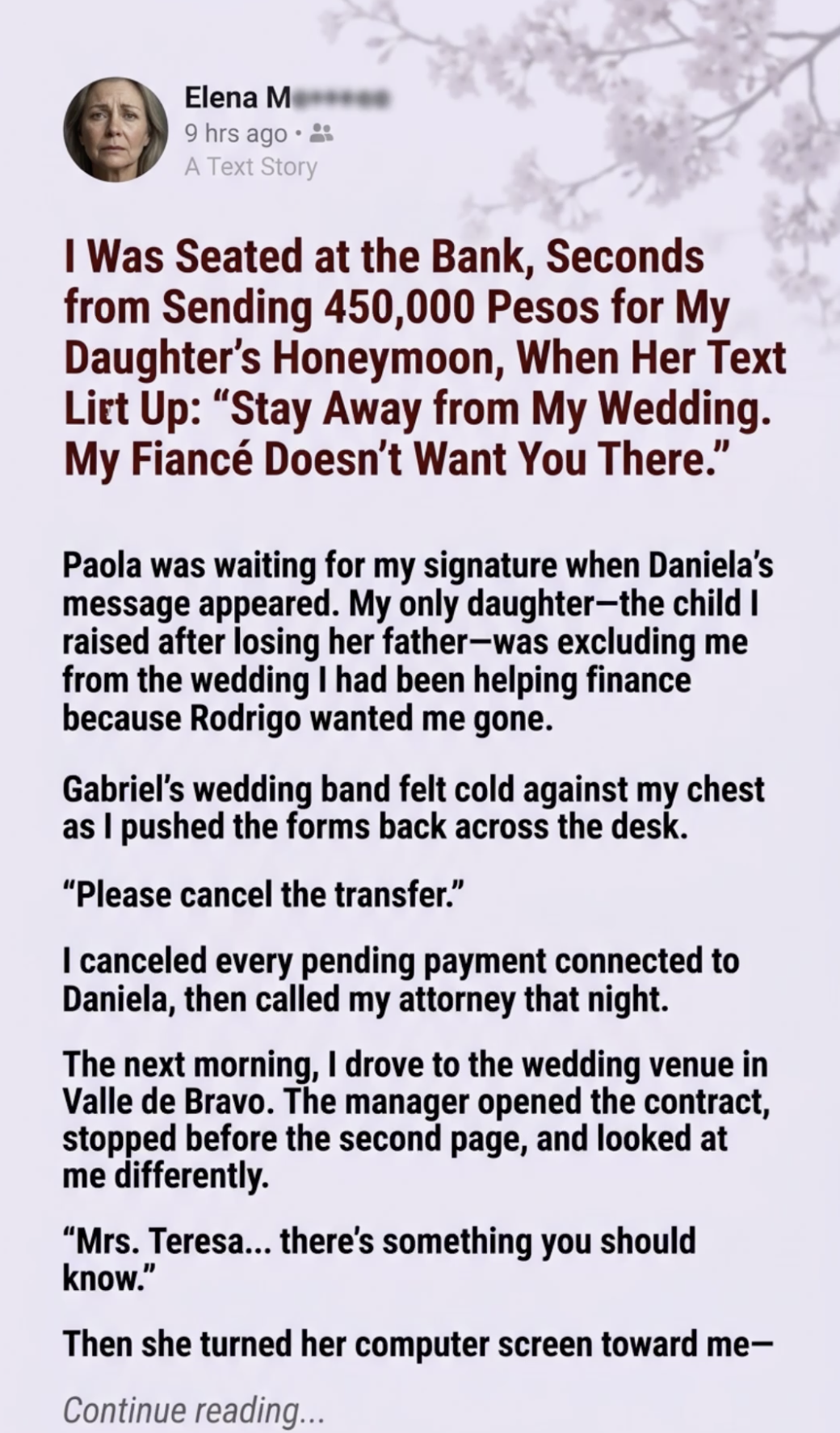
The message arrived while I was sitting inside a private office at the bank, seconds away from transferring 450,000 pesos to pay for my only daughter’s honeymoon.
I had spent months saving for that moment.
My daughter, Daniela, was getting married to a man named Rodrigo, and I wanted her wedding to be beautiful. Her father, Gabriel, had been dead for seventeen years, and ever since I lost him, I had made one promise to myself: Daniela would never feel that she had to face the world alone.
I raised her by myself, working long hours, sacrificing holidays, and putting aside money whenever I could. When she became engaged, I offered to help with the wedding expenses. When she mentioned the honeymoon, I volunteered to pay for that, too.
I thought I was giving my daughter a gift she would remember for the rest of her life.
Then my phone lit up.
Daniela: Stay away from my wedding. My fiancé doesn’t want you there.
I read the message once.
Then again.
For a moment, I couldn’t breathe.
Paola, the bank employee sitting across from me, glanced up from the transfer paperwork.
“Mrs. Teresa? Is everything all right?”
I looked at the screen, hoping the words would somehow rearrange themselves into something less cruel.
They didn’t.
I typed a response.
Daniela, what are you talking about? I’m your mother.
Three dots appeared, disappeared, and appeared again.
Then another message arrived.
Daniela: Don’t make this difficult. Rodrigo wants his wedding to be about us, not your emotions. You’ve already helped enough. Just stay away.
My fingers went numb.
I had paid the deposit for the wedding photographer. I had contributed toward the reception. I had helped arrange flowers, transport, and accommodations for relatives traveling from out of town.
And now, because Rodrigo didn’t want me there, my own daughter was telling me to stay away from the wedding I had spent months helping finance.
I looked down at the wedding band hanging from the chain around my neck.
It had belonged to Gabriel.
I touched it with my thumb, remembering the man who had once promised me that no matter what happened, our daughter would always know she was loved.
Then I pushed the paperwork back across the desk.
“Please cancel the transfer.”
Paola blinked.
“All of it?”
“All of it.”
She looked at the amount on her screen.
“Would you like a moment to reconsider?”
“No,” I said quietly. “I have reconsidered enough.”
I canceled the honeymoon transfer and asked the bank to identify any other pending payments connected to Daniela’s wedding that I could legally stop. I reviewed each one carefully, making sure I understood which transactions had already been completed and which remained under my control.
By the time I left the bank, my hands were steady.
My heart wasn’t.
That night, I barely slept.
I sat at the kitchen table with Gabriel’s wedding band in my palm and tried to understand how the little girl who used to fall asleep against my shoulder had become a woman who could send such a message.
I remembered Daniela at six, crying because she had lost a school competition.
I remembered her at thirteen, asking me whether her father would have been proud of her.
I remembered her at twenty-one, telling me she wanted to build a career and become independent.
And I remembered her at thirty, standing in my living room with Rodrigo beside her, announcing their engagement.
Rodrigo had always been polite in public. He smiled when relatives were watching and called me “Doña Teresa” with exaggerated respect.
But over the previous year, small things had begun to trouble me.
He interrupted me whenever I spoke about Daniela’s childhood. He made jokes about my age. He complained that I called my daughter too often, even though we had spoken almost every day before he came into her life.
When I offered to pay for the wedding flowers, he insisted on choosing them himself.
When I suggested a family dinner before the ceremony, he said there was no point in inviting people who would only create unnecessary drama.
I had dismissed those comments as ordinary disagreements between a mother and her future son-in-law.
I didn’t want to be the overprotective mother who couldn’t accept that her daughter was growing up.
But now, sitting alone in my kitchen, I wondered how many warnings I had ignored because I wanted Daniela to be happy.
At eleven that night, I called my attorney, Licenciada Morales.
She had helped Gabriel and me prepare our estate documents years earlier, and after his death, she had guided me through the legal and financial decisions involved in raising Daniela alone.
When I explained what had happened, she listened without interrupting.
“Teresa,” she said when I finished, “you need to separate two things. Your daughter’s decision about who attends her wedding is one matter. The money you’ve agreed to provide is another. You are not obligated to make every payment simply because you’ve already offered to help.”
“What if she’s doing this because Rodrigo is pressuring her?”
“That is possible, but we should not assume it without evidence. What we can do is review the contracts, identify which payments remain yours to control, and make sure you don’t accidentally create a legal problem by canceling something you’ve already agreed to.”
I took a breath.
“There’s something else. I want to visit the wedding venue tomorrow.”
“Why?”
“Because I paid for part of it, and I want to know exactly what I signed.”
She paused.
“Then let’s start there. Bring me every document you have. Don’t sign anything else, and don’t make any accusations until we understand the facts.”
The following morning, I drove to Valle de Bravo.
The wedding venue was a beautiful estate overlooking a lake, surrounded by trees and gardens. Daniela had chosen it because she said it reminded her of the places she and her father used to visit when she was little.
When I first saw it, I had imagined Gabriel standing beside her as she walked toward the ceremony, smiling the way he used to smile whenever she accomplished something important.
Now the thought hurt so much that I had to sit in the car for several minutes before getting out.
I walked into the reception office and asked to speak with the manager.
A woman in her fifties introduced herself as Elena. She was professional and courteous, and when I gave her my name, she immediately recognized it.
“Mrs. Teresa,” she said. “I was wondering when you might come in.”
The words made me uneasy.
“Why?”
She glanced toward the office door.
“Because there’s something about your daughter’s wedding arrangements that I believe you should know.”
She asked me to sit down, then opened the contract on her computer.
I recognized my signature on the first page.
It was the agreement I had signed months earlier when I offered to help secure the venue.
Elena scrolled down to the second page.
Then she stopped.
Her expression changed.
“Mrs. Teresa, before I show you the rest, I need to clarify something. You were listed as the person responsible for several payments. However, the instructions we received later were different from the original agreement.”
“What instructions?”
She turned the screen toward me.
A note had been added to the account, dated three weeks earlier.
It stated that I was no longer to be contacted about wedding arrangements and that all future communications should be directed exclusively to Rodrigo.
Beneath it was a message attributed to him.
The bride’s mother is emotionally unstable and must not be allowed to interfere with the event. She has agreed to provide financial support without attending. Please ensure she is not admitted to the ceremony or reception.
I stared at the words.
“I never agreed to that.”
Elena nodded.
“I understand. That’s why I wanted to speak with you.”
She opened another document.
It was an email chain between the venue and Rodrigo. In it, he had requested that my name be removed from the guest list while leaving the financial arrangements unchanged.
He had also asked whether the venue could prevent me from entering the property if I arrived on the wedding day.
My throat tightened.
“He wanted me to pay for a wedding I wasn’t allowed to attend.”
Elena lowered her eyes.
“That is what the correspondence appears to indicate.”
I gripped the edge of the desk.
“Did Daniela know?”
“I can’t answer that. Some of the messages were sent only by Rodrigo, and others included your daughter. I don’t want to draw conclusions beyond what the records show.”
She clicked on one more attachment.
It was a revised seating plan.
My name had been removed from the family table and replaced with the name of Rodrigo’s business partner.
Beside the plan was a note.
The bride’s mother should not be mentioned during the reception. We don’t want questions about her absence.
For several seconds, I could not speak.
Then I noticed the date.
The seating plan had been created before Daniela sent me the message telling me to stay away.
This was not a sudden argument.
Someone had been planning my exclusion while still expecting my money.
“May I have copies of these documents?” I asked.
“Of course,” Elena replied. “We can provide copies of the records associated with your account, subject to our privacy and contractual obligations.”
I thanked her.
Before I left, she showed me the payment schedule. Several charges had already been paid, but other services remained outstanding. Some payments were connected to my own agreement, while others belonged to Daniela and Rodrigo.
I photographed nothing without permission and took only the documents the venue authorized me to receive.
Then I called Licenciada Morales.
“I think you were right to tell me to look at the paperwork,” I said. “I found something.”
When I explained the messages, she became quiet.
“Bring those records to my office. We’ll review them carefully. And Teresa, please don’t confront Rodrigo alone. Let us establish what was agreed, what can be canceled, and what you’re legally responsible for.”
That afternoon, I sat across from her in a small office filled with law books and filing cabinets.
She reviewed the venue contract, the transfer records, and the correspondence.
“The evidence shows that Rodrigo communicated instructions about your exclusion while your financial contribution was still expected,” she said. “That is deeply concerning. But we need to distinguish between what is morally wrong and what is legally actionable.”
“What can I do?”
“First, we will formally notify the venue that you dispute any claim that you agreed to withdraw from the event while continuing to fund it. Second, we’ll review the services you personally contracted for and the terms for cancellation. Third, we’ll ask for a written accounting of the amounts paid, the amounts outstanding, and any refunds available under the agreement.”
She looked at me carefully.
“You have every right to stop and reassess a gift. But we should not assume you can recover money already spent or cancel obligations that belong to someone else.”
I nodded.
For the first time since receiving Daniela’s message, I felt that I was doing something constructive instead of simply reacting to pain.
Over the next two days, Licenciada Morales contacted the venue and requested a formal accounting. She also asked that all future instructions concerning my contractual responsibilities be confirmed in writing.
Elena cooperated.
The records revealed that Rodrigo had requested several upgrades to the wedding package after the original agreement had been signed. These included additional lighting, a more expensive bar service, and a private lounge for his business associates.
He had told the venue that the additional costs would be covered by me.
I had never authorized those upgrades.
The venue confirmed that they had not yet charged my account for the extra services. Once the discrepancy was brought to their attention, they agreed to separate the charges from my original contract and seek authorization from the people who had actually requested them.
That alone saved me from paying thousands of pesos in expenses I had never approved.
But the most troubling discovery came from a message sent by Rodrigo to the venue coordinator.
Teresa is paying because she feels guilty about not giving Daniela the family she deserves. As long as we keep her calm, she won’t question the expenses.
I read that sentence several times.
Guilty.
That was what he thought motivated me.
He believed I was trying to compensate for Gabriel’s death by buying my daughter’s happiness. He believed my love made me easy to manipulate.
And perhaps, in some ways, I had allowed that to happen.
I had paid for things I could barely afford because I wanted Daniela to have the wedding she dreamed of. I had ignored comments that hurt me because I didn’t want to create tension. I had told myself that being generous meant never keeping score.
But generosity without boundaries can become an invitation for someone else to take advantage.
I had learned that lesson too late to prevent every loss.
I did not intend to learn it twice.
On the third day, Daniela called.
“Mom, what have you done?”
Her voice was sharp and frightened.
“What do you mean?”
“Rodrigo says the venue has been asking questions about the payments. They said some services are no longer covered. Why did you cancel the honeymoon transfer?”
I sat down.
“Because you told me to stay away from your wedding.”
There was silence.
“I was upset when I sent that message.”
“Your fiancé had already asked the venue to remove me from the guest list. He told them I was emotionally unstable and that I should not be allowed on the property. He also told them to keep accepting my money.”
Daniela said nothing.
“Did you know about that?” I asked.
“I knew Rodrigo wanted a smaller family group. I didn’t know he had said those things.”
“Did you know he had removed my name from the seating plan?”
“No.”
“Did you know he had told the venue I would pay for extra services I never approved?”
Another silence.
Then she whispered, “No.”
I closed my eyes.
“Daniela, I need you to understand something. I am not canceling my love for you. I am not trying to ruin your wedding. But I will not finance an event where I have been deliberately excluded and misrepresented.”
“Rodrigo says you’re trying to control us with money.”
“Then he should have no objection to paying for the things he wants himself.”
“Mom, please. The wedding is in four days. Everyone has already made plans.”
“I know.”
“If you withdraw the money, people will think I can’t afford my own wedding.”
I felt a wave of sadness.
“Then tell them the truth. Tell them which expenses you can afford and which you cannot. A wedding is one day, Daniela. Your marriage is supposed to last much longer.”
She began to cry.
For a moment, I wanted to comfort her the way I always had. I wanted to say that I would fix everything, transfer the money, and pretend none of this had happened.
But I remembered the message on my phone.
Stay away from my wedding.
I had to let my daughter face the consequences of her own decisions.
“I love you,” I said. “But I won’t be treated as a source of money instead of a person.”
She hung up.
That evening, Licenciada Morales called with an update.
The venue had completed its review. My original agreement covered a specific set of services, and I remained responsible for the charges properly authorized under that contract. However, the additional upgrades Rodrigo had requested were not my responsibility because I had never approved them.
The venue also confirmed that a portion of the advance payment was refundable under the cancellation terms, while other amounts had already been spent on nonrefundable services.
My attorney explained the exact figures and the process for recovering the refundable portion. I followed her advice, signed the necessary documents, and made sure that no remaining payment would be taken from my account without proper authorization.
I did not demand that the wedding be canceled.
I did not contact the guests.
I did not publish the messages online or try to humiliate my daughter.
I simply withdrew the financial support I had never agreed to provide under those conditions and allowed the couple to decide how they would proceed.
The following morning, Daniela arrived at my house.
She looked exhausted. Her eyes were swollen, and she was still wearing the engagement ring Rodrigo had given her.
“Can we talk?” she asked.
I stepped aside.
She sat at the kitchen table where she had done her homework as a little girl. I made tea, but neither of us touched it.
“Rodrigo is furious,” she said.
“I’m sorry you’re dealing with that.”
“He says you made him look dishonest.”
I looked at her.
“Did I?”
She lowered her eyes.
“He said the venue misunderstood him.”
“Daniela, the messages were in writing.”
“I know.”
She covered her face with her hands.
“I didn’t realize how much he had done behind my back.”
I waited.
“At first, he said he wanted the wedding to be smaller because he didn’t want arguments between families. Then he said you might make things emotional because you still wear Dad’s ring and talk about him. He said I needed to focus on my new life.”
My heart ached.
“Did you agree with him?”
She wiped her cheeks.
“I told myself he was just stressed. I thought if I asked you to stay away, we could avoid a fight. I didn’t think about what it would mean to you.”
I reached for my cup.
“You didn’t think about how it would feel to be excluded from your own daughter’s wedding after helping pay for it.”
She nodded.
“I was selfish.”
The word hung between us.
I had waited years to hear Daniela acknowledge that she could hurt someone. But hearing it now did not make the hurt disappear.
“Do you still want to marry him?” I asked.
She looked startled.
“Of course I do.”
“Then you need to be honest with yourself about the person you’re marrying. I’m not going to tell you what decision to make. But I won’t pretend these messages are harmless.”
She stared at the table.
“He’s been telling me that once we’re married, I won’t need to worry about money. He says he has plans for his business and that everything will be easier.”
“Does he have the money to pay for the wedding?”
“He says he does, but some of it is tied up in his company.”
“Have you seen the accounts?”
She shook her head.
“Have you discussed debts, loans, and financial obligations?”
“No.”
I took a slow breath.
“Then you have important questions to answer before you marry him. Love does not require you to close your eyes.”
Daniela began crying again.
“I don’t know what to do.”
For the first time in days, I reached across the table and held her hand.
“You don’t have to decide everything this minute. But you do have to decide whether you are willing to enter a marriage where you feel afraid to disagree with your husband.”
She looked at me for a long time.
Then she whispered, “I’m sorry, Mom.”
I squeezed her hand.
“I believe you’re sorry. But an apology is the beginning of repairing something, not the end.”
She stayed for another hour. We talked about her father, the wedding, and the ways our relationship had changed since Rodrigo came into her life.
Before she left, she asked me a question I had not expected.
“If I still get married, will you come?”
I felt the old ache return.
“That depends on what happens next,” I said. “I won’t attend an event where I’m treated as an embarrassment. But if you genuinely want me there, and we can agree on respectful boundaries, we can talk about it.”
She nodded.
“I understand.”
After she left, I stood in the kitchen for a long time.
I wanted to believe that the conversation meant everything would be all right. But I had learned not to confuse a moment of remorse with lasting change.
The next two days were difficult.
Daniela and Rodrigo argued. Some relatives called me, confused about the wedding expenses. I answered only what was necessary and refused to discuss private messages with people who had no part in the matter.
I also refused to transfer the honeymoon money simply to end the conflict.
The money remained in my account.
It was not a punishment. It was a boundary.
On the evening before the wedding, Daniela called again.
This time, she sounded calmer.
“Mom, I need to tell you something.”
“I’m listening.”
“I asked Rodrigo to show me the financial records for the wedding and his business. He became angry and said I was choosing you over him.”
I said nothing.
“He told me I was being manipulated. Then he said that if I couldn’t trust him, there was no point in getting married.”
My stomach tightened.
“What did you say?”
“I told him that if our marriage depended on me never asking questions, then we weren’t ready to get married.”
I closed my eyes.
“What happened?”
“He left.”
I wanted to ask whether he had returned, whether she was safe, and whether she needed me to come over. Instead, I let her continue.
“He’s staying with a friend tonight. I don’t know whether the wedding will happen tomorrow.”
“How do you feel?”
She was quiet.
“Scared,” she admitted. “But also relieved.”
I sat down.
“Those feelings can exist together.”
“Mom, I don’t know if I can go through with this.”
“Then don’t make the decision because of the money, the guests, or the embarrassment. Make it because you understand what you’re choosing.”
She began to cry softly.
“I wish Dad were here.”
I pressed Gabriel’s wedding band against my chest.
“So do I, sweetheart.”
We stayed on the phone for nearly an hour.
I did not tell her to cancel the wedding. I did not tell her to forgive Rodrigo. I simply listened as she tried to separate the future she had imagined from the reality she was beginning to see.
The next morning, I woke before sunrise.
For a few minutes, I lay in bed wondering whether Daniela would call. Then I got up, dressed, and made coffee.
At nine o’clock, my phone rang.
It was Elena, the venue manager.
“Mrs. Teresa,” she said, “I wanted to let you know that the couple has postponed the ceremony. They contacted us early this morning.”
I closed my eyes.
“Thank you for telling me.”
“There is one other thing,” she added. “Daniela asked us to keep your original seat at the family table reserved if they reschedule the wedding.”
I could not speak for a moment.
Then I thanked her and hung up.
Daniela called shortly afterward.
“Mom, I’m not getting married today.”
Her voice trembled.
“I told Rodrigo I needed time. He said I was ruining everything. I told him that I couldn’t marry someone I was afraid to question.”
I leaned against the kitchen counter.
“Are you safe?”
“Yes. I’m at home. My cousin is coming to stay with me.”
“Good.”
“I’m sorry I told you to stay away.”
I closed my eyes.
“I know.”
“I should never have sent that message. I was so focused on making Rodrigo happy that I forgot what you have done for me my entire life.”
I felt tears rise.
“I don’t need you to repay me for raising you, Daniela. I did that because I love you. But I do need you to understand that love doesn’t mean I have to accept disrespect.”
“I understand.”
“Do you?”
She was silent for several seconds.
“I think I’m beginning to.”
That was enough for the moment.
The weeks that followed were not easy. Daniela had to explain the postponement to relatives and friends. She felt embarrassed, angry, and frightened about what the future might hold. Rodrigo sent messages insisting that she had overreacted, then messages promising that he would change, then messages blaming me for interfering.
Daniela did not rush to answer them.
She began meeting with a counselor and reviewing her finances independently. She also asked Licenciada Morales for a referral to an attorney who could advise her about any financial arrangements she had entered into with Rodrigo.
I made it clear that I would support her emotionally, but I would not take over her decisions.
Slowly, she began to see the difference between being supported and being rescued.
Several months later, Daniela told me she had ended the engagement.
She did not make the decision because of the wedding payments alone. She made it after recognizing a pattern of pressure, secrecy, and attempts to isolate her from people she trusted.
She told me that Rodrigo had repeatedly described my grief over Gabriel as a weakness he could use to influence me. He had also encouraged her to treat my financial help as an obligation rather than a gift.
The venue’s records had been the first concrete evidence that forced her to question what he had been telling her.
“I’m sorry I didn’t listen when you tried to warn me,” she said one afternoon as we sat together in my living room.
“I didn’t know everything either,” I replied. “We both have things to learn.”
She looked down at Gabriel’s wedding band, which I had placed on the table beside my tea.
“Do you think Dad would have liked Rodrigo?”
I considered the question.
“I think your father would have wanted you to be happy. And I think he would have wanted you to feel safe enough to be yourself.”
Daniela nodded.
For the first time in a long while, she smiled without looking over her shoulder to see whether someone approved.
A year later, she was rebuilding her life. She returned to a career she had put aside during the engagement, reconnected with old friends, and learned to make financial decisions without feeling that she had to justify every question.
Our relationship did not return to exactly what it had been before Rodrigo. It became something different—more honest, more adult, and more respectful of the fact that both of us could make mistakes.
I eventually used part of the money I had saved for the honeymoon to renovate my home and set aside a little more for retirement. I did not regret offering to help Daniela. I regretted only that I had allowed my generosity to become something others felt entitled to control.
As for the wedding venue, the original contract was resolved according to its terms. The refundable portion of my advance was returned, and the venue handled the other outstanding arrangements with the appropriate parties. I did not recover every peso, but I no longer felt that I had to spend more money to prove that I was a good mother.
One evening, Daniela came over for dinner.
After we ate, she helped me clear the table and noticed the green folder where I kept the old wedding documents.
“Do you still think about that day at the bank?” she asked.
“Sometimes.”
“Do you wish you had transferred the money?”
I looked at her.
“No. I wish you hadn’t felt that you needed to choose between pleasing Rodrigo and respecting me. But I’m glad I stopped before sending the money.”
She lowered her eyes.
“So am I.”
I reached for her hand.
“Daniela, I would have helped you celebrate your marriage. I would have helped you build a home. If you had needed support during a difficult time, I would have been there. None of that was the problem.”
“What was?”
“The moment you believed my love meant I could be excluded, insulted, and still expected to pay without question.”
She nodded slowly.
“I understand now.”
I hoped she did.
Because the greatest lesson I learned was not that I should never help my daughter again. It was that love and boundaries can exist together.
I could love Daniela without paying for every decision she made. I could support her without taking responsibility for her relationship. I could forgive her without pretending her words had not hurt me.
And I could remember Gabriel without using his absence as a reason to sacrifice myself endlessly.
I still wear his wedding band on a chain around my neck. Sometimes, when I touch it, I remember the promise we made to raise our daughter with love and courage.
I believe we did our best.
I also believe that raising a child means eventually allowing her to make decisions you cannot make for her, even when those decisions break your heart.
That day at the bank, I thought I was canceling a honeymoon payment.
In truth, I was finally refusing to pay for the illusion that everything was fine.
And when the wedding venue manager turned her computer screen toward me, she gave me something I had not realized I needed: proof that my instincts were not simply the fears of a grieving mother who couldn’t let go.
They were a reason to stop, ask questions, and protect what remained of my peace.
I lost money that day.
I lost the wedding I had imagined for my daughter.
But I did not lose her forever.
And I did not lose myself trying to keep her happy.
Sometimes, the most loving thing a mother can do is open her arms.
Sometimes, it is to step back and say, gently but firmly, “I love you. But I will not let you turn my love into permission to hurt me.”