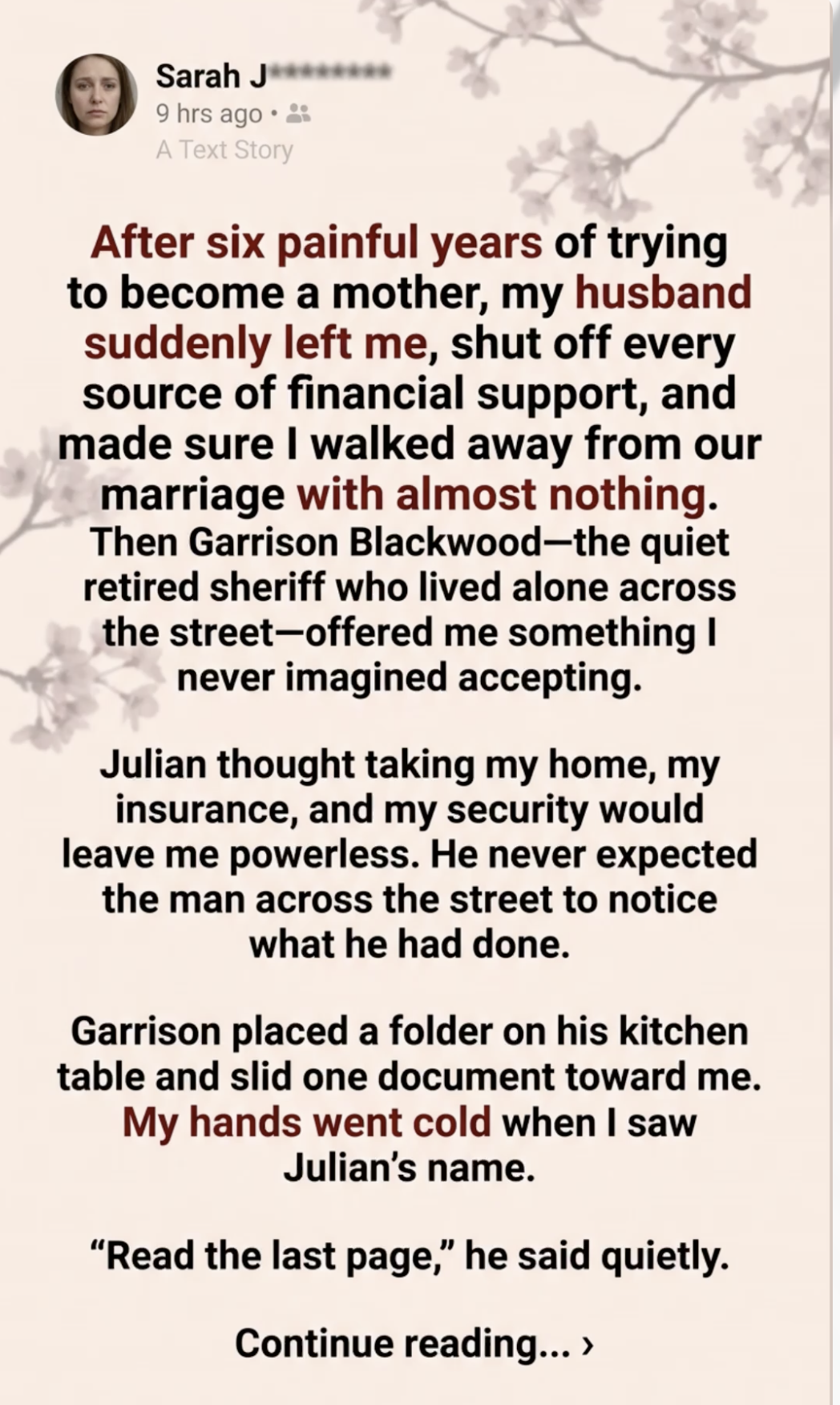
For six years, I had done everything I could to become a mother.
I had swallowed pills that made me nauseous, endured injections that left bruises across my stomach, and sat in fertility clinic waiting rooms surrounded by couples who looked as frightened as I felt. I had learned to recognize the difference between a hopeful silence and a doctor preparing to deliver bad news.
Every month, I told myself that the next treatment might work.
Every month, I tried to believe that my husband, Julian, and I were still a team.
And every month, I watched another little piece of the life I had imagined slip through my fingers.
Julian used to hold me when the pregnancy tests came back negative. He used to kiss my forehead and whisper, “We’ll get through this together, Claire.”
I believed him.
That was my first mistake.
My second was believing that the vows we exchanged meant the same thing to him that they meant to me.
The day Julian left, it was raining.
I remember that because the sound of water tapping against the kitchen window was the only thing that kept the room from feeling completely silent.
He stood beside the counter wearing his expensive navy suit, checking his phone while I sat at the table with a stack of medical bills.
“We need to talk,” he said.
I looked up immediately.
After six years of fertility treatments, those four words had become a source of dread. They could mean a new diagnosis, another financial setback, or another difficult decision.
I never imagined they would mean the end of my marriage.
“I can’t do this anymore,” Julian continued.
I stared at him. “Do what?”
He slipped his phone into his pocket.
“All of it. The appointments. The disappointment. The constant waiting for something that might never happen.”
My fingers tightened around the edge of the bill in front of me.
“We agreed we would keep trying.”
“I agreed because I thought it would work eventually.”
The cruelty of that sentence was almost too ordinary to understand.
I waited for him to soften it, to explain that he was tired or scared or overwhelmed.
Instead, he glanced toward the hallway, where our wedding photograph still hung on the wall.
“I want a divorce, Claire.”
For several seconds, I couldn’t speak.
“Is there someone else?”
He didn’t answer quickly enough.
That was all the answer I needed.
“How long?” I whispered.
“It doesn’t matter.”
“It matters to me.”
Julian exhaled impatiently. “I’m not going to spend the rest of my life discussing every mistake I’ve made. I’ve already decided.”
I looked at the man I had loved for nine years and searched for the person who used to hold my hand in the fertility clinic.
I couldn’t find him.
“What am I supposed to do?” I asked.
“You’ll figure something out.”
Then he picked up his suitcase.
He had apparently packed it before coming home.
That detail hurt more than I expected. While I had been trying to decide whether we could afford another round of treatment, Julian had been preparing his departure.
At the front door, he turned back.
“The house is in my name, Claire. The insurance is through my employer. The accounts are mine. You should talk to a lawyer if you want to argue about any of that.”
Then he walked out.
I watched his car disappear down the street.
I didn’t cry immediately. I simply sat at the kitchen table until the rain stopped, surrounded by medical bills for a future that would never arrive.
The following week, I discovered how thoroughly Julian had prepared to leave me with nothing.
Our joint checking account had been emptied except for a few dollars. The credit card I used for groceries and prescriptions was declined at the pharmacy. When I called the health insurance company, I learned that my coverage through Julian’s employer was ending under the terms of the plan, subject to the applicable continuation and enrollment rules.
He had also arranged for the mortgage payments to come directly from an account I could no longer access.
The house was where I had spent six years hoping to raise a child. Now, according to the paperwork Julian had sent through his attorney, I was expected to leave it.
I had a small amount of money in my personal savings, but most of what I had earned during our marriage had gone toward fertility treatments, household expenses, and the life Julian had insisted we were building together.
I had reduced my hours at work to accommodate appointments. I had turned down a promotion because it required travel. I had believed that when the time came for me to return to full-time work, I would be doing it as a mother.
Instead, I was forty-one years old, facing divorce, struggling to pay for medical care, and wondering whether I would have enough money to rent a room.
Julian had made his decision.
And he expected me to disappear quietly.
Across the street lived Garrison Blackwood, a retired sheriff who had been a familiar presence in our neighborhood for nearly a decade.
He was in his late sixties, broad-shouldered despite his age, with silver hair and a face that rarely gave away what he was thinking. He lived alone in a modest brick house with a neatly trimmed lawn, an old pickup truck, and a porch light he turned on every evening before sunset.
Most people considered him reserved.
He wasn’t unfriendly, exactly. He simply didn’t speak unless he had something worth saying.
I had exchanged occasional greetings with him over the years. He had helped me carry groceries once when I slipped on an icy sidewalk, and he had repaired a section of our shared fence after a storm.
When Julian and I struggled through our first failed fertility treatment, Garrison had quietly left a basket of fresh vegetables on our porch.
There had been no note.
When I thanked him later, he only shrugged.
“Garden produces more than one old man needs.”
That was the sort of person he was.
He noticed things without making a performance of noticing them.
After Julian left, I tried to keep my life looking normal.
I still opened the curtains every morning. I still watered the flowers beside the front steps. I still smiled at neighbors who asked how I was doing.
But my world had become smaller with every passing day.
I stopped driving unless absolutely necessary. I turned off the heating in rooms I wasn’t using. I sold jewelry I had received as wedding gifts and began searching for inexpensive apartments.
One afternoon, I was sitting on the front steps with a stack of unopened letters when Garrison crossed the street.
He stopped a few feet away.
“You’ve lost weight,” he said.
I tried to laugh. “Divorce diet.”
He didn’t smile.
“Have you eaten today?”
“I’m fine.”
He looked at the letters beside me, then at the dark windows of the house behind me.
“That’s not what I asked.”
Something in his voice made my carefully constructed composure crumble.
I pressed my fingers against my eyes.
“I don’t know what I’m going to do, Garrison.”
He sat on the step below me without asking permission.
For a long moment, neither of us spoke.
Then I told him everything.
I told him about the empty accounts, the insurance, the house, and Julian’s demand that I leave. I told him how ashamed I felt asking anyone for help after spending years insisting that my marriage was fine.
Most painfully, I told him about the children we had never had.
“I know it sounds foolish,” I whispered, “but I still feel as if I’ve failed at something. Julian made it sound like my inability to get pregnant was the reason he stopped loving me.”
Garrison turned his head toward me.
“Claire, listen carefully. You did not fail because you couldn’t give someone a child. And you didn’t deserve to be abandoned because your life became difficult.”
I looked at him through my tears.
“He said he couldn’t spend his life waiting.”
“Then he should have had the courage to say that honestly before he built a life around your sacrifices.”
I had no answer.
Garrison stood and brushed the dust from his trousers.
“Come over tomorrow afternoon,” he said. “There are some things I want you to see.”
“What things?”
“Paperwork.”
I almost laughed.
I had spent weeks drowning in paperwork. I had no desire to see another document.
But something about his expression stopped me from refusing.
The next afternoon, I crossed the street and entered Garrison’s house.
It smelled of coffee, old books, and cedarwood. The furniture was simple, the floors immaculate, and framed photographs lined the hallway. Most showed Garrison in uniform beside people whose names I didn’t know.
He led me to the kitchen.
A thick brown folder sat in the middle of the table.
“Sit down,” he said.
I did.
Garrison opened the folder and removed several documents. He arranged them carefully, as though he had spent a long time deciding where each one belonged.
Then he slid a single sheet toward me.
My eyes moved across the page.
And stopped.
Julian’s name appeared near the top.
Below it was the name of a company I recognized from conversations I had overheard at home: Blackwood Property Holdings.
I looked up sharply.
“What is this?”
“Read the last page,” Garrison said quietly.
My hands went cold.
The document appeared to be a copy of a financial agreement connected to a property investment made several years earlier. It included a list of payments, a description of a property, and a signature acknowledging a substantial financial obligation.
Julian’s signature was unmistakable.
I turned the page.
Then I reached the final sheet.
It was an acknowledgment of a private loan made by Garrison’s late brother, Thomas Blackwood, to Julian’s business venture.
The amount was $180,000.
I stared at it.
“Julian borrowed this from your brother?”
“That’s what the agreement says.”
“But why have I never heard about it?”
Garrison pulled out a chair and sat opposite me.
“Because Julian wasn’t eager for you to hear about it.”
He explained that his brother Thomas had owned a small commercial property several miles outside town. Before Thomas died, he had agreed to lend Julian money to help him purchase equipment and expand a construction business.
The agreement had been signed by Julian and witnessed by an attorney. Repayment was supposed to begin after the business reached a specified financial milestone.
Thomas had died before the arrangement was resolved.
Garrison had inherited his brother’s personal records, including the original agreement, payment correspondence, and a series of letters exchanged with Julian.
For a while, Garrison had assumed the matter would be settled through the estate.
Then he learned that Julian had represented himself as having no significant financial obligations while negotiating the terms of our separation.
Garrison’s expression hardened.
“I came across the documents while organizing Thomas’s estate. I recognized Julian’s name, so I checked the dates. Some of his statements about his finances didn’t match what was in the file.”
I looked down at the agreement again.
“Are you saying Julian lied about his money?”
“I’m saying there are questions that need to be answered.”
He wasn’t making accusations. He was showing me evidence and allowing me to understand it for myself.
That distinction mattered.
I turned to the final paragraph. It referred to the outstanding balance and described the conditions under which the loan could be called due.
But what frightened me most was the signature beneath it.
Julian had signed the agreement just three months before he began telling me that we couldn’t afford another fertility treatment.
I remembered those conversations with terrible clarity.
He had sat beside me on the couch and complained about the cost of medication. He had told me that we needed to be realistic about our finances. He had suggested that my treatments were placing too much strain on our future.
And all the while, he had been managing a business loan I knew nothing about.
“Why are you showing me this?” I asked.
Garrison folded his hands.
“Because I don’t believe you should walk away from your marriage without understanding your legal rights. And because I don’t like watching someone use money to make another person feel powerless.”
I swallowed.
“Can this help me get the house back?”
“Maybe. Maybe not. That isn’t something I can promise you.” He tapped the folder. “A debt to my brother’s estate doesn’t automatically make you the owner of anything. But if Julian has concealed assets, misrepresented finances, or left out obligations that affect the divorce, your attorney needs to know. The court can only make fair decisions when it has accurate information.”
For the first time in weeks, I felt something other than fear.
Not hope, exactly.
Possibility.
Garrison pushed a business card across the table.
“That’s an attorney who handled some of Thomas’s estate matters. She isn’t my lawyer anymore, and she doesn’t owe me any favors. But she’s thorough. If you want, you can call her and ask whether she can review your situation.”
I picked up the card.
“Why would you do this for me?”
He looked toward the window.
For a moment, the stern lines of his face seemed to soften.
“Because I once watched someone I cared about lose everything while the person responsible convinced everyone she was the problem.”
He paused.
“I can’t change what happened to her. But I can choose what I do when I see something similar happening again.”
I didn’t ask who he meant.
I wasn’t sure I could have handled another person’s tragedy that afternoon.
Instead, I gathered the documents with trembling hands and promised to make the call.
That evening, I sat at the kitchen table in my nearly empty house and read every page again.
For the first time since Julian had left, I wasn’t merely reacting to what he had done.
I was preparing to find out the truth.
The attorney’s name was Evelyn Price.
She met me two days later in a small office above a pharmacy. She was in her fifties, with dark-framed glasses, a calm voice, and a way of listening that made me feel I didn’t need to defend every emotion I had.
I brought everything I possessed: Julian’s divorce proposal, bank statements, insurance notices, the mortgage information, and Garrison’s folder.
Evelyn reviewed the documents without interrupting.
Then she began asking questions.
Had I signed any agreements waiving my rights to marital property?
Had Julian disclosed all his business interests?
Did I know whether the money he had borrowed had been used for his company, household expenses, or investments?
Were there records showing when our joint accounts had been emptied?
I answered as honestly as I could.
When she finished, she removed her glasses.
“Claire, I want to be clear about something. These documents do not guarantee that you’ll receive the house, and they do not establish that Julian committed fraud. We need records, not assumptions. But there are enough inconsistencies here that I would not advise you to accept his proposed settlement.”
I felt my chest tighten.
“So I don’t have to leave immediately?”
“Not simply because he says so. We need to examine the title, the mortgage, your state’s marital-property laws, and any court orders that apply. Until we understand your rights, don’t sign anything or surrender possession of the house voluntarily without legal advice.”
I almost cried with relief.
For weeks, Julian’s attorney had written as if my future were already decided. I had mistaken the confidence of those letters for authority.
Now someone was telling me that I still had choices.
Evelyn sent formal requests for financial disclosure. She asked for business records, bank statements, loan documentation, and information about assets acquired during the marriage.
She also advised me to document the loss of my insurance coverage and investigate lawful continuation options or replacement coverage so that my medical care wouldn’t be left entirely to chance.
The process was slow.
Julian responded with irritation, then anger.
He called me one evening.
“What are you doing?” he demanded.
I was standing in the kitchen, holding a mug of tea.
“I’m following my attorney’s advice.”
“You’re dragging this out.”
“You sent me a settlement that would leave me without enough money to pay rent. I think I deserve to understand our finances.”
There was a long silence.
Then he laughed without humor.
“You’ve always been emotional, Claire. That’s why I handled the money.”
The words struck me, but they no longer had the power they once did.
“You handled the money because I trusted you,” I replied. “That wasn’t permission to hide things from me.”
“You have no idea what you’re talking about.”
“Then the financial disclosure should clear everything up.”
He hung up.
I stood there shaking.
But this time, I wasn’t ashamed of the trembling. I was angry, and my anger was finally pointing in the right direction.
Over the next several weeks, Evelyn obtained records that raised more questions.
Julian had received money through his company during our marriage. Some funds had been transferred between business and personal accounts, and the timing of certain transfers required clarification. There were also documents suggesting that a portion of the business’s value might not have been properly addressed in his initial financial disclosures.
None of those facts, by themselves, proved wrongdoing.
But together, they made it impossible to accept Julian’s claim that he had nothing meaningful to divide.
The loan from Thomas’s estate also became relevant to the broader financial picture. Evelyn contacted the estate’s representative and confirmed the outstanding balance and the terms of the agreement.
Garrison provided copies of the records he had found, but he did not interfere with the case. He refused to embellish what he knew or speculate about what Julian intended.
“Facts are enough,” he told me one afternoon. “You don’t need to make someone look worse than the evidence already shows.”
I began to understand why people had respected him as sheriff.
He wasn’t interested in revenge.
He was interested in what could be proved.
Meanwhile, my own life began to change in small, practical ways.
I found part-time administrative work at a local medical office. The hours were manageable, and the salary wasn’t much, but it gave me a reason to get dressed each morning and a little money that belonged to me.
I started cooking again.
I began walking around the neighborhood after dinner, sometimes with Garrison and sometimes alone. I stopped hiding when neighbors waved at me.
One evening, I found him working in his garden.
He was kneeling beside a row of tomato plants, looking deeply offended by a weed.
“You know,” I said, “most people just pull those out.”
“Most people lack standards.”
I laughed.
It surprised both of us.
Garrison looked up, and for the first time, I saw a real smile on his face.
“There you are,” he said.
I wasn’t sure what he meant until I realized that I hadn’t laughed like that in months.
We became friends in the ordinary, unremarkable way that real friendships often begin.
He never treated me as a broken woman who needed rescuing. He asked my opinion about his garden, complained about the news, and occasionally invited me over for dinner when he cooked too much.
He didn’t ask me to tell him every detail of the divorce.
He didn’t tell me how I should feel.
He simply made room for me in his life.
And that, I discovered, was a kind of generosity I had almost forgotten existed.
Then came the settlement conference.
Julian arrived in a tailored suit with his attorney beside him. He looked confident, almost amused, as though he expected the meeting to end with me accepting a fraction of what I had once believed our marriage represented.
I sat beside Evelyn with my hands folded in my lap.
She had prepared a detailed financial summary, supported by the records obtained during disclosure. She also had a list of unresolved questions about the business, the transfers, and the outstanding loan.
The conference lasted several hours.
Julian’s confidence began to fade when Evelyn asked him to explain certain discrepancies.
At one point, his attorney requested a break.
When Julian returned, he no longer looked amused.
His lawyer spoke privately with Evelyn, and they began discussing a revised settlement.
I couldn’t hear every word, but I understood the broad outline.
The initial proposal was no longer on the table.
The parties would need to account for the relevant marital assets and liabilities, verify the business’s value, and resolve the questions surrounding the financial disclosures. The house would not simply be handed over according to Julian’s demands. Its ownership, mortgage obligations, and treatment under applicable law would have to be addressed as part of the agreement.
There were still difficult decisions ahead.
But I was no longer being asked to accept whatever Julian decided I deserved.
When the meeting ended, Julian approached me in the hallway.
“Are you happy now?” he asked.
I looked at him.
“No.”
His expression shifted, as though he had expected me to gloat.
“Then what do you want?”
I thought about the six years of appointments. The bills I had paid. The nights I had cried quietly because I was afraid he would grow tired of my sadness. The day he had walked out with his suitcase already packed.
“I wanted a husband who would tell me the truth,” I said. “I wanted someone who understood that we were supposed to face difficult things together.”
He looked away.
“You made everything about having a baby.”
“No, Julian. I made sacrifices because I believed we both wanted a family. You were allowed to change your mind. You were allowed to leave. But you weren’t entitled to rewrite our marriage as if I had contributed nothing.”
For once, he had no immediate response.
I walked away before he could find one.
The divorce was not resolved overnight.
There were more meetings, more records to review, and more difficult conversations. Evelyn made sure I understood every proposed term before I agreed to anything.
Eventually, we reached a settlement that reflected the financial information available, the applicable law, and the obligations that had to be accounted for.
I did not get everything I wanted.
I did not receive a magical windfall, and the house did not suddenly become mine without conditions. Its final disposition was negotiated as part of the settlement, with the mortgage and other relevant expenses taken into account.
But I received a fairer share of the marital assets than Julian’s original proposal had offered. I had enough to secure stable housing, pay my immediate expenses, and rebuild my life without depending on him.
Most importantly, the settlement was mine to understand.
I knew what I was signing.
I knew what I was giving up.
And I knew that no one could make me agree to something simply by insisting that I had no other choice.
The morning the final papers were signed, I sat in Evelyn’s office and stared at my name on the last page.
For six years, I had imagined a different kind of signature.
I had imagined signing adoption paperwork, school forms, and the documents that would welcome a child into our family.
Instead, I was signing the final papers of my marriage.
For a moment, grief rose so sharply that I had to put down my pen.
Evelyn waited.
“It’s all right to be sad,” she said.
“I thought if we couldn’t have a child, at least we would still have each other.”
She nodded.
“You can mourn the future you wanted without believing that future was your only chance at happiness.”
I carried those words with me.
That afternoon, I crossed the street and knocked on Garrison’s door.
He opened it wearing an old flannel shirt, holding a dish towel in one hand.
“Well?” he asked.
“It’s over.”
He studied my face.
“How do you feel?”
I considered the question.
“Heartbroken,” I said. “Relieved. Angry. Tired.”
“Sounds about right.”
I smiled faintly.
Then I hugged him.
He went still for a second, clearly surprised. Then he rested one hand gently on my shoulder.
“I’m glad you made it through,” he said.
I pulled away and wiped my eyes.
“I don’t know how to thank you.”
“You already have.”
“How?”
“You stopped believing that being treated badly was something you had to accept.”
That evening, Garrison invited me to dinner.
We ate roasted chicken and vegetables at his kitchen table. The brown folder was still there, but he had placed it inside a drawer.
For months, it had represented the first crack in Julian’s version of the truth.
Now it was simply a collection of documents.
A reminder that evidence mattered, that help could arrive quietly, and that a person who had been pushed into a corner might still have options.
After dinner, Garrison walked me home.
At the gate, I stopped and looked at the house where I had spent so many years trying to build a family.
I knew I couldn’t stay there forever. The settlement gave me a path forward, but my future would have to be built somewhere new.
For the first time, that thought didn’t feel like a punishment.
It felt like a beginning.
Months later, I moved into a small cottage with pale blue shutters and a narrow garden behind it. The kitchen was tiny, the floors creaked, and the bathroom faucet made a strange noise whenever I turned it on.
But the lease was in my name.
The bills came to my address.
And every decision about the place belonged to me.
I planted tomatoes in the backyard because Garrison insisted they were impossible to kill.
He was wrong about that.
My first plants withered in the summer heat, and I nearly gave up. But he brought over fresh seedlings and showed me how to water them properly.
The second crop survived.
By autumn, I had more tomatoes than I could eat.
I brought a basket across the street.
Garrison inspected them solemnly.
“Acceptable,” he announced.
“That’s the nicest thing you’ve ever said to me.”
“Don’t let it go to your head.”
I laughed, and the sound carried across the quiet street.
There were still days when I missed the life I had imagined. Sometimes I saw a pregnant woman in a grocery store and felt the familiar ache of what I had lost. Sometimes I woke from dreams in which Julian was kind again, and the disappointment of remembering felt like grief all over.
Healing did not mean those feelings disappeared.
It meant I stopped treating them as proof that my life was over.
I also stopped measuring my worth by whether I became a mother.
For years, I had believed that motherhood was the missing piece that would finally make me enough. I had blamed my body, my age, and every failed treatment for the growing distance between Julian and me.
But the truth was harder and more liberating.
I had not failed my marriage because I couldn’t have a child.
My marriage had failed because the person I trusted chose secrecy and cruelty when life became difficult.
Those were not the same thing.
One crisp morning, nearly a year after Julian first walked out, I was pruning the roses outside my cottage when I saw Garrison approaching with two cups of coffee.
He handed me one.
“Thought you might need this.”
“Is there a reason, or are you just trying to improve my gardening?”
“Your roses look like they survived a disagreement with a lawn mower.”
I laughed so hard that I nearly spilled the coffee.
We stood together for a while, watching sunlight move across the garden.
Then I looked at him.
“Do you ever wonder what would have happened if you hadn’t found those documents?”
Garrison considered the question.
“You would still have had choices,” he said. “Maybe you would have found a different attorney. Maybe someone else would have noticed the inconsistencies. Maybe it would have taken longer.”
“But you helped me see that I wasn’t powerless.”
He nodded.
“Sometimes people don’t need someone to save them. They need someone to remind them that they still have the right to fight for themselves.”
I looked down at my coffee.
For so long, I had mistaken dependence for love. I had thought that if I sacrificed enough, endured enough, and asked for little enough, I could keep someone beside me.
Garrison had never asked me to sacrifice my dignity to earn his kindness.
He had offered help without demanding control.
He had given me information without telling me what decision to make.
He had stood beside me while I learned to stand on my own.
That was the difference.
Julian had believed that taking away my money, my insurance, and my home would leave me helpless.
He had mistaken the things I depended on for the strength I possessed.
And I had almost made the same mistake.
I still don’t know whether I will ever become a mother. I no longer know whether that dream will take the form I once imagined, and I have stopped demanding that life answer the question immediately.
There are other possibilities now. There are choices I can make when I’m ready. There is a life that belongs to me, even if it looks nothing like the one I planned.
Sometimes I still think about the last page of that document.
Julian’s signature.
The amount he had borrowed.
The financial obligations he had failed to explain.
For a while, I thought that page had saved me.
In a way, it did.
But the document itself was never the real source of my rescue.
It was the moment I stopped accepting Julian’s version of my worth. It was the decision to seek legal advice instead of surrendering out of fear. It was the courage to ask questions, examine the facts, and refuse to sign away my future simply because someone else insisted I had no right to it.
The folder opened a door.
I was the one who walked through it.
And every morning, when I open the curtains of my little cottage, water the roses, and see the sunlight falling across a home I chose for myself, I remember something I wish I had understood years earlier.
Losing the life you thought you were supposed to have is not the same as losing your chance at a good life.
Sometimes the person who leaves you with almost nothing reveals how little they understood about what you were worth.
And sometimes the quiet person across the street, the one who notices when you’re hurting and offers a chair at his kitchen table, helps you find the strength to discover it for yourself.