The first person to ask me to go to prison for my sister was my mother.
She did not say it in those exact words at first. She stood in my childhood kitchen with both hands wrapped around a mug of cold tea, her eyes swollen from crying, and told me that sometimes love required sacrifices no one else could understand.
Then she looked at me and whispered, “Olivia has her whole life ahead of her. You can survive this. She can’t.”
I was twenty-nine years old, a criminal defense attorney who had spent years building a career on the belief that evidence mattered more than appearances.
My sister, Olivia, was twenty-seven.
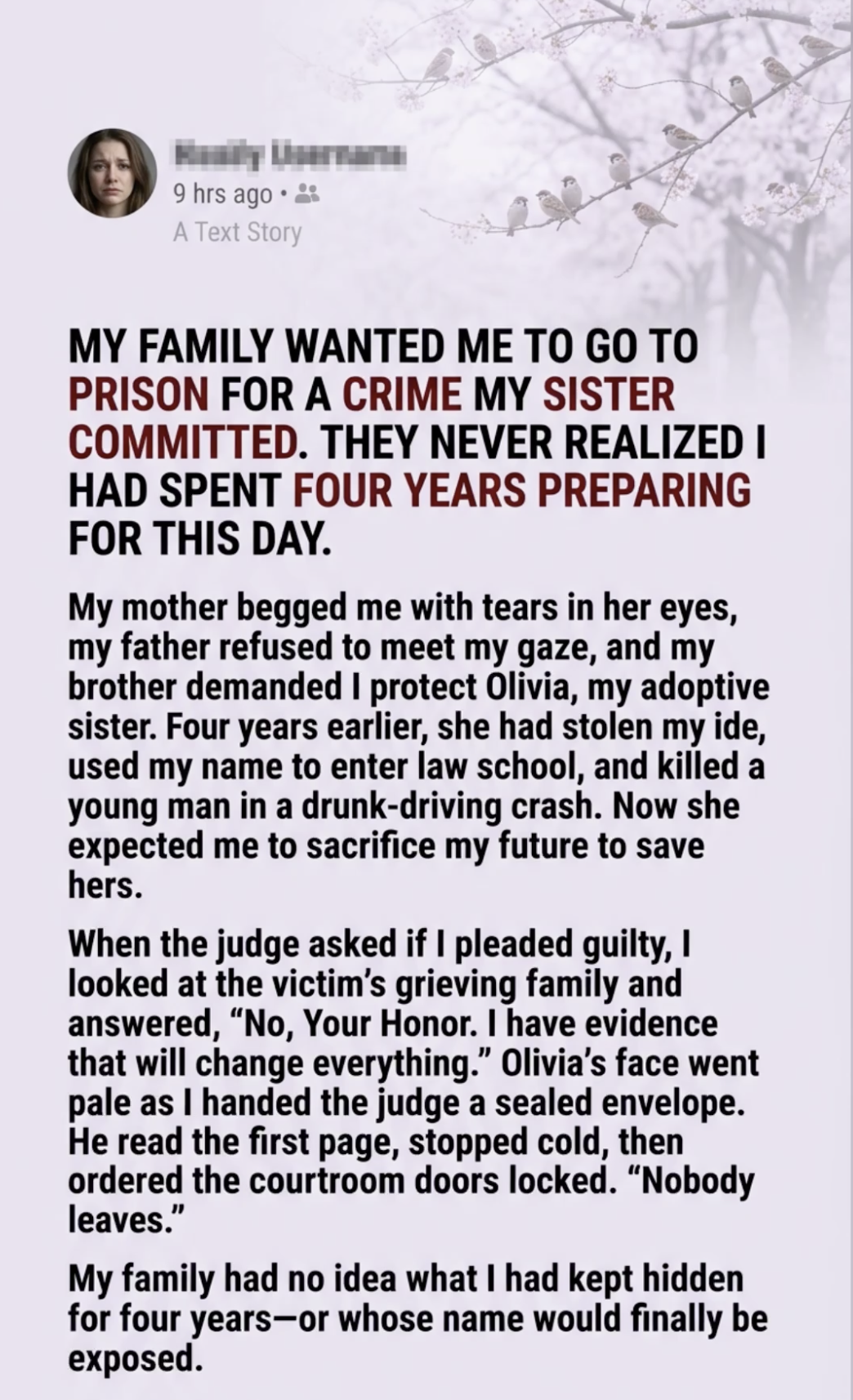
Four years earlier, she had stolen my identity, used my credentials to obtain admission to a law school she had never legitimately qualified for, and later caused a fatal drunk-driving crash that killed a twenty-two-year-old man named Ethan Cole.
Now, as the criminal case against her approached trial, she and the rest of my family wanted me to take responsibility.
They believed I would surrender because I had always been the dependable one.
They believed I would protect Olivia because she was adopted and had spent her childhood being told she needed more reassurance than I did.
They believed my love for my parents would eventually overpower my sense of right and wrong.
What they did not know was that I had spent four years documenting everything.
And on the morning of the hearing, I carried a sealed envelope into court that contained evidence capable of changing the entire case.
My father refused to look at me.
My brother threatened to disown me.
My mother begged me to remember that Olivia was family.
And Olivia, sitting beside her attorney in a pale gray suit, looked at me with the same expression she had worn when we were children and she wanted something she knew I would eventually give her.
The judge looked down from the bench.
“Ms. Bennett, how do you plead?”
I stood.
“Not guilty, Your Honor.”
Olivia’s expression changed.
I placed the envelope on the clerk’s desk.
“And I have evidence that will establish who actually committed the crimes attributed to me.”
The judge opened it.
He read the first page.
Then he stopped.
His eyes moved toward the prosecutor, then toward Olivia’s attorney.
“Counsel, approach the bench.”
The courtroom grew silent.
After a brief conference, the judge looked at the bailiff.
“Secure the courtroom doors while we determine the proper procedure for handling this material. No one is to leave until I give further instructions.”
My mother’s face went white.
My father finally looked at me.
And Olivia whispered something I could barely hear.
“You promised.”
She was right.
Four years earlier, I had promised my sister I would help her.
I had simply never promised to help her get away with murder.
I was eight years old when my parents adopted Olivia.
I remember the day clearly because my mother had spent the entire week preparing the house. She bought new curtains for the spare bedroom, painted the walls a soft yellow, and placed a stuffed rabbit on the pillow.
“Your sister is coming home,” she told me. “I want her to feel wanted.”
I was excited. I had spent years asking for a sibling, and I imagined Olivia and I would share clothes, secrets, and adventures.
When she arrived, she was six, small for her age, with dark curls and large brown eyes. She stood behind the social worker and studied the room as if she expected someone to tell her she couldn’t stay.
I took her hand.
“I’m Claire,” I said. “You can have the top bunk if you want.”
She looked at my mother before answering.
“Really?”
“Really,” I said.
For a while, we were close.
I helped her with spelling homework. She borrowed my sweaters and returned them with stains. We built forts in the living room and made up stories about the people who lived in the houses across the street.
But Olivia had a difficult time adjusting. She struggled with abandonment fears and often became distressed when she thought someone was disappointed in her.
My parents responded by protecting her from almost every consequence.
If she broke something, they said she was overwhelmed.
If she lied, they said she was afraid.
If she failed a test, they said the teacher hadn’t understood her learning style.
I learned to be the child who needed less.
When I was upset, my mother told me to be patient.
When Olivia was upset, the entire household stopped.
At first, I didn’t resent it. I understood that she had experienced things I couldn’t imagine. I wanted her to feel safe.
The problem was that our family slowly turned her pain into a permanent exemption from responsibility.
By high school, Olivia had learned that crying could end an argument. By college, she had learned that our parents would pay almost any bill rather than let her face an uncomfortable consequence.
I left for university on an academic scholarship and studied law. Olivia enrolled at a private college but changed majors several times. She eventually left without finishing her degree.
My parents described this as a temporary setback.
“She just hasn’t found her direction,” my father said.
I never argued.
After law school, I began working at a small criminal defense firm. I handled arraignments, researched motions, and spent long nights preparing cases for attorneys who had been practicing since before I was born.
I loved the work because it demanded patience. A person could be disliked and still be innocent. A person could be charming and still be guilty. What mattered was what could be established.
Olivia liked telling people that she was going to become a lawyer too.
She bought expensive suits, attended networking events, and posted photographs outside courthouses. Sometimes she used legal terminology she had heard me mention at dinner.
When people asked about her education, she changed the subject.
I assumed she was embarrassed.
Then, four years before the trial, she called me at 11:40 one night.
“Claire, I need your help.”
Her voice was shaking.
I was reviewing a motion at my apartment. I put my pen down.
“What happened?”
“I made a mistake.”
“What kind of mistake?”
She started crying.
“Can you just come home? Please?”
I drove to my parents’ house.
Olivia was sitting at the kitchen table with her laptop open. My mother stood beside her, repeatedly rubbing her shoulder. My father paced near the back door.
On the screen was an email from a law school admissions office.
The subject line read: Verification of Academic Records and Identity Documentation.
I leaned closer.
The school had received an application under my full legal name, Claire Elizabeth Bennett. The application included my academic records, personal statement, identification documents, and professional references.
But the photograph attached to the application was Olivia’s.
Someone had altered documents and submitted them using my identity.
I stared at the screen.
“Why is my name on this?”
Olivia covered her face.
“I only wanted to get in. I thought I could fix everything once I started.”
“Fix what?”
“I didn’t have the grades. I didn’t finish college. But I knew your information, and you had everything I needed. I thought if I got accepted, I could catch up.”
“You used my identity to apply to law school?”
“I was going to tell them later.”
“Tell them what? That you lied about who you were?”
My father stopped pacing.
“Claire, lower your voice.”
I turned toward him.
“Someone used my identity. This is serious.”
“She didn’t hurt anyone,” my mother said quickly.
“She used my academic records and submitted false documents. That is not nothing.”
Olivia looked up at me, tears streaming down her face.
“I was ashamed. Everyone kept asking what I was doing with my life. You were the successful one. I wanted to prove I could do something too.”
I felt anger, but beneath it was something worse: the realization that she had been willing to make me responsible for a deception I had never agreed to.
I told her she needed an attorney who was independent of our family and that the school needed to be informed.
My parents reacted as if I had suggested sending her to prison.
“You’re a lawyer,” my father said. “You know how to handle this quietly.”
“I’m not her attorney, and I can’t make false documents disappear.”
My mother began crying.
“Please don’t ruin her future over one terrible decision.”
I looked at Olivia.
“Tell the school the truth. Cooperate with the investigation. Let the consequences be what they are.”
She nodded.
For a few days, I believed she would do it.
Then she stopped answering my calls.
My parents told me the matter had been resolved. Olivia had withdrawn her application, they said. No one would be charged. I was told to stop bringing it up.
I wanted to believe them.
I returned to work and focused on my own cases.
Three months later, a police officer knocked on my apartment door.
A young man named Ethan Cole had been killed in a collision on Route 18. Investigators had identified the driver as Claire Elizabeth Bennett.
My name.
My date of birth.
My driver’s license number.
My home address.
The vehicle involved had been registered under my identity through documents I had never signed.
I was at work when the crash occurred. Security footage from the courthouse and electronic records confirmed that I had been inside a building several miles away.
The officer initially treated the identity discrepancy as a possible administrative error.
Then the toxicology results arrived.
The driver had been intoxicated.
Witnesses reported that she had crossed the center line before striking Ethan’s car.
The driver had been Olivia.
She had used my identity again.
This time, a young man was dead.
Ethan Cole was twenty-two.
He was studying engineering and working evenings at a grocery store to help pay his tuition. He had been driving home from a late shift when the collision happened.
His parents, Michael and Susan Cole, had been waiting for him to return.
They never saw him alive again.
I learned these details from the police report and later from a statement his mother submitted to the court. Each fact made the case more difficult to bear.
I was not the person who had driven into Ethan’s car.
But I knew the person who had.
And my family was already preparing a story that would protect her.
The night after the crash, my father called.
“Claire, we need to discuss what you’re going to tell the police.”
I sat down slowly.
“What I’m going to tell them is the truth.”
“No,” he said. “You need to think about what this will do to your sister.”
“What about the man who died?”
He went silent.
Then he said, “Olivia made a terrible mistake. If she goes to prison, her life is over.”
“She killed someone.”
“It was an accident.”
“Driving drunk is a choice.”
He raised his voice.
“Don’t speak about your sister like she’s a monster.”
I ended the call.
Within two days, my mother arrived at my apartment with a folder of documents and a prepared statement.
It said that I had borrowed my car to Olivia and that she had been driving with my permission. It suggested I had been aware of her drinking but had failed to stop her.
The statement was designed to make me appear responsible for the circumstances surrounding the crash.
I read it twice.
“Who wrote this?”
My mother looked down.
“Your father spoke with someone who understands these things.”
“Someone who understands how to lie?”
She began crying.
“Claire, please. Olivia cannot survive this. You have a career. You have a future. You can explain that it was a terrible misunderstanding.”
“I wasn’t there.”
“People make mistakes.”
“Mom, a young man is dead.”
She sat down, her shoulders trembling.
“I know.”
“Then why are you asking me to lie?”
She didn’t answer.
I pushed the folder back across the table.
“I’m not signing this.”
My mother left without saying goodbye.
For the first time in my life, I understood that my family was not merely asking me to protect Olivia from embarrassment. They were asking me to put my own freedom at risk.
I contacted an attorney outside my firm, a former prosecutor named Daniel Reeves. He had no connection to my family and no reason to protect anyone but his client.
I gave him the police report, the law school application, and every message I had received from Olivia.
He listened without interrupting.
When I finished, he asked, “Do you have a record of when you discovered the identity theft?”
“Yes. I saved the emails.”
“Have you kept the original files?”
“Everything I could access.”
He nodded.
“Good. Don’t delete anything. Don’t contact witnesses to influence their statements. Don’t try to investigate the crash yourself. We need to preserve the evidence and let the authorities establish what happened.”
That was the beginning of the four years I had spent preparing for the day my family had always assumed would never come.
I preserved emails, text messages, account notifications, and copies of the fraudulent application. I provided the records to investigators through my attorney. I kept a detailed timeline of where I had been on the night of the collision.
I also made a decision that changed my relationship with the case.
I would not use my legal knowledge to manufacture a defense for Olivia.
I would use it to protect my own rights and ensure the evidence was not buried.
The police eventually established that the person driving the vehicle was Olivia. But the investigation became complicated because the records had been created under my identity, and Olivia initially denied being behind the wheel.
My parents hired attorneys for her. They repeatedly insisted that the case was a tragic mix-up.
The prosecutor’s office investigated the identity fraud alongside the fatal crash. I cooperated through Daniel Reeves, providing the records I had preserved.
Then Olivia changed her story.
She claimed that I had given her access to my documents and had agreed to let her use my identity. She suggested that I had been the one who arranged the vehicle registration and that she had been too frightened to correct the record after the crash.
It was an extraordinary accusation.
It was also the accusation my family had been waiting to use.
My father told relatives I had become obsessed with punishing Olivia.
My brother, Nathan, sent me a message saying that if I cared about our family, I would stop cooperating with investigators.
My mother called every few days, alternating between apologies and pleas.
“She is your sister,” she repeated. “You are the only person who can save her.”
I wanted to ask why no one had ever told Olivia that she was responsible for saving herself.
Instead, I stopped answering.
Over time, I learned that some people would rather destroy the person telling the truth than accept the consequences of a lie.
The first major breakthrough came from a digital records examiner working with investigators.
The fraudulent law school application had been submitted from an account connected to Olivia’s personal email address. The identity documents had been modified on a device she regularly used. Several messages showed that she had discussed the application with a family acquaintance who had helped her prepare the materials.
The crash investigation produced additional records.
A traffic camera captured the vehicle shortly before the collision. A witness recognized Olivia from a photograph. Her phone records placed her near the route, and a later forensic review connected her to the vehicle.
The evidence did not depend on my word alone.
It came from records that could be independently checked.
My attorney warned me that some details might remain disputed and that the case would need to proceed through the courts. I understood. Evidence was not a magic spell that made every question disappear.
But the pattern was becoming clear.
Olivia had used my identity before the crash, and the same false identity had later been used to shift suspicion toward me.
I kept every communication from my family.
Some messages were ordinary pleas. Others were more revealing.
My father wrote, If you keep pushing this, you will destroy the only family you have.
My brother wrote, Just say you let her use the car. It doesn’t have to be complicated.
My mother sent a voice message in which she sobbed that Olivia could not endure prison.
Not one of them asked what Ethan’s parents were enduring.
Not one asked whether I could survive being blamed for a death I had not caused.
When I played the messages for Daniel, he looked at me carefully.
“Why have you kept all of this?”
“Because I knew someone would eventually say I had agreed to the story.”
He nodded.
“Preserve the originals. We’ll provide them through the proper process.”
I did not know then how much those messages would matter.
I only knew that I could no longer trust my family to tell the truth about me.
Four years passed.
The criminal case moved slowly through procedural disputes, evidentiary hearings, and challenges to the authenticity of various documents. Olivia’s defense team argued that the records did not establish her intent beyond dispute. My name remained entangled in the matter because it was the identity used in the false documents.
I kept working, though I had to explain the case to employers and professional licensing officials. My career did not collapse, but it changed. Some people believed the allegations before they saw the evidence. Others quietly withdrew from my life because they didn’t want to be associated with a scandal.
I learned who would stay when a simple explanation was no longer enough.
I also learned about Ethan’s family.
I did not approach them directly while the case was pending. My attorney advised me not to contact them without considering the legal and emotional implications. But I read the public statements they submitted and followed the proceedings through the proper channels.
Ethan’s mother wrote that her son had been the person who called his grandmother every Sunday. He had planned to finish his degree and work on renewable energy projects. He had saved money to take his parents on a vacation after graduation.
She wrote that she still expected to hear his key in the front door.
I read that sentence until I had to put the page down.
My family’s demands began to feel even more unbearable.
They wanted me to sacrifice my future so Olivia could preserve hers, while Ethan’s future had been taken from him entirely.
I had once believed that being a good daughter meant keeping the family together.
Now I understood that a family held together by one person’s silence was not truly together.
The sealed envelope took shape over the months that followed. It contained a carefully organized index of records my attorney had preserved and submitted through the appropriate channels: the identity-theft documentation, the verified digital records, the timeline establishing my whereabouts, and the communications in which members of my family had urged me to accept blame.
It also included a formal request that the court review the evidence before any plea or admission was accepted from me.
The envelope did not contain a dramatic confession that would instantly resolve the case. Real investigations rarely work that way.
It contained something more useful.
A clear path through four years of deception.
The morning of the hearing, my mother called me before sunrise.
“Claire, please come to the house before you go to court.”
I knew what she wanted.
I went anyway, partly because I needed to see her face before I made the decision that would permanently change our relationship.
She was waiting in the kitchen. My father sat at the table, staring at his hands. Nathan leaned against the counter with his arms crossed.
Olivia was not there.
My mother approached me.
“You have to tell them you were involved.”
“I wasn’t.”
“You can say you let her use your documents. You can say you knew she was drinking. You don’t have to take all the blame.”
“I didn’t give her my documents. I didn’t know she was driving that night.”
My father finally spoke.
“You are a lawyer, Claire. You understand that cases are built on what people can prove. If you insist on this version, everyone loses.”
“Everyone except the person who actually caused the crash.”
Nathan stepped away from the counter.
“You’re acting like you never made a mistake in your life.”
“I have made mistakes. I haven’t asked someone else to go to prison for them.”
His face reddened.
“Olivia is our sister.”
“So am I.”
No one answered.
My mother took my hand.
“Please. She was adopted. She has always been afraid of being abandoned. You know how hard life has been for her.”
I looked at my mother and felt a wave of sadness so intense it almost became anger.
“Do you know what it feels like to be blamed for something you didn’t do? To spend four years wondering whether the people who raised you would ever believe you?”
Her eyes filled with tears.
“You’re strong, Claire.”
“That doesn’t mean I deserve to suffer.”
I pulled my hand away.
“I am not taking responsibility for Ethan’s death. And I am not lying to the court.”
My father stood.
“Then don’t come back to this house.”
I stared at him.
For a moment, I was eight years old again, standing in the doorway while my parents welcomed Olivia into our home. I remembered promising to share everything with her.
I had never imagined that my family would one day demand that I share the consequences of a crime I had not committed.
“I won’t,” I said.
Then I left.
At the courthouse, the hallway outside the courtroom was crowded with reporters, attorneys, and members of Ethan’s family.
I saw his mother first.
Susan Cole wore a simple black jacket and held a photograph against her chest. It showed Ethan standing beside a lake, smiling at whoever had taken the picture.
I wanted to tell her that I was sorry. But I didn’t know whether my words would help or hurt, and I didn’t want to make her grief about me.
I gave her a small, respectful nod.
She returned it.
Olivia arrived with her attorney. She wore a pale gray suit and carried herself with the practiced composure of someone who had spent years trying to appear more confident than she felt.
When she saw me, she approached.
“You brought the envelope?”
I didn’t answer.
“Claire, we discussed this.”
“No. You discussed what you wanted me to do.”
Her jaw tightened.
“You said you’d help me.”
“I did help you. Four years ago, I told you to tell the truth and get independent legal advice.”
“You could still fix this.”
“No, Olivia. I can’t fix what happened to Ethan.”
She leaned closer.
“You don’t understand what prison will do to me.”
I looked at her.
“I understand what lying will do to me.”
Her expression hardened.
“You’ll regret this.”
Then her attorney called her away.
The hearing began shortly afterward.
The prosecutor summarized the outstanding issues. Olivia’s attorney challenged parts of the evidence. My own attorney addressed the allegations made against me and requested that the court examine the records showing I had been misidentified.
The judge listened without interruption.
Then he turned toward me.
“Ms. Bennett, I need to ask you directly. Do you understand the allegations before the court?”
“Yes, Your Honor.”
“And how do you plead?”
I stood.
“Not guilty, Your Honor.”
Olivia looked at me as though I had struck her.
I continued.
“I also request that the court review the evidence in this envelope before accepting any assertion that I participated in the crimes attributed to me.”
The clerk took the envelope and passed it to the judge.
He opened it.
The first page contained an index of the records and the dates on which they had been submitted to the investigative authorities. The following pages summarized the identity discrepancies, the verified digital evidence, and the messages in which my family had encouraged me to accept responsibility.
The judge read in silence.
After several minutes, he asked the prosecutor to approach the bench.
They spoke quietly. Olivia’s attorney joined them.
Then the judge looked toward the bailiff.
“Please secure the courtroom doors while we determine the appropriate procedure for reviewing this material. No one is to leave until I give further instructions.”
The words sent a ripple through the room.
My mother clutched my father’s arm.
Nathan stared at the floor.
Olivia had gone completely still.
The judge addressed the attorneys.
“The documents before me raise serious questions about the identity of the person who submitted the records and the reliability of statements made during the investigation. I am not making a finding of guilt or innocence at this stage. I am directing that the relevant materials be preserved and that the prosecution address these discrepancies before the proceedings continue.”
He turned toward the prosecutor.
“I also want to know whether the authorities have received the communications described in this index and whether any additional investigation is warranted.”
The prosecutor confirmed that some of the records were already in the case file, but the court would need to review the remaining material and determine what could properly be considered at the hearing.
The judge ordered a recess.
The doors remained closed while the attorneys discussed the next steps with the court staff.
Olivia looked at me from across the aisle.
Her lips moved.
“You promised.”
I met her eyes.
“I promised to help you. I never promised to lie for you.”
The review did not end with one dramatic revelation.
It took months for investigators to verify the remaining records, interview additional witnesses, and reconcile the different versions of events. My attorney made sure that every document was submitted properly. The prosecution had to establish what the evidence proved and what remained uncertain.
The results were devastating for my family, but they were not based on a single letter or an emotional courtroom moment.
The digital records supported the conclusion that Olivia had submitted the fraudulent law school application under my identity. The crash evidence, including witness accounts, phone records, and forensic findings, supported the conclusion that Olivia had been driving when Ethan was killed.
The records also showed that I had been at work when the collision occurred and that I had not authorized Olivia to use my identity in connection with the crash.
My family’s messages did not prove every detail of the underlying crimes, but they revealed that several relatives had pressured me to accept responsibility despite evidence contradicting their preferred story.
The prosecutor withdrew the allegations against me after reviewing the verified evidence and formally notified the court that the case against me could not be sustained.
I sat beside my attorney when the decision was announced.
I had imagined that I would feel triumphant.
Instead, I felt exhausted.
Four years of fear did not disappear because a prosecutor admitted the evidence pointed away from me. My name had been dragged through an investigation. My relationships had been damaged. I had spent years wondering whether the people who claimed to love me would ever tell the truth when it mattered.
Outside the courthouse, reporters asked whether I was relieved.
“Yes,” I said. “But this case is about more than my name. A young man died, and his family deserves honesty and accountability.”
I did not discuss the private details of the case.
I did not celebrate.
Ethan’s parents were still living with the loss of their son.
Olivia’s case continued separately.
The evidence of identity fraud was considered alongside the evidence concerning the crash. Her attorneys challenged portions of the record, and the court examined the admissible evidence under the applicable legal standards.
Eventually, Olivia entered a guilty plea to the charges established by the prosecution, including the offenses related to the fatal crash and the fraudulent use of my identity. The precise terms of her plea were determined through the court process, not by my family’s demands or my personal wishes.
At sentencing, Susan Cole spoke about her son.
She described his kindness, his plans, and the empty chair at their dinner table.
Olivia listened with her head bowed.
For the first time, she did not interrupt with an explanation.
When the judge gave her an opportunity to speak, Olivia said she was sorry.
She admitted that she had made choices that could not be undone. She acknowledged that she had tried to protect herself by allowing someone else to bear the blame.
She did not ask the Cole family to forgive her.
The judge imposed a sentence consistent with the findings and applicable law. Olivia would lose years of her freedom, face lasting consequences for her professional ambitions, and have to live with the knowledge that her decisions had destroyed a young man’s future.
The sentence could not restore Ethan to his parents.
Nothing could.
Afterward, Olivia asked to speak with me.
My attorney advised me that I had no obligation to meet her, and I took time to decide. Eventually, I agreed to a brief conversation in a public place, with clear boundaries and no discussion of pending legal matters.
She looked older than she had four years earlier.
“I know you hate me,” she said.
“I don’t hate you.”
“Then why did you do it?”
I took a breath.
“Because I didn’t do it. Because Ethan deserved the truth. Because I couldn’t spend the rest of my life pretending your choices were mine.”
She stared at the table.
“I thought you’d always protect me.”
“I tried to protect you when we were children. I tried to help you when you used my identity for the first time. I told you to come clean. You chose not to.”
“I was scared.”
“So was I.”
She looked up.
“You were never scared of anything.”
I almost laughed, but there was no humor in it.
“I was scared every day for four years. I was scared I’d lose my career. I was scared I’d be convicted for something I didn’t do. I was scared our parents would never believe me. I was scared that telling the truth would mean losing my family.”
Her eyes filled.
“And you still did it.”
“Yes.”
She nodded slowly.
“I’m sorry.”
I believed that she was sorry. But remorse did not erase the harm, and it did not obligate me to restore the relationship we had before.
“I hope you use the time ahead of you to understand why you kept making these choices,” I said. “But I can’t make that journey for you.”
She began to cry.
This time, I did not rush to comfort her.
I let her feel what she felt without taking responsibility for it.
Then I stood and left.
My parents contacted me several weeks later.
My mother wrote a long letter describing the pain of seeing Olivia sentenced. She admitted that the family had been wrong to pressure me, but she still insisted that they had acted out of love.
My father sent a shorter message.
We should never have asked you to take the blame. I don’t know how to repair what we did.
Nathan did not apologize immediately. He remained angry that Olivia had gone to prison, and for a while he blamed the prosecution, the judge, and even me.
I responded to my parents only after I had taken time to consider what I wanted.
I told them that I loved them, but love could not be used as a demand for silence. If we were going to have any relationship in the future, they would have to acknowledge what they had done without asking me to minimize it.
I did not promise that everything would return to normal.
Normal had been the problem.
For years, our family had treated Olivia’s distress as an emergency and my pain as something I could handle privately. We had confused protecting a person with protecting them from every consequence. We had confused loyalty with obedience.
I was no longer willing to live by those rules.
My parents began seeing a family counselor. I did not attend at first. I needed space to rebuild my life without being asked to manage everyone else’s feelings.
Nathan eventually sent a message acknowledging that he had threatened me because he could not accept what Olivia had done.
I thanked him for saying it.
That did not mean I trusted him again immediately.
Trust returned, if it returned at all, through consistent behavior rather than promises.
I continued working as a criminal defense attorney. The case changed the way I approached clients, but not in the way some people expected. It did not teach me that everyone accused of wrongdoing was secretly guilty. It reinforced the opposite lesson: evidence must be examined carefully, and no person should be pressured into accepting blame simply because it would make life easier for someone else.
I also began volunteering with a legal clinic that helped people resolve identity-theft problems and navigate the consequences of fraudulent records. I knew how difficult it could be to prove that your name had been used without your consent. I wanted others to have access to the kind of careful guidance that had helped me survive.
Sometimes, I still thought about the little girl who had welcomed Olivia into the house and offered her the top bunk.
I wondered whether that child would have believed what happened.
Then I remembered that the little girl had never done anything wrong by loving her sister.
The betrayal did not make that love foolish.
It simply taught me that love needed boundaries.
One year after the case ended, I visited the memorial where Ethan’s family had placed a plaque in his honor. I went alone and stood quietly for several minutes.
I did not leave a letter. I did not try to make a speech to a young man I had never met.
I simply acknowledged that his life mattered, that his death had changed many lives, and that telling the truth had been the least I could do.
On the drive home, I stopped at a roadside café and ordered coffee. I sat by the window and watched people cross the parking lot, carrying groceries, talking on phones, living the ordinary lives that can seem permanent until one terrible moment changes everything.
For four years, I had believed that the day in court would be the day I finally proved my family wrong.
I had been mistaken.
The most important thing I proved was not that Olivia had lied or that my parents had failed me.
It was that I could refuse to participate in a lie, even when the people asking me to tell it were the people I had spent my life trying to please.
I had not saved Olivia from the consequences of her actions.
I had not repaired my family.
I had not brought Ethan back.
But I had protected the truth, and I had refused to let someone else’s choices become the definition of my life.
My family once believed that being the stronger daughter meant I could carry any burden they placed on me.
They were wrong.
Strength was not accepting every sacrifice someone demanded.
Sometimes, strength meant standing in a courtroom, looking at the people who had raised you, and saying the one word they had spent years trying to prevent you from saying.
No.
And sometimes, that one word is the beginning of getting your life back.