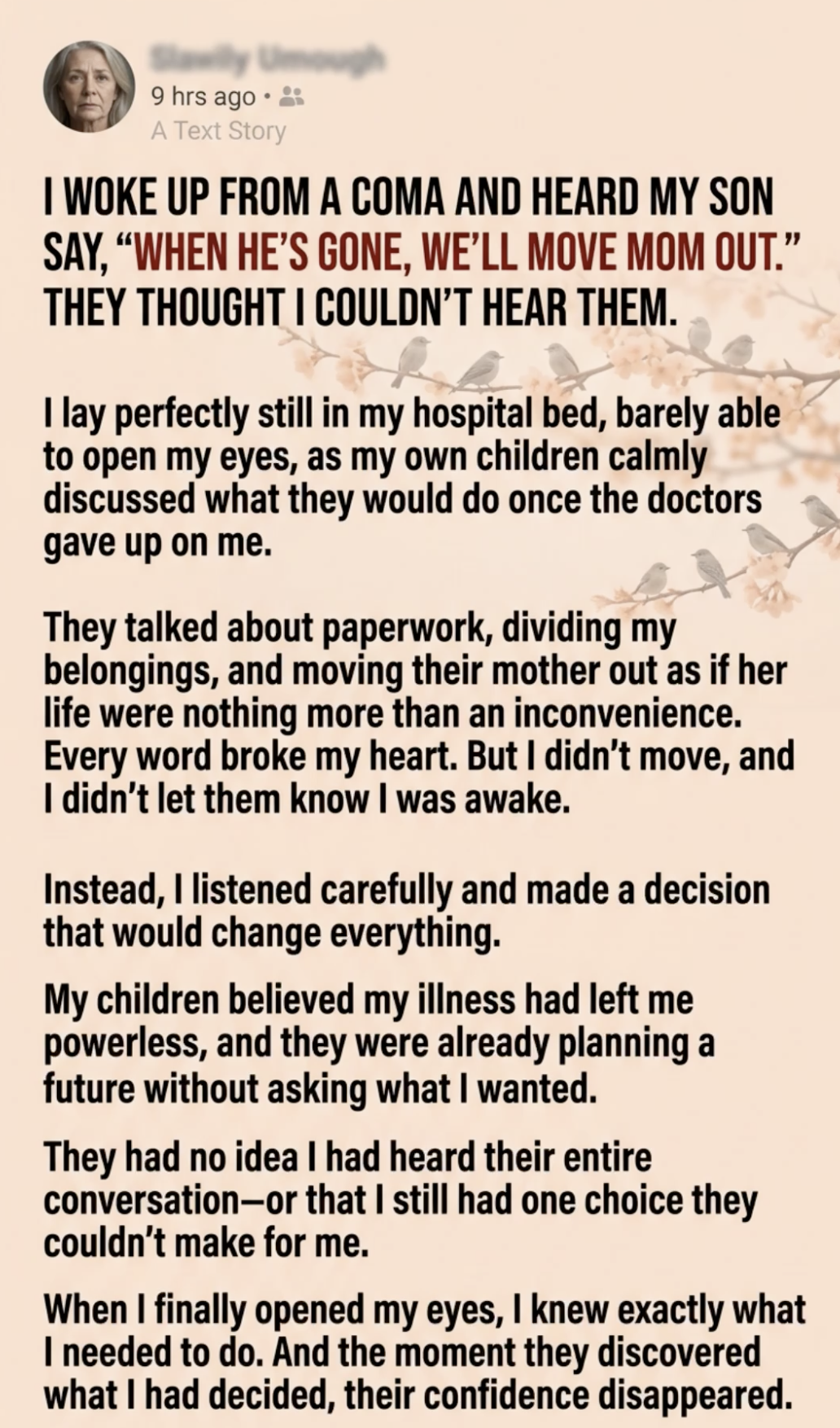
The first thing I heard after waking from my coma was my son planning my life as if I were already dead.
“When he’s gone, we’ll move Mom out,” Daniel said quietly. “We can’t keep paying for that house, and she won’t be able to manage it alone.”
My daughter, Rebecca, answered from somewhere near the hospital window.
“What about his papers? We need to know where everything is before the lawyers get involved.”
I lay perfectly still.
My eyes felt heavy, my throat was dry, and every breath seemed to require more effort than it should. I could not see them clearly, but I recognized their voices immediately. I had heard those voices at birthday parties, school concerts, family dinners, and Christmas mornings. I had comforted them when they cried and celebrated when they succeeded.
Now they were discussing what to do with me.
“He has the house, the savings, and that insurance policy,” Daniel continued. “If we wait too long, everything gets complicated.”
Rebecca sighed.
“I know. But we can’t just leave Mom there by herself. She needs someone to look after her.”
“Then we find a smaller place for her. Somewhere inexpensive. We can sell the house and split what’s left after the expenses.”
I felt something inside me break.
They were not asking whether I would recover. They were not discussing what I wanted, what frightened me, or how they might help me rebuild my life after the accident.
They were dividing the future before I had been given a chance to return to it.
I wanted to open my eyes and demand an explanation. I wanted to remind them that I was still their father, still a person with thoughts and feelings, still alive enough to hear every word.
But I was frightened.
I did not know how long I had been unconscious. I did not know how weak I was or whether my voice would work. I had only just begun to understand that I was awake.
So I remained still and listened.
Then Daniel said something that made me decide not to reveal myself just yet.
“Once the doctors tell us he probably won’t recover fully, we can start making arrangements. Mom will have to accept it. She can’t handle everything herself.”
The room fell silent.
My wife, Margaret, was not there. I wondered where she was and whether she knew what our children were planning.
I wanted to call her name.
Instead, I waited until I heard the door open and close.
Then I opened my eyes.
And the first person I asked for was my wife.
My name is Harold Bennett. I was seventy-two years old when a delivery van ran a red light and struck my car at an intersection less than two miles from my home.
I remembered leaving the hardware store with a bag of screws and a new faucet cartridge. I remembered thinking that I should call Margaret and ask whether she wanted anything from the grocery store.
Then there was a flash of white light, a violent impact, and nothing.
The doctors later explained that I had suffered serious injuries and spent several days unconscious. My recovery would take time, and no one could promise exactly how much strength or independence I would regain.
When I first woke, I had no idea how much time had passed.
I learned later that Margaret had spent nearly every day at the hospital. She had sat beside my bed, spoken to me, and held my hand even when I could not respond.
But on the morning I regained consciousness, she had gone home to shower and change clothes.
That was when Daniel and Rebecca visited.
And that was when I heard them discuss my future.
After they left, I struggled to turn my head toward the call button. My fingers barely responded, but I managed to press it.
A nurse arrived within moments.
“Mr. Bennett?” she asked, leaning closer. “Can you hear me?”
I tried to speak. My throat produced a rough whisper.
“Margaret.”
The nurse smiled.
“Your wife? I’ll let her know you’ve awakened. But first, I’m going to check your vital signs and notify your doctor.”
She spoke calmly, checking my monitors and asking me to follow her finger with my eyes. When the doctor arrived, he examined me and explained that I needed to take things slowly.
“You’ve been through a serious event,” he said. “Being awake is an important step, but we need to assess your strength, memory, and ability to communicate. Don’t try to do too much at once.”
I nodded as best I could.
When the doctor left, the nurse called Margaret.
She arrived less than forty minutes later, still wearing the cardigan she had put on before leaving the house. Her hair was damp, and she carried her handbag in one hand.
The moment she saw my open eyes, she stopped in the doorway.
“Harold?”
I managed a small smile.
She hurried to my bedside and took my hand.
“Oh, Harold. Oh, thank God.”
She cried so hard that she could barely speak. I wanted to comfort her, but my own eyes filled with tears.
She pressed my hand against her cheek.
“I’ve been talking to you every day,” she whispered. “I told you that you had to come back to me.”
I tried to say her name again.
She leaned close.
“Don’t force yourself to talk. The doctor said you might be weak. Just rest. I’m here.”
I wanted to tell her what I had heard.
But I looked at her tired face and decided to wait until I could speak more clearly.
For the moment, I needed to know something else.
“Children?” I whispered.
Margaret looked confused.
“Daniel and Rebecca? They were here earlier. They went to get coffee, I think. Why?”
I swallowed painfully.
“Talked.”
“About what?”
I closed my eyes for a moment.
“Later.”
She stroked my forehead.
“All right, sweetheart. Later.”
I had spent forty-six years loving that woman. I knew her expressions, her silences, and the difference between the smile she gave a stranger and the one she gave me when we were alone.
She was exhausted, but she was still herself.
And suddenly I knew that whatever happened next, I could not allow my children to make decisions for us simply because they believed I was too weak to object.
Margaret and I had been married for forty-six years.
We met when she was twenty-three and I was twenty-six. She worked at a local library, and I was an apprentice electrician. She used to tease me because I could repair a broken circuit in minutes but needed three attempts to choose a birthday card.
We married in a small church with thirty guests and a cake Margaret’s aunt had baked herself.
We never became wealthy, but we built a comfortable life.
I worked as an electrician for a commercial maintenance company, then eventually started a small electrical contracting business with a friend. The business grew slowly. We took on modest jobs, hired a few employees, and saved what we could.
Margaret worked in a school office until our children were older, then helped with the business accounts. She was the one who remembered insurance renewals, tax deadlines, and which customers still owed us money.
We bought our house when Daniel was four and Rebecca was two. It was a brick house with three bedrooms, a narrow driveway, and a backyard where we planted an apple tree.
The house was never impressive, but it was ours.
We paid off the mortgage before I turned sixty-five. We had retirement savings, a modest investment account, and a life insurance policy intended to help Margaret manage if I died first.
We also had a will.
Margaret and I had discussed our estate several times. Our intention was straightforward: the surviving spouse would remain financially secure and continue living in the house if possible. Whatever remained after both of us had died would be divided between our children.
We had not promised Daniel or Rebecca an inheritance on a particular date.
We had not promised them that our house would become theirs while we were still alive.
And we certainly had not given them permission to decide that Margaret should move somewhere cheaper because they wanted access to the property.
Yet that was exactly what I had heard them planning.
The knowledge left me feeling strangely exposed.
I had spent my life teaching my children to be responsible. I had helped Daniel through a difficult period when his business failed, lending him money that he later repaid in installments. I had helped Rebecca with her university expenses and watched her build a career in human resources.
I had never expected them to agree with every decision I made.
But I had believed they understood that their mother and I were people, not assets waiting to be distributed.
I was beginning to wonder how wrong I had been.
My first few days awake were difficult.
I struggled to sit upright. My muscles felt unfamiliar, and I became tired after even short conversations. Physical therapists visited to assess my mobility, while the medical team continued monitoring my recovery.
Margaret stayed close whenever she could.
She helped me understand the practical details I had missed: how long I had been hospitalized, which tests had been performed, and what the doctors believed might happen next.
She never made promises she could not keep.
“They think you have a reasonable chance of making progress,” she told me one afternoon. “But we’ll take it one day at a time.”
I was grateful for her honesty.
During a quiet moment, I told her what I had heard.
I repeated Daniel’s words about selling the house, moving her somewhere inexpensive, and dividing the money.
Margaret listened without interrupting.
At first, she looked confused. Then her face grew pale.
“They said that?”
“Yes.”
“Are you certain you heard them correctly?”
I nodded.
She looked down at our joined hands.
“I knew they were worried about the cost of your care,” she said. “Daniel asked me whether we had enough insurance. Rebecca wanted to know where we kept our financial papers. I thought they were trying to help.”
“Perhaps they believe they are.”
“Then why would they talk about selling our home while you’re still here?”
I had no answer.
Margaret was quiet for a long time.
Finally, she whispered, “I don’t want to leave our house.”
“Neither do I.”
She looked at me.
“I’ve lived there for forty-four years. Every room has a memory. The kitchen where the children did their homework. The garden where your father helped us plant the apple tree. The bedroom where we sat together after your surgery ten years ago.”
Her voice trembled.
“I don’t want to spend the rest of my life in a place someone else chooses for me because they think I’m too old to know what I need.”
I squeezed her hand.
“You won’t have to make that decision without me.”
She leaned forward and kissed my forehead.
“Then we need to make sure we’re prepared.”
For the first time since I woke, I felt something other than grief.
I felt determination.
When Daniel and Rebecca returned, I was sitting upright in bed with the help of pillows. My voice was still weak, but I could speak in short sentences.
They entered the room carrying flowers and a bag of snacks.
Daniel approached first.
“Dad! You’re awake.”
He smiled broadly and reached for my shoulder.
Rebecca stood beside him, her eyes already wet.
“We were so worried,” she said. “We thought we might lose you.”
I looked at them both.
For a moment, I saw the children they had once been. Daniel at eight, running into the house with a scraped knee. Rebecca at six, climbing onto my lap to show me a drawing.
I wanted to believe that the conversation I had overheard had been an unfortunate moment of fear and poor judgment.
So I gave them a chance to explain themselves.
“How long?” I asked.
Daniel leaned closer.
“How long have you been awake?”
“Since yesterday.”
He glanced at Rebecca.
“Why didn’t anyone tell us?”
“The nurse told your mother. She said you had gone out.”
“Oh,” he replied. “We were getting coffee.”
Rebecca placed the flowers on the table.
“Dad, how are you feeling?”
“Tired.”
“That makes sense,” Daniel said. “The doctors said your recovery could take a while.”
I watched his face.
“House,” I said.
He blinked.
“What?”
“Our house.”
The smile faded slightly.
Rebecca looked toward Daniel.
“What about it?”
“You talked. Sell it. Move Mom.”
Silence settled over the room.
Daniel’s jaw tightened.
“Dad, you were unconscious. You must have misunderstood what we were saying.”
“I heard.”
“Look, we were discussing possibilities. We were worried about Mom being alone if you didn’t recover.”
“I’m alive.”
“Of course you are,” he said quickly. “We’re grateful. That’s not what I meant.”
Rebecca stepped forward.
“Dad, we were scared. We didn’t know what was going to happen. We were trying to figure out how to help Mom if you weren’t able to come home.”
I studied her.
“Did Mom ask you to sell the house?”
She lowered her eyes.
“No.”
“Did I?”
“No,” she whispered.
“Then why were you deciding?”
Neither answered immediately.
Finally, Daniel said, “Because somebody has to think about the practical side of things. Hospital care is expensive. Your house is a lot for Mom to maintain by herself. We can’t ignore reality.”
I felt anger rise through my exhaustion.
“Reality,” I repeated.
“Yes,” he said. “We have to plan.”
“Plan with us.”
He rubbed his forehead.
“Dad, you’re not in a position to make every decision right now.”
The words struck me harder than I expected.
I was weak. I was frightened. I could not walk to the bathroom without help.
But I was still capable of understanding what my son was saying.
I looked at him steadily.
“I can decide my life.”
Daniel opened his mouth, then closed it.
Rebecca began to cry.
“Dad, we didn’t mean to hurt you.”
“But you did.”
I let the words rest between us.
Then I asked them to leave so I could rest.
They looked surprised, as if the request itself were unreasonable.
Daniel gathered the empty snack bag. Rebecca picked up her handbag.
At the door, she turned back.
“We’ll come tomorrow,” she said.
I did not promise that I would be ready to see them.
After they left, Margaret sat beside me and held my hand.
“You did well,” she whispered.
I was not sure that I had.
But I knew I had taken the first step toward reclaiming my voice.
The following week, my doctors began discussing discharge planning.
I would need rehabilitation and help with some daily activities. They were not yet certain how much independence I would regain, but they believed a structured rehabilitation program would give me the best chance.
A hospital social worker met with Margaret and me to discuss the available options.
We asked questions about home-based support, rehabilitation facilities, insurance coverage, and the cost of temporary assistance.
We did not make a decision immediately.
Instead, we requested written information and agreed to review the options together.
That evening, I asked Margaret to bring our estate documents from home.
She returned the next day with a folder containing our will, insurance information, retirement statements, and the deeds to our property.
I could not review everything in one sitting, but we began going through the papers slowly.
Our will was clear. The surviving spouse was the primary beneficiary of the estate. Our children would inherit according to the terms we had established after both of us had died.
Our house was owned jointly, and our retirement savings were held in accounts intended to support us during our remaining years.
Nothing in those documents entitled our children to sell the house or take control of our finances simply because I had become ill.
Still, I did not want to rely on my own interpretation of the paperwork.
I asked Margaret to arrange a meeting with our attorney, Susan Miller, as soon as I was well enough.
Susan had helped us prepare our estate plan years earlier. She knew our circumstances and had always encouraged us to review our documents when our needs changed.
I wanted her to confirm our options, explain what would happen if I needed ongoing assistance, and make sure Margaret’s rights were protected.
Most importantly, I wanted our decisions to remain ours.
Susan visited me at the rehabilitation center two weeks later.
By then, I could walk short distances with a frame, though I still needed assistance with several daily tasks. My speech had improved, and I was able to concentrate for longer periods.
Margaret sat beside me during the meeting.
Susan reviewed the will, the property documents, and the financial statements we had brought.
“You and Margaret have made sensible arrangements,” she said. “The surviving spouse’s rights are clearly established in your current plan. Your children do not automatically gain authority over your property or finances because you have been hospitalized.”
I nodded.
“What if I need more care?”
“Then we review the options available to you. Depending on the nature of the care, you may be able to pay for support at home, use rehabilitation services, or consider another arrangement. The important thing is that you understand the choices and make decisions while you are able to express your wishes.”
“And if I can’t?”
“Then the relevant legal documents and local law determine who can act on your behalf. We can review whether your existing arrangements are sufficient. But your children cannot simply decide to sell your home or take your money because they believe it would be convenient.”
Margaret’s shoulders relaxed.
Susan continued.
“I also recommend that we document your current preferences. You have just experienced a serious medical event. It’s reasonable to review your financial and estate plans, but there is no need to make sudden changes out of fear or anger.”
She looked at me kindly.
“Is there something specific that has prompted this meeting?”
I told her about the conversation I had overheard in the hospital.
Susan listened carefully.
When I finished, she did not immediately condemn Daniel or Rebecca.
“People sometimes discuss difficult possibilities when they’re frightened,” she said. “That doesn’t excuse making decisions for you without your consent. But before you decide what this means for your relationship with your children, it may help to establish clear boundaries and give them an opportunity to understand them.”
I appreciated that advice.
I did not want revenge.
I wanted control over my own life.
With Susan’s help, we reviewed our estate plan, confirmed our property arrangements, and discussed whether additional documents would be useful if I needed help managing my affairs in the future.
We also reviewed the financial records to make sure Margaret could access what she needed without depending on our children.
Nothing dramatic happened. No secret fortune was uncovered, and no one was suddenly disinherited.
Instead, we did something more important.
We made sure our wishes were clear, our documents were current, and our future would not be decided in a hospital corridor by people who assumed we could no longer speak for ourselves.
When Daniel and Rebecca learned that we had met with Susan, they became uneasy.
Daniel called me first.
“Dad, Mom said you hired the lawyer to review everything.”
“She helped us review our estate plan.”
“Why? Has something happened?”
“I woke up and heard you discussing what would happen to our house.”
He was silent for a moment.
“Dad, we were trying to prepare for the worst.”
“Then you should have spoken to us.”
“We didn’t know if you could hear us.”
“That doesn’t make it better.”
He exhaled sharply.
“I’ve already got enough on my plate. Work has been difficult, and I’m trying to keep my family afloat. I was worried about how we’d manage everything if you didn’t recover.”
I listened.
There was a time when Daniel would have told me everything that troubled him. As a child, he used to sit beside me in the garage while I worked and talk about his fears.
I missed that boy.
But I could not pretend that his worries gave him the right to decide our future.
“Your mother and I will make our own arrangements,” I said. “If we need help, we’ll ask.”
“So you’re cutting us out?”
“No. I’m asking you to respect us.”
He did not respond.
Then he said, “I didn’t mean it the way you heard it.”
I looked through the window at the trees outside the rehabilitation center.
“Perhaps not. But I heard what you said. I need you to understand why it hurt.”
He was quiet for a long time.
Finally, he said, “I’ll think about it.”
It was not an apology.
But it was the first time he had stopped arguing long enough to listen.
Rebecca came to visit me the following afternoon.
She brought a book I had once mentioned wanting to read and sat beside my bed without saying much.
After a while, she began to cry.
“I keep hearing your voice in my head,” she said.
“What voice?”
“When you asked why we were deciding for you.”
I waited.
“I was scared,” she continued. “I was thinking about what would happen if you couldn’t come home, and I started treating everything like a problem to solve. The house. The money. Mom’s care. I didn’t stop to think about what it must have sounded like.”
She wiped her eyes.
“I don’t want you to think we don’t love you.”
I reached for her hand.
“I believe you love me.”
She looked relieved.
“But love isn’t only what you feel,” I continued. “It’s also how you treat someone when they’re weak, frightened, or unable to defend themselves.”
She nodded, crying harder.
“I know.”
“Do you?”
She took a long breath.
“I think I’m beginning to.”
I squeezed her hand.
I wanted to tell her that everything was forgiven. But forgiveness was not a switch I could turn on because she had cried.
We needed to rebuild trust through actions.
So I told her that.
“I love you, Rebecca. I want you in my life. But your mother and I need to make our own decisions. We need to know that you will ask us what we want instead of assuming you know what’s best.”
“I will,” she whispered.
I hoped she meant it.
For the first time, though, I believed she was beginning to understand.
Recovery took longer than I wanted.
There were days when I felt strong enough to walk around the rehabilitation center, and other days when my body seemed to forget everything it had learned. I became frustrated when I needed help dressing or when a simple task left me exhausted.
Margaret never treated me as though I were a burden.
She celebrated small improvements. When I managed to walk down the hallway with less assistance, she smiled as though I had won a medal. When I grew discouraged, she reminded me that progress did not always happen in a straight line.
Eventually, my medical team agreed that I could return home with a plan for ongoing rehabilitation and some temporary support.
The first time I saw our house again, I cried.
The apple tree stood in the backyard, its branches moving gently in the wind. The curtains Margaret had sewn years earlier still hung in the living room. My old tools remained organized on the garage shelves.
Everything was familiar.
Everything reminded me of the life I had nearly lost.
Margaret helped me settle into the bedroom. We had arranged for a therapist to visit and for assistance with certain tasks while I regained strength.
The plan was not perfect, but it was ours.
Daniel arrived that weekend with groceries.
Rebecca came the following day and helped Margaret prepare lunch.
Neither of them mentioned selling the house.
For a while, we spoke about ordinary things: the weather, the neighbors, a football game, and a leak in the garden shed.
It felt good to be together without discussing money or medical decisions.
But I knew we could not pretend the hospital conversation had never happened.
One Sunday afternoon, I asked them both to sit with Margaret and me in the living room.
“I want us to agree on something,” I said.
They looked at me attentively.
“Your mother and I will need help sometimes. We may need more help in the future. When that happens, we will discuss our options together. You are welcome to offer advice, and we will listen. But no one will decide where we live or what happens to our property without involving us.”
Daniel looked down at his hands.
Rebecca nodded.
“I also want you to understand that our savings are for our lives,” I continued. “They are meant to help us remain safe, comfortable, and independent. We have a plan for what remains after we are both gone. Until then, we will use our resources according to our needs.”
Daniel shifted in his chair.
“Dad, I wasn’t trying to take anything from you.”
“I hope that is true.”
He looked up.
I held his gaze.
“But when you spoke about selling the house and dividing the money before I had even been given a chance to recover, it made me feel as though my life had already become an inconvenience.”
His face changed.
For the first time, I saw something that looked like shame.
“I didn’t think about it that way,” he said quietly.
“That is what hurt.”
Rebecca reached for Margaret’s hand.
“I’m sorry,” she said. “Both of us are.”
Margaret looked at them.
“I don’t expect you to know exactly what to do in every difficult situation,” she said. “But I need you to remember that your father and I are still here. We are still a family. Please talk to us before making plans about our lives.”
Daniel nodded slowly.
“I understand.”
This time, he did not argue.
Several months passed.
My recovery was gradual, but I regained much of my independence. I could walk around the garden, prepare simple meals, and spend time in the garage sorting tools I no longer needed.
I still had difficult days. My body reminded me that I was older and that the accident had changed me.
But I was alive.
And I was home.
Daniel began calling more often, sometimes simply to ask how I was feeling. He stopped making comments about the house and started asking whether Margaret needed anything from the store.
Rebecca visited regularly. She helped with errands but no longer assumed that she should take over every decision.
The changes were not dramatic. They were small, ordinary acts of consideration.
That was how trust began to return.
One afternoon, Daniel came over to help repair the loose railing on the back steps. We worked slowly, with him holding the tools while I explained what needed to be done.
At one point, he put down the screwdriver and looked at me.
“Dad, can I ask you something?”
“Of course.”
“Were you really awake when we were talking in the hospital?”
I nodded.
He looked away.
“I’ve thought about that conversation a lot.”
“So have I.”
He rubbed his hands together.
“I was scared. I didn’t know what would happen to you, and I was worried about Mom. I started thinking about money and responsibility because those were things I thought I could control.”
He swallowed.
“I didn’t realize how selfish it sounded.”
I waited for him to continue.
“I was talking about your life as though it was a set of problems I could solve after you were gone. I didn’t think about how you might feel. I didn’t even consider that you might recover.”
He looked at me.
“I’m sorry, Dad.”
His apology was quiet and unpolished.
It was also the first one that felt entirely his own.
I set down the piece of wood I was holding.
“I was frightened, too,” I told him. “I heard my son discussing my future as if I were already gone. I wondered whether I had failed to teach you something important.”
He shook his head.
“You didn’t fail me.”
“Perhaps I didn’t teach you everything. But you are old enough to learn.”
He gave a small, sad smile.
“I am.”
I reached over and rested a hand on his shoulder.
“I don’t expect you to be perfect. I expect you to remember that your mother and I are people with our own wishes. We may need help someday. But needing help doesn’t mean we stop being part of the decision.”
Daniel nodded.
“I understand that now.”
We returned to the railing.
We did not solve every problem in our relationship that afternoon. But something important had changed.
He had finally stopped defending the person he had been in that hospital room long enough to acknowledge the person he had become.
A year after the accident, Margaret and I sat in the garden beneath the apple tree.
The spring air was cool, and the branches were covered in pale blossoms. I held a cup of tea while Margaret read a book beside me.
I thought about how close I had come to losing everything—not only my life, but the ordinary moments I had always assumed would continue.
The morning newspaper on the kitchen table.
The sound of Margaret humming while she cooked.
The familiar creak of the stairs.
The freedom to decide whether I wanted to stay home or go for a walk.
None of those things had ever seemed extraordinary.
Now I understood how much they mattered.
Margaret closed her book and looked at me.
“What are you thinking about?”
“The hospital.”
She reached for my hand.
“Do you still think about what the children said?”
“Sometimes.”
“Does it still hurt?”
I considered the question.
“Yes. But less than before.”
She nodded.
“I don’t think they understood what they were doing.”
“Maybe they didn’t. But they understand more now.”
We sat quietly.
Eventually, I said, “I used to think the hardest part of growing old would be losing my strength.”
Margaret smiled faintly.
“And now?”
“Now I think it’s learning to accept help without allowing people to take away your voice.”
She leaned her head against my shoulder.
“That sounds about right.”
I looked at our house.
The brick walls needed repairs. The garden shed still leaked when the rain was heavy. There were bills to pay, appointments to keep, and difficult decisions waiting somewhere in the future.
But the house was still ours.
The decisions were still ours.
And our children were beginning to understand that caring for us did not mean taking our lives out of our hands.
I had not punished Daniel or Rebecca. I had not changed our will out of anger or threatened to leave them nothing.
I had simply made sure that our wishes were clear and that our future would be decided by us, not by fear, convenience, or assumptions.
That was enough.
I could not control every choice my children would make. I could not guarantee that they would never disappoint me again.
But I could choose how I responded.
I could speak when something hurt.
I could ask for help without surrendering my independence.
And I could love my children while still expecting them to respect me.
When I woke from my coma, I had heard my son say, “When he’s gone, we’ll move Mom out.”
He believed he was preparing for a future without me.
He had not imagined that I would hear him, recover, and insist on being part of the decisions that mattered.
The moment I opened my eyes, I had a choice.
I could pretend I had heard nothing and allow resentment to grow quietly between us.
Or I could speak, establish boundaries, and give my family a chance to change.
I chose to speak.
Not because I wanted to frighten them or take revenge, but because I was still alive—and my life still belonged to me.
I looked at Margaret beneath the apple tree and took her hand.
For the first time since the accident, I felt certain about the future.
It would not be free of pain, uncertainty, or difficult days.
But whatever came next, we would face it together.
And no one would decide our lives without asking us again.