I had been married to Daniel for seventeen years, and I believed I knew the man sleeping beside me better than anyone else in the world.
We had a comfortable home, two children, and the kind of ordinary routine that makes a marriage feel permanent. Daniel worked in accounting for a manufacturing company, while I managed the office at a dental clinic. Our evenings were usually predictable: dinner at six, homework at the kitchen table, a little television, and then bed.
We argued sometimes, of course. Money was occasionally tight, and the children’s schedules left us exhausted. But I had never seriously questioned his loyalty.
That changed on a Tuesday morning.
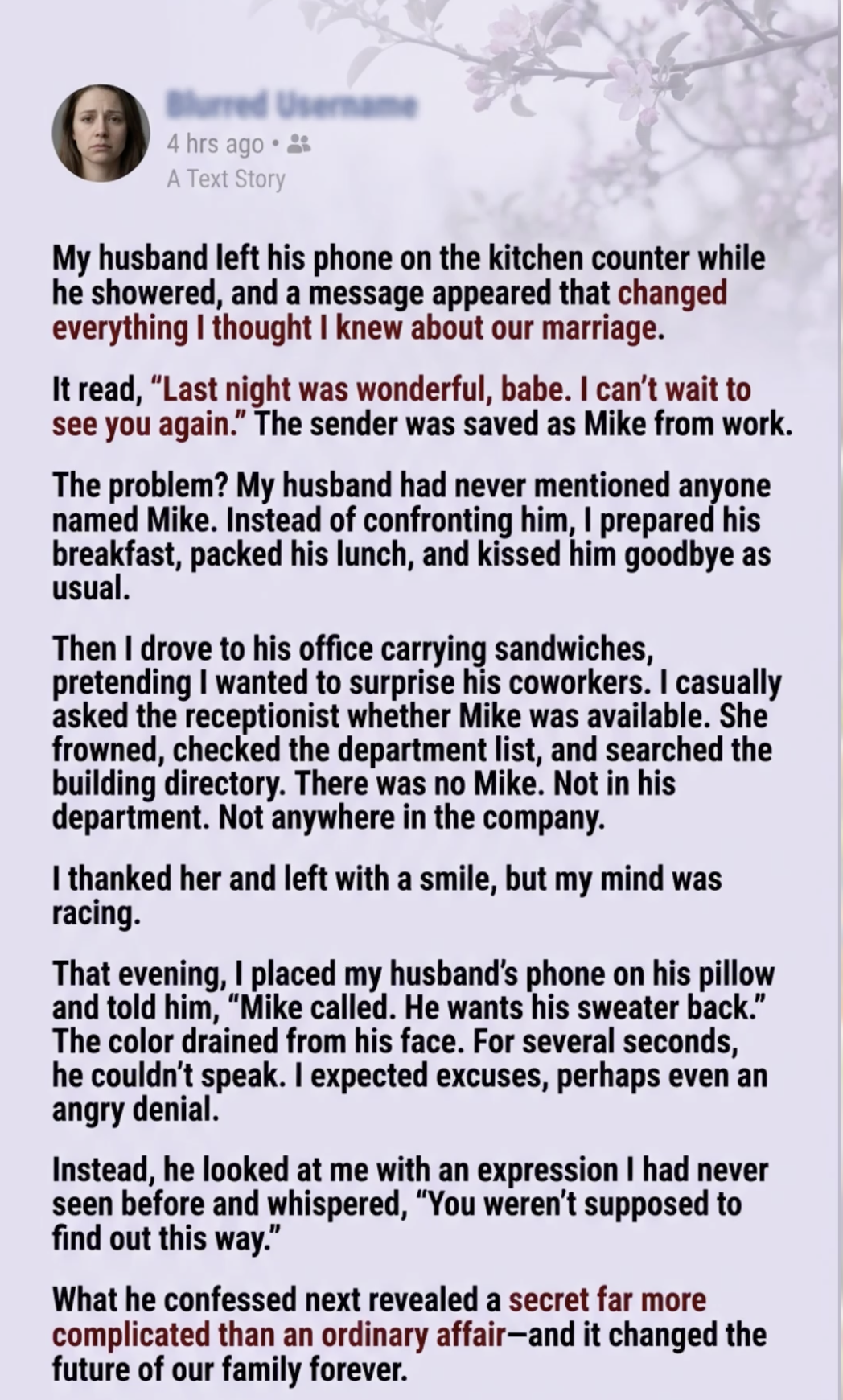
Daniel had left his phone on the kitchen counter while he showered. I was pouring coffee when the screen illuminated beside the fruit bowl.
A message appeared.
“Last night was wonderful, babe. I can’t wait to see you again.”
The sender was saved as Mike from work.
I stared at the screen until it went dark.
At first, I tried to convince myself there was an innocent explanation. Perhaps Mike was a friend who joked like that. Perhaps the message had been sent to the wrong person. Perhaps there was some context I knew nothing about.
But Daniel had never mentioned anyone named Mike.
I knew the names of his closest coworkers. I had attended office holiday parties, retirement dinners, and summer picnics. I had heard endless stories about his manager, his department, and the man who always stole food from the communal refrigerator.
Not once had I heard of Mike.
The shower stopped running.
I put the coffee beside Daniel’s usual chair and forced myself to breathe normally. When he walked into the kitchen, his hair damp and his shirt half-buttoned, I was already packing his lunch.
“Everything okay?” he asked.
“Of course,” I replied.
I watched him eat breakfast. He complained about traffic, reminded me that our daughter needed money for a school trip, and kissed my cheek before leaving.
I kissed him back.
The moment the front door closed, I felt as if the floor had shifted beneath me.
I could have called him immediately. I could have sent a screenshot of the message and demanded an explanation.
Instead, I decided I needed to know whether Mike existed.
I told myself I would regret acting on suspicion, but I would regret ignoring evidence even more.
So I made sandwiches, wrapped them in foil, and drove to Daniel’s office.
I had visited the building before, although never without him. I walked through the lobby carrying a paper bag and gave the receptionist a friendly smile.
“I’m dropping off lunch for my husband’s team,” I said. “Would you mind telling me if Mike is available? Mike from Daniel’s department.”
The receptionist looked puzzled.
“Mike?”
“Yes. I’m not sure of his last name.”
She checked the staff directory on her computer, then opened a department list.
“I’m sorry,” she said. “We don’t have a Mike in accounting. I can check the full directory.”
She searched again.
There was no Mike.
Not in Daniel’s department. Not in another department. Not anywhere on the company directory.
I thanked her and left with the sandwiches untouched.
By the time I reached my car, my hands were shaking.
I drove around the parking lot once before pulling onto the road. I did not know whether Daniel was having an affair, whether someone was using a false name, or whether I had misunderstood the message entirely.
But I knew I could not pretend everything was normal.
That evening, Daniel came home at his usual time. He asked about the children, changed out of his work clothes, and helped me clear the dinner table.
I studied him throughout the meal.
Every ordinary gesture suddenly seemed suspicious. When he turned his phone facedown beside his plate, I felt a sharp ache in my chest.
After the children went upstairs, I waited until we were alone.
Then I took his phone from the counter and placed it on his pillow in our bedroom.
When Daniel walked in, I stood beside the dresser.
“Mike called,” I said quietly. “He wants his sweater back.”
The color drained from Daniel’s face.
For several seconds, he did not move.
His eyes shifted from me to the phone and back again. His mouth opened, but no words came out.
I had prepared myself for anger. I expected him to accuse me of invading his privacy or insist that I had misunderstood.
Instead, he sat on the edge of the bed and covered his face with both hands.
“You weren’t supposed to find out this way,” he whispered.
My heart began pounding.
“Find out what, Daniel?”
He looked up. His eyes were already wet.
“Mike isn’t a coworker.”
“I gathered that.”
“He’s my son.”
For a moment, I could not understand the words.
“Your son?”
Daniel nodded, staring at the floor.
“Before I met you, I had a relationship with someone named Laura. We were young. We broke up before I knew she was pregnant. She contacted me a few months later and told me she planned to raise the baby herself.”
I stood completely still.
“You have a child?”
“Yes.”
“And you never told me?”
He swallowed.
“I found out he existed when he was already almost a year old. Laura had moved away. We spoke a few times, but things were difficult between us. She didn’t want me making promises I couldn’t keep, and I was barely managing my own life.”
“Daniel, that was seventeen years ago.”
“I know.”
“Seventeen years of marriage. Two children together. Seventeen years of birthdays, holidays, and conversations about our future. And you never thought I deserved to know?”
He had no answer.
He told me that, for years, he had known very little about Mike’s life. Laura had occasionally sent photographs and updates, but their communication had faded. Daniel said he had tried to find them once, then stopped after receiving no response.
I listened, struggling to separate the shock of his secret from the possibility that his story was true.
“Then why is Mike texting you now?” I asked.
Daniel rubbed his forehead.
“Because he contacted me six months ago.”
I felt my stomach tighten.
“Six months?”
“He found me through social media. He sent a message asking whether I was his father. We talked for a while, and eventually we met.”
“Where?”
“At a café outside the city.”
“How many times?”
“Several.”
“And the message about last night being wonderful?”
Daniel hesitated.
“We met for dinner. He stayed late because we were talking. He’d brought a sweater, and he left it at my place.”
I stared at him.
“You let me believe you were at work late while you were meeting a son you had hidden from me.”
“I was afraid.”
“Of what? That I would hate him?”
“No. That you would hate me.”
His answer hurt more than I expected.
Daniel explained that he had wanted to tell me after the first meeting, but he kept postponing it. He worried I would think he had deliberately concealed another family. He worried our children would feel betrayed. He worried that bringing Mike into our lives would expose years of decisions he was ashamed of.
Every time he planned to tell me, he said, he convinced himself he needed a little more time.
Then the next meeting came.
And the next.
The message on his phone had sounded intimate because the relationship was intimate, but not in the way I had first imagined. Mike was his biological son, a young man who had spent most of his life without knowing his father personally.
I wanted to feel relieved.
Instead, I felt as if my entire marriage had been built around a door Daniel had kept locked.
“Does Mike know about me?” I asked.
“Yes.”
“Does he know you have two other children?”
“Yes.”
“Does he know you’ve kept him a secret from us?”
Daniel lowered his head.
“He knows I haven’t told you yet.”
That was the moment I began to cry.
Not because Daniel had a child from before our marriage. I could understand a complicated past. I could understand a young man making mistakes and trying to live with them.
What I could not understand was the decision to let me live inside a version of our family that was incomplete.
I left the bedroom and slept in the guest room that night.
Daniel did not follow me.
The next morning, I called in sick to work. I sat at the kitchen table with a cup of tea that went cold while I tried to decide what to do next.
Part of me wanted to call Mike and demand answers. Another part knew that he had not been responsible for Daniel’s silence. If anything, he was another person caught in the consequences of a secret he had not created.
At lunchtime, Daniel asked whether I would be willing to meet him in a public place so we could talk.
I agreed, but I made one condition.
“No more partial truths,” I told him. “If there is anything else, you tell me now. I won’t discover another piece of my own marriage from a stranger’s message.”
He promised.
We met at a quiet café near the park where we had taken our children when they were small. Daniel brought a folder containing old photographs, messages from Laura, and recent conversations with Mike.
He did not hand them to me as proof that I should forgive him. He placed them on the table and said I could look at them if I wanted.
I read slowly.
There was a photograph of a baby in a blue blanket. A birthday picture from years later. A recent message from Mike asking Daniel whether he had ever wanted to know him better.
The messages showed an awkward relationship beginning to grow. Mike asked questions about Daniel’s childhood, his parents, and whether he had inherited his father’s habit of taking apart broken appliances instead of replacing them.
Daniel replied with stories and photographs.
In one message, Mike had written, “I don’t expect you to make up for seventeen years. I just want to know you now.”
I had to put the phone down.
Mike was not demanding money. He was not threatening Daniel. He seemed to be asking for something simple and deeply human: a chance to know his father.
But that did not erase the deception in my own home.
“Why did you save him as Mike from work?” I asked.
Daniel looked ashamed.
“When he first contacted me, I saved his number under his name. Then I panicked when you asked who was messaging me one evening. I changed the contact name.”
“So you knew you were hiding it.”
“Yes.”
“Every time you changed that name, every time you told me you were working late, every time you watched me plan our family weekends without mentioning him—you knew.”
“Yes.”
I folded my hands in my lap to keep them from shaking.
“I don’t know whether I can trust you right now.”
“I understand.”
“No, I don’t think you do. You were afraid of losing me, so you made a decision that took away my chance to choose what kind of family I wanted to be part of.”
He looked at me for a long time.
“You’re right,” he said finally.
It was the first answer that did not sound like an excuse.
Over the following days, we spoke in short, difficult conversations. I asked for space, and Daniel respected it. He slept in the guest room and took responsibility for telling our children that there was an older half-brother they had never met.
We did not tell them every detail of our marital conflict. They were entitled to the truth about their family, but they did not need to become judges in their parents’ marriage.
Our daughter, Emma, was sixteen. Our son, Noah, was thirteen. Both were stunned.
Emma asked why her father had not told us earlier. Noah wanted to know whether Mike would come to live with us.
Daniel answered their questions as honestly as he could. He told them Mike was an adult, that he had his own life, and that nobody expected them to feel close to him immediately.
Emma was angry with Daniel for several days. Noah became quiet and asked whether this meant there were other secrets.
That question hurt all of us.
Daniel promised he would answer any reasonable question and would not ask the children to keep secrets from me.
I also asked to speak with Mike before deciding whether I was ready to meet him in person.
He agreed to a video call.
When his face appeared on the screen, I saw Daniel’s eyes, the same crooked smile, and a familiar crease between his eyebrows. The resemblance was unmistakable.
Mike looked nervous.
“I’m sorry,” he said before I could speak. “I didn’t know he hadn’t told you. I thought you knew about me.”
I believed that he might have been telling the truth. There was no reason for me to punish him for a secret his father had chosen to keep.
“You don’t owe me an apology for existing,” I told him. “But I need time to understand all of this.”
“I understand.”
He explained that he had contacted Daniel because he wanted to know where he came from. He had a mother who loved him and a life he was proud of, but he had always wondered about the man whose face appeared in an old photograph his mother kept in a drawer.
He said their meetings had been uncomfortable at first. They talked about school, work, and ordinary things. Sometimes they sat in silence because neither knew what to say.
He had sent the message about the dinner because he was happy that, for the first time, he felt he might be building a real relationship with his father.
Hearing that made my anger more complicated.
I could not resent a young man for wanting to know his own family. I could resent Daniel for believing he could control the truth by keeping everyone separated.
When the call ended, I sat alone for a long time.
A week later, I agreed to meet Mike in person at a café. Daniel offered to stay away, but I asked him to come. I wanted to see how they interacted when no one was hiding anything.
Mike arrived wearing a gray sweater and carrying a small paper bag.
“I brought this,” he said, handing it to Daniel. “You left it in my car.”
Daniel laughed nervously. “I thought you’d forgotten it.”
“I nearly did.”
The sweater was ordinary, slightly worn at the cuffs. It was such a small thing, yet I felt a strange ache looking at it. The sweater had become the symbol of a relationship that had existed in the shadows of mine.
We sat together for nearly two hours.
Mike spoke about his job, his mother, and his plans to move into a new apartment. He asked me about Emma and Noah, carefully, as though he was afraid the questions might hurt me.
I told him they were still processing everything.
“I don’t want to take anything away from them,” he said. “I’m not trying to replace anyone.”
“You can’t replace anyone,” I answered. “But if we’re going to be part of each other’s lives, we have to be honest about what happened.”
He nodded.
For the first time since seeing the message, I felt I could look at the situation without imagining an affair. The truth was painful enough on its own. It did not need to be turned into something else.
Still, Daniel and I had a marriage to reckon with.
We began counseling a few weeks later. I needed a place where I could ask questions without the conversation turning into a defense of his intentions. Daniel needed to understand that fear did not excuse deception.
Our counselor asked him why he had believed secrecy would protect our family.
Daniel thought for a long time.
“I thought if I could keep the two parts of my life separate, no one would get hurt,” he said.
“And did that work?” the counselor asked.
“No.”
He looked at me.
“I made everyone live with the consequences of my fear.”
It did not repair the damage, but it was an honest beginning.
Trust returned more slowly than either of us wanted. I stopped assuming that every unexplained delay was innocent. Daniel learned that transparency meant telling me things before I discovered them, not offering explanations afterward.
We agreed on clear boundaries. He would not hide communications with Mike. I would not be expected to take on an instant maternal role simply because they were related. The children could build their own relationship with their half-brother at their own pace.
There were setbacks.
One evening, Daniel mentioned that he had arranged to have dinner with Mike the following weekend. He had intended to tell me later, once he knew the plans were definite.
When I heard that, I felt the old anger rise.
“You were about to do it again,” I said.
He immediately stopped.
“You’re right. I should have told you when we first discussed it.”
He showed me the messages and asked whether I wanted to talk through how the visit would affect our plans. He did not insist that I approve of every decision, but he understood that rebuilding trust required him to stop treating information as something he could release when it suited him.
Months passed.
Mike came to our house for dinner for the first time in the spring. Emma was polite but reserved. Noah asked him about his job and discovered they both liked repairing old bicycles. By the end of the evening, they were arguing cheerfully about which tools were worth buying and which were a waste of money.
It was not an instant, perfect family reunion.
There were awkward pauses. There were moments when I remembered the message and had to excuse myself to the kitchen. Daniel sometimes looked at me as though he wanted reassurance that everything was all right, and I had to remind him that my healing could not become another task I was expected to perform for him.
But we kept showing up.
Mike began visiting occasionally. He and Emma exchanged messages about music. Noah sent him photographs of a bicycle he was rebuilding. I learned that Mike was thoughtful, funny, and careful not to assume a place in our lives that no one had offered him.
I also learned that welcoming him did not mean pretending Daniel had done nothing wrong.
There were days when I still felt angry about the seventeen years I had spent unaware of a person who mattered so much to my husband. I wondered what else fear had persuaded Daniel to conceal, and whether our marriage would ever feel as uncomplicated as it once had.
Eventually, I understood that it might never feel uncomplicated again.
That did not necessarily mean it was beyond repair.
A year after the morning I saw the message, Daniel and I sat together on the back porch while the children were out with friends. He reached for my hand, then paused.
“Can I?” he asked.
I let him take it.
“I know I can’t give you back the truth I should have told you years ago,” he said. “I know you may never see me exactly the way you did before.”
“You’re right,” I replied.
He nodded, accepting the answer without asking me to soften it.
“But I can decide what happens from here,” I continued. “And so can you. If we stay together, it has to be because we choose honesty, even when it is uncomfortable.”
“I want that,” he said.
“I need to see it, not just hear it.”
“I know.”
We sat quietly as the evening light faded.
I had once believed that the strength of a marriage came from knowing everything about the person you loved. Now I understood that no marriage could guarantee that. People carried histories, regrets, and fears long before they met each other.
What mattered was what they did when those hidden parts finally came into the light.
Daniel had failed me. He had chosen silence when I deserved the truth, and he would have to keep earning the trust he had broken.
But Mike had not been a rival waiting to destroy our family. He was a son who had finally found his father, and two siblings who had unknowingly shared their childhood with someone they had never met.
The message that appeared on Daniel’s phone had not revealed the affair I feared.
It had revealed the family we had been denied the chance to understand.
We could not rewrite the years behind us. We could only decide whether the truth would become another secret buried beneath our lives—or the difficult beginning of something more honest.
For the first time in seventeen years, I knew exactly what I was choosing.
Not the marriage I had imagined we had.
The one we would have to build, truthfully, from that day forward.