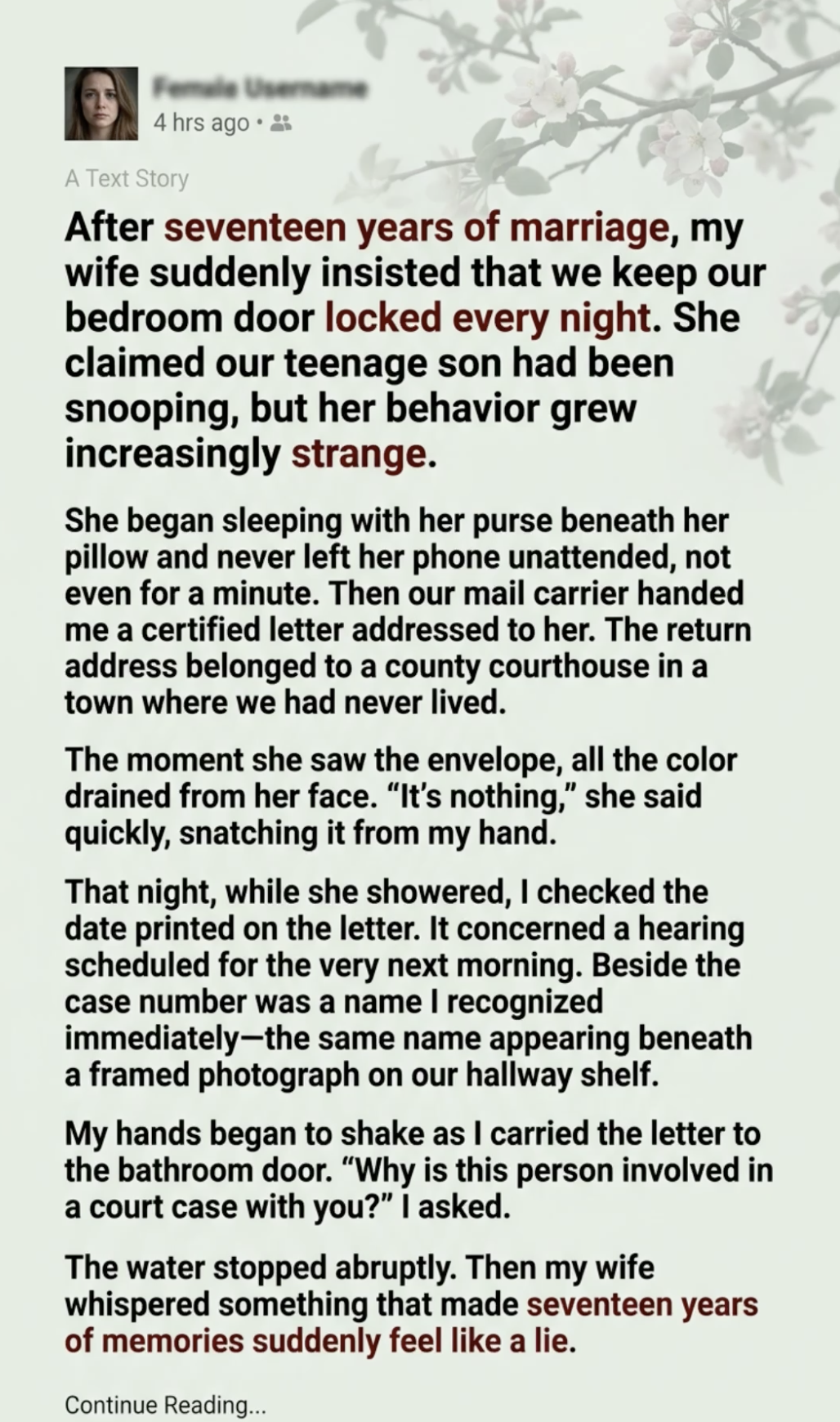
For seventeen years, I believed my wife, Margaret, and I had built an honest life together.
We had a comfortable home in a quiet neighborhood, a sixteen-year-old son named Daniel, and the ordinary routines that made our marriage feel dependable. Margaret managed the household finances, I handled most of the repairs, and we divided the responsibilities of raising our son as best we could.
We weren’t perfect. We had arguments about money, disagreements about Daniel’s screen time, and occasional stretches when work left us too tired to talk properly.
But I had never imagined that my wife was keeping a secret large enough to change everything I believed about our family.
The first warning came on a Sunday evening.
Margaret stood in the bedroom doorway holding a small brass key.
“From now on, I want us to lock this door at night,” she announced.
I looked up from the book I was reading.
“Why?”
“Daniel has been snooping.”
Our son had always been curious. He sometimes borrowed chargers without asking and had a habit of entering rooms before knocking. But I had never known him to search through our belongings.
“What has he been looking for?” I asked.
“Nothing specific. I just don’t want him going through our things.”
I shrugged.
“Then tell him to knock.”
“I have told him. Please, just lock the door.”
I agreed because the request seemed harmless. If a locked door made her feel more comfortable, I wasn’t going to turn it into an argument.
At first, that was all it appeared to be.
Then the other changes began.
Margaret started sleeping with her purse beneath her pillow. She had always kept it on the dresser, but now she placed it between herself and the mattress as though she were afraid someone might take it.
She carried her phone everywhere. If she went to the kitchen, it went with her. If she took a shower, it sat on the bathroom counter. When it rang, she answered in another room.
Whenever I asked what was happening, she gave me a different explanation.
Work was stressful.
Her sister was having problems.
Someone had been calling about an old account.
She was simply tired.
I wanted to believe her, but the explanations never quite matched her behavior.
One evening, I found her standing in our bedroom, staring at the framed photographs on her dresser.
“What are you looking at?” I asked.
She turned so quickly that the picture frame nearly slipped from her hand.
“Nothing.”
The photograph showed Margaret and her younger brother, Andrew, standing beside their parents at a family gathering. Andrew had died twelve years earlier in a car accident.
His death had devastated Margaret. For months, she barely spoke about anything else. I had attended the funeral with her, helped her mother sort through Andrew’s belongings, and sat beside Margaret through the first anniversary of his death.
I knew how much he had meant to her.
I also knew she had never fully recovered from losing him.
“Missing Andrew?” I asked gently.
She put the frame down.
“Sometimes.”
I touched her shoulder, but she moved away.
“I need to finish something,” she said.
That night, she locked the bedroom door before climbing into bed.
I lay awake for a long time, wondering what had changed.
Three days later, the answer arrived in the hands of our mail carrier.
I was home that afternoon, finishing a work report at the dining table, when someone knocked at the front door.
The mail carrier held a clipboard and a thick envelope.
“Certified delivery for Margaret,” he said. “She’ll need to sign.”
I accepted the envelope because Margaret wasn’t home yet.
The return address was a county courthouse in a town nearly two hundred miles away, a place where neither of us had ever lived.
I turned the envelope over.
It bore Margaret’s full legal name and a case number.
I had just begun wondering whether it concerned a distant relative when I heard her car pull into the driveway.
She walked through the door carrying grocery bags.
“There’s certified mail for you,” I said.
The moment she saw the envelope, her expression changed.
The grocery bags slipped from her hands. An apple rolled across the floor.
“Where did that come from?”
“The mail carrier brought it.”
She crossed the room and snatched it from my hand.
“It’s nothing.”
I stared at her.
“It’s from a courthouse.”
“I know what it is.”
“Then why are you acting like you’ve seen a ghost?”
She looked toward the hallway, as though checking whether Daniel was home.
“Please don’t ask me about this.”
Then she took the envelope upstairs and shut the bedroom door.
I stood in the kitchen, listening to her footsteps move across the floor above me.
For seventeen years, I had thought of marriage as a partnership in which difficult news was something we faced together.
Now my wife was hiding a court letter from me.
That evening, Daniel asked why his mother seemed upset.
“Your mother received some mail she’s worried about,” I said carefully.
“Is Grandma okay?”
“I don’t know.”
He looked concerned but didn’t press me.
Margaret came downstairs for dinner and behaved as though nothing had happened. She asked Daniel about school, reminded him to finish his mathematics assignment, and complained that the grocery store had raised its prices again.
But she barely touched her food.
After dinner, she took her phone and went upstairs.
I waited until I heard the shower running.
Then I walked into our bedroom.
The envelope lay on the dresser beside her purse.
I knew I should have waited for her to explain. But I was frightened by the way she had reacted, and I couldn’t make sense of why a court in a distant county would be contacting my wife.
I opened the envelope.
Inside was a notice of hearing scheduled for the following morning.
The case concerned a civil dispute involving the estate of a deceased person.
I read the first page twice.
Then I saw the name listed beside Margaret’s.
David Lawson.
My hands began to shake.
David Lawson was the name printed beneath a framed photograph on our hallway shelf.
He was Margaret’s former fiancé.
She had told me about him early in our relationship. They had been engaged in their twenties, she said, but the relationship ended before the wedding. She described it as a painful period of her life, one she had put behind her.
I had met David once, briefly, at a family event before Margaret and I married. He had been polite, reserved, and clearly uncomfortable around us.
Years later, Margaret told me he had moved away.
Then, in the year before Andrew died, I heard that David had passed away unexpectedly.
I remembered attending a small memorial service with Margaret. She had cried quietly, and I had held her hand.
I had never suspected that his death could be connected to a court case seventeen years into our marriage.
I turned to the next page.
The notice referenced a dispute concerning a trust and a beneficiary designation. It did not explain the entire matter, but it made one thing clear: Margaret was expected to appear the next morning, and David Lawson’s estate was directly involved.
I carried the papers toward the bathroom.
The water was still running.
I stopped outside the door.
“Margaret?”
She didn’t answer.
“Why is David Lawson involved in a court case with you?”
The water stopped abruptly.
For several seconds, there was complete silence.
Then she whispered through the door.
“Because David was Daniel’s biological father.”
I felt the hallway tilt beneath my feet.
I couldn’t speak.
I heard the shower curtain move, then the sound of a towel being pulled from the rack.
The door opened a few inches.
Margaret stood there with wet hair and a white towel wrapped around her shoulders. Her eyes were red.
“I was going to tell you,” she said.
“When?”
She closed her eyes.
“I don’t know.”
I looked down at the papers in my hand.
“Are you telling me our son isn’t mine?”
Margaret began to cry.
“You are his father in every way that matters.”
“That isn’t what I asked.”
She looked at me, and I saw the fear that had been hiding behind all those strange behaviors.
“Biologically,” she whispered, “David was his father.”
I stepped back.
For seventeen years, I had watched Daniel take his first steps, held him when he had nightmares, taught him to ride a bicycle, and sat beside him in hospital waiting rooms. I had attended every school meeting I could. I had stayed awake when he was sick and celebrated every small achievement.
I had never questioned whether he was my son.
Now I was being told that the story of his birth had been built on a lie.
I went downstairs and sat at the kitchen table.
Margaret followed me several minutes later, dressed in pajamas. She sat opposite me but didn’t reach for my hand.
“Tell me everything,” I said.
And for the first time in seventeen years, she did.
She and David had been engaged before she met me. Their relationship had ended after years of arguments about money, family expectations, and where they wanted to live. Margaret said she had loved him, but they had become unhappy together.
After the breakup, she moved to another city and eventually met me.
We fell in love quickly. Our relationship was steady and uncomplicated compared with the one she had left behind.
We married two years later.
But shortly before our wedding, Margaret learned she was pregnant.
She told me the pregnancy was mine.
According to her, the timing had been confusing. She had briefly seen David during the months before we married, and she had never been certain which man was the father.
She said she had convinced herself the child was mine because she wanted our marriage to begin without uncertainty.
I stared at her.
“You knew there was a possibility.”
“Yes.”
“And you never told me.”
“No.”
“Not when Daniel was born? Not when we registered his birth? Not when we brought him home?”
She shook her head, crying.
“I was afraid.”
“Of what?”
“That you would leave me. That you’d think I had married you under false pretenses. That you’d reject the baby.”
I pushed my chair back.
“You made that decision for me.”
“I know.”
“No, Margaret. You didn’t just keep a secret about another man. You decided what kind of father I was allowed to become without giving me the truth.”
She covered her face.
I walked to the window because I couldn’t bear to look at her.
“What happened when you learned David was the father?”
She told me that when Daniel was about six months old, David contacted her. He had been reviewing dates and realized there was a possibility the baby was his.
Margaret admitted the uncertainty to him.
They arranged a private paternity test.
The result confirmed that David was Daniel’s biological father.
I gripped the windowsill.
“And you kept raising him as my son without telling me?”
“Yes.”
“Did David want to be involved?”
“At first, he wanted to meet Daniel. I refused. I told him Daniel had a stable home and that involving him would destroy everything.”
She paused.
“Eventually, he stopped asking.”
I turned toward her.
“Did you ever tell him not to contact us again?”
“Yes.”
“Did he agree to stay away?”
“He said he would, as long as Daniel was safe.”
I looked at the framed photographs on the wall. Every birthday, every Christmas, every family vacation had suddenly acquired a shadow I had never known was there.
“What happened to David?”
Margaret swallowed.
“He died in a car accident when Daniel was four.”
I remembered the memorial service.
I remembered holding her hand while she cried.
“You let me comfort you over the death of a man who was your son’s father, while I had no idea who he was to our family.”
“I didn’t know how to tell you.”
“You had four years to find a way.”
She nodded.
“I know.”
I asked why the truth was emerging now.
Margaret explained that David had left behind a small estate, including a trust that had been created for Daniel. The trust had not been fully administered because of disagreements among relatives and questions about who had legal authority to manage the funds.
A relative had recently requested a review of the records. The court had issued notices to people who might have an interest in the estate, including Margaret.
The hearing was intended to clarify the beneficiary arrangements and determine how the trust should be handled.
Margaret had received earlier letters but had ignored them, hoping the issue would go away. The certified notice was different because it required her to appear.
I looked at the documents again.
“Does Daniel know?”
She shook her head.
“No.”
“Does anyone else in our family know?”
“David’s sister knows. She has known for years.”
I sat down slowly.
“So other people knew that Daniel might be David’s son while I raised him believing he was mine.”
Margaret began sobbing.
“I never wanted to hurt you.”
I had heard those words before, from people who believed good intentions could erase the damage caused by their choices.
I didn’t answer.
That night, I slept in the guest room.
The next morning, I drove Margaret to the courthouse because she was frightened and because I wanted to understand what was happening. I did not go to protect her from the consequences. I went because the legal matter involved a child I had raised and a family I had a right to understand.
We met with a court-appointed representative who explained that the hearing concerned the administration of the trust, not a decision about whether I was Daniel’s father in any meaningful family sense.
The representative also made clear that the court could not resolve every personal question between Margaret and me.
The documents confirmed that David had named Daniel as a potential beneficiary, subject to proof of identity and the terms of the trust. The court needed accurate records before determining how the estate should be distributed.
Margaret’s testimony and the existing paternity report were relevant to that process.
I listened as she answered questions about the dates, the test, and the earlier correspondence.
For the first time, I heard the full story presented without the protection of her carefully chosen words.
The paternity test had been conducted privately. David had retained a copy. Margaret had received a letter confirming the result, and the document had been kept with the records now under review.
She had not simply suspected the truth.
She had known it for sixteen years.
After the hearing, the court ordered additional records to be submitted before any final decision about the trust could be made. No one received a sudden windfall, and nothing was resolved in a single morning.
The legal process would take time.
On the drive home, Margaret sat silently in the passenger seat.
Finally, she said, “I know you may never forgive me.”
I kept my eyes on the road.
“I don’t know what I’m going to do.”
She nodded.
“I understand.”
When we arrived home, Daniel was waiting in the kitchen.
He had noticed our absence and wanted to know where we had gone.
Margaret looked at me, silently asking what we should tell him.
For the first time in seventeen years, I refused to let her decide the truth on her own.
“We need to talk to him together,” I said.
We sat Daniel down that evening.
He looked between us, confused by our serious expressions.
“Am I in trouble?” he asked.
“No,” I said immediately. “You’ve done nothing wrong.”
Margaret took a breath.
“There’s something about your biological family that we should have told you a long time ago.”
Daniel frowned.
“What does that mean?”
She explained that David Lawson, the man in the photograph, was his biological father. She told him that David had died when he was four and that I had raised him from birth believing I was his biological father.
She admitted that she had known about the paternity test and had kept the truth from both of us.
Daniel did not speak for a long time.
Then he looked at me.
“Did you know?”
“No,” I said. “I found out yesterday.”
His face crumpled.
“So you didn’t know either?”
“No.”
He looked down at his hands.
“Does that mean you’re not my dad anymore?”
The question nearly broke me.
I moved my chair closer.
“Daniel, I am your dad. I have been your dad every day of your life. Nothing about this changes the years we’ve spent together, or how much I love you.”
“But he’s my real father?”
“He’s your biological father,” I replied carefully. “And you deserve to know the truth about him. But being your father has never been just about biology.”
Daniel’s eyes filled with tears.
“Why didn’t Mom tell us?”
Margaret tried to answer, but he raised his hand.
“Please don’t explain it right now.”
He stood and went upstairs.
I followed him after a few minutes and found him sitting on his bed, staring at a photograph of the two of us fishing when he was eight.
“Are you going to leave?” he asked without looking at me.
“No.”
“Are you going to divorce Mom?”
I sat beside him.
“I don’t know what will happen between your mother and me. But I am not leaving you, Daniel. You are my son, and that will not change.”
He leaned against my shoulder and cried.
I held him until he was ready to be alone.
The following weeks were difficult for all of us.
Daniel was angry with Margaret. He wanted to know why she had never told him about David, why other relatives knew, and whether any of his memories were real.
Margaret answered what she could. She admitted that fear had controlled her decisions and that she had kept postponing the truth until postponement became a way of life.
She did not ask Daniel to forgive her.
I appreciated that, even though it could not undo the harm.
I also struggled with feelings I had never expected to experience. I did not suddenly love Daniel less, but I felt robbed of the chance to make an informed decision about the life I had chosen.
I wondered whether Margaret had ever looked at Daniel and seen David’s face. I wondered whether she had spent years comparing us in silence. I wondered how many times she had almost told me the truth and then decided I could not handle it.
When I asked her those questions, she answered honestly.
She said Daniel sometimes reminded her of David, especially when he laughed. She said she had thought about telling me many times but became more afraid with each passing year.
“I thought the longer I waited, the more it would hurt you,” she said.
I looked at her.
“The longer you waited, the more lives you made part of the secret.”
She lowered her head.
“I know.”
We began seeing a marriage counselor, not because I had promised to stay, but because I needed a place to understand my anger without letting it consume every part of my life.
The counselor encouraged us to separate three questions: what Margaret had done to our marriage, what Daniel needed to understand about his biological history, and what the legal process required of us.
Those questions were connected, but they were not the same.
I could be angry with Margaret and still be a loving father to Daniel.
Daniel could want to learn about David without rejecting me.
And the court could resolve the trust without deciding what our family meant to one another.
Slowly, we began to make room for those truths.
Daniel asked to see the paternity report. We arranged for him to receive a copy through the appropriate process and discussed the information with a counselor who understood family identity issues.
He learned that David had been a real person with a complicated history, not a villain or a perfect father invented by the circumstances.
David had struggled in his relationships. He had made mistakes. He had also tried, at different points, to find a way to acknowledge Daniel’s existence without disrupting the life he believed the boy had.
Daniel wanted to know more about him.
I supported that decision.
We contacted David’s sister, Susan, who had kept photographs and letters from her brother. She agreed to meet Daniel and share what she knew.
Before the meeting, I asked Daniel whether he wanted me to come.
“Yes,” he said. “I want you there.”
Susan greeted us warmly but cautiously. She showed Daniel photographs of David as a child, letters he had written while traveling, and a few notes in which he asked how Daniel was doing.
One letter contained a simple sentence: I hope he grows up knowing he was wanted, even if I wasn’t able to be the father he deserved.
Daniel read it twice.
He did not suddenly forgive Margaret, and he did not stop seeing me as his father. Instead, he began to understand that his history was more complicated than the story he had been given.
The legal proceedings continued for several months. The trust records were reviewed, the beneficiary details were verified, and the court eventually issued instructions for the remaining administration. Any funds intended for Daniel would be handled according to the trust’s terms, with appropriate safeguards.
We did not treat the money as compensation for the years of secrecy. It was part of David’s estate, and Daniel would decide what it meant to him when he was ready.
As for my marriage, I needed more time.
Margaret and I continued counseling, but I moved into the guest room permanently for a while. We discussed finances openly and agreed that neither of us would make major decisions affecting the family without telling the other.
She stopped hiding her phone. She stopped sleeping with her purse beneath her pillow. She no longer locked the bedroom door as though our own home were a place where she needed to guard herself against discovery.
Those behaviors had been symptoms of her fear, but removing them did not automatically restore trust.
I needed her to understand that a confession was not the same as repair.
Months later, on a quiet Sunday morning, Margaret found me sitting in the garden.
She brought two cups of coffee and sat beside me.
“I know I can’t ask you to forget what I did,” she said. “But I want you to know that I am sorry for making choices that belonged to you, too.”
I watched a bird settle on the fence.
“I believe you’re sorry.”
She looked at me.
“Does that mean you might stay?”
“It means I’m still here today. I can’t promise you what I’ll feel next month.”
She nodded, and for once she didn’t ask me to make her feel better.
That mattered.
Over time, Daniel began speaking more openly about David. Sometimes he asked Susan questions. Sometimes he asked me questions about the life we had built together. He was allowed to be curious about his biological father without having to reassure either of us.
I learned that fatherhood could not be reduced to a DNA result.
But I also learned that love did not make the truth unnecessary.
I had raised Daniel for seventeen years believing I understood the foundation of our family. When that foundation changed, the love I felt for him did not disappear. What changed was my understanding of the woman I had married and the decisions she had made on my behalf.
I could not recover the years in which I had been denied the truth.
I could decide what I would do with the years ahead.
A year after the courthouse letter arrived, Daniel and I returned to the lake where I had taught him to fish. We sat side by side on the bank, watching the water move beneath the morning light.
He had grown taller, and his voice had begun to deepen. He still carried the same old tackle box, even though one of its hinges was broken.
After a while, he turned to me.
“Do you ever wish things were different?”
I thought carefully before answering.
“I wish the truth had been told sooner. I wish you hadn’t had to learn it this way. But I don’t wish I hadn’t been your dad.”
He looked at the water.
“Sometimes I feel like I have to choose between you.”
“You don’t,” I said. “You can learn about David and still love me. You don’t have to protect my feelings by pretending he never existed.”
He nodded.
Then he leaned his shoulder against mine, the way he had when he was a little boy.
We stayed there for another hour.
I did not know whether Margaret and I would remain married forever. We were still working through the consequences of her choices, and I would not pretend that love erased seventeen years of deception.
But I knew what I would never do.
I would never make Daniel carry the burden of our marriage. I would never ask him to prove his loyalty by denying part of himself. And I would never confuse the truth about his biological father with the truth of the life we had shared.
The courthouse letter had exposed a secret that should never have been hidden.
It had forced our family to confront grief, betrayal, and questions that had no easy answers.
But it had also given Daniel something he had been denied: the right to know his own history.
And it had given me a choice I should have had from the beginning.
I could not change the past Margaret had concealed.
I could only decide whether the rest of my life would be built on the same silence—or on the truth, however painful it might be.