I had spent thirty-two years in the United States Army learning how to remain calm when everyone around me was losing control.
I had served in difficult places, led soldiers through uncertain situations, and learned that the worst decisions often happened when people acted out of anger instead of thinking clearly.
But nothing prepared me for the afternoon I returned to my beach house and discovered that my own family had turned it into a battlefield.
My name is Colonel Thomas Bennett, retired. I was sixty-one years old, and after decades of military service, I had finally built a quiet life that belonged entirely to me.
The beach house sat along a stretch of the Carolina coast, far enough from the busiest tourist areas to offer peace, but close enough to the water that I could hear the waves from the upstairs bedroom.
I had bought it with savings accumulated over years of service, careful investments, and a modest inheritance from my father. Every mortgage payment, repair bill, and insurance premium had come from my accounts.
The property was not a family resort.
It was my retreat.
After several exhausting months consulting for a defense contractor, I had scheduled a long weekend there. I planned to fish, read, sleep late, and enjoy three days without anyone asking me to solve a problem.
I had told my younger sister, Camille, about my plans two weeks earlier.
“I need a few days to myself,” I had explained over the phone. “No visitors, no family gatherings, no projects. Just quiet.”
She laughed.
“You sound like you’re preparing for another deployment.”
“Peace and quiet are harder to arrange than a deployment sometimes.”
She promised she understood.
I believed her.
On Friday afternoon, I drove down the coast with a small suitcase on the passenger seat and a bag of groceries in the back. The weather was perfect. The sky was clear, the water was blue, and I was already imagining a cold drink on the porch.
Then I turned into my driveway.
Three large SUVs were parked across the gravel, leaving barely enough room for my truck. Children’s bicycles lay scattered beside the steps. A cooler stood near the garage, and towels hung over the porch railing.
I slowed down.
At first, I wondered whether a neighbor had mistaken the property for a rental. Then I noticed a familiar blue minivan and recognized Camille’s license plate.
My sister had arrived with her husband, Richard, their two children, and what appeared to be half his extended family.
I parked behind the last SUV and stepped out.
The front door stood open.
Inside, children ran through the kitchen with sandy feet. Someone had moved the dining chairs onto the porch. A man I barely recognized was opening cabinets, searching for glasses, while two women carried bags upstairs.
I stood in the doorway for several seconds, trying to understand what I was seeing.
Then Richard appeared from the hallway wearing one of my bathrobes.
He looked at me as if I were an unexpected delivery.
“What are you doing here?” he asked.
I stared at him.
“I own this house.”
He laughed.
“Very funny. Who invited you?”
“Richard, move aside.”
His expression changed.
He stepped onto the porch and pointed at me in front of the relatives gathered around the kitchen.
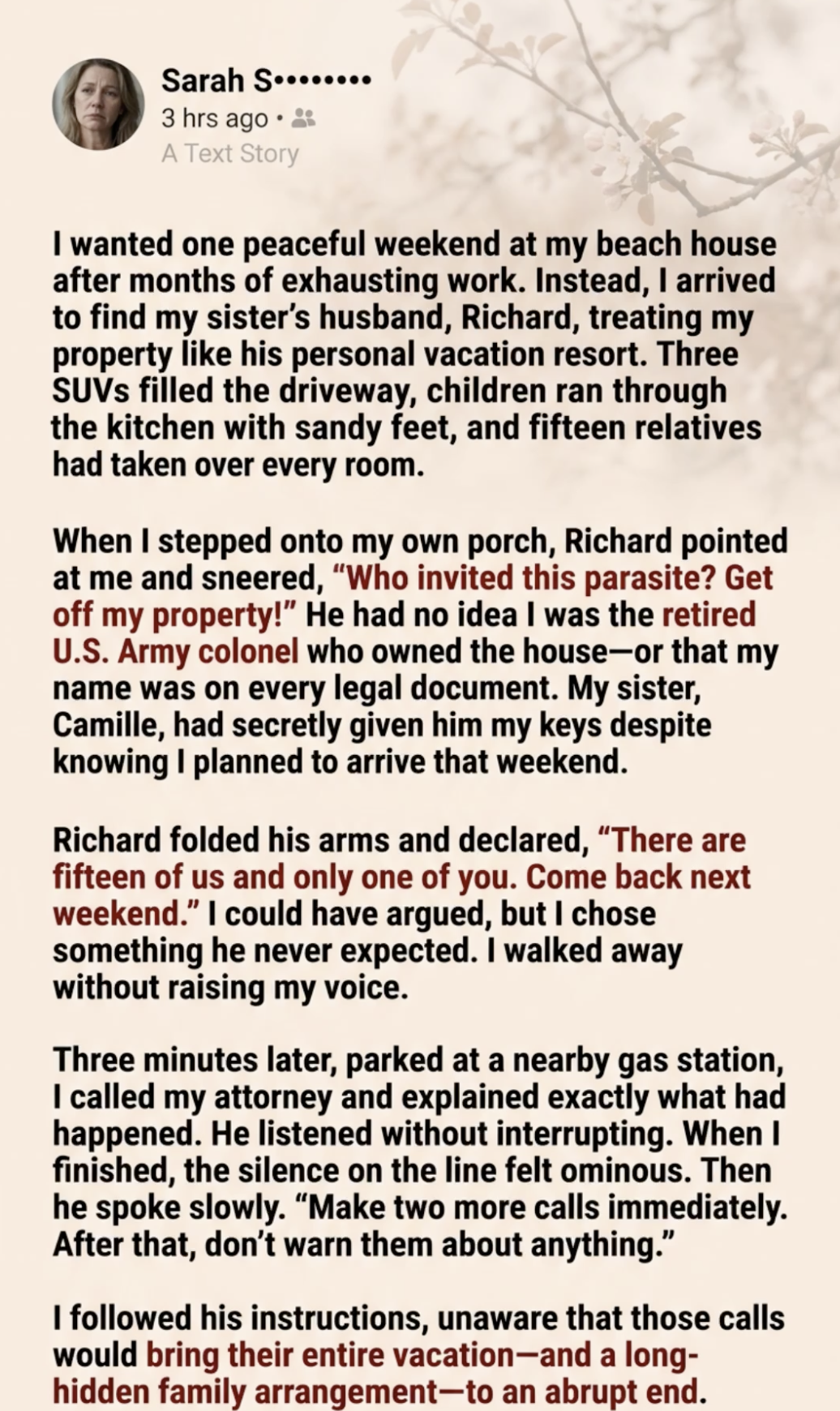
“Who invited this parasite? Get off my property!”
For a moment, I thought he was joking.
Then I realized he was serious.
I had known Richard for fourteen years. He had always been loud, boastful, and convinced that the world owed him special treatment. He enjoyed expensive cars, talked constantly about business opportunities, and treated every disagreement as a challenge to his authority.
I had tolerated his behavior for Camille’s sake.
I had paid for family dinners when his accounts were short. I had helped him move furniture, lent him tools, and once covered an unexpected car repair when Camille called me in tears.
I had never asked for repayment.
But I had never given him permission to occupy my home.
“Richard,” I said evenly, “you need to gather everyone and leave.”
He folded his arms.
“There are fifteen of us and only one of you. Come back next weekend.”
A few people laughed nervously.
Others looked away.
I searched the crowd for Camille.
She stood near the kitchen island, holding a glass of water. When our eyes met, she looked down.
That hurt more than Richard’s insult.
“Camille,” I said, “did you give him my keys?”
She swallowed.
“I thought it would be fine. Richard said he wanted to surprise everyone with a beach weekend.”
“You knew I was coming today.”
“I know, but—”
Richard interrupted her.
“She’s family. This is a family property, and we’re all entitled to use it.”
“No,” I replied. “It’s my property.”
He stepped closer.
“You can’t just throw fifteen people out because you’re in a bad mood.”
“I can ask people who have no permission to be here to leave.”
His face reddened.
“Try it.”
I looked around the room again.
Children were watching. Several adults had stopped unpacking. A woman near the stairs was holding a folded blanket against her chest, uncertain whether she should intervene.
I could have argued.
I could have reminded Richard that I had served my country longer than he had held a steady job. I could have shouted loud enough to make every person in the house understand exactly who they were dealing with.
But none of that would have solved the problem.
So I picked up my suitcase.
“Enjoy the afternoon,” I said.
Richard smirked.
“That’s what I thought.”
I walked back to my truck without raising my voice.
Three minutes later, I was parked at a gas station a short distance down the road. I called my attorney, Helen Brooks, who had handled the purchase of the beach house and several other property matters for me.
She answered on the second ring.
“Tom, what’s wrong?”
I explained what had happened, from the unauthorized entry to Richard’s refusal to leave.
Helen listened without interrupting.
When I finished, she remained silent for a moment.
Then she said, “Make two more calls immediately. After that, don’t warn them about anything.”
I sat up straighter.
“Who do you want me to call?”
“First, the local police department’s non-emergency line. Explain that you are the property owner, that you did not authorize the gathering, and that the occupants are refusing to leave. Ask what lawful steps are available. Don’t embellish anything.”
“Understood.”
“Second, call your property insurer’s emergency assistance number. Tell them what happened and ask whether the incident affects your coverage or requires any immediate documentation. Do not exaggerate the damage, and don’t threaten anyone.”
I paused.
“What are you expecting?”
“I’m not expecting anything. I’m making sure we protect your legal position. I also want you to send me your deed, the written messages showing you planned to use the house, and anything that establishes how Richard obtained the keys.”
Helen’s tone was calm, but I knew her well enough to recognize when she had begun building a case.
“Is there something else?” I asked.
“Yes. You mentioned Camille gave him the keys. Did she have permission to do that?”
“No. She had a spare key because she occasionally checked the house when I was away. I never authorized her to host anyone.”
“Good. Don’t assume that makes every action a crime. Let the local authorities determine what they can do. And don’t go back there to confront Richard alone.”
I followed her instructions.
The police dispatcher recorded the information and explained that officers could attend to assess the situation, but any dispute over possession or removal might require civil procedures depending on the circumstances. I gave them my contact details and the property’s address.
Then I called the insurer.
The representative opened an incident file and advised me to photograph any damage once I could lawfully access the property. She also reminded me that a claim would depend on the actual circumstances and the policy terms.
Neither call produced an instant solution.
But both created records.
I emailed Helen the deed, the messages in which I had told Camille I would be arriving, and a text she had sent me earlier that week confirming she knew my dates.
Then I sat in the truck and waited.
Twenty minutes later, my phone rang.
It was Camille.
“Tom, what have you done?”
I looked through the windshield at the passing traffic.
“I haven’t done anything except ask people to leave my property.”
“Richard says you’ve called the police!”
“He refused to leave after I told him the house was mine.”
“You’re humiliating us.”
“Camille, you gave him my keys after I told you I was coming. He called me a parasite in my own home.”
She began crying.
“Richard didn’t mean it like that.”
“What did he mean?”
She had no answer.
Then she said something that made me sit very still.
“You know we can’t afford to have a police incident on our record right now.”
I frowned.
“What does that have to do with this?”
She hesitated.
“Nothing. Forget I said that.”
The call ended before I could ask another question.
I immediately phoned Helen and told her what Camille had said.
“Write down the exact words and the time,” she advised. “Don’t speculate about what she meant. We’ll deal with the facts we can establish.”
I made a note.
Then I waited for the officers to call.
While I waited, I thought about my father.
He had been a quiet man who worked as a mechanic for nearly forty years. He taught Camille and me that family should help each other, but he also insisted that generosity was meaningful only when it was freely given.
“Never confuse being kind with surrendering your judgment,” he used to tell me.
I had spent years helping Camille because I loved her. After our parents died, I felt a responsibility to make sure she never felt alone.
Perhaps I had allowed that responsibility to become an excuse for overlooking behavior I would never have accepted from anyone else.
Richard’s insult had been ugly.
Camille’s decision to give him the keys had been worse.
But the phone call about a police incident suggested there was something else happening, something that might explain why Richard had been so confident about taking over my house.
I didn’t know what it was yet.
I only knew I needed to stay calm long enough to find out.
About an hour later, the local police contacted me. An officer had attended the property and spoken to the occupants.
Richard had claimed that Camille had given him permission to use the house. Camille had confirmed that she had provided the key, but she had also acknowledged that she knew I planned to arrive.
The officer explained that he could document the dispute and make clear that the property owner had withdrawn any implied permission, but the immediate legal options depended on the facts and local law. Because the group had already occupied the house and claimed permission through a family member, the officer advised that any contested removal might require further legal process.
Richard was not arrested. No one was dragged out of the house.
The officer did, however, document the situation and advise the occupants that they could not simply assume they had a right to remain indefinitely.
That was enough for Helen to begin the next step.
She prepared a formal written demand requiring Richard and the other guests to vacate the property by a specified time, subject to applicable law. She also arranged for a local property manager to attend and document the condition of the house when access could be obtained.
Then she called me.
“Tom, there’s something else you should know,” she said.
“What?”
“Your sister’s husband has been telling people that he has an ongoing arrangement with you to use the property.”
I closed my eyes.
“That’s a lie.”
“I know. But the guests may genuinely believe him. Several of them have told the property manager that Richard said he had permission to organize family vacations there.”
“Why would they believe that?”
“Because he appears to have shown them messages from Camille.”
My jaw tightened.
“What messages?”
“Nothing we’ve seen establishes that you authorized this particular weekend. But Camille apparently told him he could use the spare key and that the house was available when you weren’t there.”
I thought about the spare key I had given my sister years earlier.
It had been intended for emergencies, not for turning my home into a free resort.
Helen continued.
“There is another issue. We found a record of a payment request that Richard sent to several relatives. He appears to have collected money from them for the weekend.”
I stared at the gas station sign across the road.
“He charged them?”
“That’s what the messages suggest. We haven’t verified the full amounts or whether everyone paid. Don’t accuse him of fraud until the records establish what happened. But I want copies of the messages and any receipts the guests are willing to provide.”
Suddenly, Richard’s confidence made more sense.
He had not merely decided to use my house. He had organized a vacation around the assumption that he could control access to it.
If he had collected money from relatives, admitting that he lacked permission could embarrass him in front of the very people he had invited.
That still did not explain Camille’s strange remark about a police incident.
Helen promised to investigate the issue carefully.
“There’s one more thing,” she said. “I found a document in the county property records that you should know about.”
“What document?”
“A notice connected to an old family arrangement involving your parents’ estate.”
I sat forward.
“My parents’ estate was settled years ago.”
“The estate itself was. But there’s a separate written agreement involving Camille and Richard. It doesn’t give them ownership of your beach house. It may, however, explain why Richard believes he has a financial interest in the property.”
I felt a chill.
“What kind of agreement?”
“I’ll send you a copy. I don’t want to summarize it until I’ve reviewed the original and the related records.”
Within minutes, an email arrived.
The document was dated six years earlier, after our father’s death.
It was a private agreement between Camille and Richard concerning a business they had tried to establish. The business had failed, leaving them with debts they struggled to repay. A section of the agreement referred to a possible family loan that might be secured against future proceeds from the sale of inherited assets.
But the language was vague, and the document did not establish any claim against my beach house.
My property was not listed as collateral.
My name appeared only in a paragraph describing a possible future request for assistance.
I read the page twice.
Richard had apparently been relying on an arrangement that never gave him the rights he claimed.
Helen called again.
“This document doesn’t grant him access to your house,” she said. “And based on what I’ve reviewed so far, it doesn’t give him an ownership interest. We need to be careful not to overstate its legal effect, but it does explain why he may have convinced himself that your property was part of a larger family arrangement.”
“Did Camille know?”
“Her signature is on it.”
I sat in silence.
For years, I had believed Camille and Richard had recovered from the failure of their business. I knew they had experienced financial trouble, but Camille had told me they had resolved their debts through a repayment plan.
I had not known Richard was still treating our family’s resources as something he could access whenever he wanted.
I called Camille.
This time, she answered immediately.
“Tom, please don’t let this get out of hand.”
“What did you sign six years ago?”
Silence.
“Camille?”
“It was a private agreement.”
“Why did Richard believe he could use my beach house?”
“He said the house was part of the family arrangement.”
“It isn’t. My name is on the deed. I paid for it. You know that.”
“I know.”
“Then why did you give him the keys?”
She began crying again.
“Because he said he had a plan. He told me the relatives were already coming, and he had collected money from them. He said if I refused, everyone would blame me.”
“That was his problem to solve, not mine.”
“I know.”
“Why did you tell me it was fine?”
“I was afraid of him being angry.”
Her words were quiet.
For the first time, I heard something beneath her excuses: not merely embarrassment, but fear of confronting her own husband.
I asked whether Richard had threatened her.
She said he had not physically threatened her, but he had shouted, blamed her for their financial problems, and insisted she would ruin everything if she didn’t help him. She had given him the key because she wanted to avoid another argument.
That did not excuse what she had done to me.
But it changed how I understood her role.
“Camille, I love you,” I said. “But you cannot give away my rights to avoid a fight with your husband.”
“I know.”
“And you cannot let him insult me in front of our family while you stand there pretending nothing happened.”
She was crying too hard to answer.
I ended the call and returned to Helen’s email.
The agreement from six years earlier had no magic power. It did not make Richard the owner of my property. It did not allow him to collect vacation money on my behalf. It did not turn a spare key into a legal right to occupy the house.
But it did reveal a long-running pattern: Richard had repeatedly treated the possibility of family help as a promise he could enforce.
I had allowed that pattern to continue by stepping in whenever Camille was distressed.
This time, I would not solve the problem by paying, apologizing, or pretending the insult hadn’t happened.
I would let the facts and the proper process do their work.
The next morning, Helen arranged a meeting with me, a local property manager, and a representative from the attorney’s office. We reviewed the deed, the written demand, the police incident record, and the messages concerning the unauthorized gathering.
The property manager also contacted several relatives who had paid Richard for the weekend.
One couple provided a receipt showing they had transferred him money for what he described as a three-night stay at the beach house. Another relative produced a group message in which Richard called himself the person responsible for organizing the property.
Neither document proved that he had committed a crime. They did, however, establish that he had represented himself as having authority to arrange the stay.
Helen advised that any possible claims about misrepresentation or money owed would need to be assessed separately, based on the complete evidence. Our immediate priority was restoring lawful control of the property and preventing further unauthorized use.
By midday, the formal demand had been delivered.
Richard called me almost immediately.
“You’ve got to be kidding me,” he shouted. “You’re actually trying to throw your own family out?”
“You were told you didn’t have permission to stay.”
“Camille gave me the keys!”
“She did not own the house.”
“She said it was available!”
“She knew I was coming.”
He swore under his breath.
“You’re making me look like a criminal in front of everyone.”
“I haven’t called you a criminal. I’ve documented what happened.”
“You’re a retired colonel. You should understand loyalty.”
I nearly laughed.
“Loyalty does not mean allowing someone to take over my home and call me a parasite.”
“You’re going to regret this.”
I ended the call.
I did not threaten him. I did not respond to his insults. I forwarded the record of the call to Helen and followed her advice.
By late afternoon, the atmosphere at the beach house had changed.
Several relatives had begun packing. They had learned that Richard did not own the property and had no written authorization from me. Some were embarrassed. Others were angry that he had collected money without making his authority clear.
One older cousin called to apologize.
“We thought you had invited everyone,” she said. “Richard told us you wanted the family to spend time together.”
“I didn’t,” I replied.
She sighed.
“He made it sound as though this was a regular arrangement.”
I thanked her for telling me the truth.
The property manager documented the condition of the house and made arrangements for the remaining occupants to leave according to the agreed legal process. Some departed voluntarily that evening. Others needed more time to arrange transportation.
No one was physically removed by force.
By the following afternoon, the house was empty.
I returned with the property manager and walked through every room.
The kitchen floor was gritty with sand. Several towels had been left damp on the sofa. A bedroom lamp had been knocked sideways, and a cabinet door was loose.
There was no catastrophic damage, but the house had clearly been used without care.
I photographed everything and sent the records to the insurer and my attorney.
Then I stood in the kitchen, looking at the counter where strangers had prepared meals in my home while Richard told me to leave.
I felt no satisfaction.
I felt tired.
I had wanted a peaceful weekend. Instead, I had spent two days documenting an incident involving my own sister and a man who believed confidence could substitute for permission.
I opened the back door and stepped onto the porch.
The sea was calm. Waves rolled toward the shore, and the wind carried the familiar smell of salt and wet sand.
For the first time since arriving, I could hear them clearly.
I made coffee, sat in my favorite chair, and watched the sun sink toward the horizon.
I had my house back.
But the family problem was not finished.
Two days later, Camille came to see me.
She arrived alone, carrying a small overnight bag. She looked exhausted, and for once she wasn’t trying to defend Richard before I had spoken.
“Can we talk?” she asked.
I let her in.
We sat at the kitchen table.
She told me that Richard had been furious after everyone left. Several relatives had demanded their money back, and he had accused her of making him look dishonest by admitting that I had never authorized the gathering.
“Did you know he was collecting money?” I asked.
“Not at first. I knew he was inviting people. He told me they would help cover the food and fuel. I didn’t understand that he was presenting it as a paid stay.”
“Why didn’t you tell him no?”
She stared at her hands.
“Because I was afraid of what would happen when I did.”
I waited.
“Richard has been under pressure for years,” she continued. “The business failed, we had debts, and every time I questioned one of his plans, he said I didn’t believe in him. I started giving in because it was easier than fighting.”
I understood more than I wanted to.
Camille had spent years avoiding conflict, while I had spent years rescuing her from the consequences of it. Between us, we had created a situation in which Richard could assume someone else would always absorb the cost.
But I was not willing to return to that arrangement.
“You need to decide what you want your life to look like,” I told her. “I can’t make that decision for you. But I won’t provide my home, my money, or my name as cover for Richard’s choices.”
She nodded.
“I understand.”
“Do you?”
She looked up.
“Yes. I should never have given him the key. I knew you were coming. I knew you wanted a quiet weekend, and I let him convince me that his plans mattered more.”
It was the first complete apology she had offered.
I accepted that she meant it, but I did not tell her everything was forgiven.
Trust would have to be rebuilt.
Over the following weeks, the relatives who had paid Richard worked out refunds with him individually. The property manager provided the documentation needed to support any legitimate claims about damage. Helen confirmed that the old family agreement did not grant Richard rights to the beach house.
There was no dramatic courtroom victory, no secret fortune, and no sudden arrest.
There was something more ordinary and more useful: the truth had been documented, the property had been returned to its owner, and the people involved had to deal with the consequences of their decisions.
Richard never apologized to me directly.
He sent a short message saying I had overreacted and that family should settle disagreements privately. I did not respond.
Camille told me later that he was still angry about the money he had to return and the embarrassment he had suffered. I felt sorry for her, but I did not offer to repair his reputation or pay his obligations.
If she needed help making decisions about her own safety or finances, I would listen. If she needed someone to accompany her to a professional adviser, I would consider it. But I would not confuse helping my sister with protecting her husband from the consequences of his behavior.
That distinction took me years to learn.
A month later, I invited Camille to meet me at a café away from the house.
We talked for nearly two hours.
She admitted that she had often told Richard I would help them because she assumed I always would. She had treated my generosity as a permanent resource rather than a choice I was free to make.
I told her I had also played a part in that pattern. I had stepped in so quickly that neither of us had learned how to say no without feeling guilty.
We agreed that if we were going to remain close, we needed clearer boundaries.
She would never lend out my keys again. No one would be invited to the property without my explicit permission. Financial help would be discussed honestly, with no promises made on my behalf.
Those rules were not punishment.
They were the conditions under which trust might grow again.
That summer, I returned to the beach house for another long weekend.
This time, I arrived to an empty driveway, a clean kitchen, and the sound of the ocean beyond the porch.
I unpacked my suitcase, made a sandwich, and sat outside with a book.
At sunset, I thought about the afternoon Richard had pointed at me and called me a parasite.
The insult had been meant to make me feel powerless, to suggest that one man with fifteen relatives could decide who belonged in my own home.
But ownership was not the most important lesson I took from that day.
I had spent my career believing that leadership meant stepping forward whenever a problem appeared. In my family, I had allowed that instinct to become an obligation. I had solved problems before anyone asked, paid bills without asking questions, and absorbed conflict because I believed keeping the peace was the same as protecting the people I loved.
It wasn’t.
Sometimes peace was simply silence purchased at someone else’s expense.
And sometimes the kindest thing a person could do was stop paying that price.
I still loved my sister. I still hoped Richard would eventually recognize the damage his behavior had caused. I did not need to hate either of them to establish a boundary.
But I would never again mistake access to my life for ownership of it.
That weekend, I slept with the windows open and listened to the waves until morning.
For the first time in months, nobody needed me to rescue them.
And my beach house was finally mine again.