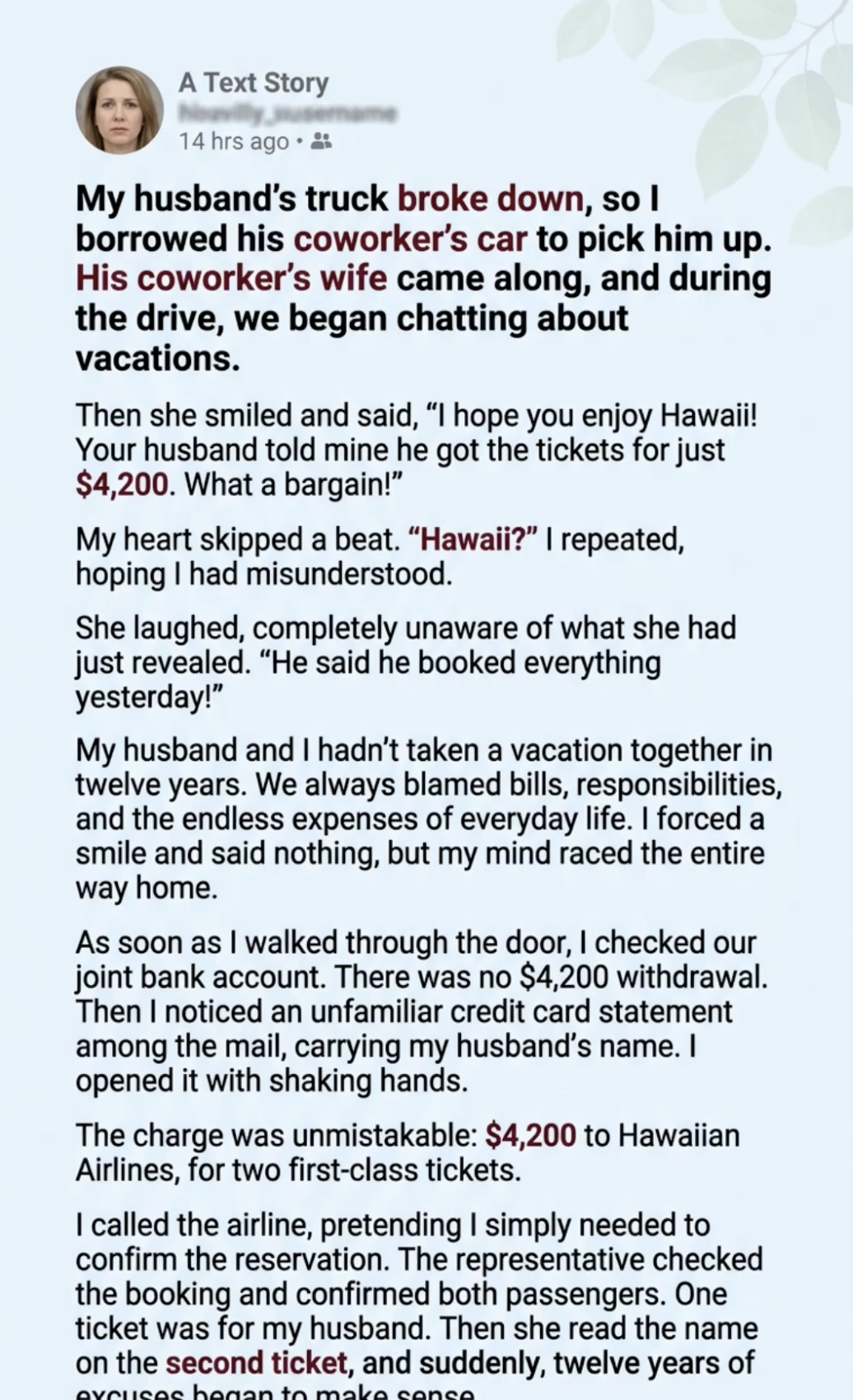
The name the airline representative read was not mine.
For several seconds, I couldn’t speak. I sat at the kitchen table with the phone pressed against my ear, staring at the stack of unpaid bills beside my coffee cup.
“I’m sorry,” I finally managed. “Could you repeat that name?”
The representative did.
It was Melissa Grant.
My husband’s coworker had mentioned Melissa several times over the past year. She worked in the same department as my husband, Daniel, and occasionally attended company dinners. I had met her once at a holiday gathering, where she had complimented my necklace and asked how long Daniel and I had been married.
Twelve years, I had told her.
She had smiled and said, “That’s wonderful. You two must have so many stories.”
At the time, I thought she was simply being friendly.
Now I sat holding a phone while the airline confirmed that my husband had purchased two first-class tickets to Hawaii, spending $4,200 on a trip that I had never known existed.
One ticket was for Daniel.
The other was for Melissa.
And neither ticket was for me.
I thanked the representative, ended the call, and remained at the table long after the screen went dark.
I didn’t cry immediately.
I couldn’t.
My mind was too busy replaying twelve years of conversations, canceled plans, and explanations that had seemed reasonable when I wanted so badly to believe them.
Daniel and I had been married for twenty-one years. We had a daughter, Sophie, who was now nineteen and attending college. We owned a modest house, drove practical cars, and had spent most of our marriage trying to keep up with the ordinary expenses of adult life.
We weren’t wealthy, but we weren’t struggling to survive, either.
Still, whenever I suggested taking a vacation, Daniel found a reason to postpone it.
The roof needed repairs.
The car needed new tires.
Sophie needed money for school.
His department was short-staffed.
Next year would be better.
There was always a next year.
For twelve years, I accepted those explanations because I believed we were making sacrifices for our family. I picked up extra shifts at the accounting office where I worked, compared grocery prices, and put small amounts into a savings account whenever I could.
I had stopped buying new clothes unless I genuinely needed them. I had learned to cut my own hair between appointments and to make a single roast chicken stretch across three meals.
I wasn’t angry about those choices. I thought we were building something together.
What hurt was discovering that while I had been treating our marriage like a partnership, Daniel had apparently been making plans that excluded me.
I looked toward the hallway, where his work boots sat beside the door.
An hour earlier, I had borrowed a car to collect him because his truck had broken down. His coworker, Paul, had offered to lend us his wife’s vehicle, and Melissa had come along for the drive.
During the trip, Melissa had chatted cheerfully about travel.
Then she had mentioned Hawaii.
“I hope you enjoy your vacation!” she’d said. “Daniel told Paul he got the tickets for just $4,200. What a bargain!”
I had forced myself to smile.
When I asked what she meant, she explained that Daniel had booked everything the previous day.
I had spent the rest of the drive trying to convince myself that there must be a misunderstanding.
Perhaps Daniel had arranged a work trip. Perhaps the tickets were for clients. Perhaps the second passenger was someone else with the same name.
But the credit card statement had destroyed those possibilities one by one.
The unfamiliar card carried Daniel’s name. The airline charge was clearly listed. The reservation number matched the booking the representative had checked.
I had enough information to know something was terribly wrong.
What I didn’t yet know was how much of our marriage had been built around the truth he had chosen not to tell me.
Daniel arrived home shortly after six.
He walked through the front door carrying a paper bag of takeout and complaining about the truck’s repair estimate.
“Four hundred dollars just to replace a part,” he said, dropping his keys on the counter. “Cars are money pits.”
I looked at him.
He glanced up.
“What?”
“Nothing,” I said.
I wasn’t ready to confront him while I was still shaking. I wanted to see whether he would tell me anything on his own.
He put the food on the table and asked about my day. He told me his supervisor had been difficult, that a meeting had run late, and that he was exhausted.
He talked about everything except Hawaii.
After dinner, he carried his plate to the sink, kissed my cheek, and went upstairs to shower.
I sat alone at the table.
The credit card statement was still in front of me.
I could have walked upstairs and demanded an explanation. I could have thrown the paper at him and shouted Melissa’s name until he admitted what he had done.
Instead, I took photographs of the statement and saved the airline confirmation number. I made a copy of the information and placed it in a folder with our other financial records.
I wasn’t planning revenge.
I was trying to make sure that when I finally confronted my husband, I wouldn’t allow him to turn the conversation into a debate about what I remembered or what I thought I had seen.
Over the next two days, I paid attention.
Daniel was unusually protective of his phone. He carried it into the bathroom and kept it beside him even when he was watching television.
When a message arrived, he sometimes smiled before turning the screen facedown.
Once, while he was outside checking his truck, his phone lit up on the counter.
I didn’t touch it.
I didn’t need to.
I had already seen enough to know that I had to ask him directly.
On Wednesday evening, after dinner, I placed the credit card statement on the kitchen table.
Daniel came in from the garage, wiping his hands with a paper towel.
He stopped when he saw the paper.
For a moment, his face went completely still.
Then he looked at me.
“Where did you get that?”
“It came in the mail.”
“You opened my mail?”
“It was delivered to our house, addressed to you, and mixed in with the household statements. I opened it because I didn’t recognize the account.”
He picked it up and scanned the page.
I watched his expression change as he realized I had found the airline charge.
“It’s a work-related expense,” he said.
“Two first-class tickets to Hawaii?”
“It’s complicated.”
“Then explain it.”
He set the paper down.
“Melissa and I are going to a conference. The company is paying for part of it.”
“Which conference?”
He hesitated.
“It’s a client event.”
“What is the client’s name?”
“Why are you interrogating me?”
I felt a strange calm settle over me.
“Because I spent twelve years believing we couldn’t afford a vacation, Daniel. Because I have watched you postpone every trip I’ve suggested while telling me that we needed to be responsible. And because I just discovered that you’ve purchased two first-class tickets to Hawaii for yourself and another woman.”
“She isn’t just another woman. She’s a colleague.”
“Then why didn’t you tell me about the trip?”
He rubbed his forehead.
“I knew you’d react like this.”
I stared at him.
“You knew I’d be upset that you were planning a vacation with another woman without telling me?”
He didn’t answer.
I asked whether the company had actually approved the trip.
Daniel looked away.
That was when I knew the conference explanation was a lie.
“Is there a conference?” I asked.
“Not exactly.”
“Is this a business trip?”
He pulled out a chair and sat down.
“No.”
The word was quiet, but it changed everything.
I lowered myself into the chair across from him.
“Are you having an affair with Melissa?”
Daniel stared at the table for so long that I could hear the refrigerator humming in the next room.
Finally, he said, “It’s been going on for a while.”
I felt the room tilt slightly.
“How long?”
“About a year.”
A year.
For twelve months, I had been working, paying bills, worrying about our daughter’s tuition, and believing my husband when he said we needed to postpone our plans.
For twelve months, he had been sharing something with another woman that he had refused to share with me.
I asked him whether the affair had begun before or after he started using the credit card.
He said the card was opened about ten months earlier.
“Is that how you’ve been paying for everything?”
“Not everything.”
“Hotels? Dinners? Gifts?”
He didn’t answer directly. He said he had paid for some things himself and that the balance wasn’t as large as I might imagine.
I asked to see the statements.
He became defensive, insisting that he had a right to privacy.
I reminded him that privacy was not the same as hiding financial obligations that could affect our household.
After a long argument, he finally admitted that the card carried a balance from several months of personal expenses. He had been making payments from his own checking account, but some of that money came from his regular income, which had previously helped cover our shared expenses.
He claimed he had never intended to put the family in financial danger.
Perhaps he hadn’t.
But intent did not erase the choices he had made.
I asked the question that had been sitting in my chest since the airline representative read Melissa’s name.
“Why did you never take me anywhere?”
Daniel looked up.
“I thought we were happy.”
“Were we?”
He opened his mouth, then closed it.
I reminded him of the anniversary weekend I had planned three years earlier. I had found a small hotel near the coast, saved enough to pay for two nights, and arranged for Sophie to stay with my sister.
Daniel had canceled the day before we were supposed to leave because of a supposed emergency at work.
I remembered eating the groceries I had purchased for the trip while he watched television.
I remembered telling myself that marriage meant being flexible.
I remembered how embarrassed I had felt when my sister asked whether everything was all right.
“Was Melissa there that weekend?” I asked.
Daniel’s silence answered before his words did.
“Yes,” he finally admitted. “We had dinner with a client.”
I closed my eyes.
The trip I had canceled my own plans for had been another evening he spent with her.
I wasn’t sure which hurt more: the affair itself or the realization that I had repeatedly made room for his excuses while he made room for someone else.
That night, I slept in the guest room.
Daniel came to the doorway twice, asking whether we could finish talking.
I told him I needed time.
At two in the morning, I woke up and sat beside the window, looking at the streetlight illuminating our driveway.
I thought about the first years of our marriage, when Daniel and I used to drive to the lake with sandwiches packed in a cooler. We didn’t have much money then, either, but we had found ways to enjoy ourselves.
We had watched sunsets from public beaches. We had taken day trips to small towns and eaten lunch on park benches. Once, we had driven three hours to see a waterfall because I had mentioned it in passing.
He had been the one who suggested the trip.
When had that man disappeared?
Or had I simply been so determined to preserve our life together that I hadn’t noticed how far apart we had become?
The next morning, I called my sister, Karen.
I told her what I had discovered.
She listened without interrupting.
When I finished, she said, “You don’t have to decide the rest of your life today.”
I started crying then.
Not because her words solved anything, but because I had spent so long trying to be reasonable that I had forgotten I was allowed to be hurt.
Karen came over that afternoon. She brought lunch, helped me organize the statements, and reminded me to think carefully before making any financial decisions.
I contacted a family lawyer for an initial consultation. I also reviewed our accounts to understand our income, savings, mortgage, and outstanding obligations. I wanted to know what was in my name, what was joint, and what steps would protect my financial stability while I decided what came next.
The lawyer explained that the implications of Daniel’s separate credit card depended on the account, the source of payments, and the applicable law. I didn’t need to make accusations or take drastic action immediately. I needed records and a clear understanding of our situation.
That advice helped me breathe again.
I wasn’t going to empty our accounts or destroy his belongings. I wasn’t going to call his employer and make claims I couldn’t substantiate.
I was going to make decisions based on facts.
Two days later, Daniel asked to speak with me.
He sat across from me at the kitchen table, the same place where I had shown him the statement.
“I want to explain what happened,” he said.
“I’m listening.”
He admitted that he had begun spending time with Melissa after a difficult period at work. They had worked on a project together, and he said he enjoyed how she listened to him without asking him to deal with household responsibilities or family problems.
He described it as a friendship that had gradually become something more.
He said he knew it was wrong, but he had convinced himself that he could end it whenever he wanted.
I asked whether Melissa knew he was married.
“Yes.”
“Did you tell her we hadn’t taken a vacation together in twelve years?”
He nodded.
“Did you tell her why?”
He looked uncomfortable.
“I told her we had grown apart.”
I felt my stomach tighten.
“Did you tell her I was the one who kept suggesting trips?”
“No.”
“Did you tell her I was saving money for us while you were spending it on her?”
He looked down.
“No.”
I leaned back in my chair.
“You didn’t just have an affair, Daniel. You gave her a version of our marriage that made your choices seem reasonable. You made me the person who didn’t understand you, while you were the person hiding the truth.”
He began to cry.
I had seen Daniel cry only a handful of times in twenty-one years. His tears once would have moved me to comfort him immediately.
This time, I remained seated.
“I know I hurt you,” he said.
“You hurt me, but I also need you to understand that I’m not responsible for making this easier for you.”
He nodded slowly.
He told me he had canceled the Hawaii trip.
I asked him to show me confirmation of the cancellation and any refund information. He did. The airline had charged a cancellation fee, and the refund would depend on the fare conditions.
I also asked him to provide all statements from the unfamiliar credit card so we could determine the total amount involved.
He agreed, although he looked ashamed as he handed over the records.
The statements showed that the $4,200 charge was the largest single expense, but there were other purchases connected to the affair: restaurant bills, hotel stays, and several expensive gifts.
The total was more than I had expected.
It wasn’t enough to ruin us financially, but it was enough to make me question every time Daniel had told me that there was no money for something important to me.
I did not assume every purchase was connected to Melissa simply because it was unfamiliar. We reviewed the transactions together and identified those he acknowledged. The rest would need clarification.
For the first time, Daniel could no longer hide behind general statements about being careful with money.
He had to look at the actual numbers.
And I had to look at the life those numbers described.
In the weeks that followed, Daniel moved into the spare bedroom.
We continued sharing the house while we discussed practical arrangements, but our marriage was no longer operating as though nothing had happened.
I told him I was not prepared to promise reconciliation.
He said he wanted to save the marriage.
I asked what that meant beyond saying he was sorry.
He agreed to end personal contact with Melissa, to be transparent about the financial records, and to attend counseling if I was willing to consider it. He also agreed to work out a repayment plan for expenses that had been paid from money intended for our shared household.
I made it clear that I would not be checking his phone every hour or following him to work. I didn’t want a marriage in which I had to become a detective to feel safe.
If he wanted to rebuild trust, the responsibility belonged to him.
A month later, I met Melissa by accident at a grocery store.
She was standing near the produce section, holding a basket and examining a bag of apples.
When she saw me, her face changed.
“Linda,” she said quietly.
I could have walked away. Part of me wanted to.
But I had spent enough time carrying questions that other people refused to answer.
“Did you know Daniel was married when your relationship began?” I asked.
She looked down.
“Yes.”
“Did he tell you we hadn’t taken a vacation together in twelve years?”
“Yes.”
“Did he tell you why?”
She hesitated.
“He said you didn’t like traveling anymore.”
I almost laughed, but there was no humor in it.
I told her that I had suggested trips repeatedly, that I had saved money for them, and that Daniel had canceled plans more than once. I didn’t need to tell her every detail of our marriage. I only wanted her to understand that the story she had been given was incomplete.
Melissa’s eyes filled with tears.
“He told me he was going to leave,” she said. “He said he was trying to figure out how to tell you.”
“Did he tell you that before or after he bought the tickets?”
She had no answer.
I realized then that she might have believed some of his promises. That did not make her innocent of every choice, but it reminded me that I could not know exactly what Daniel had told her or what she had chosen to believe.
“I don’t want to fight with you,” I said. “I’m not here to negotiate my marriage with you. Whatever happens between Daniel and me is something he and I have to face.”
She nodded.
I left my basket on the counter for a moment and walked outside to breathe.
I had imagined confronting Melissa many times. I thought I might feel triumphant afterward.
Instead, I felt tired.
The person who had made vows to me was Daniel. He was the person who had chosen to hide his relationship, conceal the credit card, and tell me there was no money for a vacation.
I could not make my recovery depend on whether Melissa apologized.
I had to focus on what I needed.
Three months after I discovered the tickets, Daniel and I began marriage counseling.
I agreed to attend because I wanted to understand whether anything remained that could be repaired, not because I had decided to stay.
The first sessions were painful.
Daniel wanted to talk about how lonely he had felt. I wanted him to understand how lonely it was to share a home with someone who repeatedly dismissed the things that mattered to me.
Our counselor helped us separate those issues.
Daniel could have felt dissatisfied in our marriage. He could have asked for changes, requested counseling, or even chosen to leave.
What he could not reasonably expect was to avoid an honest conversation while spending money on a secret relationship and then ask me to treat the deception as a misunderstanding.
For the first time, he began acknowledging that his unhappiness did not excuse his choices.
I also had to acknowledge something difficult.
Over the years, I had grown accustomed to accepting postponements without asking for a real plan. I had often swallowed disappointment because I believed keeping the peace was part of being a good wife.
That did not cause Daniel’s affair. His choices were his own.
But I could see that I had become so focused on preserving our routine that I had stopped insisting on the kind of partnership I wanted.
I wasn’t going to make that mistake again.
I opened a separate account for my personal income and worked with the lawyer to establish clear financial boundaries while we considered our options. We agreed that household bills would be paid from a transparent shared arrangement, and neither of us would take on new shared obligations without discussing them first.
Daniel began making payments toward the expenses he acknowledged were connected to his affair. I kept records, not as a way to humiliate him, but because financial accountability needed to be concrete.
Some evenings, we managed to talk calmly.
Other evenings, a small reminder brought everything back. A hotel advertisement on television. A song we had heard during our honeymoon. A message arriving on his phone after dinner.
Healing was not a straight line.
I stopped asking myself whether I was forgiving him quickly enough.
There was no schedule for that.
Six months after the discovery, I took a week off work.
For years, I had imagined what it would feel like to stand beside the ocean in Hawaii. I had saved photographs of beaches and quiet coastal towns, telling myself that someday Daniel and I would go.
I wasn’t ready to travel that far, and I didn’t want to turn a vacation into a symbolic test of whether I had moved on.
Instead, I booked three nights at a small seaside inn a few hours away.
Karen came with me.
We drove with the windows down, stopped at roadside cafés, and spent an afternoon walking along the shore. We ate seafood at a little restaurant overlooking the water and laughed about things that had nothing to do with my marriage.
On the second evening, I watched the sun sink below the horizon.
I thought about the woman I had been when I first suggested a vacation to Daniel. She had believed that if she was patient enough, responsible enough, and loving enough, the two of them would eventually get the life they wanted.
I wished I could tell that woman something.
I wished I could tell her that she did not have to wait twelve years to deserve a few days of happiness.
When I returned home, Daniel asked how the trip had been.
“Wonderful,” I said.
He looked at me for a long time.
“I’m glad you went.”
“So am I.”
He didn’t ask whether I had missed him.
I didn’t offer to reassure him.
We continued counseling for several more months. Daniel remained consistent in some ways, and in others he struggled. I learned that remorse could be genuine without being enough to restore a marriage. Trust depended on what someone did repeatedly, especially when there was no immediate reward for doing it.
Eventually, I made a decision.
I would not return to our old marriage simply because we had shared twenty-one years and raised a daughter together. If we were going to stay married, it would have to be a different relationship, one in which honesty and mutual respect were not optional.
Daniel understood that I was still uncertain.
He agreed not to pressure me for an answer.
I have not decided whether our marriage will survive. That is a question I will answer based on what happens next, not on how frightened either of us feels about change.
What I know is that I will never again accept the idea that there is no money, no time, or no room for the things that matter to me while someone else quietly makes different choices.
The $4,200 ticket was not the most expensive thing Daniel bought.
The real cost was the time I spent believing that our shared dreams had to wait because we were building a life together.
Now I understand that a shared life cannot be built by one person making sacrifices while the other hides the truth.
I still hope to see Hawaii someday. Perhaps I will go with Karen. Perhaps I will go alone. Perhaps, if enough changes, I will go with Daniel.
But I will never again measure my worth by whether someone chooses to take me along.
The day Melissa casually mentioned those first-class tickets, I thought my world had fallen apart.
In reality, the truth had finally opened a door I had been afraid to approach.
And for the first time in twelve years, I began making plans for a future that included me.