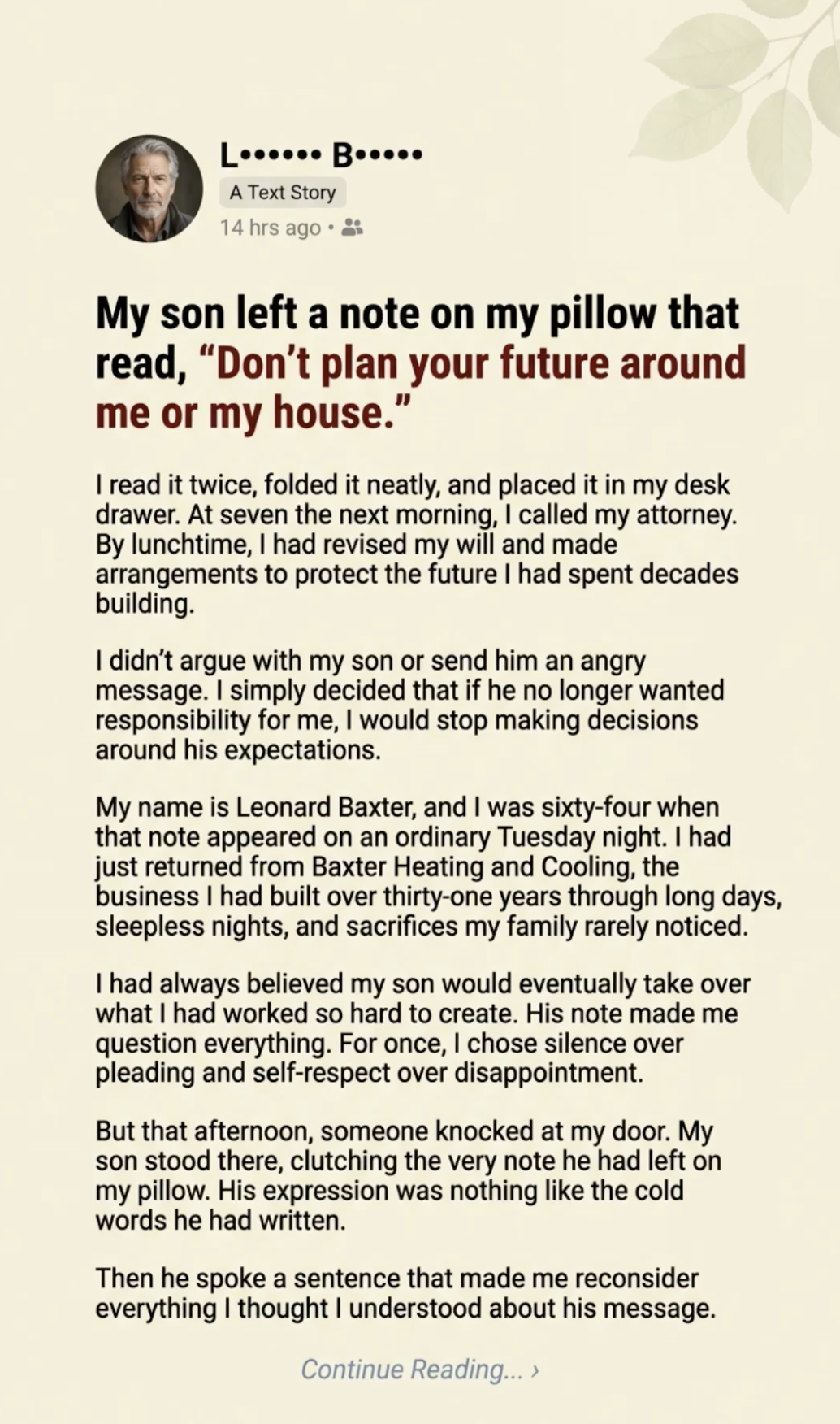
At seven the next morning, I called my attorney.
By lunchtime, my will had been revised, my financial documents were being reviewed, and the plans I had quietly made for my retirement had changed.
I didn’t shout at my son. I didn’t send him a furious message or demand that he explain himself.
I simply stopped making decisions around a future he had told me not to expect.
My name is Leonard Baxter. I was sixty-four years old when my son, Daniel, left a note on my pillow that changed the way I thought about family, money, and the life I had spent thirty-one years building.
The note contained just one sentence.
“Don’t plan your future around me or my house.”
I read it twice.
Then I folded it neatly and placed it in the top drawer of my desk.
For most of my life, I had believed that family meant showing up, even when it was inconvenient. It meant helping when someone needed you, making sacrifices when necessary, and building something that could eventually benefit the people you loved.
That was how I had raised Daniel.
It was also how I had built Baxter Heating and Cooling, the small business that had supported my family through three decades of hard work.
I had started with a used service van, a borrowed set of tools, and enough money saved to cover a few months of expenses. I worked through freezing nights when furnaces failed, climbed into cramped attics during summer heat waves, and answered emergency calls while other families sat down to dinner.
There were years when I barely took a vacation.
There were Christmas mornings when I left the house before sunrise because a customer’s heating system had failed.
I had missed school concerts, postponed birthdays, and promised my late wife, Margaret, that someday things would become easier.
Eventually, they did.
The company grew. We hired technicians, opened a small office, and built a reputation for reliable work. I paid our mortgage, helped Daniel through college, and made sure he never had to worry about the things that had kept me awake at night when I was young.
After Margaret died six years earlier, I kept working because the business gave my days structure and purpose.
I also began thinking about retirement.
I imagined selling the company or transferring it to Daniel if he truly wanted to run it. I pictured moving into a smaller home, traveling occasionally, and spending more time with my grandchildren.
Daniel had talked about buying a larger house with his wife, Rachel. They had two children, Emily and Noah, and their current home was becoming cramped.
I had offered to help them find a place with more room.
At one point, Daniel joked that if I ever needed help in my old age, I could stay in their guest room.
He had laughed when he said it, but I remembered those words because they had comforted me.
I never expected my son to become my full-time caregiver. I had enough savings to pay my own expenses, and I intended to remain independent for as long as possible.
Still, I believed we had a shared understanding: I would help them when I could, and when I eventually needed support, we would talk honestly about what was realistic.
The note on my pillow made me wonder whether that understanding had ever existed.
The night before I found it, Daniel had visited my house for dinner.
He arrived alone, which wasn’t unusual. Rachel had taken the children to visit her sister, and Daniel said he wanted to discuss something about the business.
We ate in the kitchen, where Margaret and I had shared thousands of meals.
After dinner, Daniel asked whether I had made any decisions about retirement.
“I’ve been looking at the numbers,” I told him. “The company is in a good position. If you want to take it over eventually, we could talk about a gradual transition.”
He stared at his plate.
“And if I don’t?”
“Then I’ll consider other options. I can hire a general manager, sell the business, or wind it down over time. I’m not going to force you into something you don’t want.”
He nodded, but his expression remained tense.
I asked whether everything was all right at home.
“Fine,” he said.
I knew that tone. It was the same one he had used as a teenager when something was bothering him and he didn’t want to discuss it.
“Daniel, if there’s something you need to tell me, you can tell me.”
He stood and carried his plate to the sink.
“I’m tired, Dad. Let’s not do this tonight.”
I let the matter rest.
He left around nine.
I watched him back out of the driveway and assumed we would speak again over the weekend.
The following morning, I found the note on my pillow.
At first, I thought it was some kind of misunderstanding. Perhaps he had written it after an argument with Rachel. Perhaps he was trying to tell me that he couldn’t promise to care for me when I became older.
I read the sentence again.
“Don’t plan your future around me or my house.”
There was no explanation. No signature. No suggestion that we should talk.
I sat on the edge of the bed and felt a sadness that was almost physical.
I had never asked Daniel to give up his life for me. I had never demanded that he promise me a room in his house or rearrange his children’s lives around my needs.
What I had expected was a conversation.
Instead, he had left a sentence on my pillow as though I were a business arrangement he wanted to terminate.
I dressed, made coffee, and sat at the kitchen table.
Then I called my attorney, Helen Morris.
Helen had handled the company’s legal work for years. She had also helped me settle Margaret’s estate and update my documents after her death.
When she answered, I told her I needed an appointment.
“Is everything all right, Leonard?”
“I need to review my will, my estate plan, and the arrangements I’ve made for retirement.”
There was a pause.
“Of course. I can see you this morning.”
I hung up and looked through the kitchen window at the driveway.
For the first time, I understood that I had been building my future around assumptions I had never properly discussed with my son.
That needed to change.
Helen arrived at my office at ten.
I showed her the note.
She read it, then looked at me.
“Has Daniel told you he doesn’t want to inherit the business?”
“Not directly.”
“Has he asked you for money or property?”
“Not recently.”
“Then let’s separate what this note says from what you fear it means.”
That was why I trusted Helen. She never encouraged me to make a major decision while I was upset.
She explained that a will should reflect my wishes, not serve as a response to an argument. If I wanted to change beneficiaries, make different charitable gifts, or provide for my grandchildren, we could discuss those choices carefully.
She also reminded me that the business was a separate issue. We needed to review its ownership, any outstanding obligations, and the options available if I wanted to retire.
I told her that I had assumed Daniel would eventually take over.
“Assumptions aren’t succession plans,” she said gently. “Have you ever asked him whether he truly wants to run the company?”
I thought about that.
I had asked him, of course. But usually I had framed the question as though his future involvement were the natural next step. I had talked about how proud he would be to carry the family name forward and how much easier it would be than starting something from scratch.
Daniel had never shown much enthusiasm.
He had studied engineering but eventually found work in project management for a construction firm. He liked his job. He enjoyed solving problems, coordinating teams, and coming home without a phone ringing every twenty minutes.
I had always told myself he would change his mind.
Perhaps he had been trying to tell me otherwise for years.
Helen and I spent the morning reviewing my documents. I updated my will to reflect my current priorities, including provisions for my grandchildren and a clearer plan for the disposition of the business. We discussed who could make financial and medical decisions for me if I became unable to do so, and I arranged to review those documents separately.
I did not remove Daniel from my will out of anger.
I did not transfer the business to a stranger to punish him.
Instead, I made sure my estate plan did not depend on Daniel becoming my caregiver or business successor. I wanted the resources I had earned to support my own retirement and be distributed according to my considered wishes.
By lunchtime, the first round of revisions was complete.
I went to a nearby diner, ordered soup and a sandwich, and sat by the window.
I expected to feel triumphant.
Instead, I felt tired.
Changing legal documents did not change the fact that my son had hurt me. It simply meant I was no longer going to confuse love with an unspoken agreement about my future.
I finished lunch, returned to my office, and spent the afternoon reviewing the company’s financial reports.
At around four, someone knocked on the front door of my house.
I had gone home early.
When I opened the door, Daniel stood on the porch.
He was holding the note.
His face was pale, and his eyes were red as though he hadn’t slept.
“Dad,” he said, “please tell me you haven’t done anything yet.”
I stared at him.
“What do you mean?”
He lifted the paper.
“I found out you called Helen.”
I felt a sudden flare of anger.
“How do you know that?”
“She called me.”
Helen had not disclosed any details of my revised documents, but she had contacted Daniel because he had previously been listed as a potential successor in some of the company’s planning documents. She had told him that I was reviewing my estate and business arrangements and that he should speak with me directly about his intentions.
Daniel looked down at the note in his hand.
Then he said the sentence I had never expected to hear.
“Dad, I didn’t write that because I don’t want you in my life. I wrote it because I’m afraid you’re giving up your life for me, and I don’t know how to stop you.”
I stood in the doorway, unable to respond.
For a moment, the words made no sense.
Then he looked at me with the same frightened expression he had worn as a boy when he came home with a broken bicycle and expected me to be disappointed.
“I think you misunderstood what I meant,” he said.
I stepped aside.
“Come in, Daniel.”
We sat in the living room.
He placed the note on the coffee table and rubbed his palms against his jeans.
“I should never have left it like that,” he began. “I know how it looked.”
“Then tell me what you meant.”
He took a long breath.
“Rachel and I have been arguing about the future. Not about you exactly, but about what everyone expects us to do.”
I waited.
He explained that Rachel had recently accepted a promotion at her company. It would require more travel and longer hours, but it was an opportunity she had worked toward for years.
At the same time, Daniel had been struggling with the pressure he felt about my retirement and the business.
He knew I had spent decades building Baxter Heating and Cooling. He knew I was proud of it. He also knew I had quietly imagined handing it over to him.
“I love you, Dad,” he said. “But I don’t want to run the company. I don’t want to spend the rest of my life managing emergency calls and worrying about payroll. I like my work. I like being home with my kids. And I feel guilty every time you talk about retiring because I know you expect me to take over.”
I looked at him.
“I told you I wouldn’t force you.”
“I know. But you keep planning around it. You talk about what we’ll do with the company, what house I’ll have, how you’ll move in with us someday if you need help. You say it like we’ve already agreed.”
I opened my mouth, then closed it.
He was right about one thing.
I had never demanded that he take over the business, but I had treated the idea as a future certainty.
I had described my retirement as though it were a family project that Daniel would eventually manage.
“Why didn’t you just tell me?” I asked.
“I tried.”
“When?”
“Last Christmas. And again in March. Every time I said I wasn’t sure about the business, you told me I would understand when I was older or that I’d feel differently when I had more experience.”
I remembered those conversations.
I had thought I was encouraging him.
He had experienced them as pressure.
Daniel continued.
“Then last week, you told Rachel that if you sold the company, you might use the money to buy a place near us. She thought you meant you were planning to move in eventually, and she panicked. We have two kids, Dad. We’re trying to make decisions about their schools and our work. We love you, but we can’t promise what our lives will look like ten or fifteen years from now.”
I felt a knot form in my chest.
“I never meant to make you feel trapped.”
“I know that now. But I was scared you would keep making plans based on what you hoped we’d do. I thought if I wrote something blunt enough, you’d finally understand that you need your own plan.”
He glanced at the note.
“I wrote it after dinner. I wanted to talk to you the next day, but I lost my nerve. So I left it on your pillow. It was cowardly, and I’m sorry.”
I studied him.
He was no longer the boy I remembered. He was a grown man with a wife, children, responsibilities, and fears of his own.
Yet I had been treating his future as if it were an extension of mine.
I had spent thirty-one years building a company that required sacrifice. I had convinced myself that because the business had given my family security, passing it to Daniel would be a gift.
I had not considered that he might see it as a burden.
“I thought I was helping you,” I said quietly.
“I know.”
“I thought that if I made sure the company was successful, it would give you choices.”
“It did, Dad. You gave me choices. That’s why I need you to let me make them.”
His words stung, but they were fair.
I looked at the note again.
“Don’t plan your future around me or my house.”
I had read it as rejection.
He had intended it as a boundary, though he had expressed it in the harshest possible way.
“Daniel,” I said, “I need you to understand something, too.”
He looked up.
“I have never expected you to become my full-time caregiver. I have savings. I have a business. I can pay for help if I need it. But I did believe that if something happened to me, we would discuss it together. I thought that was what family meant.”
His eyes filled.
“It is. I want to be part of your life. I just don’t want either of us making promises we might not be able to keep.”
For the first time that afternoon, I understood what he was trying to say.
He wasn’t asking me to stop loving him.
He was asking me to stop turning my love into a plan he had never agreed to follow.
We talked for nearly three hours.
Daniel told me that Rachel had been worried about my plans because she feared they would eventually be expected to provide a room, transportation, and daily care without having discussed what that would mean for their children.
I told him that I had never intended to impose those responsibilities on them.
But I also admitted that I had imagined growing older close to my grandchildren, perhaps sharing meals and attending school events. I had assumed that being nearby would naturally mean being included in their daily lives.
We both realized that we had been making assumptions.
I had assumed my son would eventually run my business.
He had assumed I expected him to take responsibility for my old age.
Neither of us had clearly explained what we wanted.
The note had been a terrible way to begin the conversation, but it had exposed a problem we needed to address.
I told Daniel about the meeting with Helen.
He looked worried.
“Did you take me out of your will?”
“I revised my will.”
“That isn’t what I asked.”
I took a moment before answering.
“I made sure my plans don’t depend on you running the company or taking care of me. I haven’t made these decisions to punish you. I want the business handled properly, and I want my retirement to be secure. I also want my grandchildren provided for in a way that makes sense.”
He nodded slowly.
“I understand.”
“I hope you do. Because I won’t change those plans just to prove that I’m angry, and I won’t change them back just because you’re afraid of what they mean. I’ll make decisions based on what’s right for me.”
Daniel looked down at his hands.
“That’s fair.”
I told him that the company would be professionally valued and that I would explore whether a general manager could run it, whether a sale made sense, or whether an orderly closure would be better than continuing indefinitely.
He seemed relieved.
Then I asked whether he wanted any involvement at all.
“I’d like to know how you’re doing,” he said. “I can help you think through options if you want me to. I just don’t want to be the automatic successor.”
“That sounds reasonable.”
He smiled faintly.
“I should have said that years ago.”
“Yes,” I said. “You should have.”
We both laughed, although there was still hurt between us.
Before he left, Daniel picked up the note and held it out to me.
“You can throw this away,” he said. “I don’t want it to be the last thing you remember from me.”
I took it.
“I won’t throw it away just yet.”
He looked surprised.
“Why?”
“Because I think we both need to remember what happens when we avoid an honest conversation for too long.”
He nodded.
Then he hugged me.
It was a brief, awkward embrace, the kind men in our family had always seemed to prefer.
But it was genuine.
Over the next several months, I began making changes to my life.
I hired an experienced operations manager to help run Baxter Heating and Cooling while I evaluated the company’s future. The manager, a man named Peter Lawson, had spent twenty years in the industry and understood both the technical work and the financial side of the business.
For the first time in decades, I allowed someone else to handle the daily schedule.
At first, I struggled.
I checked the dispatch board every morning and called the office more often than necessary. I worried that customers would be disappointed or that employees would think I had stopped caring.
Peter reminded me that a successful business should not depend on one person being available every hour of every day.
Slowly, I began to trust the system we had built.
I also met with a financial planner to review my retirement budget. I calculated what I could afford for housing, healthcare, travel, and future support if I needed help with daily tasks.
The numbers were reassuring.
I had worked hard, saved consistently, and built a business with real value. I could afford to make decisions based on my own needs rather than on the assumption that my son would eventually provide a solution.
I considered selling the company, but I wasn’t ready to decide immediately. Peter agreed to manage it for a year while we evaluated the options.
I moved the question of succession out of family conversations and into a professional plan.
That single change removed a great deal of tension.
Daniel began visiting on Sundays again. Sometimes he brought the children. Sometimes he came alone and helped me with small repairs around the house.
We didn’t talk about the business unless I asked him for his opinion, and I stopped asking whether he would eventually take it over.
Our relationship grew easier because neither of us was constantly defending a future that the other had imagined.
One Sunday, Emily asked me whether I was going to live with her family when I became old.
Daniel looked uncomfortable, but I smiled.
“I don’t know yet, sweetheart. I’ll make sure I have a safe place to live, and I’ll spend as much time with you as we can arrange.”
She considered that answer.
“Can I still come to your house?”
“Of course.”
She ran off to find Noah.
Daniel looked at me.
“Thank you,” he said.
“For what?”
“For not making her feel like she has to choose between loving you and having her own life.”
I thought about that.
“I don’t want either of you to feel that way.”
He nodded.
“I wish I’d understood that sooner.”
“So do I.”
Nearly a year after the note appeared on my pillow, I made a decision about Baxter Heating and Cooling.
Peter wanted to buy a minority share and continue managing the business. After reviewing the proposal with Helen and my financial planner, I agreed to a gradual ownership transition, with clear terms, independent valuation, and protections for the employees.
I would remain involved as an adviser for a limited period, but I would no longer be responsible for daily operations.
It was not the future I had once imagined.
Daniel did not take over the company.
He did not become the person who carried the Baxter name into another generation of heating and cooling work.
Instead, he continued building his own career.
At first, that felt like a loss. I had spent years picturing the company as a family legacy that would pass from father to son.
But as I watched Peter lead the team and Daniel grow more confident in his own work, I began to understand that a legacy did not have to be repeated exactly to matter.
I had built a company that employed good people, served its community, and supported my family.
Daniel had built a life of his own.
Both things could be true without one replacing the other.
I also made a more practical plan for my future. I updated my medical directives, arranged for professional assistance if I ever needed it, and identified several people who could help with specific tasks without assuming that any one person would be responsible for everything.
Daniel remained part of my emergency contact arrangements because we discussed it and both agreed. But I no longer expected him to be the sole answer to every possible problem.
I bought a smaller house closer to the town center, where I could walk to the library, visit the market, and attend community events without needing to drive everywhere.
It had two bedrooms, a little garden, and a porch where I could sit in the evening.
Daniel and Rachel came to see it before I moved in.
Rachel walked through the kitchen and smiled.
“This feels like you,” she said.
I laughed.
“That’s the idea.”
She apologized for the tension that had grown around my retirement plans. She said she had been worried about the children and their future, but she recognized that she and Daniel had allowed their fears to become assumptions about what I expected from them.
I accepted her apology.
I also told her that I wanted us to keep talking honestly, especially when something felt uncomfortable.
She agreed.
That evening, we ate dinner together at the new house. The children argued over who would get to sleep in the spare room when they stayed overnight, and Daniel complained that I had chosen a dining table that was too heavy to move.
It was an ordinary family evening.
And for the first time in a long while, I enjoyed it without wondering what any of us owed the others.
On the anniversary of the day I found the note, I opened my desk drawer and took it out.
The paper had become soft along the folds.
“Don’t plan your future around me or my house.”
I read the words one more time.
Then I placed the note in a folder with the documents from that year.
I did not keep it because I wanted to punish Daniel.
I kept it because it reminded me of the moment I finally stopped confusing hope with certainty.
My son had been wrong to leave those words on my pillow without explaining himself. He had caused unnecessary pain because he was afraid of having a difficult conversation.
But his message had forced me to confront something I had avoided for years: my future belonged to me.
I could love Daniel without expecting him to run my business.
I could enjoy my grandchildren without assuming I would live in their home.
I could plan for old age without treating independence as a failure or family support as a guarantee.
And I could make decisions about the money I had earned without using those decisions to test whether my son loved me.
A few weeks later, Daniel came over to help me plant flowers in the garden.
We worked side by side, moving soil into the flower beds and arguing about whether the roses needed more space.
At one point, he stopped and looked at me.
“Dad, do you ever wish I’d taken over the company?”
I thought about it honestly.
“Sometimes I wish you had wanted it,” I said. “Not because you owed it to me, but because I imagined it would be something we shared.”
He nodded.
“I understand.”
“But I don’t wish you had taken it just to make me happy. That wouldn’t have been fair to either of us.”
He smiled faintly.
“I think I can live with that.”
“So can I.”
We went back to planting.
The sun was warm, the garden smelled of fresh soil, and for once, neither of us was trying to arrange the other’s future.
That evening, I sat on my porch and watched Daniel drive away.
I felt no anger.
I felt no need to call him back and ask whether he would be there for me in ten years.
I had made plans. I had protected my finances. I had created a future that did not depend on anyone keeping a promise they had never made.
And I had learned something more important than how to revise a will or sell a business.
Love is not a contract that guarantees someone will live the life you imagined for them.
A father can offer his son every opportunity and still have to let him choose a different road.
A son can set boundaries without abandoning his father, though he must learn to express those boundaries with honesty and kindness.
And a man who has spent his whole life building something for his family must eventually learn that his own future deserves the same care.
I still love my son.
I still hope we will share many years together.
But I no longer plan my life around the house he may someday own or the responsibilities he may someday accept.
I plan it around the life I have, the resources I have earned, and the relationships we choose to nurture honestly.
The note that once felt like a rejection now reminds me of the conversation we should have had years earlier.
And whenever Daniel visits, I am grateful that he comes because he wants to—not because either of us believes love must be measured by an inheritance, a business, or a room in someone’s house.
At sixty-four, I thought I was protecting myself from my son’s rejection.
What I was really doing was learning to stand on my own feet again.
That was the beginning of a better future for both of us.