My name is Victoria Bennett, and until that night, I believed I knew the man I had been married to for nine years.
I was forty-one, the founder of a successful luxury property investment company, and the owner of a six-million-dollar estate in Beverly Hills. My husband, Trevor, had spent most of our marriage chasing business opportunities that rarely paid off. I had supported him through every failed venture, every expensive mistake, and every promise that the next investment would finally make him successful.
I never imagined that the greatest mistake of my life would be trusting him with my heart.
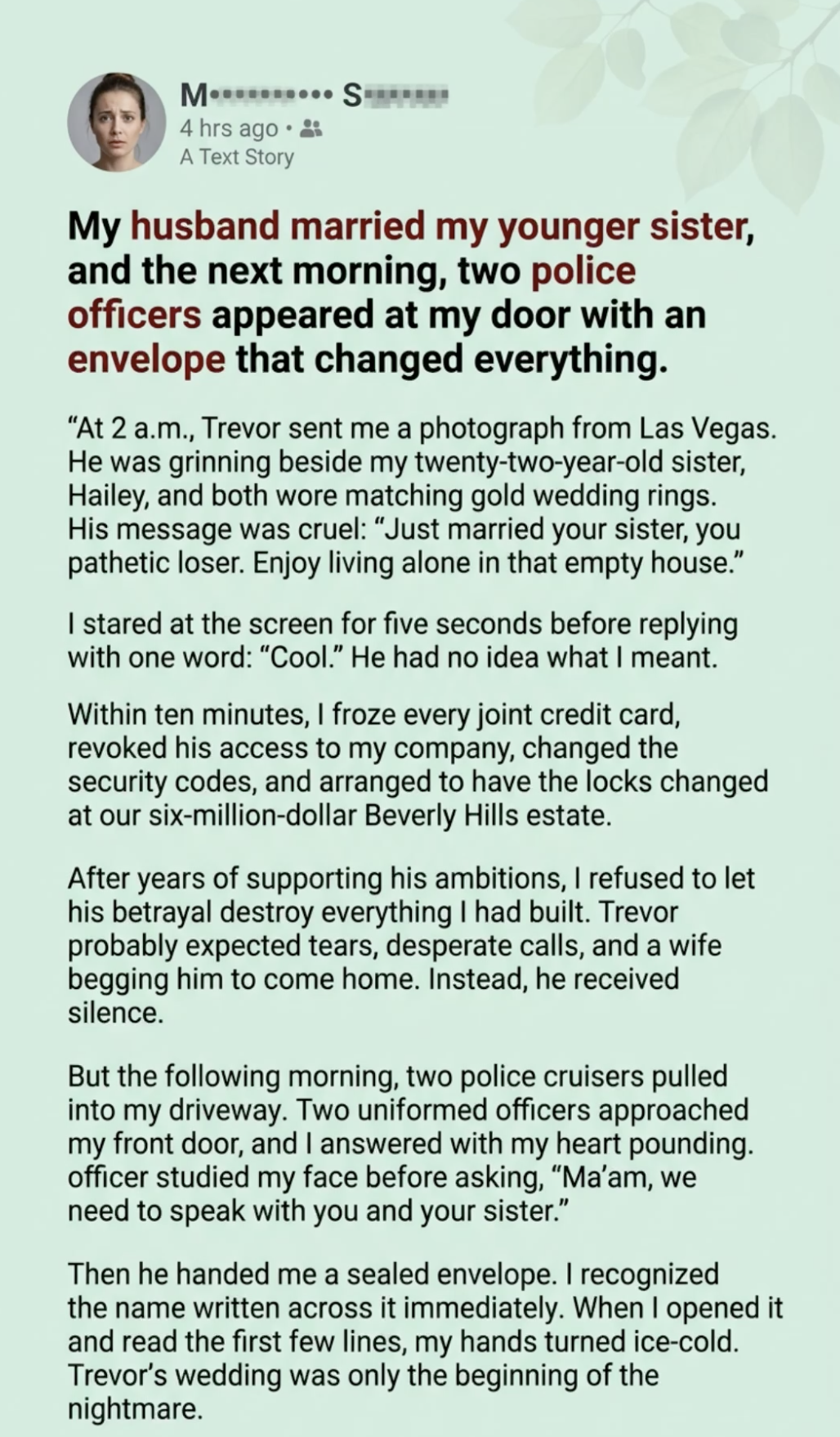
At precisely 2:07 a.m., my phone lit up beside my bed.
A photograph appeared on the screen.
Trevor stood beneath the bright lights of a Las Vegas wedding chapel, wearing a black suit and a grin I had not seen directed at me in years. Beside him stood my younger sister, Hailey, who was only twenty-two.
Both wore matching gold wedding rings.
For several seconds, I couldn’t breathe.
Then his message arrived.
“Just married your sister, you pathetic loser. Enjoy living alone in that empty house.”
I read it twice, hoping exhaustion had somehow turned the words into something else.
It hadn’t.
Hailey was the little girl I had helped raise after our father died. I had paid for her college courses, helped her find her first apartment, and covered her expenses whenever she called crying about money. When our mother passed away, I became the person Hailey turned to whenever life became difficult.
I had never treated her as a burden. I had treated her as family.
And now she was wearing my husband’s ring.
I stared at the photograph for five seconds before typing a single word.
“Cool.”
Trevor had expected a different response. I could almost hear the laughter he would share with Hailey when I began calling, begging for an explanation.
But I didn’t call.
Instead, I got out of bed, walked into my home office, and began protecting everything I had spent years building.
My company’s attorney helped me initiate the appropriate steps to restrict Trevor’s business access and preserve company records. I contacted the bank about the joint accounts and cards, asking what protections could legally be applied. I arranged for a locksmith to change the estate’s access codes, making sure the changes complied with our ownership and occupancy arrangements.
By sunrise, I had stopped treating the situation like a marital argument.
It was a legal and financial crisis.
Trevor had confused my kindness with weakness. He had assumed that because I had supported him for years, I would continue supporting him after he humiliated me.
He was wrong.
At 8:16 the next morning, I was standing in the kitchen when I heard vehicles pulling into the driveway.
Two police cruisers stopped outside the front entrance.
My stomach tightened.
I hadn’t called the police. I hadn’t threatened Trevor. I hadn’t done anything that should have brought officers to my door.
Two uniformed officers walked toward me. The older one introduced himself as Officer Ramirez, while his partner remained beside him holding a sealed envelope.
“Mrs. Bennett?” Ramirez asked.
“Yes.”
“We need to speak with you about your husband and your sister.”
My fingers went cold.
He studied my expression before continuing.
“Before we go further, we need to confirm a few details about your identity and your relationship to the people named in this document.”
His partner handed me the envelope.
My name was printed across the front in block letters.
Underneath it was a case reference number and the name of a law firm I recognized immediately.
Harrington, Cole and Pierce.
They had represented my company during a complicated acquisition three years earlier. I knew the firm’s senior partner, Richard Cole, personally.
I opened the envelope.
The first page contained a formal notice requesting my cooperation in an investigation involving suspected financial fraud, forged signatures, and the possible misuse of company funds.
The second page made my hands tremble.
It listed a series of transactions from an account connected to Trevor’s business ventures. Several payments had been authorized using documents that appeared to carry my signature.
I had never signed them.
The largest transfer was for $840,000.
The money had been moved through two companies I had never heard of, then into an account associated with a business Trevor had recently claimed was on the verge of securing a major investment.
I looked up at Officer Ramirez.
“What does this have to do with Hailey?”
He exchanged a brief glance with his partner.
“Your sister’s name appears on some of the documents. We aren’t asking you to draw conclusions. We need to establish what you know and determine whether your signature was used without your authorization.”
Suddenly, the wedding photograph made a terrible kind of sense.
Trevor hadn’t merely decided to leave me for my sister.
He had spent months preparing something, and I was beginning to suspect that the marriage was connected to it.
I invited the officers into the sitting room and called my attorney before answering any substantive questions. I gave the officers the information I could verify and agreed to preserve the relevant records.
When they left, I sat alone with the envelope resting on my lap.
For nine years, I had believed Trevor’s greatest weakness was his ambition. I had told myself he was a good man who simply wanted to prove he could succeed.
Now I wondered whether I had mistaken calculation for desperation.
At 9:42 a.m., my phone rang.
Hailey.
I let it ring twice before answering.
“Victoria,” she whispered. “Please don’t hang up.”
Her voice sounded nothing like the confident woman in the wedding photograph.
“What do you want, Hailey?”
“I need to explain.”
“You had an entire wedding ceremony to explain yourself. You chose not to.”
She began crying.
“Trevor told me you knew.”
“Knew what?”
“That the marriage was going to happen. He said you two had been separated for months and that you were only staying in the house because of the business.”
I closed my eyes.
Trevor and I had argued about money, work, and his failed investments. But we had never separated. We had slept in the same house the previous night, and he had kissed my forehead before leaving for what he claimed was a business meeting.
Hailey had either believed an extraordinary lie or chosen to accept it because the truth was inconvenient.
“Why did he send me that photograph?” I asked.
She fell silent.
“Hailey, answer me.”
“He said he wanted you to understand that it was over.”
“And the money?”
Her breathing changed.
“What money?”
I knew then that she was frightened, but fear alone could not tell me whether she was innocent.
I told her the police had delivered documents concerning forged signatures and suspicious transfers.
She began sobbing harder.
“He said those were just business arrangements. He told me everything had been approved.”
“Did you sign anything?”
“I signed papers for a company he said we were going to run together. He told me it was for the wedding and our future.”
“What company?”
She gave me a name.
It matched one of the companies listed in the envelope.
I felt the room tilt around me.
“Hailey, listen carefully. Don’t destroy anything, don’t sign anything else, and don’t let Trevor talk you into explaining this away before you’ve spoken to your own lawyer.”
“You think I helped him steal from you?”
“I think I don’t know what happened yet. And neither do you.”
She went quiet.
Then she said something that changed the direction of the entire investigation.
“Victoria, he told me he needed to marry me before the end of the month.”
“Why?”
“He said it would make everything easier to transfer.”
I gripped the phone.
“What was he transferring?”
“I don’t know. He said there was a trust, and that after the wedding we would be protected. He told me you were going to lose the company anyway because investors were coming after you.”
I had never been informed of any such threat.
Trevor had been telling my sister a story in which I was already defeated, my company was collapsing, and their marriage was simply the beginning of a new life.
But the documents suggested that he had been using my name while I was still paying the bills.
I asked Hailey where she was.
“I’m still in Las Vegas.”
“Stay somewhere safe. Don’t meet Trevor alone. And don’t take my word for anything, either. Get independent legal advice.”
She whispered, “Do you hate me?”
I looked at the photograph still open on my phone.
“I don’t know what I feel yet.”
It was the most honest answer I could give her.
Over the next several days, my attorneys and the investigators began piecing together the financial records. I learned that Trevor had created a series of small companies, each with a different purpose on paper. Some had been established to pursue real estate opportunities. Others appeared to exist mainly to receive transfers and pay expenses that had little connection to legitimate business activity.
My signature appeared on loan documents, guarantees, and authorizations I had never approved.
The records did not prove that every suspicious transaction had been made by Trevor, and I refused to let anger substitute for evidence. I provided the investigators with my original signature records, company correspondence, and the dates when I had been out of the country.
The evidence gradually narrowed the possibilities.
A digital audit showed that several documents had been submitted through an account associated with Trevor’s business office. Messages recovered from company records suggested that he had been trying to move assets before creditors could question his failed investments.
Then my attorney found the trust.
It was not the trust Trevor had described to Hailey.
Years earlier, when my company began acquiring commercial properties, I had established a carefully structured investment arrangement with independent oversight. Trevor had no authority to transfer its assets, and Hailey had no automatic claim to them simply because she married him.
Yet Trevor had repeatedly referred to the arrangement in messages as though he could control it.
One email, sent to a business associate, included a sentence that made my attorney stop reading aloud.
“Once Victoria realizes what’s happened, the marriage will make it impossible for her to separate the personal assets from the business obligations.”
He had misunderstood the legal structure he was trying to exploit.
Worse, he had apparently believed that marrying Hailey would help him create confusion about ownership, responsibility, and who had authorized which transactions.
It was not a clever plan. It was a desperate one.
But it could still have caused enormous damage.
The wedding was not the legal weapon Trevor imagined it to be. It did not automatically give him control of my company or erase the need to establish who had signed what. His actions, if proven, would be judged on the evidence—not on the fact that he had married my sister.
That realization gave me something I hadn’t felt since receiving his message.
Control over my next step.
I filed for divorce and instructed my attorneys to pursue every lawful measure necessary to protect my business. I stopped paying Trevor’s personal expenses, separated the accounts where legally permitted, and required independent approval for transactions that previously could have passed through familiar channels.
I also refused to use the investigation as a weapon against Hailey.
If she had knowingly participated, the evidence would have to establish that. If she had been deceived, that would matter too. She was an adult, and she had made choices that hurt me, but I was not going to invent facts simply because I wanted someone to blame.
Three days after the wedding, Hailey returned to Beverly Hills.
She arrived without Trevor, carrying a small suitcase and looking as though she hadn’t slept.
I met her in the garden rather than letting her walk straight into the house.
For a long moment, neither of us spoke.
Then she removed her wedding ring.
“I should never have believed him,” she said.
“No,” I replied. “You shouldn’t have.”
She flinched, and I immediately regretted how sharp my voice sounded. But I did not take the words back.
She explained that Trevor had approached her months earlier, telling her that our marriage was already finished. He had portrayed himself as a trapped husband who had stayed with me only because of my wealth and business connections. He promised Hailey a fresh start, a home of her own, and a chance to build a company without depending on me.
She wanted to believe him.
That did not excuse the photograph, the cruel message, or the secrecy. But it explained how he had convinced her that she was stepping into a love story rather than a betrayal.
“I thought I was finally getting something that belonged to me,” she whispered. “Something that wasn’t because you paid for it.”
I stared at her.
“You never had to compete with me, Hailey. I was your sister.”
“I know that now.”
“Did you know about the money?”
She looked down at the ring in her hand.
“I knew he was moving money. He said it was his business income. I didn’t know he was using your signature. I should have asked more questions.”
It was the first answer she had given me that sounded less like an excuse and more like an admission.
I told her that I could not promise to forgive her. Trust was not something she could reclaim by crying in my garden or handing back a ring.
She nodded.
“I understand.”
For the first time, she did not ask me to make her feel better.
The legal process took months. Investigators continued examining the transfers, and the attorneys negotiated over disputed assets and company obligations. Trevor denied wrongdoing through his representatives, and the allegations remained subject to the legal process. I would not call him guilty before the evidence had been tested, but I would no longer protect him from the consequences of his own decisions.
His marriage to Hailey did not rescue him from the financial questions he had created.
And it did not give him the house.
The estate remained mine under the ownership arrangements already in place, subject to the legal review of our marital assets. I had the locks changed only after my attorney confirmed the proper steps. I did not throw his belongings into the street or take revenge through reckless decisions. I documented everything and let the law do its work.
Eventually, Hailey moved into a modest apartment and found a job unrelated to Trevor’s companies. She began paying back the money I had once given her for her education, even though I had never demanded repayment. She said she needed to rebuild her life without relying on another person’s promises.
I accepted the first payment but told her she did not need to buy her way back into my life.
We began speaking occasionally. At first, our conversations were short and awkward. Sometimes we talked about our mother. Sometimes we discussed ordinary things, like work or a restaurant we used to visit as children.
We did not pretend that nothing had happened.
One evening, nearly a year after the photograph arrived, Hailey came to dinner. Before leaving, she stopped beside the front door and looked at me.
“I don’t expect you to trust me again,” she said. “But I hope someday we can be sisters without pretending I didn’t hurt you.”
I studied her face.
“I hope so too.”
It was not forgiveness, not yet. It was simply the truth.
After she left, I walked through the quiet house and remembered Trevor’s message.
“Enjoy living alone in that empty house.”
For months, I had thought the word empty described what he had left behind.
I was wrong.
The house had been full of things I had mistaken for love: obligations, excuses, unspoken debts, and the belief that loyalty meant enduring anything.
When Trevor left, those things finally had room to disappear.
I still had the company I had built, the home I had earned, and the freedom to decide what came next. I had lost a husband and, for a time, the sister I thought I knew. But I had not lost myself.
The envelope the police brought that morning had changed everything—not because it destroyed my life, but because it forced me to look at the truth without the excuses I had spent years making for someone else.
Trevor believed his wedding photograph would leave me broken and begging.
Instead, it became the first piece of evidence in a story he could no longer control.
And the one word I had sent him at two in the morning remained the only answer he ever received from me that night.
“Cool.”
Not because I wasn’t hurt.
Because, at last, I understood that I could be hurt without surrendering everything I had built.