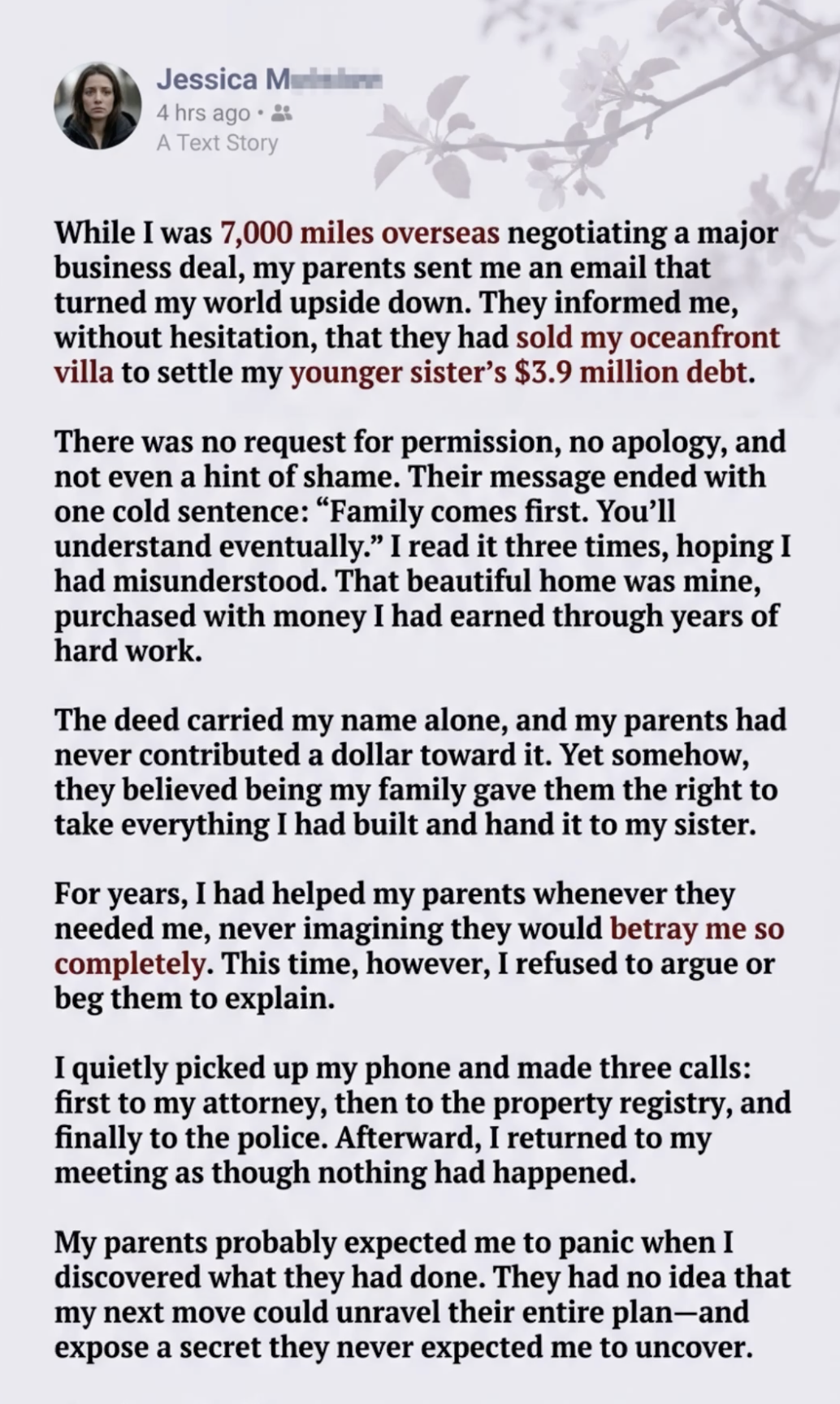
My name is Alexandra Bennett, and I was sitting in a glass-walled conference room in Singapore when my parents informed me that they had sold my oceanfront villa.
I was thousands of miles from home, negotiating a business acquisition that had taken nearly a year to arrange. My team had spent months reviewing contracts, meeting investors, and preparing financial projections. If everything went according to plan, the deal would become the largest transaction of my career.
Then my phone vibrated.
An email from my father appeared on the screen.
The subject line read: Regarding the Villa.
I opened it expecting something about a maintenance issue or a payment that needed my attention.
Instead, I read a message that made the room seem to disappear around me.
My parents had sold my property to settle my younger sister Olivia’s $3.9 million debt.
They hadn’t asked for my permission. They hadn’t warned me. They hadn’t even bothered to call.
The email ended with one sentence.
“Family comes first. You’ll understand eventually.”
I read it three times.
My villa stood on a beautiful stretch of coastline, with floor-to-ceiling windows overlooking the ocean, a private terrace, and a small garden I had spent years designing. I had purchased it with money earned through my own work, after years of long hours, difficult negotiations, and sacrifices my family had rarely acknowledged.
The deed listed me as the sole owner.
My parents had never contributed a dollar toward the purchase.
Yet they apparently believed that being my parents gave them the right to take my property and use it to rescue my sister.
For several seconds, I couldn’t move.
Across the table, my business partner Daniel noticed my expression.
“Alexandra? Is everything all right?”
I locked my phone and placed it facedown.
“Something has happened at home,” I said. “I need five minutes.”
I walked into the corridor, closed the door behind me, and opened the email again.
The wording was cold and matter-of-fact. My father described the sale as a necessary family decision. My mother had been copied on the message. Neither of them mentioned how the property had been transferred, who had signed the documents, or whether the buyer knew that I had never authorized the transaction.
They seemed to believe that the decision was already final.
I felt the first wave of anger rising inside me, but beneath it was something more frightening.
How had they done it?
A property registered solely in my name could not ordinarily be sold by my parents simply because they wanted to pay another family member’s debt. The exact legal position would depend on the jurisdiction and the documents involved, but my parents had no authority that I knew of to act on my behalf.
I immediately called my attorney, Margaret Ellis.
She answered after two rings.
“Alexandra, I thought you were in meetings all day.”
“I am. But I need you to listen carefully. My parents say they’ve sold my villa.”
There was a pause.
“Sold it how?”
“To pay Olivia’s $3.9 million debt.”
Margaret’s tone changed instantly.
“Did you sign a sale agreement? Give them power of attorney? Authorize anyone to act for you?”
“No. Absolutely not.”
“Send me the email and every document you have. Don’t confront them yet. We need to establish what was filed, whether any transfer has been registered, and what steps are available to protect your ownership.”
I forwarded the message.
Then I made my second call, this time to the property registry.
I provided the information needed to identify the property and asked whether any transfer, application, or restriction had recently been recorded against the title. The employee could not discuss every detail with me immediately, but she confirmed that a transaction had been submitted for processing.
My hands tightened around the phone.
“Who submitted it?”
“I can provide the information available through the appropriate procedure,” she explained. “You may need to make a formal request or have your attorney contact our legal department.”
I thanked her and ended the call.
Then I called the police.
I explained that my parents had claimed to sell my property without my permission and that a transaction appeared to have been submitted to the registry. I asked how to report suspected unauthorized use of my identity or forged documents if the records supported that concern.
The officer took my details and advised me to preserve the email, avoid altering relevant records, and provide any suspicious documents through the appropriate channels.
I returned to the conference room ten minutes later.
Daniel looked up from his notes.
“Everything okay?”
“No,” I answered honestly. “But I have people handling it.”
I sat down, opened my laptop, and resumed the meeting.
My parents had probably expected me to panic, call them in tears, and beg them to explain. They had likely imagined that I would eventually accept what they had done because refusing would make me the daughter who abandoned her sister in a crisis.
They had made one serious mistake.
They had assumed that my love for my family would prevent me from protecting myself.
They were about to discover otherwise.
By the time my meeting ended, Margaret had sent me a message asking me to call immediately.
The registry had identified the submitted transaction.
The sale documents included a power of attorney bearing my name.
I had never signed such a document.
Margaret had also discovered that the purported authorization had been witnessed and notarized several weeks earlier, when I had been traveling overseas.
“Alexandra,” she said when I called, “we have a significant problem. Someone has submitted documents purporting to authorize your parents to act for you. We need to determine whether the signatures and notarization are genuine. If you did not sign this, we have grounds to ask the relevant authorities to investigate.”
“Can you stop the transfer?”
“We can urgently seek the appropriate protective measures and notify the registry that the authorization is disputed. I can’t promise the outcome before the authorities review it, but we need to act immediately.”
I authorized her to take the necessary lawful steps.
Within hours, she had prepared a formal notice disputing the power of attorney and requested that the registry flag the transaction while the documents were reviewed. She also contacted the buyer’s legal representative, informing them that the registered owner disputed the purported authorization and that proceeding without resolving the issue could create serious legal complications.
The buyer agreed to pause the remaining steps pending clarification.
For the first time since opening my father’s email, I took a full breath.
The villa might still be mine.
But the question remained: who had forged my authorization, and why had my parents believed they could get away with it?
That evening, my mother called.
I let the phone ring until the final moment before answering.
“Alexandra, your father says you’ve contacted a lawyer.”
“Yes.”
Her voice immediately sharpened.
“Why would you do that? This is a family matter.”
“You sold my house without my permission.”
“We did what we had to do. Olivia was in serious trouble.”
“Then you should have helped her with your own money.”
“We don’t have that kind of money,” she snapped. “You do.”
I closed my eyes.
There it was—the belief that had followed me through much of my adult life. Because I had worked hard and built a successful career, my family considered my resources available whenever they wanted them.
“Having money doesn’t mean you own my property,” I replied.
My mother sighed impatiently.
“You’re making this much more difficult than it needs to be. The buyer has already paid a deposit. Your sister’s creditors are waiting. We can’t simply undo everything now.”
“Who signed the power of attorney?”
She went silent.
“Mom, did you sign my name?”
“No one is trying to hurt you.”
“That wasn’t my question.”
She began crying, but I could not tell whether the tears came from guilt, fear, or frustration that the transaction had been challenged.
“Your father handled the paperwork,” she finally said. “He told us it was all arranged.”
“Did I authorize him to sign for me?”
“I don’t know what you want me to say.”
“The truth.”
She hung up.
I stared at the phone, feeling as though the last thread connecting me to my childhood had snapped.
For years, I had helped my parents whenever they needed me. I had paid for emergency repairs to their house, covered medical expenses, and helped them through financial difficulties without demanding repayment. When Olivia needed help, I had often stepped in before she even asked.
I had never believed that helping family meant surrendering the right to say no.
Apparently, my parents disagreed.
The next morning, Margaret received a call from the registry’s legal department. The transaction had been placed under review, and the buyer had been notified that the purported power of attorney was disputed.
The officials would not yet say whether the document was forged. That required examination of the original paperwork and the circumstances surrounding its preparation.
Margaret arranged for an independent document examiner to compare the signature with verified examples of my handwriting. She also requested the records from the notary who had supposedly witnessed my authorization.
Meanwhile, the police asked me to provide a formal statement and copies of the relevant emails. They explained that the matter could involve suspected forgery or fraud, but that the evidence would need to establish who had prepared and submitted the documents.
I cooperated fully.
Then Margaret called again.
“There is something else,” she said.
“What?”
“The sale proceeds were not going directly to Olivia’s creditors. The agreement lists an intermediary company as the recipient of a substantial portion of the money.”
I sat down.
“What company?”
She gave me the name.
I recognized it immediately.
It was a small consulting company that had appeared in Olivia’s financial records during a previous dispute. Several years earlier, Olivia had asked me to review a business proposal she claimed would solve her money problems. The numbers had never made sense, and I had declined to invest.
She had accused me of refusing to support her.
Now the same company appeared in the documents connected to the sale of my villa.
“Why would the buyer send money there?” I asked.
“We don’t know yet. The agreement describes the payment as part of a debt settlement. We need the underlying contracts, the creditor’s instructions, and the company’s ownership records.”
I felt a chill move through me.
This was no longer simply a family argument about helping my sister.
Someone had arranged a complicated transaction using my property, and the paperwork might reveal that the stated purpose was not the whole story.
I asked Margaret to investigate the intermediary company and notify the authorities about the connection.
Two days later, the independent examiner reported that the signature on the power of attorney showed several inconsistencies with my verified signatures. The examiner could not conclusively identify the person who had written it from the comparison alone, but the findings supported further investigation.
The notary’s records raised additional questions.
According to the submitted paperwork, I had personally appeared before the notary to authorize the transaction. Yet travel records and company records showed that I had been overseas on the stated date.
I had not been in the country.
I had not met the notary.
And I had not signed the document.
The evidence was becoming harder to explain away.
My father called that afternoon.
“Your lawyer is threatening everyone,” he said angrily.
“She’s protecting my property.”
“You’re going to ruin your sister’s life over a piece of real estate?”
“No. You put my property into a transaction without my consent. I am trying to find out how you did it.”
“We were trying to save Olivia.”
“From what?”
He hesitated.
“Her debts.”
“Why did you need a power of attorney with my signature?”
“Because the paperwork needed to be completed quickly.”
“That doesn’t answer the question.”
He lowered his voice.
“Your mother and I thought you’d eventually understand. Olivia was desperate. If we’d asked you, you would have said no.”
I stared at the wall.
“So you decided that my answer didn’t matter.”
He said nothing.
That silence told me more than his explanations had.
I ended the call and returned to the documents Margaret had sent. I read every page carefully, searching for the detail that would explain why my parents had been so determined to sell the villa without speaking to me first.
Then I found an attachment to the sale agreement.
It was a settlement schedule listing several debts that were supposedly connected to Olivia’s business. Some were legitimate loans. Others were described as private obligations supported by promissory notes.
One creditor’s name appeared repeatedly.
The name belonged to a private investment company that had financed one of Olivia’s failed ventures.
But the contact address for that company matched an address used by the intermediary business.
I sent the information to Margaret.
She reviewed it and called me back within the hour.
“Alexandra, I think we need to look more closely at the relationship between these companies. They may have overlapping interests. We can’t assume that yet, but it is significant enough to investigate.”
I remembered Olivia’s business proposal from years earlier. I remembered the strange financial projections and her insistence that I should trust her because we were sisters.
I had declined to invest, but I had kept a copy of the proposal.
I searched my archived emails and found it.
The company structure in the old proposal was remarkably similar to the one appearing in the current transaction. Several names had changed, but the underlying arrangement looked familiar.
I forwarded everything to Margaret.
For the first time, I began to suspect that the $3.9 million debt might be more complicated than my parents had described.
It was possible that Olivia owed money to outside creditors. It was also possible that some of the companies involved were connected in ways that had not been disclosed to my parents or to the buyer.
Only a proper investigation could establish the truth.
But the discovery gave us a new direction.
Margaret asked the authorities to examine the relationship between the companies, the movement of the proposed sale proceeds, and the documents used to authorize the transaction.
Meanwhile, the buyer formally suspended the sale pending resolution of the disputed authorization. Because the title transfer had not been completed, my ownership remained on the register while the investigation proceeded.
I was relieved, but I knew the matter was far from over.
My parents had made a decision that could have cost me my home. Even if the transaction was ultimately stopped, I would still need to understand what they had done and why.
A week later, Margaret arranged a meeting with my parents’ attorney.
My father arrived looking exhausted. My mother sat beside him, refusing to meet my eyes.
Their attorney explained that they claimed to have acted under instructions they believed were legitimate. He said they were cooperating with the review and would provide the records requested.
Margaret placed a copy of the disputed power of attorney on the table.
“Who prepared this document?”
My father looked at it.
“Olivia brought us the paperwork.”
I felt my chest tighten.
“You told me you handled it.”
“I handled the sale arrangements,” he said. “Olivia said the authorization had already been taken care of.”
“Taken care of by whom?”
He looked toward my mother.
She began crying.
“We thought she had arranged everything,” my mother whispered. “She said you had agreed to help her, but you didn’t want to get involved directly.”
I shook my head.
“I never agreed to sell my villa.”
My father rubbed his forehead.
“Olivia told us you had promised to help her with the debt. She said you wanted to keep the matter private because of your business negotiations.”
It was a convenient explanation, one that had allowed them to proceed without checking with me.
But it did not explain why my name had appeared on a power of attorney claiming that I had personally signed before a notary.
Margaret asked whether my parents had seen me sign it.
Neither answered.
Finally, my father admitted that they had not.
They had relied on Olivia’s assurances and the documents she provided.
That admission did not settle who had prepared the signature or whether my parents knew it was false. Those questions remained for investigators to establish.
But it revealed that they had been willing to risk my property without verifying the most basic fact: whether I had consented.
I left the meeting feeling hollow.
I had spent years believing my parents might make poor decisions, but that they would never knowingly place me in danger.
Now I understood that their desire to rescue Olivia had outweighed their willingness to protect me.
The investigation continued for several months.
The authorities examined the power of attorney, the notary records, the sale agreement, and the financial arrangements involving the intermediary company. They also interviewed people connected with Olivia’s business dealings.
The evidence established that the authorization submitted in my name was not genuine. The transaction was halted, and the attempted sale was referred for further legal action. The authorities continued examining who had created the document and who had knowingly relied on it.
The investigation into Olivia’s debt revealed a more complicated picture as well. She did owe substantial money, but the records showed that the settlement schedule included obligations whose amounts and beneficiaries were disputed. Some payments appeared to be connected to companies with overlapping business relationships.
I refused to speculate about who had orchestrated every part of the arrangement. I had learned that suspicion was not proof.
What mattered was that the villa had not been sold with my permission, and the attempted transfer could no longer proceed as though nothing were wrong.
My parents eventually acknowledged that they had acted without my consent. They said they had believed they were saving Olivia from financial ruin and that they had not expected the paperwork to be challenged.
I listened to their explanation.
Then I told them the truth.
“You were so worried about saving Olivia that you never stopped to consider what you were doing to me. You decided that my home, my work, and my future were less important than the emergency you wanted to solve.”
My mother cried.
My father stared at the floor.
Neither asked me to withdraw the complaint. By then, they understood that the matter was no longer mine to settle through a private family promise. The relevant authorities would determine what had happened and what consequences followed.
I continued working with Margaret to protect my ownership and resolve the remaining property issues. The villa stayed in my name, and the disputed transaction was not completed.
I returned to Singapore to finish the business deal I had been negotiating when the email arrived. The work was difficult, but the experience taught me something about myself: even in the middle of a personal crisis, I could make decisions carefully rather than allowing panic to control me.
The acquisition closed several weeks later.
My team celebrated with dinner overlooking the city. Everyone congratulated me on the deal, unaware of how close I had come to losing the home I had worked so hard to purchase.
I thanked them and smiled.
But my mind was already on the oceanfront villa.
When I finally returned home, I drove there alone.
The house looked exactly as I remembered it. Sunlight spilled across the terrace, waves broke against the shore, and the garden moved gently in the ocean breeze.
I stood by the windows and watched the water.
For years, that villa had represented the reward for every difficult decision I had made. It was proof that I could build a life through patience, hard work, and independence.
My parents had treated it as a resource they could spend whenever Olivia needed rescuing.
I would never look at family in quite the same way again.
I didn’t cut my parents out of my life in a single dramatic moment. I set boundaries. I stopped providing money without clear terms. I insisted that important decisions be discussed honestly, and I made it clear that no one could use my property or identity without my consent.
My relationship with Olivia became distant. I hoped she would eventually take responsibility for her financial decisions, but I no longer offered to solve every problem she faced.
I also stopped confusing love with unlimited access to my life.
Months later, my father sent me another email.
It was much shorter than the first.
He wrote that he was sorry he had failed to ask for my permission. He said he had convinced himself that the family’s needs justified what he was doing, and that he now understood how badly he had misjudged the situation.
I read it carefully.
I did not immediately forgive him, but I appreciated that, for once, he had acknowledged the actual harm rather than hiding behind the phrase “family comes first.”
I wrote back that family should mean trust, honesty, and respect—not the right to take from one person to rescue another.
I told him that rebuilding our relationship would take time.
Then I closed my laptop.
The email that had once seemed like a declaration that my parents could do whatever they wanted had become a turning point in my life.
They had believed that my love for them would make me surrender my home without a fight. They had believed that my success meant I could absorb any loss. And they had believed that I would eventually understand because they were family.
What they had failed to understand was that family did not cancel the need for consent.
My villa remained mine, but the experience changed more than my property records. It changed the way I understood loyalty, responsibility, and the difference between helping someone and allowing them to control your future.
I still loved my family.
But I no longer believed that love required me to sacrifice everything I had built.
And the next time someone told me that family came first, I knew I would ask one question before agreeing to anything:
“Does family come first only when I’m the one expected to pay?”