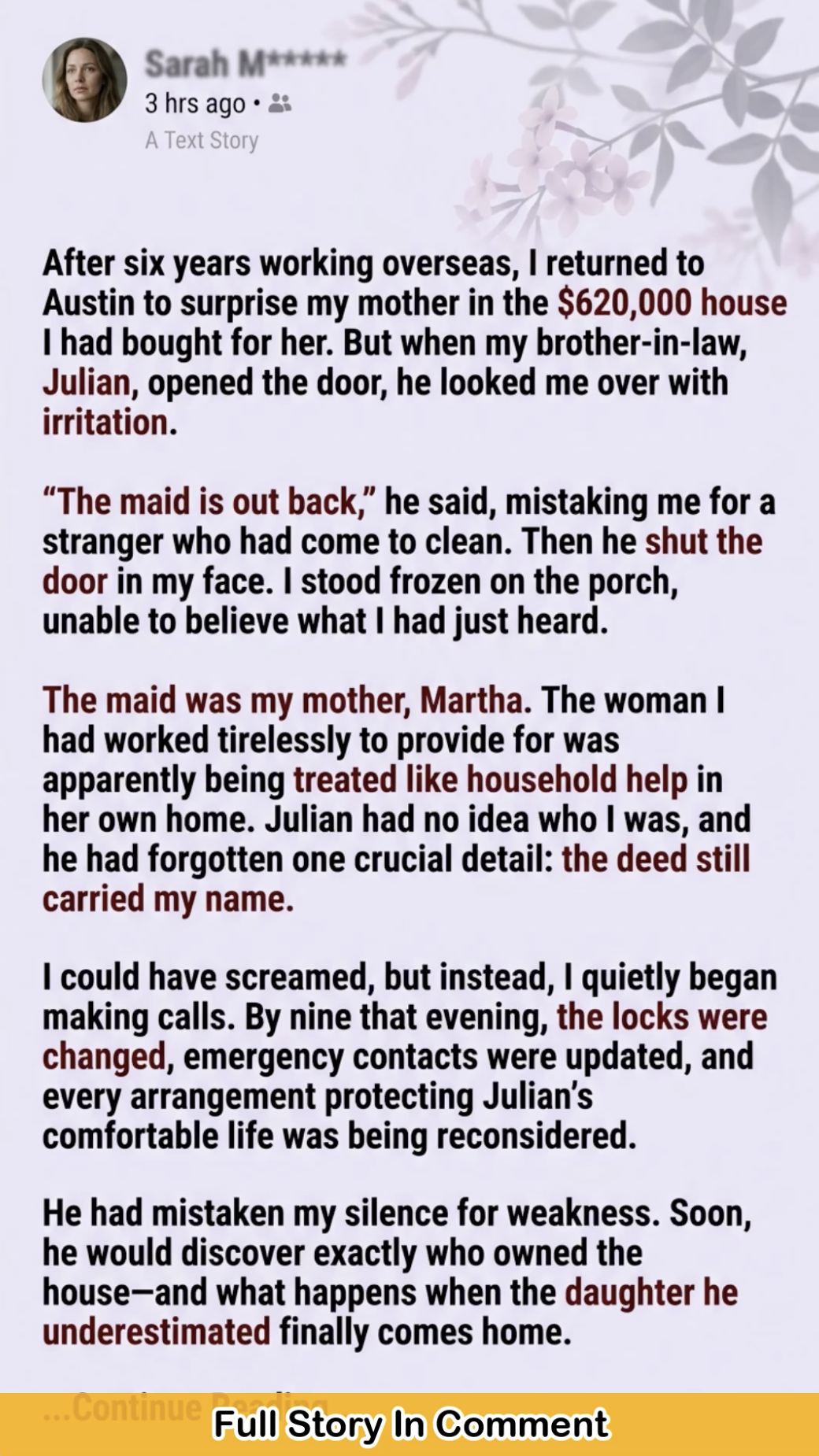
Six years is a long time to live away from home.
I learned that lesson in hotel rooms, rented apartments, and airport lounges scattered across three countries. I learned how to sleep through construction noise, how to eat dinner alone without feeling lonely, and how to smile during exhausting workdays when all I wanted was to hear my mother’s voice.
But every sacrifice had a purpose.
My mother, Martha, had spent most of her life putting everyone else first. After my father died, she worked long hours, stretched every dollar, and made sure my younger sister, Emily, had opportunities she herself had never enjoyed. When I finally secured a well-paying overseas position, I promised myself that my mother would never again have to worry about rent, repairs, or whether she could afford to retire.
So I bought her a house in Austin.
It cost $620,000, and I paid for it with money I had saved over years of working abroad. The deed remained in my name, but the house was hers to enjoy for as long as she wanted. I furnished it according to her tastes, planted roses along the walkway, and made sure the kitchen had the wide counter she had always wanted for baking.
I never told her how much the house cost.
I simply said, “Mom, you don’t have to worry about where you’ll live anymore.”
She cried when she saw it for the first time.
She walked through every room touching the walls, opening cabinets, and peering through the windows as though she expected someone to tell her it was all a mistake.
“You’re sure this is really mine?” she asked.
“It’s your home,” I told her.
For the next six years, I checked on her regularly. We spoke by video call every Sunday, though sometimes our conversations were brief because of the time difference. She always told me she was fine. She showed me the flowers blooming in the yard and the new curtains she had bought for the living room.
Occasionally, Emily appeared in the background.
She had married Julian two years before I purchased the house. At first, I thought he was charming. He spoke confidently, dressed well, and always seemed to know exactly what to say when meeting someone new.
But I gradually noticed that his conversations revolved around money, property, and what other people could do for him.
Emily often defended him.
“He’s ambitious,” she would say whenever I expressed concern. “He wants to build a better life for us.”
I wanted to believe her.
When Emily and Julian encountered financial difficulties, I allowed them to stay with Mom temporarily. Their apartment lease had ended unexpectedly, and Emily assured me they would find somewhere else within a few months.
I agreed because I trusted my sister.
I didn’t realize that my temporary kindness would slowly turn into a situation I barely recognized.
Then, after six years abroad, I finally arranged a long visit home.
I told my mother I would be busy with work for another week. I wanted to surprise her, so I booked my flight, packed her favorite chocolates, and bought a blue scarf I knew she would love.
During the flight to Texas, I imagined her face when I walked through the front door.
I pictured her laughing, hugging me tightly, and telling me I should have warned her because she would have cooked enough food for a dozen people.
Instead, I arrived at her house shortly before noon on a Thursday and found a strange car parked in the driveway.
I assumed Emily had bought something new.
I carried my suitcase up the walkway and rang the bell.
The door opened, and Julian stood there wearing a gray T-shirt and expensive-looking sneakers. He looked me over with visible irritation.
“Can I help you?” he asked.
I smiled.
“I’m here to see Martha.”
He glanced at my suitcase.
“The maid is out back.”
For a moment, I thought I had misunderstood him.
“I’m sorry?”
He sighed as if I had inconvenienced him.
“If you’re here to clean, the back entrance is around the side. We don’t need anyone coming through the front door.”
Then he closed the door.
Right in my face.
I stood on the porch, staring at the wood grain beneath the brass handle.
I had spent years working so my mother could live comfortably. I had bought the house, paid the bills, and made sure she would have a safe place to grow older.
And now my own brother-in-law had mistaken me for a stranger who had come to clean his house.
But that wasn’t the part that frightened me most.
It was the way he had said it.
Not as a joke. Not with uncertainty. He had spoken as though the woman who lived in that house was expected to serve him.
I walked around the side of the building.
The backyard was neat, but the flower beds needed attention. My mother’s gardening gloves lay on a chair beside the patio. Near the kitchen door stood a basket of folded laundry.
Then I saw her.
Mom was kneeling beside a low garden bed, pulling weeds. She wore an old blouse, faded trousers, and a pair of rubber gloves. Her hair was tied back loosely, and she looked tired.
For a second, I couldn’t move.
“Mom?”
She turned.
Her face changed instantly.
“Oh, sweetheart!”
She hurried toward me, pulling off her gloves as she came. I dropped my suitcase, and we embraced beside the flower beds.
She held me so tightly that I could feel her shoulders trembling.
“Why didn’t you tell me you were coming?” she whispered.
“I wanted to surprise you.”
She laughed through her tears, but the laughter faded when she looked toward the house.
“Did Julian see you?”
“Yes.”
Her eyes dropped.
“What did he say?”
I hesitated.
“He told me the maid was out back.”
Mom closed her eyes.
That small reaction told me more than any explanation could have.
“How long has this been happening?” I asked.
She immediately shook her head.
“It’s nothing. He’s just under a lot of pressure.”
“Mom, look at me.”
She did, though reluctantly.
“Why were you working in the garden while he was inside?”
“I like gardening.”
“That’s not what I asked.”
She began removing the dirt from her gloves.
“Julian says the house needs to stay presentable. He doesn’t like clutter, and he says I leave too many things around. Sometimes he asks me to tidy up before Emily comes home.”
“Emily lives here too?”
Mom hesitated.
“They’ve been staying here longer than expected.”
“How long?”
“Almost a year.”
A year.
The arrangement I had approved for a few months had become a permanent living situation without my knowledge.
I looked toward the back door.
“Does Julian pay rent?”
“No.”
“Does Emily?”
Mom shook her head.
I felt a slow, heavy anger building inside me.
“Then why are you doing their laundry?”
She looked away.
“I don’t want to cause trouble between them.”
“You’re not causing trouble by living in your own home.”
She began to cry.
I took her hands.
“Mom, this is your home. You don’t owe anyone the right to treat you like a servant.”
She pressed her lips together, trying to stop herself from crying.
“I know you bought it for me, but the deed is in your name. Julian says that means he and Emily need to help decide how things are managed. He says I should be grateful they’re here because I might need help as I get older.”
I stared at her.
“Did he tell you that I wanted them to make decisions for you?”
“He says you worry about me from far away, and he knows what’s happening here.”
“And you believed him?”
She looked wounded.
“I wanted everyone to get along.”
That was when I understood the extent of the problem.
My mother wasn’t simply uncomfortable. She had been made to feel that asking for respect would threaten the little peace she had left.
I hugged her again.
“You don’t have to explain anything right now. Let’s get you inside.”
We entered through the kitchen.
Julian was standing at the counter, drinking coffee. He glanced at me and frowned.
“Didn’t I tell you to use the back entrance?”
Mom froze beside me.
I set my suitcase down.
“No,” I said calmly. “You told me the maid was out back.”
He rolled his eyes.
“Look, I don’t have time for this. We’re expecting someone later, and I don’t want strangers wandering around the house.”
I took a slow breath.
“My name is Claire Bennett. I’m Martha’s daughter.”
He stared at me.
Then his expression shifted.
“Claire?”
“Yes.”
He looked me over again, this time with uncertainty.
“I didn’t recognize you.”
“You didn’t ask.”
He gave a short laugh.
“Well, nobody told me you were coming.”
“I didn’t know I needed permission to visit my mother.”
Mom moved toward the kitchen table, looking uncomfortable.
Julian noticed her expression and softened his voice.
“Claire, you’re making this into something it isn’t. I thought you were a cleaning woman. It’s an honest mistake.”
“An honest mistake would have been asking who I was. You shut the door in my face.”
He set down his coffee.
“You’re taking this personally.”
“I am taking it seriously.”
I looked around the kitchen. My mother’s favorite ceramic bowls were stacked on a high shelf she could barely reach. The wide counter I had paid to install was covered with Julian’s paperwork, electronics, and takeout containers. A pile of laundry sat beside the pantry.
This was not the home I had imagined when I bought it for her.
“Where is Emily?” I asked.
“At work.”
“And when will she be home?”
“Later.”
“Good. We’ll all sit down together.”
Julian laughed again, but there was a nervous edge to it.
“Why? So you can lecture us about how generous you are?”
“No. So I can understand why my mother feels like a guest in the house I bought for her.”
His expression hardened.
“You’re not here. We are. Someone has to take care of things.”
“Then why is my mother doing your laundry?”
He had no answer.
Instead, he turned toward the refrigerator and muttered something about people who lived overseas thinking money gave them the right to control everyone.
I said nothing more.
That was the moment I decided not to argue with him until I understood the full situation.
I helped Mom put away the groceries, made her a sandwich, and sat with her while she ate. I asked simple questions about her daily routine, whether she had been seeing friends, and whether she still attended her weekly church group.
Her answers troubled me.
She had stopped going to church because Julian complained that she spent too much time away from the house. She rarely invited friends over because he said the living room was too crowded. She had stopped baking for the neighbors because he objected to the mess.
Each restriction had sounded small when described separately.
Together, they had narrowed her life until she was almost invisible in her own home.
That evening, I went into the guest bedroom and called my attorney, Daniel Reeves, who had helped me purchase the property years earlier.
I explained what had happened and asked him to review the deed, the occupancy arrangements, and any legal obligations I had toward the people living there.
Daniel listened carefully.
“First,” he said, “we need to distinguish between ownership and occupancy. Your name on the deed gives you important rights, but we should not assume that means you can remove everyone immediately. Texas law and the details of their living arrangement matter.”
“I understand.”
“Second, has your mother given anyone authority to manage her finances or make decisions on her behalf?”
“Not that I know of.”
“Then let’s verify that. We should also make sure she has access to her own bank accounts, identification, medications, and important documents.”
I thanked him and asked him to begin reviewing the paperwork.
Then I contacted the property manager who handled the home’s insurance and maintenance arrangements. I asked her to confirm that all current records were accurate and that no one had made unauthorized changes to the property accounts.
I did not ask anyone to cancel services or cut off access to necessities. My mother lived there, and protecting her was the priority.
At nine that evening, I sat at the kitchen table and wrote down everything Mom had told me.
The spare keys.
The unpaid living arrangement.
The pressure to do household chores.
The restrictions on her social life.
The claim that Julian and Emily should help manage the house because the deed was in my name.
I also wrote down the date and exact words Julian had used when he opened the door.
I wanted a clear record, not a family argument built on competing memories.
When Julian came into the kitchen, he saw the papers.
“What are you doing?”
“Making notes.”
“About me?”
“About what happened today.”
He leaned against the counter.
“You can’t just fly in here after six years and start making rules.”
I looked up.
“I didn’t make the rules. I bought a house so Mom could live safely and comfortably.”
“She’s fine.”
“Then you shouldn’t have any difficulty explaining why she feels she has to serve you.”
He folded his arms.
“You think money makes you better than everyone else.”
“No. I think respect should not depend on money.”
He stared at me for a moment.
Then he said the one thing that made the situation unmistakable.
“You should be thanking us. If we weren’t here, your mother would be alone.”
I glanced toward the hallway, where Mom had gone to rest.
“Being alone is not the same as being mistreated.”
He pushed away from the counter.
“You’re going to regret making this a fight.”
I kept my voice steady.
“I’m not looking for a fight, Julian. I’m looking for the truth.”
He walked away.
The next morning, I took Mom to breakfast at a small café she used to visit with my father. She seemed nervous at first, checking her phone every few minutes.
“Does Julian expect you to tell him where you are?” I asked.
“He likes to know.”
“Does he get angry if you don’t answer?”
“Sometimes.”
I put down my coffee.
“Mom, you’re allowed to go out. You’re allowed to see friends. You don’t need permission to enjoy your day.”
She stared at her hands.
“I know that in my head. It’s just difficult when someone keeps telling you that you’re being selfish.”
I reached across the table.
“You are not selfish.”
For the first time since my arrival, she smiled without looking frightened.
We spent the morning walking through a local garden center. She chose two rose bushes and a pot of lavender. She talked about how much she had missed gardening when she stopped visiting her friends.
When we returned to the house, Emily was waiting in the living room.
She stood when she saw us.
“Claire, Julian says you’re trying to throw us out.”
I set the plants down.
“Did he tell you what happened yesterday?”
“He said you came in angry and started threatening to change the locks.”
“I did not threaten to lock anyone out. I told him I was going to review the legal and living arrangements because Mom is unhappy.”
Emily looked at our mother.
“Are you unhappy?”
Mom opened her mouth, then closed it.
Emily sighed.
“Mom, you should have told me.”
“I tried,” Mom whispered. “But every time I said something, you told me Julian was under pressure and I should be patient.”
Emily’s face fell.
“I didn’t realize it was that bad.”
“That’s because you weren’t the one being told to clean up after everyone,” I said.
Emily began to cry.
I felt sorry for her, but I wasn’t going to let her tears erase the problem.
“Emily, I love you. I don’t want to damage your marriage. But I will not ignore what’s happening to Mom just to keep everyone comfortable.”
She nodded slowly.
“Can we talk about this without Julian?”
“Yes. But we need to talk about everything, including how long you have been living here and what arrangements you believe were agreed upon.”
We spent nearly two hours discussing it.
Emily admitted that their financial situation had worsened after Julian’s business lost a major client. They had intended to stay with Mom for a few months, but rent in Austin had become expensive, and they had fallen behind on several payments.
Instead of telling me, Julian had persuaded Emily that it was better to remain quiet until they got back on their feet.
Then the temporary arrangement became routine.
Julian began making decisions about furniture, repairs, and household schedules. Emily went along with him because she was embarrassed about their finances and worried that moving out would strain their marriage.
Mom, meanwhile, tried to avoid arguments by doing whatever was asked of her.
No one had explicitly told her that she could not leave.
But over time, she had learned that every disagreement brought criticism, cold silence, or accusations that she was being difficult.
I listened to all of it.
I understood that financial stress could make people frightened and defensive. I understood that my sister had made mistakes because she wanted to protect her marriage.
What I could not accept was the decision to make our mother feel powerless in her own home.
“Here’s what needs to happen,” I said when we finished.
“First, Mom’s needs and wishes come first. She decides what help she wants, who visits her, and how she spends her time.
“Second, you and Julian need a realistic plan for moving into a home of your own. I’m willing to give you a reasonable period to arrange that, but it cannot remain open-ended.
“Third, no one gets to use my name on the deed to frighten Mom or claim authority over her. I own the property, but that does not make her a child. She deserves independence and dignity.”
Emily nodded.
“What if we can’t afford another place immediately?”
“Then we discuss realistic options. I can help you look at a budget, identify housing resources, or explore temporary arrangements with clear boundaries. But I will not solve the problem by letting Mom be treated like household staff.”
For once, Emily did not argue.
Julian, however, was furious when he learned about the conversation.
He accused me of humiliating him and trying to control his marriage. He said I had no right to dictate how another adult lived.
I told him I agreed that adults deserved independence.
“That’s why you and Emily need to make your own housing arrangements instead of expecting my mother to organize her life around yours.”
He called me arrogant.
I ended the conversation.
Over the next several days, Daniel reviewed the property documents and helped me establish a clear, lawful process for resolving the occupancy issue. We documented the arrangements and the notice required under the circumstances. I also confirmed that no one had authority to make financial decisions for Mom simply because they lived in the house.
I arranged for Mom to meet independently with her bank so she could review her accounts and make sure she understood every authorization attached to them. I encouraged her to speak privately with her doctor about her well-being, not because I thought she was incapable, but because she deserved professional support if the stress had affected her health.
I also helped her reconnect with two friends from church.
One afternoon, I returned from the grocery store to find Mom sitting on the patio with both women, laughing over cups of tea.
It was a simple sight, but it moved me more than I expected.
For months, she had been shrinking her life to avoid upsetting the people around her. Now she was beginning to reclaim it.
The housing situation took longer to resolve.
Julian initially refused to discuss a departure date. Daniel explained that we had to follow the appropriate legal process and avoid taking actions that could unlawfully interfere with anyone’s rights. I was frustrated, but I followed his advice.
Eventually, Emily and Julian agreed to move into a smaller rental property after they worked through their budget and found a place they could afford.
The move was tense.
Julian barely spoke to me. Emily cried while packing her belongings, and Mom kept asking whether the family would ever feel normal again.
I hugged her.
“Normal doesn’t have to mean pretending nothing happened.”
Before leaving, Emily apologized to Mom for ignoring her complaints.
“I’m sorry I let things go this far,” she said. “I thought I was keeping the peace, but I wasn’t listening to you.”
Mom held her daughter’s hands.
“I love you. But I need you to hear me when I tell you something is wrong.”
Emily nodded through her tears.
Julian offered a brief apology, though he focused more on the misunderstanding at the door than on the months that had preceded it. I accepted that he had said the words, but I did not pretend they repaired everything.
Trust would have to be rebuilt through behavior, not promises.
After they moved out, I had the house cleaned and rearranged the kitchen so Mom could reach everything comfortably. We put her baking bowls back on the lower shelves. I helped her clear the counter and chose a small table where she could work on flower arrangements.
I also gave her a new set of keys and made sure she knew that no one would enter without her knowledge.
The deed remained in my name, as it had from the beginning. But I made one thing clear to everyone: the house was not a weapon I intended to use against my family. It was the place I had purchased so my mother could live with security and peace.
I stayed in Austin for several weeks before returning overseas.
On my last evening, Mom and I sat on the porch watching the sun fade behind the neighboring rooftops. The roses she had chosen were beginning to open.
“I was so embarrassed when Julian called you the maid,” she said quietly.
I took her hand.
“You don’t need to be embarrassed about his behavior.”
“I should have said something sooner.”
“You were trying to keep your family together.”
She looked at me.
“And you?”
“I was trying to make sure you didn’t have to choose between having a home and being respected.”
She leaned against my shoulder.
“I don’t want you to think you have to rescue me from everything.”
“I don’t,” I said. “I want you to know you can ask for help without giving up your voice.”
We sat together for a long time.
Before I left, I made sure she had the numbers of her friends, her doctor, Daniel, and me. We agreed on regular calls, but I also encouraged her to build a life that didn’t depend on waiting for me to call from another country.
When I returned overseas, I thought often about the moment Julian had opened the door.
For a few seconds, I had been so shocked that I could barely speak. I had wanted to shout at him, to tell him exactly how much I had sacrificed and how much that house had cost.
But eventually, I understood that the most important question wasn’t whether he knew who I was.
It was whether my mother felt safe being herself in the place I had bought for her.
That was what mattered.
I had spent six years working abroad believing that providing a house would be enough to protect her. I had learned that a secure home also required boundaries, honest communication, and the freedom to say no.
I could not control every decision my sister made or every word her husband spoke. I could, however, make sure my mother had support, understood her rights, and no longer felt she had to earn her place in her own home by serving others.
Months later, Mom sent me a photograph of the rose bushes blooming beside the porch. In the picture, she stood smiling in her favorite gardening hat, holding a pair of pruning shears.
Her message read: The roses are doing beautifully. I had coffee with my friends this morning, and I’m baking a cake tomorrow. I finally feel like myself again.
I saved the photograph and looked at it whenever work became exhausting.
I had bought that $620,000 house because I wanted to give my mother a better life. But the most valuable thing I brought home that Thursday was not money, a deed, or the authority to change the locks.
It was the decision to listen when she finally admitted she was unhappy.
And the lesson I carried back overseas was simple: a house can provide shelter, but a home only becomes a place of peace when the people living inside are treated with dignity.