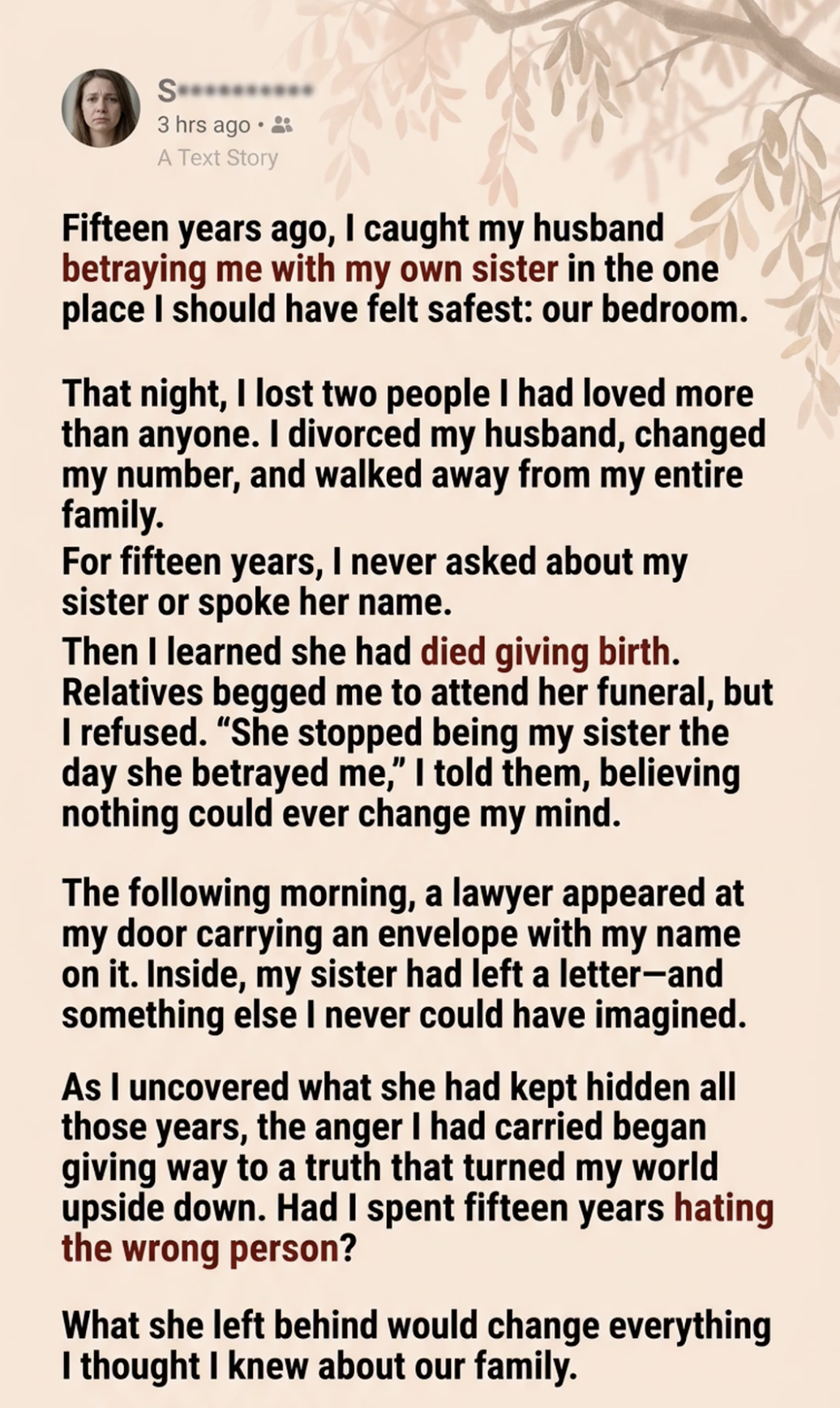
Fifteen years ago, I discovered my husband, Daniel, in our bedroom with my younger sister, Rachel. It was the kind of betrayal that doesn’t simply break your heart; it makes you question every memory you once treasured. The man I had built a life with and the sister I had protected since childhood had chosen to hurt me in the cruelest way imaginable.
I didn’t scream. I didn’t throw anything. I stood in the doorway, staring at them, while the world I knew collapsed around me.
Daniel tried to explain. Rachel cried and reached for my hand. I walked away before either of them could say another word.
Within months, I had divorced Daniel, changed my phone number, and moved to another state. I stopped attending family gatherings and ignored messages from relatives who insisted that time would heal everything. Whenever someone mentioned Rachel, I ended the conversation.
For fifteen years, I lived as though my former family no longer existed.
Then, on a rainy Tuesday morning, my aunt called from an unfamiliar number.
“Rachel is gone,” she said through tears. “She died giving birth to her second child.”
I held the phone against my ear, unable to speak.
My aunt begged me to attend the funeral. She said Rachel had spent years regretting what she had done and that her children deserved to know their mother’s family.
I refused.
“She stopped being my sister the day she betrayed me,” I said.
I hung up and spent the rest of the day trying to convince myself that I felt nothing.
The following morning, someone knocked on my door.
A man in a charcoal suit stood outside, holding a leather briefcase and a sealed envelope.
“Are you Claire Morgan?” he asked.
“Yes.”
“My name is Thomas Reed. I’m an attorney representing your late sister’s estate. She left specific instructions that this letter be delivered to you personally.”
I stared at the envelope. My name was written across it in Rachel’s handwriting.
I hadn’t seen her handwriting in fifteen years, yet I recognized it instantly.
“Why would she leave me anything?”
“She asked me to give you this letter before you made any decisions regarding the estate. She also left a document and several personal belongings that she specifically wanted you to receive.”
I almost shut the door.
Then I noticed something written beneath my name.
Claire, please read this before you decide what you believe about me.
My fingers began to tremble.
I stepped aside and allowed the attorney to enter.
We sat at my kitchen table. Thomas placed the envelope between us, then removed a thick folder from his briefcase.
“Your sister anticipated that you might be unwilling to meet with me,” he said. “She asked me not to pressure you. She simply wanted you to have the truth.”
“What truth?”
He looked at me carefully.
“Some things about the night you discovered her with your husband were not what you believed them to be.”
I felt a surge of anger so powerful that I nearly stood up.
“Don’t you dare tell me I misunderstood what I saw. I walked into my own bedroom. I saw them together. I heard my husband admit he’d been seeing her behind my back.”
Thomas didn’t argue.
“I understand. I’m not asking you to forgive anyone. I’m asking you to read what she left.”
I broke the seal.
Inside was a handwritten letter, several old photographs, and a smaller envelope containing a copy of a medical record. I looked at the letter first.
Dear Claire,
If you’re reading this, I’m gone, and I have finally run out of time to tell you what I should have told you fifteen years ago.
I know you hate me. I know you have every reason to. I betrayed your trust, and nothing I write can undo the pain I caused.
But there is something you never knew about the night you found Daniel and me. I have carried it for fifteen years, and I cannot leave this world without giving you the truth.
I stopped reading.
My throat tightened, and I pressed my hands against the table.
I wanted to tear the letter apart. I wanted to throw it into the fireplace and return to the life I had carefully built without Rachel.
But I kept reading.
Daniel and I had been arguing that night. He had discovered something about our family that he believed I was hiding from him. He demanded that I tell you. I refused because I was terrified of what the truth would do to you.
You walked in before I could explain anything.
I will never pretend that what you saw didn’t look unforgivable. I will never ask you to forget the pain. But I need you to understand that there was more happening than you knew.
Please look inside the smaller envelope. The document there will explain why I could never bring myself to contact you, even when I wanted to.
I reached for the smaller envelope.
Inside was a copy of a birth certificate.
The name of the child was Ethan Morgan.
His date of birth was fifteen years earlier, just a few months after the night I had discovered Daniel and Rachel together.
Under the section marked Father, a name had been entered.
Daniel Morgan.
I stared at the paper.
For several seconds, I couldn’t understand what I was seeing.
Then the dates began to line up.
The affair had happened fifteen years ago. Rachel had given birth to a boy shortly afterward. She had kept the child, raised him, and never told me.
My first thought was that Ethan was Daniel’s son.
My second thought was that Rachel had built an entire life around the secret while I had spent fifteen years trying to forget her.
I looked at Thomas.
“Is this real?”
“The birth certificate is an official copy,” he replied. “However, it establishes what was recorded, not every circumstance surrounding the child’s paternity. Your sister left additional documents concerning Ethan, and I believe you should read them before drawing conclusions.”
He slid the folder toward me.
Inside were photographs of a little boy with dark hair and a familiar smile. In one photograph, Rachel stood beside him at a birthday party. In another, she held him in front of a school building.
There were also school records, medical forms, and a letter from a family counselor.
I turned another page.
It was a document signed by Daniel acknowledging that he had been involved in Ethan’s life for several years.
My stomach twisted.
Daniel had never told me about a child.
But I had divorced him and walked away from our marriage. I had changed my number and refused every attempt my relatives made to reach me. It was entirely possible that I had cut myself off from information that might otherwise have reached me.
That realization did not make the betrayal hurt less.
It made the years feel more complicated.
I turned back to Rachel’s letter.
Ethan is your nephew. He knows very little about you because I refused to let him grow up believing he was entitled to a relationship with someone who had every reason to hate his mother.
I never told him that you were cruel or that you abandoned us. I told him I had hurt you, and that you had chosen to protect yourself.
He asked about you when he was little. I showed him photographs of us as children. He always wanted to know whether you liked the same books and music he did.
I told him that you were a good person, even if I had lost the right to be part of your life.
I lowered the letter.
For fifteen years, I had imagined Rachel as someone who had stolen my husband and moved on without remorse. I had pictured her laughing with Daniel, enjoying the life I had lost, while I struggled to rebuild my own.
But the photographs showed a different kind of life. Rachel had raised a child, worked ordinary jobs, and grown older without ever repairing the relationship she had destroyed.
I still did not know whether she had truly changed.
A letter written by someone who had died could not answer every question.
“What does Ethan know about me now?” I asked.
Thomas folded his hands.
“He knows that you are his aunt. He knows your relationship with his mother ended after a serious betrayal. He also knows that she hoped you might someday be willing to meet him.”
“Does he want to meet me?”
“He asked me to tell you that he would welcome a conversation, but he does not expect you to take responsibility for him or to forgive his mother.”
I stared at the photographs.
How could I meet the son of the man who had betrayed me and the sister who had helped him do it?
And yet, Ethan was not responsible for any of it.
I returned to Rachel’s letter.
There is one more thing you need to know about that night.
Daniel told you that we had been seeing each other for months. I will not deny that we had crossed boundaries long before you found us. We did. I made choices that hurt you, and I cannot rewrite them.
But I need you to know that Daniel was not the person I thought he was, and I discovered that too late.
I paused.
Rachel’s next words were difficult to read.
He had been telling us different stories. He told me that you had already agreed to separate, that your marriage was ending, and that you were staying only because you felt responsible for our parents. He told you something different because he wanted to keep both relationships alive.
When I realized how thoroughly he had lied, I confronted him. That was the argument you walked in on.
I remembered the night vividly.
Daniel had looked frightened when I entered the bedroom. Rachel had been crying. I had assumed their expressions were the result of being caught.
Perhaps they were.
But I now wondered whether they had been arguing because their lies had finally collided.
The letter continued.
I am not asking you to believe I was innocent. I wasn’t. I wanted Daniel, and I allowed myself to believe what he told me because it was easier than admitting I was hurting my own sister.
When you walked in, I should have told you everything. Instead, I panicked. I let you leave believing the worst because I thought you would never forgive me, and I was ashamed.
By the time I understood how much I had destroyed, you were gone.
I set the letter down and covered my face.
For years, I had thought there was only one version of the story: my husband and my sister had betrayed me, and I had been the innocent person left to suffer.
That version was not entirely wrong.
But it was incomplete.
Rachel had betrayed me. Daniel had deceived both of us. Whatever arguments had preceded my arrival, they did not erase the choices either of them had made.
Still, I had never known the full extent of Daniel’s lies.
I looked at the last page.
Claire, I don’t expect you to forgive me. I don’t expect you to attend my funeral, and I don’t expect you to love me because I am dying.
But if there is one thing I hope you can do, it is to separate what I did to you from the life Ethan deserves to live.
He is not a punishment for my mistakes. He is not proof that you lost something you were supposed to have. He is a child who deserves to know that his family is larger than the mistakes of the adults who came before him.
I have left a small education fund for him. I have also left you a box of our childhood photographs. If you never want to see him, I will understand. But I wanted you to have the choice I took away from you fifteen years ago.
I am sorry, Claire. I have been sorry for a very long time.
Your sister,
Rachel.
I sat at the table until the light outside began to fade.
Thomas remained quiet.
Finally, I asked him about the education fund. He explained that Rachel had set aside money for Ethan’s future and had named a trustee to administer it. The fund was not an inheritance intended to buy my forgiveness. It was a separate arrangement for her son’s education.
The box of photographs, he told me, was waiting in his office.
I thanked him and asked for time to think.
After he left, I called my aunt.
For the first time in fifteen years, I asked her to tell me what had happened after I disappeared.
She explained that Rachel had tried to contact me several times in the first year. She wrote letters, sent messages through relatives, and even visited my former apartment once, only to learn I had moved away.
Eventually, Rachel stopped trying.
Not because she believed she deserved forgiveness, my aunt said, but because she thought continuing to contact me would only reopen the wound.
Daniel had remained in contact with Rachel for a while, but their relationship had not lasted. They had struggled with the consequences of their choices, and Daniel had eventually moved away. He remained involved in Ethan’s life to varying degrees, though their relationship was complicated.
Rachel never remarried.
She raised Ethan largely on her own, working as an office administrator and taking evening classes when she could. She rarely spoke about me, but she kept our childhood photographs in a drawer beside her bed.
“She missed you,” my aunt said.
I closed my eyes.
“I missed who I thought she was.”
“I know.”
“Why didn’t anyone tell me about Ethan?”
“We didn’t know how. You made it clear you didn’t want to hear her name. We thought telling you about her child would only hurt you more.”
I understood their hesitation, though it left me grieving for the years in which I might have known my nephew.
When the call ended, I sat in the dark living room.
I had spent fifteen years protecting myself from Rachel’s betrayal. I had rebuilt my career, bought a small house, made new friends, and learned to be content with a quiet life.
But I had also carried my anger everywhere.
It had become part of how I introduced myself to the world: the woman whose husband cheated with her sister, the woman who had walked away from her family and never looked back.
I had believed that refusing to forgive Rachel was the same as refusing to let her hurt me again.
Now I wondered whether I had allowed the betrayal to keep controlling a part of my life long after both of them were gone from it.
The following morning, I called Thomas.
“I’d like to meet Ethan,” I said. “But I want to do it slowly, and I don’t want him to feel responsible for repairing anything between his mother and me.”
“That is entirely reasonable,” he replied. “I’ll ask whether he is comfortable arranging a meeting.”
A week later, Ethan called.
His voice was younger than I expected, though he was already fifteen. He sounded nervous, and so was I.
“Hello, Aunt Claire,” he said.
I gripped the phone.
“Hello, Ethan.”
There was a pause.
“Mom told me you might not want to talk to me.”
“Your mother was right that I was hurt. But you didn’t do anything wrong.”
“I know,” he said quietly. “She told me that, too.”
I swallowed.
“I’m sorry we didn’t meet sooner.”
He didn’t rush to comfort me.
“She said you were a good sister before everything happened.”
I looked at the photographs on my table.
“I loved her very much.”
“She loved you, too.”
His words hurt, but not in the way I had expected. They reminded me that Rachel had continued to be a person after I had removed her from my life. She had been a mother, a daughter, and a woman who had made mistakes she could not undo.
We arranged to meet at a public garden the following Saturday.
When I arrived, Ethan was standing beside a fountain with his hands in his jacket pockets. He had dark hair, a thoughtful expression, and a smile that reminded me of our father.
For a moment, I could barely speak.
“Hi,” he said.
“Hi.”
We walked along the garden paths and talked about ordinary things. He told me about school, his favorite subjects, and his plans to study engineering. I told him about my work and the city where I lived.
Neither of us tried to turn the meeting into a dramatic reunion.
Before we parted, he handed me a small photograph.
It showed Rachel and me as children, sitting together on our parents’ front steps. Rachel had her arm around my shoulders, and I was laughing at something outside the frame.
“Mom kept it in her bedroom,” Ethan said. “She wanted you to have it.”
I held the photograph carefully.
“Thank you.”
He looked at me.
“I don’t expect you to forgive her because of me.”
“I’m glad you understand that.”
“But I hope you won’t disappear from my life just because she made mistakes.”
I took a breath.
“I can’t promise we’ll become close overnight. But I would like to get to know you.”
He smiled, and for the first time that day, I felt some of the tension leave my shoulders.
Over the next several months, Ethan and I exchanged messages and met occasionally for lunch. I attended a school event after he invited me, and he came to my home during the summer holidays.
We built a relationship carefully, without pretending that the past had never happened.
I also learned more about Rachel’s final years. She had developed a serious pregnancy-related complication during the birth of her second child, and despite emergency treatment, she died shortly afterward. Her younger child was being cared for by Daniel and relatives who were helping the family through the loss.
I attended a small memorial gathering several weeks after her funeral.
I stood near the back of the room, uncertain whether I belonged there. My aunt came to stand beside me. We looked at the photographs of Rachel displayed on a table: Rachel holding her newborn, Rachel laughing with Ethan, Rachel standing beside a birthday cake.
I cried.
Not because the betrayal had vanished, and not because I had suddenly decided that what she did was acceptable.
I cried because my sister was gone, and I would never have the chance to hear her explain the past in her own voice. I would never be able to ask why she made the choices she did, or tell her how those choices had shaped my life.
I had wanted an apology for fifteen years.
When it finally came, it was in a letter written by someone who could never answer another question.
I took a moment alone beside the memorial table.
“I’m still hurt,” I whispered. “But I’m tired of carrying this every day.”
There was no answer, of course.
I didn’t need one.
Forgiveness, I realized, did not mean declaring that Rachel had done nothing wrong. It did not mean restoring the relationship we once had or pretending that fifteen years could be returned to us.
It meant deciding that the worst thing she had done would no longer be the only thing I remembered about her.
I would remember the sister who taught me to ride a bicycle, who shared a bedroom with me when we were children, and who once stayed awake all night when I had a fever.
I would also remember the sister who betrayed me, because that was part of the truth.
And I would let both memories exist without allowing either to erase the other.
That evening, I placed the childhood photograph beside a picture of Ethan on my bookshelf.
For fifteen years, I had believed that cutting Rachel out of my life meant I had escaped the damage she caused.
Now I understood that the past had not disappeared simply because I refused to speak its name. It had remained with me, shaping my anger and my choices.
Rachel’s letter had not changed the fact that she and Daniel betrayed me.
It had changed what I knew about the people involved, what I understood about the years that followed, and what I wanted to do with the time I still had.
I could not reconcile with my sister.
But I could choose not to punish her son for a mistake he never made.
And I could stop letting the worst night of my life decide what the rest of my life would look like.
Sometimes the truth does not erase betrayal. It simply gives us the chance to stop living inside it.