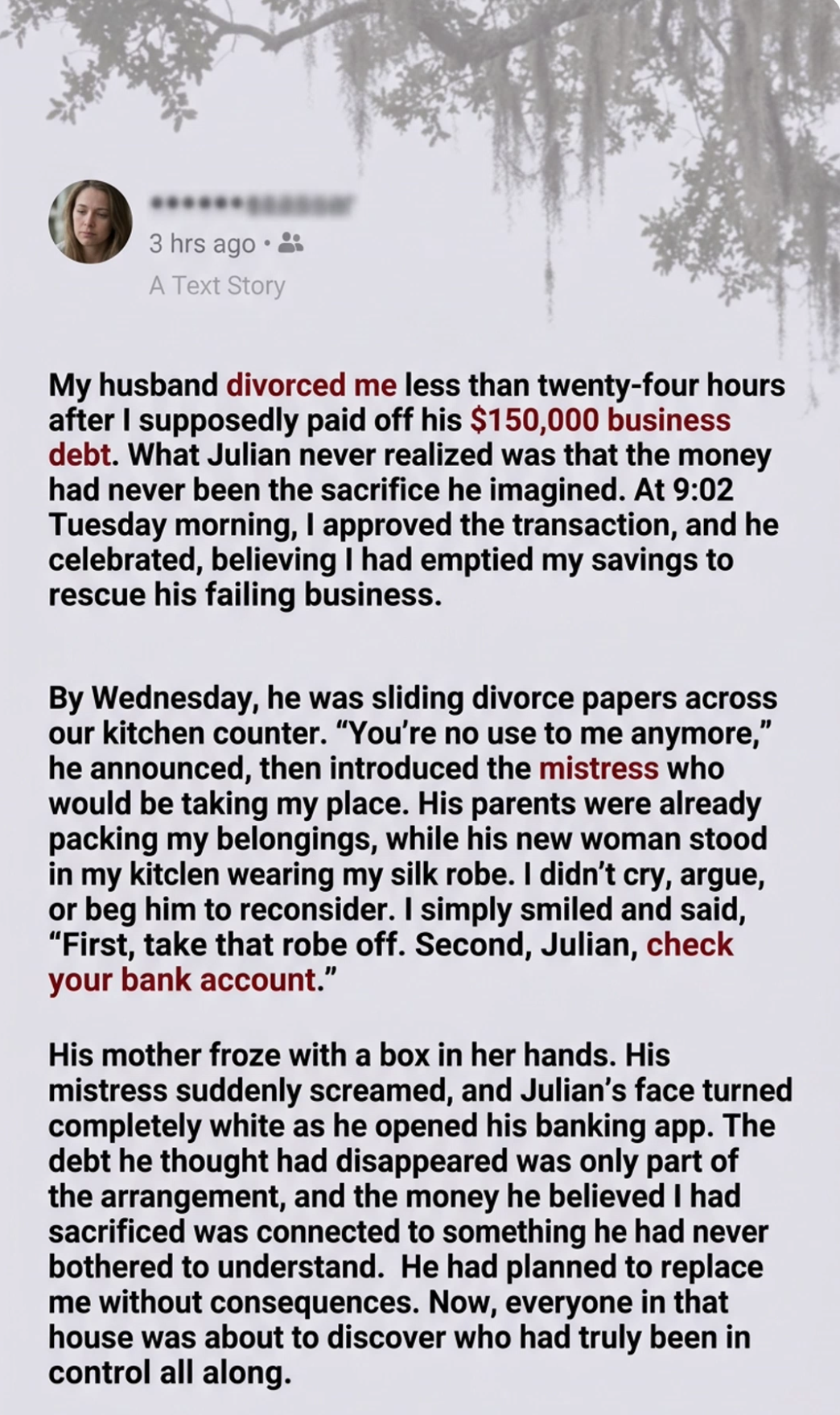
At 9:02 on Tuesday morning, I approved a transaction that my husband, Julian, believed would save his failing business.
By Wednesday morning, he was asking me to leave our home.
“You’re no use to me anymore,” he said, sliding a stack of divorce papers across the kitchen counter. “I need someone who can help me move forward, not someone who keeps reminding me how much I owe her.”
I looked at the man I had been married to for eleven years and wondered when the person I loved had disappeared.
Then his mistress walked into my kitchen wearing my silk robe.
Behind her, Julian’s mother was packing my belongings into cardboard boxes, while his father carried my framed photographs toward the garage.
Nobody asked whether I had somewhere to go.
Nobody seemed concerned that the woman they were throwing out had just supposedly sacrificed her savings to rescue Julian’s company from $150,000 in debt.
I didn’t cry.
I didn’t argue.
I simply looked at the woman wearing my robe and said, “First, take that off. Second, Julian, check your bank account.”
His mother froze.
His mistress stopped smiling.
Julian pulled out his phone, still wearing the smug expression of a man who believed he had already won.
Then he opened his banking app.
The color drained from his face.
“What have you done?” he whispered.
I folded my hands on the counter.
“Nothing you didn’t agree to.”
What Julian had never understood was that the money he believed I had sacrificed was never quite what he thought it was. The transaction he celebrated on Tuesday was connected to an agreement he had signed months earlier without bothering to read the details.
And by Wednesday morning, the consequences of that decision were finally arriving.
To understand why, I have to go back to the beginning.
Chapter One: The Wife Who Always Fixed Everything
My name is Claire Bennett. I was thirty-nine when my marriage ended, and for most of those eleven years, I believed Julian and I were building something that would last.
We met at a charity dinner when I was twenty-seven. I worked in financial operations for a regional investment firm, while Julian was an ambitious entrepreneur who dreamed of owning his own logistics company.
He wasn’t wealthy when we met.
He drove an aging sedan, rented a small apartment, and spent most evenings drawing business plans on napkins. But he had energy, confidence, and a way of making the future sound exciting.
When he spoke about his plans, I believed him.
Two years later, we married.
I used part of my savings to help furnish our first house, and I helped him prepare the financial projections for his company. I never thought of those contributions as sacrifices. We were partners, and I wanted us both to succeed.
Julian launched Bennett Logistics with two trucks, a small warehouse, and a handful of employees.
For several years, the company grew.
He hired more drivers, expanded into neighboring states, and began winning contracts with regional manufacturers. His parents, Richard and Eleanor, praised him constantly. At family gatherings, Richard would raise his glass and tell everyone that his son was going to become a major business owner.
I was proud of Julian, too.
But as the company expanded, our relationship changed.
He began working later. Business dinners became overnight trips. He stopped asking for my opinion and started describing financial decisions after they had already been made.
When I asked about the company’s cash flow, he accused me of being negative.
“You’re always looking for problems,” he would say. “Sometimes you need to trust me.”
I tried.
When one of his customers paid late, I helped him review the accounts. When fuel costs increased, I researched ways to reduce expenses. When he struggled to secure financing for additional vehicles, I helped organize the paperwork.
Whenever the company faced a crisis, Julian came to me.
And whenever I helped him solve it, he treated the rescue as evidence that he had been right all along.
His parents encouraged that attitude.
Eleanor frequently reminded me that a good wife stood beside her husband during difficult times. She rarely mentioned that a good husband should also stand beside his wife.
I ignored the imbalance because I believed marriage required patience.
Then Julian made the business decision that nearly destroyed everything.
He borrowed heavily to acquire a smaller transportation company. The acquisition looked promising on paper, but several contracts fell through shortly after the deal closed. Maintenance costs were higher than expected, and one of the acquired company’s largest customers went bankrupt.
Within months, Julian was struggling to meet his obligations.
He stopped sleeping properly. He became irritable and defensive. His phone rang constantly, and I began finding unopened letters from lenders on his desk.
One evening, I found him sitting in the dark office above our garage.
“What happened?” I asked.
He rubbed his face.
“I’m in trouble.”
It was the first honest thing he had said to me in weeks.
He showed me the figures.
Between a business loan, outstanding supplier invoices, and a personal guarantee attached to one financing agreement, he was facing approximately $150,000 in urgent obligations.
If he failed to negotiate a solution, the company could lose important contracts and potentially face insolvency.
“Can you help me?” he asked.
I sat beside him and reviewed the documents.
“We need to understand exactly what is due, which creditors have priority, and whether the company can realistically recover.”
He looked at me with exhausted eyes.
“I don’t need a lecture, Claire. I need my wife.”
I closed the folder.
“Then let’s solve it together.”
At the time, I thought that was what we were doing.
I had no idea that Julian was already imagining a future without me.
Chapter Two: The Money He Thought Was Mine
There was something Julian never understood about my finances.
Before we married, my grandmother had left me an inheritance. She had worked as an accountant for decades and had been careful with every dollar she earned. Her estate included a modest investment portfolio and a share in a commercial property.
I invested the inheritance conservatively and kept it separate from our ordinary household finances.
Over time, the investments grew.
I didn’t hide the existence of the inheritance from Julian. He knew I had received it. What he never bothered to understand was how the assets were structured, what belonged to me personally, and what financial commitments were attached to them.
He assumed that because I worked in finance and had savings, I could always produce whatever amount he needed.
I had helped him before, so he believed I would do it again.
But after reviewing the company’s obligations, I realized that simply giving Julian $150,000 would not necessarily solve his problems.
His company needed a restructuring plan, not another temporary rescue.
I consulted an independent attorney and a financial adviser. They reviewed the loan agreements, the business’s accounts, and the options available to prevent a collapse.
We eventually identified a legitimate way to resolve the most urgent debt.
A separate investment entity that I controlled could provide funding to settle the specified obligations, but only under a formal agreement. The company would have to acknowledge the amount advanced, provide accurate financial disclosures, and accept clear repayment terms.
The agreement also addressed what would happen if the business failed to meet those terms.
I was not trying to trap my husband. I wanted the arrangement documented so that neither of us would have to rely on vague promises later.
Julian signed the necessary documents after his lawyer had an opportunity to review them.
He was impatient during the process.
“Can we get this over with?” he asked. “I have customers waiting, and the bank is breathing down my neck.”
“Have you read the agreement?”
“Of course.”
He hadn’t.
I knew that because he asked me the next morning whether the company would need to make monthly payments under the arrangement. The payment schedule was clearly set out in the document he had signed.
I reminded him to speak with his lawyer if he had questions.
He waved me away.
“Claire, you handle the paperwork. I handle the business.”
That was the moment I began to understand how little he respected the work I did.
He wanted the benefit of my financial knowledge without acknowledging that it had value.
Still, I proceeded.
On Tuesday at 9:02 a.m., I authorized the transaction through the agreed process. The funds were applied to the specified obligations, and the creditors issued confirmation that the debts covered by the settlement had been paid.
Julian received the confirmation shortly afterward.
He called me from his office, practically shouting with relief.
“You did it! Claire, you actually did it!”
“We followed the agreement,” I replied.
“You saved the company.”
“I helped create a solution. The business still needs to follow the restructuring plan.”
He laughed.
“Always the cautious one. Just let me enjoy this for once.”
That evening, he came home with an expensive bottle of wine. He ordered dinner from our favorite restaurant and talked about how he planned to rebuild the business.
For the first time in months, he seemed relaxed.
He kissed my cheek and said, “I don’t know what I’d do without you.”
I smiled, believing we had survived the worst part of the crisis.
Then his phone lit up on the table.
A message appeared from a woman named Vanessa.
Tomorrow, finally. I can’t wait to stop pretending.
I stared at the screen.
Julian snatched up the phone.
“Who is Vanessa?” I asked.
“Someone from the office.”
“What does she mean by ‘stop pretending’?”
He looked at me for a moment, then sighed as though I had inconvenienced him.
“I was going to tell you.”
I felt the room grow cold.
“Tell me what?”
He looked away.
“I’m leaving you, Claire.”
The words seemed absurd.
We had spent the previous evening reviewing ways to keep our marriage and his business stable. He had celebrated the settlement that morning. He had kissed me at dinner.
Now he was telling me that he was leaving.
“Are you having an affair?”
He didn’t deny it.
“How long?”
“That’s not important anymore.”
“It is to me.”
He stood up.
“I’m tired of this marriage. I’m tired of having to explain every decision to you. I want a fresh start.”
I stared at him.
“You asked me to help you save your company yesterday.”
“And you helped. Thank you. But that doesn’t mean I owe you the rest of my life.”
I hadn’t asked him to owe me anything.
I had expected him to treat me like a human being.
Instead, he looked at me as though our eleven years together were an invoice he had finally paid.
By the next morning, he had made his decision official.
Chapter Three: The Woman in My Silk Robe
At 8:15 Wednesday morning, I walked into the kitchen and found Julian sitting at the counter with a stack of documents.
His mother stood near the pantry, taping a cardboard box shut.
His father was carrying framed photographs toward the garage.
I stopped in the doorway.
“What is happening?”
Julian pushed the documents toward me.
“Divorce papers. My attorney has prepared them. You can have your lawyer review everything, but I want this handled quickly.”
I didn’t touch the papers.
“You arranged all this overnight?”
“I’ve been thinking about it for months.”
That was somehow worse than hearing he had decided the night before.
For months, he had let me believe we were working to save our marriage while secretly planning to replace me.
Eleanor lifted another box.
“We thought it would be easier if you started packing today.”
I looked at her.
“You’re packing my things?”
“Don’t make this unpleasant, Claire. Julian needs a fresh start, and you need to accept that the marriage is over.”
I turned back to my husband.
“Where am I supposed to go?”
“You have your own resources. You’ll manage.”
Then Vanessa appeared in the hallway.
She was younger than I was, perhaps thirty-two, with long blond hair and an expression of effortless confidence. She walked into the kitchen wearing my cream-colored silk robe.
The robe had been a gift from my grandmother before she died.
I had kept it carefully for years.
Vanessa glanced at me, then at Julian.
“Is this the wife?”
The question was so casually cruel that for a moment I couldn’t respond.
Julian gave a small shrug.
“Ex-wife, soon enough.”
I looked at Vanessa.
“Take that off.”
She glanced down at the robe.
“Oh, this? Julian said I could borrow it.”
“It’s mine.”
She smiled.
“I’m sure you have plenty of clothes.”
I felt something inside me settle.
Not break.
Settle.
I had spent eleven years trying to keep the peace with Julian. I had explained away his selfishness, excused his arrogance, and told myself that the pressure of running a business made him behave differently than he really was.
But there was no confusion now.
He had accepted my help, planned his departure, and brought another woman into my home before I had even had time to process the divorce.
His parents were helping him remove me from my own life.
I didn’t scream.
I didn’t throw anything.
I simply turned to Julian.
“Before we discuss these papers, check your bank account.”
He frowned.
“What?”
“Your bank account.”
He gave an irritated laugh.
“Claire, this is not the time for one of your financial lectures.”
“Then it should take you only a few seconds.”
Something in my expression must have unsettled him, because he pulled out his phone.
He opened the banking app.
His eyes moved across the screen.
Then he stopped breathing for a moment.
“What is this?”
Vanessa walked closer.
“What happened?”
Julian refreshed the page.
His face went pale.
“That’s impossible.”
Eleanor put the box down.
“Julian?”
He looked up at me.
“The money is gone.”
I folded my arms.
“Which money?”
“The settlement funds. The money that paid the debt.”
I held his gaze.
“The creditors were paid. That part happened exactly as agreed.”
“Then where is the rest?”
“There wasn’t a personal gift to you.”
His mouth opened, but no words came out.
The money had not been deposited into Julian’s personal account as a windfall. It had been used under the written arrangement to settle the specified company obligations. The funding was documented as a business liability, not a gift from a wife to a husband.
Julian had treated the transaction as if I had handed him $150,000 and walked away with nothing.
But that wasn’t what he had signed.
The settlement had resolved the specified debts. It had not erased his responsibilities under the new agreement.
He stared at his phone.
Then he looked at the documents on the counter.
“What did you do to me?”
I shook my head.
“I didn’t do anything to you, Julian. You signed the agreement. You had the opportunity to have your lawyer review it. You chose not to understand it.”
“You told me the debt was paid!”
“The debts covered by the settlement were paid. The company still has obligations under the restructuring agreement.”
“You made it sound like you were saving me!”
“I was trying to save the business. I never promised to give you ownership of my assets or make your financial responsibilities disappear.”
His mother looked between us.
“Julian, what is she talking about?”
He ignored her.
He was still staring at the phone, searching for a number that would make the situation different.
Then he whispered, “The company owes your investment entity?”
“Yes.”
“How much?”
“The amount specified in the agreement, subject to the payments and adjustments set out there.”
His face went white again.
Vanessa took a step backward.
And for the first time that morning, nobody in the kitchen had anything to say.
Chapter Four: The Agreement He Never Read
Julian’s first reaction was anger.
He accused me of misleading him, manipulating him, and using his financial desperation to gain control over his company.
I let him finish.
Then I took a copy of the signed agreement from my bag and placed it on the counter.
“Read section four,” I said.
He stared at the pages.
“Read it.”
He flipped to the section.
The agreement stated that the funding had been provided by a separate investment entity under a documented restructuring arrangement. It specified the obligations of the company, the repayment schedule, the conditions under which additional security could be required, and the remedies available if the company defaulted.
It did not give me unrestricted control over Julian’s business.
It did not mean I could take the company away simply because we were divorcing.
But it did mean the company could not pretend the funding was a gift.
Julian read the paragraph again.
Then he looked at me.
“You knew I was going to leave you.”
“No.”
“Then why did you make me sign this?”
“Because the company needed a real financial arrangement. I was not going to put my own assets at risk based on a promise you made during a crisis.”
“You could have told me the consequences!”
“I did. Your lawyer had the documents. You were asked to review them. You signed them.”
He slammed the papers down.
“I thought you trusted me.”
“I did trust you. That’s why I agreed to help. But trust doesn’t mean refusing to document a six-figure transaction.”
Richard, his father, stepped into the conversation.
“This is ridiculous. She’s your wife. Surely there is some way to undo this.”
I turned to him.
“Your son decided to divorce me. That doesn’t cancel a separate business agreement.”
Eleanor looked furious.
“You’re using money to punish him.”
“No. I’m refusing to pretend that money was a gift when the documents clearly say otherwise.”
Vanessa had gone very quiet.
She removed the robe and placed it on the counter without looking at me.
For the first time, she seemed to realize that Julian’s version of the story had left out some important details.
He had told her that the business was saved, that I had agreed to help him without expecting repayment, and that our marriage was already finished.
He had not told her that the company still had obligations under a formal agreement.
He had not told her that I had independent legal advice.
And he had apparently not told her that his new life depended on the success of a business that was still financially vulnerable.
“Julian,” she said carefully, “you told me the debt was gone.”
“It is gone!”
“But you just said—”
“Not now, Vanessa.”
She looked at me.
“Does this mean he could lose the company?”
“That depends on the business’s performance, whether it meets the agreement’s terms, and what happens next. I’m not going to speculate about that.”
I wasn’t trying to humiliate her. She had participated in a cruel situation, but I didn’t know everything Julian had told her or what she believed.
The person responsible for the financial decisions was Julian.
He turned back to me.
“You can’t do this. We were married.”
“Yes, we were. And we’re getting divorced. The financial agreement is a separate matter. Our lawyers can handle both properly.”
His expression changed.
For the first time, he seemed to understand that I wasn’t going to be pulled into an emotional argument where he could make me feel guilty enough to surrender.
I wasn’t going to sign away my rights to prove that I had loved him.
I wasn’t going to take revenge.
I was going to let the documents speak for themselves.
Chapter Five: The Divorce He Wanted So Quickly
Julian had assumed the divorce would be simple.
He believed I would be too shocked and hurt to challenge anything. He expected me to accept whatever his attorney had prepared, leave the house, and allow him to move on with Vanessa.
But the house was jointly owned, and our marital finances needed to be reviewed. I also had separate assets whose ownership and treatment would have to be established under the applicable law.
I hired my own divorce attorney.
She advised me not to move out permanently or sign anything before the property, accounts, and business arrangements had been properly reviewed. She also explained that the divorce itself would not automatically determine the outcome of the company’s separate financing obligations.
We requested financial disclosures from Julian and his company.
He resisted.
He claimed that the business was his alone and that I had no reason to examine its records.
My attorney reminded him that the company agreement and the divorce involved distinct legal questions. The appropriate documents would need to be reviewed through the proper process.
As the weeks passed, the truth became clearer.
Julian had been planning to leave me for longer than he admitted. He had rented a small apartment for Vanessa months earlier, and he had been moving personal items there gradually.
He had also told his parents that I was emotionally unstable and that he needed their help removing me from the house.
His mother had believed him without asking me a single question.
That hurt almost as much as Julian’s betrayal.
Eleanor had known me for eleven years. I had helped her arrange medical appointments, paid for a repair when her heating system failed, and hosted family gatherings when she couldn’t manage the preparations.
I had treated her like family.
Yet she had been willing to stand in my kitchen and pack my belongings without asking what had happened.
When she finally called me, she sounded defensive.
“I think there has been a misunderstanding,” she said.
“About what?”
“Julian says you are trying to ruin him financially.”
“I’m not trying to ruin anyone. The company has a written agreement. It needs to honor that agreement.”
“But he says you planned this.”
“I did not plan our divorce. I agreed to a documented business transaction because his company was in trouble.”
She fell silent.
Then she said, “You know he has always been under pressure.”
“I know. I lived with that pressure, too.”
“I just think you should consider everything he has done for you.”
I closed my eyes.
“Mrs. Bennett, I don’t want to argue about who owes whom gratitude. The divorce is being handled by our attorneys. The business agreement will be handled separately. I suggest we leave it there.”
She began to protest, but I ended the call politely.
For the first time in years, I wasn’t trying to make my husband’s family approve of me.
I didn’t need their permission to protect myself.
The divorce took months rather than days. There were disagreements about the house, personal property, and the division of marital assets. My attorney made sure that any settlement reflected the applicable law and the actual financial records rather than Julian’s preferred version of events.
I didn’t demand the business as revenge.
I didn’t ask for money I wasn’t entitled to.
I simply refused to surrender what was legally mine.
Meanwhile, Julian’s company continued operating under the restructuring arrangement.
The creditors had received the payments specified in the settlement, but the company still needed to meet its remaining obligations. Julian had to make difficult decisions about expenses, staffing, and expansion.
For the first time, he could no longer rely on me to solve every problem while he took credit for the result.
And Vanessa began to discover that being with a successful-looking businessman was very different from living with one whose finances were under pressure.
Chapter Six: When the Mistress Learned the Truth
Three months after Julian filed for divorce, Vanessa contacted me.
I almost ignored the message.
Then I read it again.
Claire, I know you probably don’t want to hear from me, but I think you deserve to know something. Could we talk?
I hesitated before agreeing to meet at a quiet café.
Vanessa arrived without makeup and looked exhausted. She ordered tea, wrapped both hands around the cup, and stared at the table.
“I owe you an apology,” she said.
I waited.
“Julian told me your marriage had been over for years. He said you were only staying because you wanted financial security. He told me you had agreed to help with the business because you didn’t want him to leave.”
I felt a familiar ache, but I wasn’t surprised.
“That isn’t what happened.”
“I know that now.”
She looked up.
“He also told me the $150,000 had been a gift. He said you were wealthy enough that the money didn’t matter to you.”
I said nothing.
“I believed him,” she continued. “I wanted to believe him. I knew he was still married, but he made it sound as though the paperwork was just a formality and you were both ready to move on.”
She swallowed.
“When I walked into your kitchen wearing your robe, I thought I was stepping into my new life. I didn’t stop to think about what I was doing to you.”
I looked at her carefully.
“Why are you telling me this?”
“Because I think he lied to both of us.”
I didn’t feel sympathy for her in the way she might have hoped. She had made choices, too. She had known Julian was married and had participated in a cruel scene designed to push me out of my home.
But I could recognize that she was beginning to understand the consequences of those choices.
“What happened between you?” I asked.
Vanessa looked down.
“After the divorce papers were filed, he started talking about the company constantly. He blamed you for every problem. He said you had trapped him with legal documents and that he couldn’t trust anyone.”
“Did you believe him?”
“At first. Then I saw the agreement.”
She explained that Julian had asked her to review a document for him because he wanted help understanding the repayment schedule. She had noticed that the terms were not what he had described.
When she questioned him, he became furious.
He accused her of taking my side.
“I asked him why he had signed something he hadn’t read,” she said. “He told me that you were supposed to be his wife, and wives were supposed to help without making everything complicated.”
I almost laughed.
Even after everything that had happened, Julian still believed that the problem was the woman asking questions.
“What did you do?” I asked.
“I moved out.”
She said it quietly.
“I realized I had fallen in love with the version of him he wanted me to see. I don’t know whether he ever loved me, but I know he wanted someone who would agree with him and never ask what anything cost.”
I took a slow breath.
“I’m sorry you were hurt,” I said. “But I can’t make your decisions for you, and I can’t take responsibility for what Julian told you.”
“I know.”
She reached into her bag and pulled out the silk robe.
“I brought this back. I washed it. I should never have taken it in the first place.”
I accepted it.
“Thank you.”
We didn’t become friends. We didn’t hug or promise to keep in touch.
We simply finished our tea and went our separate ways.
As I walked to my car, I realized something important: I no longer needed Julian’s new relationship to fail in order to feel that I had won.
His choices had already revealed what I needed to know.
I could move forward without waiting for everyone else to suffer.
Chapter Seven: The Meeting That Changed Everything
Six months after the transaction, Julian requested a formal meeting about the business agreement.
The company’s financial position had improved in some areas, but it remained under pressure. He wanted to renegotiate the repayment schedule and remove certain conditions he considered restrictive.
My attorney and the company’s representatives arranged the meeting.
I attended with my financial adviser and legal counsel. Julian arrived with his own attorney.
He looked older than he had a year earlier. The confidence that once filled every room had been replaced by a strained expression and a habit of tapping his pen against the table.
His lawyer began by explaining the company’s position.
They argued that the original schedule was difficult to meet and proposed revised terms. My adviser reviewed the numbers, asked questions about cash flow, and requested supporting documents.
The discussion was professional.
Nobody shouted.
Nobody threatened to destroy anyone’s life.
That was how serious financial matters were supposed to be handled.
After reviewing the information, we agreed to consider a revised schedule if the company could demonstrate that the proposed payments were realistic and that the new terms would protect the investment.
The final agreement was documented through the lawyers.
There was no dramatic seizure of the company. No surprise arrest. No magical transfer of ownership.
There were contracts, figures, negotiations, and consequences.
At the end of the meeting, Julian asked whether he could speak to me privately.
My attorney advised that we keep any discussion about the business within the documented process. I agreed to a brief conversation in the presence of counsel.
Julian looked at me.
“I never thought it would end like this.”
“Neither did I.”
“I thought the company was everything. I thought if I could get through that debt, I could start over.”
“You could have started over without humiliating me.”
He looked away.
“I know.”
It was the first time I had heard him acknowledge the way he treated me without immediately blaming someone else.
He continued.
“I thought you would always be there. You had money, you understood the business, and you always found a solution. I convinced myself that meant I could do whatever I wanted, and you’d still help me.”
I didn’t answer.
He rubbed his forehead.
“When the money went through, I felt free. I thought the biggest problem in my life was gone. I didn’t think about the agreement. I didn’t think about what you had actually done.”
“You didn’t want to think about it.”
He nodded.
“You’re right.”
For a moment, I remembered the young man I had met at the charity dinner. The man who had drawn business plans on napkins and talked about building something worthwhile.
I wondered whether he had changed or whether I had simply stopped overlooking the parts of him I didn’t want to see.
“I did love you, Claire,” he said.
I believed that he might have loved me in his own way.
But love without respect had not been enough to sustain our marriage.
“I loved you, too,” I replied. “That doesn’t mean we should have stayed married.”
He looked at me.
“Do you hate me?”
I thought about the hospital of memories I had carried through those months: the betrayal, the boxes, the robe, the lies, and the humiliating way he had announced that I was no longer useful.
“No,” I said. “I don’t want to spend my life hating you.”
He seemed relieved.
“But I don’t trust you anymore,” I continued. “And I won’t put myself in a position where my future depends on you treating me fairly.”
He lowered his head.
“I understand.”
I hoped he did.
Then we returned to our attorneys and finished the meeting.
That was the last time we spoke about our marriage as though there might be something left to save.
Chapter Eight: The Life I Built After Julian
The divorce was finalized after the remaining property and financial matters were resolved.
I moved into a smaller house with a bright kitchen, a little garden, and enough room for the things I actually cared about. I kept the furniture I loved and donated the rest.
The silk robe went into a drawer beside my grandmother’s jewelry.
I didn’t keep it because it reminded me of Vanessa.
I kept it because it belonged to a part of my life that was mine before Julian’s betrayal and would remain mine afterward.
I returned to work with a renewed sense of purpose. I had always been good at financial analysis, but I began taking on projects that challenged me in ways I had previously avoided. I helped small business owners understand cash flow, debt, and the importance of reading agreements before signing them.
I never discussed Julian’s company by name.
I didn’t need to.
The lesson was broader than our marriage: a financial rescue is not the same as a gift, and trust does not remove the need for clear agreements.
A year after the divorce, I received an update from a former colleague who still worked in the logistics industry.
Julian’s company had survived, though it was smaller than before. He had sold some vehicles, reduced overhead, and focused on the contracts that remained profitable. The restructuring had forced him to run the business more carefully.
He was making payments under the revised agreement.
I felt no urge to celebrate his difficulties or take credit for his survival.
The business had been his responsibility all along.
He had made decisions, signed contracts, and chosen how to treat the people around him. Now he had to live with the consequences and do the work required to rebuild.
That was fair.
Vanessa eventually moved away. I heard through mutual acquaintances that she had started a new job and was living on her own. I hoped she would make better choices in the future.
Eleanor sent me a brief letter on what would have been my wedding anniversary.
She wrote that she had been wrong to help Julian pack my belongings before I had even had a chance to speak. She said she had believed her son without considering how much I had contributed to his life.
She didn’t ask me to forgive her.
I appreciated that.
I wrote back, thanking her for acknowledging what had happened. I wished her well, but I didn’t return to the role of daughter-in-law who organized every family gathering and solved every problem.
Some relationships could be repaired only to a limited degree.
I had finally learned that I didn’t need to restore every relationship to its former shape.
I only needed to decide which ones could exist in my life without requiring me to abandon myself.
Chapter Nine: The Meaning of That Tuesday Morning
Two years after Julian filed for divorce, I found an old photograph from our early marriage.
We were standing outside our first house, holding two paper cups of coffee. Julian had one arm around my shoulders, and I was laughing at something outside the frame.
We looked happy.
Perhaps we had been.
I no longer needed to rewrite every good memory as a lie just because the marriage had ended badly. There had been genuine affection, shared dreams, and years when I believed we were building a future together.
But there had also been warning signs.
I had ignored the way Julian dismissed my questions. I had allowed him to treat my financial knowledge as a service he could demand rather than a skill deserving respect. I had repeatedly rescued him without insisting that he take responsibility for the decisions that created the emergencies.
I wasn’t responsible for his affair or his cruelty.
But I could learn from the ways I had made it easier for him to assume I would always fix things.
I placed the photograph in a box and returned to my desk.
On it sat a framed sentence my grandmother had written in a notebook years before she died:
Never confuse being needed with being loved.
I had thought it meant that I should avoid depending on other people.
Now I understood something different.
Being needed can feel like love because it gives you a purpose. When someone relies on you, you can convince yourself that you are indispensable. You can tolerate disrespect because you believe the person would collapse without you.
But a healthy relationship doesn’t require one person to be endlessly useful.
It allows both people to contribute, to make mistakes, to ask for help, and to remain worthy of respect even when they cannot provide anything in return.
Julian had believed that I was valuable because I could save his business.
When he thought the immediate crisis was over, he decided he no longer needed me.
He was wrong about what my value meant.
The $150,000 settlement had never been proof that I was willing to sacrifice everything for him. It was a documented financial arrangement designed to address a specific business problem.
I had helped because I believed the company could recover and because I wanted to give my marriage a chance.
But I had also protected myself with independent advice, written terms, and a clear understanding of the risks.
That was not revenge.
It was responsibility.
The moment Julian checked his bank account and realized the money was not a personal gift, he finally confronted a truth he had ignored throughout our marriage: my generosity did not make me his property.
My expertise did not make me his employee.
And my love did not give him permission to discard me without consequences.
I never needed to destroy him to prove that.
I simply stopped protecting him from the results of his own choices.
Sometimes, when people hear the story, they ask whether I regret helping him with the debt.
I don’t.
I regret believing that saving his business would somehow save our marriage. I regret the years I spent treating his problems as my responsibility while assuming that my own needs could wait.
But I do not regret acting with care, seeking professional advice, or insisting that the arrangement be documented.
I didn’t get the ending I once imagined.
I didn’t grow old with Julian. We didn’t build the retirement life we had discussed or spend our later years looking back on the company he had created.
Instead, I built a different life—one in which I no longer measured my worth by how much trouble I could solve for someone else.
And if there is one thing I would tell the woman I was at twenty-seven, standing beside a hopeful young entrepreneur outside a charity dinner, it is this:
Love generously, but never abandon your judgment.
Help the people you care about, but don’t confuse helping them with taking responsibility for every choice they make.
Read the agreement. Ask the difficult questions. Protect the future you have worked to build.
And if someone decides that you are no longer useful once their crisis has passed, believe what their behavior is telling you.
You do not have to beg them to recognize your worth.
You do not have to destroy them to recover your own dignity.
Sometimes the strongest response is simply to stand up, take your belongings, and let the truth remain exactly where it belongs.
On that Wednesday morning, Julian believed he was removing an unwanted wife from his home.
What he had actually done was end the relationship that had allowed him to rely on my love without respecting it.
He checked his bank account expecting to discover that I had sacrificed everything.
Instead, he discovered that I had never agreed to sacrifice my future.
And that was the moment I finally began living for myself.