The day my daughter abandoned me at my wife’s grave, the temperature was thirty-four degrees, and the wind was strong enough to make my hands shake.
I was seventy-one years old.
My wife, Eleanor, had been dead for eleven months.
And I was standing in a cemetery nearly 190 miles from home, watching the taillights of my daughter’s SUV disappear beyond the iron gates.
At first, I thought Vanessa and her husband, Derek, had gone to get coffee.
Then my phone vibrated.
It was a message from Derek.
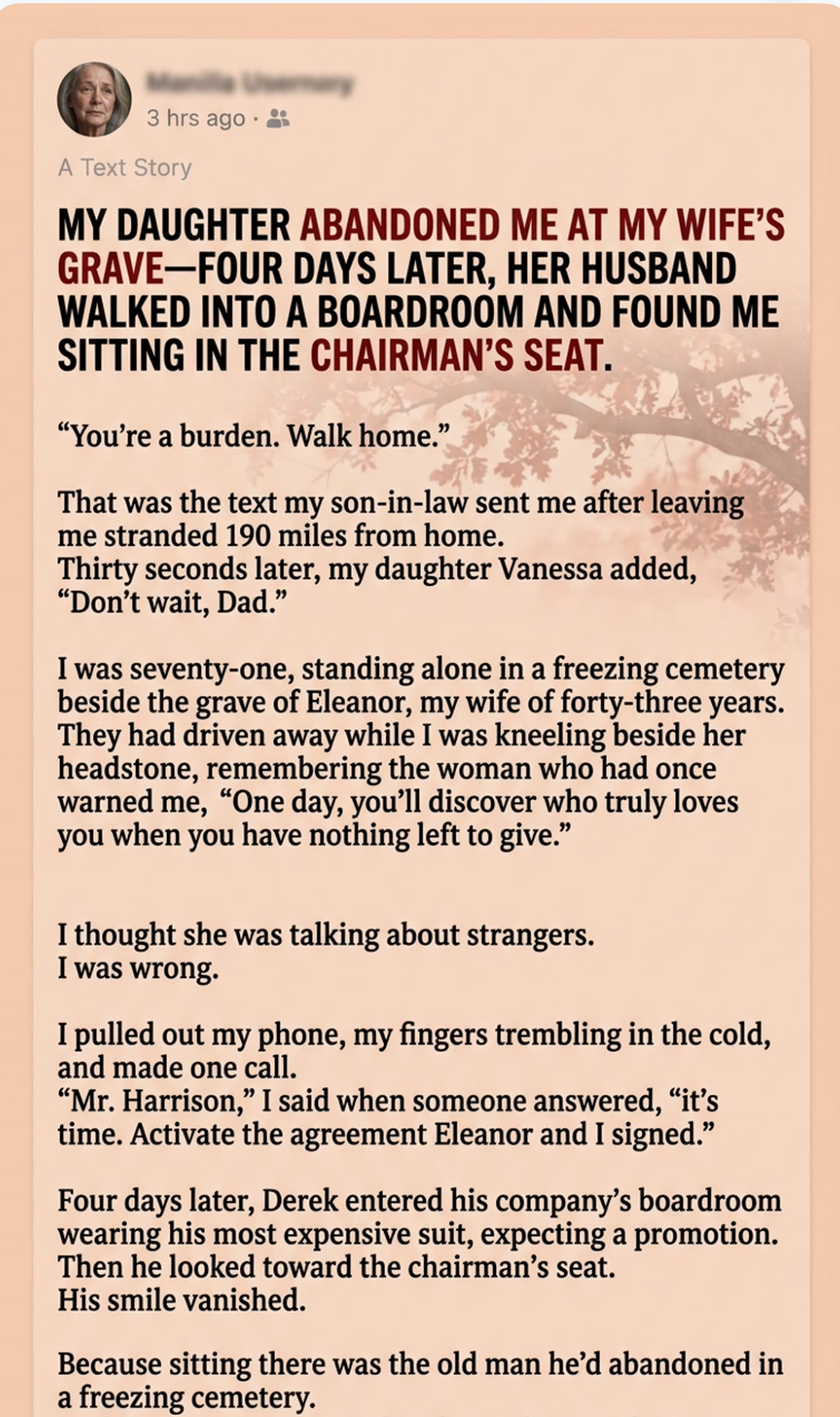
You’re a burden. Walk home.
I stared at the words, certain I had misunderstood.
Thirty seconds later, another message appeared.
This one was from my daughter.
Don’t wait, Dad.
I read it three times.
There was no explanation. No apology. No indication that either of them intended to return.
I stood beside Eleanor’s grave, holding a small bouquet of white roses, and felt a kind of loneliness I had never experienced before.
Forty-three years of marriage had taught me what it meant to have someone beside you through every hardship.
Eleven months of widowhood had taught me what it meant to wake up without that person.
But nothing had prepared me for discovering that my own daughter could leave me in a cemetery and drive away.
I looked down at Eleanor’s headstone.
Eleanor Margaret Whitmore. Beloved Wife, Mother, and Friend.
Her favorite words were engraved beneath her name.
Love is measured by what we do when no one is watching.
I had chosen those words myself.
Now they seemed almost painfully appropriate.
I lowered myself onto the stone bench beside her grave and took out my phone.
My fingers were trembling, but not entirely from the cold.
I found a number I had not called in nearly a year.
When the man answered, I said quietly, “Mr. Harrison, it’s time. Activate the agreement Eleanor and I signed.”
There was a long silence.
Then he asked, “Are you absolutely certain, Thomas?”
I looked toward the cemetery gates.
“Yes,” I said. “I’m certain.”
Four days later, Derek would walk into a boardroom expecting the greatest promotion of his career.
He had no idea I would be waiting for him.
And he certainly didn’t know what was inside the leather folder resting on the table in front of me.
But to understand what happened in that boardroom, you need to understand the life Eleanor and I had built—and why our own daughter believed I had nothing left.
The Man Everyone Underestimated
My name is Thomas Whitmore.
For most of my life, I was the sort of man people barely noticed.
I wore ordinary clothes, drove practical cars, and never enjoyed talking about money.
My father had been a machinist. My mother worked in a grocery store. Neither had much, but they taught me that a person’s character mattered more than the balance in a bank account.
When I was twenty-four, I started a small industrial supply business with a borrowed truck, a rented warehouse, and $6,000 in savings.
Eleanor was twenty-two.
We had been married for less than a year.
She worked as a bookkeeper during the day and helped me prepare invoices at night. When customers paid late, she found ways to stretch our grocery budget. When the truck broke down, she sat beside me while I repaired it.
For the first three years, we barely made enough to survive.
Then things slowly improved.
We won contracts with local manufacturers. We hired employees. We opened a second warehouse.
Over the following decades, our little business grew into Whitmore Industrial Holdings, a company supplying equipment, maintenance components, and logistics services to manufacturers across several states.
Eventually, we acquired smaller companies and expanded into commercial property and industrial distribution.
By my sixty-fifth birthday, the business employed hundreds of people.
But Eleanor and I never lived like the wealthy couple people expected us to be.
We stayed in the same comfortable house we had purchased when Vanessa was twelve.
We drove our cars until they needed replacing.
And we kept our financial affairs private.
Eleanor used to laugh when someone assumed we were ordinary retirees living on a modest pension.
“Let them think what they want,” she would say. “We know who we are.”
Our daughter Vanessa grew up with every opportunity we could reasonably provide.
She attended good schools, took music lessons, traveled with us during summer vacations, and graduated from college without student debt.
I loved her more than I knew how to express.
When she married Derek Collins, I hoped she had found the same kind of partnership Eleanor and I had enjoyed.
At first, Derek seemed charming.
He was ambitious, well-spoken, and always dressed as though he had somewhere important to be.
He worked in corporate finance and spoke constantly about promotions, acquisitions, and executive opportunities.
Eleanor noticed something about him before I did.
“He’s very interested in what people can do for him,” she said one evening.
I dismissed her concern.
“He’s young. He’s ambitious.”
“So were you,” she replied. “But you never measured someone’s worth by their usefulness.”
I wish I had listened more carefully.
The Changes After Eleanor Died
Eleanor became ill shortly after our forty-third wedding anniversary.
The diagnosis was serious, and despite treatment, her condition deteriorated.
During her final months, I stepped away from the daily operations of Whitmore Industrial Holdings.
The board appointed an experienced executive team to manage the business, while I retained my ownership interests and the right to nominate directors through a family holding trust.
Eleanor and I had already spent years planning for retirement and succession.
We wanted the company to survive without depending on us personally.
We also wanted to protect the employees who had helped build it.
But as Eleanor became weaker, she grew increasingly concerned about Vanessa and Derek.
They visited more frequently than they had in years.
At first, I was grateful.
Then I noticed that their visits often turned into conversations about our estate.
Derek asked about the company valuation.
Vanessa wanted to know whether our house had been placed in a trust.
They asked whether I had updated my will and whether Eleanor’s illness had changed our financial plans.
One evening, while Eleanor was resting upstairs, Derek approached me in the kitchen.
“Thomas, have you thought about simplifying things?” he asked.
“What things?”
“The company. Your investments. All the responsibilities you’re carrying.”
“I have people managing those.”
“Of course. But at your age, you shouldn’t have to worry about complicated financial decisions.”
I remember smiling politely.
“I’m still capable of reading a balance sheet, Derek.”
He laughed.
“That’s not what I meant.”
But I suspected it was exactly what he meant.
After Eleanor died, Vanessa’s behavior changed even more.
She began referring to me as fragile.
She told relatives I was struggling to manage ordinary tasks.
She insisted that I shouldn’t drive long distances or handle important paperwork alone.
Some of her concerns sounded reasonable. I was grieving, and I had become quieter.
But there was a difference between worrying about someone’s well-being and treating them as incapable.
One afternoon, Vanessa brought me a folder.
“I think you should sign these, Dad.”
Inside were documents prepared by an attorney I had never met.
They included a broad durable power of attorney naming Vanessa as my agent.
I read the papers carefully.
“Why would I sign this?” I asked.
“So I can help you manage things.”
“I already have estate documents and advisers.”
“Derek says those arrangements are outdated.”
I closed the folder.
“Then Derek can discuss his concerns with my attorney.”
Vanessa’s expression hardened.
“You don’t trust me?”
“Trust isn’t the issue. These documents would give you substantial authority over my affairs.”
She stood up.
“You always have to make everything difficult.”
That was the first time I saw genuine anger beneath her concern.
It would not be the last.
Eleanor’s Warning
Three weeks before Eleanor died, she asked me to bring a small wooden box from our bedroom closet.
Inside were family photographs, letters, and several documents.
At the bottom was a sealed envelope addressed to our attorney, Samuel Harrison.
Eleanor placed it in my hands.
“Promise me you’ll give this to Samuel when the time comes.”
“What is it?”
“Something we discussed years ago.”
I recognized the documents.
They related to our family trust and the voting rights attached to our ownership in Whitmore Industrial Holdings.
Eleanor and I had established a succession agreement that would preserve my authority to nominate a majority of the holding company’s directors while I remained capable and willing to serve.
The agreement also contained provisions governing how our family shares would eventually be transferred.
Vanessa would receive a substantial inheritance under our estate plan, but she would not automatically gain control of the company.
Any future transfer of voting control required a formal process and the approval of independent trustees.
Eleanor had insisted on those safeguards.
At the time, I thought she was being overly cautious.
Now I understood why.
She squeezed my hand.
“Thomas, I want Vanessa to be happy. But I don’t want her to think love means getting everything she asks for.”
“She would never hurt us.”
Eleanor looked at me with tired, gentle eyes.
“I hope you’re right.”
Then she said something I would remember for the rest of my life.
“One day, you may discover who truly loves you when you have nothing left to give.”
I thought she was talking about strangers.
I was wrong.
The Cemetery Trip
Eleven months after Eleanor’s death, I decided to visit her grave on what would have been our forty-fourth wedding anniversary.
She was buried in the town where we had married, near her parents and younger brother.
It was a long drive, but I wanted to bring her white roses.
Vanessa offered to take me.
I was surprised.
For weeks, she had barely spoken to me except to ask about financial matters.
“Are you sure?” I asked.
“Of course, Dad. Derek can drive us.”
I thanked her.
I even allowed myself to hope that the trip might help us reconnect.
The drive began pleasantly enough.
Vanessa asked about my health. Derek talked about work. We stopped for breakfast at a roadside restaurant.
But about halfway to the cemetery, Derek brought up Whitmore Industrial Holdings.
“I’ve been speaking with some people about a senior executive position,” he said.
“That’s good.”
“Actually, it’s with one of the companies in the Whitmore group.”
I looked at him through the rearview mirror.
“Which one?”
“Whitmore Distribution Services.”
I knew the subsidiary well.
It had recently begun restructuring its management team.
Derek continued.
“The board is considering me for a regional leadership role. Eventually, I could move into corporate management.”
“That sounds like an opportunity.”
“It would be, especially if the right people supported me.”
I said nothing.
Then Vanessa turned around in the passenger seat.
“Dad, you still have influence with the board, don’t you?”
“I have certain rights as a shareholder.”
“Then you could recommend Derek.”
“I wouldn’t recommend anyone for a position without reviewing their qualifications.”
Her face changed.
“Seriously?”
“Vanessa, I don’t interfere in hiring decisions to benefit relatives.”
Derek gripped the steering wheel.
“After everything I’ve done for this family, you’d rather let strangers decide?”
I looked at him.
“What exactly have you done for this family, Derek?”
The silence that followed was uncomfortable.
For the rest of the drive, neither of them spoke much.
When we reached the cemetery, I asked for a few minutes alone beside Eleanor’s grave.
Vanessa agreed.
I carried the roses down the gravel path and knelt beside the headstone.
I told Eleanor how much I missed her.
I told her the house was too quiet.
I told her I had finally repaired the old garden gate she used to complain about.
Then I heard a car engine.
I looked up.
The SUV was moving toward the cemetery exit.
At first, I assumed Derek was repositioning the vehicle.
Then it passed through the gates.
I stood, confused.
A few moments later, my phone vibrated.
You’re a burden. Walk home.
The message came from Derek.
Then Vanessa’s message arrived.
Don’t wait, Dad.
I called her.
She didn’t answer.
I called Derek.
He rejected the call.
I stood there, stunned.
They had left me nearly 190 miles from home because I had refused to influence a corporate appointment.
I was seventy-one years old, but I was not helpless.
I knew how to arrange transportation, and I had money available.
What hurt was not the practical inconvenience.
It was the deliberate cruelty.
They had chosen the one place where I was most vulnerable and used it to punish me.
That was when I called Samuel Harrison.
The Agreement
Samuel had been our family attorney for nearly twenty-five years.
He knew our estate plan, our corporate structure, and Eleanor’s concerns about succession.
When I told him what had happened, he was silent for several seconds.
“Are you somewhere safe?” he asked.
“I’m at the cemetery.”
“Can you get indoors?”
“Yes. There’s an office near the entrance.”
“I’ll arrange transportation. First, tell me exactly what happened.”
I explained the conversation in the car, the sudden departure, and the messages.
Samuel asked me to preserve the texts and send him screenshots.
Then he asked whether I was ready to exercise the rights reserved to me under the family trust.
For months, I had declined to become more involved in the company.
I had wanted to grieve privately.
I had also wanted to give Vanessa and Derek every opportunity to demonstrate that my suspicions were unfounded.
But the cemetery incident changed my understanding of their intentions.
They were not simply impatient.
They were willing to humiliate me when I refused to give them what they wanted.
“Yes,” I told Samuel. “I want to review everything. And I want the trustees and board to understand what’s happening.”
Samuel reminded me that exercising my rights would require proper notice, documentation, and compliance with the company’s governing agreements.
I understood.
I wasn’t asking him to bypass the rules.
I wanted to use them.
He arranged for a car service to take me to a nearby hotel, where I stayed overnight.
The next morning, I returned home.
Vanessa had left three messages.
The first said she was sorry things had become “emotional.”
The second claimed Derek had been under pressure at work.
The third asked whether I had reconsidered helping him with the promotion.
There was no question about whether I had made it home safely.
I did not reply.
Instead, I went to Samuel’s office.
What Derek Didn’t Know
Derek believed I had retired completely from Whitmore Industrial Holdings.
He knew I had founded the original company, but he assumed my ownership had been diluted or transferred when I stepped away from daily management.
Vanessa had apparently encouraged that assumption.
In reality, Eleanor and I had retained a controlling voting interest through the family trust.
The holding company owned a majority stake in Whitmore Distribution Services, the subsidiary where Derek hoped to become an executive.
Under the trust agreement, I had the right to direct the voting of those shares while I remained competent and actively involved.
The agreement also allowed me to nominate directors to the holding company’s board.
The chairman had recently announced his retirement.
The board had already discussed asking me to return in a nonexecutive leadership role, but I had declined.
After the cemetery incident, I reconsidered.
Samuel and the independent trustees reviewed the documents.
They confirmed that I could resume an active role in exercising the trust’s voting rights.
The existing directors then followed the company’s procedures to appoint me chairman at a properly convened meeting.
It was not an overnight takeover.
The legal authority had existed for years.
I was simply choosing to exercise it again.
Samuel also reviewed Derek’s employment situation.
Derek was not yet a senior executive.
He was a finance manager at Whitmore Distribution Services and had applied for a newly created vice president position.
His application was scheduled for final review at the next board meeting.
That meeting was four days after the cemetery trip.
I asked Samuel to arrange for me to attend as the newly appointed chairman.
“Thomas,” he said, “you need to be careful not to turn this into a personal vendetta.”
“I know.”
“Any employment decision involving Derek must be based on legitimate company considerations.”
“I understand.”
He studied me for a moment.
“Then what do you want?”
I thought about Eleanor.
I thought about the employees who had spent decades building the business.
And I thought about the man who had abandoned a seventy-one-year-old widower at a cemetery because he wouldn’t provide a favor.
“I want the board to know who they’re considering for a leadership position,” I said. “And I want the decision made properly.”
Samuel nodded.
“That we can do.”
Four Days Later
The boardroom was on the top floor of Whitmore Industrial Holdings’ headquarters.
I had not been there in almost a year.
When I entered, several longtime executives stood to greet me.
Some had worked with me for decades.
Others had joined after I stepped away.
I shook their hands and took my seat at the head of the table.
A brass nameplate had been placed in front of me.
Thomas Whitmore — Chairman
Samuel sat to my right.
The other directors took their places.
At ten o’clock, Derek was invited into the room to discuss his candidacy for the vice president position.
He entered wearing a dark blue suit and carrying a leather portfolio.
He was smiling.
Then he looked toward the chairman’s seat.
His smile disappeared.
For several seconds, he stood completely still.
“Thomas?”
I looked at him.
“Good morning, Derek.”
He glanced around the table.
“I didn’t realize you were attending.”
“I am.”
His eyes moved to the nameplate.
“Chairman?”
“Yes.”
He gave a short, nervous laugh.
“I must be missing something.”
Samuel spoke calmly.
“Mr. Whitmore was appointed chairman following the appropriate corporate procedures. The appointment was communicated to the board and relevant executives.”
Derek swallowed.
“I see.”
He looked at me again.
I could almost see him replaying the cemetery trip.
The text message.
The cold.
The empty road.
For the first time, he seemed to understand that the man he had dismissed as a burden still held considerable authority.
I opened the leather folder in front of me.
“Before we discuss your application, Derek, there are several matters the board needs to address.”
He sat down slowly.
The Documents on the Table
The first document was the family trust agreement.
It established the voting structure and confirmed the authority Eleanor and I had retained.
The second was the record of my appointment as chairman.
The third was a summary of Derek’s application for the executive position.
And the fourth was a written statement describing what had happened at the cemetery, supported by copies of the messages he and Vanessa had sent me.
Derek stared at the papers.
“What is this?” he asked.
“A matter relevant to the board’s consideration of your judgment,” I replied.
He looked around the room.
“That’s a private family disagreement.”
“Leaving an elderly relative stranded nearly 190 miles from home after he refuses to help your career is not simply a disagreement.”
His face reddened.
“You’re making it sound worse than it was.”
I slid the printed message across the table.
You’re a burden. Walk home.
Derek looked down.
No one spoke.
Then one of the independent directors, a woman named Patricia Cole, asked, “Mr. Collins, did you send this message?”
He hesitated.
“Yes, but—”
“And did you leave Mr. Whitmore at the cemetery without arranging transportation?”
Derek shifted in his chair.
“Vanessa and I were upset. We assumed he’d call someone.”
Patricia looked at him.
“You were aware he was nearly 190 miles from home?”
“Yes.”
“And you left anyway?”
Derek didn’t answer immediately.
Finally, he said, “It was a bad decision.”
I watched him carefully.
He wasn’t apologizing because he had suddenly understood the cruelty of what he’d done.
He was apologizing because he had discovered that the person he mistreated could affect his career.
That distinction mattered.
But I had promised Samuel I would not use the boardroom merely to settle a personal score.
So I let the other directors ask their questions.
They reviewed Derek’s professional record, his references, and the qualifications required for the new position.
There were already concerns about his management style.
Two employees had reported that he sometimes used intimidation when deadlines were missed.
His supervisor had described him as technically capable but difficult to work with.
Those concerns had been documented before I returned to the board.
The cemetery incident added another serious question about his judgment.
After Derek finished answering, Patricia thanked him and asked him to wait outside.
He looked at me.
“Thomas, can we talk privately?”
“Not during this meeting.”
“Please.”
I closed the folder.
“The board has a process to follow.”
He left the room.
For the first time since Eleanor died, I felt no urge to rescue him from the consequences of his own choices.
The Board’s Decision
The directors discussed Derek’s application without him present.
I disclosed my family relationship and the personal conflict, and I did not participate in the final vote on his promotion.
The independent directors unanimously decided not to appoint him to the vice president position.
They concluded that his professional record did not demonstrate the leadership qualities required for the role.
The cemetery incident was considered as part of the broader concerns about judgment and conduct, but it was not treated as an automatic reason for dismissal.
The board also referred the existing workplace complaints to the company’s human resources and compliance teams for an independent review.
Derek would remain employed while that review proceeded, subject to the company’s ordinary policies.
I was satisfied.
I hadn’t wanted him fired simply because he had hurt me.
I wanted him to understand that ambition did not excuse cruelty and that leadership required more than expensive suits and polished presentations.
When he was invited back into the room, Patricia informed him that he had not been selected.
Derek’s expression tightened.
“May I ask why?”
She explained the board’s concerns about his leadership record and judgment.
He listened without speaking.
Then he looked at me.
“You did this.”
I shook my head.
“You made your decisions, Derek. The board made its own.”
He stood.
“You’ve been waiting for a chance to humiliate me.”
“No,” I replied. “I spent years trying to believe you were a better man than you showed yourself to be.”
His jaw tightened.
I continued quietly.
“Four days ago, you left me at my wife’s grave because I wouldn’t help you get a promotion. You believed I had nothing you needed. Today, you discovered otherwise.”
He stared at me.
“I didn’t know you were chairman.”
“That,” I said, “is precisely the problem.”
He looked confused.
“You shouldn’t need to know someone’s title, wealth, or influence before deciding to treat them with basic decency.”
No one interrupted.
Derek gathered his portfolio and left.
The door closed behind him.
I sat silently for a moment.
Then I turned to the board.
“Now,” I said, “let’s get back to the business of running this company.”
Vanessa’s Phone Call
My daughter called me that afternoon.
I had expected it.
Her voice was sharp with anger.
“Dad, what did you do to Derek?”
“I attended a board meeting.”
“You ruined his career!”
“He was considered for a promotion. The board decided not to appoint him.”
“You could have helped him!”
“I could have recommended him if I believed he was qualified. I didn’t.”
She was silent for a moment.
Then she said, “You embarrassed him in front of everyone.”
I looked out my office window.
“Vanessa, four days ago, you left me at your mother’s grave.”
She sighed.
“Are you still upset about that?”
I closed my eyes.
“Still upset?”
“We were angry. We made a mistake.”
“You drove away while I was kneeling beside her headstone.”
“You had a phone.”
“You knew how far we were from home.”
“We knew you’d figure something out.”
I let the silence stretch.
Then I asked her a question.
“If I had no money, no company, and no influence, would you have come back for me?”
She didn’t answer.
“Vanessa?”
Finally, she said, “That’s not fair.”
I felt a deep sadness settle over me.
“Neither was leaving your father alone in the cold.”
Her voice changed.
“Dad, you’re taking this too far.”
“No. I’m finally taking it seriously.”
She began crying.
For a moment, I felt the old instinct to comfort her.
When she was little, I had carried her after she scraped her knees. I had sat beside her during fevers and helped her practice spelling words at the kitchen table.
But she was no longer a child.
She was a grown woman who had made a deliberate choice.
“I love you, Vanessa,” I said. “That hasn’t changed.”
“Then why are you doing this?”
“Because loving you doesn’t mean pretending you haven’t hurt me.”
I told her I needed distance.
I also told her that my estate plan would be reviewed with Samuel and the independent trustees, not because I wanted revenge, but because I needed to ensure that no one could pressure me into surrendering control of my finances or the company.
Vanessa became angry again.
“So you’re cutting me out of everything?”
“I haven’t made that decision.”
“Then what are you saying?”
“I’m saying you are not entitled to control my life because you expect to inherit something when I die.”
She hung up.
I sat with the phone in my hand for a long time.
Then I placed it on the desk and returned to work.
The Letter Eleanor Left Behind
Two weeks later, Samuel brought me another envelope.
It was the one Eleanor had given him before she died.
He explained that she had written a personal letter to be delivered if I ever decided to exercise the succession protections we had established together.
I opened it alone that evening.
Her handwriting was familiar, and seeing it made my chest ache.
My darling Thomas,
If you’re reading this, something has happened that made you question the people around you.
I hope I’m wrong about what I feared. I hope Vanessa has grown into a woman who understands that love is not something we exchange for favors.
But if she hasn’t, I want you to remember something.
You spent your life taking care of people. You gave our daughter every opportunity we could afford. You built a company that provided work for families we may never meet. You tried to be generous, even when generosity cost you something.
Please don’t confuse generosity with surrender.
You are allowed to protect yourself.
You are allowed to say no.
And you are allowed to expect kindness from the people who say they love you.
I don’t want you to become bitter. I don’t want you to spend your remaining years fighting over money or titles.
I want you to live.
Take the trip we always talked about. Sit in the garden. Read your books. Laugh with old friends.
And remember that you were a good husband long before you were a successful businessman.
All my love,
Eleanor.
I held the letter against my chest.
For the first time in months, I cried without trying to stop myself.
Eleanor had understood me better than anyone.
She knew that my greatest weakness wasn’t pride or greed.
It was my fear of disappointing the people I loved.
She had spent our marriage reminding me that kindness required judgment.
Now, even after her death, she was still teaching me.
The Months That Followed
Derek did not lose his job that day.
But the independent review of his workplace conduct eventually resulted in formal disciplinary action and a performance improvement plan.
Several months later, he resigned.
I had no involvement in his decision.
Vanessa blamed me for a long time.
She sent angry messages, then apologetic ones, then angry messages again.
At one point, she accused me of choosing the company over my family.
I told her the company had nothing to do with why I was hurt.
“What happened at the cemetery would have mattered even if I had been a retired janitor living on a small pension,” I said.
She didn’t respond.
For nearly three months, we barely spoke.
During that time, I made changes to my life.
I returned to the company as nonexecutive chairman, attending board meetings and helping with long-term planning without managing daily operations.
I also began doing things Eleanor had wanted us to do together.
I visited the coast for a weekend.
I reconnected with an old friend I hadn’t seen in years.
I joined a local volunteer group that helped older residents with transportation and home repairs.
I discovered that being useful didn’t have to mean being available to everyone at every moment.
Then, one Sunday afternoon, Vanessa appeared at my door.
She wasn’t wearing expensive clothes or carrying a designer handbag.
She looked tired.
“Can we talk?” she asked.
I let her inside.
We sat in the living room, where Eleanor’s photograph still stood on the mantel.
For several minutes, Vanessa stared at it.
Then she began to cry.
“I’ve been thinking about that day,” she said.
I waited.
“I told myself you were being stubborn. I told myself Derek was under pressure. I told myself we were teaching you a lesson.”
She wiped her face.
“But Mom would have been ashamed of me.”
I felt tears rise in my own eyes.
“Yes,” I said quietly. “I think she would have been very disappointed.”
Vanessa nodded.
“I know.”
She told me that Derek had become increasingly resentful after losing the promotion. He blamed me for his professional problems and insisted that I had deliberately ruined his future.
For a while, Vanessa had believed him.
Then she began looking at the situation differently.
She remembered the drive to the cemetery.
She remembered my asking for a few minutes alone with Eleanor.
And she remembered seeing Derek pull away while I was still kneeling beside the grave.
“I could have told him to stop,” she whispered. “I could have made him turn around.”
“Yes,” I said.
“But I didn’t.”
“No.”
She looked at me.
“I was angry because you wouldn’t give us what we wanted. And I let that anger matter more than whether you were safe.”
I appreciated that she wasn’t making excuses.
But an apology could not erase the memory of standing alone beside Eleanor’s grave.
“I don’t know how to fix this,” Vanessa said.
“Neither do I.”
She looked frightened.
“Does that mean you don’t want me in your life?”
I shook my head.
“It means we have to rebuild something we damaged. And rebuilding takes time.”
She nodded.
We talked for nearly two hours.
I didn’t promise to restore her place in my financial affairs.
I didn’t promise that everything would return to normal.
But when she left, I hugged her.
It was the first time in months that the embrace felt sincere.
One Year Later
A year after the cemetery incident, I returned to Eleanor’s grave.
This time, I drove myself.
The weather was warmer, and the trees along the cemetery road were beginning to turn green.
I carried white roses, just as I had the year before.
When I reached the headstone, I placed the flowers carefully beside it.
“Hello, Ellie,” I said.
I sat on the stone bench and told her about the past year.
I told her the company was doing well.
I told her I had finally taken the coastal trip we had planned.
I told her about the volunteer work and the people I had met.
And I told her that Vanessa and I were speaking again.
Our relationship was not what it had once been.
We met for lunch occasionally. We spoke on the phone. She had begun counseling and was working through the choices that had damaged our family.
I still maintained firm boundaries around money and business.
But I was beginning to see signs of genuine change.
Derek and Vanessa were living separately while they decided whether their marriage could continue.
I did not interfere.
That was their decision to make.
I looked at Eleanor’s photograph, which I had brought in my coat pocket.
“You were right about so many things,” I whispered.
The breeze moved through the trees.
For a while, I sat quietly, remembering our wedding day, our first apartment, the nights we worried about paying bills, and the years when our business finally began to succeed.
I remembered how she used to squeeze my hand beneath the dinner table when someone said something foolish.
I remembered her laughter.
Most of all, I remembered the way she had loved me when I was young, broke, uncertain, and afraid.
She hadn’t loved me because I owned a company.
She hadn’t loved me because I could provide expensive things.
She had loved the man I was.
And that was what I had nearly forgotten.
When I finally stood to leave, I touched the top of her headstone.
“I’m doing all right, Ellie,” I said. “I think you’d be proud.”
As I walked toward my car, my phone vibrated.
It was a message from Vanessa.
Dad, just checking that you got there safely. Call me when you’re ready. Love you.
I stopped and read it.
Then I looked back toward Eleanor’s grave.
A year earlier, my daughter had sent me two words that broke my heart.
Don’t wait.
Now she was asking me to let her know I was safe.
It was a small change.
But sometimes the smallest changes are the ones that matter most.
I replied:
I’m safe. I’ll call you when I get home. Love you too.
Then I put my phone away and continued walking.
I had spent most of my life believing that my greatest responsibility was to provide for my family.
Eleanor had taught me something deeper.
Providing for people is important.
But so is teaching them that love cannot be purchased, demanded, or inherited.
Four days after being abandoned at my wife’s grave, I sat in the chairman’s seat and watched a man discover that the elderly father-in-law he had dismissed still possessed considerable power.
For a moment, I thought that was my victory.
I was wrong.
My real victory came later, when I realized I no longer needed anyone to know how much money I had, what company I controlled, or what title I held in order to believe I deserved respect.
I was seventy-two years old when I finally understood the lesson Eleanor had been trying to teach me.
A person’s worth does not disappear when others stop finding them useful.
And sometimes, the most important inheritance we leave our children is not the fortune we have built.
It is the example we set when we finally learn to stand up for ourselves.