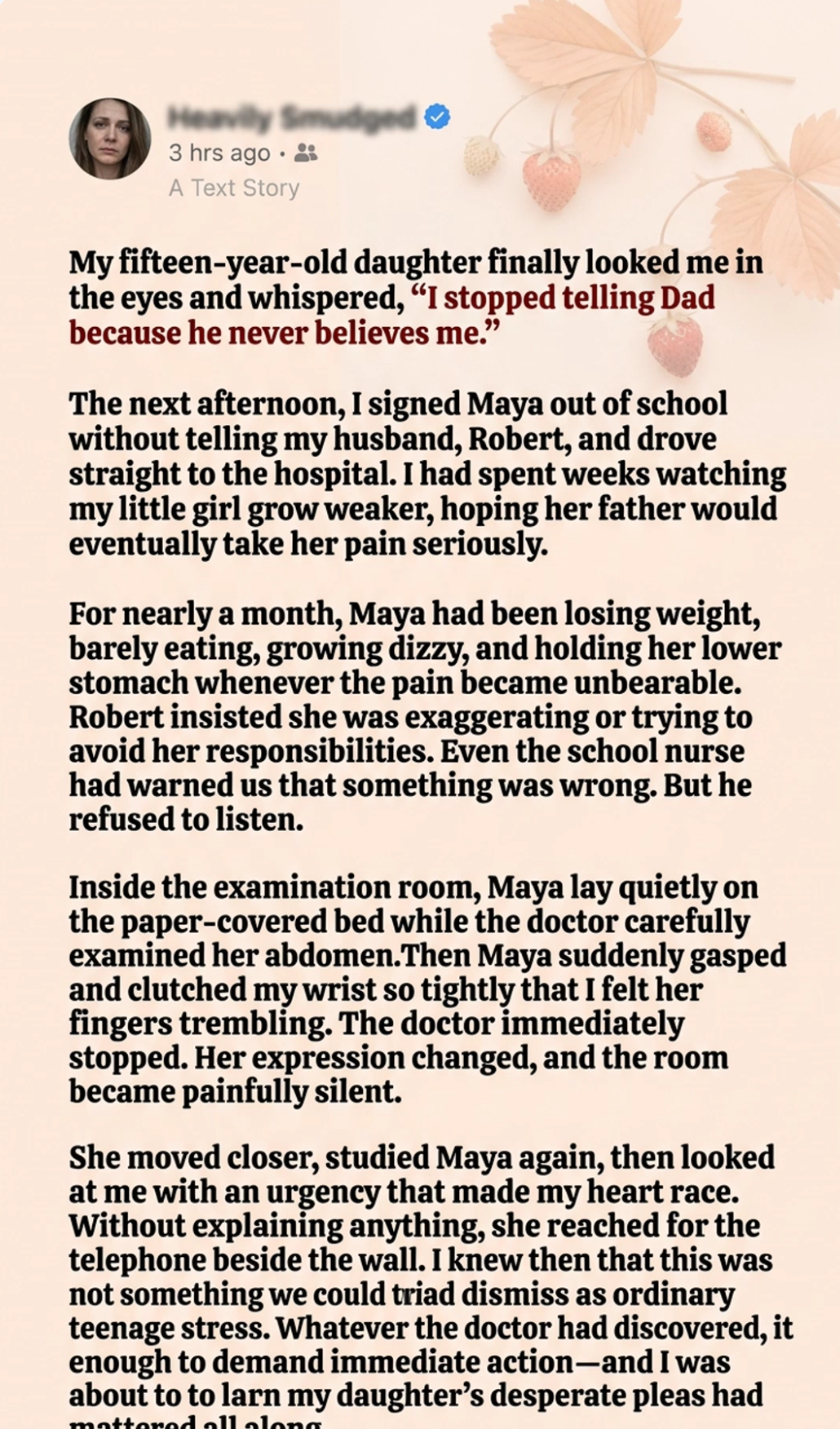
For nearly a month, I watched my daughter Maya slowly disappear before my eyes. At fifteen, she should have been worrying about school dances, friendships, and whether her favorite jeans still fit. Instead, she spent her mornings leaning against the bathroom sink, her afternoons curled beneath a blanket, and her evenings pushing food around her plate while trying not to cry. Every few days, she complained about the pain in her lower abdomen. Sometimes it was a dull ache. Other times, it struck so sharply that she had to stop walking and wait for it to pass. She was losing weight, growing pale, and becoming dizzy whenever she stood too quickly. I knew something was wrong. My husband, Robert, insisted I was overreacting. “She’s fifteen,” he told me one evening. “Teenagers exaggerate everything. She probably wants to get out of schoolwork.” When Maya asked to stay home because the pain had kept her awake all night, he accused her of being lazy. When the school nurse called to report that Maya had nearly fainted during class, Robert complained that the school was making a fuss over nothing. I argued with him, but every conversation ended the same way: he dismissed my concerns, and I went to bed wondering whether I was somehow failing to protect my child. Then, one Tuesday night, Maya sat beside me on the edge of my bed. Her face was pale, and her hands were trembling. “Mom,” she whispered, “I stopped telling Dad because he never believes me.” Something inside me broke. I pulled her close and promised that I would take her to a doctor the next morning, whether Robert agreed or not. The following afternoon, I signed her out of school and drove straight to the hospital. Maya sat in the passenger seat with one hand pressed against her stomach. Every few minutes, she closed her eyes and breathed through the pain. I kept glancing at her, fighting the terrible thought that we had already waited too long. At the hospital, a nurse took her temperature, checked her blood pressure, and asked a series of questions about her symptoms. When Maya admitted that she had experienced several episodes of severe pain and had begun feeling faint, the nurse’s expression became more serious. We were taken to an examination room, where a doctor named Dr. Patel listened carefully as I described the past month. She asked Maya to explain the pain in her own words, and my daughter answered quietly, almost apologetically, as though she expected to be told she was making a fuss. Dr. Patel examined her abdomen gently. At first, she asked Maya to point to the places that hurt most. Then she pressed lightly on the lower right side. Maya gasped and grabbed my wrist so tightly that her fingernails dug into my skin. “Please stop,” she whispered. Dr. Patel immediately withdrew her hand. Her expression changed. She asked Maya to remain still, then checked her vital signs again and pressed the call button. Within minutes, another nurse entered. Dr. Patel explained that Maya needed urgent assessment for a possible abdominal emergency. She ordered blood tests, urine testing, and an ultrasound, and told us that depending on the results, Maya might need immediate treatment. I felt the room tilt around me. “Is she going to be all right?” I asked. “We need to find out exactly what’s happening,” the doctor replied. “But you were right to bring her in today.” Those words brought tears to my eyes. I had spent weeks questioning myself because Robert had made me feel foolish for worrying. Now a medical professional was telling me that Maya’s symptoms deserved urgent attention. As the nurses prepared Maya for testing, I called Robert. He answered after several rings. “Where are you two?” he asked. “At the hospital. Maya needs urgent tests.” There was a pause. “You took her to the hospital without telling me?” “I told you she was getting worse.” “This is ridiculous. You can’t turn every stomachache into an emergency.” I looked through the open doorway at my daughter, who was lying motionless on the bed, her eyes fixed on the ceiling. “Robert, she nearly fainted at school. She can barely eat. The doctor is concerned.” He sighed impatiently. “Fine. I’ll come when I can.” He hung up before I could respond. I put my phone away and returned to Maya’s side. She looked at me with frightened eyes. “Is Dad angry?” she asked. “Your dad can be angry later,” I said, taking her hand. “Right now, we’re going to make sure you’re safe.” The ultrasound took place less than an hour later. I waited outside the imaging room, staring at the clock and praying for an explanation that would be serious enough to justify our concern but not so serious that it would change Maya’s life. When the technician finished, she did not offer a diagnosis. She simply said that the images needed to be reviewed by the doctor. Back in the examination area, Dr. Patel returned with a second physician. They spoke quietly, reviewed the findings, and then asked me to step closer while Maya rested. “The imaging shows a concerning abnormality in the lower abdomen,” Dr. Patel explained. “There appears to be a significant inflammatory process, and we need additional assessment to determine the cause. Given the location of her pain and the way she reacted during the examination, appendicitis is one possibility. We also need to consider a problem involving an ovary, such as ovarian torsion, which can threaten the blood supply to the ovary and requires urgent treatment.” I gripped the edge of the chair. I had never heard a doctor discuss my daughter’s body in such serious terms. “What happens now?” “We’re involving the pediatric surgical team immediately. They will review the imaging and decide whether she needs surgery. We won’t delay care while waiting for symptoms to become worse.” Maya heard enough to understand that something serious might be happening. “Mom,” she whispered, “am I going to die?” I sat beside her and brushed the hair away from her forehead. “We’re here, sweetheart. The doctors are taking care of you, and I’m staying with you.” I wanted to promise her that nothing terrible could happen, but I knew she needed my honesty more than an empty guarantee. A short time later, the pediatric surgeon arrived. After reviewing the scans and examining Maya, he explained that the findings were concerning for ovarian torsion. The ovary appeared to have twisted around the tissues supporting it, potentially restricting its blood supply. Her symptoms had developed over several weeks, and the team could not safely assume that the problem would resolve on its own. They recommended urgent surgery to inspect the affected area and, if possible, untwist the ovary and restore its blood flow. The surgeon carefully explained the risks, including the possibility that the tissue had been damaged. I listened to every word, asking questions whenever I could think of one. Maya was frightened, but she remained remarkably brave. She signed the consent forms with my help, then reached for my hand. “I knew something was wrong,” she said softly. “I wasn’t making it up.” I bent over her and kissed her forehead. “I know, sweetheart. I’m sorry you had to keep asking us to listen.” The surgical team took her away shortly afterward. I sat in the waiting room, watching the automatic doors close behind her, and felt the weight of every day we had spent arguing instead of seeking medical care. I wondered how many times Maya had endured pain alone because she had learned that telling us would only lead to another accusation. Robert finally arrived nearly an hour after the surgery had begun. He came through the hospital doors with his phone in his hand, looking annoyed rather than frightened. “Where is she?” he demanded. I stood up. “She’s in surgery.” His face changed. “Surgery? For what?” I told him what the doctors suspected and explained that they were trying to save the affected ovary. For the first time since Maya’s symptoms began, Robert had nothing to say. He sat down heavily and stared at the floor. “Why didn’t you tell me it was this serious?” he asked eventually. I felt anger rise so quickly that I had to pause before answering. “I did tell you. I told you she was losing weight. I told you she was dizzy. I told you the school nurse was worried. Maya told you she was in pain. You decided none of us knew what we were talking about.” He opened his mouth, then closed it again. We waited in silence. After what felt like an eternity, the surgeon emerged. He told us that the operation had gone as well as they could have hoped. The ovary had twisted, restricting its blood supply, but the surgical team had been able to untwist it and restore circulation. They had secured the tissue to reduce the risk of the same problem occurring again. The surgeon could not promise that there would be no long-term effects, but the ovary appeared viable, and they would monitor Maya closely as she recovered. I began crying before he finished speaking. Robert covered his face with both hands. “She’s going to be okay?” he asked. “She’s recovering, and the immediate problem has been treated,” the surgeon replied. “We’ll continue monitoring her and explain the follow-up plan before discharge.” When we were finally allowed to see Maya, she looked exhausted, with an IV line in her arm and a blanket tucked around her shoulders. But she was awake. Her eyes found mine, and she gave me a small, tired smile. I sat beside her and held her hand. Robert stood at the foot of the bed, unable to meet her eyes. After a while, he pulled a chair closer. “Maya,” he said, his voice breaking, “I’m sorry.” She looked at him without speaking. “I thought you were exaggerating. I thought you were trying to avoid school, and I didn’t understand how much pain you were in.” Maya swallowed. “I kept telling you.” Robert nodded, tears running down his cheeks. “I know.” “You said I was being dramatic.” “I was wrong.” She turned her face toward the window. “I stopped telling you because it hurt when you didn’t believe me.” No one in that room could pretend those words were anything less than the truth. Robert began crying openly. He apologized again, but Maya did not rush to comfort him. She was the child in the hospital bed. She was the one who had endured the pain and the fear. It was not her responsibility to make her father feel better about his mistakes. I stayed beside her while he sat quietly, finally listening without interrupting. Over the next few days, Maya gradually regained her strength. The medical team monitored her recovery, adjusted her pain relief, and explained the warning signs that would require immediate medical attention. Before she was discharged, we received instructions for follow-up appointments and discussed what to expect during her recovery. The doctors also explained that ovarian torsion can be difficult to recognize because its symptoms may overlap with other abdominal conditions, and that sudden or severe abdominal pain, particularly when accompanied by vomiting, dizziness, or worsening symptoms, should never be ignored. Maya would need time to heal, but she was home within days, sleeping in her own bed and slowly returning to her usual routines. Robert changed in some ways after that experience. He began asking Maya how she felt instead of immediately offering explanations for why she might be wrong. When she complained of pain or exhaustion, he listened and asked whether she wanted help. He attended her follow-up appointments and took notes while the doctor spoke. But I knew that a few apologies could not erase weeks of disbelief. Maya needed consistency, not a dramatic promise made beside a hospital bed. One evening, several weeks after we returned home, I found her sitting at the kitchen table with her homework spread in front of her. She looked healthier, though she still tired more easily than before. I sat beside her and asked how she was feeling. “Better,” she said. Then she hesitated. “Mom, if something like that happens again, will you believe me?” My throat tightened. “Every time,” I told her. “I might not always know what’s wrong, and I might need to ask questions or take you to someone who can help. But you will never have to prove that your pain is real before I take it seriously.” She leaned against my shoulder, and I wrapped my arm around her. Later, Robert joined us. He did not try to defend himself or explain why he had misunderstood the situation. Instead, he asked Maya whether she wanted to talk about how things had felt for her. She told him that she had been frightened, not only by the pain but by the thought that nobody would believe her if it became worse. He listened until she finished. Their relationship did not repair itself overnight. There were still difficult conversations, and Maya sometimes hesitated before telling him when something bothered her. Robert had to learn that trust was rebuilt through repeated actions, not demanded because he was her father. He also had to accept that being a parent meant taking a child’s distress seriously even when the cause was not immediately obvious. As for me, I learned a lesson I will carry for the rest of my life: a child should never have to become sicker to earn the right to be heard. Maya’s symptoms were real long before the ultrasound revealed the danger. The school nurse had noticed. My daughter had tried to explain. I had raised my concerns. The warning signs had been there, even when the diagnosis was not clear. I was grateful that we reached the hospital when we did, and I will always be thankful to the medical team who treated her. But I still think about the words Maya whispered to me that night: I stopped telling Dad because he never believes me. No child should learn to suffer in silence because speaking up feels pointless. Maya survived a frightening medical emergency, and our family had a chance to change. Her father learned that love without listening can leave a child feeling utterly alone. I learned that protecting my daughter sometimes meant acting even when my husband disagreed. And Maya learned something she should have known all along: she deserved to be believed when she said she was hurting. Her voice mattered before the doctors confirmed it, before the tests revealed anything, and before anyone knew how serious the situation had become. It mattered from the very beginning.
My Husband Thought Our Daughter Was Pretending to Be Sick—Then the Hospital Called in a Surgical Team, and He Finally Realized His Mistake