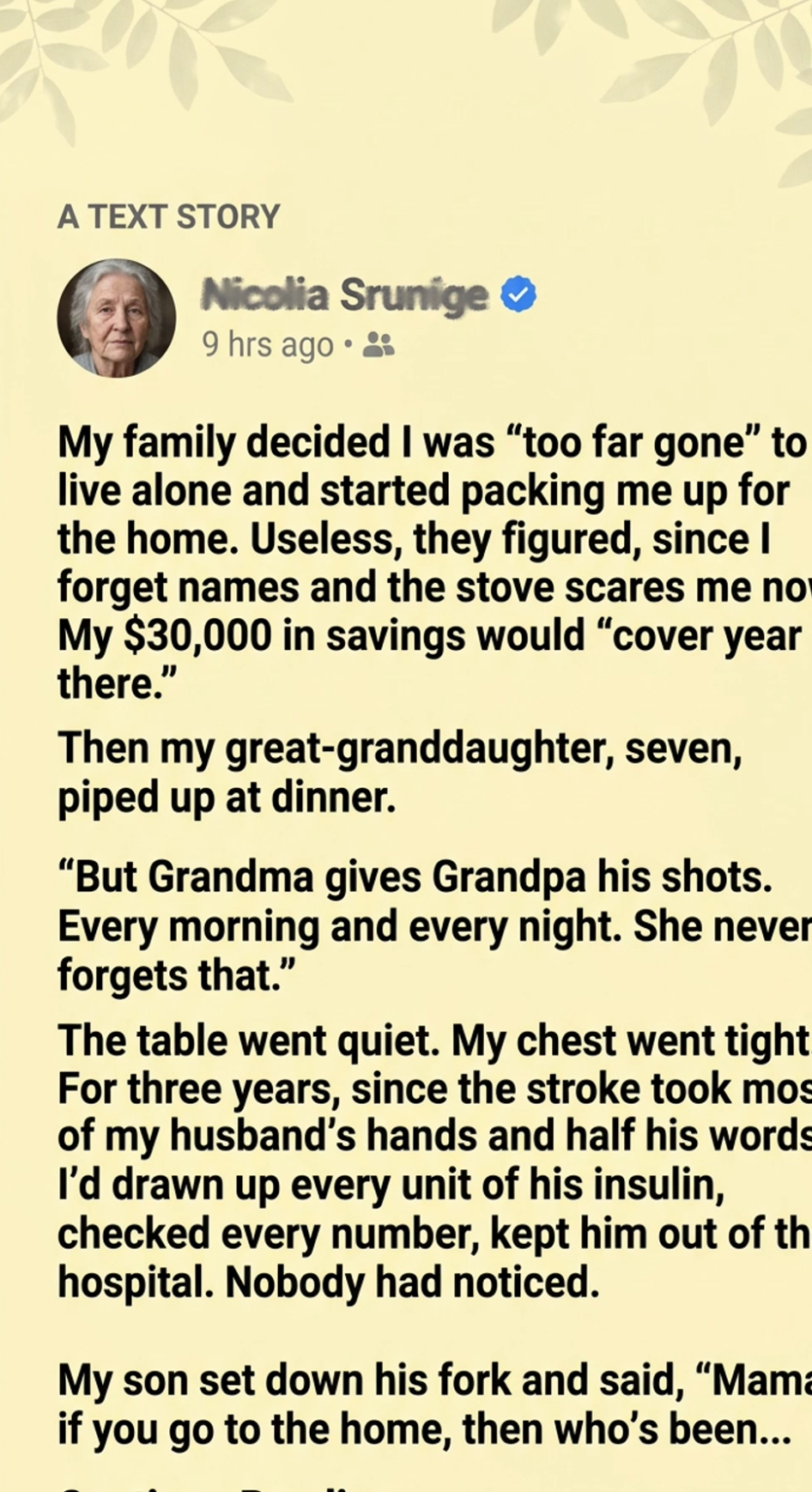
The first time my son called me too far gone, I was standing in my own kitchen, holding a cup of tea I could no longer remember making.
“Mom, you can’t keep living like this,” Robert said. “You forget people’s names. You leave things in strange places. Last week, you called me three times because you couldn’t remember whether we’d spoken that morning.”
I looked at him across the kitchen island. At sixty-nine, I had learned that there were few things more humiliating than watching your own children discuss your future as though you were no longer in the room.
“I remembered you eventually,” I said.
“That isn’t the point.”
He had brought his sister, Linda, with him. She stood near the refrigerator with a folder of brochures tucked beneath her arm. One showed a smiling elderly couple sitting in a sunlit garden. Another advertised a residential care facility with polished floors, cheerful staff, and a dining room that looked more like a hotel restaurant than a place where people went when their families no longer knew what to do with them.
Linda placed the brochures on the counter.
“We’ve been researching places,” she said gently. “There are lovely homes nearby. You’d have meals prepared, people to talk to, and someone to help if you fell.”
I glanced toward the living room, where my husband, George, sat in his wheelchair watching the afternoon news. His right hand rested awkwardly on his lap. His left fingers moved slightly when he tried to reach for the blanket across his knees.
Three years earlier, a stroke had taken much of the strength from his hands and left him struggling to find words. Some days, he could tell me what he wanted. Other days, I had to watch his face and guess.
Since then, I had organized our lives around his needs.
I knew which medicines he took in the morning and which he needed at night. I knew the difference between his ordinary tiredness and the particular stillness that meant his blood sugar might be dropping. I knew how to help him dress without hurting his shoulder, how to support him during transfers, and how to recognize when he was frustrated because he could not make his mouth form the words he wanted.
My children saw the wheelchair, the slurred speech, and the appointments.
They saw me growing older beside him.
What they did not see was the life we had built around those things.
“Where would George go?” I asked.
Linda looked at Robert before answering.
“We’d arrange appropriate care for him, too, if necessary.”
“Appropriate care?”
“You know what I mean, Mom.”
I did know.
They wanted to separate us, place us somewhere safe, and convince themselves that they had solved a problem.
Robert pulled out a chair.
“We have to talk about your savings, too. You have about thirty thousand dollars, right? That should cover a good portion of the first year, depending on the place.”
I stared at him.
“My savings?”
“Your money would help pay for the care you need.”
“And George?”
“We’d work that out.”
I looked down at my hands. They were trembling slightly, and I could not tell whether it was anger, exhaustion, or the embarrassment of having to defend a life I had lived for nearly seventy years.
“I am not moving into a home,” I said.
Robert sighed.
“Mom, this is exactly what we mean. You aren’t being realistic.”
He said it as though my refusal proved his argument.
I wanted to tell him that I had spent three years keeping his father alive and comfortable at home, that I had learned things I never imagined I would need to know, and that I was still the woman who had raised him after his own father worked double shifts at the factory.
Instead, I turned toward the living room.
George was looking at me.
His eyes were clear, even when his words were not.
I could tell he understood enough to know that we were discussing something important.
I crossed the room and adjusted the blanket over his knees.
“Would you like some tea, darling?”
He nodded.
I carried his cup to the table, helped him position his hands, and waited until he had taken a few careful sips.
When I returned to the kitchen, Linda was already making notes on one of the brochures.
That was when I understood that they had not come to ask what I wanted.
They had come to tell me what they had decided.
My name is Eleanor Bennett, and for most of my life, I was the person everyone called when something needed fixing.
When my children were small, I could stretch a grocery budget until payday, sew a torn school uniform while dinner cooked, and remember every appointment without writing anything down. I worked for years as a bookkeeper at a local building supply company, where mistakes could cost real money and accuracy mattered.
I was never perfect, but I was organized.
I kept household accounts in neat ledgers and saved receipts in labeled envelopes. I could tell you how much we had paid for our first washing machine and the month we finally finished paying off our mortgage.
After retirement, I enjoyed a quieter life. George and I tended our garden, visited our grandchildren, and took short trips whenever his health allowed.
Then came the stroke.
It happened on an ordinary Tuesday morning.
George had been reading the newspaper at the kitchen table when his cup slipped from his hand. He tried to speak, but the words came out wrong. When I saw the confusion in his eyes and the way one side of his face had fallen, I called emergency services.
At the hospital, the doctors explained that the stroke had damaged parts of his brain responsible for movement and language. He survived, but his recovery would be long, and some limitations might remain.
I remember holding his hand beside the hospital bed and promising him that we would figure things out together.
I had no idea how many things I would need to learn.
When he came home, I attended therapy sessions and listened carefully to the nurses. I learned how to help him move safely, how to prepare food that he could manage comfortably, and how to organize his medications so that we did not miss doses.
At first, our children helped.
Linda brought meals. Robert installed grab bars in the bathroom. They visited on weekends and offered suggestions.
But as months became years, their visits grew less frequent.
They had jobs, children, mortgages, and lives of their own. I understood that. I never expected them to abandon their responsibilities to become full-time caregivers.
Still, I sometimes wished they would ask more questions.
Instead, they usually asked whether George was eating, whether he had attended therapy, and whether I was tired.
I always said we were managing.
And most days, we were.
The difficulty began when I started forgetting small things.
I misplaced my reading glasses. I walked into a room and occasionally forgot why I had entered. I called my granddaughter by her mother’s name, then laughed at myself when I caught the mistake.
At first, I blamed exhaustion.
Caring for George required constant attention. Some nights, I woke several times to check that he was comfortable. Other nights, I lay awake worrying about his health, our finances, and the possibility that I might become ill before he did.
Eventually, I visited my doctor.
She listened to my concerns and arranged an assessment. We discussed my sleep, stress, medications, and other possible explanations for the lapses in memory. She explained that occasional forgetfulness could have several causes and that it would be premature to assume I had a progressive memory disorder without further evaluation.
I left with a plan for follow-up appointments and some practical recommendations.
I also bought a large wall calendar and began using a notebook to keep track of tasks.
I was learning to work around my limitations rather than pretend they did not exist.
Unfortunately, my children saw the notebook and decided it was evidence that I could no longer manage my life.
Robert noticed when I repeated a question. Linda became concerned when I once forgot the name of a neighbor I had known for years.
Neither asked what I could still do.
They focused on what I sometimes forgot.
And because I was ashamed of those moments, I did not tell them how frightened I occasionally felt.
I did not want to become another problem they had to solve.
So I kept most of my worries to myself.
I kept caring for George.
The insulin injections had become part of our daily routine during the second year after his stroke.
George had developed diabetes years earlier, and his treatment required careful monitoring. After the stroke, his mobility and communication difficulties made it harder for him to manage everything independently.
His diabetes care team reviewed his medication plan and showed us how to administer his prescribed insulin safely. They explained the importance of following his individual dosing instructions, checking his glucose as directed, and recognizing the signs of low blood sugar.
I wrote everything down.
Morning routine. Evening routine. Glucose readings. Medication times. Questions for the next appointment.
I kept the supplies in a designated place and used a written checklist so that tiredness would not lead to mistakes.
At first, George was embarrassed to need my help.
“I used to do everything myself,” he said one afternoon, struggling to fasten the cuff of his shirt.
“You still do plenty,” I told him.
He gave me a look that suggested he did not believe me.
I sat beside him and buttoned the cuff.
“You married me because I was beautiful,” I said. “You stayed because I could organize your life.”
He laughed.
It was a small, breathy laugh, but it made the whole room feel warmer.
From then on, we treated his care as something we managed together. I prepared what he needed, and he participated as much as he could. We checked the written instructions rather than relying on memory alone.
Some mornings were harder than others. There were days when his hand trembled, when he grew frustrated with his speech, or when I was so tired that I needed to sit down before beginning the routine.
But I kept showing up.
Every morning.
Every evening.
I recorded the readings, followed his prescribed plan, and contacted his medical team whenever something concerned me.
Over time, his care became so routine that I stopped thinking of it as something extraordinary.
It was simply what I did for my husband.
I never imagined that one day it would become the thing that forced our children to see me differently.
The family dinner took place on a Sunday evening in early spring.
Linda had organized it at her house, saying she wanted everyone together before the children became too busy with school activities. Robert brought his wife, Susan, and their two children. My granddaughter, Emily, arrived with her husband and their seven-year-old daughter, Sophie.
George and I were driven over by Robert.
I had not wanted to go. I was tired, and the thought of sitting at a crowded table while everyone watched to see whether I remembered names made me anxious.
But George wanted to see the family.
He had spent the afternoon choosing a clean shirt, and he smiled when I told him he looked handsome.
So I went.
The table was full of food, and the conversation moved quickly from school reports to house repairs, vacations, and a cousin’s upcoming wedding.
I listened more than I spoke.
When I forgot the name of Susan’s new colleague, Linda exchanged a glance with Robert.
When I asked Emily whether she was still working at the clinic, she gently reminded me that she had changed jobs six months earlier.
I felt my face grow hot.
I tried to focus on my plate.
Then Robert cleared his throat.
“We’ve been talking about Mom’s situation,” he said.
The conversation slowed.
I looked up.
He explained that they had researched residential care options and believed it was time for me to move somewhere with professional support. They were concerned about my memory, the stove, and the demands of caring for George.
“We don’t want Mom getting hurt,” he said. “And we need to be realistic about what she can handle.”
Linda nodded.
“We’ve found a place that seems very nice. It has gardens, activities, and medical staff. Mom could use her savings to cover the first year, and then we could review the situation.”
My stomach tightened.
I looked around the table.
No one seemed surprised. They had discussed my future without me and arrived at a decision.
“I can still cook,” I said quietly.
“Mom, last month you left a pan on the stove,” Robert replied.
“I turned it off.”
“After Linda called you.”
I lowered my eyes.
He was not entirely wrong. I had forgotten a pan once, and Linda had reminded me to turn off the burner. It had frightened me enough that I had since begun using a timer and avoiding the stove when I felt tired.
But one mistake had become, in my children’s minds, proof that I could no longer be trusted.
Then Robert mentioned the money.
“We have to think about the practical side. Mom has around thirty thousand dollars in savings. That would cover much of the first year, depending on the facility.”
I stared at him.
He was discussing my savings as though the money had already been assigned to someone else.
“And George?” I asked.
“We’ll work out his care separately.”
“Separately?”
Linda reached for her water glass.
“Mom, Dad may need a different level of support. We have to consider what’s best for both of you.”
I looked at George.
He was staring at his plate, his jaw tight. His right hand moved slightly, as though he wanted to reach for mine but could not coordinate the movement.
I felt a terrible pressure behind my ribs.
For three years, I had helped him through every day. I had adjusted our home, learned his routines, organized his medication, and done everything I could to keep us together.
Now my children were discussing separating us as though we were pieces of furniture that could be rearranged for convenience.
I opened my mouth, but no words came.
Then Sophie, my seven-year-old great-granddaughter, looked up from her mashed potatoes.
“But Grandma gives Grandpa his shots.”
Everyone stopped talking.
Sophie looked around the table, confused by the silence.
“Every morning and every night,” she continued. “She checks the little number first, and then she gets everything ready. She never forgets that.”
I felt my chest tighten.
Sophie had spent several afternoons at our house while her mother worked. She had watched me follow George’s diabetes routine, though I had never thought she was paying much attention.
She pointed toward me with her fork.
“When Grandpa feels funny, Grandma knows what to do. She calls the nurse if she isn’t sure. She writes everything in her book.”
Robert set down his fork.
Linda’s expression changed.
Sophie continued, oblivious to the storm she had just interrupted.
“Last time, Grandpa said he was scared, and Grandma told him they would do it together. She always remembers because she loves him.”
The room went completely silent.
I looked at my son.
His face had lost its color.
For the first time that evening, he was not looking at my forgotten names or the incident with the stove.
He was looking at me as though he had just realized there was an entire part of my life he had never bothered to understand.
Then he asked the question that changed everything.
“Mama,” he said slowly, “if you go to the home, then who’s been taking care of Dad’s insulin every morning and every night?”
I could not answer immediately.
My eyes filled with tears.
“Me,” I whispered.
Robert leaned back as though the words had physically struck him.
Linda covered her mouth.
George turned his head toward me. His eyes were wet, and his left hand moved across the table until his fingers touched mine.
Sophie looked puzzled.
“Who did you think was doing it?” she asked.
No one answered her.
For the first time in years, my children had no ready explanation.
After dinner, Robert insisted on driving us home.
He was unusually quiet during the journey. At a traffic light, he glanced at me and then looked away.
“Mama, I didn’t know you were doing all that.”
I looked out the window.
“You never asked.”
He tightened his grip on the steering wheel.
“I thought the nurse handled his medication.”
“The nurse visits when she is scheduled. She helps review his care, but she doesn’t live here.”
“I thought Linda was checking on you.”
“Linda calls. Sometimes she visits. But she doesn’t see our whole day.”
He nodded, looking ashamed.
“I should have known.”
“Yes,” I said. “You should have.”
He did not defend himself.
When we reached our house, he helped George out of the car and wheeled him into the living room. I made tea, placed the cups on the table, and settled beside my husband.
Robert stood near the doorway.
“I’d like to come tomorrow,” he said. “Could you show me how you do everything?”
I studied him.
“Why?”
“So I can understand. So I can help properly.”
I wanted to believe him, but I had heard promises before.
“You can come,” I said. “But you need to understand something first. I am not a child who needs you to take over every decision. If you want to help, you need to listen to me.”
He nodded.
“I understand.”
After he left, I sat beside George for a long time.
He could not tell me everything he was feeling. The stroke had made some words difficult to retrieve, and frustration often caused him to stop speaking altogether.
But he reached for my hand.
I leaned toward him.
“I’m all right,” I whispered.
He squeezed my fingers as tightly as he could.
That night, I cried in the bathroom with the door closed so he would not hear me.
I cried because my children had frightened me. I cried because I was exhausted. I cried because I had spent so long trying to prove that I was still capable that I had forgotten I deserved help without being stripped of my independence.
And I cried because a seven-year-old child had noticed something that the adults in my family had overlooked.
I was not simply a woman who forgot names.
I was a wife who had spent three years caring for the person she loved.
Robert arrived the next morning at eight-thirty.
He brought a notebook, a pen, and a bag of groceries.
I was surprised to see that he had not brought another brochure.
“Where do we start?” he asked.
I showed him the calendar on the kitchen wall, the written medication schedule, and the folder where I kept George’s medical information. I explained how I organized the supplies, recorded his glucose readings, and followed the instructions provided by his diabetes team.
I did not ask Robert to administer anything himself. He was there to learn what our routine involved, not to take over a medical task he had never been trained to perform.
I showed him the written records and explained the warning signs that prompted me to contact the medical team. I also showed him the emergency information posted beside the telephone.
He listened carefully.
At one point, he looked at the notebook where I had recorded George’s readings.
“You’ve written down everything.”
“Not everything,” I said. “But the important things.”
He turned several pages.
“Every day?”
“Every day.”
He looked up at me.
“And you remember all this?”
I understood what he meant.
“I remember the routine. When I’m tired, I use the notebook. When I forget a name, I look it up. When I am unsure about a medical question, I call the people who know more than I do.”
I paused.
“Being careful is not the same as being incapable, Robert.”
He lowered his eyes.
“I know.”
“No,” I said gently. “I don’t think you did.”
We spent the next two hours reviewing the routine. Then I showed him the grab bars in the bathroom, the transfer equipment recommended by George’s therapist, and the way we had rearranged the furniture to make movement safer.
Robert was quiet throughout.
Before leaving, he stood in the kitchen and looked around.
“I thought you were barely managing.”
“I am managing,” I said. “But I am tired, and I need help sometimes. Those things can both be true.”
He nodded.
“Then we need to find out what help would actually make things easier.”
That was the first sensible thing anyone in my family had said about the situation.
The next few weeks changed our family, though not all at once.
Robert arranged a meeting with George’s care team so he could understand his father’s needs directly. Linda attended as well. They learned about the routines, the equipment, the medication schedule, and the importance of having a clear plan for emergencies.
They also learned that caring for someone after a stroke was not simply a matter of being patient.
It required practical knowledge, regular review, and attention to the caregiver’s health as well as the patient’s.
George’s nurse encouraged us to discuss respite care and additional support. She explained that accepting help did not mean we had failed, and that a care plan should protect both of us.
I agreed.
For the first time, I felt able to say that I was tired without worrying that my words would be used as evidence that I needed to be removed from my own home.
We arranged for a trained caregiver to visit several times a week. The visits gave me time to rest, attend my own appointments, and shop without worrying about leaving George alone.
We also made practical changes around the house. I installed a timer on the stove, placed reminders in useful locations, and continued using my calendar and notebook.
My doctor followed up on the memory concerns. We reviewed my sleep and stress, and she arranged further assessment rather than assuming the forgetfulness was simply a normal part of aging. The results did not provide an instant answer to every question, but they gave us a clearer plan for monitoring my health and addressing the things that could be improved.
I learned to ask for help earlier.
My children learned to offer it without making every conversation about moving me into a facility.
Most importantly, we agreed that decisions about my living arrangements would not be made without my participation.
The brochures disappeared from the kitchen counter.
The house remained ours.
One Saturday afternoon, about a month after the dinner, Robert came over with a small wooden box.
“I found this while cleaning out Dad’s old desk,” he said.
Inside was a photograph of George and me on our wedding day.
I was twenty-four, wearing a simple white dress, and George had his arm around my waist. We were standing outside a church, laughing at something someone had said just before the picture was taken.
Robert picked it up.
“I remember this day.”
“You were five,” I said. “You refused to let anyone else hold the ring pillow.”
He smiled.
“I thought I was helping.”
“You were very serious about it.”
He laughed, then became quiet.
“Mama, I’ve been thinking about what happened at dinner.”
I waited.
“I was so focused on the things you were forgetting that I didn’t think about everything you were still doing. I saw your mistakes and assumed they told the whole story.”
He looked at the photograph.
“I treated you like a problem we needed to solve instead of asking what you needed.”
I felt my throat tighten.
“Yes,” I said. “You did.”
He nodded, accepting the words without defending himself.
“I’m sorry.”
I looked at my son, remembering the little boy who used to run into my room after nightmares and ask me to leave the hallway light on.
I had loved him through scraped knees, teenage arguments, broken friendships, and the uncertainty of his early adulthood.
Now he was an adult trying to understand that his mother was still a person with a life and a voice of her own.
“I forgive you for making a mistake,” I said. “But I need you to remember what you learned. Don’t decide what someone can or cannot do based on the first thing you notice about them.”
He nodded.
“I will.”
Then he asked whether he could help us with the garden.
We spent the afternoon planting herbs beside the back steps.
It was not a grand reconciliation. There were no speeches or dramatic embraces. We worked slowly, talked about ordinary things, and shared a pot of tea when we finished.
For me, that was enough.
Linda’s apology came later.
She called one evening while I was sorting laundry.
“I’ve been thinking about Sophie,” she said.
“So have I.”
“She noticed what we didn’t.”
I sat on the edge of the bed.
“She noticed what was in front of her.”
Linda was quiet.
“I was so frightened that something would happen to you. I imagined you falling or leaving the stove on. I thought the safest thing was to move you somewhere people could watch you.”
“I understand that you were worried.”
“But I never asked what you were actually doing each day. I didn’t ask how you managed Dad’s care. I just assumed that because you forgot things, you couldn’t be trusted to make decisions.”
I listened.
“I was wrong,” she whispered.
“Yes,” I said. “You were.”
She began to cry.
I let her cry without rushing to comfort her.
For years, I had been the person who made everyone else feel better. I was always smoothing over arguments, reassuring worried relatives, and telling people that everything would be fine.
That evening, I allowed Linda to sit with the discomfort of what she had done.
Eventually, she asked what she could do to make things right.
“Visit us,” I said. “Not just when there’s a problem. Come and have tea. Ask me how I am. Ask George what he wants. And if you are worried, talk to us before deciding what our lives should look like.”
“I can do that.”
“Good.”
We ended the call gently.
I did not expect everything to change overnight, but I felt a little less alone.
The most surprising change came from Sophie.
She began visiting us every other weekend with her mother. She liked helping me water the plants and arranging the books on the lower shelves. Sometimes she sat beside George and read aloud from a picture book while he listened.
One afternoon, she asked me why the family had wanted to send me away.
I considered how to answer a seven-year-old.
“Sometimes grown-ups get frightened when they see someone they love having difficulties,” I said. “They think they need to make a decision quickly, and they forget to ask questions.”
“Were you frightened?”
“Yes,” I admitted.
“Because you might forget Grandpa’s medicine?”
“No, sweetheart. I was frightened that people would stop listening to me because I sometimes forget other things.”
She thought about that.
Then she took my hand.
“I listen to you.”
I kissed her forehead.
“I know you do.”
She looked pleased with herself and returned to her drawing.
I watched her for a moment, feeling a warmth that had nothing to do with being praised.
Sophie had not understood the medical details. She had not studied my records or examined my capabilities. She had simply noticed a repeated act of love and spoken about it honestly.
Her words had not proved that I could do everything safely or that I would never need more support. They had revealed that my family had been looking at only one part of me.
That distinction mattered.
I could have memory problems and still be capable of meaningful decisions. I could need help with the stove and still manage other parts of my life. I could grow older, become more forgetful, and still be the person who knew George better than anyone else.
My worth had never depended on doing everything perfectly.
George’s health remained complicated.
Some days were good. Other days, his speech was more difficult, or he needed extra help moving around the house. We continued working with his care team, following the prescribed medication plan, and adjusting our routines as needed.
There were setbacks, but we no longer faced them alone.
Robert learned to recognize when his father was frustrated and how to give him time to respond. Linda became more involved in arranging appointments and organizing meals. They did not become full-time caregivers, and I did not expect them to.
Instead, we developed a practical schedule that gave everyone a role.
The professional caregiver continued visiting several times a week. I attended my own medical appointments and accepted respite when I needed it. We also discussed what would happen if either George or I required more support in the future.
Those conversations were not easy, but they were different from the one that had started everything.
Nobody arrived with brochures and announced a decision.
We talked. We listened. We considered options together.
My thirty thousand dollars remained in my savings account, where it could serve the purposes I chose rather than being treated as money already assigned to a residential facility.
I also met with a financial adviser to review our longer-term plans. We discussed potential care costs, our income, and how to protect enough savings for emergencies.
I felt calmer knowing that we were planning for the future instead of treating the future as a reason to take control away from me.
One evening, Robert sat beside me after helping his father settle into bed.
“I’m glad we didn’t rush into anything,” he said.
“So am I.”
He looked toward the bedroom door.
“I didn’t realize how much Dad depended on you.”
I smiled sadly.
“He depends on many people now. That’s all right. No one should have to do everything alone.”
Robert nodded.
Then he said something I will never forget.
“I think I was so afraid of losing the mother I remembered that I forgot to meet the mother sitting right in front of me.”
I reached over and squeezed his hand.
“That happens more often than you think.”
A year after that dinner, we celebrated Sophie’s eighth birthday in our garden.
The children ran between the flower beds, and the adults gathered around a table covered with sandwiches, fruit, and a large chocolate cake. George sat beneath the shade of the old maple tree, smiling as Sophie showed him the birthday card she had made.
Robert helped me carry plates outside.
For a moment, I watched him move through the garden and remembered the night he had set down his fork and asked who was caring for his father.
That question had opened a door.
Not because it proved that I was strong enough to do everything, but because it forced my family to acknowledge that they had not known enough to make the decision they were preparing to impose on me.
Later, when everyone had eaten, Sophie climbed onto the bench beside me.
“Grandma,” she said, “do you remember when I told everyone about Grandpa’s shots?”
“I do.”
“Were you happy I said it?”
I considered her question.
“I was sad that I had to be reminded that people should listen to me. But I was proud of you for noticing something important and being brave enough to say it.”
She smiled.
“Mom says I should always tell the truth, even when grown-ups are talking.”
“Your mom is right.”
Sophie leaned against me.
“Will you always stay here?”
I looked across the garden at George, who was watching us.
“I hope we can stay here for a long time,” I said. “And if we ever need more help, we’ll make that decision together.”
She seemed satisfied with that answer.
Then she jumped down and ran toward the other children.
I sat quietly for a few minutes.
I knew there might come a day when my memory difficulties became more serious. I knew George might need a level of care we could no longer provide at home. I was not foolish enough to believe that love alone could solve every medical or practical problem.
But I also knew that needing support did not mean I had stopped being a person capable of making decisions.
My children had finally begun to understand that.
They no longer measured my entire life by the names I occasionally forgot or the pan I had once left on the stove. They asked what I wanted. They listened when I described my routines. They helped me make plans without treating every difficulty as proof that I was incapable.
And when I needed a rest, they did not call it failure.
They called it a rest.
George died peacefully two years later, after a gradual decline in his health.
By then, we had spent decades together, and the last years of his life had taught me more about love than all the years before them.
I was beside him when he died.
I held his hand and spoke to him, even when he could no longer answer. I told him about the garden, the children, and the little house we had built together. I reminded him of our wedding day and the first home we had bought before everything became complicated.
I told him that he had been loved.
After his funeral, the house felt unbearably quiet.
For several weeks, I moved through the rooms slowly, touching the things he had used and trying to adjust to a world in which I no longer needed to prepare his morning tea or organize his evening routine.
My children worried about me, as they should have.
But this time, they did not decide what I needed without asking.
Robert came over and sat with me. Linda brought food and helped with errands. They asked whether I wanted company, whether I needed practical assistance, and whether I had spoken with my doctor about my own health.
I continued my medical follow-ups and used the tools that helped me manage my memory. I accepted help when I needed it and made my own decisions about how to spend my days.
I was still forgetful sometimes.
I still misplaced my glasses. I still occasionally called someone by the wrong name before correcting myself.
But I was also the woman who had loved her husband for more than four decades, the mother who had raised two children, and the grandmother who had learned to navigate a difficult season without surrendering her independence.
My family finally understood that these things could all be true at once.
On the first anniversary of George’s death, Sophie came to visit me.
She brought a small framed photograph of George and me sitting together in the garden.
“I thought you might like this,” she said.
I held the frame against my chest.
“Thank you, sweetheart.”
She sat beside me on the sofa.
“Do you miss Grandpa?”
“Every day.”
“Do you still remember how to give him his shots?”
The question caught me off guard.
I smiled through my tears.
“I remember the routine, darling. But I don’t have to do it anymore.”
She nodded thoughtfully.
Then she reached for my hand.
“Grandpa knew you loved him.”
I looked at the photograph again.
“Yes,” I whispered. “I think he did.”
That afternoon, I placed the picture on the shelf beside our wedding photograph. I stood there for a long time, remembering the man I had loved and the family we had built.
I had once feared that growing older would mean slowly disappearing from the lives of the people I loved. I had worried that every forgotten name would erase another part of who I was.
But that was not what happened.
What changed my life was not the disappearance of my memory lapses. It was the moment my family finally looked beyond them.
They learned to see what I could do, what I needed help with, and what I still wanted for myself.
They learned that caring for someone does not give you the right to silence them.
And I learned that accepting help does not mean surrendering my dignity.
Today, I still live in the home George and I shared. I have help with certain tasks, regular medical appointments, and a calendar that keeps my days organized. I no longer try to prove that I can do everything alone.
I do not need to.
Sometimes I forget a name, and we laugh gently as I look it up. Sometimes I need someone to check a detail or remind me about an appointment. Those moments are part of my life, but they are not the whole of it.
When my family gathers for dinner now, they ask me questions and wait for my answers. They ask what I think before discussing plans that affect me. They understand that my savings are mine to manage and that my future is not a problem to be solved without my consent.
And every time Sophie visits, she runs into the kitchen and asks whether I need help setting the table.
I usually tell her I have it under control.
Then I let her carry the napkins.
Because the lesson she taught us was never that an older person should have to prove their worth by caring for someone else.
It was that a person should never be reduced to the things they struggle to remember.
My children once saw my forgetfulness and decided I was too far gone to live independently. They looked at my thirty thousand dollars and saw a way to pay for the decision they had already made.
My great-granddaughter looked at the same woman and remembered what she had witnessed every morning and every night: a grandmother who showed up for her husband, followed his care plan, kept careful records, and loved him through a difficult illness.
Her simple observation did not solve every problem. It did something more important.
It made my family stop and ask what they had failed to see.
And that is what I hope they remember long after I am gone.
Growing old does not erase a lifetime of knowledge, sacrifice, humor, courage, and love. Forgetting a name does not mean forgetting how to care. Needing help does not mean someone else should take away your voice.
Sometimes the person everyone thinks needs saving is the very person who has been quietly holding the family together.
And sometimes it takes a seven-year-old child, speaking honestly over a dinner plate, to remind the adults that they should have been listening all along.