The decision about my future was made at my own dining room table, in the house where I had lived for forty-two years.
My son, Robert, sat at one end with a folder of brochures from three assisted-living facilities. My daughter, Linda, had brought a yellow legal pad covered in figures. My granddaughter sat beside her husband, looking uncomfortable, while my seven-year-old great-granddaughter, Sophie, swung her legs beneath her chair and concentrated on cutting her chicken into tiny squares.
I sat opposite them, listening as if they were discussing somebody who had already died.
“We’ve been looking at places,” Robert said, sliding a glossy brochure toward me. “They’re clean, safe, and they have nurses on staff. You wouldn’t have to worry about cooking or managing everything by yourself.”
“I manage just fine,” I said.
Linda sighed the way she did whenever I disagreed with something she had already decided.
“Mama, last month you forgot the name of the neighbor you’ve known for twenty years. You left a pot on the stove. And you called me twice in one afternoon because you couldn’t remember whether I was coming on Tuesday or Wednesday.”
“I remembered you were coming,” I replied. “I forgot which day.”
“That isn’t the point.”
Apparently, nothing I said was the point anymore.
I was sixty-nine years old. My name was Eleanor Whitmore, and I had been a wife, mother, bookkeeper, volunteer at my church, and caretaker of an aging household long before anyone began speaking about me as though I were a problem to be managed.
Since my husband, George, had suffered a stroke three years earlier, I had also become his primary caregiver.
But my children rarely talked about that.
They talked about the stove.
They talked about the time I misplaced my glasses and accused the television of making the room look blurry. They talked about how I sometimes searched for a word and had to circle around it before finding the right one.
They did not talk about the medication chart hanging beside our refrigerator.
They did not talk about the blood sugar readings I recorded every day.
They did not talk about the insulin syringes I prepared for George each morning and evening, following the instructions his medical team had given us.
And they certainly did not talk about the nights I stayed awake listening to his breathing because I was afraid he might become ill while I slept.
Robert tapped the brochure.
“The place we like costs about thirty thousand dollars a year. Your savings would cover the first year, and then we could figure out the rest.”
My fingers tightened around my fork.
Thirty thousand dollars.
It was almost everything I had saved independently over the past twenty years. Money from my part-time bookkeeping work, birthday checks I had tucked away, and the small inheritance my older sister had left me.
I had imagined using it to repair the roof, replace our aging furnace, and perhaps take one final trip to the coast with George if his health allowed it.
Now my children were discussing spending it to remove me from my own home.
“What about your father?” I asked.
Linda exchanged a glance with Robert.
“Dad needs more help than you can safely provide,” she said gently. “And you need help yourself. Maybe it’s time we stopped pretending you can do everything.”
George sat beside me in his wheelchair. His right hand rested on the armrest, and his left fingers curled slightly toward his palm. Since his stroke, he could speak in short phrases, but exhaustion often made the words difficult to find.
He looked from our children to me.
“Eleanor,” he said.
I reached over and covered his hand with mine.
“I’m here, George.”
He tried to say something else, but the effort frustrated him. His mouth tightened, and he looked down.
Robert leaned forward.
“Dad, we’re trying to make things easier for both of you.”
George shook his head once.
But nobody asked what he meant.
Then Sophie, who had been quietly pushing a piece of broccoli around her plate, looked up.
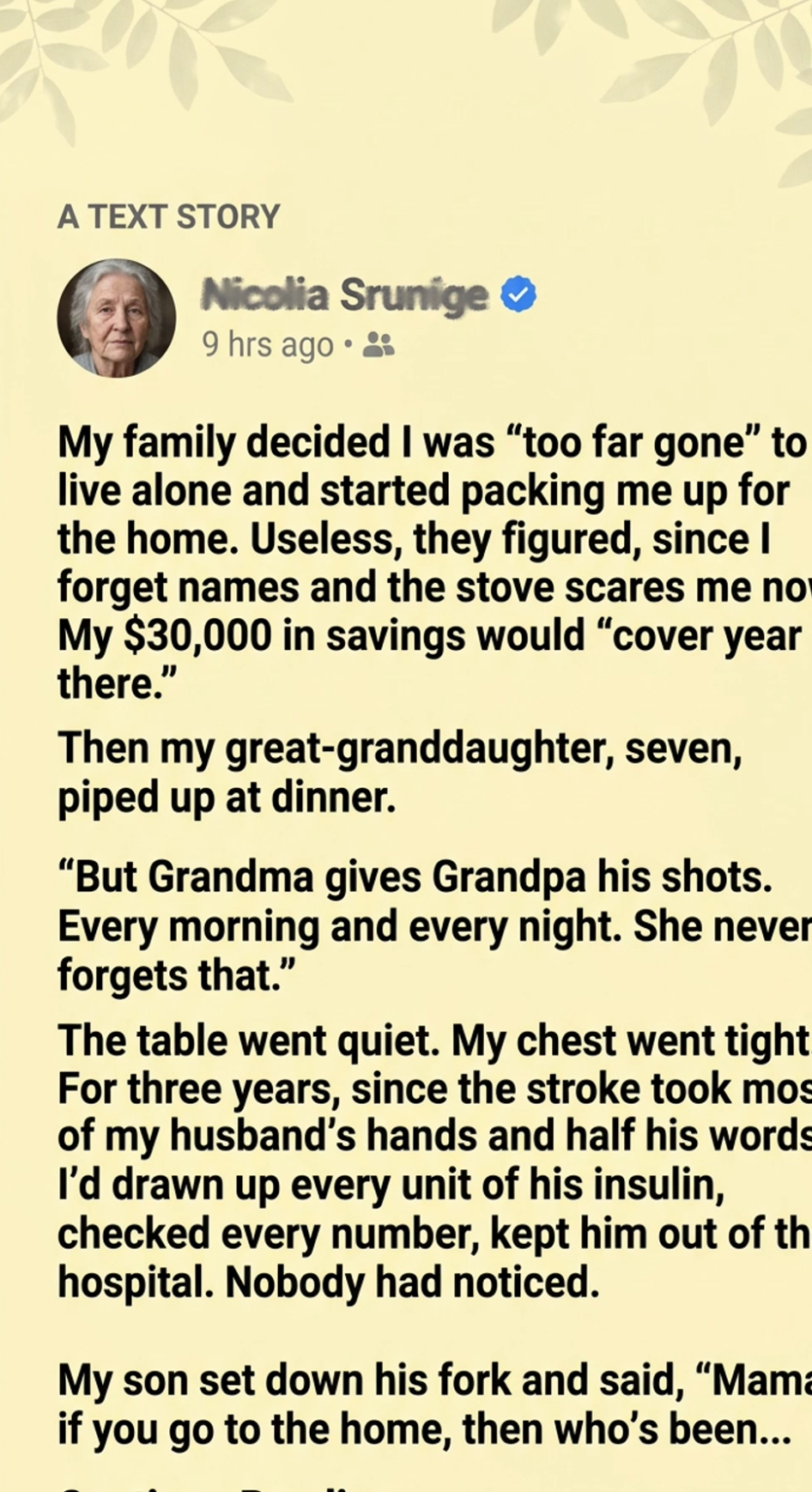
“But Grandma gives Grandpa his shots,” she said.
Every adult at the table turned toward her.
“What was that, sweetheart?” Linda asked.
“Grandma gives Grandpa his shots. Every morning and every night. She never forgets that.”
The room became so quiet that I could hear the refrigerator humming in the kitchen.
Sophie continued, entirely unaware that she had just interrupted a family decision that had been months in the making.
“She checks his little machine, too. And she writes the numbers in the book. Grandpa says she’s the best nurse in the whole world.”
My chest tightened.
I looked at Robert.
For the first time that evening, he was not looking at the brochure.
He was looking at me.
“Mama,” he said slowly, “you give Dad his insulin every day?”
“Twice a day, as prescribed,” I answered.
“Every day?”
“Robert, yes.”
He looked toward his father, then back at me.
“If you go into that home, who’s been taking care of Dad’s insulin?”
I almost laughed.
Not because the question was funny, but because he had finally asked it.
For three years, I had been standing in the same kitchen, following the same medication schedule, checking the same readings, and writing the same careful notes. My children had visited, brought groceries, taken their father to appointments when I asked, and discussed his condition with his doctors.
Yet somehow, the most ordinary part of our days had become invisible to them.
“I have,” I said. “I’ve been taking care of it.”
Robert opened his mouth, then closed it again.
Linda’s face changed. Her eyes moved toward the refrigerator, where a whiteboard displayed George’s medication schedule and the dates of his appointments.
“You do all of that yourself?”
“I follow the plan his medical team gave us. I keep the records, and I call the clinic whenever something concerns me. I don’t change his doses on my own.”
I had not intended to sound defensive, but I suddenly felt as though I were sitting an examination I had never been told I needed to pass.
Linda looked down at her plate.
“Why didn’t you tell us?”
I stared at her.
“I did tell you.”
Neither of them answered.
I remembered the phone calls. The messages about a low reading after George had eaten less than usual. The appointment when I asked the nurse to explain the instructions one more time so I could write them down correctly. The afternoon Robert had visited and found me updating the medication log.
He had glanced at it and said, “You certainly keep busy, Mom.”
Then he had gone back to his phone.
I had not hidden my work. They had simply stopped seeing it.
And that hurt more than the suggestion that I needed help.
George’s stroke had happened on a rainy Tuesday in October.
He had been seventy-two then, and I was sixty-six. We had been married for forty-three years. Our life together was not glamorous, but it was steady. We had raised two children, paid off our mortgage, endured layoffs and illnesses, and learned how to disagree without making every argument a catastrophe.
Then one morning, George dropped his coffee cup.
I remember the sound of ceramic breaking against the kitchen floor. I remember his bewildered expression when he tried to speak and the words came out wrong.
I called emergency services with shaking hands.
At the hospital, doctors explained that the stroke had damaged parts of his brain responsible for movement and language. He survived, but his recovery was long and incomplete.
He came home with a wheelchair, a list of medications, physical therapy appointments, and instructions that seemed to multiply every time a new specialist entered the room.
At first, our children helped constantly.
Robert handled insurance calls. Linda organized appointments. Our granddaughter visited with Sophie and brought casseroles that filled the freezer.
But weeks became months, and months became years.
Their lives resumed.
Robert had a demanding job and two teenage children. Linda helped care for her own mother-in-law. Our granddaughter worked full-time and was raising Sophie with her husband.
Nobody abandoned us deliberately. Life simply filled their calendars until helping became something they intended to do rather than something they regularly did.
I understood that.
What I did not understand was how quickly understanding became an expectation that I should manage everything alone.
George needed help bathing, dressing, transferring from his wheelchair, and moving safely around the house. His speech improved, but some days he could not get the words out at all. His right hand remained weak.
His diabetes complicated everything.
Before the stroke, he had managed his own medication. Afterward, the responsibility shifted to me.
At the hospital, a diabetes nurse showed me how to use his glucose meter, recognize concerning readings, prepare his prescribed insulin, and document what I had done. She made me demonstrate the process until she was satisfied I understood it.
I asked questions.
I wrote everything down.
When I was uncertain, I called the clinic rather than guessing.
I kept the supplies in a labeled container, stored them according to the instructions, and maintained a log that included his readings, medication times, meals when relevant, and anything unusual I noticed.
The routine became the framework around which our days were built.
At six-thirty each morning, I made coffee for myself and tea for George. I checked his blood sugar according to his care plan, reviewed the instructions, and administered his prescribed insulin. In the evening, I repeated the process.
I watched for changes in his appetite, energy, mood, and movement. I kept the phone numbers for his medical team beside the refrigerator. I learned to distinguish between what I could safely handle and what required professional advice.
I was not a nurse.
I never claimed to be one.
I was a wife who had been taught how to perform specific tasks for her husband, and I took that responsibility seriously.
There were frightening days. Once, George became unusually weak and confused, and I called for urgent medical advice. Another time, a medication instruction changed after an appointment, and I asked the nurse to review the updated schedule with me rather than relying on my memory.
Those experiences taught me something important: being capable did not mean pretending I never needed assistance.
I needed help lifting George safely. I needed someone to stay with him when I had medical appointments of my own. I needed rest.
But needing help was not the same as being incapable of making decisions.
My children had somehow confused the two.
The dinner ended without anyone discussing the nursing-home brochures again.
After the others left, Linda remained in the kitchen, stacking plates that did not need to be stacked.
“I didn’t know it was that much,” she said.
I rinsed a glass.
“You knew your father needed medication.”
“Of course I did. I just didn’t realize how much you were doing yourself.”
I turned off the tap.
“Linda, what did you think happened between the visits?”
She looked uncomfortable.
“I suppose I thought you had a routine.”
“I do have a routine.”
“I mean, I thought it was all manageable.”
“It is manageable some days. Other days, it isn’t.”
She leaned against the counter.
“Then why didn’t you tell us you were struggling?”
I looked at my daughter for a long moment.
“I told you I was tired. I told you I needed someone to stay with your father while I went to the dentist. I told you I was frightened the night he became ill. You said you would see what you could arrange.”
Her eyes filled with tears.
“I thought you were saying you were tired the way everyone says they’re tired.”
“I was saying I was tired because I was tired.”
She lowered her head.
I felt sorry for her. I did. She was not a cruel woman. She loved me, and she loved her father. But love did not automatically teach a person how to listen.
Sometimes families hear what is convenient because hearing the truth would require them to change their lives.
Linda wiped her cheek.
“I’m sorry, Mama.”
I nodded, but I did not rush to comfort her.
An apology was a beginning. It was not a solution.
That night, after George was settled in bed, I sat at the kitchen table with my notebook open.
The nursing-home brochure lay beside it.
I looked at the photographs of smiling residents sitting in a sunlit common room. There was nothing wrong with a good residential care facility. Some people needed one, and some people thrived there.
But I did not want to move simply because my children had become frightened by my age.
I wanted an honest assessment of what I could do, what I could no longer do safely, and what support would allow George and me to remain at home.
I wrote three questions on a fresh page.
What can I still manage safely?
What help do I actually need?
Who gets to decide where I live?
The third question was the most important.
Two days later, Robert called.
He sounded different from the man who had presented the brochures.
“Mama, I’ve been thinking about what Sophie said.”
“So have I.”
“I spoke to Dad’s clinic. They said we should arrange a review of his care plan and talk about support at home.”
“That sounds sensible.”
“They also said we should make sure you have a proper assessment of your memory and daily functioning. Not because we’re trying to prove anything. They said it could help us understand what support would be useful.”
I appreciated that he had spoken to a professional rather than simply searching for a reason to put me somewhere.
“I agree,” I said. “But I want to be included in those conversations.”
“Of course.”
“And I don’t want anyone making arrangements to move me while we’re still figuring things out.”
There was a pause.
“Okay, Mama.”
It was the first time in months that he had sounded as though he understood I was a participant in the discussion rather than its subject.
We arranged an appointment with my primary-care doctor. I brought a list of the things that concerned me: forgetting names, occasionally losing track of a date, misplacing items, and feeling less confident around the stove.
I also brought examples of what I managed every day.
My doctor listened without rushing me.
She explained that memory changes could have several causes, including stress, poor sleep, medication effects, hearing difficulties, and medical conditions. She recommended appropriate screening and follow-up rather than assuming that every lapse meant dementia.
She also asked me questions about my daily functioning.
Could I manage my finances? Could I follow written instructions? Did I get lost in familiar places? Had I experienced any sudden changes in thinking or behavior?
I answered honestly.
There were things I could still do well and things that had become harder.
I had paid the electricity bill late twice because I misplaced the reminder. I had become anxious about cooking on the stove after leaving a pot unattended. I sometimes forgot names, especially when several people were talking at once.
But I could explain George’s care routine, describe his medication instructions, maintain his records, and recognize when I needed professional guidance.
My doctor did not tell me I was perfectly fine. She did not tell me I was incapable, either.
She explained that the assessment was one part of understanding my health, not a verdict on my worth or my right to participate in decisions.
That distinction brought tears to my eyes.
For months, I had feared that one forgotten name would erase forty years of competence.
Now someone had finally looked at the whole picture.
My doctor recommended further monitoring, practical changes at home, and a referral for an occupational-therapy assessment to identify safety risks. She also suggested that we discuss caregiver support because George’s needs were substantial.
I left with a plan rather than a label.
For the first time in a long while, I felt that the future might belong to me again.
The next family meeting took place at our house a week later.
This time, there were no glossy brochures on the table.
There was a notebook, a calendar, and a list of questions.
Robert had contacted a local service that helped families arrange in-home support. Linda had researched respite care, which would allow someone trained to assist George to stay with him while I rested or attended appointments.
Our granddaughter offered to organize a shared calendar so the family could coordinate visits instead of relying on vague promises.
I listened as they explained what they had found.
Then I placed my own list on the table.
“I want to remain here if it’s reasonably safe,” I said. “I want George to remain here if his needs can be met here. I am willing to accept help. I am not willing to have my home and savings treated as though they belong to everyone except me.”
Robert nodded.
“That makes sense.”
“I also want us to stop using the word ‘home’ as though it’s a punishment. If either of us eventually needs residential care, we’ll evaluate it properly. But we are not going to decide based on embarrassment, convenience, or fear.”
Linda took a breath.
“Agreed.”
I continued.
“Second, we need a written care plan for your father that everyone understands. His medication instructions must come from his medical team. If someone else helps administer his insulin, that person needs the appropriate training and must follow the prescribed plan.”
Robert wrote that down.
“Third, I need regular breaks. I love your father, but I cannot be awake and available every minute of every day.”
“You shouldn’t have to be,” Linda said quietly.
“And fourth, I want control of my own money. We can discuss expenses and make a budget, but nobody is going to spend my savings on a facility without my agreement.”
No one argued.
That surprised me more than anything else.
Perhaps the dinner had forced them to confront a truth they had not wanted to see: they had been so focused on my mistakes that they had forgotten to measure my abilities.
They had mistaken my silence for contentment and my endurance for unlimited capacity.
I had made my own mistake, too. I had been so determined to prove that I could manage that I rarely admitted how much I needed help.
We could not change the past, but we could change the arrangement.
Over the next month, a home-care coordinator visited us and assessed our needs. An occupational therapist identified improvements that could reduce the risk of falls and kitchen accidents. We installed better lighting, placed frequently used items within easy reach, and added reminders for appointments and household tasks.
I began using an electric kettle and a countertop appliance with an automatic shutoff for simple meals. We arranged for someone to help with heavier household work.
A trained caregiver came several afternoons each week to assist George with personal care and give me time away from the house.
At first, I hated leaving him.
I would sit at the grocery store café checking my phone, imagining every possible emergency. The caregiver gently reminded me that she would contact me if anything required my attention.
Eventually, I learned to finish a cup of tea without looking at the screen every thirty seconds.
I visited my sister’s grave. I bought a new pair of shoes. I sat in the park and watched children chase pigeons.
Small things, perhaps, but they reminded me that I was still a person outside my responsibilities.
The family calendar helped, too. Robert began visiting on Wednesday evenings. Linda came on Saturdays and handled errands that required lifting or driving. Our granddaughter brought Sophie on Sundays, and sometimes the child stayed long enough to help me sort old photographs.
The arrangement was not perfect. People canceled. George had difficult days. My memory still occasionally betrayed me, and I continued to follow up with my doctor.
But the burden was no longer mine alone.
Most importantly, nobody spoke about the nursing home as though the decision had already been made.
Several weeks after that first dinner, Sophie came to visit with a sheet of paper clutched in both hands.
“Grandma, I made you something.”
It was a drawing of our family.
George sat in his wheelchair, smiling beneath an enormous yellow sun. I stood beside him, holding a little blue book. Sophie had drawn herself between us, with arms long enough to reach both our hands.
At the bottom, in crooked letters, she had written: GRANDMA TAKES CARE OF GRANDPA.
I hugged her.
“You remembered that?”
She looked puzzled.
“Of course. You do it every day.”
Children sometimes notice what adults have trained themselves to overlook.
I placed the drawing beside the refrigerator, just above the medication schedule.
Not because I needed proof that I was useful.
Because it reminded me that the small, faithful things we do each day are often the most important things we do.
The following spring, George developed a chest infection that left him weak. His doctors treated him promptly, and he recovered, but the episode forced us to reconsider how much care he might eventually need.
This time, our family approached the question differently.
We spoke with his medical team about his prognosis, his mobility, and the level of assistance he required. We discussed the cost and availability of home care, the strain on me, and the possibility that residential care might become the safest choice if his needs exceeded what we could provide.
No one pretended that love could replace professional support.
No one pretended that staying at home was always the right answer.
And no one assumed that moving into a facility would mean I had failed.
We agreed to review the plan regularly and make decisions based on George’s needs, my health, our finances, and our wishes.
That was what I had wanted from the beginning: not an unconditional promise that nothing would ever change, but the dignity of being included in the changes that might come.
As for my thirty thousand dollars, I moved it into an account in my own name and reviewed my financial arrangements with a qualified adviser. I made sure my paperwork was current and that my wishes were clearly documented.
The money was still available for care if we needed it.
But it was no longer being treated as a fund my children could spend simply because they were worried about me.
One evening, Robert sat beside me on the porch while George rested inside.
“I owe you an apology,” he said.
I looked at him.
“For what?”
“For deciding what you needed before asking you. For treating the things you forgot as more important than everything you still did.”
I watched the evening light settle over the garden.
“I think you were frightened,” I said.
“I was.”
“So was I.”
He turned toward me.
“You were?”
“Of course. I was afraid of forgetting something important. I was afraid of falling. I was afraid of becoming a burden to your father. And I was afraid that if I admitted any of it, you would decide I couldn’t make my own decisions anymore.”
He stared at his hands.
“I never thought about it that way.”
“That’s why we have to talk to each other.”
He nodded.
Then he said something I had waited months to hear.
“What do you need from me, Mama?”
Not what should we do with you?
Not where should we put you?
What do you need?
I told him I needed consistency, honesty, and help that did not require me to beg for it. I needed him to understand that I could be vulnerable without becoming invisible.
He listened.
And when he left that evening, he did not take the folder of nursing-home brochures with him.
He left it in the recycling bin.
George lived for another two years.
His condition gradually worsened, and there came a time when home care was no longer enough to meet all his needs. After careful discussions with his doctors and with George included as much as his communication difficulties allowed, we chose a residential care facility that could provide the level of support he required.
It was not the place my children had selected for me in that first meeting.
It was a decision made for George, with him, based on his needs.
I visited every day I could. On the days I could not, the family shared the visits. I brought his favorite music, read him passages from the newspaper, and told him about Sophie, who was growing taller and losing her baby teeth.
Sometimes he spoke very little. Sometimes he held my hand and managed a few words.
One afternoon, as I was preparing to leave, he looked directly at me.
“Good wife,” he whispered.
I bent down to kiss his forehead.
“You were a good husband.”
His fingers tightened around mine.
“Home,” he said.
I understood what he meant, though I could not know whether he meant our house, our life together, or the feeling of being loved.
“I know,” I whispered. “You are loved wherever you are.”
He died peacefully several weeks later, with our children nearby and my hand resting on his.
The grief was enormous, but I was not left to carry it alone.
Robert came to my house the morning after the funeral. He brought coffee and sat with me at the kitchen table, the same table where my future had once been discussed without my permission.
“I don’t want you to be alone all the time,” he said. “But I also don’t want to make decisions for you. We can talk about what comes next whenever you’re ready.”
I looked around the kitchen.
The refrigerator still held George’s old medication schedule. Beside it was Sophie’s drawing, its paper faded slightly from the sunlight.
“I’ll need time,” I said.
“Take all the time you need.”
And for once, he meant it.
I remained in my home. I continued seeing my doctor, accepted help with the tasks that had become difficult, and made plans for the years ahead. Some days were lonely. Some were peaceful. I still forgot names, and I still occasionally walked into a room and wondered why I had gone there.
But I also remembered how to laugh.
I joined a small group at the library. I began having lunch with an old friend twice a month. I helped Sophie with her reading and listened as she told me elaborate stories about her school friends.
I was no longer caring for George every morning and evening, but the years of doing so had taught me something I would never forget.
A person is more than the mistakes other people can see.
A forgotten name does not erase a lifetime of love. A frightening moment in the kitchen does not cancel decades of competence. And needing assistance does not mean surrendering the right to participate in decisions about your own life.
Months after George’s death, Sophie came over to help me bake cookies.
She stood on a chair at the counter, carefully measuring flour.
“Grandma,” she asked, “are you going to stay here forever?”
I smiled.
“Forever is a very long time, sweetheart.”
“But you like this house.”
“I do.”
“Then you should stay while you like it.”
I laughed, and she laughed with me.
It was a simple answer, offered without a committee meeting, a financial calculation, or a brochure.
Of course, life is rarely as simple as a child’s solution. There may come a time when I need more help than I can receive at home. If that happens, I will face it honestly, with people who respect my wishes and professionals who can help me understand my options.
But that decision will be made with me, not merely about me.
My children had once believed that my forgotten names and my fear of the stove told the whole story of who I had become.
Sophie had reminded them that I was still the woman who remembered her husband’s medication schedule, who kept careful records, who noticed when his voice sounded different, and who stayed beside him through three difficult years.
She had not proved that I needed no help.
She had proved that I deserved to be seen completely.
And that is what I want every older person to know: you can accept help without surrendering your dignity. You can acknowledge your limitations without allowing others to define you by them. You can love your family while insisting that your voice still matters.
Growing older may change the way we live.
It should never make us disappear from our own lives.