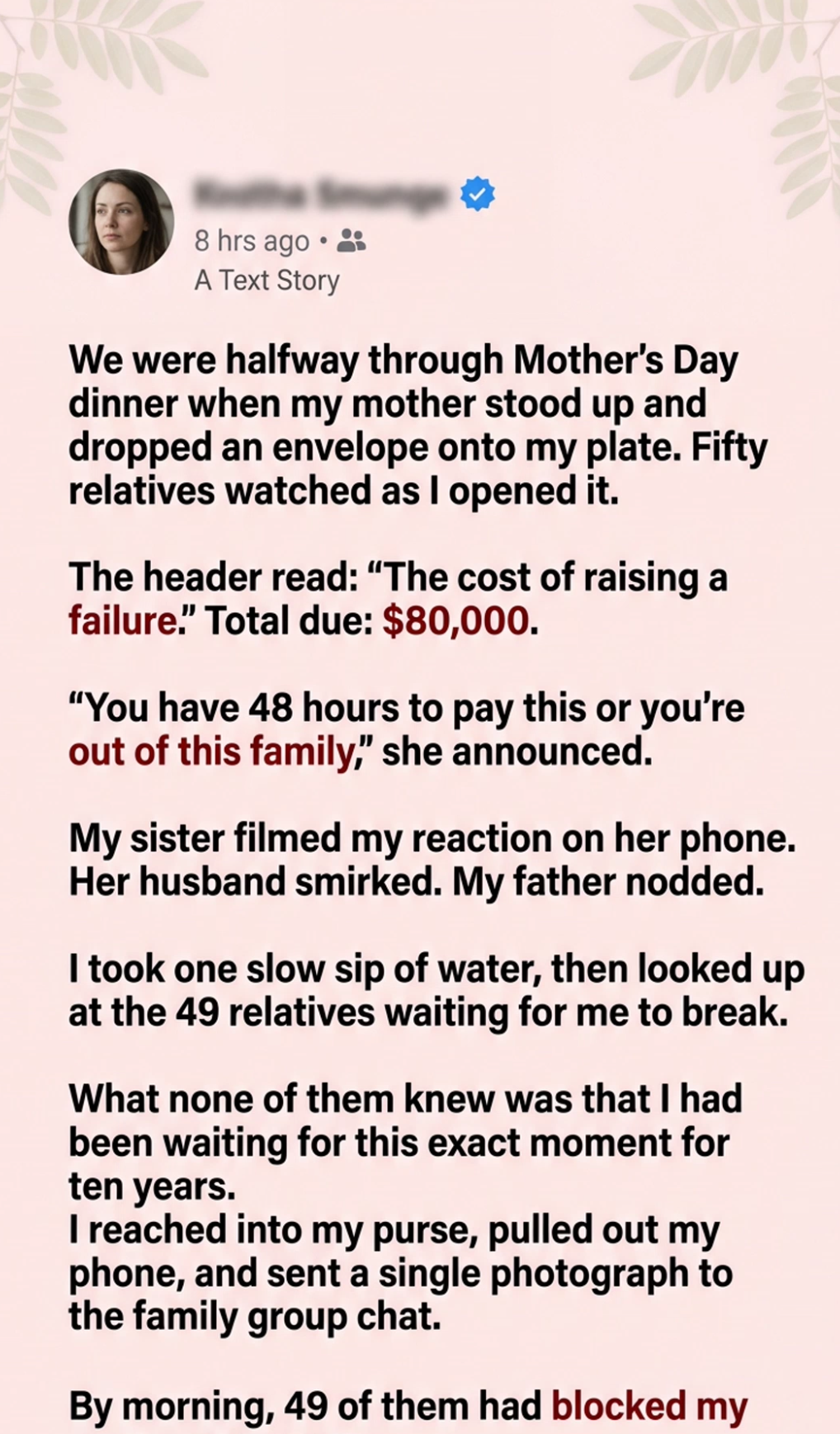
We were halfway through Mother’s Day dinner when my mother stood up, tapped her wineglass with a spoon, and announced that she had something important to discuss.
Fifty relatives sat around the long dining table, surrounded by flower arrangements, roast chicken, polished silverware, and the kind of forced cheerfulness that had defined our family gatherings for as long as I could remember.
I was thirty-four years old, unmarried, and apparently still the family disappointment.
My older sister, Vanessa, raised her phone before our mother had even finished speaking.
“Everyone needs to hear this,” she said, angling the camera toward me. Her husband, Mark, leaned back in his chair with a satisfied smile.
My mother, Patricia, approached me carrying a cream-colored envelope.
She dropped it directly onto my dinner plate.
Inside was a typed document with a bold heading: THE COST OF RAISING A FAILURE.
Beneath it was a list of expenses dating back to my childhood. School tuition. Clothes. Medical bills. Summer camps. College fees. Food, housing, transportation, and various amounts labeled “emotional support” and “parental sacrifice.”
At the bottom, beneath a thick black line, were four words.
TOTAL DUE: $80,000.
I stared at the page.
My mother folded her arms.
“You have forty-eight hours to pay this money,” she announced. “If you don’t, you’re out of this family. No more holidays, no more invitations, no more pretending you’re one of us.”
Someone near the far end of the table gasped.
My father, Richard, nodded as if my mother had just explained a reasonable business arrangement.
Vanessa zoomed in on my face.
“Go ahead,” she whispered. “Tell everyone how unfair your life has been.”
I could have reminded them that I had paid for my own apartment since I was twenty-three. I could have pointed out that I had never asked my parents for money after graduating from college. I could have explained that the supposed debt included expenses they had voluntarily incurred while raising a child they had chosen to bring into the world.
Instead, I picked up my water glass and took one slow sip.
Then I looked around the table.
Forty-nine relatives were waiting for me to cry, shout, or beg.
My mother was smiling.
She believed she had finally cornered me.
What none of them knew was that I had been waiting ten years for this exact moment.
I reached into my purse, pulled out my phone, and opened the family group chat.
Then I sent a single photograph.
Within seconds, the room began to change.
My aunt Margaret stopped chewing.
My cousin Daniel stood up so quickly that his chair scraped against the floor.
Vanessa’s smile disappeared.
And my father, the man who had nodded approvingly when my mother demanded eighty thousand dollars, stared at his own phone as though the screen had suddenly become dangerous.
By the following morning, forty-nine relatives had blocked my mother.
The fiftieth person was my father.
But before I explain what was in that photograph, you need to understand why I had spent ten years preparing for the day my family would finally expose itself.
Because the eighty-thousand-dollar demand was not the beginning of my family’s betrayal.
It was merely the first time they had put it in writing.
My name is Claire Bennett, and I grew up in a house where love was treated like a reward.
My older sister, Vanessa, was the kind of daughter my mother proudly described to strangers. She was beautiful, confident, socially gifted, and skilled at making people feel that knowing her was a privilege.
She received the lead roles in school plays, the best birthday parties, and the sort of praise that made even ordinary achievements sound extraordinary.
When she graduated from college, my parents hosted a celebration for more than a hundred people.
When I graduated two years later, my mother told me she had a headache and suggested we celebrate quietly over lunch.
Vanessa studied communications at an expensive private university. My parents paid her tuition, bought her a car, and helped her rent an apartment after graduation.
I attended a state university and worked evenings at a bookstore to cover my expenses.
Whenever I mentioned how hard I was working, my mother reminded me that nobody had forced me to choose a difficult path.
“You’ve always made things harder than they need to be,” she would say.
My father rarely contradicted her.
He was not a loud man. He preferred to sit quietly, reading the newspaper or checking his phone while my mother controlled the conversation. When she criticized me, he would look up briefly, then return to whatever he had been doing.
His silence taught me something I spent years trying to unlearn: sometimes the person who refuses to participate in cruelty still helps it continue.
By the time I was twenty-four, I had stopped expecting my family to understand me.
I worked in financial compliance for a regional bank, lived in a small apartment, and spent my weekends taking professional courses. I wasn’t glamorous, but I was independent. I paid my bills, maintained my friendships, and had begun saving enough money to consider buying a modest home.
My mother called that boring.
Vanessa called it a waste of potential.
“You could do so much more if you weren’t obsessed with spreadsheets,” she told me at a family barbecue.
I smiled and asked her how her new business was going.
She changed the subject.
At the time, I did not know that her business had already begun to unravel.
I would learn that later.
For now, I was simply the daughter who never seemed to do enough to earn the same affection her sister received without asking.
Then, when I was twenty-four, my grandmother Evelyn died.
And everything changed.
Grandma Evelyn had been the only person in my family who never made me feel that love was something I needed to earn.
She was my mother’s mother, a quiet woman with silver hair, sharp eyes, and a habit of keeping careful records of everything that mattered to her.
She remembered birthdays, saved handwritten letters, and kept receipts in labeled folders. She had worked as a bookkeeper for a small manufacturing company for more than thirty years before retiring.
She was also the person who taught me how to manage money.
When I was sixteen, she gave me a used notebook and told me to record every dollar I earned and spent.
“Money is not the most important thing in life,” she said. “But knowing where it goes can protect you from people who think they have a right to decide for you.”
At the time, I thought she was talking about ordinary budgeting.
Years later, I understood that she had been talking about our family.
Grandma had noticed how my mother treated me. She had noticed that Vanessa could make a mistake and receive sympathy while I could do everything correctly and still be criticized.
She never openly attacked my mother. Instead, she asked questions.
Why had Vanessa’s car insurance been paid from Grandma’s account when my parents had promised to cover it?
Why had my mother asked for money to repair the roof when the contractor’s invoice showed the work had already been completed?
Why did I seem to apologize whenever I entered a room?
My mother hated those questions.
“She fills your head with nonsense,” she told me once.
Grandma simply smiled.
“Then it should be easy to prove me wrong.”
When Grandma died, I was devastated.
At the funeral, my mother cried so loudly that several people approached her to offer comfort. Vanessa stood beside her, holding her arm. My father thanked guests and handled the arrangements.
I sat in the second row, holding the handkerchief Grandma had given me when I was twelve.
After the service, an attorney named Helen Foster approached me.
She had handled Grandma’s estate for many years.
“Your grandmother asked me to speak with you privately,” Helen said. “Would you be available tomorrow morning?”
My mother overheard her.
“What is this about?” she demanded.
Helen remained composed.
“Estate administration, Patricia.”
“My mother was very clear that everything would be handled within the family.”
“Your mother made her wishes clear in a legally executed will.”
The words seemed to irritate my mother more than they should have.
The following morning, I met Helen at her office.
She explained that Grandma had left specific gifts to several relatives, including money for her grandchildren. She had also established a separate investment account for me, funded over many years.
The account was intended to help me buy a home or continue my education.
The amount was substantial enough to change my life, but it came with a condition: I could not withdraw the principal until I turned thirty, unless the funds were needed for a qualifying emergency under the trust’s terms.
Grandma had also left me a sealed envelope.
Inside was a handwritten letter.
My dear Claire,
You have spent too much of your life trying to convince people that you deserve a place at their table. One day, you will discover that you do not need to keep asking for a chair in a room where people are determined to make you stand.
I have set aside something to give you choices. Do not use it to buy affection. Do not use it to rescue people who repeatedly refuse to change. And do not confuse keeping the peace with being treated fairly.
I hope you never need the papers Helen has prepared. But if anyone tries to make you responsible for debts you did not create, please remember that being related to someone does not make every demand legitimate.
Build a life you can stand on yourself.
All my love, Grandma.
I read the letter three times.
Then I folded it carefully and placed it in my purse.
I had no idea how much I would eventually need her advice.
The first demand came six months later.
My mother called me on a Sunday afternoon and asked whether I could lend Vanessa twelve thousand dollars.
“It’s temporary,” she said. “Her business is having a difficult quarter, and she needs to cover a few obligations.”
“What kind of obligations?”
“Business expenses.”
“Which expenses?”
“Claire, I am not asking you to audit your sister. I am asking you to help your family.”
I told her I would need to understand the terms before lending anyone that much money.
She became offended.
“You’ve always been selfish with money.”
I reminded her that I had saved the money myself and was trying to buy a home.
She hung up.
Three days later, Vanessa called.
She was crying.
Her small event-planning company had fallen behind on vendor payments. She said she had a major contract coming in and needed a bridge loan to keep the business operating.
I sympathized with her situation, but I did not have twelve thousand dollars available to lend without jeopardizing my own plans.
“I can help you review your budget,” I offered. “I can help you put together a payment schedule or talk through options with your creditors.”
“I don’t need a spreadsheet, Claire,” she snapped. “I need my sister.”
I offered what I could safely afford: a thousand dollars, with the understanding that it was a loan and that we would write down the repayment terms.
She refused.
“Keep your money,” she said. “Clearly, it matters more to you than I do.”
That evening, my mother sent a message to the family group chat.
Some people have plenty of money but no heart.
She did not mention my name, but everyone knew whom she meant.
An aunt called to tell me I should apologize. A cousin said family came before financial independence. My father sent a short message asking me not to make things difficult for my mother.
I did not apologize.
Vanessa’s business eventually closed.
She blamed the economy, unreliable vendors, and a former employee who had allegedly mishandled accounts. My parents helped her pay several outstanding bills, and she moved back into their house for a time.
I assumed the matter was over.
I was wrong.
A few weeks after the closure, I received an email from my mother containing a spreadsheet.
The subject line read: Family Support Balance.
The spreadsheet listed the cost of raising me from birth to age eighteen, along with several expenses from my college years.
It included school supplies, dental appointments, winter coats, groceries, a family vacation, and a portion of the mortgage payment for the house where I had grown up.
At the bottom was a figure.
Eighty thousand dollars.
There was no explanation for how she had calculated it. Some items appeared twice. Others were estimates. A few had no dates or supporting receipts.
I called her.
“What is this?”
“A record of everything your father and I sacrificed for you.”
“Are you asking me to repay my childhood?”
“I’m asking you to recognize what you owe.”
“I never agreed to repay any of these expenses.”
“Children don’t have to sign contracts to understand their obligations.”
I looked at the spreadsheet again.
My parents had fed me, housed me, and raised me. I had always appreciated that. I had never believed that parents should be paid back for doing what they chose to do when they brought a child into the world.
But my mother was not asking for gratitude.
She was assigning a price to it.
I told her I would not pay the eighty thousand dollars.
She called me ungrateful.
I ended the conversation.
Then I printed the email and placed it in a folder.
I did not know why I felt compelled to preserve it. Perhaps Grandma’s letter had made me cautious. Perhaps some part of me understood that my mother was not going to let the matter disappear.
Over the following months, she brought it up repeatedly.
At Christmas, she mentioned the money while handing me a gift.
At a cousin’s wedding, she told an aunt that I had become wealthy and forgotten where I came from.
When I bought a used car, she asked how I could afford it while refusing to help my sister.
I was not wealthy. I had a steady job, a modest apartment, and savings accumulated through years of careful decisions.
But my mother had decided that my independence was evidence of disloyalty.
The more I refused to surrender my money, the more determined she became to collect it.
Then, when I was twenty-seven, I discovered that the eighty-thousand-dollar spreadsheet was only the beginning.
My grandmother’s trust became available to me when I turned thirty.
By then, I had advanced to a senior role in financial compliance. I had enough savings for a down payment and was considering purchasing a small townhouse.
Helen Foster contacted me before the trust distribution.
She wanted to review the documents with me and explain my options.
During the meeting, she asked whether I had ever received any requests from my mother to sign documents relating to Grandma’s estate.
I said no.
Helen paused.
“Your mother contacted our office twice after Evelyn died,” she explained. “She asked whether the trust could be redirected to help another family member. We explained that we could not do that without your consent and that the trust terms did not permit the change she requested.”
“What did she want to redirect it for?”
Helen opened a file.
“She said your sister had urgent financial needs. She also suggested that you might not be capable of managing a large inheritance independently.”
I felt a chill move through me.
“Did you tell her how much was in the trust?”
“No. We provided information only as permitted by the estate documents. The relevant records are here, and you are welcome to review them.”
She showed me copies of the correspondence.
My mother had argued that Vanessa needed the money more than I did. She had suggested that I was too cautious, too isolated, and too focused on saving to appreciate what the family needed.
There was no indication that she had been able to access the funds.
The trust had been administered according to its terms.
But the correspondence revealed something I had not understood before: my mother had spent years trying to position herself as the person entitled to decide what happened to money that was legally mine.
Helen advised me to keep the documents and seek independent legal advice if anyone later tried to pressure me into transferring assets or accepting a debt.
I followed her advice.
I bought a small townhouse with a manageable mortgage. I kept a separate emergency fund and continued working.
I did not tell my family the exact amount I had received from the trust.
When my mother asked, I said I was managing my finances responsibly.
She accused me of hiding money from her.
I replied that my finances were private.
She did not speak to me for nearly two months.
Then Vanessa called to say she was getting married.
I attended the wedding. I smiled for photographs. I congratulated her.
For a while, I thought perhaps we could move forward.
But the family had developed a pattern: whenever I established a boundary, my mother treated it as a personal attack. Whenever Vanessa experienced a setback, my mother expected me to help repair it. Whenever I declined, I became the villain in a story told to relatives who had never heard my side.
I grew tired of defending myself.
So I stopped explaining.
I worked. I saved. I built friendships outside the family. I kept Grandma’s letter in a small box with the estate documents.
And I waited for the next demand.
It came ten years after the first spreadsheet.
It arrived on Mother’s Day.
By the time I was thirty-four, Vanessa and Mark had two children, my parents had retired, and the family had developed a comfortable routine of holidays, birthdays, and dinners where everyone pretended old arguments had been resolved.
My mother was particularly fond of Mother’s Day.
She expected flowers, a restaurant reservation, and a public acknowledgment of how much she had sacrificed for her children.
That year, she chose a restaurant with a private dining room and invited fifty relatives.
I assumed she wanted to celebrate.
Instead, she used the gathering to stage a public confrontation.
I learned later that she had spent several weeks discussing the plan with Vanessa. They believed that if the demand were made in front of enough witnesses, I would feel too embarrassed to refuse.
They had prepared the document in advance.
They had decided on the amount.
They had even arranged for Vanessa to record my reaction.
What they had not anticipated was that I had spent ten years preserving every email, spreadsheet, message, and letter connected to their demands.
Nor had they anticipated that I had received professional advice about protecting myself from financial pressure.
When my mother dropped the envelope onto my plate, I did not need to invent a response.
I already knew what I would do.
I opened the family group chat.
Then I sent a photograph of the original eighty-thousand-dollar spreadsheet, followed by a second photograph: a page from Grandma Evelyn’s estate file showing that my inheritance had been placed in a trust for my benefit alone.
I attached a short message.
For ten years, I have been told that I owe our parents $80,000 for being raised. I have also been told that refusing to give Vanessa money makes me selfish. Since this demand is now being made publicly, I am sharing the documents that explain why I have refused to pay it.
The spreadsheet contains no signed loan agreement, no repayment contract, and no evidence that I agreed to reimburse my parents for ordinary childhood expenses. I will not accept a debt simply because someone has typed a number on a page.
I love my family. I will not purchase my place in it.
Then I put my phone down.
For several seconds, nobody spoke.
My mother reached for her glass.
“That’s a very clever trick,” she said. “But it doesn’t change what we sacrificed for you.”
“No,” I replied. “It doesn’t. You raised me, and I am grateful for that. But gratitude is not a debt of eighty thousand dollars.”
Vanessa’s phone was still recording.
“Stop acting like a victim,” she snapped. “You have money. We all know you have money.”
“I have savings because I worked and saved. They are not available for anyone to claim simply because they want them.”
My father shifted in his chair.
“Patricia,” he said quietly, “perhaps this isn’t the place.”
She turned on him.
“You agreed with me!”
He looked at the document in front of me.
“I agreed that we should talk to her. I didn’t agree to humiliating her in front of everyone.”
It was the first time I could remember him contradicting my mother in public.
She stared at him as though he had betrayed her.
Then my phone began to vibrate.
Messages appeared in the family chat.
My aunt Margaret wrote that she had never heard of a parent billing an adult child for childhood expenses.
My cousin Daniel asked whether the eighty-thousand-dollar figure had any legal basis.
Another relative wanted to know why Vanessa had been recording me.
My mother’s face reddened.
“Everyone is taking this out of context,” she said.
But the context was sitting on the table in front of us.
It was a document with a total, a deadline, and a threat to expel me from the family.
I folded the paper carefully and placed it back in the envelope.
“You gave me forty-eight hours,” I said. “I won’t be paying you. If you choose to exclude me from family gatherings, that will be your decision.”
I stood, thanked the restaurant staff for the meal, and walked out.
Vanessa called after me, but I did not turn around.
Outside, the evening air was cool. My hands were shaking, and my stomach hurt, but I felt something I had not felt in years.
Relief.
For once, I had not begged to be understood.
I had simply told the truth.
By eight the next morning, forty-nine relatives had blocked my mother.
The fiftieth person was my father.
He had not blocked her out of anger. He had simply stopped answering her calls after she demanded that he tell everyone I had manipulated the situation.
He refused.
Instead, he sent me a message.
Claire, I’m sorry I let this go on for so long. I should have spoken up years ago.
I read the message several times.
It was not enough to repair everything, but it was the first honest acknowledgment I had received from him.
My mother, meanwhile, was furious.
She called me repeatedly. When I did not answer, she left voicemails accusing me of turning the family against her.
She said I had humiliated her.
She said I had made her look greedy.
She said I had destroyed Mother’s Day.
I listened to the first two messages and deleted the rest without playing them.
The relatives who contacted me were divided into three groups.
Some apologized for believing the stories my mother had told about me.
Some admitted that they had always suspected something was wrong but had never wanted to become involved.
A few insisted that I should apologize for embarrassing my mother, even though she had been the one to place the demand in front of fifty people.
I thanked those who offered sincere apologies. I told the others that I was not going to debate my right to refuse an invented debt.
Then I went to work.
My mother had expected the confrontation to derail me. She had imagined me spending the following days pleading with relatives and trying to restore my place in the family.
Instead, I answered emails, attended meetings, and went home to my quiet townhouse.
For the first time, I did not feel obligated to repair a conflict I had not created.
But there was one part of the story I had not yet addressed.
The photograph of Grandma’s trust documents had revealed why I had refused to hand over my inheritance. It had not revealed the full reason my mother had become so determined to collect money from me.
That truth emerged three days later.
My aunt Margaret called me on Thursday evening.
She had been one of the relatives who blocked my mother, and she sounded unsettled.
“Claire, I think there’s something you should know,” she said. “Your mother has been asking family members for money.”
I sat down.
“What do you mean?”
“She told us that your sister’s family was in trouble. She said you had agreed to help, but you were refusing to follow through. She asked several of us to contribute toward what she called a family emergency.”
“How much?”
“Different amounts. She asked me for five thousand dollars. Daniel said she asked him for eight.”
I felt cold.
“Did she tell you what the emergency was?”
“She said Vanessa had debts that needed to be paid before the end of the month. She also said you had plenty of money but were deliberately withholding it.”
I closed my eyes.
Vanessa had never repaid the thousand dollars I had lent her years earlier. I had not pursued it because I knew her business had failed and I did not want money to become the center of every conversation.
But I had never agreed to pay her other debts.
“Did anyone give her money?” I asked.
Margaret hesitated.
“I did.”
“How much?”
“Two thousand dollars.”
I felt a wave of anger, followed by sadness.
My aunt was a widow living on a fixed income. Two thousand dollars was not a small amount for her.
“Did she give you any documents?”
“No. She said it was urgent and that the family needed to act quickly.”
I told Margaret I was sorry she had been put in that position. I also encouraged her to preserve the messages and speak with an independent adviser about her options.
After we hung up, I called Daniel.
He confirmed that my mother had approached him as well. He had not given her money because he wanted to understand the circumstances first.
Then he told me something that made the picture clearer.
Vanessa and Mark had taken out a business loan to finance a small event venue. The business had struggled after a series of canceled bookings and rising operating costs. They had personally guaranteed part of the debt.
My mother had been helping them make payments.
When her own retirement savings began to shrink, she turned to relatives for assistance.
And when those relatives hesitated, she told them that I was refusing to pay the eighty thousand dollars I supposedly owed our parents.
The story had been designed to make me look selfish while making her demands appear reasonable.
The eighty-thousand-dollar document was not merely an attempt to extract money from me.
It was part of a larger effort to convince the family that I was withholding money that rightfully belonged to everyone else.
I felt sick.
But I also felt certain.
I would not be drawn into paying debts I had not created, and I would not allow my relatives to be pressured into giving money based on a distorted story.
I contacted Helen Foster, the attorney who had handled Grandma’s trust, and asked for a referral to an independent attorney who could advise me about the situation.
The attorney reviewed the spreadsheet, the messages, and the documents my mother had presented at dinner.
She explained that ordinary parental expenses did not automatically become a repayable debt simply because a parent later demanded reimbursement. Whether any particular amount was legally recoverable would depend on the facts and applicable law, but the document my mother had prepared did not, by itself, establish that I owed her eighty thousand dollars.
She also advised me not to make accusations I could not substantiate and not to threaten legal action simply to frighten my family.
Instead, we prepared a brief written response stating that I disputed the alleged debt, had not agreed to repay the listed expenses, and would communicate about any further demands in writing.
I sent it to my mother.
Then I stopped discussing the matter with relatives who wanted to argue about it.
I could not control what my mother said.
I could control what I signed, what I paid, and what I allowed into my life.
A week after Mother’s Day, my father came to my townhouse.
He stood on the doorstep holding a paper bag from the bakery near my parents’ house.
“I brought those lemon cookies you like,” he said.
I stepped aside.
He looked older than I remembered, though we had spoken only a few days earlier. He sat at my kitchen table and placed the bag between us.
For a long time, neither of us spoke.
Finally, he said, “Your mother believes you owe her an apology.”
“I know.”
“She says you made her look like a terrible person.”
I folded my hands.
“Dad, I didn’t write the document. I didn’t announce a deadline. I didn’t threaten to disown anyone.”
He looked down.
“No. You didn’t.”
“Why did you nod when she put it in front of me?”
He took a long breath.
“I thought if I supported her in front of everyone, she might calm down. I thought we could discuss the money privately later.”
“And you thought humiliating me was an acceptable way to begin that discussion?”
He flinched.
“No,” he said. “I suppose I did.”
It was the most honest thing he had ever said about our family.
He told me that my mother had become increasingly anxious about money. She worried that she and my father would outlive their savings. She worried about Vanessa’s financial troubles and the possibility that her grandchildren would lose their home.
Instead of facing those fears directly, she had begun treating my money as a solution.
My father had gone along with her because disagreement made their marriage difficult.
“I should have stopped it,” he said. “I knew the spreadsheet was wrong. I knew you hadn’t agreed to pay us back. I just kept hoping the whole thing would go away.”
I looked at the man who had spent decades sitting silently while my mother criticized me.
“I needed you to stand up for me when I was younger,” I said. “Not just when other people finally saw what was happening.”
His eyes filled.
“I know.”
We sat quietly for several minutes.
I did not tell him everything was forgiven. I did not promise that our relationship would immediately become close.
Instead, I poured him coffee.
We talked about ordinary things: the weather, his garden, the repairs needed on the family house. When he left, he hugged me awkwardly at the door.
It was not a complete reconciliation.
It was a beginning.
Vanessa did not visit.
For several weeks, she sent messages insisting that I had turned our relatives against her and that my refusal to help had made her financial problems worse.
I did not respond to the accusations.
Eventually, she sent a different message.
I need to talk to you.
We met at a café halfway between our homes.
She looked exhausted. Her expensive handbag was gone, replaced by a plain canvas tote. She had stopped wearing the jewelry she once displayed at every family gathering.
“I know you think I’m a terrible person,” she began.
“I haven’t said that.”
“You made me look terrible.”
“I shared the document Mom put on my plate. You filmed me while she threatened to disown me. I didn’t force either of you to do those things.”
She looked away.
For the first time, she did not argue.
She told me the event venue had been losing money for more than a year. Mark had taken a second job, and they had sold one of their cars. Their lender had agreed to a repayment arrangement, but the monthly payments were still difficult.
My mother had helped them repeatedly.
Vanessa admitted that she had known about the eighty-thousand-dollar spreadsheet. She had encouraged our mother to present it at dinner because she believed I would finally agree to pay.
“Mom said you had enough money to solve the problem,” she explained. “She said you were just being stubborn.”
“Even if I had enough money, that wouldn’t make the debt mine.”
“I know that now.”
I looked at her carefully.
“Do you?”
She pressed her lips together.
“I don’t know. I know I was wrong to let her do that in front of everyone.”
“That is a start.”
Vanessa began to cry.
She said she had always felt that our mother loved me differently because Grandma had trusted me with the inheritance. She believed I had been given something she had never received, and every time she struggled financially, the resentment returned.
I listened.
Her feelings might have been real, but they did not justify what she had done.
“I didn’t ask Grandma to leave me that money,” I said. “And I didn’t take anything away from you. Whatever she decided, she made that decision herself.”
Vanessa nodded.
“I know.”
She asked whether I would help her review her finances.
I agreed to look over her budget and help her identify questions to ask a qualified financial adviser. I made it clear that I would not lend her money or guarantee her debts.
She accepted those boundaries.
It was not the sisterhood I had imagined when we were children, but it was more honest than what we had before.
My mother remained silent for nearly two months.
Then, one Sunday afternoon, she called.
I almost let it go to voicemail.
Something in me wanted to avoid another argument, another accusation, another demand disguised as a family obligation.
But I answered.
“Claire,” she said.
“Hello, Mom.”
There was a long pause.
“I have been thinking about Mother’s Day.”
“So have I.”
“I didn’t handle things well.”
I waited.
She continued, her voice stiff.
“I was worried about Vanessa. I thought if you helped, we could get through the financial problems. I didn’t want the family to fall apart.”
“Then why did you threaten to throw me out of it?”
She had no immediate answer.
“I thought you would understand,” she finally said.
“I understood that you wanted eighty thousand dollars from me. I understood that you were willing to humiliate me in front of fifty relatives to get it.”
“I didn’t mean to humiliate you.”
“You handed me a document titled ‘The Cost of Raising a Failure’ and filmed my reaction through Vanessa. What did you think would happen?”
She began to cry.
For a moment, I felt the familiar urge to comfort her, to tell her that it was all right, to make the discomfort disappear.
I resisted it.
“I’m sorry,” she said.
It was the first direct apology she had offered without adding that I had caused the problem.
I took a slow breath.
“I’m willing to have a relationship with you, Mom. But I will not pay the eighty thousand dollars, and I will not accept threats about being excluded from the family. If we are going to move forward, we have to speak to each other with respect.”
She sniffed.
“You’ve become very hard.”
“No,” I said quietly. “I’ve become clear.”
She did not answer.
We spoke for another ten minutes. The conversation was uncomfortable, but she did not threaten me again. Before we hung up, she asked whether I would consider having lunch with her.
I said I would think about it.
I did not agree immediately, because I had learned that an apology was not the same as a changed pattern.
Over the following months, my mother and I met several times in public places. Sometimes we had pleasant conversations. Sometimes she made a remark about money or complained that relatives had stopped calling her.
When that happened, I reminded her that she could rebuild those relationships by speaking honestly and taking responsibility for her actions.
I did not argue for hours.
I did not apologize for refusing the debt.
And I did not confuse being a good daughter with being an endlessly available source of money.
Slowly, our conversations became less tense.
We never returned to the relationship we had before Mother’s Day.
In some ways, that was a loss.
In other ways, it was a relief.
A year later, I celebrated my thirty-fifth birthday in my townhouse.
I invited my father, Vanessa, Mark, my aunt Margaret, and several cousins who had reached out after the dinner. My mother was invited, too, although she asked beforehand whether I expected her to apologize in front of everyone.
I told her no.
“I want us to have a peaceful evening,” I said. “If we need to discuss the past, we can do that privately.”
She came with a small cake and a card.
The gathering was modest. There were no speeches about sacrifice, no lists of debts, and no public demands.
At one point, Aunt Margaret stood beside me in the kitchen.
“I should have asked questions before giving your mother money,” she said. “I believed what she told me because I trusted her.”
“You trusted your sister,” I replied. “I understand why.”
“I still wish I’d known the truth.”
I smiled.
“The important thing is that you know it now.”
Later, Vanessa approached me with an envelope.
My heart sank for a moment, but she quickly explained.
“It isn’t a bill,” she said. “It’s a repayment.”
Inside was a check for the thousand dollars I had lent her years earlier.
She had not been legally compelled to repay it, and I had not demanded it. She had simply decided that she wanted to settle the old loan.
“I know it’s not much compared with what I owe other people,” she said. “But I wanted to start making things right.”
I accepted the check.
“Thank you.”
She hugged me.
For the first time in years, the embrace did not feel like a performance for the family.
It felt like two sisters trying to begin again.
The following spring, I used part of my savings to make a down payment on a small house with a garden.
It was not extravagant. The kitchen needed updating, and the upstairs bathroom had old tiles that I planned to replace when I could afford it.
But the house was mine.
I planted roses along the fence, bought a sturdy wooden table for the kitchen, and hung Grandma Evelyn’s letter in a frame beside my desk.
I did not spend the money to prove anything to my family.
I spent it because I wanted a home where I could live according to my own choices.
My mother visited one afternoon after I had finished planting the first row of flowers.
She stood in the doorway, looking around.
“You’ve done a nice job,” she said.
“Thank you.”
She looked toward the garden.
“Your grandmother would have liked this.”
I smiled.
“I think she would have.”
We stood together in silence.
Then my mother said, “I still wish things had turned out differently.”
“So do I.”
She looked at me.
“Do you think you’ll ever forgive me completely?”
I considered the question.
“I don’t know what completely means,” I answered. “I can forgive you for the things you regret and still remember what happened. I can love you and still say no. Those things don’t have to cancel each other out.”
She nodded slowly.
For once, she did not try to change my answer.
After she left, I returned to the garden.
I thought about the girl I had been at twenty-four, sitting in her apartment and wondering why refusing an unreasonable request could make her feel like a criminal.
I thought about Grandma Evelyn’s letter and the warning she had given me: never use money to buy affection.
Most of all, I thought about the Mother’s Day dinner.
My mother had believed the envelope would frighten me into submission. She had expected fifty witnesses to make me feel small enough to pay.
Instead, the document exposed something I had spent years trying to hide from myself.
I could not force my family to treat me fairly.
I could not make my mother understand that love was not a ledger.
I could not persuade every relative to see the truth.
But I could stop participating in the arrangement that had made me responsible for everyone else’s happiness.
That was what changed my life.
Not the photograph.
Not the family group chat.
Not the relatives who blocked my mother by morning.
It was the moment I understood that I did not need to pay eighty thousand dollars to prove I had been a good daughter.
I had already spent my life trying to be one.
Now I was learning to be a good daughter to myself.
And for the first time, I was no longer afraid of what it might cost.