My son, Daniel, was born on a rainy Thursday in November 1998. I remember the date because I had waited nine months to hear his first cry, and when it finally came, I cried harder than he did.
The delivery had been exhausting, but the doctor assured me everything had gone well. Daniel weighed seven pounds, four ounces. His fingers curled around mine, his cheeks were pink, and his breathing seemed strong. When I asked whether anything had gone wrong during labor, the doctor smiled and said, “You both did beautifully. He’s a healthy little boy.”
I believed him.
For the first three years of Daniel’s life, I held on to those words like a promise.
Then, one afternoon, while we were playing with wooden blocks on the living room floor, Daniel suddenly went still. His eyes rolled upward, his arms stiffened, and his little body began shaking violently. I screamed for my husband, Mark, while trying to keep Daniel from striking his head against the coffee table.
The seizure lasted less than two minutes, but by the time it stopped, I felt as though the world had split open beneath us.
At the hospital, doctors ran tests and asked questions. Had he been sick? Had he fallen? Was there a family history of epilepsy? We answered everything we could, but the results offered few answers.
More seizures followed.
Soon, Daniel struggled with things other children his age did naturally. He spoke later than expected. He had difficulty balancing, remembering instructions, and controlling his movements. Some days he seemed to understand everything around him but could not find the words to express it. Other days, even familiar routines overwhelmed him.
We visited neurologists, developmental specialists, genetic counselors, and rehabilitation clinics. We traveled to hospitals in neighboring cities, sometimes spending entire days in waiting rooms only to leave with another referral and another bill.
One specialist suggested a genetic disorder. Another suspected an unusual metabolic condition. A third said the cause might never be identified.
Every appointment began with hope and ended with uncertainty.
We spent money we had saved for a house, postponed repairs, sold our second car, and borrowed from relatives. Over the years, the cost of Daniel’s treatment, therapy, medication, testing, and specialized care reached approximately $340,000.
I never regretted a single dollar spent on my son. I would have sold everything we owned if it meant finding an answer.
But the question never left me.
Why had Daniel been born apparently healthy, only to begin experiencing severe problems so young?
Whenever I asked whether something could have happened during delivery, the doctors reviewed the summary in his medical file. It described an uncomplicated birth, with no documented event that explained his later difficulties.
I accepted that explanation because I had no reason not to.
Mark and I eventually learned to live around the uncertainty. We organized our days around Daniel’s medication, therapy appointments, and seizure precautions. I learned how to recognize the subtle changes that sometimes preceded an episode. I could tell from the sound of his breathing whether he was sleeping peacefully or beginning to struggle.
By the time Daniel reached adulthood, he needed continued support with many everyday tasks. He could read simple instructions, enjoy old movies, recognize familiar music within seconds, and make jokes that surprised people who assumed his disabilities defined everything about him.
He also understood more than strangers realized.
One evening, when he was twenty-four, I found him sitting beside the window, watching children ride bicycles along our street.
“Mom,” he asked, “why was I different from the other kids?”
I sat beside him.
“We don’t know everything yet,” I said carefully. “But being different doesn’t make you less important.”
He nodded, though I could see that the answer had not satisfied him.
After he went to bed, I sat at the kitchen table and opened the thick folder where I had kept his medical records for years. I reviewed the birth summary again, searching for something I might have overlooked.
There was nothing.
For months afterward, the question returned whenever the house became quiet. Eventually, I began wondering whether the hospital’s records were complete.
In the spring of the previous year, I learned about the Freedom of Information Act and discovered that certain records held by publicly operated hospitals could be requested through the appropriate legal process. Because Daniel had been born at a hospital that had since become part of a public medical system, I contacted its records department to ask what documentation might still be available.
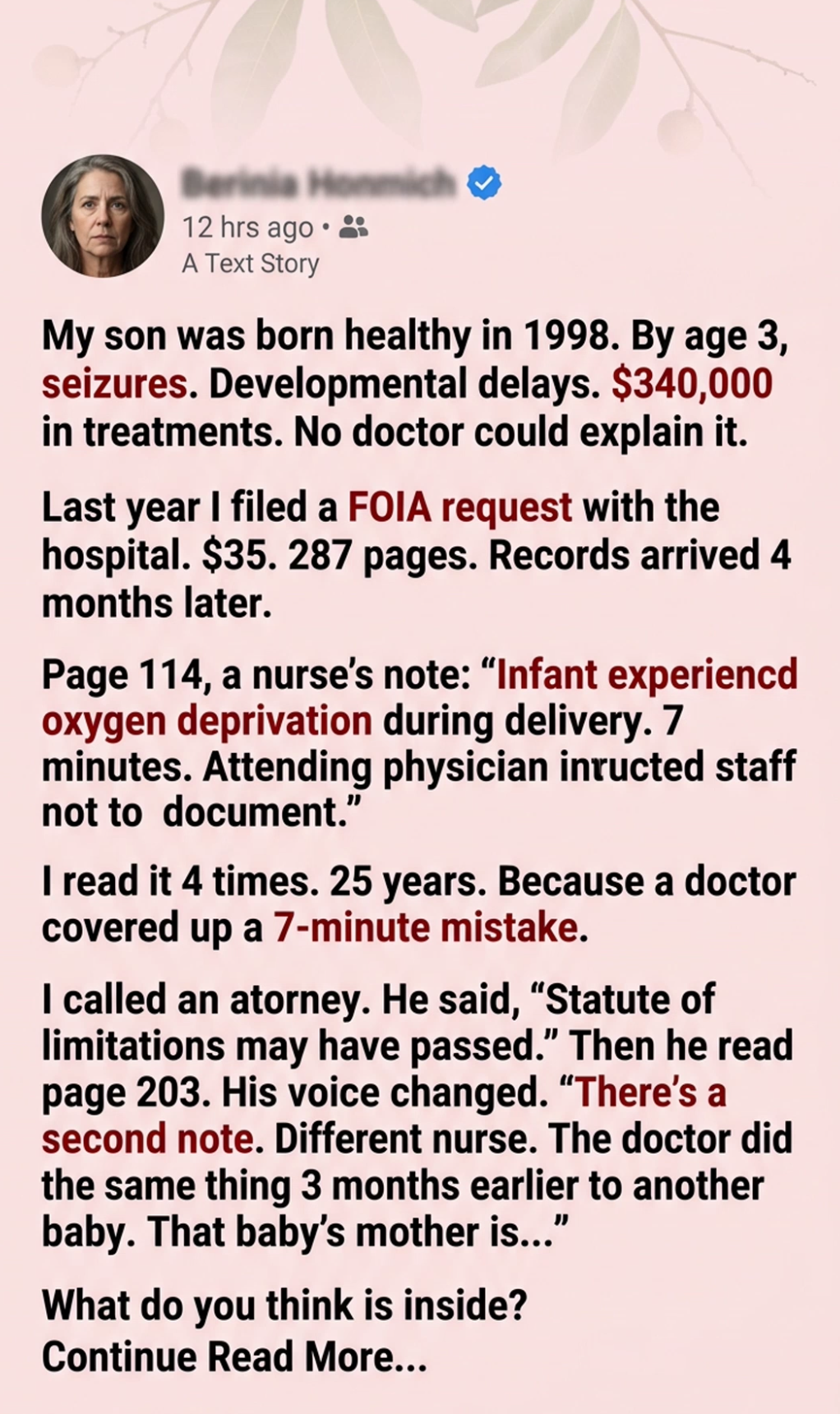
The request cost thirty-five dollars.
I almost abandoned it twice. The hospital had changed its recordkeeping systems, and the staff warned me that older files might have been archived or destroyed. Still, I submitted the forms and waited.
Four months later, a thick envelope arrived.
Inside were 287 pages.
There were familiar documents: delivery summaries, laboratory results, nursing charts, medication records, and discharge instructions. Some pages were difficult to read. Others contained abbreviations that meant little to me.
I spent several evenings sorting everything into chronological order.
Then I reached page 114.
It was a nursing note from the night Daniel was born. The handwriting was hurried, and part of the entry had been copied into the hospital’s electronic archive years later.
The note described a period of severe difficulty during delivery. It recorded that Daniel had experienced oxygen deprivation for approximately seven minutes and required urgent intervention before his condition stabilized.
At the bottom was a sentence that made my hands go cold.
“Attending physician instructed staff not to document the event in the routine delivery summary.”
I read it once.
Then again.
Then a third time, moving my finger beneath the words as if that might change what they said.
Seven minutes.
For twenty-five years, I had been told there was no documented complication that explained Daniel’s condition. Yet here was a note suggesting that a serious event had occurred—and that someone had deliberately kept it out of the ordinary record.
I carried the pages into the living room and placed them on the coffee table. Mark read the note without speaking. When he reached the bottom, he looked at me.
“Could this be a mistake?” he asked.
“I don’t know.”
“Could the nurse have misunderstood?”
“I don’t know that either.”
Those were the only honest answers I had.
The note was disturbing, but it was not a medical diagnosis. Oxygen deprivation during birth can cause serious injury, yet the significance of any particular episode depends on the circumstances, the baby’s condition, and the available medical evidence. The note alone could not establish that the event had caused Daniel’s disabilities.
Still, it raised questions that demanded answers.
I contacted an attorney who handled medical negligence and hospital-record disputes. I sent him the relevant pages and arranged a consultation.
He listened patiently as I explained the seizures, the years of testing, and the money we had spent trying to understand what had happened to our son.
When he finished reading page 114, he leaned back in his chair.
“I’m concerned,” he said. “If this is authentic, it raises serious questions about the accuracy of the medical record. But the statute of limitations could be a major obstacle. Depending on the jurisdiction and the circumstances, the deadline may have expired long ago.”
I felt the hope draining from me.
“So even if someone concealed what happened, we can’t do anything?”
“I’m not saying that yet. I need to review the entire file, the hospital’s policies, and the law that applies to your case.”
He turned several pages, marking passages with a yellow pen.
Then he stopped.
It was page 203.
His expression changed so abruptly that I noticed before he said a word.
“What is it?” I asked.
He read the passage again, then returned to the beginning of the page.
“This is another nursing note,” he said. “Different nurse. Different patient.”
I leaned forward.
The note had been entered three months before Daniel’s birth. It described a newborn who had suffered a serious delivery complication involving oxygen deprivation. It also documented a disagreement over what should be entered into the final delivery summary.
The language was not identical to the note concerning Daniel, but the similarities were unmistakable.
The same attending physician had been named.
The same unusual instruction appeared in the record: the complication was not to be included in the routine summary.
My attorney turned the page toward me.
“Do you recognize this patient’s name?”
I looked at the line he indicated.
I did not.
The child’s surname was different from ours, and the mother’s name meant nothing to me. But the attorney had already begun searching through the accompanying documents.
“There should be a way to determine whether this family was ever notified of the discrepancy,” he said. “We need to be careful. We can’t assume the two cases had the same outcome, and we certainly can’t conclude that the doctor caused either child’s long-term condition without further evidence. But if these records are authentic, this may not have been an isolated documentation problem.”
For the first time in years, someone was taking my questions seriously.
Then he found a second reference to the earlier birth.
It was in a quality-review document, filed separately from the ordinary medical chart. The document indicated that the case had been discussed internally. It did not establish why the review had ended or whether any formal finding had been made, but it showed that hospital staff had recognized a discrepancy in the records.
The attorney tapped the page.
“This is important,” he said. “We need the complete review file, if it still exists.”
I asked whether the other family might know what had happened.
“Possibly. But we have to respect their privacy and use the proper legal channels. I can make inquiries through the hospital or seek disclosure where the law allows it. We should not simply obtain or circulate another patient’s confidential medical information.”
I understood. I had spent twenty-five years trying to find answers for my own child. I would not want another parent’s private suffering turned into gossip.
Before we left, the attorney made copies of the pages and gave me a list of records he wanted to authenticate. He also explained that proving a cover-up, proving negligence, and proving that negligence caused Daniel’s disabilities were separate legal questions. Each would require evidence.
The distinction mattered, but I barely slept that night.
I kept thinking about the mother whose name appeared on page 203. Had she been told that her baby’s delivery had gone smoothly? Had she spent years visiting specialists without knowing that a serious complication might have occurred? Had she also been given a medical summary that left out something important?
I imagined her sitting at a kitchen table, sorting through bills and reports, searching for an explanation that never came.
For the first time, I realized that whatever had happened to Daniel might have consequences beyond our family.
The next several weeks were filled with paperwork, calls, and long conversations with the attorney. We requested clarification from the hospital, asked for information about the record-retention policy, and sought an independent review of Daniel’s medical history.
The hospital initially responded with a formal letter stating that it took record integrity seriously and would review the concerns. It did not admit wrongdoing. It also warned that the age of the records could limit what investigators could reconstruct.
I found the letter cold and frustrating, but I knew that anger alone would not establish the truth.
Then, one afternoon, the attorney called.
“I have an update,” he said. “The hospital has confirmed that the older nursing note is part of its archived record. It is not a document you or I can treat as conclusive proof of malpractice, but its authenticity is no longer the main question.”
“What is the main question?”
“Why the final summaries differed from the contemporaneous notes, who made the decision, and whether the difference affected the care or the information given to the families.”
He paused.
“And there may be a way to contact the other family through an appropriate intermediary. I can’t promise they will respond, but we can make the request.”
A few days later, the attorney told me that the other mother had agreed to receive a letter from him. He did not disclose her address or private information. Instead, he forwarded a short message explaining that another family had discovered a potentially related discrepancy in archived records and would welcome a conversation if she was comfortable.
I waited for a reply that might never come.
Two weeks passed.
Then the attorney called again.
“She wants to speak with you,” he said.
My heart began beating so hard I had to sit down.
We arranged a meeting at a quiet café halfway between our homes. I arrived early and chose a table near the window. I had brought a folder containing copies of Daniel’s records, but I suddenly worried that placing them in front of a stranger would feel like asking her to relive something painful.
When she entered, I recognized her from the photograph the attorney had shown me only after she gave permission for it to be shared.
Her name was Elaine Carter.
She looked to be in her early sixties. She carried a small handbag and held it with both hands as she approached the table.
“You’re Daniel’s mother?” she asked.
I nodded.
“My name is Elaine. My son is Matthew.”
We sat down.
For several moments, neither of us knew where to begin. I finally explained what I had found on page 114 and how the attorney had discovered the second note.
Elaine listened without interrupting. When I finished, she opened her handbag and took out a folded piece of paper.
“I’ve been looking for an explanation for twenty-eight years,” she said.
Her son, Matthew, had been born in August 1998. His delivery had been difficult, but the family had been assured that he recovered quickly. As he grew older, he experienced developmental challenges and recurring seizures. Like Daniel, he had undergone years of testing and treatment.
Elaine had asked doctors whether the birth might have played a role. She had been told that no clear evidence established a connection.
She had never seen the nursing note.
“When the attorney contacted me, I thought someone was trying to sell me a lawsuit,” she admitted. “Then he explained that he wasn’t asking me for money or promising a result. He was asking whether I wanted to learn more.”
She unfolded the paper.
It was a letter she had written to herself many years earlier, after another appointment ended without an answer.
“I wrote down every question I wanted to ask,” she said. “I thought if I kept the questions organized, someone would eventually be able to answer them.”
I felt tears gathering in my eyes.
“I did the same thing,” I told her.
We spent the next hour comparing only the details we were comfortable sharing. The similarities were unsettling, but neither of us pretended we could determine what had caused our sons’ conditions. We agreed that the records needed independent medical and legal review, not assumptions based on two incomplete files.
Before we left, Elaine reached across the table and held my hand.
“Whatever the final answer is,” she said, “at least we know we weren’t foolish for asking.”
Those words stayed with me.
The following months were difficult. Independent specialists reviewed Daniel’s birth records and later medical history. They explained that the note described a potentially significant event, but the surviving documents did not contain enough information to determine precisely how long Daniel’s brain had been deprived of oxygen, what interventions were performed, or whether the episode was the direct cause of his disabilities.
The attorney continued examining the legal issues. The hospital’s records department located additional archived material, though not every document had survived. Some entries supported the timeline in the nursing note; others were incomplete or ambiguous.
The physician named in the records had retired years earlier. The hospital could not establish from the surviving documents why the delivery summaries had omitted the events described by the nurses. The review therefore focused on what could be verified rather than what anyone suspected.
For a while, I found that uncertainty unbearable.
I wanted a clear confession. I wanted someone to explain why a mother had been reassured when the record suggested that something serious had happened. I wanted an answer that would account for every seizure, every sleepless night, every therapy session, and every time Daniel had struggled to do something other children managed easily.
But life rarely arranges its truths so neatly.
The attorney eventually explained that the age of the case presented substantial legal barriers. He was still assessing whether any exception or separate claim might apply, but he warned us not to count on compensation or a courtroom victory. The evidence would have to meet legal standards that were different from the standards required to raise legitimate questions about recordkeeping.
I was disappointed, but I did not stop asking questions.
I learned to separate what we knew from what we suspected.
We knew the archived nursing note existed. We knew it described oxygen deprivation during Daniel’s delivery. We knew it recorded an instruction that the event should not appear in the routine summary. We knew a similar discrepancy appeared in a separate record from an earlier delivery involving the same physician.
We did not yet know exactly why the summaries had been changed, whether every relevant detail had been preserved, or how much the delivery events had contributed to either boy’s disabilities.
Those unanswered questions mattered. So did the possibility that a medical record could shape a family’s understanding of a child’s life for decades.
Daniel was the person most affected by all of it, and I had to remember that his story was not simply a legal case.
One evening, I told him what I had found.
I explained the note in simple, careful language, pausing whenever he wanted to ask a question. I told him that doctors had documented a problem during his birth and that we were trying to understand whether it had contributed to his difficulties. I did not tell him that we had proved the cause, because we had not.
Daniel listened quietly.
“So they might have known something happened?” he asked.
“The records suggest that someone knew there had been a serious problem,” I replied. “We’re still trying to understand why it wasn’t included in the main report.”
He looked down at his hands.
“Did you do something wrong?”
The question struck me harder than any medical report.
“No, sweetheart,” I said, taking his hand. “You did nothing wrong. And neither did I. We trusted the people responsible for your care. We were trying to help you.”
He leaned against my shoulder.
“Okay,” he said.
It was not a dramatic moment. There was no sudden revelation or miraculous recovery. There was simply a son who had spent much of his life wondering why things were harder for him, and a mother who could finally tell him that his questions were reasonable.
Elaine and I remained in contact. We exchanged updates when we received new information, and we encouraged each other to keep copies of every document and to ask for independent advice before drawing conclusions. Matthew and Daniel eventually met at a small community gathering. They discovered they both enjoyed old science-fiction films and terrible puns, and they spent most of the afternoon laughing about movies neither of us had understood when we were younger.
Watching them together changed something in me.
For years, I had measured time by hospital appointments, test results, and unanswered questions. Now I could see two men whose lives were much larger than the medical events recorded in their files.
That did not make the questions less important. It made the reason for asking them clearer.
The hospital later informed us that it was reviewing the handling of the archived records and the process by which delivery summaries were completed. We did not receive every answer we wanted, and we never obtained a definitive explanation for the wording of the original note. The attorney continued to assess our options, but no guaranteed legal outcome emerged.
I still keep the 287 pages in a labeled binder in my study.
Page 114 is marked with a yellow tab. Page 203 has a blue one.
Sometimes I take them out and read the notes again. The words still hurt. I still wonder what might have been different if the records had been complete, if questions had been answered honestly, or if someone had explained the uncertainty to us when Daniel was young.
I may never know the full truth.
But I know this: the thirty-five dollars I spent on that records request gave us something we had been denied for twenty-five years—not certainty, but evidence worth investigating, questions worth asking, and the knowledge that we were not imagining the gaps in our story.
And it gave Elaine and me the chance to stand beside each other instead of searching alone.
Daniel still has seizures. He still needs support, patience, and care. No document can erase those struggles, and no legal finding could give him back the childhood he might otherwise have had.
But these days, when he asks why his life has been different, I can answer him more honestly.
“We don’t know everything,” I tell him. “But we’re no longer pretending there are no questions.”
He usually nods and asks what we’re having for dinner.
Life continues. It always has.
The seven minutes recorded in that old nursing note may never tell us the whole story. Yet the pages that survived have reminded us that medical records are more than paperwork. They can shape what families believe, what doctors investigate, and whether people spend years blaming themselves for something they could never have known.
I cannot change what happened in 1998.
I can insist that the surviving evidence be examined carefully, that our questions receive serious answers, and that Daniel’s life be understood as more than a mystery hidden in a hospital file.
That is what I intend to do.
And if another parent is sitting at a kitchen table tonight, staring at a medical report that doesn’t explain their child’s struggles, I hope they know they are allowed to ask for the records, seek independent advice, and keep asking respectful, evidence-based questions.
Sometimes the truth arrives decades late.
Sometimes it arrives incomplete.
But even then, it can change the way a family understands its past—and help them face the future without carrying blame that never belonged to them.