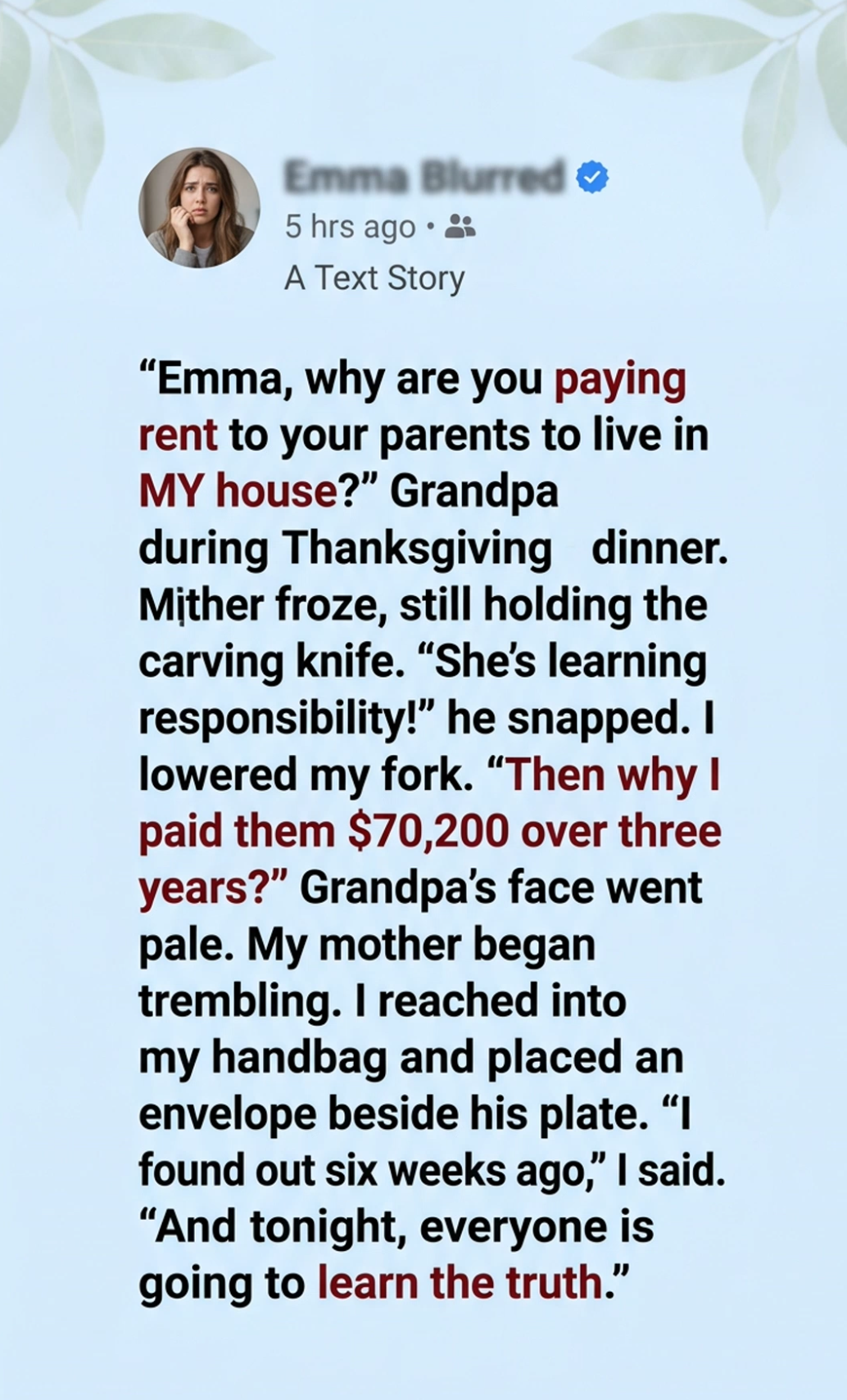
“Emma, why are you paying rent to your parents to live in MY house?”
My grandfather’s voice cut through the Thanksgiving dinner like a blade.
For a moment, nobody moved.
The candles flickered on the dining table. My uncle stopped chewing. My younger cousin lowered his glass. Even the old wall clock in the hallway seemed louder than before.
My father, Richard, stood at the head of the table with a carving knife in his right hand and a half-sliced turkey in front of him.
“What are you talking about, Dad?” he asked.
His voice was sharp, but I noticed the way his fingers tightened around the knife.
Grandpa Arthur looked directly at me.
“I asked why my granddaughter is paying rent to her parents to live in my house.”
I lowered my fork.
“Because Dad told me I had to,” I answered quietly. “He said the house belonged to him and Mom now, and that if I wanted to live there, I needed to contribute like a responsible adult.”
My father’s face darkened.
“She’s learning responsibility!” he snapped.
Grandpa didn’t look at him.
“Then why,” I continued, “have I paid them seventy thousand, two hundred dollars over the last three years?”
My mother, Linda, suddenly gripped the edge of the table.
Grandpa’s face went pale.
And that was when I knew.
He hadn’t known.
Not about the rent. Not about the money. Not about the lies that had become so ordinary in my parents’ house that I had almost convinced myself they were normal.
I reached into my handbag and took out a thick envelope.
“I found out six weeks ago,” I said.
I placed it beside Grandpa’s plate.
“And tonight, everyone is going to learn the truth.”
Nobody touched the turkey.
Nobody asked me to pass the potatoes.
For the first time in my twenty-seven years, my father had no immediate answer.
And I was finally ready to tell everyone why.
Chapter One: The House That Was Supposed to Be Mine
Three years earlier, I had been twenty-four, working as a medical billing specialist at a small clinic outside town.
My salary wasn’t impressive, but I had always been careful with money. I drove a used Honda, packed lunch instead of buying it, and kept a spreadsheet of every bill.
I wasn’t rich.
I simply wanted to build a life in which I didn’t have to ask anyone for permission to breathe.
My grandfather understood that about me.
Arthur Bennett had spent forty years running a hardware store before retiring. He was a quiet man who believed that promises mattered more than appearances. He rarely gave advice unless someone asked for it, but when he did speak, people listened.
My parents, unfortunately, had a different philosophy.
My father believed that being the head of the family meant having the final word. My mother believed that keeping the peace meant agreeing with him, even when she privately knew he was wrong.
My older brother, Jason, was their favorite example of success.
When Jason bought a new truck, Dad helped with the down payment. When he wanted to start a landscaping business, Mom covered his first several months of expenses. When his business struggled, my parents called it a temporary setback and helped him again.
When I asked for help paying for a professional certification, Dad told me I needed to learn to stand on my own two feet.
I paid for it myself.
I had learned early that Jason received support, while I received lectures.
Still, I loved my family. I kept telling myself that their treatment of me came from good intentions, even when the evidence suggested otherwise.
Then, shortly after my twenty-fourth birthday, Grandpa called me into his study.
He was sitting beside the window with a folder on his desk.
“Your grandmother and I bought that house on Willow Creek Road when your father was still in high school,” he said.
My grandmother had died six years earlier, and the house had remained one of the family’s most important possessions. It was a modest three-bedroom home with a wide porch, an old maple tree in the front yard, and a kitchen where generations of us had gathered for holidays.
I had spent countless weekends there as a child.
Grandpa continued.
“Your parents have been living in the house for a while. I’ve been thinking about what happens next.”
I assumed he was going to tell me he planned to sell it.
Instead, he pushed the folder toward me.
“I want you to have the house someday. But I don’t want you to think of it as a gift that means you never have to work. I want you to build a life there.”
I stared at him.
“Grandpa, what do you mean?”
“I mean that I’ve decided to transfer the property to you, with the legal arrangements my attorney and I have discussed. Your parents can remain there for now under a written agreement, but the ownership will be yours.”
I couldn’t speak.
The house was worth considerably more than anything I could have afforded on my salary. It was not a mansion, but it was safe, familiar, and full of memories.
“Why me?” I finally asked.
He smiled sadly.
“Because I’ve watched you work for everything you’ve got. And because I want you to have somewhere to begin, not somewhere you have to spend your whole life trying to earn.”
I hugged him so tightly that he laughed.
I asked whether my parents knew.
“They know I’m making arrangements,” he said. “I’ll discuss the details with them when everything is finalized.”
I trusted him.
A few weeks later, Grandpa told me the legal paperwork had been completed. He said he had made sure the transfer was properly recorded and that his attorney had copies of the documents.
I didn’t ask to see them.
That was my first mistake.
My second was believing my father would tell me the truth.
Chapter Two: The Rent
My parents called me into the living room one Sunday evening.
Dad sat in his favorite armchair. Mom stood near the fireplace, folding and unfolding a dish towel.
“We need to discuss your living arrangements,” Dad began.
I had been staying in the house since leaving a small apartment that had become too expensive after my rent increased.
Dad had told me I could move back temporarily while I saved for a down payment on my own place.
Now he was looking at me as though I had been taking advantage of him.
“You’re an adult,” he said. “You can’t expect to live here for free.”
“I wasn’t expecting to,” I replied. “I thought I was helping with groceries and utilities.”
“That isn’t enough.”
Mom nodded.
“Your father is right, Emma. You need to learn how the real world works.”
I felt embarrassed, although I couldn’t explain why. I had a job, paid my bills, and had never asked them for spending money.
“How much do you want me to pay?”
Dad had already prepared the answer.
“Nineteen hundred and fifty dollars a month.”
I stared at him.
“That seems high for a room.”
“Then find somewhere else,” he replied.
Mom immediately softened her voice.
“Your father doesn’t mean that, sweetheart. But we have expenses. The house needs maintenance. Property taxes are expensive. We’re giving you a chance to save while you live here.”
I wanted to believe her.
I also knew that renting a room elsewhere would cost nearly as much once I added utilities, transportation, and the deposit.
So I agreed.
The first payment came out of my checking account on the first of the following month. Dad told me to transfer the money to Mom because she handled the household finances.
I set up an automatic transfer.
Every month, nineteen hundred and fifty dollars went into her account.
Over three years, that became $70,200.
I didn’t spend that money on rent alone. I also bought groceries, paid for repairs when Dad said something had broken, and occasionally covered household bills when Mom claimed their account was running low.
Whenever I questioned the arrangement, Dad reminded me how much it cost to maintain a house.
“You should be grateful,” he said. “A stranger would charge you even more.”
Sometimes, when I came home late from work, I heard my parents discussing money in the kitchen.
They would stop talking when I entered.
When Jason visited, he never paid a cent.
He had his own apartment, but he frequently stayed overnight. Mom would prepare his favorite meals and send him home with containers of food.
One evening, I asked why Jason didn’t contribute when he stayed for several nights each month.
Dad looked offended.
“Your brother has a business to run. He has responsibilities.”
“So do I.”
“You have a steady paycheck. That’s different.”
I swallowed my anger.
I didn’t want another argument.
I told myself I was building savings, learning independence, and making the best of a temporary situation.
But there was something I couldn’t ignore.
Despite paying almost two thousand dollars every month, I wasn’t allowed to make even small decisions about the house.
I couldn’t repaint my bedroom without asking Dad. I couldn’t replace the broken bathroom faucet because he insisted he would handle it. I wasn’t allowed to invite friends over without giving my parents advance notice.
When I suggested that we put the household arrangement in writing, Dad laughed.
“Are you trying to turn your own parents into landlords?”
The accusation made me feel ashamed.
I dropped the subject.
For three years, I paid the money and tried to be the daughter they wanted.
Then I discovered the truth.
Chapter Three: The Letter in the Filing Cabinet
Six weeks before Thanksgiving, my mother asked me to find a folder in the study.
She was preparing paperwork for an insurance renewal and said she needed a copy of an old document.
“The gray folder in the bottom drawer,” she told me. “You know the one.”
I went into the study and opened the filing cabinet.
The gray folder wasn’t there.
Instead, I found a thick envelope marked with my grandfather’s name.
I almost put it back.
Then I noticed my name printed beneath his.
Emma Bennett — Property Transfer.
My heart began to beat faster.
I opened the envelope carefully.
Inside were copies of the deed, a property record, and a letter from Grandpa’s attorney confirming that the house on Willow Creek Road had been transferred into my name.
The transfer date was nearly three years earlier.
I read the documents twice.
Then a third time.
There was no misunderstanding.
My parents had not merely been allowed to live in the house. According to the records, I was the legal owner.
I stood there, holding the papers, unable to understand why my father had been collecting rent from me as though he owned the property.
I heard footsteps in the hallway.
I quickly returned the documents to the envelope, but I couldn’t bring myself to put it back in the drawer.
I took it to my bedroom and locked the door.
For the next hour, I sat on the edge of my bed, reading every page.
The documents were clear about the ownership transfer, although I knew I would need an attorney to explain what rights and obligations applied to my parents’ occupancy.
What I didn’t know was why they had lied.
That evening, I called Grandpa.
He answered on the second ring.
“Emma? Is everything all right?”
I tried to speak, but my voice broke.
“Grandpa, why didn’t you tell me the house was in my name?”
Silence.
Then I heard him exhale slowly.
“You found the papers.”
“Yes.”
Another silence followed.
“Your father told me he had explained the arrangement to you,” Grandpa said.
My stomach twisted.
“He told you that?”
“He said you understood the house was yours and that you were helping with the expenses while your parents continued living there.”
I closed my eyes.
“Grandpa, Dad has been charging me nineteen hundred and fifty dollars every month. He said he owned the house. He told me I had to pay rent or leave.”
I heard a sharp breath on the other end of the line.
“What?”
“I’ve paid seventy thousand, two hundred dollars over three years.”
Grandpa didn’t answer immediately.
When he finally spoke, his voice was different.
Not angry.
Worse.
Hurt.
“I gave that house to you so you would have security,” he said. “I never intended for your parents to use it to make money from you.”
“Did you know they were charging me?”
“No.”
I began to cry.
I wasn’t crying because of the money alone.
I was crying because my grandfather had tried to give me something that would help me build my future, and my parents had turned it into another reason to make me feel indebted to them.
“I’m sorry,” I whispered.
“You have nothing to apologize for.”
“I’m afraid if I confront Dad, he’ll say I’m ungrateful.”
“Emma, listen to me. You have every right to ask questions about your own property and your own money.”
I wiped my face.
“What should I do?”
“First, don’t get into a shouting match. Keep copies of everything. Then speak with an independent attorney. Someone who represents you, not me and certainly not your father.”
I nodded, even though he couldn’t see me.
“Will you help me?”
“Of course. But I want you to make your own decisions. I don’t want you to feel that you owe me obedience just because I gave you a house.”
That sentence stayed with me.
For the first time, I understood the difference between a gift and a trap.
Grandpa’s gift had been meant to give me freedom.
My parents had made me feel as though I owed them my entire life for the privilege of living inside it.
Chapter Four: Six Weeks of Silence
I didn’t confront my parents immediately.
I needed to understand what had happened before I accused anyone of anything.
The next morning, I contacted a property attorney recommended by a colleague. I brought copies of the deed, the transfer documents, and my bank statements.
The attorney, Ms. Collins, reviewed everything carefully.
“The documents indicate that you own the property,” she explained. “However, ownership doesn’t automatically settle every question about your parents’ right to occupy it. We need to review any written or verbal arrangements, local law, and the circumstances of their residency.”
“What about the money they’ve taken?”
“That depends on what they represented to you, what you agreed to pay, and what the evidence shows. We shouldn’t assume every payment is automatically recoverable. But if you were deliberately misled, that’s something we can investigate.”
She asked me to gather every rent transfer, text message, email, and note relating to the arrangement.
I did.
I found messages from Dad saying, Your rent is due tomorrow. Don’t make me chase you.
Another read, If you can’t afford the payment, perhaps you’re not ready to live independently.
Mom had sent me reminders about the “household contribution” and told me to transfer the money directly to her account.
I also found a message from Dad thanking me for helping cover the property taxes.
I printed everything.
Then Ms. Collins asked me a question that made my hands go cold.
“Have your parents ever told you that they were collecting this money on your grandfather’s behalf?”
“No,” I answered. “They said the house belonged to them.”
“Do you have that in writing?”
I searched my messages and found a text from three years earlier.
This is my house, Emma. If you live under my roof, you follow my rules and pay your share.
I showed it to her.
She read it twice.
“Keep the original message,” she said. “Don’t delete anything, and don’t alter any records.”
Over the next several weeks, I tried to act normally at home.
I ate dinner with my parents. I went to work. I paid my usual bills, but I stopped making extra household payments that hadn’t been agreed upon in advance.
I also began saving every dollar I could.
Meanwhile, I learned something else.
The property taxes had been paid from an account Grandpa maintained for the house. He had arranged for those expenses to be covered during the period when my parents were living there.
The money I had been paying them wasn’t needed for the reason Dad had given me.
That didn’t prove where every dollar had gone, but it made his explanation increasingly difficult to believe.
I asked my mother one afternoon whether the house needed repairs.
“Not particularly,” she replied.
“Then why did Dad say the rent was so high because of repairs and taxes?”
She froze for half a second.
Then she busied herself with the dishes.
“Your father handles those things.”
“Mom, did Grandpa give me the house?”
The plate in her hand slipped slightly against the sink.
“What kind of question is that?”
“A simple one.”
She turned toward me.
“You shouldn’t be going through private family documents.”
“They had my name on them.”
Her expression hardened.
“Your father knows what’s best for this family.”
That was all she said.
I went to my room and shut the door.
I no longer needed her to admit what had happened. Her reaction told me enough about how unwilling she was to discuss it honestly.
Still, I wasn’t prepared for what I discovered next.
A few days before Thanksgiving, Ms. Collins called me.
“I reviewed the documents your grandfather’s attorney provided,” she said. “There’s an additional issue you should know about.”
My stomach tightened.
“What is it?”
“Your father contacted your grandfather’s attorney around the time the property transfer was completed. He asked whether the deed could be changed so that he and your mother would retain ownership.”
“Could it?”
“Your grandfather refused. The attorney’s file contains a letter explaining that the transfer was intended to give you independent ownership.”
I sat down.
“Did Dad know the house was legally mine?”
“Yes. The correspondence strongly indicates that he knew.”
I felt a strange calm settle over me.
My father hadn’t misunderstood.
He hadn’t made an honest mistake.
He had known the house belonged to me.
And he had charged me rent anyway.
Ms. Collins continued.
“I recommend that you don’t make any threats or attempt to force your parents out on your own. Let us handle the legal questions properly. If you choose to confront them, do it safely and keep the discussion factual.”
I thanked her.
Then I called Grandpa and asked him whether he still wanted to come to Thanksgiving dinner at my parents’ house.
“Of course,” he said. “Why?”
“Because I think it’s time everyone heard the truth.”
He was quiet for a moment.
“Are you sure?”
“No,” I admitted. “But I’m tired of being afraid.”
“Then I’ll be there.”
Chapter Five: Thanksgiving
Thanksgiving had always been my mother’s favorite holiday.
She spent days preparing the meal, polished the silverware, and arranged the table as though we were hosting a magazine photo shoot.
This year, the house looked exactly as it always had.
The same white curtains.
The same framed family photographs.
The same wooden dining table where my father expected everyone to listen when he spoke.
I arrived early to help Mom prepare the vegetables.
She seemed unusually cheerful.
“Your father invited Jason to bring his new girlfriend,” she said. “We’re going to have a full table this year.”
I nodded.
“That’s nice.”
She studied me.
“Are you all right, sweetheart? You’ve been distant lately.”
I wanted to ask her how she could say that while knowing what had happened.
Instead, I answered, “I’ve had a lot on my mind.”
She looked relieved that I hadn’t challenged her.
“Don’t bring your work stress to dinner, okay? Your father has had a difficult few months.”
I almost laughed.
My father had spent three years collecting rent from his own daughter for a house he didn’t own, but apparently his stress was the family emergency that mattered.
By five o’clock, everyone had arrived.
Jason came in wearing an expensive jacket and carrying a bottle of wine. He hugged Mom, shook Dad’s hand, and barely acknowledged me.
My uncle Peter brought pumpkin pie. My aunt Susan brought a casserole. Grandpa arrived last, carrying a small box of chocolates for Mom.
He greeted everyone politely, but his eyes met mine for a moment.
He knew why we were there.
Dinner began as usual.
Dad carved the turkey and talked about Jason’s business. Mom praised the food. My uncle discussed a new truck he was considering buying.
Then Grandpa looked across the table at me.
“Emma, how are things going at the house?”
I knew what he was doing.
He was giving me an opportunity to speak.
“Fine,” I said. “Although I’ve been thinking about how much it costs me to live there.”
Dad gave a short laugh.
“Here we go.”
Grandpa set down his fork.
“What do you mean?”
I took a breath.
“Dad charges me nineteen hundred and fifty dollars every month to live in the house.”
My aunt looked surprised.
Jason frowned.
“That’s a lot for a room.”
Dad pointed the carving knife toward him.
“It’s not just a room. She’s living in a family home. She uses the kitchen, the laundry, the utilities. She needs to learn responsibility.”
Grandpa’s expression changed.
“Emma, why are you paying rent to your parents to live in MY house?”
The table went silent.
Dad froze.
Mom’s hand began to tremble.
I lowered my fork.
“Because Dad told me I had to. And because I believed him.”
Dad slammed the knife onto the cutting board.
“Don’t start making accusations in front of everyone!”
“Then why have I paid you seventy thousand, two hundred dollars over three years?”
He opened his mouth.
Nothing came out.
I reached into my handbag and placed the envelope beside Grandpa’s plate.
“I found out six weeks ago,” I said. “I checked the property records, spoke with an attorney, and collected my bank statements.”
My father stared at the envelope as if it were something dangerous.
“What did you do?” he demanded.
“I found the deed.”
Grandpa reached for the envelope and opened it.
I had prepared copies of the property transfer, a summary of my payments, and selected messages in which Dad had claimed the house was his.
I had also included the letter from Grandpa’s attorney confirming that the transfer had been intentional.
Grandpa read silently.
My father shifted in his chair.
“Arthur, this is a private family matter.”
Grandpa looked up.
“You made it a family matter when you lied to my granddaughter.”
Dad’s face reddened.
“I never lied.”
I slid a printed message across the table.
This is my house, Emma. If you live under my roof, you follow my rules and pay your share.
Dad looked at the message.
Then he looked at me.
“You took my words out of context.”
“Then explain the context,” I said.
He had no answer.
My mother began crying.
“Please,” she whispered. “Not tonight.”
I turned toward her.
“Mom, you knew?”
She covered her mouth.
“Emma—”
“You knew the house belonged to me, didn’t you?”
She looked at Dad.
That was all the answer I needed.
Jason leaned back in his chair.
“Wait. Grandpa gave Emma the house?”
“Yes,” Grandpa said. “I transferred it to her because I wanted her to have a secure place to build her future.”
Jason looked at Dad.
“Then why were you charging her rent?”
Dad stood so quickly that his chair scraped across the floor.
“Because somebody had to pay for this household!”
Grandpa didn’t flinch.
“I arranged for the property expenses to be covered.”
“Not everything!” Dad shouted. “You have no idea what it costs to keep a family together!”
“Then why didn’t you tell Emma the truth?” I asked.
“Because you wouldn’t understand!”
I stared at him.
“Understand what?”
He pointed toward me.
“You’ve always thought you deserved special treatment. You get a house handed to you, and suddenly you’re too good to contribute?”
The words hurt, but they no longer confused me.
“I paid seventy thousand dollars,” I said. “I contributed more than you asked for. I paid on time. I bought groceries. I covered extra bills when Mom said there wasn’t enough money. And all that time, you let me believe I was lucky you allowed me to stay.”
Dad’s jaw tightened.
“You’re my daughter.”
“Yes,” I replied. “That’s why I trusted you.”
The room was so quiet that I could hear someone breathing heavily at the far end of the table.
Then Grandpa spoke.
“Richard, where did the money go?”
My father looked toward the kitchen.
“Household expenses.”
“Which expenses?” Grandpa asked.
Dad said nothing.
I had expected him to deny everything. I had expected him to shout, blame me, or accuse Grandpa of turning me against him.
I hadn’t expected the next thing he said.
“Jason needed help.”
My brother went completely still.
“What?” he asked.
Dad rubbed his forehead.
“Your business was struggling. You had equipment payments, the truck, and the loan. The money had to come from somewhere.”
I turned toward Jason.
“You were getting my rent money?”
Jason looked horrified.
“I didn’t know it was your money.”
Dad immediately interrupted.
“He didn’t ask questions because he didn’t need to. I was helping my son.”
I felt something inside me break—not loudly, not dramatically, but with the finality of a door closing.
“You took money from me to support Jason,” I said. “And you told me it was rent.”
Dad raised his voice.
“I was keeping this family afloat!”
Grandpa stood.
“No. You were using one child to finance another and calling it responsibility.”
My mother sobbed into her napkin.
“Richard, stop,” she whispered.
But he wasn’t finished.
“You all act as though I’m some criminal,” he said. “I raised you. I put a roof over your head. I worked my whole life for this family. And now everyone wants to humiliate me over money?”
I looked at him for a long moment.
“Dad, you could have asked me for help. You could have told me Jason was struggling. I might have agreed to contribute something. But you chose to lie to me for three years.”
His expression hardened.
“You should be grateful we let you stay.”
Grandpa’s voice thundered across the table.
“Get out of my sight, Richard.”
Nobody moved.
Dad looked at his father in disbelief.
“Excuse me?”
“You heard me. You will not speak to Emma like that in this house.”
“This is my house!”
Grandpa lifted the deed.
“No, son. It isn’t.”
For the first time in my life, my father looked genuinely frightened.
Not because he had been caught in an argument.
Because he had lost control of the story he had been telling everyone—including himself.
Chapter Six: The Money Behind the Lies
The dinner ended shortly afterward.
My aunt helped Mom clear the table. My uncle took Grandpa into the living room. Jason stood near the back door, staring at his phone without reading anything on the screen.
Dad disappeared into the study.
I followed him after a few minutes.
He was standing behind the desk, his hands pressed against the wood.
“You’ve made your point,” he said without looking at me.
“I didn’t come here to make a point.”
“Then what do you want?”
“The truth.”
He laughed bitterly.
“You got it. The money helped your brother.”
“You told me the house needed repairs and that I was paying property taxes.”
“I never said every dollar went toward those things.”
“You told me the money was rent.”
“That’s what families do! They help each other!”
“Then why didn’t you tell me?”
He finally looked at me.
“Because you would have said no.”
I stared at him.
“So you knew I wasn’t agreeing to help Jason. You knew I thought I was paying rent. And you decided to lie because it was easier.”
He said nothing.
I continued.
“How much did you give him?”
“That’s none of your business.”
“It’s my money.”
His face twisted.
“Your money? You’re twenty-seven years old, Emma. Do you know how much I sacrificed to raise you?”
“I know you raised me. I know you fed me, bought my clothes, and paid for things when I was a child. I will always be grateful for that. But I didn’t agree to spend my adult life paying you back for being my father.”
He looked away.
For a moment, I thought he might finally understand.
Then he said, “If you take this any further, you’ll destroy your mother.”
I felt the old guilt rise in my chest.
It had always worked before.
Whenever Dad did something wrong, Mom became the reason I was expected to forgive him. If I objected, I was hurting her. If I defended myself, I was breaking the family apart.
This time, I didn’t retreat.
“I’m not destroying Mom,” I said. “I’m asking you to take responsibility for what you did.”
He shook his head.
“You’ve changed.”
“Yes,” I replied. “I have.”
I walked out of the study.
In the living room, Grandpa was waiting for me.
“Are you all right?”
“I don’t know.”
He nodded.
“You don’t have to know tonight.”
I sat beside him.
For a while, we listened to the sounds of the kitchen. My mother was crying softly. My aunt was trying to comfort her.
Then Grandpa handed me a glass of water.
“Your grandmother used to say that the truth is like sunlight,” he said. “People can close the curtains, but that doesn’t mean the sun has gone away.”
I smiled weakly.
“Did she say that when Dad was being difficult?”
He chuckled.
“More often than you might imagine.”
I leaned my head against his shoulder.
For the first time that evening, I allowed myself to cry.
Not because I regretted speaking up.
Because I was grieving the family I had believed I had.
Chapter Seven: My Mother’s Confession
The following morning, my mother called me into the kitchen.
Dad had left early, claiming he needed time to think. Jason had gone home. Grandpa had stayed overnight in the guest room because he didn’t want me to drive back to his place while I was upset.
Mom looked exhausted.
Her eyes were swollen, and her hair was tied back carelessly.
“Sit down,” she said.
I sat.
She placed a cup of tea in front of me.
“I owe you an explanation.”
I waited.
She twisted her wedding ring.
“When your grandfather transferred the house, your father was furious. He felt humiliated that his own father had given such a valuable thing to his daughter instead of to him.”
“That doesn’t explain the rent.”
“I know.”
She stared into her tea.
“Your father believed the house should eventually belong to him. He thought Grandpa would change his mind if he kept arguing. When that didn’t happen, he decided that since he and I were living there, we should collect money from you.”
“Did he tell you that was his plan?”
She nodded.
“And you agreed?”
She began crying.
“At first, I told him it wasn’t right. I said we should tell you about the transfer. He said you were young, that you didn’t understand property expenses, and that the money would help us maintain the house.”
“But Grandpa was paying the property expenses.”
“I know that now.”
“Mom, did you know that then?”
She hesitated.
“I knew he was helping with some expenses. I didn’t know exactly how much he was covering.”
I felt anger rise again.
“You could have asked.”
“Yes,” she whispered. “I could have.”
I looked at her.
“Why didn’t you?”
She wiped her eyes.
“Because your father gets angry when people challenge him. And because I was afraid that if I opposed him, our marriage would become unbearable.”
I sat silently.
For years, I had thought my mother simply didn’t care enough to defend me.
Now I was beginning to understand that she had been afraid of my father.
But understanding was not the same as excusing.
“You let me believe I was a burden,” I said. “Every time I paid rent, Dad reminded me how lucky I was to have a place to live. I worked extra hours. I stopped going out with friends. I put off buying a reliable car because I thought I had to save more.”
Mom cried harder.
“I know.”
“No, I don’t think you do.”
I took a breath.
“I trusted you. I thought if I ever needed help, you would be honest with me. Instead, you watched while I paid money I didn’t owe under the arrangement you told me about.”
She reached for my hand.
I let her touch it, but I didn’t hold hers.
“I’m sorry,” she said.
It was the first apology she had offered without blaming Dad, Grandpa, or the circumstances.
I wanted to accept it immediately.
I wanted to tell her everything was fine so she could stop crying.
That was what I had always done.
But I was tired of making everyone else comfortable at my own expense.
“I hear your apology,” I said. “But I need time. And I need you to understand that things can’t go back to the way they were.”
She nodded slowly.
“What happens now?”
“I’m going to work with my attorney to sort out the house and the money. I won’t be paying rent anymore. And I won’t cover household expenses unless we agree on them honestly and in writing.”
She looked frightened.
“Are you going to make us leave?”
“I haven’t decided what happens with the house yet. But I’m not going to make that decision because Dad threatens me or because you cry. I’ll make it after I understand my rights and what is fair.”
For once, she didn’t argue.
She simply nodded.
It wasn’t forgiveness.
It was a beginning.
Chapter Eight: My Brother’s Secret
Two days after Thanksgiving, Jason came to see me.
He stood outside my bedroom door with his hands in his pockets.
“Can I talk to you?”
I let him in.
He looked around the room as if he had never really noticed it before.
“Dad told me what happened,” he said.
I sat on the edge of my bed.
“Did he?”
“He said you’re upset because he used the money to help me.”
“That’s one way to describe it.”
Jason winced.
“I didn’t know he was taking your rent money.”
I believed him.
Jason had always been selfish in certain ways, but he wasn’t usually cruel. He had allowed our parents to rescue him so often that he rarely questioned where the money came from.
“Did you know Grandpa gave me the house?” I asked.
Jason hesitated.
“I knew he was planning something. Dad told me he thought Grandpa was making a mistake.”
“Did you know the transfer had gone through?”
“No.”
I watched him carefully.
“Then why didn’t you ask?”
Jason sat down.
“Because I didn’t want to get involved. Dad said the house would eventually be his, and I assumed he knew what he was talking about.”
I almost smiled at the absurdity of it.
“That seems to be everyone’s excuse.”
He rubbed his face.
“How much did Dad give me?”
“I don’t know exactly.”
“I checked my business records yesterday. There were transfers from Mom’s account over the last three years. I thought they were money they’d saved for me.”
My chest tightened.
“How much?”
“About thirty-eight thousand dollars.”
I stared at him.
He looked sick.
“I used it to cover equipment payments and part of the truck loan. I thought they were helping me because the business was struggling.”
“They were helping you with money I paid them.”
“I know.”
He looked down at his hands.
“I should have asked where it came from.”
“Yes,” I said. “You should have.”
He swallowed.
“I can pay you back.”
I didn’t answer immediately.
Part of me wanted to say yes, to tell him that if he repaid the money, we could move past this.
But money wasn’t the only thing that had been taken from me.
“You can speak to my attorney about repayment,” I said. “I’m not making private agreements that could create more confusion.”
He nodded.
“I understand.”
“Do you?”
He looked up.
“I think I do now.”
For the first time, my brother seemed to understand that being the favored child hadn’t protected him from the consequences of our parents’ decisions.
It had simply kept him from seeing the cost.
Before he left, he paused at the door.
“Emma, I’m sorry.”
I believed that apology, too.
But I wasn’t ready to tell him everything was forgiven.
“Then show me,” I said. “Don’t just say it.”
He nodded and left.
That afternoon, I sent Ms. Collins a summary of what Jason had told me.
The attorney advised that any repayment should be documented properly and handled separately from the question of my parents’ occupancy.
I agreed.
For the first time, I wasn’t trying to solve the family’s problems by myself.
I was allowing the people who had created those problems to take responsibility for them.
Chapter Nine: The Decision About the House
Over the next several weeks, my attorney reviewed the property documents, the payment records, and the circumstances surrounding the rent arrangement.
She explained that recovering the full $70,200 might not be straightforward. Some money could be characterized as agreed household contributions, while other payments might be disputed. We would need to assess each category carefully and determine what claims were supported by the evidence.
I wanted to pursue the money.
But I also wanted a life that didn’t revolve around fighting my parents.
Ms. Collins helped me separate those decisions.
“You can seek repayment without deciding that you must remove your parents immediately,” she said. “And you can make a housing decision based on your own needs rather than guilt.”
That distinction mattered.
My parents had lived in the house for years. It was familiar to them, and my mother had nowhere else she could comfortably move without planning. I didn’t want to punish her simply because she had been too afraid to challenge Dad.
But I also couldn’t keep living under the same roof while pretending nothing had happened.
I decided that I would move into the house as its owner, establish a written occupancy arrangement if my parents wished to remain temporarily, and require them to respect clear boundaries.
They would not collect rent from me.
They would not make financial decisions on my behalf.
And if they wanted to continue living there, we would need a lawful, written agreement that protected everyone’s rights.
My attorney handled the formal notices and reviewed the applicable requirements. Nothing would happen through threats or sudden lock changes. I wanted the transition to be fair and legally sound.
When I explained my decision to Grandpa, he nodded.
“That’s sensible.”
“Are you disappointed that I’m not making them leave immediately?”
“Not at all. It’s your house, Emma. The question isn’t what I would do. It’s what you can live with.”
I smiled.
“Grandma would have liked that answer.”
“She would have told you to stop worrying about what everyone else liked.”
He was right.
I had spent so long trying to be the easy daughter that I had forgotten I was allowed to be a person with needs of my own.
My father did not take the decision well.
When I told him I would be moving into the main bedroom and taking responsibility for the property, he accused me of trying to humiliate him.
“You want me to live in a house owned by my daughter?”
“You’ve been living in a house owned by your daughter for three years,” I replied. “The difference is that now we’re going to be honest about it.”
He called me ungrateful.
He said Grandpa had turned me against him.
He said I was destroying the family.
I listened without arguing.
Then I told him that any further discussion about the house needed to go through my attorney.
He hung up on me.
For the first time, the sound of the phone disconnecting didn’t make me panic.
It simply meant the conversation was over.
Chapter Ten: The First Repayment
The legal process took months.
There were letters, financial records, meetings, and difficult conversations. Some expenses were legitimate. Others were not clearly documented. My attorney negotiated with my parents’ representative, and we eventually reached a written settlement concerning the disputed payments.
The agreement did not return every dollar I had paid.
Some money was treated as a contribution toward household costs under the circumstances of my residency. Other amounts were repaid or credited as part of the settlement.
My father had to acknowledge that the house belonged to me and that he had misrepresented the ownership when collecting rent.
The settlement also established a timetable for my parents’ transition to other housing.
They were given reasonable time to arrange their affairs, and the occupancy agreement was handled through the proper legal process.
My mother moved into a small rental townhouse nearby.
Dad initially refused to move, insisting that he had a right to stay. Eventually, after receiving legal advice of his own, he accepted the arrangement.
He did not apologize.
Not then.
Jason, however, began making regular repayments under a separate agreement. He sold the truck he had bought with part of the money and reduced his business expenses. It wasn’t an easy process, but he followed through.
The first payment arrived in my account on a rainy Tuesday morning.
I stared at the notification for a long time.
It wasn’t a fortune.
It wasn’t even close to the amount I had lost.
But it represented something I hadn’t felt in years: evidence that my boundaries could have consequences.
I moved into the house two weeks after my parents left.
The first night, I slept in the bedroom I had grown up in.
The house was quiet.
There were no arguments coming from the living room. No reminders about money. No footsteps outside my door signaling that someone wanted to tell me what I had done wrong.
I walked through every room.
The kitchen still had the same old cabinets. The maple tree outside my window had lost most of its leaves. The porch boards creaked when I stepped onto them.
It was the same house.
But for the first time, I didn’t feel like a guest.
I felt like I belonged there.
Chapter Eleven: The Apology I Never Expected
Almost five months after Thanksgiving, my father called.
I nearly let it go to voicemail.
Then I answered.
“Emma.”
“Dad.”
There was a long silence.
“Your mother says you’ve been doing well.”
“I’m fine.”
“I heard you’ve repainted the kitchen.”
“I have.”
Another silence.
Then he said, “I suppose the house looks better now.”
It wasn’t an apology, but it was the closest thing to a peaceful opening he had offered in months.
“Dad, why are you calling?”
He exhaled.
“I’ve been thinking about what happened.”
I waited.
“I shouldn’t have told you the house was mine.”
The words were stiff, almost painful for him to say.
“No,” I replied. “You shouldn’t have.”
“And I shouldn’t have taken the money without telling you where it was going.”
I felt my throat tighten.
It was the first time he had acknowledged the truth without immediately blaming someone else.
“Why did you do it?” I asked.
He was quiet for so long that I thought he had hung up.
Finally, he answered.
“Because I was angry.”
“About what?”
“Your grandfather giving you the house. I thought he was saying I hadn’t done enough for my family. I thought he was choosing you over me.”
I sat down at the kitchen table.
“So you decided to prove you were still in control.”
“I suppose I did.”
“And you used me to do it.”
He didn’t argue.
“Yes.”
I looked out the window at the maple tree.
“I need you to understand something, Dad. I wasn’t trying to take anything from you. I was trying to build a life. Grandpa gave me a chance to do that, and you turned it into a debt I could never repay.”
“I know.”
“No, you didn’t know then. Maybe you do now.”
He sighed.
“I don’t expect you to forgive me.”
I hadn’t expected those words.
For once, he wasn’t demanding that I put his feelings ahead of my own.
“I don’t know if I can forgive you yet,” I said.
“That’s fair.”
We talked for another ten minutes.
He told me he was looking for work that would allow him to cover his expenses independently. He said he had started meeting with a counselor because his anger was damaging more relationships than he wanted to admit.
I didn’t know whether the changes would last.
I wasn’t ready to trust him simply because he had apologized.
But when we ended the call, I felt something loosen inside me.
Not forgiveness.
Possibility.
Chapter Twelve: A Different Kind of Thanksgiving
The following Thanksgiving, I hosted dinner at the house.
I invited Grandpa, Mom, Jason, Aunt Susan, Uncle Peter, and a few friends who had supported me during the previous year.
I wasn’t sure whether Dad would come.
Three days before the holiday, he called and asked if he could attend.
I considered the question carefully.
“Are you willing to respect my house and the people in it?” I asked.
“Yes.”
“Are you willing to let me decide how the evening goes without turning it into an argument?”
He paused.
“Yes.”
“Then you can come.”
He arrived carrying a pumpkin pie.
He looked older than he had the year before, although perhaps I was simply seeing him differently.
He greeted Grandpa politely. He helped Jason carry chairs from the garage. He complimented the food without trying to control the conversation.
When dinner was served, Grandpa stood and raised his glass.
“To family,” he said.
Everyone lifted their glasses.
Then he looked at me.
“And to the courage to tell the truth, even when the truth makes the room uncomfortable.”
I smiled.
My mother wiped her eyes.
Jason reached across the table and squeezed my hand.
Dad lowered his gaze for a moment, then looked up.
“I want to say something,” he began.
The table grew quiet.
“I was wrong about what happened last year. I lied to Emma about the house, and I took money from her under false pretenses. I convinced myself I was helping the family, but I was protecting my pride.”
He swallowed.
“I hurt my daughter. I put my wife in a position where she felt she had to stay silent. And I allowed my son to benefit from something he didn’t understand.”
Jason looked down.
Dad continued.
“I can’t undo that. I can only try to do better.”
He turned toward me.
“Emma, I’m sorry.”
The apology was not perfect.
It did not erase three years of humiliation, anxiety, and lost savings. It did not restore the trust I had once placed in him without question.
But it was honest.
And honesty was the one thing I had needed from him all along.
“Thank you for saying that,” I replied.
I didn’t hug him.
I didn’t tell him everything was forgiven.
I simply accepted the apology for what it was: a beginning, not a conclusion.
Then I passed him the potatoes.
It was a small gesture, but it felt right.
The evening continued.
We talked about Jason’s business, which had begun recovering after he cut expenses and changed how he managed his money. Mom told us about her new garden. Grandpa shared stories about my grandmother, including the time she accidentally served salt instead of sugar in a cake.
For the first time in years, Thanksgiving felt like a gathering rather than a performance.
There were no accusations.
No secret debts.
No one reminding me how lucky I was to be allowed a place at the table.
Because I had finally learned something important.
Being part of a family did not mean surrendering the right to ask questions.
Love did not mean accepting dishonesty.
And gratitude did not mean owing someone unlimited access to your life.
Epilogue: The House With the Maple Tree
A year later, I sat on the front porch with Grandpa, watching the evening sunlight fall across the yard.
The maple tree was covered in new leaves.
I had repaired the porch steps, repainted the kitchen, and turned the smallest bedroom into a home office. I had also restarted the savings plan I had abandoned while paying rent.
I wasn’t wealthy.
I wasn’t suddenly free of every worry.
But I had control over my future, and that mattered more than I could explain.
Grandpa took a sip of tea.
“Do you regret what happened?” he asked.
I thought about the question.
“I regret that it happened. I regret losing three years to a lie. But I don’t regret finding out the truth.”
He nodded.
“That’s a good distinction.”
I looked toward the front door.
For a long time, I had believed that a peaceful family was one in which nobody raised their voice, nobody asked uncomfortable questions, and nobody admitted that something was wrong.
Now I understood that silence could look peaceful while quietly destroying the people trapped inside it.
The house had been a gift, but the real gift was what it taught me.
I could love my parents without allowing them to control me.
I could forgive without pretending nothing had happened.
I could accept an apology without immediately restoring the trust that had been broken.
And I could be grateful to my grandfather without feeling that I owed him my choices.
That Thanksgiving dinner had begun with a question that made everyone freeze.
“Emma, why are you paying rent to your parents to live in MY house?”
At the time, I thought the answer would destroy my family.
Instead, it forced us to confront the truth about the family we had become.
Some relationships changed permanently. Some began to heal. Others required distance.
But the biggest change happened inside me.
I stopped confusing obedience with love.
I stopped believing that being a good daughter meant accepting every unfair demand.
And I stopped apologizing for protecting what was mine.
As the sun disappeared behind the maple tree, Grandpa rested his hand on my shoulder.
“Your grandmother would be proud of you,” he said.
I smiled, feeling the quiet comfort of a home that no longer came with a hidden price.
For the first time in my life, I wasn’t paying rent to belong.
I was simply home.