The first thing my mother did when I walked into the hotel lobby was smile.
Not the warm smile she used for strangers, neighbors, or the women at her charity luncheons. This was the small, satisfied smile she wore whenever she believed she had finally put me in my place.
“Your room has been canceled, sweetheart,” she announced.
I stopped beside the marble reception desk, my suitcase still in my hand.
“What?”
My mother, Diane Henderson, adjusted the gold bracelet around her wrist. Behind her, my older sister, Vanessa, was sitting on a velvet sofa with a champagne flute in her hand. My father, Richard, stood beside her, scrolling through his phone as if the entire situation had nothing to do with him.
“The hotel says there was a cancellation request,” my mother continued. “Apparently, your reservation was removed this morning.”
I looked at the receptionist.
She offered me an apologetic expression. “I’m sorry, ma’am. The reservation under your name is no longer active.”
My stomach tightened.
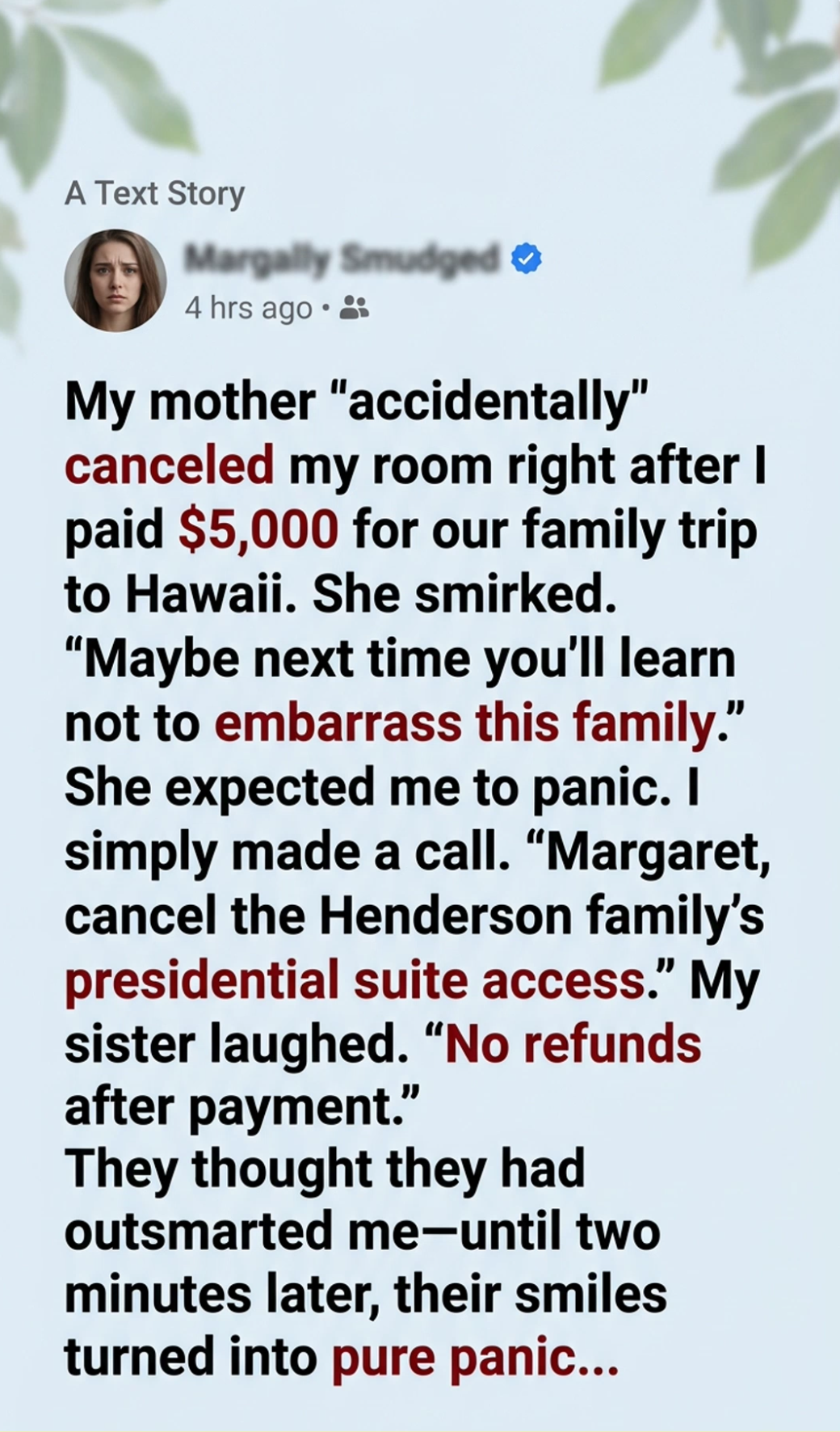
I had paid $5,000 toward this trip.
Five thousand dollars from the savings I had spent almost two years building. Five thousand dollars I had contributed because my parents insisted that our first family vacation in years should be unforgettable.
I had covered the initial deposit, arranged the airport transfers, and helped coordinate the hotel reservations. My mother had promised that everything would be divided fairly.
Now, standing in a luxury hotel in Honolulu, I was being told that I had nowhere to sleep.
“Mom,” I said slowly, “why would you cancel my room?”
She tilted her head.
“Perhaps you should ask yourself why we felt it was necessary.”
Vanessa laughed into her champagne.
“Oh, don’t start, Claire. We haven’t even checked in properly.”
I stared at her.
“What does that mean?”
My mother lowered her voice, though not enough to prevent the receptionist from hearing.
“Maybe next time you’ll learn not to embarrass this family.”
There it was.
The real reason.
Not an accidental booking error. Not a misunderstanding. Not some computer problem.
Punishment.
Three weeks earlier, I had refused to lie for Vanessa.
My sister had been telling everyone that she had personally organized the entire Hawaii vacation. She posted photographs of the resort, described the presidential suite she claimed to have secured, and told her friends that she had arranged a special experience for our parents.
The truth was that she had done almost none of the work.
I had researched the hotel, negotiated the group arrangements, transferred the money, and spent hours speaking with the management team.
Vanessa had contributed a few messages in the family group chat.
Yet when a family friend asked who had made the trip possible, Vanessa smiled and said, “I wanted to do something special for Mom and Dad.”
I corrected her.
Not rudely. Not dramatically.
I simply said, “Actually, I’ve been handling the bookings and paid the initial $5,000 deposit.”
Vanessa’s smile disappeared.
Later that evening, my mother called me and accused me of humiliating my sister.
“You made her look like a liar,” she said.
“I corrected something that wasn’t true.”
“You could have let her have her moment.”
“Her moment was built on my work and my money.”
My mother hung up on me.
I should have recognized the warning signs then.
Instead, I assumed the argument would fade once everyone calmed down.
I was wrong.
Now, in the middle of a hotel lobby, my mother looked almost delighted by my confusion.
“You can find another hotel,” she said. “There are plenty on the island.”
Vanessa raised her glass.
“And good luck getting your money back. No refunds after payment.”
She laughed again.
My father finally looked up from his phone.
“Claire, please don’t turn this into another scene. We came here to enjoy ourselves.”
I looked at him.
“Dad, I paid $5,000.”
He sighed as if I had inconvenienced him.
“And we appreciate that.”
“Then why am I the only person without a room?”
“Your mother made the arrangements.”
“That doesn’t answer my question.”
He looked away.
My mother folded her arms.
“Perhaps if you had been more supportive of your sister, things would be different.”
I felt a familiar ache in my chest.
For most of my life, I had been the dependable daughter.
I was the one who remembered birthdays, paid bills when my parents were short, helped my father understand paperwork, and drove my mother to appointments. When Vanessa needed money, I lent it to her. When she forgot deadlines, I helped her meet them.
Whenever I accomplished something, my parents called it an obligation.
Whenever Vanessa accomplished something, they called it extraordinary.
I had spent years believing that if I became patient enough, generous enough, and successful enough, they would eventually treat us equally.
But equality had never been the arrangement.
My role was to give.
Vanessa’s role was to receive.
And whenever I objected, I was accused of ruining the family.
I glanced at the receptionist.
“Could you tell me when the cancellation was requested?”
She checked her screen.
“It was submitted at 9:17 this morning.”
I looked at my watch.
It was now 2:46 p.m.
“Was the room canceled by the person whose name was on the reservation?”
The receptionist hesitated.
“I can provide only limited details, but the request came through the group booking account.”
I nodded.
“Thank you.”
My mother gave a dismissive wave.
“Are we finished? Some of us would like to start our vacation.”
I looked at her for a long moment.
Then I smiled.
Not because I was happy.
Because I had finally understood something.
They believed I was trapped.
They believed I had spent $5,000, had no way to recover it, and would be forced to beg them to let me stay with the family.
They had mistaken my silence for helplessness.
I set my suitcase upright beside the desk.
“Actually, Mom, I think you’re right. We should make a few calls.”
Vanessa rolled her eyes.
“Oh, here we go. Who are you calling? The manager? Your lawyer?”
I took out my phone.
“Someone who can help.”
My mother smirked.
“Don’t be ridiculous.”
I scrolled to a contact saved under one name.
Margaret.
Then I pressed call.
She answered on the second ring.
“Claire, darling! Have you arrived? I was just checking that everything went smoothly.”
“I’m here,” I said. “But there’s been a change in the arrangements.”
“What’s happened?”
I glanced at my family.
My mother was already turning toward the elevators. Vanessa had resumed scrolling through her phone.
They were so certain that I would do nothing that they had stopped paying attention.
“Margaret, I need you to cancel the Henderson family’s presidential suite access.”
The reaction was immediate.
Vanessa’s head snapped up.
My mother froze.
My father lowered his phone.
Margaret paused.
“I’m sorry, Claire. Did you say the Henderson family?”
“Yes. All of the suite privileges connected to the group booking. Please suspend the premium arrangements until the account holder situation is clarified.”
“Of course. You’re the authorized coordinator for the group package. I’ll notify the hotel management immediately.”
“Thank you.”
I ended the call.
For a few seconds, nobody spoke.
Then Vanessa burst out laughing.
“Presidential suite access? Claire, you don’t even have a room!”
My mother recovered first.
“What exactly do you think you’re doing?”
“Making a phone call.”
“You cannot cancel our accommodations.”
“I didn’t say I was canceling your accommodations.”
Vanessa pointed at me.
“You’re trying to scare us because you’re embarrassed. That’s pathetic.”
I picked up my suitcase.
“Enjoy your vacation.”
I started walking toward the seating area near the windows.
Behind me, my mother called, “Claire! Get back here!”
I kept walking.
Two minutes later, the hotel manager approached my family.
He was a tall man wearing a dark suit, with a tablet in his hand and a professional expression that suggested he had dealt with difficult guests before.
“Mr. and Mrs. Henderson?” he asked. “May I speak with you regarding your group’s premium accommodations?”
My mother immediately straightened.
“Yes. Is there a problem?”
“I’m afraid we need to verify the authorization associated with your reservation package. Certain privileges have been temporarily suspended pending clarification of the booking account.”
Vanessa stood.
“What does that mean?”
“The presidential suite access, private lounge reservations, and several premium services were attached to a package arranged through our corporate hospitality partner. We need confirmation from the authorized coordinator before those services can continue.”
My father frowned.
“That’s ridiculous. We paid for this vacation.”
The manager glanced at his tablet.
“According to our records, the initial payment and the group package authorization were submitted by Ms. Claire Henderson.”
My mother’s face changed.
“That cannot be right.”
“I’m afraid it is, ma’am.”
Vanessa looked from the manager to me.
“Claire, what did you do?”
I sat in a nearby chair.
“Nothing that wasn’t already in the records.”
My father stepped toward the manager.
“We’re her parents. Surely you can make an exception.”
“I’m sorry, sir. I can only follow the terms of the booking agreement.”
The manager explained that the standard hotel reservations were separate from the premium package. The family still had to settle the status of their individual rooms, but the special access, private dining arrangements, and suite privileges could not be restored without the proper authorization.
Vanessa’s face went pale.
“Wait. You’re saying we might lose the presidential suite?”
“The suite reservation itself will remain subject to its own payment and booking conditions,” the manager clarified. “However, the associated premium services are on hold until the booking authority is resolved.”
My mother turned toward me.
“Claire, fix this.”
I blinked.
“Fix what?”
“This ridiculous misunderstanding.”
“You canceled my room.”
“It was a mistake.”
“Was it?”
My mother opened her mouth, then closed it.
I pulled out my phone and showed her the message I had received that morning from the hotel booking system. It confirmed that my reservation had been canceled through the group account.
“Someone deliberately submitted that request,” I said. “And I would like to know who.”
My father rubbed his forehead.
“Your mother was trying to make a point.”
“By canceling a room I’d paid for?”
“She didn’t think you’d take it this far.”
I looked at him.
“So you knew?”
He didn’t answer.
That was enough.
Vanessa crossed her arms.
“You’re acting like some kind of criminal mastermind because Mom canceled one room. You always do this. You make everything about money.”
I stared at her.
“Then why were you so proud of spending money you didn’t contribute?”
Her cheeks reddened.
“I helped organize the trip!”
“You sent three messages and chose the restaurant for the first night.”
“I did more than that!”
“Then show me the receipts.”
She went silent.
The manager politely excused himself, explaining that he would return once the booking arrangements had been reviewed.
As soon as he was out of earshot, my mother leaned toward me.
“You’ve made your point. Now reverse whatever you did.”
“I haven’t made any demands.”
“You called Margaret and had our privileges canceled!”
“I asked her to suspend the package authorization while the account was reviewed. She agreed.”
“You know perfectly well what this means to us.”
I almost laughed.
They had traveled to Hawaii expecting a luxury experience. My mother had planned to photograph herself beside the ocean in designer clothes. Vanessa had told her friends that she would be staying in a presidential suite.
Now, for the first time, they were facing the possibility that their vacation might not unfold exactly as they had imagined.
And somehow, I was expected to rescue them.
“Mom,” I said, “you canceled my room to punish me. You did that knowing I’d paid $5,000 toward the trip.”
“It was a misunderstanding.”
“Then let’s review the records and settle it properly.”
My father looked uncomfortable.
“Can’t we discuss this privately?”
“We’ve been discussing it privately for years. It hasn’t helped.”
My mother lowered her voice.
“Don’t forget who raised you.”
I felt the old reflex rise inside me—the urge to apologize, to smooth things over, to make sure everyone was comfortable again.
Then I remembered the $5,000.
I remembered every time I had lent Vanessa money and never received it back.
I remembered my mother telling me that correcting a lie was worse than telling one.
And I remembered that, less than ten minutes earlier, she had smiled while telling me I had nowhere to sleep.
“I haven’t forgotten,” I said. “That’s why this hurts.”
I stood and walked away before she could respond.
Margaret called me about fifteen minutes later.
She was the hospitality director for a company that arranged premium travel packages for corporate clients and selected private groups. I had met her through a professional conference two years earlier, when I helped coordinate an event for my employer.
We had stayed in touch because I occasionally assisted with administrative projects, and she had offered me a discounted group package for the family trip.
I had been transparent with my parents about the arrangement. I had also told them that the premium services depended on the booking terms and the authorized coordinator.
They had assumed the connection was meaningless.
It wasn’t.
“Claire,” Margaret said, “I’ve reviewed the request. The cancellation of your individual room came through the group booking account, but the premium package is attached to your authorization. We can keep the standard reservations separate while we investigate the unauthorized changes.”
“Thank you. I don’t want anyone stranded.”
“Of course. Are you safe? Do you have somewhere to stay tonight?”
“Yes. I can arrange my own accommodation.”
“Please let me know if you need assistance.”
After we hung up, I booked a room at a smaller hotel a short drive away. It wasn’t as luxurious as the resort my family had chosen, but it was comfortable, clean, and available.
For the first time that afternoon, I could breathe.
I checked in, unpacked my suitcase, and sat by the window overlooking a small garden.
I had come to Hawaii hoping for a peaceful week with my family.
Instead, I had learned exactly how little they valued my presence when they couldn’t control me.
I was disappointed.
But I wasn’t defeated.
That evening, I walked along the beach alone.
The sky turned orange over the water, and the waves moved gently across the sand. I watched families taking photographs, children chasing one another, and couples walking hand in hand.
I thought about how much energy I had spent trying to earn my parents’ approval.
I had believed that being useful would make me indispensable.
But usefulness was not the same as love.
And I was tired of paying for the difference.
The following morning, my phone was filled with messages.
My mother had sent seven.
Vanessa had sent eleven.
My father had called four times.
The first message from my mother read:
You have embarrassed this family enough. Call me immediately.
The second said:
The manager tells us there is a problem with the premium package. You need to resolve this before breakfast.
The third was shorter.
Please stop being difficult.
Vanessa’s messages were even more revealing.
You are ruining everything.
The lounge won’t let us in.
Mom is crying.
The manager says the package is under review.
Call Margaret and fix it.
I put the phone down.
For once, I didn’t feel responsible for everyone’s emotions.
I sent one message to the family group chat.
My individual reservation was canceled without my consent after I contributed $5,000 toward the trip. I have requested a review of the group booking authorization. I will cooperate with the hotel to clarify the records, but I will not accept responsibility for changes I did not make.
Then I muted the conversation.
At noon, Margaret called again.
“There’s an update,” she said. “The hotel has confirmed that your room was canceled using the group account. The request came from a device associated with your mother’s email address.”
I closed my eyes.
“Can they restore the room?”
“Your original room has already been released, but we found an alternative available at the same property. Before making any changes, I wanted to ask what you prefer.”
I considered it.
I could return to the resort.
I could let my family see that I hadn’t been forced away.
But I knew what would happen. My mother would call the matter settled, Vanessa would insist that everyone move on, and my father would say that no one should ruin a vacation over a misunderstanding.
The truth would disappear beneath the demand for peace.
“I’ll keep my current hotel,” I told Margaret. “Please restore whatever standard booking rights I personally paid for, if that’s possible, and continue reviewing the group package separately.”
“Understood. We’ll document everything and handle the payments according to the agreement.”
That afternoon, my father finally reached me.
His voice was calmer than before.
“Claire, we need to talk.”
“We’re talking.”
“Your mother made a mistake.”
“Then she can acknowledge it.”
“She says she didn’t realize the cancellation would affect the group arrangements.”
“She knew she was canceling my room.”
He sighed.
“You know how your mother gets when she’s upset.”
I looked out at the garden.
“I do. I’ve known it my whole life.”
“Can we please move forward?”
“Not until we settle what happened.”
“What do you want from us?”
I almost answered automatically: an apology, an explanation, a promise that things would change.
But I had learned not to ask for promises that could be withdrawn as soon as I stopped being useful.
“I want the $5,000 contribution documented accurately,” I said. “I want the booking records corrected. And I want you to stop telling people I ruined this vacation when I didn’t cancel my own room.”
He was silent.
Then he said, “That’s a lot to ask.”
“No, Dad. It’s a lot of paperwork. The money was already a lot.”
He hung up.
For the rest of the day, I heard nothing.
The next morning, I received an email from the hotel management team. They had completed their preliminary review and confirmed that the group booking account had been used to request my cancellation.
The hotel had not determined that the request was fraudulent in a legal sense, but it had documented that I had not personally submitted it.
The premium package remained under review because the terms required confirmation from the authorized coordinator for certain services.
I forwarded the email to my father and mother.
I didn’t add a single sentence.
An hour later, Vanessa called.
I answered because I wanted to hear what she had to say.
“You’ve made your point,” she began.
“Have I?”
“Yes. Everyone knows you paid for the trip. Everyone knows you have some connection to Margaret. You can stop now.”
“I haven’t done anything to you.”
“You’re making us look terrible.”
“I didn’t cancel my room.”
“Mom says she was trying to teach you a lesson.”
I took a slow breath.
“What lesson?”
“That you can’t embarrass the family and expect everyone to pretend nothing happened.”
I almost admired the confidence with which she repeated our mother’s reasoning.
“So correcting your story was embarrassing,” I said, “but canceling my room after I paid $5,000 was acceptable?”
Vanessa didn’t answer.
“Did you know she was going to do it?”
Another pause.
Then she said, “I knew she was upset.”
“That isn’t what I asked.”
“Claire, why does everything have to be an interrogation?”
“Because you never answer a direct question.”
She exhaled sharply.
“Fine. I knew she wanted you to feel what it was like to be excluded. I didn’t think you’d involve the hotel.”
My throat tightened.
“You knew she planned to exclude me?”
“I thought it was just a room change!”
“You laughed when she told me there were no refunds.”
“Because you were acting dramatic!”
I ended the call.
I sat in silence for several minutes, looking at my phone.
I had spent years assuming that my sister’s cruelty came from immaturity, jealousy, or a desire to impress our parents.
Now I understood something worse.
She knew exactly what was happening.
She simply believed that I would accept it.
That evening, Margaret called with a final update about the premium package.
The hotel had separated my individual booking from the family group account and restored the services associated with my personal authorization where the terms permitted. The other premium services would remain unavailable until the package’s payment responsibilities and authorization were resolved.
The standard room reservations for my parents and sister were not automatically canceled. They could continue their stay if they chose to pay for their own accommodations and services under the hotel’s regular policies.
No one was being thrown out.
No one was being denied a bed.
They had simply lost the assumption that the luxury package would continue without my cooperation.
I thanked Margaret for handling the matter professionally.
Then I made one more decision.
I asked her to remove my name from any future financial responsibility for the family’s bookings and to send me a final statement showing what I had paid, what services were covered, and which charges remained outstanding.
I wanted the record to be clear.
I would not finance another vacation on the strength of a family promise.
The following morning, my mother arrived at my hotel.
I had not told her where I was staying, but Margaret had passed along a message asking whether I would agree to meet her in a public area. My mother had apparently learned the hotel’s name from a reservation notification.
I met her in the lobby.
She was wearing oversized sunglasses and a pale linen dress. Without her usual audience, she looked tired.
“Can we talk?” she asked.
I nodded toward a pair of chairs.
She sat down and clasped her hands.
“I don’t understand why you had to involve Margaret.”
“Because the booking was made through her program.”
“You could have just called me.”
“I did. You told me I should learn not to embarrass the family.”
She looked away.
“I was angry.”
“So was I.”
“Your sister was upset after what you said at dinner.”
“I told the truth.”
“You made her feel small.”
“Mom, she took credit for my work and my money.”
My mother rubbed her forehead.
“You always have to be right.”
“No. I just don’t want to be punished for refusing to lie.”
She stared at me.
For a moment, I thought she might finally understand.
Instead, she said, “You know your father and I wanted this trip to be special.”
“I wanted that too.”
“We’ve worked hard all our lives. We wanted to enjoy ourselves.”
“And I helped pay for it.”
“Yes.”
“Then why did you cancel my room?”
Her eyes filled with tears.
“Because I wanted you to understand that your actions have consequences.”
I felt something inside me settle.
Not anger.
Not surprise.
Certainty.
“You wanted to teach me a lesson,” I said. “But you taught me something else. You taught me that even after I contribute $5,000, you can still decide I don’t belong.”
She began to cry.
I let her.
For years, my mother’s tears had ended every difficult conversation. They made me feel cruel for asking questions and selfish for expecting answers.
This time, I didn’t take the words back.
“I love you,” I said. “But I won’t keep proving it by paying for things while you treat me this way.”
She wiped her face.
“Are you saying you won’t help us anymore?”
“I’m saying I won’t agree to financial arrangements that aren’t clear, fair, and voluntary. And I won’t accept being humiliated as the price of belonging to this family.”
She looked at me as if I had spoken another language.
Then she stood.
“Your father will be very disappointed.”
“I know.”
She walked toward the doors without hugging me.
I watched her leave, and I felt a sadness I couldn’t quite describe.
I wasn’t happy that my family was fighting.
I wasn’t proud of the hotel dispute.
I was grieving the hope that, one day, my parents would love me without needing me to earn it.
But grief, I was learning, was not a reason to return to a pattern that kept hurting me.
Two days later, Vanessa sent a message.
It was the first time she had written without blaming me.
I’m sorry I laughed about the room. I knew Mom was trying to punish you, and I went along with it. I didn’t think about how humiliating it would be.
I read the message twice.
Then another appeared.
I also shouldn’t have taken credit for organizing the trip. You did most of the work, and you paid the deposit. I wanted Mom and Dad to think I was the daughter who could do something special for them.
I sat on the edge of my bed.
It wasn’t a complete apology. It didn’t explain every time she had taken advantage of me or every time my parents had favored her.
But it was the first honest thing she had said in a long time.
I replied:
Thank you for acknowledging it. I need time, but I appreciate the honesty.
I didn’t promise to forgive everything.
I didn’t need to.
On my final evening in Hawaii, I ate dinner alone at a small restaurant near the water. The food was simple, the service was kind, and no one at the table expected me to pay for their happiness.
Afterward, I walked along the beach and watched the sun sink below the horizon.
I thought about the $5,000.
I could have spent that money on a professional course, a trip with friends who appreciated me, or a dozen things I had put off because my family needed something.
For a moment, I regretted every dollar.
Then I reminded myself that generosity had not been the mistake.
The mistake had been believing that generosity would guarantee respect.
I could still be kind.
I could still help people.
I could still love my family.
But I could do those things without surrendering my judgment, my dignity, or my right to say no.
When I returned home, I reviewed the final hotel statement. The accounting was complicated because the trip included separate room charges, package services, and a group deposit, but the records clearly showed my original contribution and the services connected to it.
I worked with the hotel to close out my own obligations. Any disputed amounts were handled through the booking terms rather than through family arguments.
I did not demand that the hotel punish my parents.
I did not try to have their ordinary reservations canceled.
I simply made sure I was no longer financially responsible for arrangements they had used to exclude me.
My parents finished their vacation. They paid for the standard services they chose to use, and the family trip ended without the dramatic catastrophe they had feared.
But things were different afterward.
I stopped lending Vanessa money without a clear repayment agreement.
I stopped volunteering to manage family events unless everyone agreed on responsibilities beforehand.
I stopped covering expenses simply because my mother said she was stressed.
At first, my parents accused me of becoming cold.
Then they called me distant.
Eventually, they began asking before assuming I would help.
It wasn’t the relationship I had once wanted, but it was more honest than what we had before.
Several months later, my father called and asked whether I would help him organize a family reunion.
I told him I could help with the schedule, but I wouldn’t pay deposits or manage bookings without everyone’s agreement in writing.
He hesitated.
Then he said, “All right. That’s fair.”
It was a small sentence.
But for us, it was a beginning.
Vanessa and I slowly rebuilt our relationship. She apologized in person for taking credit for the Hawaii trip, and I accepted the apology without pretending the past had vanished. We began meeting for coffee occasionally, just the two of us, without our parents present.
Sometimes she still slipped into old habits.
Sometimes I still felt the urge to rescue her.
The difference was that I recognized the pattern now.
And I could choose differently.
My mother never fully admitted that she had deliberately canceled my room to punish me. She continued to call it an emotional mistake, a misunderstanding, or a moment of poor judgment.
I eventually stopped arguing over the exact label.
The facts were enough.
I had paid $5,000.
My room had been canceled through the family booking account.
My mother had told me I deserved it.
And when I stopped allowing them to treat my contribution as an unlimited entitlement, they discovered that I had more power than they had assumed.
Not because I could control their vacation.
Not because I could make the hotel do whatever I wanted.
But because I could withdraw my own participation, protect my own money, and refuse to cooperate with an arrangement that treated me unfairly.
That was the lesson I carried home from Hawaii.
Months later, I found the photograph I had taken on my final evening there. The sun was disappearing into the Pacific, and the sky was streaked with gold and pink.
I had been alone when I took it.
Yet when I looked at the picture, I didn’t see loneliness.
I saw the first evening in years when I hadn’t been trying to prove that I deserved a place in someone else’s life.
My mother had canceled my room because she thought exclusion would make me obedient.
My sister had laughed because she thought I would have no choice but to accept it.
My father had stayed silent because he believed keeping the peace mattered more than telling the truth.
They expected me to panic.
They expected me to beg.
They expected me to pay for the privilege of being humiliated.
Instead, I made one phone call, protected my own interests, and walked away from the argument.
The two minutes that followed didn’t destroy my family’s vacation.
They exposed the arrangement that had existed for years.
I had been paying for the privilege of being considered a good daughter.
And when I finally stopped, I discovered that I could still be a good person without being their financial safety net.
I could love them without financing every decision.
I could forgive without pretending.
And I could belong to myself, even when my family refused to make room for me.
That was worth far more than a presidential suite in Hawaii.