The first thing I noticed was the silver locket.
It hung from a delicate chain around the girl’s neck, resting just above the collar of her dark blue dress. The oval pendant had a tiny scratch near its clasp, a mark I remembered because I had accidentally made it while opening the gift box on the night I proposed to my wife.
I had given that locket to Laura on our wedding day.
She had worn it when she died.
Or at least, that was what I had believed for seventeen years.
The second thing I noticed was the girl’s eyes.
They were Laura’s eyes—warm brown with tiny golden flecks near the pupils. When she looked up at me, I felt as though someone had opened a door into a room I had spent nearly two decades trying to keep locked.
My mother, Margaret, stood beside her, one hand resting protectively on the girl’s shoulder.
My mother’s sixty-fifth birthday party had been underway for almost an hour. Relatives filled the living room, music played softly from a speaker near the fireplace, and a large chocolate cake sat on the dining table. Everyone had been laughing when I arrived.
Now the room was silent.
I stared at my mother.
“Who is she?”
My mother swallowed.
“Daniel, please. Not here.”
“Not here?” My voice rose. “You have a strange girl standing beside you wearing my wife’s locket, and you want me to pretend nothing is happening?”
The girl flinched.
I saw it, but my anger was already moving faster than my judgment.
“Mom, answer me!”
My mother closed her eyes for a moment.
“Her name is Emily.”
The name struck me like a physical blow.
Emily.
That was the name Laura and I had chosen for our daughter before she was born.
I took a step backward.
“No.”
The girl looked directly at me.
“My name is Emily Hayes,” she said quietly. “And I think you’re my father.”
A glass slipped from someone’s hand in the kitchen and shattered on the floor.
Nobody moved to clean it up.
For seventeen years, I had told myself that my daughter was somewhere in the world, living a life that had nothing to do with me. I had convinced myself that the adoption was final, that I had no right to search for her, and that leaving her alone was the one decent thing I could do after the terrible words I had spoken.
Now she was standing in front of me.
Seventeen years old.
Alive.
And looking at me as if she had spent her entire life wondering what kind of man could give away his own child.
I turned toward my mother.
“Tell me this is a joke.”
“It isn’t.”
“You knew?”
“Yes.”
“How long?”
My mother started crying.
“Daniel—”
“How long have you known?”
“Since the day she was born.”
My hands began to shake.
I looked at Emily again. She was trying to remain composed, but her fingers had curled tightly around the strap of her small handbag.
“Why is she here?” I asked.
My mother took a breath.
“Because she deserves to know the truth about her family.”
I laughed once, harshly and without humor.
“Her family? You mean the family that let her father abandon her?”
Emily’s face went pale.
My mother stepped between us.
“You need to listen before you decide what happened.”
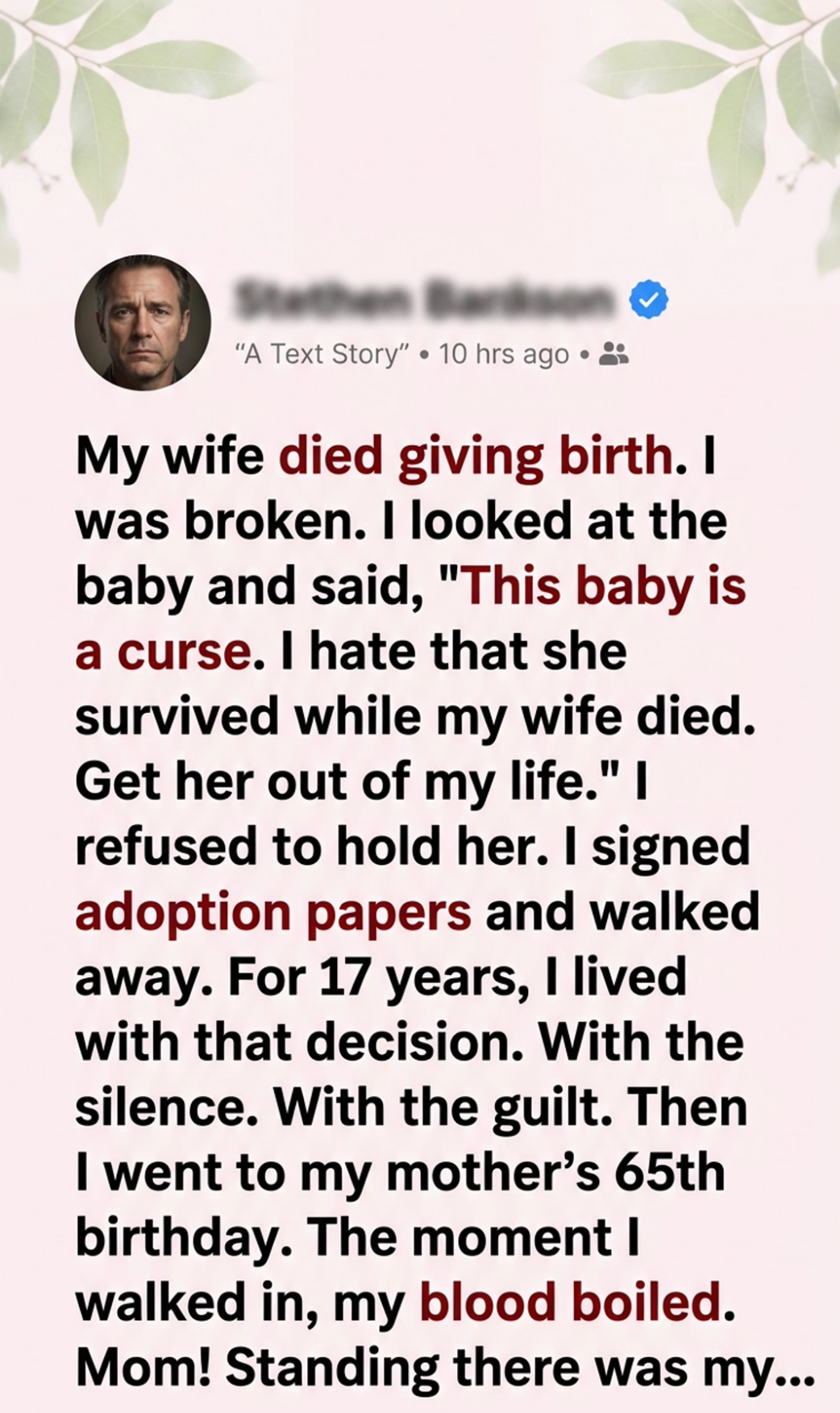
“Listen?” I snapped. “I spent seventeen years trying not to remember that day. I signed those papers because I couldn’t bear to look at her. You knew how I felt. You were there!”
“Yes,” my mother whispered. “I was there.”
“Then explain why you brought her into this house without warning me.”
“I didn’t bring her here to hurt you.”
“Then why?”
My mother looked at Emily.
“Because she asked to meet you.”
The girl’s chin lifted slightly.
“I didn’t know you would be angry.”
I turned toward her.
“Angry? You have no idea what you’re walking into.”
The moment I said it, I saw her eyes fill with tears.
She didn’t cry. She simply nodded, as if my reaction had confirmed something she had suspected long before arriving.
“I’m sorry,” she said. “I thought maybe you’d want to meet me.”
Then she turned toward the front door.
My mother caught her hand.
“Emily, wait.”
But the girl gently pulled free.
“No, Grandma. It’s okay.”
Grandma.
The word made my chest tighten.
Emily had called my mother Grandma, and my mother had accepted it naturally. They weren’t strangers who had met that morning. They had a relationship, a history, a whole world of conversations and memories from which I had been absent.
Emily reached for the door.
Something inside me finally broke through the anger.
“Wait.”
She stopped without turning around.
I had spent seventeen years imagining what I might say if I ever saw my daughter again. Sometimes I imagined apologizing. Sometimes I imagined explaining that grief had destroyed my judgment. In my worst moments, I imagined that she would never want to meet me at all.
I had never imagined this.
I had never imagined that the first words out of my mouth would be another rejection.
“Please,” I said, my voice suddenly unsteady. “Don’t leave yet.”
Emily turned slowly.
I looked at my mother.
“Tell me everything.”
My mother led us into the small study at the back of the house. She closed the door, leaving the party behind us. Through the walls, I could hear relatives speaking in hushed voices and someone turning off the music.
Emily sat in the chair beside the window.
I remained standing.
My mother took the sofa across from us and folded her hands in her lap.
“Seventeen years ago,” she began, “you were in a hospital room with Laura. She was bleeding, the doctors were rushing around, and nobody knew whether either of them would survive.”
“I remember.”
I remembered every second.
The white walls. The fluorescent lights. The nurse who wouldn’t meet my eyes. The doctor who had spoken to me in a quiet voice, explaining that Laura had suffered a catastrophic complication during delivery.
I remembered asking whether they could save her.
I remembered being told that they had tried everything.
And I remembered the silence that followed.
Laura had been twenty-nine years old. She had laughed with her whole body, sung while washing dishes, and left little notes inside my work bag whenever she knew I was having a difficult week.
We had been married for four years.
We had spent months preparing for our daughter, painting the nursery pale yellow and arguing affectionately over whether a baby needed more clothes or more blankets.
Laura had wanted to name her Emily.
I had agreed because I loved the way Laura said the name.
Then Laura died, and the baby survived.
When the nurse placed the newborn in my arms, I looked at her tiny face and saw the future I had lost. I saw Laura’s absence in every breath the baby took.
I said the words that would follow me for the rest of my life.
“This baby is a curse. I hate that she survived while my wife died. Get her out of my life.”
My mother covered her mouth.
“I remember,” she said.
I looked away.
“I didn’t know what I was saying.”
“You knew enough to say it more than once.”
I closed my eyes.
She was right.
I had refused to hold the baby. I had refused to look at the photographs the nurses tried to show me. When the hospital social worker explained the adoption process, I signed the preliminary paperwork and told her I wanted nothing more to do with the child.
I hadn’t asked who would adopt her.
I hadn’t asked whether I could receive updates.
I had asked only how quickly everything could be finished.
Within days, I left the hospital without my wife or daughter.
I moved into my mother’s guest room for two weeks, then returned to work. I threw myself into my job, accepted extra assignments, and filled my evenings with anything that kept me from sitting alone in the house Laura and I had shared.
I never remarried.
I told people I wasn’t interested in starting another family. I said I had learned to live alone.
The truth was that I was afraid of loving someone again and losing them.
I was also afraid that if I ever allowed myself to think about Emily, I would have to face what I had done.
My mother continued.
“The adoption was arranged through a licensed agency. The couple who adopted Emily lived several hours away. They had waited years for a child.”
I looked at her.
“Who were they?”
“Thomas and Rebecca Miller.”
I had never heard those names.
“Did they know what I said?”
“They knew you were grieving and that you had decided not to raise her. The agency told them very little beyond what they needed to know.”
“Did they know I never wanted to see her?”
My mother hesitated.
“They knew you had signed the papers.”
“That isn’t what I asked.”
“No,” she said softly. “They didn’t hear those words from me.”
I stared at her.
“You hid things from them?”
“I didn’t tell them every cruel thing you said. I didn’t think Emily needed to grow up carrying the burden of your worst moment.”
I wanted to argue, but the truth was more complicated than I wanted it to be.
My mother had been trying to protect a child.
She had also made decisions about my daughter without my knowledge.
“How did you meet her?” I asked.
My mother looked at Emily.
“Tell him.”
Emily took a breath.
“My parents told me I was adopted when I was six. They said my birth mother died during childbirth and that my birth father had been unable to raise me.”
Her voice was calm, but I noticed that she kept pressing her thumb against the edge of her handbag.
“They never made me feel unwanted. They were wonderful parents. They came to every school concert, every basketball game, every parent-teacher meeting. Dad taught me how to ride a bike. Mom helped me study for my exams. I never doubted that they loved me.”
I felt an unexpected rush of gratitude toward two people I had never met.
Emily continued.
“But I always wondered about my birth family. I wanted to know whether I looked like anyone. Whether my mother liked the same books I did. Whether my father had my eyes or my nose.”
She looked at me.
“Last year, my adoptive mother helped me request the non-identifying information the agency could legally provide. I learned my birth mother’s name was Laura and that she had died in childbirth.”
Her eyes lowered to the locket.
“Then I found a letter.”
“What letter?”
“One Grandma had written to my adoptive parents when I was a baby.”
I turned toward my mother.
She nodded slowly.
“I wrote to them a few months after the adoption. I wanted to know that Emily was safe. I asked whether I could receive a photograph once in a while. They agreed to send updates through the agency.”
My voice was barely audible.
“You kept in contact with them?”
“Not secretly in the way you’re imagining. The agency allowed limited communication, and the adoptive parents knew who I was. I never tried to interfere with their family. I sent cards on birthdays and Christmas. Sometimes they sent photographs.”
I felt a mixture of shame and anger.
“You watched her grow up while I pretended she didn’t exist.”
My mother did not defend herself.
“Yes,” she said. “I did.”
“And you never told me.”
“I tried.”
I stared at her.
“When?”
“About six months after the adoption, I asked whether you wanted a photograph. You told me you never wanted to see the baby again. You said if I brought her up, you would stop speaking to me.”
I remembered the argument.
I had been sitting at the kitchen table, staring at an untouched cup of coffee. My mother had gently mentioned that the agency had sent an update.
I had slammed my hand against the table.
I had told her that I couldn’t survive another reminder of Laura’s death.
Then I had walked out.
I had forgotten the exact words I used afterward.
My mother hadn’t.
“I should have tried again,” she said. “But you were in a terrible place, and I was afraid of losing you too.”
I sat down at last.
For years, I had told myself that nobody had given me a choice. That the adoption had been a decision made in the fog of grief, and that after I signed the papers, there was nothing left to do.
But my mother had offered me a photograph.
And I had refused it.
Emily watched me quietly.
“Why did you want to meet me now?” I asked.
She hesitated.
“Because I’m seventeen. I’ll be eighteen next year, and I’ve been thinking about what it means to know where I came from. I didn’t want to spend the rest of my life wondering whether you were alive, whether you had other children, whether you ever thought about me.”
She paused.
“I wasn’t expecting you to love me immediately. I just wanted to meet you once.”
Her honesty hurt more than anger would have.
I looked at the locket again.
“Where did you get that?”
Emily touched it.
“Grandma gave it to me last month. She said it belonged to my mother.”
My mother reached into her handbag and took out a small envelope.
“I kept it after Laura died,” she said. “The hospital returned Laura’s personal belongings to me because you couldn’t bear to take them. I stored them safely. I didn’t know what else to do.”
She placed the envelope on the table.
Inside was a hospital inventory sheet and a small photograph of Laura wearing the locket.
I recognized the picture immediately.
It had been taken three months before Emily’s birth. Laura was sitting on our back porch, one hand resting on her pregnant stomach, laughing at something I had said behind the camera.
I had not seen that photograph in seventeen years.
I sat staring at it until the room blurred.
“Why didn’t you give it to me?”
My mother answered gently.
“I tried to give you the whole box of Laura’s things after the funeral. You told me to put it away because you couldn’t look at any of it.”
I remembered that too.
I had asked my mother to take the photographs, clothes, and jewelry out of the house. I told her I couldn’t bear to see them.
She had kept everything.
I had thought she was preserving my memories.
I had never considered that she was also preserving Emily’s connection to her mother.
Emily leaned forward.
“Can I ask you something?”
I looked up.
“Yes.”
“Did you ever think about me?”
The question was so quiet that I almost wished she had shouted it.
I could have told her that I thought about her every birthday, that I remembered the day she was born, that I had spent years wondering whether she was safe.
All of those things were true.
But none of them changed the fact that I had walked away.
“Yes,” I said. “I thought about you.”
“Then why didn’t you look for me?”
I opened my mouth.
Nothing came out.
There was no answer that would make sense to a child who had spent seventeen years growing up without her birth father.
I could explain grief. I could explain trauma. I could describe the way pain had narrowed my world until I could barely see beyond the next hour.
But I couldn’t use those things to make my decision disappear.
“Because I was a coward,” I finally said.
My mother looked at me, startled.
Emily’s eyes widened slightly.
“I was so angry and so broken that I convinced myself avoiding you was the same as protecting you. I told myself you would have a better life without a father who couldn’t look at you without remembering your mother. And I was afraid that if I searched for you, I would have to admit what I had done.”
I swallowed.
“I told myself a lot of things because they were easier than facing the truth.”
Emily was silent.
“I don’t expect you to forgive me,” I continued. “And I won’t ask you to pretend I was a good father. I wasn’t there. I didn’t raise you. I missed every birthday, every first day of school, every time you needed someone to help you through something difficult.”
My voice broke.
“I am sorry.”
Emily looked down at her hands.
“Do you hate me?”
“No.”
The answer came immediately.
“No, Emily. I never hated you. I hated the pain I felt when I looked at you, and I blamed you for something you had no control over. That was wrong. You were a baby. You deserved love.”
She wiped a tear from her cheek.
“I used to wonder whether there was something wrong with me,” she admitted. “Even though my parents always told me I was wanted, I wondered whether my birth father had looked at me and decided I wasn’t worth keeping.”
I felt as though the floor had dropped away beneath me.
“You were always worth keeping.”
“But you didn’t keep me.”
I lowered my head.
“No. I didn’t.”
For a long time, none of us spoke.
Then Emily stood.
“I think I need some air.”
My mother rose, but Emily shook her head gently.
“I’ll be outside for a minute.”
She walked through the back door toward the garden.
I remained in the study, staring at the photograph of Laura.
My mother sat beside me.
“You cannot ask her to heal your guilt,” she said quietly.
I looked at her.
“What do you mean?”
“You may want to call her every day, tell her everything, give her presents, and somehow make up for seventeen years. But this is not about making yourself feel better. She has parents who raised her. She has a life. If you want to be part of it, you have to respect the pace she chooses.”
I nodded slowly.
“I understand.”
“Do you?”
I looked toward the garden.
“I think I’m beginning to.”
My mother took my hand.
“I loved Laura. I loved that little girl before I ever saw her. I also loved you, and I watched you disappear into your grief. I wanted to save both of you, but I didn’t know how.”
Her eyes filled with tears.
“I should have been more persistent. But I was afraid that if I forced the truth on you, you would shut me out forever.”
I squeezed her hand.
“I’m sorry I made you choose between protecting me and telling the truth.”
She leaned her head against my shoulder.
For the first time in seventeen years, we cried about Laura together.
Not the frantic, angry crying of the hospital.
Not the silence that followed the funeral.
This was different.
It was the grief we had postponed because we thought surviving meant never looking back.
After several minutes, I went outside.
Emily stood near the garden fence, looking at the flowers my mother planted every spring. The late afternoon sun illuminated the silver locket at her throat.
I stopped a few feet away.
“May I stand here?”
She nodded.
We watched a pair of birds move between the branches of an old apple tree.
“Grandma says my mother liked gardening,” Emily said.
“She did.”
“What was she like?”
I smiled sadly.
“Your mother was stubborn. She could argue with a parking meter and somehow make it apologize. She sang terribly when she cooked, but she insisted she was improving. She loved old movies, lemon cake, and books with endings that made her cry.”
Emily smiled faintly.
“That sounds nice.”
“She also talked to plants.”
“Really?”
“She said they grew better when they felt appreciated.”
Emily laughed.
The sound startled me because it was so much like Laura’s.
I laughed too, though tears were running down my face.
“Do you have any photographs?” Emily asked.
“Yes. Your grandmother kept them.”
“Would you show me sometime?”
The word sometime felt like a door opening a fraction.
“Of course. Whenever you’re ready.”
She turned toward me.
“I want to be clear about something.”
“Okay.”
“My parents are my parents. Thomas and Rebecca raised me. They stayed up with me when I was sick. They helped me with homework. They were there when I was frightened. I love them, and I don’t want meeting you to make them feel like they weren’t enough.”
I nodded immediately.
“They are your parents. Nothing I say or do should take that away from them.”
“Good.”
She seemed relieved.
“And I’m not promising that we’ll become close,” she added. “I don’t know what I want yet.”
“You don’t have to promise anything.”
She studied me for a moment.
“Are you going to disappear again?”
The question hurt, but I understood why she needed to ask it.
“No,” I said. “I won’t disappear because this is difficult. But I also won’t force you to see me if you decide you aren’t ready.”
She looked away.
“Okay.”
It wasn’t forgiveness.
It wasn’t even trust.
But it was a beginning.
Before Emily left that evening, she agreed to exchange contact information with me. We took no photographs together. We made no promises about future holidays or family gatherings. She hugged my mother goodbye and thanked her for the birthday party.
At the door, Emily turned toward me.
“Can I ask one more thing?”
“Anything.”
“Did my mother know you would give me her name?”
I shook my head.
“She chose it. She said Emily sounded like someone who would be brave and kind.”
Emily touched the locket.
“I hope I am.”
I looked at her, seeing both the girl she had become and the baby I had refused to hold.
“You already are.”
She left with my mother, who had promised to drive her home to her adoptive parents.
I watched the car disappear down the street.
For seventeen years, I had imagined that seeing my daughter again would bring relief. I thought I would finally be able to apologize, explain my grief, and somehow close the chapter I had refused to read.
Instead, I discovered that guilt did not vanish simply because the person you had hurt was standing in front of you.
It became more real.
It acquired a voice, a face, and a life of its own.
And it asked questions you could not answer with excuses.
That night, I returned to my empty house and opened the box of Laura’s belongings for the first time.
I sat on the floor until midnight, looking through photographs, letters, and small objects I had not seen since the hospital.
There was a yellow baby blanket Laura had knitted during her pregnancy. It was uneven at the corners because she had taught herself from a book and refused to ask anyone for help.
There was a list of names she had written in blue ink.
Emily was circled twice.
There was also a letter she had written to our daughter when she was seven months pregnant.
I had never seen it before.
My sweet Emily,
I don’t know what you’ll be like when you grow up. I don’t know whether you’ll love music or science, whether you’ll be quiet like your father or talkative like me. But I know this: you are already loved more than you can possibly understand.
I hope you grow up knowing that you never have to earn your place in this world. You belong here simply because you are here.
If life is ever difficult, remember that you were wanted. You were dreamed of. You were loved before we ever saw your face.
And if you ever feel alone, look at the stars. Your father and I have spent many nights looking at them together, wondering what kind of future we will build for you.
All my love,
Mom.
I pressed the letter against my chest.
Laura had written those words believing we would raise our daughter together.
She had not known that she would die, that I would collapse beneath the weight of my grief, or that the baby she loved would grow up wondering why her birth father had never searched for her.
I had no way to repair the years I had lost.
But I could stop making the same mistake.
The next morning, I sent Emily a message.
Thank you for meeting me yesterday. I know I hurt you, even before we met, and I won’t ask you to make me feel better about that. If you ever want to hear stories about your mother or see her photographs, I’ll be here. You don’t owe me a reply.
She responded three hours later.
Thank you for telling me the truth. I’d like to see the photographs sometime.
I read the message several times.
Then I put my phone down and cried.
Not because everything had been fixed.
Because, for the first time in seventeen years, I had a reason to stop running from the past.
Over the following months, Emily and I began communicating slowly.
At first, we exchanged short messages. She asked about Laura’s favorite books, whether she had played an instrument, and what kind of food she liked. I sent her photographs with brief explanations, careful not to overwhelm her with everything I had kept hidden.
Emily shared small pieces of her life too.
She liked biology and wanted to study environmental science. She played basketball, although she admitted she wasn’t very good at it. She loved her adoptive parents deeply and worried that learning about her birth family might somehow hurt them.
I told her that loving more people did not mean loving anyone less.
Eventually, she invited me to meet Thomas and Rebecca.
I was nervous in a way I had not been since my first day at work.
Thomas was a broad-shouldered man with gray hair and a warm handshake. Rebecca had kind eyes and a habit of touching Emily’s shoulder whenever she spoke, as if their connection was so familiar that neither of them needed to think about it.
They welcomed me into their home, but they did not pretend the meeting was easy.
“I want you to know something,” Rebecca said after we sat down. “We love Emily more than anything. We are glad she has the chance to learn about Laura. But we will always be her parents.”
“I would never ask you to be anything else,” I replied.
Thomas studied me.
“Why now?”
The question was fair.
I could have said that Emily had found me, that my mother had arranged the meeting, or that I had finally been given another chance.
Instead, I answered honestly.
“Because she asked to meet me, and I realized that I had spent seventeen years hiding from the consequences of my decision. I can’t change what I did. I can only decide whether I continue to run away.”
Rebecca nodded slowly.
“That’s a beginning.”
It took time for all of us to find our footing.
There were awkward dinners and long silences. There were moments when Emily asked questions I struggled to answer, and moments when she needed space I didn’t know how to give.
I learned not to call repeatedly when she didn’t respond immediately.
I learned not to buy expensive gifts as a substitute for being present.
I learned that she did not need me to become a perfect father overnight. She needed me to be honest, patient, and consistent.
On her eighteenth birthday, Emily invited me to a small family dinner.
Thomas grilled chicken in the backyard. Rebecca made a lemon cake. My mother arrived with a bouquet of yellow flowers, and everyone laughed when she insisted on taking too many photographs.
I brought Emily a small wooden box.
Inside was Laura’s letter, the original photograph of Laura wearing the locket, and the yellow baby blanket.
“I thought these belonged with you,” I said. “But if you want them to stay with me for now, that’s okay too.”
Emily lifted the blanket carefully.
“She made this?”
“Yes.”
“She wasn’t very good at knitting, was she?”
I laughed.
“No. But she was determined.”
Emily smiled as she unfolded the letter.
She read it quietly, then wiped her eyes.
When she finished, she looked at me.
“Did you read this before today?”
“No. I found it the night you met me.”
“Why didn’t you send it sooner?”
I took a breath.
“Because I wanted to make sure you were ready to receive it. I should have asked you rather than deciding for you, but I didn’t want to put another burden on you.”
She nodded.
Then she folded the letter carefully and placed it back in the box.
“Thank you.”
It was a small sentence, but I understood how much it cost her to say it.
After dinner, we stood together beneath the old apple tree in Thomas and Rebecca’s backyard.
Emily looked up at the branches.
“Grandma told me Mom used to talk to plants.”
“She did.”
“Do you think she would be angry with you?”
I couldn’t answer immediately.
“I think she would be heartbroken about what happened. I think she would have wanted me to get help instead of shutting everyone out. And I think she would have wanted you to grow up surrounded by love.”
Emily looked down at the locket.
“Do you think she would have loved me?”
I turned toward her.
“Emily, she loved you before she ever saw your face. I have her letter to prove it.”
She nodded, her eyes shining.
Then she leaned against my shoulder.
It was not a dramatic reconciliation. No one clapped. No music swelled in the background. The years between us did not disappear.
But she chose to stand beside me.
For the first time, I understood that being given another chance did not mean being restored to the place I had abandoned. It meant being allowed to build something new, slowly, with the person I had hurt.
Years earlier, I had looked at my newborn daughter and called her a curse because I could not bear the pain of losing her mother.
Now I understood the terrible injustice of those words.
Emily had never been the cause of my suffering. She had been another person suffering the same loss, a child who deserved protection at the very moment I was too broken to provide it.
I could not give her back the birthdays I had missed, the school performances I had never attended, or the nights she might have wondered why her birth father had never come looking for her.
I could not undo the adoption or rewrite the day Laura died.
But I could be present now.
I could listen when Emily wanted to speak and respect her when she needed silence. I could honor the parents who had raised her instead of pretending I deserved the place they had earned. I could tell her about Laura without making her responsible for comforting me.
And I could finally grieve my wife without blaming the daughter she had loved so fiercely.
On the anniversary of Laura’s death, Emily and I visited the cemetery together.
We stood beside Laura’s grave while a gentle wind moved through the trees.
Emily placed a small bouquet of yellow flowers against the headstone.
“Hi, Mom,” she whispered. “I’m here.”
I stood a few steps away, unable to speak.
After a moment, Emily reached for my hand.
I took it carefully.
For seventeen years, I had believed that walking away from my daughter was the only way to survive my wife’s death.
I had been wrong.
I had survived, yes. I had worked, paid bills, celebrated birthdays, and learned to live alone. But I had mistaken the absence of pain for healing, and silence for peace.
The truth was that grief had never disappeared. It had simply waited for me to become brave enough to face it.
My daughter had not returned to erase my guilt.
She had come to learn where she came from.
And in giving her the truth, I finally began to understand what Laura had written before she died: that Emily had never needed to earn her place in the world.
She had always belonged.
I was the one who had needed to learn how to love her.
And this time, I would not walk away.