Every year, the same thing happened in our house.
Fourteen members of my husband’s family arrived with hungry stomachs, cheerful greetings, and absolutely no intention of helping me.
They came for the annual family dinner, a tradition my husband, Daniel, insisted was sacred. His parents, his two sisters, their husbands, several cousins, and a few other relatives filled our dining room until every chair was occupied.
And every year, I disappeared.
Not physically, of course. I was always there, just rarely where anyone could see me for more than a few seconds.
I was in the kitchen peeling potatoes, stirring gravy, roasting meat, and preparing the desserts his mother loved. I was in the laundry room searching for the extra tablecloth. I was upstairs making sure the guest bathroom had clean towels. I was carrying platters from the kitchen while everyone else sat comfortably around the dining table.
I learned to recognize the sound of an empty glass being placed on the table.
I knew when Daniel’s father wanted another serving of potatoes, when his mother expected fresh coffee, and when his younger sister, Melissa, would announce that she was saving room for dessert before asking whether I had made her favorite lemon cake.
I knew all their preferences.
They knew almost nothing about me.
For eleven years, I had convinced myself that this was simply what a good wife did. Daniel worked hard, and I wanted his family to feel welcome. His parents had helped us purchase our house, contributing a significant amount toward the down payment when we bought it. Daniel reminded me of that generosity whenever I questioned anything about the annual gathering.
“They gave us a chance to own this place,” he would say. “The least we can do is have everyone over once a year.”
I never disagreed with the fact that his parents had helped us.
I disagreed with the idea that their financial contribution had somehow purchased eleven years of my unpaid labor.
But I rarely said that aloud.
Instead, I smiled, tied on my apron, and went back to the kitchen.
Over time, the dinner became less like a family celebration and more like a performance in which everyone had a role except me.
Daniel was the gracious host. His mother was the respected matriarch. His father told stories. His sisters discussed vacations, shopping, and their children’s achievements.
And I was the woman who made everything happen.
If the food was delicious, everyone praised the cook without looking up from their plates.
If something was missing, everyone looked toward the kitchen.
One year, Melissa complained that the roast was too dry. Another year, Daniel’s mother remarked that my dining room decorations looked cheaper than the ones she had seen at a friend’s house.
Once, after I had spent nearly two days preparing the meal, Daniel’s aunt asked whether I had considered taking a cooking class.
I stood beside the sink holding a stack of dirty plates.
I wanted to tell her that I had cooked for fourteen people after working a full week, while she had arrived with a store-bought bottle of wine and a list of suggestions.
Instead, I smiled.
“Maybe someday,” I said.
That evening, after everyone left, I found Daniel on the sofa watching television.
“How did everything go?” I asked.
“Great,” he answered. “Mom said the dinner was wonderful.”
I waited.
He continued watching television.
Finally, I asked, “Did anyone notice how much work it took?”
Daniel glanced at me as though I had asked an unreasonable question.
“Why do you need everyone to congratulate you? They’re family.”
I looked at the kitchen, where the counters were covered with dishes and the floor was scattered with crumbs.
Then I looked at my husband.
“I wasn’t asking for congratulations,” I said quietly. “I was asking you to notice.”
He sighed, turned up the television, and said he had a headache.
That was the end of the conversation.
Or at least, I thought it was.
The truth was that something inside me had begun to change.
It happened gradually, through a hundred little disappointments that were individually easy to excuse but impossible to ignore when added together.
I noticed that Daniel never asked whether I wanted to host the dinner. He simply announced the date.
I noticed that his sisters never offered to bring a dish, even when I told them I was overwhelmed.
I noticed that his mother thanked Daniel for being such a wonderful son whenever the evening went well, but blamed me whenever anything went wrong.
Most painfully, I noticed that Daniel seemed to believe my time was worth less than everyone else’s.
His work mattered. His family’s comfort mattered. His parents’ expectations mattered.
My exhaustion was an inconvenience.
By the time the next annual dinner approached, I had spent months thinking about what I wanted to do.
I didn’t want revenge.
I didn’t want to humiliate his family.
I didn’t even want to cancel the gathering.
I wanted to stop disappearing inside my own home.
So, three weeks before the dinner, I decided to tell Daniel that I would no longer host it.
I waited until we had finished dinner one evening. We were sitting at our kitchen table, and Daniel was scrolling through his phone.
“Your family dinner is coming up,” I said.
He barely looked up.
“Next Saturday. I know. Mom wants the usual menu.”
“I won’t be hosting it this year.”
His thumb stopped moving.
“What?”
“I said I won’t be hosting the dinner.”
He put his phone down.
“What do you mean, you won’t host it?”
“I mean exactly that. Someone else can organize it this year. Your sisters have houses. Your parents have a house. We can rent a room somewhere. There are plenty of options.”
Daniel stared at me as if I had suddenly begun speaking another language.
“Our house is the only one big enough!”
“Then perhaps we can rent a larger place.”
“That’s ridiculous.”
I folded my hands on the table.
“I’ve hosted this dinner for eleven years. I’m tired, Daniel. I want to sit with everyone instead of spending the entire evening in the kitchen.”
He pushed his chair backward.
“My parents helped us buy this house. Is this how you show gratitude?”
There it was.
The sentence he had used whenever he wanted to end a discussion.
For years, those words had made me feel selfish. They reminded me that his parents had helped us when we needed it, and I had always been grateful.
But gratitude was not a lifetime contract.
“I am grateful for what your parents did,” I said. “I have never denied that. But their help doesn’t mean I have to serve fourteen people every year for the rest of my life.”
His face reddened.
“Serve them? They’re my family, not strangers!”
“Then why am I the only one expected to take care of them?”
He opened his mouth, but I continued.
“Why don’t you cook the entire meal this year? Why don’t you clean the house, set the table, refill everyone’s drinks, and wash the dishes afterward? If it’s just a family tradition, you should be able to manage it.”
Daniel gave a short, disbelieving laugh.
“You know I have work.”
“So do I.”
“You work from home!”
“And that means my time doesn’t count?”
He stared at me.
For a moment, I thought he might actually hear what I was saying.
Instead, he shook his head.
“You’re making a big deal out of nothing.”
I stood up, carried my plate to the sink, and rinsed it.
“I’ve made a big deal out of nothing for eleven years,” I said. “This time, I’m not changing my mind.”
He didn’t speak to me for the rest of the evening.
The next morning, he was still angry.
By lunchtime, he had called his mother.
I knew because I could hear his voice from the study.
“She suddenly refuses to host,” he said. “I don’t know what’s gotten into her.”
There was a pause.
“No, Mom, I tried explaining. She says she’s tired.”
Another pause.
“Well, I can’t exactly tell everyone not to come. The house is ready, and everyone already knows the date.”
My hand froze over the vegetables I was chopping.
The house was ready?
I hadn’t cleaned the guest rooms. I hadn’t bought the groceries. I hadn’t even confirmed how many people were coming.
Daniel had apparently decided that my refusal was simply a temporary tantrum he could ignore.
When he came into the kitchen, I asked him directly.
“Did you tell your family the dinner was canceled?”
“No.”
“Why not?”
“Because I knew you’d calm down.”
I set the knife on the cutting board.
“I am calm.”
He waved his hand dismissively.
“Look, I understand you’re upset. But this is important to my parents. You can take a break afterward if you need one.”
“Daniel, I am not hosting this dinner.”
He grabbed his keys.
“Fine. Do whatever you want. But don’t embarrass me in front of my family.”
Then he left.
For the first time in eleven years, I didn’t spend the following days preparing for his family’s arrival.
I didn’t make a shopping list.
I didn’t marinate the meat.
I didn’t clean every room until it looked as though nobody lived there.
I didn’t call his sisters to ask whether their children had dietary restrictions.
Instead, I went about my ordinary week.
I worked. I exercised. I met a friend for coffee. I read a book in the evening.
Whenever I felt the familiar guilt creeping in, I reminded myself that I had made a reasonable request.
I wasn’t preventing Daniel from seeing his family.
I was simply refusing to do every job associated with their visit.
Two days before the dinner, Daniel brought home a large bag of groceries and placed it on the kitchen counter.
“Here,” he said. “I bought the things you need.”
I looked inside.
There was a large roast, potatoes, carrots, cream, butter, several bags of salad, and ingredients for the desserts.
He had also purchased the special cheese his mother liked.
“Why did you buy these?” I asked.
“Because the dinner is Saturday.”
“I told you I wasn’t cooking.”
He looked irritated.
“I thought you might change your mind once you realized how much trouble this would cause.”
I put the groceries back into the bag.
“You can return them or cook them yourself.”
He stared at me for several seconds before carrying the bag to the refrigerator.
That night, he slept facing the other side of the bed.
The next morning, his mother called me.
I almost didn’t answer, but something told me I should.
“Dear,” she began in her familiar sweet voice, “Daniel tells me you’ve been feeling overwhelmed.”
“I have.”
“Well, we all get tired. That’s part of being married.”
I said nothing.
She continued.
“Your father-in-law and I helped you buy that lovely house because we wanted our family to have somewhere comfortable to gather. You know how much that means to us.”
“Yes,” I said. “And I’m grateful.”
“Then I don’t understand why you’re making this difficult.”
I looked out the kitchen window at the small garden I had planted the previous spring. It was the only part of the house that felt entirely mine because I had created it without anyone else’s instructions.
“Because I don’t want to spend another family dinner standing in the kitchen while everyone else enjoys it.”
“Oh, but you always enjoy cooking!”
I nearly laughed.
There was a time when I had enjoyed cooking. I loved trying new recipes, making elaborate cakes, and setting a beautiful table.
But when a pleasure becomes an obligation, it can turn into resentment.
“I enjoy cooking when I choose to,” I replied. “I don’t enjoy being expected to do everything.”
Her voice cooled.
“I see. Well, I hope you understand the message you’re sending.”
“I do.”
I ended the call politely.
Then I put my phone down and went for a walk.
By Saturday morning, I knew Daniel was counting on me to surrender at the last minute.
He woke early, showered, and put on the shirt he usually wore when entertaining his family. He moved around the house with increasing agitation.
At ten o’clock, he opened the refrigerator.
At ten fifteen, he asked where I kept the roasting pan.
At ten thirty, he wanted to know whether the dining room table could accommodate fourteen people.
I answered his questions without sarcasm.
“The roasting pan is in the lower cabinet.”
“The extra chairs are in the garage.”
“The table can fit fourteen if you use the extension.”
He waited for me to offer more.
I didn’t.
At eleven, he finally exploded.
“You cannot be serious about this!”
I was sitting in the living room with my laptop, finishing a work report.
“I am.”
“My parents will be here in a few hours!”
“Then you should probably start cooking.”
“You’re my wife!”
I closed my laptop.
“And I’m a person, Daniel.”
He stood in the middle of the room, breathing hard.
“I cannot believe you’re doing this to me.”
I looked at him for a long moment.
“That’s the problem. You think I’m doing something to you. I’m simply no longer doing everything for you.”
He walked away, muttering under his breath.
I heard cupboard doors opening and closing in the kitchen. A few minutes later, he called one of his sisters and asked whether she could bring a side dish.
She sounded surprised.
Then annoyed.
Then she agreed to bring a bowl of salad.
It was the first contribution anyone in his family had made without my asking in eleven years.
I might have felt triumphant if the situation hadn’t been so sad.
At two o’clock, Daniel stood at the kitchen counter, staring at the roast as if it were a complicated engineering problem.
“Do you know how long this takes?” he demanded.
I looked at the clock.
“You have about three hours.”
He grabbed his phone and began searching for cooking instructions.
I returned to my report.
By three thirty, the kitchen smelled wonderful. Daniel had managed to get the roast into the oven, though he had forgotten to remove the plastic wrapping from one of the vegetable packages before throwing it into a saucepan.
I quietly removed it before anything melted.
He didn’t thank me.
At four, I changed into a dark green dress, put on my earrings, and applied a little lipstick.
Daniel looked up when I walked downstairs.
“What are you doing?”
“Getting ready for dinner.”
“You’re not going to help?”
“No.”
He looked at my dress, then at the kitchen.
“You can’t be serious.”
“I’ve been serious for three weeks.”
The doorbell rang.
His parents arrived first.
His mother stepped inside carrying her handbag and a small gift bag.
“Hello, darling!” she said to me.
“Hello. It’s lovely to see you.”
She looked past me toward the kitchen.
“Something smells a little different this year.”
“Daniel’s been cooking.”
Her smile faltered.
“Daniel?”
My husband appeared in the doorway, holding a dish towel.
“Everything is under control,” he announced.
His mother gave me a look I couldn’t quite interpret.
I returned her smile and took her coat.
Over the next hour, the house filled with relatives.
Melissa arrived with her husband and children. Daniel’s older sister brought a bowl of salad. His aunt arrived with a bottle of wine. Cousins and in-laws followed, carrying purses, coats, and the expectation that everything would be ready for them.
Several people looked toward the kitchen when they entered.
Others asked me whether I needed help.
I said yes.
Most of them looked surprised.
A few actually followed me into the kitchen.
Daniel’s cousin, Rachel, helped set the table. His aunt sliced bread. Melissa’s husband carried chairs from the garage.
The work was divided among more people in twenty minutes than it had been in eleven years.
And yet, even then, I didn’t take over.
I showed them where things were and let them do the work themselves.
When Daniel’s mother asked whether the gravy needed more seasoning, I handed her the spoon.
“You can taste it and decide.”
She blinked.
Then she tasted it.
“A little more pepper,” she said.
“It’s in the cupboard.”
She looked at me for a moment before reaching for it.
I could almost see her trying to understand why the usual arrangement wasn’t happening.
At six o’clock, everyone finally sat down.
Daniel stood at the head of the table and thanked everyone for coming.
He looked exhausted.
The roast was slightly overcooked at the edges, the potatoes were unevenly mashed, and the gravy was thicker than it should have been.
But the food was perfectly edible.
For the first time in eleven years, I sat down with everyone else while the meal was still hot.
I took a plate, served myself, and listened to the conversations.
Nobody asked me to fetch anything for the first ten minutes.
It felt so unfamiliar that I kept waiting for someone to call my name.
Eventually, Daniel’s father asked me how work was going.
I looked up, surprised.
“It’s going well. I just finished a major project.”
“That’s good,” he said. “Daniel tells me you’re doing well with that.”
I nodded.
Then Melissa began talking about her children’s school, and the conversation moved on.
Still, the small question stayed with me.
Someone had finally asked me about my life while I was sitting at the table.
As dinner continued, the family gradually relaxed. People laughed, shared stories, and passed dishes around.
Daniel made a few jokes about the difficulties of cooking for fourteen people.
Everyone laughed.
Then his aunt said, “Well, now you know what your wife goes through every year.”
The table became quieter.
Daniel forced a smile.
“Yes. I have a new appreciation for it.”
I watched him.
I wanted to believe him.
But appreciation expressed only when the work becomes inconvenient for the person who previously ignored it isn’t enough to change a relationship.
So I waited.
After dinner, several relatives began carrying their plates to the kitchen. Rachel offered to help wash the dishes, and Melissa started packing leftovers into containers.
I thanked them.
For the first time, I didn’t feel guilty accepting help.
Daniel stood near the dining room doorway, rubbing the back of his neck.
“So,” he said quietly when we were briefly alone, “are we done with this now?”
I looked at him.
“Done with what?”
“This whole thing. You’ve made your point.”
I could have argued.
I could have listed eleven years of meals, dirty dishes, early mornings, and late nights.
Instead, I said, “You’ll understand in a few minutes.”
His expression tightened.
“What does that mean?”
I walked toward the kitchen.
On the counter sat a silver serving tray.
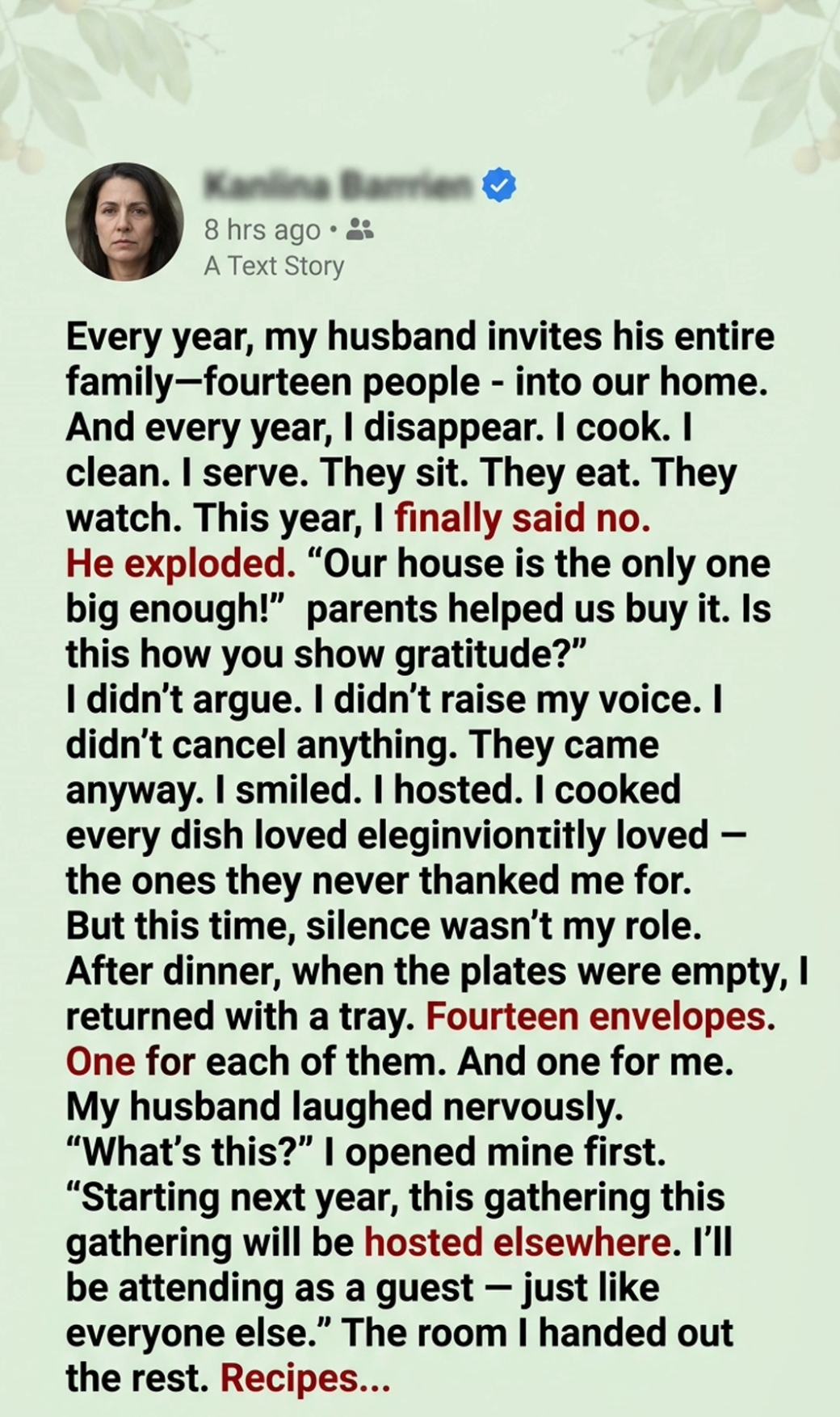
Fourteen cream-colored envelopes rested on it, each with a name written neatly across the front.
There was one for Daniel’s mother.
One for his father.
One for each sister, each spouse, and each other relative who had attended our annual gathering.
And one for me.
I had spent several evenings preparing them, not because I wanted to hurt anyone, but because I wanted to make a decision that couldn’t be dismissed as a passing emotion.
I lifted the tray and carried it into the dining room.
The conversations gradually faded as everyone noticed what I was holding.
Daniel stared at the envelopes.
“What are those?”
I placed the tray in the middle of the table.
“Something I’ve wanted to say for a long time.”
His nervous laugh sounded forced.
“Is this some kind of joke?”
“No.”
I picked up my envelope.
My hands were steady.
For years, I had imagined this moment with anger. I had imagined delivering a speech that would make everyone ashamed of themselves.
But as I stood in front of the people who had unknowingly become part of my exhaustion, I felt something different.
Relief.
I opened my envelope and unfolded the letter inside.
Then I read it aloud.
“Dear family,
“For eleven years, I have been proud to welcome you into our home. I have cooked your favorite meals, remembered your preferences, prepared your rooms, and worked hard to make this gathering feel special.
“I did those things because I wanted everyone to feel loved.
“But somewhere along the way, a tradition that should have brought us together became a responsibility that belonged almost entirely to me.
“I have spent most of these evenings in the kitchen, eating last, cleaning after everyone, and missing the conversations and memories that everyone else gets to enjoy.
“I have tried to explain this privately, but my feelings have often been treated as an inconvenience rather than something worth understanding.
“So I have made a decision.
“Starting next year, this gathering will be hosted somewhere else. I will attend as a guest, just like everyone else.
“I will not organize the menu, cook for fourteen people, clean the house from top to bottom, or take responsibility for making the evening perfect.
“I will be happy to contribute a dish if I choose to, just as any other guest might.
“This isn’t a punishment. It isn’t a rejection of the family. It’s simply a boundary.
“I hope this tradition continues for many years, but it must become something everyone helps create rather than something one person is expected to provide.
“Thank you for listening.”
I folded the letter and placed it on the table.
For several seconds, nobody spoke.
Daniel’s face had lost its color.
His mother stared at me as though I had announced that I was moving to another country.
Then Melissa reached for her envelope.
“What did you put in these?” she asked.
“Something for each of you.”
She opened hers.
Inside was a handwritten recipe card for the lemon cake she had praised every year.
Beneath it was a short note.
Melissa, this is the recipe you have always loved. I thought you might enjoy making it yourself sometime. It would mean a lot to me if, next year, you brought it to the family gathering.
Melissa read the note twice.
Then she looked at me.
I turned toward Daniel’s mother.
“Would you open yours, please?”
She hesitated before slipping her finger beneath the envelope flap.
Inside was a copy of my recipe for the roast, along with the instructions for the gravy and the vegetables.
Her note read:
For the years you have told everyone how much you love this meal, I wanted to make sure the recipe was available to you. Perhaps you could prepare it for the family next year.
Her lips parted slightly.
Daniel’s father opened his envelope next.
His contained a handwritten list of the supplies I had always used to prepare the dining room, along with a note asking whether he would consider organizing the seating and table arrangements at the next gathering.
The other envelopes contained recipes, instructions, or small requests for each person to contribute something they had always enjoyed.
Some were assigned desserts.
Others were invited to organize games for the children, prepare side dishes, arrange transportation for the older relatives, or coordinate the next location.
I had not assigned anyone an unreasonable burden.
I had simply divided the work among fourteen adults.
And then there was one final envelope on the tray.
The one addressed to Daniel.
He picked it up slowly.
“What’s mine?” he asked.
“Open it.”
He tore the envelope at the edge and removed the letter.
His eyes moved across the page.
Then he stopped.
I had written:
*Daniel,
“You have often reminded me that your parents helped us buy this house. I will always be grateful for that generosity.
“But I need you to understand that a gift does not erase the value of my time, and being your wife does not mean I should automatically become responsible for everyone else’s comfort.
“I have not asked you to choose between me and your family. I have asked you to stand beside me while we welcome them.
“For eleven years, I have wanted a partner in this tradition, not an audience.
“Next year, I want you to help find a location, coordinate the plans, and contribute your share of the work. I want us to attend together rather than have me serve everyone while you receive the credit for being a wonderful host.
“I love you. But I cannot keep sacrificing my peace to protect a tradition you refuse to question.
“If this marriage is going to remain strong, we need to build a life in which both of us matter.”
Daniel lowered the letter.
For a moment, I thought he might become angry again.
Instead, he looked around the table at his family.
His mother was holding her recipe card. Melissa was reading her note. Rachel had already begun discussing possible locations for next year’s dinner with one of the cousins.
Nobody was laughing at me.
Nobody was calling me ungrateful.
Nobody was telling me that I had embarrassed the family.
That silence was more powerful than any argument I could have made.
Finally, Daniel spoke.
“You planned all this without telling me?”
I nodded.
“I tried telling you for three weeks that I wasn’t going to host the dinner. You chose not to believe me.”
He swallowed.
“You could have just refused to cook.”
“I did.”
He looked down at the letter again.
Then he asked a question that surprised me.
“Do you really feel that way? That you’ve been alone in this?”
I took a breath.
“Yes.”
His shoulders dropped.
“I didn’t realize.”
The words hurt more than I expected.
Not because I believed he was lying, but because I wondered how a person could live beside someone for eleven years and fail to notice how exhausted they had become.
“You didn’t realize because you never had to,” I said gently. “Every year, everything was ready when you wanted it. You never had to think about what it cost me.”
He rubbed his forehead.
“I thought you liked doing it.”
“I liked making people happy. I didn’t like being expected to do it all.”
His mother finally spoke.
“Perhaps we should have offered to help.”
I turned toward her.
“Yes. That would have made a difference.”
She looked uncomfortable.
“I suppose we all got used to things being done a certain way.”
“That happens,” I said. “But we can change it.”
She looked down at the recipe card.
“I can make the roast next year.”
Melissa nodded quickly.
“I’ll bring the lemon cake.”
Rachel offered to organize the games and activities for the children.
Daniel’s father said he would look into renting a community room or finding a restaurant with a private dining area.
The suggestions began slowly, almost awkwardly, but soon several people were discussing possibilities.
For the first time, the family was planning the gathering together.
Daniel remained quiet.
After a while, he pulled a chair beside mine and sat down.
“I’m sorry,” he said.
I looked at him.
“I should have listened when you first told me you were tired. I shouldn’t have used my parents’ help to make you feel guilty.”
I waited.
He continued.
“I think I liked being the person who brought everyone together. I liked that my family thought our house was the best place for the dinner. I never really thought about how much of that was because of you.”
It was the first time he had acknowledged the truth without trying to defend himself.
“I appreciate you saying that,” I replied. “But I need things to change, not just tonight.”
“I understand.”
I hoped he did.
But I also knew that an apology made in front of fourteen relatives could not erase eleven years of habits.
The real test would come after everyone went home.
It came sooner than I expected.
As the evening ended, Daniel’s mother approached me near the front door.
She held the envelope containing her recipe.
“Would you mind showing me how you make the gravy sometime?” she asked.
I smiled.
“Of course. I’d be happy to teach you.”
She hesitated.
“And I am sorry I never offered to help before.”
The apology was awkward and imperfect, but it was genuine enough that I accepted it.
After the last relative left, Daniel and I stood in the dining room looking at the remaining dishes.
For eleven years, this would have been the moment when I rolled up my sleeves and began cleaning while he relaxed in the living room.
This time, he took two plates from the table.
“Let’s do it together,” he said.
We washed the dishes side by side.
He dried while I rinsed. He wiped the counters while I packed the leftovers. When I told him I was tired, he suggested leaving the remaining work until morning.
I stared at him.
“Are you sure?”
He gave me a small, embarrassed smile.
“Yes. The kitchen will still be here tomorrow.”
It was such an ordinary sentence.
But I realized that I had spent years believing everything had to be finished immediately because everyone else’s comfort depended on me.
That night, I went to bed without checking whether the dining room was perfect.
And I slept better than I had in months.
The following weeks were not magically perfect.
Daniel occasionally slipped into old habits. He sometimes assumed I would handle a task simply because I had always done it before.
But now I spoke up.
When he asked me to organize a family birthday dinner without discussing it first, I asked him which parts he planned to handle.
When his mother suggested that we host another gathering, I reminded her that we had agreed to share the responsibilities.
At first, Daniel looked uncomfortable whenever I challenged an assumption.
Then he began to understand that a boundary was not an attack.
It was information.
It told him where my limits were and what I needed from our marriage.
A few months later, Daniel’s family held a small planning meeting for the next annual dinner.
They chose a restaurant with a private room, divided the cost among the adults, and assigned responsibilities for coordinating the event.
Melissa volunteered to bring the lemon cake.
His mother offered to make a family recipe book using the cards I had distributed.
Daniel handled the reservation and confirmed the guest count.
I contributed a simple appetizer.
Nobody expected me to arrive early.
Nobody expected me to stay late.
On the evening of the gathering, I wore a blue dress and arrived with Daniel just before the reservation time.
When we entered the private room, his mother stood up and greeted us.
“There’s a seat saved for you,” she said, pointing toward the table.
Not a place beside the kitchen.
Not a place where I could jump up to fetch forgotten dishes.
A seat among everyone else.
I sat down.
Dinner was noisy, imperfect, and wonderful.
The roast was slightly underseasoned, the children spilled juice on the tablecloth, and someone forgot to bring the serving spoon for the salad.
Nobody blamed me.
We laughed, passed the dishes around, and solved the small problems together.
At one point, Daniel reached beneath the table and took my hand.
“I owe you more than an apology,” he whispered.
I looked at him.
“What do you mean?”
“I need to keep showing you that I understand. I don’t want you to have to reach a breaking point before I listen.”
I squeezed his hand.
“That would mean a lot.”
He nodded.
For the first time, his words felt less like a promise made to end an uncomfortable conversation and more like a commitment he intended to keep.
That night, when we returned home, I thought about the fourteen envelopes.
They had not been threats.
They had not been punishments.
They had been invitations.
An invitation for each person to see the work that had remained invisible for years. An invitation to participate rather than merely receive. An invitation to create a tradition that did not depend on one woman exhausting herself to make everyone else happy.
And the envelope I had written for myself was the most important one of all.
It had reminded me that I was allowed to be part of my own life.
I could love my husband without surrendering my voice.
I could appreciate his parents without accepting endless obligations.
I could welcome his family without becoming their servant.
Most importantly, I could say no without becoming a bad person.
The following year, our family gathering took place at a rented hall. His mother prepared the roast, Melissa brought the lemon cake, Daniel organized the seating, and everyone contributed something.
I arrived as a guest.
I ate while the food was hot.
I joined the conversations.
I laughed until my cheeks hurt.
And when dinner ended, I helped clear a few plates because I wanted to—not because everyone assumed I would.
Later, as we walked to the car, Daniel slipped his arm around my shoulders.
“Was this better?” he asked.
I thought about it.
“Yes,” I said. “Because this time, I was actually here.”
He stopped walking and looked at me.
“I should have made room for you years ago.”
I leaned against him.
“You can start now.”
And that was what we did.
Not with one grand gesture or a perfect apology, but with ordinary choices repeated over time.
A question before making plans.
An offer to help without being asked.
A willingness to listen when something mattered to me.
And the understanding that love was not measured by how much one person could endure in silence.
For eleven years, I had believed that keeping the peace meant making myself smaller.
I finally learned that real peace does not require one person to disappear.
Sometimes, the strongest thing you can do is put fourteen envelopes on a table, tell the truth without raising your voice, and give everyone—including yourself—the chance to begin again.