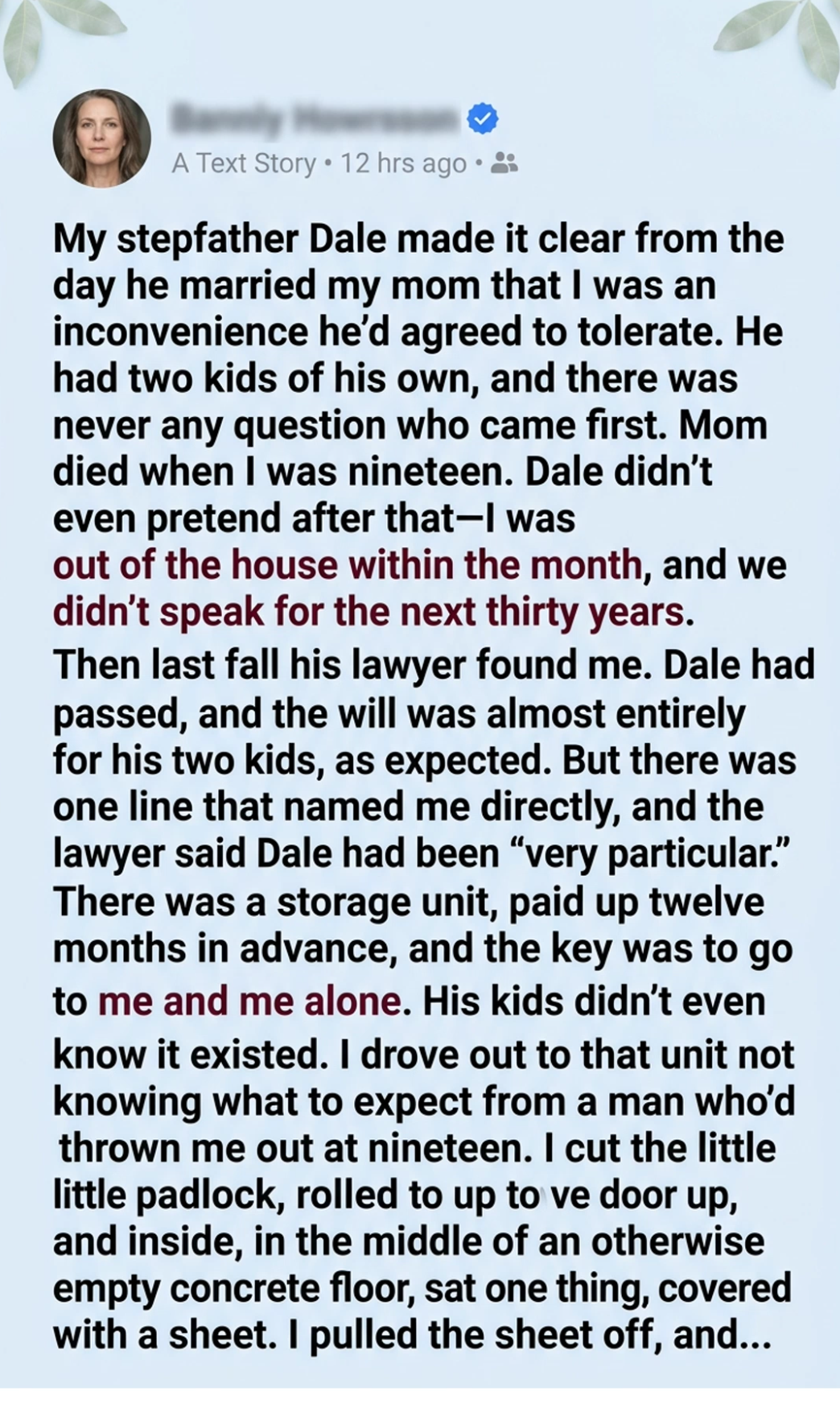
My stepfather, Dale Mercer, made one thing clear from the beginning: I was not his child, and he had no intention of pretending otherwise.
I was eleven when my mother married him.
My biological father had left when I was six. I remembered him mostly through fragments—a blue pickup truck, the smell of his aftershave, and the way he used to lift me onto his shoulders so I could see over the fence at the county fair.
Then, one morning, he was gone.
My mother, Linda, never spoke badly about him. She simply worked two jobs, paid the bills as best she could, and tried to make our small rented house feel like a home.
By the time Dale came into our lives, I had learned to make myself useful. I washed dishes without being asked, packed my own school lunches, and rarely complained when money was tight.
Dale arrived with a comfortable income, a large house outside town, and two children of his own: Melissa, who was thirteen, and Jason, who was nine.
He was polite enough in front of other people. At church gatherings, he called me his stepson. At family dinners, he made sure I had a place at the table.
But inside the house, the distinction was impossible to miss.
Melissa received a new bedroom set when she complained that her old one looked childish. Jason got a bicycle for his birthday, followed by a gaming console at Christmas.
When I asked whether I could join a school trip that cost eighty-five dollars, Dale studied the permission slip as though I had asked him to purchase a car.
“Your mother needs to learn to budget for these things,” he said.
My mother paid for the trip herself.
That evening, she came into my room and sat on the edge of my bed.
“I know this is hard,” she whispered.
I shrugged, pretending it did not matter.
“Dale isn’t used to having another child around. Give him time.”
So I did.
I spent years trying to become the sort of boy he might eventually accept. I kept my grades high, mowed the lawn, shoveled snow, and worked weekends at a grocery store when I turned sixteen.
Whenever Dale needed help carrying lumber, cleaning the garage, or fixing something around the house, I was there.
When Jason broke a window with a baseball, Dale blamed the poor condition of the yard and bought him a new glove.
When I accidentally scratched the family car while learning to park, Dale made me pay for the repair out of my savings.
I paid without arguing.
I thought that if I proved I was responsible enough, quiet enough, and grateful enough, one day he might look at me and see something other than an obligation.
He never did.
The worst part was that my mother loved him.
She knew he could be cold, but she also saw the man who brought her coffee when she worked late, who held her hand during thunderstorms, and who sat beside her when she became ill.
I couldn’t ask her to choose between us.
I convinced myself that tolerating Dale was the price of keeping her happy.
Then, when I was nineteen, my mother died.
It happened in February, after a long illness that had gradually stolen her strength. During her final weeks, I slept in a chair beside her bed whenever I could. I held her hand, read her favorite books aloud, and told her stories about the things we would do when she felt better.
We both knew she would not get better.
The night before she died, she asked me to come closer.
“Whatever happens,” she said, her voice thin and tired, “don’t let anyone make you believe you weren’t loved.”
I swallowed hard.
“Mom, you’re not going anywhere.”
She smiled sadly.
“Promise me.”
I promised.
She died the next morning.
At her funeral, I stood beside Dale while people offered their condolences. He accepted their sympathy with a composed expression, thanking everyone for coming.
Melissa cried into her father’s shoulder. Jason stared at the floor.
I felt as though someone had removed the foundation beneath my feet.
My mother had been the one person who made that house feel like mine.
Without her, I was simply a nineteen-year-old boy living in a home where nobody wanted him.
Three weeks after the funeral, Dale called me into the kitchen.
He was sitting at the table with a stack of papers and a mug of coffee.
“I think it’s time we discussed your future,” he said.
I sat opposite him.
“What about it?”
“You’re an adult now. You have a job. You can support yourself.”
I stared at him, waiting for him to say something else.
He didn’t.
“You want me to move out?”
“I think that’s best.”
“My mom has been gone three weeks.”
His jaw tightened.
“Linda would have wanted you to become independent.”
I felt something inside me go still.
“You don’t know what she would have wanted.”
For a moment, his expression changed. Then the familiar coldness returned.
“This is my house. I have two children to think about, and I can’t keep supporting someone who isn’t my responsibility.”
I wanted to remind him of the years I had spent helping him, of the chores I had done, the money I had saved, and the countless times I had tried to earn his approval.
Instead, I asked the only question that mattered.
“When do you want me gone?”
“By the end of the month.”
I left the kitchen without another word.
I packed my clothes into two suitcases, put my school certificates and a few photographs into a cardboard box, and arranged to rent a small room above a mechanic’s garage.
Dale didn’t help me move.
He didn’t offer money for a deposit or ask whether I had somewhere safe to sleep.
On my last evening in the house, I stood in my mother’s bedroom.
Her perfume still lingered faintly in the closet. On the bedside table sat a photograph of the two of us at a lake, taken the summer before she became ill.
I slipped it into my suitcase.
Then I walked downstairs.
Dale was watching television in the living room.
“I’m leaving,” I said.
He glanced up.
“All right.”
That was the last conversation we had for thirty years.
At first, I thought he might change his mind. Perhaps he would call after a few weeks, once his anger had faded. Perhaps he would realize that grief had made him cruel.
But the phone never rang.
I wrote one letter, not asking for money or an apology, just telling him that I had found steady work and was doing all right.
He never answered.
Eventually, I stopped waiting.
I built a life.
I worked at a hardware store, then trained as an electrician. I rented a better apartment, bought a used car, and eventually started a small electrical contracting business with a friend named Paul.
The business grew slowly. We took whatever jobs we could get—repairing faulty wiring, installing lights in small shops, replacing old electrical panels in houses that had not been updated in decades.
There were years when money was tight. There were months when I wondered whether I should abandon the business and find a safer job.
But every time I felt like giving up, I remembered my mother telling me not to let anyone convince me I wasn’t loved.
I married a woman named Rachel when I was thirty-one.
She had a warm laugh, an easy way of making strangers feel welcome, and the rare ability to recognize when I was hurting even when I said nothing.
I told her about Dale before we married.
She listened without interrupting.
“Do you want him at our wedding?” she asked.
I shook my head.
“Do you want to invite him?”
“No.”
“Then we won’t.”
She never pressured me to reconcile. She understood that some wounds did not heal simply because enough years had passed.
We had a daughter, Emily, and later a son, Noah.
I made a decision when Emily was born: my children would never have to earn their place in my life.
I would never compare them, never make one feel like a burden because the other needed something, and never confuse providing a roof over their heads with loving them.
I made mistakes, of course. I worked too much sometimes. I was impatient when deadlines piled up. But whenever I got something wrong, I apologized.
I wanted my children to know that being their father was not a duty I tolerated.
It was a privilege I would choose every day.
As the years passed, I heard occasional news about Dale through distant relatives.
Melissa married a real estate agent and moved two towns away. Jason took a job in finance and rarely visited the old neighborhood. Dale sold the large house after retirement and bought a smaller place near a golf course.
I learned that he had developed heart problems in his late sixties.
I also learned that he had never remarried.
I didn’t contact him.
I told myself that our relationship had ended the day he sent me away, and that the passage of time did not create an obligation to reopen it.
Still, every now and then, I wondered whether he remembered my mother.
I wondered whether he ever thought about the boy who had stood in his kitchen with two suitcases, waiting for a goodbye that never came.
Then I would look at my own children and put the thought away.
I had a family. I had work. I had a life that no longer depended on Dale Mercer noticing me.
For thirty years, that was enough.
Then, last October, a lawyer called.
I was in my office reviewing invoices when my receptionist transferred the call.
“Is this Mr. Andrew Bennett?” a man asked.
“Yes.”
“My name is Thomas Whitaker. I’m an attorney handling the estate of Dale Mercer.”
For several seconds, I couldn’t speak.
“Dale Mercer?” I finally asked.
“Yes. He passed away six weeks ago. I understand he was your stepfather.”
I leaned back in my chair.
“I haven’t spoken to him in thirty years.”
“I was made aware of that,” the lawyer said. “Nevertheless, your name appears in a document he prepared shortly before his death.”
I almost laughed.
“What did he leave me? A bill?”
The lawyer paused.
“No. His estate is largely divided between his biological children, Melissa and Jason. However, there is a separate provision naming you specifically.”
I waited.
“He instructed me to provide you with the key to a storage unit that he rented several years ago. The rental has been paid for twelve months in advance. His written instructions state that the key must be delivered to you personally and that no other beneficiary is to be given access without your authorization.”
I frowned.
“A storage unit?”
“Yes.”
“What is inside it?”
“I don’t know. Mr. Mercer was very particular about maintaining the privacy of that arrangement. He told me that I was not to inspect the contents, and he made certain that the rental agreement was in order.”
“Why me?”
“I asked him the same question.”
“And?”
“He said you would understand when you saw it.”
I stared at the invoices scattered across my desk.
For thirty years, Dale had made no effort to contact me. He had never met my wife, never seen his step-grandchildren, and never asked whether I was alive or dead.
Now he was gone, and he had left me a mystery.
“When can I collect the key?” I asked.
“I can send it by courier, but I would prefer to hand it to you myself. There are a few documents I’d like you to sign acknowledging receipt.”
We arranged to meet two days later.
Thomas Whitaker was a careful, soft-spoken man in his sixties. He wore a charcoal suit and carried a thick leather folder.
He greeted me in his office and placed a small envelope on the desk.
Inside was a brass key attached to a white plastic tag. The tag had a unit number written on it in black ink.
B-214.
Thomas slid a document toward me.
“Before you sign, there is something else I should mention. Mr. Mercer came to see me on several occasions during the final year of his life. He was very specific about this provision.”
“What did he say?”
“He said the contents belonged to you. Not to your mother, not to his children, and not to the estate.”
I looked at him.
“Did he explain why?”
“No.”
“Did he leave a letter?”
“Not one that I was authorized to give you.”
That answer bothered me.
“What does that mean?”
Thomas folded his hands.
“It means he left instructions concerning the timing and circumstances under which certain documents could be released. I have followed those instructions as written.”
I studied his face, trying to determine whether he was hiding something or simply being a lawyer.
Finally, I signed the receipt.
On my way home, I called Rachel and told her what had happened.
She was quiet for a moment.
“Are you going to go?”
“I don’t know.”
“Yes, you do.”
I looked at the brass key in my hand.
“I don’t want to give him the satisfaction of making me curious.”
Rachel sighed gently.
“Andrew, he’s dead. You don’t have to prove anything to him anymore. If you want to see what’s there, go. Not for him. For yourself.”
She was right.
The following Saturday, I drove to the storage facility.
It stood on the edge of town, behind a row of warehouses and an auto-parts distributor. The sky was overcast, and the wind carried the smell of damp leaves across the parking lot.
I found Building B and walked down the narrow corridor until I reached Unit 214.
The lock was old and slightly rusted.
I inserted the key and turned it.
The padlock opened with a sharp click.
I rolled the metal door upward.
At first, I thought the unit was empty.
There were no stacked boxes, no furniture, no shelves filled with forgotten belongings. The concrete floor was bare except for a single object positioned in the exact center of the room.
It was covered by a white sheet.
I stood at the entrance, staring at it.
Whatever Dale had intended, he had gone to considerable trouble to make sure I found this one thing and nothing else.
I stepped inside.
My footsteps echoed against the metal walls.
For a moment, I considered leaving. I could lower the door, return the key to my pocket, and allow the mystery to remain a mystery.
Then I remembered the last time I had walked out of Dale’s house.
I had been nineteen, grieving, frightened, and desperately hoping that the man who had lived under the same roof as me for eight years might show the smallest sign of caring.
He had looked at me and said, “All right.”
I had spent thirty years learning not to wait for anything from him.
Now I was going to find out why he had sent me here.
I reached for the sheet.
It felt heavy and slightly dusty beneath my fingers.
I pulled it away.
And froze.
Underneath stood an old upright piano.
Not an ordinary piano.
It was a dark walnut upright with a small brass plate above the keys. The wood was scratched along the lower panel, and the right corner had a dent I recognized immediately.
I knew that dent.
I knew the narrow crack beside the middle pedal. I knew the little brass music stand that never sat straight. I knew the faded blue ribbon tied around one of the handles on the side.
I had not seen that piano since I was eleven years old.
It had belonged to my mother.
For a moment, I couldn’t breathe.
Before she married Dale, the piano had stood in the living room of our little rental house. My mother played it on Sunday mornings while I sat on the carpet with a bowl of cereal. She wasn’t a concert pianist, but she could make a room feel peaceful with a simple melody.
She taught me to play when I was eight.
I had never been particularly talented. I stumbled over scales and struggled with the left hand, but she never made me feel foolish.
“Music isn’t a race,” she used to say. “You don’t have to be perfect to make something beautiful.”
After she married Dale, the piano disappeared from the living room.
He said it took up too much space.
I remembered watching two men carry it into the garage. I asked my mother whether we could bring it back inside.
“Perhaps someday,” she said.
But someday never came.
When I was nineteen and preparing to leave, I searched for it. The garage was crowded with boxes and tools, and I couldn’t find the piano anywhere.
I asked Dale about it.
“It’s gone,” he said.
“Where?”
“Sold.”
I remembered the way he had turned away before I could ask anything else.
I had assumed he sold it to clear space or make a little money. It had been another piece of my mother taken from me, another reminder that her life before Dale had little value in his house.
Yet here it was.
Thirty years later.
I reached out and touched the wood.
A sound escaped my throat that I barely recognized as my own.
I had not cried over Dale in years. I had not even cried when Thomas called to tell me he was dead.
But standing in that storage unit, with my mother’s piano in front of me, I felt eleven years old again.
I brushed my hand over the brass plate.
Then I noticed something tucked behind the music stand.
A small envelope.
My name was written on it in Dale’s blocky handwriting.
ANDREW.
Nothing else.
I opened it carefully.
Inside was a short note.
Andrew,
If you are reading this, I have finally done one thing I should have done a long time ago.
There is something inside the piano that belongs to you. Before you open it, I need you to know that I was wrong about more things than I can explain in a letter.
I don’t expect forgiveness.
Dale.
I read it twice.
Then I looked at the piano again.
Something inside it?
I lifted the music stand and examined the back. At first, I saw nothing unusual. Then I noticed that one of the wooden panels beneath the keyboard did not sit flush with the frame.
I crouched down and ran my fingers along the edge.
There was a small brass latch hidden behind the lower panel.
I pressed it.
The panel shifted outward.
Behind it sat a flat metal box.
My hands began to shake as I eased it free.
The box was about the size of a large book, with a simple clasp. I opened it.
Inside were three things.
A bundle of letters tied with a faded blue ribbon.
A small silver locket.
And a sealed envelope with my mother’s handwriting on the front.
For Andrew, when he is old enough to understand.
I sank onto the concrete floor.
My mother’s handwriting had not changed in my memory. The letters leaned slightly to the right, and she always made the capital A in my name larger than the rest.
I held the envelope against my chest.
For several minutes, I could do nothing but stare at it.
Then I opened it.
My sweet Andrew,
If you are reading this, I hope you are old enough to understand that adults can make mistakes, and sometimes they make them because they are frightened.
I bought this piano before you were born. It was the first beautiful thing I ever owned that wasn’t given to me by someone else. When I brought you home from the hospital, I played it while you slept in your little basket beside the window.
I always hoped you would keep it one day.
When I married Dale, he told me the piano was too large for the house. I agreed to let him move it into storage because I thought it was a small thing, and I wanted our new family to work.
I should have known that asking you to give up small things would become a habit.
Please don’t think I didn’t notice how hard you tried to make Dale love you. I saw every time you helped him, every time you swallowed a hurtful word, and every time you pretended you weren’t disappointed.
You never needed to earn a place in our family. You were my son before Dale ever entered our lives, and you will always be my son.
If things ever become difficult between you and Dale, remember that his inability to love you properly is not proof that you are difficult to love.
You are not a burden, Andrew.
You never were.
All my love,
Mom.
By the time I reached the end, the paper was wet with tears.
I had heard those words before, in a different form, during her final days. But seeing them written in her own hand was like hearing her voice again.
I pressed the letter to my face.
For thirty years, I had carried a quiet fear that I had somehow deserved what happened to me. I had known, intellectually, that I was a child and that Dale had been responsible for his own choices.
But a part of me had always wondered whether I could have done something differently.
Perhaps I had been too sensitive. Perhaps I had asked for too much. Perhaps I had made it difficult for him to accept me.
My mother’s letter did not change the past.
It did, however, remind me of something I had almost forgotten.
I had been loved.
Completely.
Without conditions.
When I finally looked back into the box, I noticed that the bundle of letters was much thicker than I had first thought.
The top envelope was addressed to Dale.
The date on it was three months before my mother died.
I untied the ribbon and began reading.
The letters had been written over several years. Some were short notes, while others filled several pages. They were all from my mother to Dale.
The first few described ordinary family matters—school schedules, medical appointments, bills, and the repairs needed around the house.
Then the tone changed.
Dale,
Andrew asked me today whether you would ever love him the way you love Melissa and Jason. I told him you cared about him, but I couldn’t answer the question he was really asking.
He wants to know whether he belongs here.
I need you to understand what that question is doing to him.
Another letter read:
I heard you tell him that he was not your responsibility. He was standing in the hallway, and you knew he could hear you.
You may believe you were speaking to me, but you were speaking about my child. I will not allow him to grow up thinking that he must disappear to make everyone else comfortable.
I stopped reading.
I had never known my mother had confronted Dale so directly.
I had thought she had accepted the situation because she wanted to preserve her marriage. Perhaps she had tried to protect me in ways I had never seen.
I continued.
The letters became more personal, more urgent.
I love you, Dale, but I cannot keep pretending that fairness means giving Andrew less because he is not biologically yours.
He has never asked you to replace his father. He has only asked you to treat him with the same ordinary kindness you give your own children.
If you cannot do that, then we need to talk honestly about what kind of home we are building.
The final letter was dated four days before my mother died.
Dale,
The doctors have told me I may not have much time. I am frightened, not for myself alone, but for Andrew.
He is nineteen, and he will still be learning how to live when I am gone. He may look older than he feels. He may pretend he needs nothing because he has learned that asking can be painful.
Please don’t punish him for losing me.
Please don’t make him leave the only home he has known simply because I am no longer here to remind you that he belongs.
If you remember nothing else from our marriage, remember this: you promised to help me build a family. You did not promise to love only the children who carried your name.
If you cannot love Andrew, at least do not make him believe he is unworthy of love.
I put the letter down.
The storage unit was silent except for the hum of a distant ventilation fan.
I read those words over and over.
My mother had known exactly what might happen after her death.
She had tried to prevent it.
And Dale had ignored her.
I felt anger rise in me, hot and familiar. It would have been easier if the letters had shown that Dale had never cared at all. It would have been easier if he had simply been cruel without reflection.
But these letters proved he had understood.
He had understood what I needed. He had understood how his behavior hurt me. He had understood what my mother was asking.
And he had done it anyway.
I returned the letters to the box, trying to keep them in order.
Then I noticed a second envelope beneath my mother’s final letter.
This one was from Dale.
It was addressed to Thomas Whitaker, the lawyer who had called me.
The envelope had been opened, and inside was a handwritten statement.
Thomas,
If Andrew comes for the piano, give him this letter. Do not give it to my children unless he chooses to share it.
I am aware that what I am leaving him is not enough to repair what I did. There is no amount of money that can give him back the years I took from him.
But I want him to know the truth.
I stopped reading and took a long breath.
Then I continued.
After Linda died, I told myself that Andrew was an adult and that he would be better off learning to stand on his own. The truth is that I did not want the reminder of her life before me in my house.
He looked too much like her when he was upset. He had her way of going quiet instead of arguing. Every time I saw him, I remembered the things she had said about me, and rather than face them, I made him pay for them.
I knew he had done nothing wrong.
I knew he was grieving.
I knew he had nowhere else to go.
I sent him away anyway.
I lowered the letter.
My hands were cold.
For thirty years, I had imagined dozens of explanations for Dale’s behavior. Some were generous, others bitter. I had wondered whether he had simply been selfish, whether he had resented the money my mother spent on me, or whether he had never wanted a family beyond the one he already had.
I had never imagined that seeing me reminded him of his own failures.
The thought did not excuse him.
But it explained why he had chosen the cruelest possible response to his own discomfort.
He had made a grieving nineteen-year-old pay for feelings that belonged to him.
I continued reading.
I sold the piano shortly after Andrew left. I told him it was gone because I wanted him to stop asking questions about the past.
But I did not sell it.
I paid a man to move it into a storage unit. I visited it twice in the first year. Then I stopped going because I could not bear to look at it.
Years later, when I finally went back, I found the letters Linda had hidden inside it. I don’t know whether she intended me to find them or whether I simply discovered them by accident. I read every one.
I had no excuse after that.
I could have called Andrew. I could have written to him. I could have admitted what I had done.
Instead, I told myself that too much time had passed, that he probably hated me, and that contacting him would only reopen old wounds.
Those were convenient excuses. I was afraid he would answer the phone and ask me why.
I did not have an answer that would make me look like a good man.
So I stayed silent.
I sat motionless for a long time.
Dale had not forgotten me.
He had chosen not to reach out.
That distinction mattered.
The next section described the final year of his life.
His health had deteriorated after a heart attack. He had become less independent, and Melissa and Jason had begun discussing his estate.
According to the letter, Dale had initially intended to leave everything to his two children, as I had expected.
Then, while sorting through his belongings, he had found an old photograph of my mother sitting at the piano with me beside her.
The picture had been taken when I was nine.
I was looking at the keys, my tongue sticking out slightly in concentration. My mother was laughing.
Dale wrote that he had carried the photograph around for several days.
He had eventually gone to see Thomas and asked him to locate me.
The lawyer had found my business through a public registration and confirmed my address through ordinary records.
Dale had wanted to contact me directly, but by then his health was failing.
I told myself I was trying to make things right, the letter continued.
I need to be honest about that, too. Part of me wanted to leave something behind so that Andrew might remember me differently. I wanted to believe I could do one decent thing at the end and make the rest of my life easier to bear.
But I cannot ask him to make me feel better.
The piano is his. Linda wanted him to have it, and I had no right to take that from him.
The letters are his, too. He deserves to know that his mother saw what was happening and that she never believed he was the problem.
If he chooses to hate me, I have earned that.
If he chooses never to think of me again, I have earned that as well.
Do not tell him he owes me forgiveness. Do not tell him I was lonely. Do not tell him I regretted it unless he asks.
I am sorry.
Dale.
I folded the letter carefully.
I had expected a secret inheritance, perhaps a sum of money or a document that might complicate the estate.
Instead, Dale had left me something that was both more valuable and more painful.
He had returned a piece of my childhood.
He had also given me evidence that the boy I had been was never imagining the hurt.
I remained in the storage unit until the afternoon light began to fade.
Before leaving, I examined the piano one more time. I checked the pedals, lifted the lid, and pressed a few keys.
The first note came out weakly and slightly out of tune.
The second was better.
I tried a simple melody my mother had taught me when I was eight. My fingers stumbled over the middle notes, and I had to start again.
But by the third attempt, I could hear the tune.
It filled the empty storage unit, soft and imperfect.
I closed my eyes.
For the first time in thirty years, I felt as though my mother were sitting beside me.
Not because the piano was magical or because the past had somehow been repaired, but because the sound belonged to a part of my life that Dale had never managed to erase.
I arranged for a professional piano mover to collect it the following week.
Getting it into our house took most of the morning. The movers carried it carefully through the front door and placed it in the living room beside the window.
Emily came downstairs while they were unpacking the protective blankets.
“What is that?” she asked.
“My mother’s piano.”
I had told my children about their grandmother, but they had never seen the instrument she loved.
Emily ran her hand over the polished wood.
“Can you play it?”
“A little.”
“Can you teach me?”
I smiled.
“If you’re patient with me, I’ll try.”
That evening, after the children had gone to bed, Rachel found me sitting beside the piano with the box of letters on my lap.
She sat beside me without speaking.
I gave her my mother’s letter first.
She read it slowly. When she finished, she took my hand.
“She loved you so much,” she said.
“I know.”
“And Dale knew what he was doing.”
I looked down.
“Yes.”
Rachel rested her head against my shoulder.
“You don’t have to decide what you feel about him tonight.”
I nodded.
For several days, I thought about the letters constantly.
I was angry that Dale had waited until death to tell the truth. I was grateful that he had preserved the piano. I was saddened by the years he had spent hiding from his own actions. And I was frustrated that part of me still wanted something from him.
Not money.
Not an inheritance.
Just the chance to look him in the eye and ask why he had found it so easy to send me away.
I wanted to tell him that I had spent years believing I was the unwanted child, that I had worked harder than necessary to prove my worth, and that I had built a life around the determination never to make anyone feel the way he had made me feel.
But Dale was dead.
There would be no conversation.
I had to decide what to do with the truth on my own.
A week after I collected the piano, Thomas called again.
“There is one more matter,” he said. “Mr. Mercer left instructions that I should contact you after you had collected the contents of the unit.”
“What else is there?”
“Nothing of significant monetary value. He left a separate written statement concerning the piano and the letters. I wanted to make sure you had received everything before I sent it.”
I thought about the letter in the box.
“I have his statement.”
“Then you have what he intended you to have.”
I hesitated.
“Did he ever say anything about my mother?”
Thomas was quiet for a moment.
“Yes. He said she was the best person he had ever known.”
I swallowed.
“Did he say anything about me?”
“He said that you were the person he had failed most completely.”
I closed my eyes.
Thomas continued, gently, “I don’t believe he expected you to forgive him. I think he wanted you to know that he had finally stopped blaming you for something you never did.”
After we hung up, I sat alone in my office.
For years, I had imagined that if Dale ever apologized, I would feel vindicated. I thought the words would make the hurt smaller, perhaps even allow me to set it down.
But his apology had arrived without the person who owed it.
It could not answer my questions or change what had happened.
It could only tell me that I had been right to feel hurt.
Somehow, that was both less and more than I had expected.
Two weeks later, Melissa called.
I had not spoken to her in years, although we had exchanged brief greetings at a distant relative’s funeral once.
“I heard you got the piano,” she said.
“Yes.”
There was a pause.
“Dad never told us about it.”
“I gathered that.”
“He kept the storage payments separate. We found the records while handling his estate.”
I waited.
“Jason and I didn’t know what he was doing,” she continued. “I don’t want you to think we knew about the letters or the piano.”
“I didn’t think you did.”
She exhaled.
“Dad could be difficult. You know that.”
I looked at the photograph of my mother beside the piano.
“Yes, I do.”
“Jason thinks you should have told us what was in the unit.”
“Why?”
“Because we’re family.”
The words landed strangely.
For thirty years, nobody had called me family.
Now that Dale was dead, the word had suddenly become useful.
“Melissa,” I said carefully, “I don’t have a problem with you or Jason. But the piano belonged to my mother. The letters were written to me or concerned my life. Dale specifically left them to me.”
“I know.”
“And I don’t want to argue about something that should never have been taken from me in the first place.”
She was silent for a long time.
Then she said, “I suppose I understand.”
I wasn’t sure she did, but I was tired of explaining my childhood to people who had not lived it.
Before we ended the call, she surprised me.
“I remember Mom—Linda—playing that piano,” she said. “She used to let me sit beside her sometimes.”
I hadn’t expected that.
“Did she?”
“Yes. I was younger than you, but I remember the songs. She was kind to me.”
I felt my anger soften just a little.
“She was kind to everyone.”
“I know.”
For a moment, we were not the children of a dead man dividing up his past. We were simply two people remembering a woman who had tried to love the family she had.
Melissa said she was sorry for what had happened after our mother died.
I thanked her.
It was not a reunion. We did not suddenly become close. But when we ended the call, I felt less inclined to carry resentment toward her.
Dale’s choices had shaped all of us differently. I did not have to inherit his bitterness along with his memories.
As the weeks passed, I began to play the piano regularly.
I was never particularly good, and I no longer had the patience I possessed as a child. My fingers were stiffer, my memory less reliable, and the instrument needed tuning.
But Emily sat beside me after school, learning the same simple melodies my mother had taught me.
She made mistakes without embarrassment.
When she struck the wrong key, she laughed and started again.
One evening, she looked at me and asked, “Grandma taught you this?”
“Yes.”
“Was she nice?”
I smiled.
“She was the kindest person I ever knew.”
“Did she know you would be a good dad?”
The question caught me off guard.
“I hope so.”
Emily considered this.
“I think she would be proud.”
I turned toward the keys because I didn’t want my daughter to see the tears in my eyes.
That night, after everyone was asleep, I took my mother’s letter from the box and read it again.
You are not a burden, Andrew.
You never were.
I had spent thirty years building a life that proved I could survive without Dale’s approval.
But perhaps survival had never been the whole point.
Perhaps the real work was learning that the child I had been did not need to be defended anymore.
He did not need to become more useful, more successful, or more agreeable to deserve love.
He had deserved it all along.
In the spring, I took the piano to a specialist who restored old instruments. The work was expensive, but I paid for it gladly. When it came home, the wood gleamed, the keys moved smoothly, and the sound was warm and clear.
The blue ribbon was still tied to the side handle.
I left it there.
I also framed my mother’s letter—not the whole thing, just the final lines—and placed it in my study, where I could see it whenever I sat at my desk.
Rachel asked me whether keeping Dale’s letter troubled me.
“Sometimes,” I admitted.
“Do you hate him?”
I thought about the question.
“I hate what he did. I hate that he knew it was hurting me and kept doing it. I hate that he waited until he was dying to tell the truth.”
“And him?”
I looked toward the living room, where the piano stood beneath the window.
“I don’t know if I hate him anymore. I don’t think I need to decide.”
Rachel nodded.
“That sounds fair.”
I didn’t forgive Dale in some grand, dramatic moment. There was no sudden peace, no revelation that made the past acceptable.
Instead, the anger became less immediate. I could think of him without feeling as though I were back in that kitchen, waiting to learn how many days I had left in my own home.
I could acknowledge that he had done one decent thing at the end of his life without pretending it balanced the years of rejection.
His final act had not made him a good father.
It had not made him a good stepfather.
But it had returned something that belonged to me.
And perhaps that was all it could ever do.
A year after the lawyer’s call, Emily performed a short piano piece at her school’s spring concert. She had practiced for weeks, and she was nervous enough to grip the edge of the bench before beginning.
I sat in the audience beside Rachel and Noah.
When Emily finished, she looked toward us.
I stood and applauded until my hands hurt.
Afterward, she ran into my arms.
“Did you hear me?” she asked.
“Every note.”
“Even the wrong one?”
“Especially the wrong one.”
She laughed.
On the drive home, I thought about my mother sitting beside me when I was eight, patiently guiding my fingers across the keys. I thought about the boy I had been at nineteen, carrying two suitcases out of a house where he had never quite belonged.
I wished I could go back and tell that boy what I knew now.
That he would build a business with his own hands.
That he would marry a woman who loved him without asking him to earn it.
That he would become a father who never made his children question whether they were wanted.
That one day, the piano he thought had been sold would come back to him, carrying letters that proved his mother had seen him clearly all along.
Most of all, I would tell him that Dale’s rejection was not a verdict on his worth.
It was a reflection of Dale’s limitations.
I could not go back and change the day I left that house.
But I could stop allowing that day to define every year that followed.
When we arrived home, Emily went straight to the piano and played her piece again. Noah sat beside her, tapping a rhythm on the bench. Rachel called from the kitchen that dinner would be ready in ten minutes.
I stood in the doorway and listened.
For a moment, I imagined my mother in her old place beside the window, smiling as the music filled the room.
Then I stepped forward and sat beside my daughter.
“Show me the part you like best,” I said.
She moved over to make room for me.
And together, we began again.
I never received the apology I would have wanted from Dale. I never heard him say my name with affection or watched him welcome my children into his home. Those years were gone, and no letter could bring them back.
But I no longer needed to spend my life waiting for him to admit that I had mattered.
My mother had known.
I had built a family that knew.
And now, every time the piano played, I was reminded of the truth that had survived thirty years of silence:
I had never been the inconvenience.
I had been a child who deserved love.
Dale had been the adult who failed to give it.
That was his story to carry.
The life I built afterward was mine.