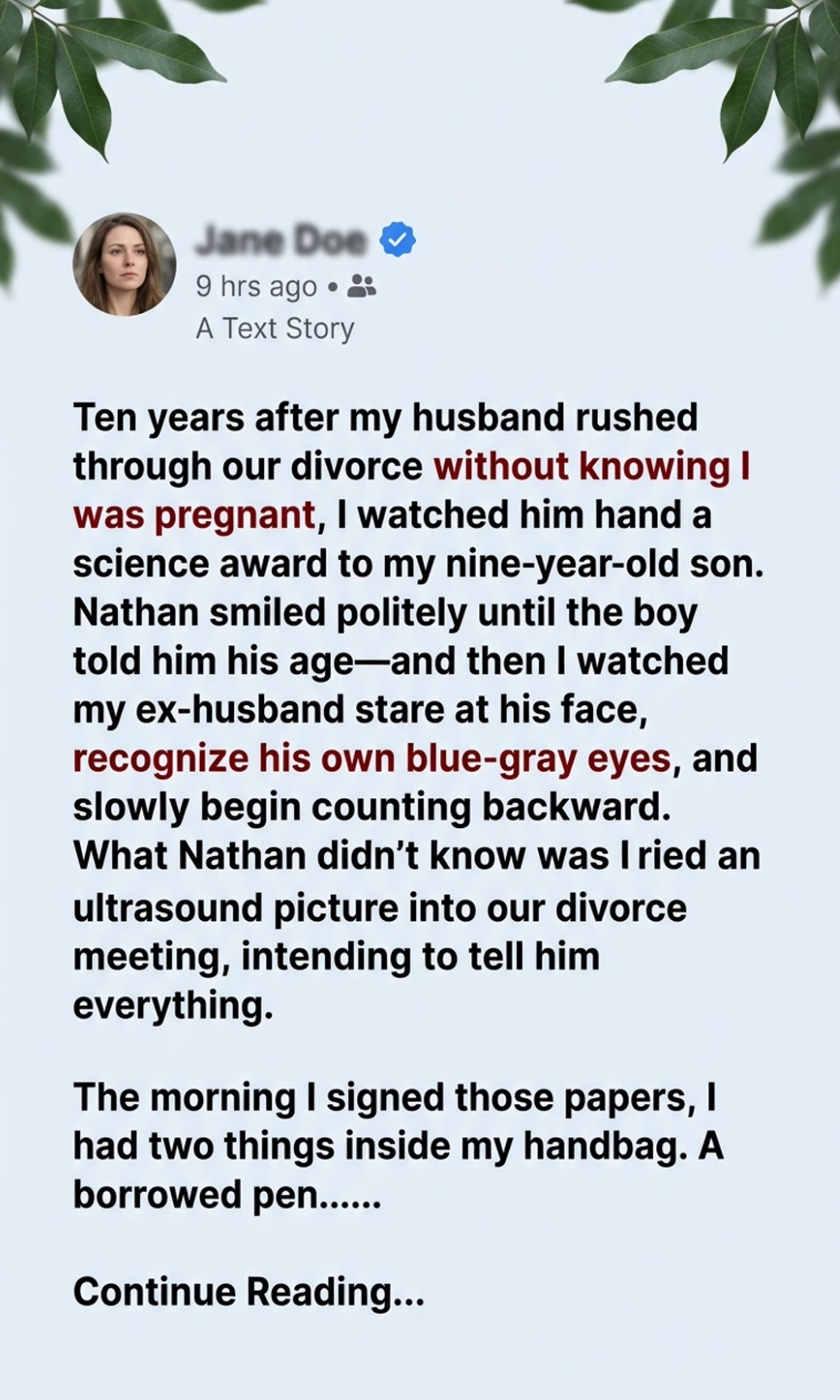
The morning I signed my divorce papers, I carried two things inside my handbag.
A borrowed blue pen and a small ultrasound photograph.
The pen belonged to my neighbor, Mrs. Collins, who had lent it to me outside the courthouse because I had forgotten mine. The ultrasound photograph was folded inside a plain white envelope, hidden beneath a packet of tissues and a bottle of aspirin.
One was meant to help me finish a painful chapter of my life.
The other could have changed the entire story.
My husband, Nathan Reed, sat across the conference table in a charcoal suit, checking his watch while his attorney reviewed the final pages. He had always been punctual, but that morning his impatience seemed almost cruel.
“Are we nearly finished?” he asked.
His lawyer, Mr. Bennett, adjusted his glasses. “Just the final signatures. Once everything is filed, the divorce will be complete.”
Nathan nodded.
He didn’t look at me.
For seven years, I had been the woman who remembered his mother’s birthday, brought him coffee before early meetings, and stayed awake when he worked late. I had celebrated his first promotion as if it were my own achievement. When his father died, I held him through the night while he cried into my shoulder.
But by the end of our marriage, he looked at me as though I were an obligation he had already paid too much to fulfill.
His career had grown quickly. He had become a rising star in a technology company, traveling to conferences, meeting influential people, and spending more nights in hotel rooms than at home. At first, I told myself it was temporary. I believed that if I remained patient, our marriage would eventually find its way back to us.
Then came the late-night arguments, the canceled anniversaries, and the long silences that stretched across our dinner table.
Finally, one Sunday evening, Nathan came home, placed his briefcase beside the door, and told me he wanted a divorce.
He said he no longer felt the same way about me.
He said we had grown apart.
He said he didn’t want to waste another year pretending.
I remembered sitting on our sofa, staring at the man I had married, trying to understand how someone could speak so calmly while dismantling another person’s entire future.
“Is there someone else?” I asked.
He paused.
“There is no point discussing that.”
His answer was enough.
I cried for three nights. On the fourth, I stopped asking him to reconsider.
I thought that if he could walk away so easily, I needed to find a way to stand on my own.
What I didn’t know then was that my body had already begun changing in ways I couldn’t explain.
I had been tired for weeks. Certain smells made me nauseated, and I found myself falling asleep in the middle of the afternoon. I blamed stress until I missed my period.
The pregnancy test showed two pink lines.
I took another.
Then a third.
All three told me the same thing.
I was pregnant.
For several minutes, I sat on the bathroom floor with the tests beside me, one hand covering my mouth.
Nathan and I had talked about children when we first married. We had imagined a little house filled with laughter, a garden where our children could play, and family holidays that would become treasured traditions.
But as his career accelerated, those conversations disappeared. Whenever I mentioned starting a family, he told me we should wait until things settled down.
I had believed we had time.
Now I was carrying a child whose father was preparing to leave me.
At my first appointment, the doctor confirmed the pregnancy and printed an ultrasound photograph. I studied the tiny shape on the screen, struggling to understand that something so small could already be the center of my world.
I decided I would tell Nathan.
Not over the telephone. Not through a message. I wanted to look him in the eyes and give him the chance to decide what kind of father he wanted to be.
That was why I carried the photograph into our divorce meeting.
When Mr. Bennett pushed the documents toward me, I reached into my handbag for the pen.
My fingers brushed the envelope.
I could feel the photograph through the thin paper.
“Before I sign,” I said quietly, “there’s something I need to tell you.”
Nathan finally looked up.
“What is it?”
I swallowed.
For one brief moment, I imagined telling him everything. I imagined his expression changing, his chair scraping backward, and his hand reaching across the table to take mine.
I imagined him asking if I was all right.
I imagined him saying that we would work it out.
Then his phone vibrated.
He glanced at the screen and sighed.
“Can we please do this later? I have a meeting in forty minutes.”
Something inside me went still.
“It’s important, Nathan.”
“Everything has been important lately, Emily. That’s part of the problem. I can’t keep putting my life on hold because you’re not ready to let go.”
I stared at him.
He didn’t know what I was about to say. He didn’t know that his child was already growing inside me. Yet he had managed to make me feel as though sharing the news would be another selfish demand.
I looked at the photograph inside the envelope.
Then I looked at the divorce papers.
I could have told him anyway. I could have placed the ultrasound on the table and insisted that he listen.
But I was frightened.
I was frightened that he would accuse me of trying to save our marriage with a baby. I was frightened that he would stay out of obligation, resenting both me and the child. Most of all, I was frightened that he would look at the photograph, look at me, and tell me that nothing had changed.
So I signed.
The pen scratched against the paper.
Nathan signed after me.
He stood, shook Mr. Bennett’s hand, and thanked him for making the process efficient.
Then he turned to me.
“I hope things work out for you.”
I waited for something more.
An apology. A question. A sign that the years we had shared meant something.
Instead, he picked up his briefcase.
“Goodbye, Emily.”
The door closed behind him.
I remained at the table until the room was empty.
Then I took the ultrasound photograph from my handbag, held it against my chest, and cried so hard that I could barely breathe.
That afternoon, I went home and began planning a future for two.
I never told Nathan about the pregnancy.
Not because I wanted to punish him.
Not because I believed a child should grow up without a father.
I told myself that if Nathan wanted to leave me without hearing me out, I would not force him to become a husband again. I would not use our child to keep him beside me.
I would raise the baby myself.
And if he ever wanted to know the truth, I hoped he would find a way to ask.
But life rarely unfolds according to the promises we make ourselves in moments of heartbreak.
Ten years later, I stood in the auditorium of Westbridge Elementary School, watching Nathan Reed walk onto the stage.
And I realized that some secrets do not stay buried forever.
My son, Lucas, was nine years old and had a habit of asking questions that made adults pause.
Why did the moon seem to follow the car?
Why couldn’t scientists make a machine that cleaned every river in the world?
Why did some plants grow toward the sunlight?
When he was five, he took apart an old alarm clock because he wanted to know what made it ring. I found the pieces arranged in neat rows across the kitchen table, along with a handwritten diagram that looked remarkably organized for a kindergartner.
When he was seven, he entered a school science fair with a homemade water filter made from gravel, sand, charcoal, and a plastic bottle. His project didn’t win first place, but he spent the next week explaining to anyone who would listen why the filtered water still wasn’t safe to drink.
That was Lucas.
Curious, thoughtful, and stubborn in the best possible way.
He had my dark brown hair and my habit of biting my lower lip when concentrating. But there was one feature that had never come from me.
His eyes.
They were blue-gray, unusual and striking, with a pale ring around the iris that seemed to catch the light. Whenever Lucas looked directly at someone, his eyes could make them feel as if he were listening to every word, even the ones they hadn’t spoken.
People often asked where he had gotten them.
“His father,” I would answer when I couldn’t avoid the question.
It was the truth, although I rarely explained more.
Lucas knew that his father and I had divorced before he was born. He knew his father lived somewhere else and had a career in technology. He knew I had chosen not to make contact.
But he didn’t know his father’s name.
When he was younger, I told him that some stories were complicated and that I would explain everything when he was old enough to understand.
As he grew older, I worried that the truth would hurt him. I worried that he would ask why his father had never visited, why he had never sent a birthday card, or why no one had ever come to a school event to watch him receive an award.
I had no answers that could make those questions easier.
So I waited.
I worked as a school librarian, a job I loved because I could surround Lucas with books while still earning enough to support us. We lived in a modest two-bedroom apartment above a small bakery. The kitchen window overlooked a narrow alley, and the heating system rattled whenever the weather turned cold.
We didn’t have much, but we had our routines.
Pancakes on Saturday mornings.
Library books stacked beside his bed.
A birthday cake made from scratch, even when I was exhausted.
And every evening, before he went to sleep, Lucas would tell me one interesting thing he had learned that day.
For nine years, I built our life around the certainty that I would never abandon him.
I couldn’t control who his father had chosen to be.
I could control what kind of mother I became.
Then Lucas’s school announced its annual Young Innovators Showcase.
Students from several schools would present science projects to a panel of judges. The winner in each age group would receive a medal and a certificate at a public ceremony.
Lucas entered with a project he called the RainSaver System.
He had designed a small model that collected rainwater from a rooftop, filtered debris, and directed the water into a storage container for use in a garden. He had built it with recycled plastic, a few inexpensive valves, and materials purchased with money he had saved from his birthday gifts.
He spent three weeks testing it.
The first version leaked.
The second overflowed.
The third worked, but the filter clogged after a heavy simulated rainfall.
Instead of giving up, he revised the design and tested it again.
When his teacher, Mrs. Alvarez, called to tell me that Lucas had won the regional award, I sat down on the edge of my bed and cried.
Not because of the medal.
Because I had watched him work so hard without ever asking for praise. I had watched him fail, become frustrated, and start again. I knew how much it meant to him to have someone recognize the effort behind his ideas.
“You have to come, Mom,” he said that evening, bouncing on his heels. “They said the award presenter is someone important in science and technology.”
“I wouldn’t miss it for anything.”
He hugged me around the waist.
“And you have to take pictures.”
“I’ll take so many pictures you’ll get tired of seeing yourself.”
He laughed.
Neither of us knew that the man presenting his award would be Nathan.
I discovered it three days later, when the school emailed the program for the ceremony.
The guest speaker was listed as Nathan Reed, chief innovation officer at Meridian Technologies and a donor to the regional science education foundation.
I read the name twice.
Then I read it a third time.
Nathan Reed.
My ex-husband.
The man who had walked out of a conference room ten years earlier without knowing that he was about to become a father.
I closed my laptop.
For several minutes, I could hear nothing except the refrigerator humming in the kitchen.
I considered keeping Lucas home.
I could call the school and say he was sick. I could invent a family emergency. I could tell Mrs. Alvarez that something had come up and ask whether the award could be delivered later.
But what would I be teaching my son?
That he should hide from difficult situations?
That his achievements mattered less than my fear?
Lucas had earned his place on that stage. He had worked for it, and he deserved to receive his award without worrying about the past.
I decided I would go.
I would sit quietly in the audience. I would keep my distance from Nathan. I would make sure Lucas had his moment.
And if Nathan recognized me, I would deal with it then.
The auditorium was filled with families, teachers, and students wearing their best clothes.
Lucas wore a white shirt, navy trousers, and a tie he had insisted on choosing himself. I had tried to straighten it twice in the car, but he kept loosening it because he said it was difficult to breathe.
“You look handsome,” I told him.
“You already said that.”
“I might say it again.”
He smiled and took my hand.
We found two seats near the center of the auditorium. I had deliberately chosen a row several seats away from the aisle, hoping it would make it easier to avoid Nathan if he came through the audience.
I was foolish to think a seating arrangement could protect me from ten years of history.
At precisely ten o’clock, the principal stepped onto the stage.
She welcomed everyone, thanked the sponsors, and spoke about the importance of encouraging children to question the world around them.
Then she introduced the guest speaker.
“Please join me in welcoming Mr. Nathan Reed, whose work in technology and environmental innovation has helped fund science education programs throughout our region.”
The audience applauded.
Nathan walked onto the stage.
He looked older than he had at the divorce meeting, naturally. There were faint lines beside his eyes, and a few silver strands had appeared at his temples. His shoulders were broader, his expression more controlled.
But he still walked the same way, with the confident, purposeful stride of someone accustomed to entering rooms where people waited to hear him speak.
I remembered that walk.
I had once watched for it through the window every evening, hoping to see him coming home early.
Now I watched him take the microphone.
“Thank you for having me,” he began. “When I was young, I thought being good at science meant having the right answers. As I grew older, I realized that the most important skill is learning how to keep asking the right questions.”
The irony was so sharp that I almost laughed.
Nathan continued, speaking about curiosity, persistence, and the courage to make mistakes.
He was a good speaker. He always had been. He knew how to make an audience feel that he was speaking directly to them.
Then he began presenting the awards.
One by one, students crossed the stage. Nathan shook their hands, posed for photographs, and congratulated them on their projects.
I clapped for every child.
My palms were damp.
When the final category was announced, Lucas leaned forward in his seat.
“And now,” the principal said, “our regional Young Innovators Award goes to a student whose RainSaver System demonstrates an impressive understanding of water conservation, practical engineering, and independent problem-solving. Please congratulate Lucas Morgan.”
Lucas turned to me with an expression of pure astonishment.
“That’s me,” he whispered.
I laughed through the sudden pressure in my throat.
“I know, sweetheart. Go get your award.”
He stood, straightened his tie, and walked toward the stage.
I watched him climb the steps.
Nathan held a certificate in one hand and a small silver medal in the other.
“Congratulations,” he said as Lucas approached.
“Thank you, sir.”
Nathan smiled for the photographer.
Lucas shook his hand.
For one brief second, it looked like any other award ceremony. A successful professional congratulating a promising young student. A proud child receiving recognition for hard work.
Then the photographer asked Lucas to turn toward the audience.
The overhead lights fell across his face.
Nathan’s smile faltered.
I saw it from my seat.
His eyes moved from Lucas’s hair to his nose, then settled on his eyes.
He stared.
Lucas, unaware of the storm beginning inside the man beside him, accepted the medal.
“What’s your project called?” Nathan asked.
“The RainSaver System.”
“That’s a clever name. How old are you, Lucas?”
“Nine.”
Nathan stopped moving.
The photographer lowered the camera slightly.
“Nine?” Nathan repeated.
“Yes, sir. I turned nine in March.”
Nathan’s gaze sharpened.
“What year were you born?”
Lucas answered.
I couldn’t hear the words clearly from where I sat, but I saw Nathan’s expression change as the date registered.
His fingers tightened around the edge of the certificate.
For a moment, he looked as though someone had struck him.
Nine years.
The divorce.
The month of March.
The woman he had left behind.
His eyes traveled back to Lucas’s face.
And then, slowly, he began counting backward.
I knew exactly what he was calculating because I had spent the same ten years trying not to calculate it myself.
The last night we had been together.
The date I had discovered the pregnancy.
The morning we signed the papers.
The months that followed.
His face had gone pale by the time he looked at Lucas again.
“What’s your mother’s name?” he asked.
Lucas blinked, surprised by the question.
“Emily Morgan.”
Nathan’s lips parted.
He looked toward the audience.
I could have lowered my head. I could have pretended not to see him.
Instead, I stood.
Our eyes met across the crowded auditorium.
For ten years, I had imagined what it might feel like to see Nathan again. In some versions of that imagined moment, I was angry enough to tell him exactly what he had lost. In others, I was calm and distant, so unaffected that he would understand how completely I had moved on.
I had never imagined standing in a school auditorium, watching him realize that his son was standing beside him.
Nathan whispered something to the principal and stepped away from the microphone.
Lucas glanced between him and the audience.
“Did I do something wrong?” he asked.
Nathan looked down at him immediately.
“No. No, you didn’t.”
His voice had changed.
It was quieter now, unsteady around the edges.
“You did a wonderful job.”
He handed Lucas the medal.
Then he turned toward me again.
I could see the questions forming on his face.
But before he could ask them, Lucas walked down the steps, holding his certificate in both hands.
He came straight to me.
“Mom, did you see? He asked me how old I was!”
“I saw, sweetheart.”
“Isn’t he amazing? He knew all about the project.”
I forced myself to smile.
“He seemed very interested.”
Lucas looked at the medal around his neck.
“I wish Dad could have seen this.”
The words struck me harder than anything Nathan could have said.
I wrapped my arms around my son.
“I know,” I whispered.
Behind us, the applause continued as another group of students was called to the stage.
I could feel Nathan watching us.
For the first time in ten years, I had no idea what would happen next.
I thought Nathan would approach me immediately.
He didn’t.
He remained near the stage for the rest of the ceremony, shaking hands with teachers and posing for photographs. But every few minutes, I caught him looking in our direction.
Once, his eyes met Lucas’s, and he seemed to forget what he was saying to the person beside him.
After the ceremony, I took Lucas to the lobby.
He was still talking about the award.
“Mom, did you hear what the judge said about my filter? She said I should try testing it with different types of soil. I could make a second version that works better with clay.”
“That sounds like a great idea.”
“And Mr. Reed said engineers have to think about the people who will actually use their inventions. I never thought about that before.”
I nodded, listening carefully even as my heart raced.
Lucas was proud. He was excited. He had no reason to understand why I was gripping the strap of my handbag so tightly.
Then I heard Nathan behind me.
“Emily.”
My son stopped speaking.
I turned.
Nathan stood several feet away, his hands hanging awkwardly at his sides. He looked like a man who had rehearsed a hundred speeches and forgotten every word.
Lucas glanced at me.
“Do you know Mr. Reed?”
I looked at Nathan.
“Yes,” I said. “I know him.”
Nathan swallowed.
“Lucas, would you mind giving your mother and me a few minutes to talk? Your teacher is over there with the other award winners. You can show her your certificate.”
Lucas looked uncertain.
I squeezed his shoulder.
“It’s all right. Go show Mrs. Alvarez your medal. I’ll be right here.”
He hesitated, then walked toward his teacher.
As soon as he was out of earshot, Nathan took a breath.
“Is he mine?”
There was no anger in his voice.
Only disbelief.
I could have lied. I could have told him that Lucas’s eyes were a coincidence, that the dates meant nothing, that he had misunderstood the situation.
But Lucas deserved better than another lie, and I was tired of carrying the entire weight of the truth.
“Yes,” I said.
Nathan closed his eyes.
For several seconds, he didn’t speak.
When he opened them, they were wet.
“You were pregnant when we divorced?”
“Yes.”
“How long did you know?”
“I found out shortly before the meeting.”
He looked at me as if he were trying to reconcile my answer with a memory he had never questioned.
“You were going to tell me?”
I stared at him.
“I brought the ultrasound photograph with me.”
His face crumpled.
“You brought it to the meeting?”
I nodded.
“Why didn’t you tell me?”
The question might have sounded accusatory if he had spoken it differently. Instead, he seemed genuinely desperate to understand.
I took a slow breath.
“I tried.”
Nathan looked down.
I continued before I could lose my courage.
“I told you there was something important I needed to discuss. You said you had a meeting and couldn’t keep putting your life on hold because I wasn’t ready to let go.”
He flinched.
“I didn’t know.”
“No. You didn’t.”
“I would have listened.”
“Would you?”
He looked up sharply.
I hated how much the question hurt him. I hated that a part of me still wanted to soften every difficult truth for his sake.
But I had spent years making his choices easier while carrying their consequences alone.
“I don’t know what you would have done,” I said. “I can’t tell you that you would have stayed, or that we would have reconciled, or that everything would have been wonderful. I can only tell you what happened. I was pregnant, and I left that room alone.”
Nathan pressed a hand against his mouth.
“I had a son,” he whispered. “For nine years, I had a son, and I didn’t know.”
“Yes.”
“Did you never think I deserved to know?”
The pain in his voice finally brought the anger I had held inside me for so long to the surface.
“Of course I thought you deserved to know. I thought about telling you every single day during my pregnancy. I thought about it when Lucas was born, when he took his first steps, when he said his first word, when he started school, and when he asked me why his friends had fathers who came to their sports days.”
Nathan stared at me.
“Then why?”
“Because I was afraid,” I said. “And because you had made it very clear that you wanted a life without me. I didn’t want to use a baby to force you back into a marriage you didn’t want.”
“I would never have thought that.”
“You might not have. But I was sitting across from a man who couldn’t spare five minutes to hear me speak. I was frightened, Nathan. I was alone. And I made a decision I believed I could live with.”
He looked toward Lucas, who was showing his certificate to Mrs. Alvarez.
The boy’s face lit up when his teacher congratulated him.
Nathan watched him with an expression I couldn’t fully interpret.
“Does he know about me?”
“He knows he has a father. He knows we divorced before he was born. He doesn’t know your name.”
Nathan’s jaw tightened.
“What have you told him?”
“That I would explain everything when he was old enough.”
“And when will that be?”
“I don’t know. I was hoping I would figure it out before today.”
He looked at me again.
“Emily, I missed everything.”
I couldn’t answer.
He had missed everything. The first laugh, the first tooth, the first fever, the first day of kindergarten. He had missed the nights I walked the apartment with a crying baby against my shoulder. He had missed the mornings I worked on little sleep and pretended I wasn’t exhausted.
But he had also missed the chance to choose.
And I had helped make that choice for him.
Both truths existed, and neither could erase the other.
Nathan wiped his eyes.
“Can I talk to him?”
I shook my head gently.
“Not today. Not like this.”
His face fell.
“He’s my son.”
“Yes,” I said. “But he’s also a nine-year-old boy who came here to receive an award. He doesn’t know you, and he has no idea what’s happening. I won’t let him become responsible for your shock or my fear.”
Nathan looked as though he wanted to argue.
Then he lowered his head.
“All right.”
I hadn’t expected him to agree so quickly.
“I want to meet with you,” he said. “Tomorrow, if possible. Somewhere quiet. We can talk about how to tell him.”
I hesitated.
There were a thousand reasons to refuse.
But Lucas deserved the truth, and Nathan deserved the opportunity to hear it properly.
“Tomorrow at two,” I said. “At the coffee shop on Willow Street. Just you and me.”
“I’ll be there.”
I nodded.
Then I turned away before either of us could say anything else.
That night, Lucas placed his medal on the kitchen table and ate two slices of pizza while explaining how he planned to improve his water filter.
I listened, asked questions, and tried to remember every detail.
I wanted to preserve the simplicity of that evening for as long as possible.
After dinner, he helped me wash the dishes.
“Mom?”
“Yes?”
“Why did Mr. Reed look so strange when I told him my age?”
My hand stopped beneath the running water.
“He might have been surprised. Sometimes adults get distracted when they’re thinking about something.”
Lucas considered that.
“Do you know him from work?”
“No.”
“School?”
“No.”
He rinsed a plate and placed it in the drying rack.
“Then how do you know him?”
I turned off the faucet.
I had promised myself I would not lie to Lucas again. But I also knew that telling him everything in the middle of an ordinary Tuesday evening, while he was still excited about his award, would be unfair.
“Lucas, there’s something about your father that I need to explain to you.”
He became very still.
“My father?”
I nodded.
“Mr. Reed is your father.”
For a moment, my son simply stared at me.
Then he looked down at his hands.
“Really?”
“Yes.”
He swallowed.
“Does he know that?”
“He found out today.”
Lucas pulled out a chair and sat down.
I sat beside him.
He didn’t cry. He didn’t shout. He didn’t ask why I had kept the secret.
He was too busy trying to understand a truth that had just rearranged his entire world.
“Why didn’t he come to my birthday parties?” he asked.
The question I had dreaded had finally arrived.
“Because he didn’t know you existed.”
Lucas looked at me.
“But you knew him.”
“Yes.”
“And you knew he was my father.”
“Yes.”
He stared at the table for a long time.
“Why didn’t you tell him?”
I told him the truth as gently as I could. I explained that Nathan and I had divorced before I knew how to tell him about the pregnancy. I explained that I had been frightened and hurt, and that I had believed it was better to raise Lucas on my own than to force Nathan to stay.
I did not tell him that his father was a terrible man.
I did not tell him that Nathan would have been a wonderful father.
I didn’t know either of those things.
When I finished, Lucas rubbed his eyes.
“Are you mad at him?”
“Sometimes I was.”
“Are you mad at me?”
The question shattered me.
I reached for his hands.
“Never. Not for one second. You are the best thing that ever happened to me.”
He searched my face.
“Did Dad not want me?”
I took a breath that trembled on the way out.
“I don’t know what your father would have wanted if he had known about you. I can’t answer for him. But I know this: you were never unwanted by me. I wanted you the moment I knew you were there, and I have loved you every day since.”
Lucas’s eyes filled with tears.
“Will he want to see me now?”
“I think he will.”
“Do you want me to see him?”
That was the hardest question of all.
Because the honest answer was complicated.
Part of me wanted to protect Lucas from disappointment. Part of me wanted Nathan to experience the same helplessness I had felt when he walked out of our marriage. And another part, the part I rarely admitted even to myself, wanted to see whether the man I had loved could become someone our son could trust.
“Yes,” I said finally. “If you want to meet him, I will help you. But you don’t have to decide tonight.”
Lucas leaned against me.
We sat together for a long time, neither of us speaking.
Before he went to bed, he asked one more question.
“Does he have eyes like mine?”
I smiled sadly.
“Yes, sweetheart. He does.”
Lucas touched the edge of his medal.
“Then I guess that’s where they came from.”
I kissed his forehead.
“Yes,” I whispered. “I guess it is.”
After he fell asleep, I went to my bedroom and opened the drawer where I kept old documents.
At the bottom, inside a small envelope, was the ultrasound photograph.
The paper had faded slightly at the edges. I had carried it through three apartments, two jobs, and countless moments when I wondered whether I had made the right decision.
I placed it on my bedside table.
For the first time in ten years, I no longer wanted to hide it.
Nathan arrived at the Willow Street coffee shop twenty minutes early.
I knew because I saw him through the window as I approached. He sat at a table near the back, untouched coffee in front of him, staring at his phone without appearing to read anything on the screen.
When I entered, he stood.
“Thank you for coming.”
I removed my coat and sat across from him.
“You said you wanted to talk.”
He nodded.
For a moment, we were simply two people who had once shared a home and now had no idea how to begin speaking to each other.
Then Nathan reached into his jacket and took out a folded piece of paper.
It was the program from the science ceremony.
Lucas’s name was circled.
“I looked him up last night,” he admitted. “The school website has photographs of the projects. There was one of him holding his water filter. I must have looked at it fifty times.”
I felt a sharp pang in my chest.
“He worked hard on it.”
“I can tell.”
Nathan looked down at the paper.
“Emily, I need you to know that I never remarried. I dated someone for a while, years ago, but it ended. I spent most of my time building my career. I told myself I had made the right decision leaving our marriage because I was unhappy and needed to move forward.”
He rubbed his forehead.
“I never thought about the possibility that there was a child. I never imagined—”
He stopped.
“I know that doesn’t excuse anything. It just explains why I never looked for him.”
I studied his face.
“Did you ever think about me?”
The question escaped before I could stop it.
Nathan looked up.
“Yes.”
I hadn’t expected the answer to come so quickly.
“Not every day,” he continued. “Not after the first few years. But sometimes I would see something that reminded me of you. A book you loved. A song we used to hear in the car. I wondered whether you were happy.”
He paused.
“I told myself you were probably better off without me.”
I gave a small, humorless laugh.
“That was convenient.”
“I know.”
He didn’t defend himself.
For the first time since I had known him, Nathan seemed willing to sit with the consequences of something he had done without immediately trying to explain them away.
He took a breath.
“Did you keep the ultrasound because you wanted to tell me someday?”
“Yes.”
“Why didn’t you?”
“Because I was afraid that if I contacted you, you would think I was trying to get you back. And because, after Lucas was born, every year that passed made the decision harder to undo.”
Nathan’s eyes filled again.
“I wish you’d told me.”
“So do I,” I said.
The admission surprised us both.
I looked at my hands.
“I wish I had been brave enough to tell you. I wish I hadn’t let my fear make the decision for both of us. I can’t change that now.”
Nathan reached across the table, then stopped before touching my hand.
“I would have wanted to know my son.”
“I believe you.”
“Do you?”
I met his gaze.
“I believe you want to know him now. That’s different from knowing what you would have done ten years ago.”
He slowly withdrew his hand.
“You’re right.”
We sat quietly for a moment.
Then he asked, “What happens now?”
“That’s up to Lucas, too.”
“I understand.”
“I need you to understand something else. You don’t get to appear in his life, make promises because you’re overwhelmed, and disappear if things become difficult. He’s not a second chance for you to feel better about yourself.”
Nathan’s face tightened.
“I would never do that.”
“You don’t know what you would do. You haven’t been his father for a single day.”
The words sounded harsh, but I needed him to hear them.
“If you want a relationship with Lucas, you must be patient. He may be curious one day and angry the next. He may ask questions you don’t know how to answer. He may need time before he trusts you. You cannot demand affection simply because you’re his biological father.”
Nathan nodded slowly.
“What do you need from me?”
“Consistency. Honesty. And no promises you can’t keep.”
He looked down at his coffee.
“I can do that.”
“Then we’ll see.”
I opened my handbag and took out the envelope.
Nathan stared at it.
“Is that—?”
“The ultrasound photograph.”
I placed it on the table between us.
He didn’t touch it at first.
Then he picked it up with both hands, as carefully as if it were made of glass.
The photograph showed a tiny shape surrounded by darkness. It was difficult to make out anything recognizable, but Nathan stared at it as though he were looking at the most important picture in the world.
“This was taken before the divorce?”
“Yes.”
He turned the photograph over.
My handwriting was on the back.
Our little miracle. I hope we can give this baby a happy life.
Nathan read the words twice.
Then he covered his face.
I had seen him angry, proud, impatient, and exhausted. I had seen him cry once, at his father’s funeral.
But I had never seen him break down like that.
“I am so sorry,” he whispered.
I felt tears gathering in my own eyes.
“I know.”
“No, Emily. I am sorry for the way I treated you. I was so focused on getting out of a marriage I thought was making me unhappy that I stopped seeing you as a person. You were trying to tell me something important, and I couldn’t even give you five minutes.”
He lowered his hands.
“I can’t undo that. I can’t give you back those years, and I can’t make up for the things I missed with Lucas. But I am sorry.”
For years, I had imagined hearing those words.
I had imagined they would make me feel vindicated, or relieved, or finally free of the anger I carried.
Instead, I felt tired.
Not the tiredness that comes from working too many hours or sleeping too little, but the deeper exhaustion of discovering that an apology can be sincere and still fail to repair what happened.
“Thank you for saying that,” I replied.
Nathan nodded.
“Would you let me write him a letter? Not to pressure him. Just to introduce myself and explain what I can.”
I considered it.
“A letter would be a good place to start.”
He carefully returned the photograph to its envelope.
“I don’t expect you to forgive me for everything.”
“Good,” I said. “Because I’m not ready to.”
For the first time that morning, a faint, sad smile crossed his face.
“I wouldn’t expect you to be.”
We left the coffee shop separately.
But when I walked away, I realized that something had changed.
For ten years, I had carried the entire story by myself.
Now Nathan knew the truth.
What happened next would depend on what all three of us chose to do with it.
Nathan’s letter arrived five days later.
He had written it by hand, on ordinary white paper, without his company logo or any of the polished language he used in professional speeches.
He began by telling Lucas who he was.
He explained that he had met Lucas at the science ceremony and had been surprised to learn they were connected. He said he had recently discovered that he was Lucas’s biological father and that he understood this news might feel strange or confusing.
He did not ask Lucas to call him Dad.
He did not claim that their shared eyes meant they already knew each other.
He wrote about his work in technology, his interest in environmental engineering, and the fact that he had once built a small radio with his own father.
Then he wrote one sentence that made me stop reading.
I don’t expect you to feel anything for me simply because we share a family connection. If you ever want to meet me, I would be grateful for the chance to listen to you and learn who you are.
At the end, he included his phone number and email address.
No pressure.
No deadline.
No demand for an answer.
I gave the letter to Lucas after dinner.
He read it once, then a second time.
“Did he really write all this himself?”
“Yes.”
“Can I keep it?”
“Of course.”
He folded the paper and placed it inside the drawer of his desk, beside his science notebooks.
For the next week, he said little about Nathan.
I didn’t push him.
Then, one Saturday morning, while we were eating pancakes, Lucas asked whether his father liked science when he was young.
“I think he did,” I said. “He was always interested in how things worked.”
Lucas smiled slightly.
“Maybe that’s why I like it.”
“Maybe.”
He stared at his plate.
“Could I meet him somewhere? Not at his house. Maybe at the science museum?”
I felt my heart tighten.
“If that’s what you want, we can arrange it.”
“I want you to come, too.”
“I will.”
We agreed to meet Nathan at the city’s science museum the following Saturday.
Nathan arrived early again.
He was standing near an exhibit about electricity, holding a small paper bag. When he saw us, he put it down on a bench and approached slowly.
“Hello, Lucas.”
“Hi.”
Nathan looked at me briefly, as if asking whether he should offer his hand.
I gave a small nod.
He held it out.
Lucas shook it.
Their hands met, and for a second, I saw something almost unbearable in Nathan’s expression. He was trying to keep himself calm, but his eyes were fixed on Lucas’s face with a mixture of wonder and grief.
“Thank you for coming,” Nathan said.
Lucas glanced at the paper bag.
“What’s that?”
“Something I thought you might like. But you don’t have to take it if you don’t want to.”
He opened the bag and removed a small beginner’s electronics kit.
Lucas’s eyes widened.
“Is that a circuit board?”
“It is. I wasn’t sure whether you already had one, so I chose a simple kit that lets you build a few different projects.”
Lucas examined the box.
“Can we build a radio with it?”
Nathan’s expression softened.
“We can try.”
I watched them stand beside the exhibit, discussing circuits and electrical resistance.
For the first fifteen minutes, I barely heard their conversation. I was too busy studying Nathan.
He didn’t interrupt Lucas. He didn’t pretend to know answers he didn’t know. When Lucas asked a question, Nathan considered it carefully before responding.
When he made a mistake, he admitted it.
It was a small thing.
But it mattered.
After an hour, we went to the museum café.
Lucas asked Nathan about his childhood. Nathan told him about growing up in a small town, about riding his bicycle to school, and about building a wooden bridge with his father for a school project.
“Did your father come to your school events?” Lucas asked.
Nathan went quiet.
“Yes,” he said. “Most of them.”
“Did you like that?”
“Very much.”
Lucas stared at his cup.
“I think I would have liked that.”
Nathan looked as though the words had struck him in the chest.
“I wish I had known you,” he said quietly.
Lucas didn’t answer immediately.
Then he asked, “Can we meet again?”
Nathan’s eyes filled.
“If you want to, absolutely.”
“I want to show you my next project. I’m thinking about making a solar-powered water pump.”
Nathan smiled.
“I’d love to see it.”
As we left the museum, Lucas walked a few steps ahead of us, studying the brochure he had picked up at the entrance.
Nathan fell into step beside me.
“Thank you,” he said.
I glanced at him.
“For what?”
“For giving me a chance.”
I watched Lucas stop near the doors to examine a display about space exploration.
“Don’t thank me yet,” I said. “Keep showing up.”
Nathan nodded.
“I will.”
The months that followed were neither easy nor dramatic.
There was no magical transformation in which Nathan suddenly became the perfect father. There were awkward conversations, missed signals, and moments when Lucas withdrew because he didn’t know how to express what he was feeling.
But Nathan kept showing up.
He attended Lucas’s next science presentation, sitting in the back of the classroom because Lucas said he didn’t want too much attention. He came to the school garden when Lucas’s class planted vegetables. He learned that Lucas disliked tomatoes but loved tomato soup, that he was nervous before speaking in front of groups, and that he often pretended not to be tired because he didn’t want to miss anything interesting.
Nathan never asked Lucas to call him Dad.
For months, Lucas called him Mr. Reed.
Then one afternoon, while they were working on a model wind turbine at our kitchen table, Lucas said, “Nathan, can you pass me the small screwdriver?”
Nathan handed it over.
“Here you go.”
I looked up from the book I was reading.
Neither of them seemed to notice what had happened.
But I did.
Nathan had become a person Lucas could address without formality, a person whose presence was beginning to feel familiar.
It wasn’t fatherhood in its fullest sense.
Not yet.
But it was a beginning.
Nathan also began taking responsibility for the years he had missed.
He paid for Lucas’s school activities without trying to buy affection. He contributed to a savings account for Lucas’s future education, and he did so only after we agreed on the arrangement. He asked before making plans. He respected the boundaries I set.
When Lucas had a difficult day, Nathan didn’t insist on being included. He waited until Lucas was ready to talk.
And when Lucas finally asked why Nathan hadn’t known about him, Nathan did not blame me.
He told Lucas that he and I had divorced before Lucas was born, that he had not known about the pregnancy, and that he regretted the way he had treated me during our separation.
He said that I had made a decision out of fear, and that he could understand why I had been afraid.
Then he told Lucas something I had never heard him say before.
“Adults make mistakes, sometimes serious ones. The important thing is not to pretend they didn’t happen. The important thing is to take responsibility for them and do better.”
Lucas listened quietly.
Then he asked whether Nathan had ever loved me.
Nathan looked at me before answering.
“Yes,” he said. “I did love your mother. But I didn’t know how to protect our marriage, and I allowed my own ambition and impatience to become more important than the person I had promised to care for.”
I looked away, blinking rapidly.
Lucas considered the answer.
“Are you going to get married again?”
Nathan smiled faintly.
“I don’t know.”
“Are you going to be friends with Mom?”
Nathan took a slow breath.
“I hope we can be respectful and kind to each other. Your mother and I don’t need to be married or even close friends for us to work together to make sure you have a good life.”
Lucas seemed satisfied with that.
Then he returned to his wind turbine.
It was a small conversation, but afterward I felt something loosen inside me.
Nathan was no longer asking me to rewrite the past so that he could feel better about it.
He was learning how to live honestly with what had happened.
A year after the science award ceremony, Lucas entered another regional competition.
This time, his project was a compact solar-powered irrigation system designed for small community gardens. It used a miniature solar panel to power a pump that drew water from a storage container and delivered it through a simple drip system.
Lucas spent months testing the design.
Nathan helped him understand how to calculate the pump’s power requirements, while I helped him organize his notes and practice his presentation.
We argued over the best way to explain the system to the judges. Lucas insisted that the project should be described in simple language, so that children his age could understand it.
He was right.
On the day of the competition, he stood beside his model and explained how solar energy could help small gardens conserve water.
The judges asked difficult questions.
Lucas answered some confidently and admitted when he didn’t know something.
When the results were announced, he won first place.
Nathan clapped so loudly that Lucas laughed from the stage.
After the ceremony, the three of us went to a small restaurant near the river. Lucas insisted on ordering dessert before the main course, claiming that winning a science competition qualified him to make unusual decisions.
Nathan agreed.
I rolled my eyes.
“You two are going to make a terrible team.”
“We already are,” Lucas replied.
We laughed.
For a moment, the three of us looked almost like the family I had imagined when I was young.
But I understood something by then that I hadn’t understood during my marriage.
A family doesn’t have to look exactly as you once dreamed for it to be real.
Nathan and I were not going to become the couple we had been before the divorce. Too much had happened, and too much time had passed. There were wounds that would never entirely disappear.
But we could still become two adults who loved the same child enough to work together.
And perhaps that was a better outcome than trying to recreate a past that had never been as perfect as I remembered.
After dinner, Nathan walked Lucas to the car while I paid the bill.
When I joined them, Lucas was showing Nathan a drawing of his next project.
“I want to build something that can collect rainwater from apartment rooftops,” he explained. “Then people could use it for plants and cleaning, so they wouldn’t waste drinking water.”
Nathan listened carefully.
“That sounds promising. What do you think the biggest challenge will be?”
“Making sure the water stays clean.”
“Then that should be one of the first things you test.”
Lucas nodded enthusiastically.
I stood beside the car, watching them talk.
Nathan looked up and caught my eye.
For a moment, neither of us spoke.
Then he said, “You did a wonderful job raising him.”
The words were simple.
They were not an attempt to reclaim credit. They were not a request for forgiveness.
They were an acknowledgment.
I looked at Lucas, who was still explaining his design.
“Yes,” I said quietly. “I did.”
Nathan nodded.
“And I know I wasn’t there.”
I studied him.
“No,” I said. “You weren’t.”
He accepted the answer without defending himself.
Then he opened the car door for Lucas.
As my son climbed inside, he leaned out again.
“Are we meeting next weekend?”
Nathan smiled.
“Of course.”
“Good. I want to show you the new calculations.”
“I’ll be ready.”
Lucas pulled the door shut.
I watched Nathan step back onto the pavement.
Ten years earlier, I had left a conference room believing that I would have to carry the rest of my life alone.
For a long time, I had thought the secret in my handbag had been the beginning of everything that went wrong.
Now I understood that it was only one part of a much larger story.
I had been frightened. Nathan had been selfish. We had both made decisions that shaped a child’s life before he was old enough to understand what a decision was.
We could not change those choices.
But we could choose what came next.
Several months later, Lucas asked me to help him find the ultrasound photograph.
We were cleaning out the drawer in my bedroom when he came across the small envelope.
“Is this the picture you took before I was born?”
I nodded.
He opened it carefully.
For a long time, he studied the image.
“That’s me?”
“Yes, sweetheart.”
He turned the photograph over and read my handwriting.
Our little miracle. I hope we can give this baby a happy life.
He looked up.
“Did you write this before you and Dad divorced?”
“Yes.”
“Were you happy when you found out about me?”
I sat beside him.
“I was scared, but I was also happier than I knew how to explain. I remember sitting on the bathroom floor, looking at the pregnancy test, and realizing that my life was going to change forever.”
“Were you sad that Dad didn’t know?”
I thought carefully before answering.
“Yes. I was very sad. I wanted you to have the chance to know him, but I didn’t know how to make that happen without hurting you or myself.”
Lucas folded the envelope closed.
“I’m glad I know him now.”
“So am I.”
He leaned against my shoulder.
“Do you wish you had told him?”
The question deserved an honest answer.
“Sometimes,” I said. “I wish I had found the courage to tell him. But I also know that I was making the best decision I could with the fear and information I had at the time. I can’t spend the rest of my life punishing myself for being afraid.”
Lucas was quiet for a moment.
“Dad says people have to learn from mistakes.”
“He’s right.”
“Do you think you and Dad made a mistake?”
I considered the question.
“I think we both made choices that hurt people. And I think we’ve both learned things from them. That doesn’t mean everything can be fixed, but it means we can try to do better.”
Lucas looked at the photograph again.
“Can I keep this?”
I smiled.
“Of course.”
He placed it in a small box where he kept his science medals, drawings, and other things that mattered to him.
Then he hugged me.
“Thank you for taking care of me, Mom.”
I wrapped my arms around him.
“There was never a day when I wouldn’t have chosen you.”
He held me for another moment before returning to his room.
I stayed seated beside the drawer, listening to the familiar sounds of our apartment: the refrigerator humming, a motorbike passing in the alley, the faint clatter of dishes from the neighboring flat.
For ten years, I had treated the ultrasound photograph as evidence of the life I had lost.
Now it felt like something else.
A reminder of the moment I became Lucas’s mother.
A reminder that love could begin in fear and still grow into something beautiful.
And a reminder that the past did not have to determine every choice we made in the future.
On Lucas’s tenth birthday, Nathan arrived at our apartment carrying a cake.
It was slightly crooked, with blue icing around the edges and a small plastic rocket on top.
“I attempted to make it myself,” he announced.
Lucas stared at the cake.
“You made that?”
“I did.”
“Why is the rocket leaning?”
Nathan looked down.
“Gravity.”
Lucas burst out laughing.
I couldn’t help smiling.
We placed the cake on the kitchen table, and Lucas invited Nathan to stay for dinner. Nathan looked at me first, waiting for my answer.
I nodded.
“There’s enough food.”
We ate roasted chicken, potatoes, and vegetables. Lucas told us about a new book he had started reading, then explained a theory about how cities could use rooftop gardens to reduce heat.
Nathan asked questions. I brought out more food. Lucas interrupted both of us whenever he remembered another detail.
It was ordinary.
That was what made it special.
After dinner, we sang happy birthday. Lucas blew out the candles and made a wish he refused to reveal.
When we began clearing the table, Nathan paused beside the kitchen window.
“Emily, can I ask you something?”
I dried my hands.
“Go ahead.”
“Do you think we’ll ever be able to talk about the past without it hurting so much?”
I considered the question.
“Maybe. But I don’t think the goal should be to make it stop hurting completely. Some things hurt because they mattered.”
Nathan nodded.
“I’ve thought about that day at the courthouse more times than I can count.”
“So have I.”
“I wish I could go back and give you those five minutes.”
I looked at him.
“I wish you had given them to me, too.”
He lowered his eyes.
Then I added, “But we can’t go back. We can only decide what kind of people we want to be now.”
Nathan looked toward Lucas, who was in the living room assembling a small electronic toy.
“I want to be someone he can count on.”
“Then keep being that person.”
“I will.”
He paused.
“And Emily?”
“Yes?”
“Thank you for loving him so well.”
My eyes filled.
I didn’t tell him that I had once imagined those words coming from him in a different life, in a different home, when our marriage still had a chance.
I didn’t need to.
I simply nodded.
“Thank you for showing up now.”
Nathan smiled sadly.
It wasn’t a promise of romance. It wasn’t forgiveness wrapped in a convenient bow.
It was something more modest, and perhaps more meaningful.
Two people acknowledging the truth and choosing to move forward without pretending the past had never happened.
When Nathan left that evening, Lucas walked him to the door.
“See you next Saturday?”
“Next Saturday,” Nathan promised.
Lucas held out his hand for a fist bump.
Nathan returned it.
After the door closed, Lucas came back into the kitchen and leaned against me.
“Mom?”
“Yes?”
“I’m glad you didn’t keep me a secret forever.”
I held him close.
“So am I.”
He looked up at me, his blue-gray eyes bright beneath the kitchen light.
For years, those eyes had reminded me of the man who had left us before he knew we existed. I had sometimes wondered whether seeing them every day would always bring back the pain of that morning.
But as I looked at my son, I understood something I should have understood long ago.
Those eyes did not belong to the past.
They belonged to Lucas.
They belonged to the boy who asked questions, who built things with his hands, who tried again when his experiments failed, and who had learned that people could make mistakes without being defined by them forever.
Nathan had given him his eyes.
I had carried him into the world.
And Lucas was becoming his own person, shaped by far more than either of us could control.
I kissed the top of his head.
“Me too, sweetheart.”
That night, after Lucas went to bed, I took the ultrasound photograph from his box and held it beneath the light.
The image was still small and blurry.
The handwriting on the back was still mine.
But I no longer saw it as a symbol of a life that might have been.
I saw it as the beginning of the life I had actually lived.
It had been harder than I imagined. There had been lonely nights, difficult choices, and years when I believed I had to be strong because there was no one else to be.
There had also been laughter, discoveries, bedtime stories, school projects, and a little boy who had grown into a thoughtful, curious child.
I had not given Lucas the childhood I once dreamed of.
I had given him a childhood filled with love.
And now, slowly, he was building a relationship with a father who had missed his beginning but was finally learning how to be present.
That would never erase the past.
It didn’t have to.
I slipped the photograph back into its envelope and placed it in the box beside Lucas’s medals.
Then I closed the drawer.
For the first time in ten years, I no longer felt that I was hiding something.
I was simply putting a chapter of our story where it belonged.
Behind us, not erased, but no longer in control of what came next.
And as I turned off the light, I realized that the most important part of our story had never been the secret Nathan discovered on that auditorium stage.
It was what we chose to do after the truth finally came out.
Because sometimes a family doesn’t begin the way we expect.
Sometimes it begins with a mistake, a painful silence, and a truth that arrives years too late.
But if the people involved are willing to take responsibility, to listen, and to keep showing up, even a broken beginning can lead somewhere good.
Not back to the life that was lost.
Forward, into a different one.
And for Lucas, that was enough.