My aunt Eleanor had always been a private woman.
She lived alone in a weathered two-story house at the end of a quiet street, surrounded by overgrown hydrangeas and an old wooden fence that leaned farther with every passing winter. Her husband had died many years earlier, and she never remarried. She had no children, and although she had relatives scattered across the state, she rarely invited anyone into her personal affairs.
I was the exception.
I had been close to Aunt Eleanor since childhood. When my parents divorced, she was the person who listened without judging me. When I lost my first job, she helped me pay rent without making me feel ashamed. When I eventually built a stable life of my own, she never asked for anything in return.
We spoke every Sunday evening, sometimes for ten minutes and sometimes for an hour. We discussed ordinary things: the weather, her garden, my work, and the books she was reading. She rarely talked about money or the past.
So when she died unexpectedly at seventy-eight, I felt as though someone had removed one of the few steady foundations in my life.
At the funeral, I stood beside her closed casket and remembered the last conversation we had shared.
She had sounded tired that evening, but her voice was clear.
“Promise me something,” she had said.
“What is it?”
“If something happens to me, don’t make any quick decisions about the house.”
I laughed softly. “Aunt Eleanor, you aren’t going anywhere.”
“Everyone goes somewhere eventually,” she replied.
I promised her I would think carefully before making any decisions.
At the time, I assumed she was simply worried that I might sell the house and let strangers tear apart the garden she had spent decades cultivating.
I had no idea how important that promise would become.
Two weeks after the funeral, I met with her attorney, Mr. Bennett, in a small office above a bank.
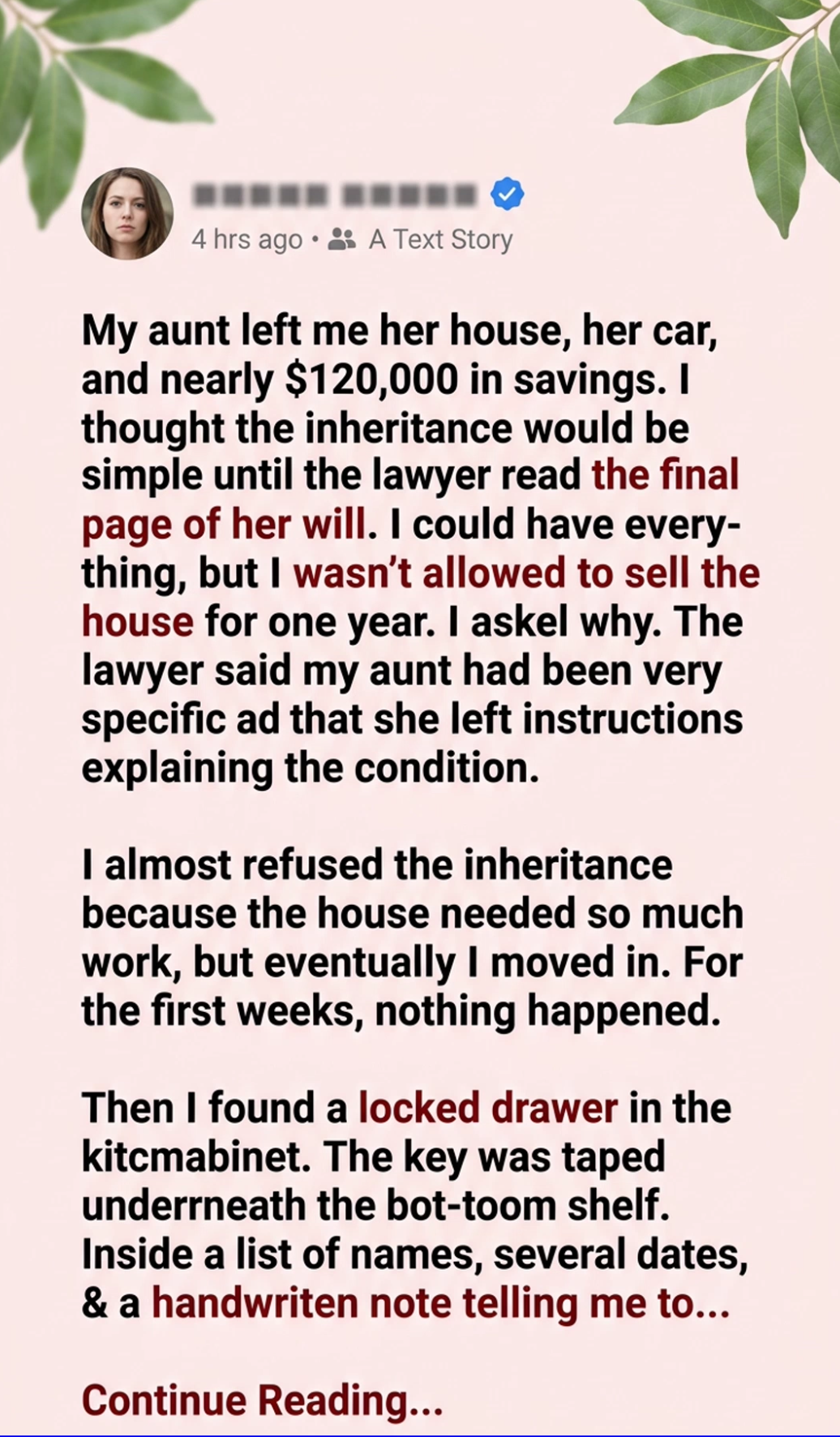
He opened a thick folder and explained that Eleanor had left me the house, her car, and approximately $120,000 in savings.
I was stunned.
I had never expected to inherit anything substantial. I assumed her estate would be divided among several relatives, with perhaps a small keepsake left to me.
Instead, I was the primary beneficiary.
Then Mr. Bennett turned to the final page.
“There is one condition,” he said.
I leaned forward.
“The house cannot be sold for twelve months after your aunt’s death.”
I stared at him.
“Why?”
He folded his hands.
“Your aunt was very specific. She wanted you to occupy the property, or at least retain control of it, for a full year. She also left a sealed letter explaining her reasoning. You may read it after you have taken possession of the house.”
“That sounds ridiculous,” I said before I could stop myself. “The roof leaks. The kitchen needs work. The plumbing is old. I don’t even know how much it would cost to make the place livable.”
Mr. Bennett did not argue.
“I understand your concerns. You should have the estate documents reviewed independently if you wish. But your aunt was deliberate about this provision.”
I left the office feeling overwhelmed.
The inheritance was generous, but it was also a responsibility I had never asked for. I had a job, a small apartment, and my own expenses. Moving into Eleanor’s house would mean taking on repairs, maintenance, insurance, and a property that seemed to have accumulated every problem imaginable over the years.
For several days, I considered declining the inheritance.
Then I remembered my promise.
I decided to move in for the year.
The house smelled of old wood, dust, and the lavender sachets Eleanor used to keep in her drawers. Sunlight filtered through faded curtains, revealing scratches on the floors and hairline cracks in the plaster.
The kitchen was the worst room. One cabinet door hung crookedly, the sink leaked, and the linoleum had begun peeling near the refrigerator.
I spent my first week sorting through boxes, cleaning shelves, and making lists of necessary repairs.
Nothing unusual happened.
The neighbors waved when I arrived home from work. A delivery driver brought a package addressed to Eleanor. The garden needed trimming, and the old car required a new battery.
Life settled into a quiet routine.
By the third week, I had almost forgotten the strange condition in the will.
Then, on a rainy Thursday afternoon, I found the drawer.
I was cleaning the lower kitchen cabinets when I noticed that one section of the cabinet beneath the counter didn’t quite line up with the others. The wood looked slightly newer around the edges, as if someone had repaired it and tried to make the work invisible.
I pressed against the panel.
Nothing happened.
I tried pulling the handle, but it wouldn’t move.
There was a lock.
I searched the kitchen for a key, checking the drawers, the pantry, and the old ceramic bowl where Eleanor kept spare buttons and loose change.
I found nothing.
Just as I was about to give up, I remembered that the bottom shelf beneath the cabinet was unusually thick.
I crouched down and ran my fingers along its underside.
Something small and metallic brushed my fingertips.
A key.
It had been taped beneath the shelf with yellowing adhesive tape.
My heart began to beat faster.
I unlocked the drawer.
Inside lay a folded sheet of paper, a narrow black notebook, several old photographs, and a sealed envelope with my name written across the front.
The handwriting was Eleanor’s.
I sat on the kitchen floor and opened the envelope.
Dear Claire,
If you have found this drawer, then you have kept your promise and stayed in the house long enough to discover what I could not explain to you while I was alive.
Before you read anything else, understand this: the names in the notebook belong to people who came to me for help. Some were afraid. Some were ashamed. Some believed that no one would ever listen to them.
I kept their stories because someone needed to remember the truth.
The house is not a treasure chest, and the money is not a reward. They are the means by which you can finish something I was never able to finish myself.
I stopped reading.
What had my aunt been involved in?
I turned to the black notebook.
The first page contained a list of names, each followed by a date and a short handwritten note. Some entries went back more than thirty years.
Beside one name, Eleanor had written: “September 14 — returned the blue envelope.”
Beside another: “November 3 — spoke to the school principal.”
A third entry read: “June 22 — payment refused. Keep original receipt.”
The notes made little sense to me.
Then I recognized a surname.
Holloway.
It belonged to a family that had lived three houses away from Eleanor when I was a child.
I remembered a girl named Rebecca Holloway, who had disappeared from our neighborhood for several months when we were in middle school. Adults had whispered about her family, but whenever I asked questions, my parents told me not to repeat gossip.
I turned the page.
Rebecca’s name appeared three times.
Beside the last entry, Eleanor had written:
She finally told the truth. Keep the letter safe.
I felt a chill move through me.
What truth?
I examined the photographs. One showed Eleanor standing beside a younger woman in front of the house. Another showed a group of people gathered around a table covered with papers.
On the back of the group photograph, Eleanor had written a date from twenty-seven years earlier and a single sentence:
The night we agreed not to let them bury it.
I immediately called Mr. Bennett.
He listened while I explained what I had found.
When I finished, he was silent for several seconds.
“Your aunt anticipated that you might discover those materials,” he said. “She instructed me not to explain their contents unless you contacted me after taking possession of the house.”
“Did you know what they were?”
“I knew she had kept records relating to a matter she considered deeply important. I did not know every detail.”
“Then why the one-year restriction?”
“Your aunt believed that someone might try to acquire the property if its contents became known. She wanted the house protected while you decided what to do with the information.”
I gripped the phone.
“Who would want these records?”
“I cannot answer that without reviewing the documents. But I recommend that you don’t discard anything, and that you arrange a meeting with me as soon as possible.”
Before we ended the call, he added one more thing.
“Claire, your aunt also left instructions that you should read the final pages of the notebook before making any decision about the estate.”
I looked down at the book.
“What final pages?”
“The ones she marked with a red ribbon.”
I found the ribbon tucked between two pages near the back.
The final section contained a list of twelve names.
Some were unfamiliar. Others belonged to people who had held positions of authority in our town decades earlier: a former school administrator, a retired police officer, a local businessman, and a man who had once served on the county board.
At the bottom of the page was another note.
If the house is sold before the records are understood, the people who were silenced may never receive the truth they were promised.
I read the sentence twice.
Then I heard a car pull into the driveway.
Through the kitchen window, I watched a dark sedan stop near the porch. A man stepped out, checked the house number, and approached the front door.
I didn’t recognize him.
When I opened the door, he smiled politely.
“I’m looking for Eleanor,” he said.
“My aunt died several weeks ago.”
His smile faded slightly.
“Oh. I’m sorry to hear that.”
“Did you know her?”
“We had some business together years ago.”
“What kind of business?”
He glanced past me into the hallway.
“Nothing that would concern you. I heard the property might be available.”
“It’s not.”
“I understand. Perhaps you would reconsider if you received a generous offer.”
He handed me a business card.
His name was Martin Hale.
He said he represented a property investment company interested in acquiring older homes in the neighborhood.
I thanked him and closed the door.
Then I returned to the kitchen and looked at the locked drawer.
For the first time, I wondered whether his visit had been a coincidence.
I called Mr. Bennett again and told him about the stranger.
He asked me to keep the business card and make no commitments until we had reviewed the estate documents and the notebook.
The next morning, I drove to his office with the materials.
He read the names, studied the photographs, and examined the handwritten notes. His expression grew increasingly serious.
“This is more complicated than I expected,” he said.
“What is it?”
He took a breath.
“Your aunt spent many years helping people document allegations of financial exploitation, intimidation, and misconduct connected to a local redevelopment project. Some of these records may be relevant to unresolved civil disputes. Others may be personal accounts that need to be handled with great care.”
“Was she investigating them?”
“Not officially. She was a librarian for most of her working life. But she kept records, helped people write statements, and preserved documents they were afraid to store in their own homes.”
I thought about Eleanor’s quiet manner, her habit of listening without interrupting, and the way she remembered details other people forgot.
“She never told me any of this.”
“Perhaps she was protecting you. Perhaps she was protecting the people who trusted her. We shouldn’t assume her reasons without understanding the full history.”
He opened the envelope containing the original letter again.
“There is another name here that matters.”
He pointed to the first page of the notebook.
“Rebecca Holloway.”
I told him what I remembered about the girl who had disappeared from our neighborhood.
Mr. Bennett nodded.
“Your aunt’s notes suggest that Rebecca was one of the first people to come to her. We need to locate her if possible. She may be able to explain the significance of these records.”
Over the following days, Mr. Bennett helped me organize the documents. We contacted people whose names appeared in the notebook, carefully explaining that we were trying to understand historical records rather than making accusations.
Some refused to speak.
Others had moved away.
One elderly man cried when I read him a note Eleanor had written decades earlier. He said she had helped his family when they were being pressured to leave their home. He had kept a copy of a letter she helped him draft, but he had never known whether anyone else had preserved evidence of what happened.
“I thought she had forgotten us,” he said.
I felt tears sting my eyes.
“She didn’t.”
We eventually located Rebecca, who was living in another state. At first, she was reluctant to speak with us. After Mr. Bennett explained that I had inherited Eleanor’s records, she agreed to a video call.
Rebecca appeared on the screen as a woman in her forties, with tired eyes and a careful way of speaking.
When I showed her the photograph, she covered her mouth.
“I haven’t seen that in years,” she whispered.
She explained that when she was seventeen, her family had discovered irregularities involving a redevelopment plan near our old neighborhood. Several residents believed their properties had been undervalued and that they had been pressured into signing agreements they did not understand.
Rebecca’s father had refused to sign.
After that, their family experienced a series of disturbing incidents. Their business lost a major contract. Their home was vandalized. Rumors spread about Rebecca’s mother, and her father was accused of misconduct at work.
The family eventually left town.
Eleanor had helped Rebecca preserve copies of correspondence and write down what had happened. She also encouraged several other residents to keep their own records.
“Your aunt told me that even if no one listened immediately, the truth should not depend on one person’s memory,” Rebecca said.
“Why didn’t she take the documents to the authorities herself?” I asked.
“She tried to get people to listen. Some did. Others were afraid. Some of the records were incomplete, and the people involved had money and influence. She didn’t want to make accusations she couldn’t support.”
Rebecca paused.
“She told me she was building an archive, not a weapon.”
Those words stayed with me.
Over the next month, we discovered that Eleanor had preserved copies of correspondence, meeting notes, property notices, and personal statements from several families. Some documents supported claims that residents had been misled about their rights. Others raised questions that required independent investigation.
We did not find a single paper that magically solved every problem. Instead, we found a careful record of people who had been afraid they would never be believed.
The notebook was not proof that every allegation was true.
It was proof that Eleanor had taken their concerns seriously enough to preserve their accounts.
And that mattered.
As word spread that the records had survived, Martin Hale returned.
This time, he arrived with a formal purchase proposal for the house.
The offer was substantially higher than the property’s estimated market value.
He told me the company wanted to renovate the neighborhood and that selling would give me enough money to start a new life.
I asked why he was so interested in my aunt’s property.
He said it was a convenient location for a larger development.
I asked whether he knew about the notebook.
His expression changed.
“I don’t know what you’re talking about.”
I did not accuse him of anything. I simply told him that the house was not for sale and that any future decisions would be made after consulting my lawyer.
He left without another word.
Mr. Bennett later advised me that the offer alone did not establish wrongdoing. The company might have had ordinary commercial reasons for wanting the property. We documented the visit and continued our work without jumping to conclusions.
That was what Eleanor would have wanted.
By the time six months had passed, the house no longer felt like a burden. I had repaired the leaking roof, replaced the worst of the damaged kitchen cabinets, and restored the garden.
The old house had become a place where people could sit at the kitchen table and talk about things they had carried in silence for decades.
I did not turn it into a public museum or publish the names in the notebook. Some people had shared deeply personal information, and their privacy mattered. With legal guidance, we contacted appropriate organizations and identified which documents could responsibly be shared with the people concerned.
Several families discovered records that helped them understand their histories. One woman found a letter from her father that she had believed was lost. Another family learned that a property dispute they had considered hopeless had been documented by more people than they realized.
Not every question was resolved. Not every person received an apology. Some of the people named in the old records had died, and some allegations could no longer be independently verified.
But the documents gave people something they had been missing: a fuller account of what had happened.
Near the end of the year, I received another letter from Eleanor’s attorney. It contained the final instructions she had left for me.
She had written that the twelve-month condition was not intended to force me to keep the house forever. She wanted me to have enough time to understand why it mattered before deciding whether to sell it.
The money, she explained, was there to cover repairs, legal expenses, and the costs of preserving the records if I chose to do so. It was also mine to use for my own future.
The house was not a trap.
It was an opportunity.
I sat at the kitchen table and cried for a long time.
I missed my aunt terribly. I wished she had trusted me enough to tell me some of this while she was alive. But I understood why she might have feared that the records could place people at risk if they were handled carelessly.
She had left me more than property.
She had left me a responsibility to listen.
When the year was over, I had a decision to make.
I could sell the house, take the money, and move somewhere easier to maintain. Or I could keep it and continue the careful work Eleanor had begun.
After speaking with my family and the people who had trusted Eleanor, I decided to keep it for the time being. I could afford the maintenance, and I wanted the records to remain secure while the remaining questions were addressed.
I established a small charitable fund from part of the inheritance to help local residents access legal guidance when facing housing disputes. I worked with established community organizations rather than trying to investigate complaints myself.
The rest of the money remained in savings, giving me security and the freedom to make choices without fear.
One afternoon, I stood in the kitchen and looked at the cabinet where I had found the locked drawer. The repaired wood blended almost perfectly with the rest of the room.
I could almost imagine Eleanor standing beside me, wearing her faded blue cardigan and reminding me not to rush into anything.
I finally understood the condition in her will.
She had not wanted me to discover a fortune hidden behind a secret wall or uncover a simple mystery with an easy answer. She wanted me to remain long enough to meet the people whose lives had intersected with hers, to understand the care she had taken, and to decide for myself what should happen next.
A year earlier, I had nearly refused the inheritance because the house needed too much work.
Now I knew that the most valuable thing inside it had never been the furniture, the car, or the money.
It was the evidence that one quiet woman had refused to let frightened people disappear from history.
I still miss my aunt every Sunday evening, when the hour comes that we used to spend talking on the phone. Sometimes I make tea and sit at the kitchen table with her notebook nearby, remembering her patience and her determination.
I cannot promise that every story she preserved will end with justice. Life is rarely that tidy.
But I can promise that the people who trusted her will not be dismissed simply because their stories are inconvenient.
My aunt left me a house I could not sell for one year.
In that year, I discovered that a home can hold more than memories, and an inheritance can be more than a transfer of money or property.
Sometimes it is a responsibility passed quietly from one generation to the next.
And sometimes the most important thing a person leaves behind is not what they owned, but the people they refused to forget.