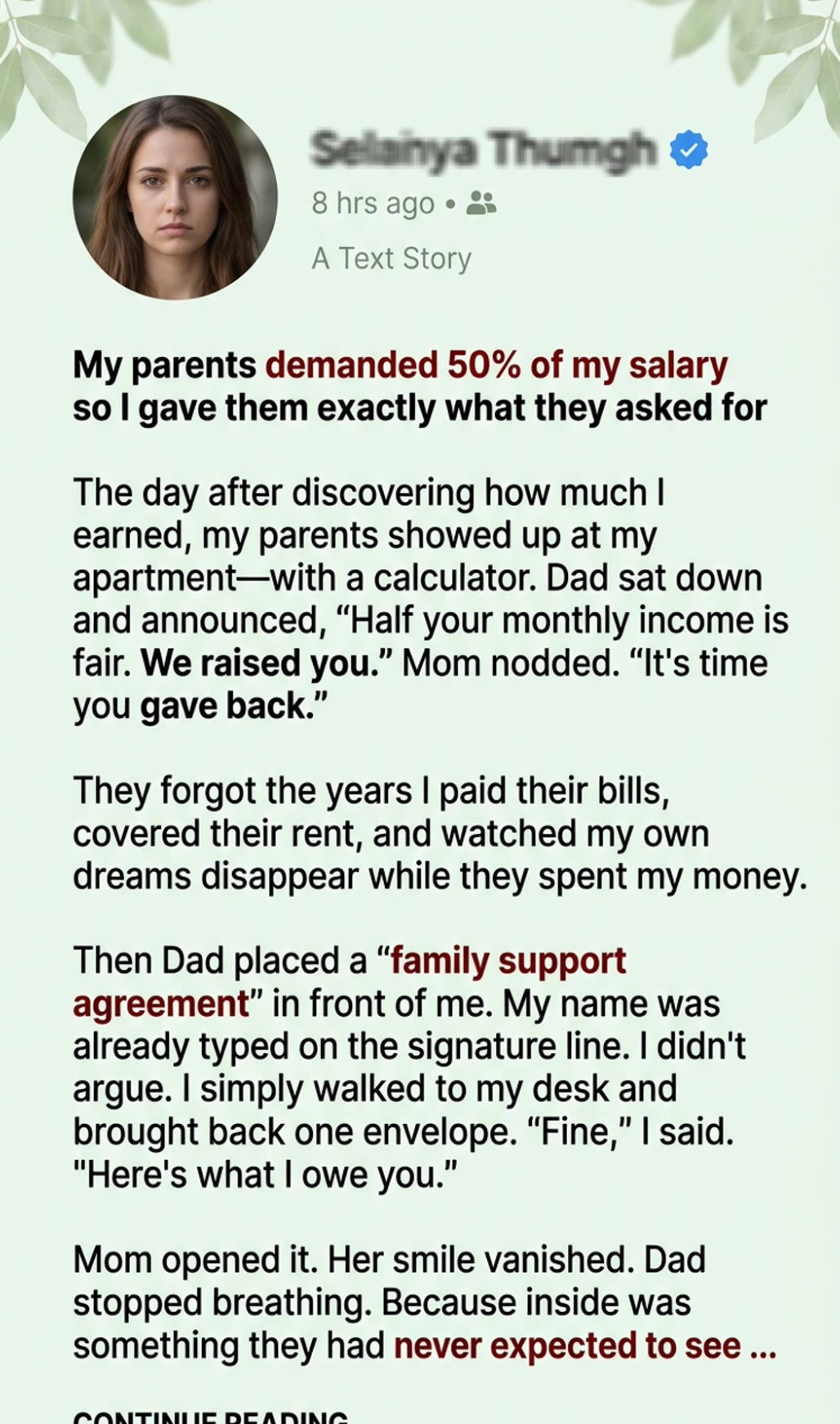
My name is Daniel Morgan, and I was thirty-four years old when my parents decided that my success belonged to them.
For most of my life, I had believed that being a good son meant being dependable. If my parents needed help, I helped. If they had a bill they couldn’t pay, I found the money. If something broke in their house, I took time off work to fix it. And whenever my father said that family should always come first, I swallowed whatever disappointment I felt and did what he asked.
I never thought of myself as a victim.
I thought I was doing what responsible adults did for the people who had raised them.
The trouble was that my parents had gradually stopped seeing my help as a kindness. To them, it had become an obligation—one they believed could never be satisfied.
My father, Richard, was sixty-two and had worked in construction for much of his life. He was proud, stubborn, and convinced that respect meant obedience. He rarely asked for anything directly. Instead, he announced what needed to happen and expected everyone around him to adjust.
My mother, Linda, was gentler in public. She volunteered at church events, remembered birthdays, and could make a stranger feel welcome in minutes. But at home, she had a way of turning every boundary into evidence that someone didn’t love her enough.
When I was younger, I thought their behavior was normal.
My younger sister, Emily, had a different relationship with them. She was charming, spontaneous, and very good at escaping uncomfortable conversations. If Dad asked her for money, she would laugh and promise to look into it. If Mom complained, Emily would hug her, say she loved her, and somehow leave without making a commitment.
I admired my sister’s ability to protect her own life.
I also resented myself for not being able to do the same.
I was the dependable one. The son who stayed late, answered calls, and fixed problems. When my parents needed someone to handle paperwork, they called me. When they were short on rent, they called me. When Dad’s truck needed repairs or Mom’s insurance payment was overdue, they called me.
And because I usually said yes, they gradually stopped considering that I might have plans of my own.
The pattern began when I was twenty-six.
My father had been laid off after a construction company reduced its workforce. He said the unemployment payments weren’t enough to cover the mortgage, utilities, and groceries. My mother worked part-time at a local pharmacy, but her income was modest.
They were frightened, and I understood why.
At the time, I was working as a junior software developer. I rented a small apartment, drove an old sedan, and was trying to save enough money to move into a better place.
When Dad called and said they were two months behind on their mortgage, I transferred $1,800.
“Just until I get back on my feet,” he promised.
Three months later, he needed another $900 for the electricity bill and a car payment.
Then my mother needed money for a dental procedure.
Then the mortgage rate changed, and they were short again.
Each time, I told myself it was temporary.
I delayed buying a newer car. I stopped taking weekend trips with friends. I cooked at home instead of going out, and I put off replacing my laptop even though it was slowing down my work.
Whenever I felt frustrated, I reminded myself that my parents had sacrificed for me when I was a child.
They had kept a roof over my head. They had attended school meetings, bought my books, and helped me get through difficult years.
I didn’t want to become the kind of son who forgot his family the moment he began earning a decent living.
But there was a difference between helping my parents through a difficult period and becoming the permanent solution to every financial problem they encountered.
I didn’t understand that difference until much later.
By the time I turned thirty, I had paid off the remaining balance on their overdue mortgage payments, covered several car repairs, helped replace their failing refrigerator, and sent money almost every month.
My mother called these transfers “little things.”
Dad called them “what family does.”
I called them support.
I kept the word in my head because it sounded kinder than the truth.
I was becoming their emergency fund, their insurance policy, and their first response to every inconvenience.
And the more I gave, the less they seemed to notice.
Then, at thirty-one, my career changed.
The company I worked for was acquired by a larger technology firm. I had spent years building software systems, learning unfamiliar tools, and taking responsibility for projects that other people didn’t want. When a senior engineering position opened, my manager encouraged me to apply.
I did.
The interview process was difficult, but I got the job.
My salary increased substantially, and for the first time in my adult life, I could imagine a future that wasn’t built entirely around paying someone else’s bills.
I could save for a home.
I could invest.
I could take a vacation without calculating how much money I would need to send my parents afterward.
I could even consider starting a family someday without feeling that I was already responsible for one.
I didn’t tell my parents the exact amount I earned.
I wasn’t hiding anything shameful. I simply wanted to enjoy my achievement before it became another family discussion about money.
I told them I had received a promotion and that my financial situation had improved.
Dad grunted.
“Good. You should be earning more by now.”
Mom said she was proud of me.
For a few weeks, that was the end of it.
Then my company held an employee recognition event, and one of my colleagues posted a photograph on social media. The caption congratulated several employees on their promotions, including me, and mentioned the compensation range associated with the new role.
The number wasn’t my exact salary, but it was close enough.
My parents saw it.
I didn’t know that until the following evening, when Mom called and asked whether I had time to stop by for dinner.
Her voice was unusually cheerful.
“We haven’t had you over in ages,” she said. “Your father has been talking about you all day.”
I should have been suspicious.
Instead, I bought a pie from a bakery and drove to their house.
Dinner was pleasant at first. Dad asked about my job, and Mom wanted to know whether I was planning to move to a larger apartment.
Then Dad set down his fork.
“So, how much are you making now?”
I gave him a general answer.
“Enough to be comfortable.”
He frowned.
“That’s not a number.”
I looked at him.
“Why do you need the exact amount?”
“Because your mother and I have been talking. You’re doing very well, and we think it’s time we made a proper arrangement.”
“What kind of arrangement?”
Mom placed her napkin beside her plate.
“We’ve supported you all these years, Daniel. We never asked you to pay us back when you were young. But now you’re earning good money, and we need to think about our future.”
I nodded slowly.
“I already help with your bills.”
Dad waved his hand.
“Yes, but that’s whenever something comes up. We’re talking about something regular. Something fair.”
“How much?”
He leaned back in his chair.
“Half your monthly income.”
For a moment, I genuinely thought I had misunderstood him.
“Half?”
“Fifty percent,” he repeated. “Every month. Automatically.”
Mom nodded as if he had suggested a sensible grocery budget.
“You don’t have children. You don’t have a mortgage. You have more money than you need. Your father and I raised you, and we sacrificed plenty.”
I looked from one parent to the other.
They were serious.
I could see it in their faces. They had discussed this beforehand, reached an agreement between themselves, and invited me to dinner so they could present it as a decision already made.
“Dad, I have my own expenses. I have retirement savings, insurance, and plans for the future.”
“Everyone has expenses.”
“I’ve already been helping you.”
“And we’re grateful,” Mom said quickly. “But gratitude doesn’t pay our bills.”
I stared at her.
The words hurt more than I expected.
For years, I had paid their bills precisely because I was grateful. I had never sent them invoices. I had never reminded them of every transfer. I had never asked them to prove that they deserved help.
Now they were telling me that my generosity had not been enough.
Dad took a drink of water.
“We raised you. We fed you, clothed you, paid for your education, and gave you a home. You didn’t do those things for yourself.”
“I was a child.”
“And we were the ones responsible for you. Now it’s your turn to be responsible for us.”
I felt the old instinct rise inside me.
Explain yourself. Stay calm. Make them understand. Find a compromise.
That instinct had kept me trapped for years.
But something had changed.
I was no longer the frightened young man who believed that disappointing his parents meant failing as a son.
I was an adult who had worked hard to build a life, and they were asking me to surrender half of it because they had decided that my success belonged to them.
I put down my fork.
“I’m not agreeing to that tonight.”
Dad’s expression hardened.
“Then you can think about it.”
“I will.”
The dinner ended shortly afterward.
On the drive home, I kept hearing his words.
We raised you.
I didn’t deny that they had raised me. I didn’t deny that they had worked hard or that they had made sacrifices.
What troubled me was the way they used those facts as a debt that could never be repaid.
I thought about the money I had sent them over the years. I remembered the apartment I had wanted to buy at twenty-nine, the vacation I had canceled because Dad needed a repair, and the months I had spent working overtime while my own savings barely moved.
I had helped because I loved them.
They had decided that love meant I could never say no.
The next morning, I went to work and tried to concentrate. I attended meetings, reviewed code, and answered messages. But the demand kept circling through my mind.
By lunchtime, I had made a decision.
I wasn’t going to argue with my parents about what I owed them.
I was going to find out exactly what I had already given.
For years, I had kept my bank statements, transfer confirmations, and receipts in digital folders. I had done it for practical reasons, not because I expected to use them against my family. I wanted to know where my money was going and make sure I could account for my finances.
That afternoon, I created a spreadsheet.
I searched my bank records, checked old emails, and added every transfer I could verify. I included the mortgage payments, utilities, car repairs, medical expenses, and the money I had sent when they were short on groceries.
I separated regular support from one-time emergencies.
I excluded birthday gifts, holiday presents, and anything I had willingly purchased for them as a gift. I didn’t want to inflate the total by counting ordinary family gestures as debts.
I also separated expenses I had paid directly from transfers they had received. Where I wasn’t certain of the exact purpose, I marked the entry for review rather than pretending I knew.
The numbers grew.
After several hours, I sat back and stared at the screen.
Over eight years, I had provided more than $118,000 in financial support.
That figure did not include the value of my time, the jobs I had postponed, or the opportunities I had declined because I needed to remain available whenever they called.
It was simply the money I could document.
I checked the totals twice.
Then I checked them a third time.
The amount was real.
I printed the spreadsheet and began gathering the supporting documents. I organized everything by year and labeled the transfers clearly. I included the bills I had paid directly and the messages in which my parents had asked for specific amounts.
I wasn’t preparing a lawsuit.
I wasn’t trying to punish them.
I wanted a record that could not be dismissed as an emotional exaggeration.
Then I found something else.
About four years earlier, when my father was between jobs, he had asked me to lend him $12,000 to cover overdue housing expenses and a vehicle repair. He had promised to repay me when he found steady work.
We had exchanged emails about it.
In one message, he wrote, I know this is a loan, Daniel. I won’t forget it. I’ll pay you back when I’m working again.
He never repaid the money.
Later, when I mentioned it, he said he considered it part of the general support I had provided. I hadn’t pressed the issue because I wanted to avoid another family argument.
I printed that email, too.
There were other messages. My mother had once written, We’ll make things right when we’re back on our feet.
Another said, I don’t know what we’d do without you.
I read those words with a strange mixture of sadness and anger.
They had known I was helping.
They had known the help mattered.
They had even acknowledged that some of the money was a loan.
Yet now they were demanding half my income as if I had spent my entire life receiving benefits from them and had never once given anything in return.
I placed the documents in a large envelope.
On the front, I wrote one word:
RECORDS.
Then I put the envelope in my desk drawer and went to bed.
I slept badly, but I had made up my mind.
The next afternoon, my doorbell rang.
When I opened it, my parents stood in the hallway.
Dad held a leather folder. Mom carried her handbag and wore the expression she used when she expected a difficult conversation to end with everyone agreeing that she had been right all along.
“We’ve brought the agreement,” Dad announced.
He walked inside before I could invite him.
Mom followed.
They sat at my kitchen table, and Dad placed the folder in front of him. He took out a printed document, a pen, and a small calculator.
I stared at the calculator.
“You brought one?”
“Of course,” he said. “We need to make sure the numbers are correct.”
He tapped the paper.
At the top, the document read: FAMILY SUPPORT AGREEMENT.
My full name was typed beneath the heading.
So were my parents’ names.
The agreement stated that I would transfer fifty percent of my net monthly income to a joint account controlled by them. It also said the arrangement would continue indefinitely unless all parties agreed in writing to end it.
There was a clause requiring me to provide proof of my income whenever my salary changed.
Another paragraph said that if I failed to make a payment, my parents could demand immediate repayment of any previous support they had provided to me, with a figure to be determined later.
I read the document twice.
“Who wrote this?”
“Your father found a template online,” Mom answered.
Dad tapped the signature line.
“It’s straightforward. You pay half your income, and we can plan our retirement properly. No more uncertainty about whether we’ll have enough.”
I looked at him.
“What happens if I lose my job?”
“We’d discuss it.”
“What happens if I buy a home and have a mortgage?”
“Then you’d need to plan responsibly.”
“What happens if I have children?”
Dad sighed.
“Daniel, you’re looking for problems. We’re asking you to do something fair.”
I picked up the document.
“Did you have a lawyer review this?”
“No need. It’s a family arrangement.”
“Then why does it say you can demand repayment of previous support if I miss a payment?”
Dad shifted in his chair.
“It’s there to protect everyone.”
“Everyone except me, apparently.”
Mom folded her arms.
“Why are you making this so difficult? We didn’t raise you to become selfish.”
There it was again.
The word they used whenever I refused to make their lives easier.
Selfish.
I looked at the signature line. My name had already been typed there, leaving a blank space above it as though my agreement were a formality.
They had come to my apartment with a calculator because they believed this was a negotiation they had already won.
They expected anger, perhaps. They expected me to argue, complain, and eventually accept a smaller percentage.
They did not expect me to agree.
I placed the agreement on the table.
“Fine,” I said.
Dad blinked.
“Fine?”
“You want me to give you exactly what I owe you?”
“That’s what we’ve been saying.”
I stood up.
“All right. Give me a minute.”
I walked into my home office, opened the desk drawer, and took out the envelope I had prepared the night before.
For a moment, I stood there holding it.
I wasn’t proud of the fact that I had spent hours documenting money given to my own parents. I wished none of this had become necessary. I wished they had asked for help honestly, explained their concerns, and respected my right to decide what I could afford.
But they had chosen a different path.
They had arrived with a contract designed to turn family love into a permanent financial obligation.
I returned to the kitchen and placed the envelope in front of them.
“Fine,” I repeated. “Here’s what I owe you.”
Mom reached for it first.
She expected a check, perhaps. Maybe she thought I had finally accepted their demand and brought the first payment.
She opened the flap and pulled out the first sheet.
Her smile disappeared.
Dad leaned forward.
“What is that?”
Mom turned the page.
Then another.
Her face grew pale.
Inside the envelope was a cover letter, a year-by-year ledger of every financial transfer I could verify, copies of bank statements and paid bills, the email acknowledging the $12,000 loan, and a summary of the total support I had provided over eight years.
At the bottom of the cover letter, I had written:
Financial support provided to Richard and Linda Morgan, 2018–2026: $118,430.72.
Dad stared at the number.
“That can’t be right.”
“It is,” I said. “I checked it three times.”
Mom began flipping through the pages faster.
“Mortgage payments? The refrigerator? The medical bills?”
“Yes.”
“All of this was money you gave us?”
“Or expenses I paid directly for you.”
Dad took the ledger from her.
He read the entries, his lips moving slightly as he followed the rows.
For the first time in my life, my father seemed unable to find a sentence that would put him back in control of a conversation.
Then he found the copy of his old email.
His face changed.
“I said I’d pay you back,” he muttered.
“You did.”
“That was years ago.”
“I know.”
“I was in a difficult situation.”
“I know that, too.”
He looked up.
“Are you saying we owe you all this money?”
“No. I’m showing you what I have already given you. I never asked for most of it back. I gave it because I wanted to help.”
Mom’s eyes were wet now.
“Then why are you doing this?”
I took a breath.
“Because you came here yesterday and told me that half my income belongs to you. You said I owed you because you raised me. You presented a contract that would give you control over my finances indefinitely. And you did all of that without acknowledging how much I have already sacrificed.”
Dad put the ledger down.
“We never forced you to give us money.”
“No. You didn’t hold a weapon to my head. But every time I said I couldn’t help, you told me I was ungrateful. Every time I tried to save for something of my own, you reminded me how much you had done for me. I kept helping because I loved you and believed you needed me.”
I pointed to the papers.
“This is what that help looked like in real numbers.”
Mom wiped her eyes.
“We never meant for you to feel that way.”
“Maybe not. But that’s how it happened.”
Dad pushed the papers away.
“Fine. You’ve helped us. We’re not denying that. But parents do things for their children. That doesn’t mean you can use it against us whenever you want.”
“I’m not using it against you. I’m asking you to stop treating me as if I have never done anything for you.”
He shook his head.
“You’ve changed, Daniel.”
I looked at him.
“Yes. I have.”
He seemed surprised by the answer.
I continued.
“I’ve changed because I finally understand that helping someone doesn’t mean giving them the right to control my life. I’m willing to help you when I can, but I will decide what I can afford. I will not sign this agreement, and I will not give you half my salary.”
Mom glanced at the final sheet.
“What is this?”
She had reached the last document in the envelope.
It was a one-page letter addressed to both of them. I had written it the previous evening, after finishing the spreadsheet.
It was not a demand for repayment.
It was a statement of boundaries.
The first paragraph explained that I considered the past financial assistance voluntary, except for the $12,000 loan my father had explicitly acknowledged in writing. I was not demanding immediate repayment of that loan, but I would no longer treat it as though it had never existed.
The second paragraph stated that I would not agree to any automatic transfer of my salary or sign any document granting my parents control over my income.
The third paragraph explained that I would continue to consider reasonable requests for help, provided those requests were made honestly and discussed without insults, threats, or claims that my entire income belonged to them.
The final paragraph was simple.
I love you both, but I am your son, not your retirement account. I will help when I choose to help. I will not be financially controlled in exchange for being loved.
Mom read that paragraph twice.
Then she looked at me.
“You really mean this?”
“Yes.”
Dad stood up so abruptly that his chair scraped against the floor.
“This is unbelievable. We raised you, and now you’re giving us paperwork like we’re strangers.”
I remained seated.
“You brought me a contract.”
He opened his mouth, then closed it.
For a few seconds, the only sound in the kitchen was the ticking of the wall clock.
Then Dad grabbed the family support agreement and folded it in half.
“Keep your money,” he said. “Don’t come crying to us when you need family.”
He walked toward the door.
Mom gathered the papers more slowly.
She looked as though she wanted to say something, but she followed him without speaking.
I watched them leave.
When the door closed, I sat alone at the table.
My hands were shaking.
I had imagined that showing them the records would feel like winning an argument. Instead, I felt grief. I had not wanted to prove that I had given my parents more than a hundred thousand dollars.
I had wanted them to look at me and recognize that I had been trying.
For years, I had believed that if I helped enough, sacrificed enough, and remained patient enough, they would eventually understand.
But the problem had never been that I hadn’t given enough.
The problem was that they had begun to believe there was no limit to what they could demand.
And I had finally drawn one.
The days that followed were painful.
My mother did not call.
My father sent a short message saying that he hoped I was satisfied with humiliating them.
I did not respond.
A week later, Emily called me.
“Mom says you sent them a bill for everything they’ve ever done for you.”
I closed my eyes.
“That’s not what happened.”
“She says you gave them a spreadsheet and demanded more than a hundred thousand dollars.”
“I showed them a record of the financial support I’ve provided over the years. I didn’t demand that they repay it.”
“But Dad says you used the money to threaten them.”
“Did he show you the agreement he wanted me to sign?”
There was a pause.
“What agreement?”
I told her about the contract and the demand for half my monthly income.
Emily was quiet for a long time.
Then she said, “He didn’t mention that part.”
“Of course he didn’t.”
She sighed.
“Daniel, I know they’ve been asking you for money for years. I didn’t realize it was that much.”
I softened.
“I didn’t want you to feel responsible for it.”
“I’m not. But I think I should have helped more.”
I appreciated the honesty.
Emily had not created the problem, and I wasn’t going to make her responsible for fixing it. I told her that if she wanted to help our parents in the future, she could decide what was reasonable for her. She didn’t have to copy my choices, and neither did I.
A few days later, she visited my apartment.
We sat at the kitchen table where our parents had placed the agreement.
She looked around.
“You’ve always been the one who kept everything together,” she said.
“I thought that was what I was supposed to do.”
“Maybe that’s what they taught you.”
I looked at her.
She continued.
“When I was younger, I thought you liked helping them. You never told me how much pressure you felt. Every time they called, you handled it. I assumed you were okay.”
“I wanted you to have your own life.”
“I know. But I think I used that as an excuse not to look too closely.”
Her admission meant more to me than she realized.
For the first time, someone in my family had acknowledged that my reliability might have come at a cost.
Emily did not offer to solve everything. She didn’t promise that our parents would change. She simply listened while I explained what I had been afraid to say for years: that I loved them, but I was tired of being treated as if my life existed only to support theirs.
Before she left, she hugged me.
“You can still be a good son without giving them half your salary,” she said.
I smiled sadly.
“I’m starting to believe that.”
Two weeks later, Mom called.
I almost didn’t answer.
When I did, she sounded tired.
“Can we talk?”
“Of course.”
She asked whether she could visit. I suggested we meet at a café instead, somewhere neutral where we could speak without Dad dominating the conversation.
She agreed.
When she arrived, she looked smaller somehow. She ordered tea and spent several minutes stirring it without drinking.
Finally, she said, “Your father is very angry.”
“I’m sorry he’s upset.”
“He thinks you don’t respect him anymore.”
“I respect him as my father. I don’t agree that he is entitled to half my income.”
She nodded slowly.
“I understand that now.”
I waited.
Mom looked down at her hands.
“When we first started asking you for money, we were frightened. Your father had lost his job, and I didn’t know how we were going to keep the house. Every time you helped, it felt like we could breathe again.”
“I understand that.”
“But then we got used to it. We stopped worrying about what would happen if we needed something because we knew you would help.”
She swallowed.
“I think we stopped asking whether you could afford it. We just assumed you would find a way.”
It was the closest thing to an acknowledgment I had ever heard from her.
I felt some of the tension leave my shoulders.
“That’s exactly what happened.”
She looked up.
“When your promotion became public, your father said it was proof you had enough money to take care of us properly. He said we had invested in you all those years, and now we deserved a return.”
I stared at her.
“Your father used those exact words?”
She nodded, ashamed.
“I told him you had already helped us more than we could have expected. But I didn’t stop him from bringing the agreement.”
That was important.
My mother had not been the one who typed the contract, but she had agreed to present it. Her gentleness did not erase her part in the decision.
“I need you to understand something,” I said. “I don’t regret helping you when you were struggling. I regret that we reached a point where I couldn’t say no without being told I was a bad son.”
Mom’s eyes filled with tears.
“I am sorry.”
I believed that she was sorry in that moment.
But an apology was only a beginning.
I told her I would continue to help with genuine emergencies when I could, but there would be no automatic transfers, no unlimited promises, and no more conversations in which my salary was treated as family property.
She agreed.
Then she asked whether I would consider helping them review their monthly budget.
I said yes, provided we approached it as a planning exercise rather than a demand for money.
It was the first reasonable request they had made in a long time.
Over the next month, I helped my parents examine their expenses. We found subscriptions they no longer used, a vehicle payment they could not comfortably afford, and several household expenses that could be reduced. I encouraged them to speak with a qualified financial adviser about retirement planning and to contact their mortgage provider to discuss their options.
I did not promise to fill every gap.
I did not agree to give them a percentage of my income.
And when Dad complained that the changes would require them to give up some comforts, I reminded him that retirement planning meant making choices based on what they could actually afford.
He was not pleased.
But for the first time, he had to confront the difference between needing help and expecting someone else to fund every decision.
The most difficult conversation came three months later.
Dad invited me to his house.
I considered declining, but I decided to go.
He was sitting at the kitchen table when I arrived. The family support agreement was gone. In its place was a stack of bills and a notebook.
“I’ve been thinking about what you said,” he began.
I sat down.
He rubbed his hands together.
“I don’t like how you handled things.”
I almost smiled.
“That’s not exactly an apology.”
“No,” he admitted. “It isn’t.”
He stared at the notebook.
“I thought that because we raised you, you would always take care of us. I didn’t think about how much we were asking.”
I remained quiet.
He continued.
“I was proud when I found out how much you were making. Then I started thinking about what we could do with that money. I convinced myself that asking for half was reasonable because we were your parents.”
He finally looked at me.
“I didn’t stop to consider that you might have plans of your own.”
It wasn’t a perfect apology. My father was still uncomfortable admitting that he had been wrong. But for him, it was a significant step.
“Thank you for saying that,” I replied.
He nodded.
“I also want to talk about the loan.”
The $12,000.
He had not forgotten it.
“I can’t repay the whole amount right now,” he said. “But I can start making monthly payments. I should have done that years ago.”
I thought about the old email, the number in my ledger, and the years I had spent avoiding the subject.
“Let’s make a realistic plan,” I said. “Something you can afford without creating another crisis.”
We agreed on a modest monthly payment and put it in writing. I didn’t add interest or penalties. I wasn’t interested in turning my father into an enemy or making him suffer for the years he had failed to repay me.
I wanted the agreement to mean something because we both chose to honor it.
When I left his house that afternoon, I felt lighter than I had in months.
Not because the money was coming back.
Because I had finally been able to speak to my father as an adult rather than as a child trying to earn approval.
The months that followed were not perfect.
Dad still occasionally made comments about my salary. Mom sometimes asked for help before explaining the full situation. There were moments when I felt the old guilt returning, especially when they sounded disappointed.
But I learned to ask questions before agreeing.
What is the expense?
How much is needed?
Is it an emergency, or is there another solution?
Can I afford to help without sacrificing my own responsibilities?
Sometimes the answer was yes.
Sometimes it was no.
And I stopped treating either answer as a measure of how much I loved them.
I also made changes to my own life.
I increased my retirement contributions, built a proper emergency fund, and began saving for a home. I took a vacation I had postponed for years and spent two weeks exploring a part of the country I had always wanted to see.
For the first time in a long while, I made plans without first calculating what they might cost my parents.
It felt strange.
Then it felt wonderful.
About a year after the argument, I bought a small house.
It wasn’t a mansion. It had three bedrooms, a modest garden, and a kitchen that needed updating. But it was mine, purchased with money I had saved through years of work.
When I told my parents, Mom cried.
This time, her tears were different.
“I’m proud of you,” she said.
Dad shook my hand and walked through the rooms, asking practical questions about the roof and the heating system.
At the back door, he paused.
“You worked hard for this,” he said.
“Yes, I did.”
He looked at me for a moment.
“I should have remembered that.”
I didn’t know what to say, so I simply nodded.
Our relationship improved gradually, not because one conversation erased years of unhealthy expectations, but because we began to establish a different pattern. They learned that I would help when I could, and I learned that I could love them without being available for every request.
Emily became more involved in family decisions. She and I started discussing our parents’ needs together rather than allowing every problem to land on my shoulders. We divided responsibilities when appropriate and encouraged Mom and Dad to make decisions based on their own resources.
There were still disagreements.
There were still difficult days.
But no one brought a contract to my apartment again.
The last time I looked at the ledger, I realized I no longer needed it to defend myself. It had served its purpose. It reminded me that my memories were not exaggerations and that the sacrifices I had made were real.
I kept the records with my financial documents, not as a weapon, but as part of my history.
The $118,430.72 had not been wasted simply because my parents had failed to appreciate it at the time. Much of that money had kept a roof over their heads, paid for necessities, and helped them through genuine hardship. I did not regret those things.
What I regretted was believing that love required me to keep giving until there was nothing left for myself.
I had once thought a good son was the one who never said no.
Now I understood that being a good son also meant being honest, setting limits, and refusing to let resentment replace affection.
My parents had raised me, and I would always be grateful for the parts of that upbringing that helped me become the man I was.
But raising a child is not a loan that comes due when the child begins earning a salary.
It is a responsibility adults accept because they chose to bring a life into the world. Gratitude may inspire a grown child to offer support, but it does not give parents ownership of that child’s future.
I learned that lesson at thirty-four, sitting across from two people I loved while they demanded half of everything I had worked for.
They had arrived with a calculator, a contract, and the certainty that I would sign.
They left with a ledger showing how much I had already given, a letter explaining what would change, and the realization that their son was no longer willing to confuse obedience with love.
The envelope did not destroy my family.
It forced us to look at the way we had been treating one another.
And the most important thing inside it wasn’t the total, the bank statements, or the old email promising repayment.
It was the truth I had finally learned to say aloud:
I can love my parents, honor the sacrifices they made, and help them when they genuinely need it without surrendering the life I worked so hard to build.
For the first time, that truth felt like freedom.