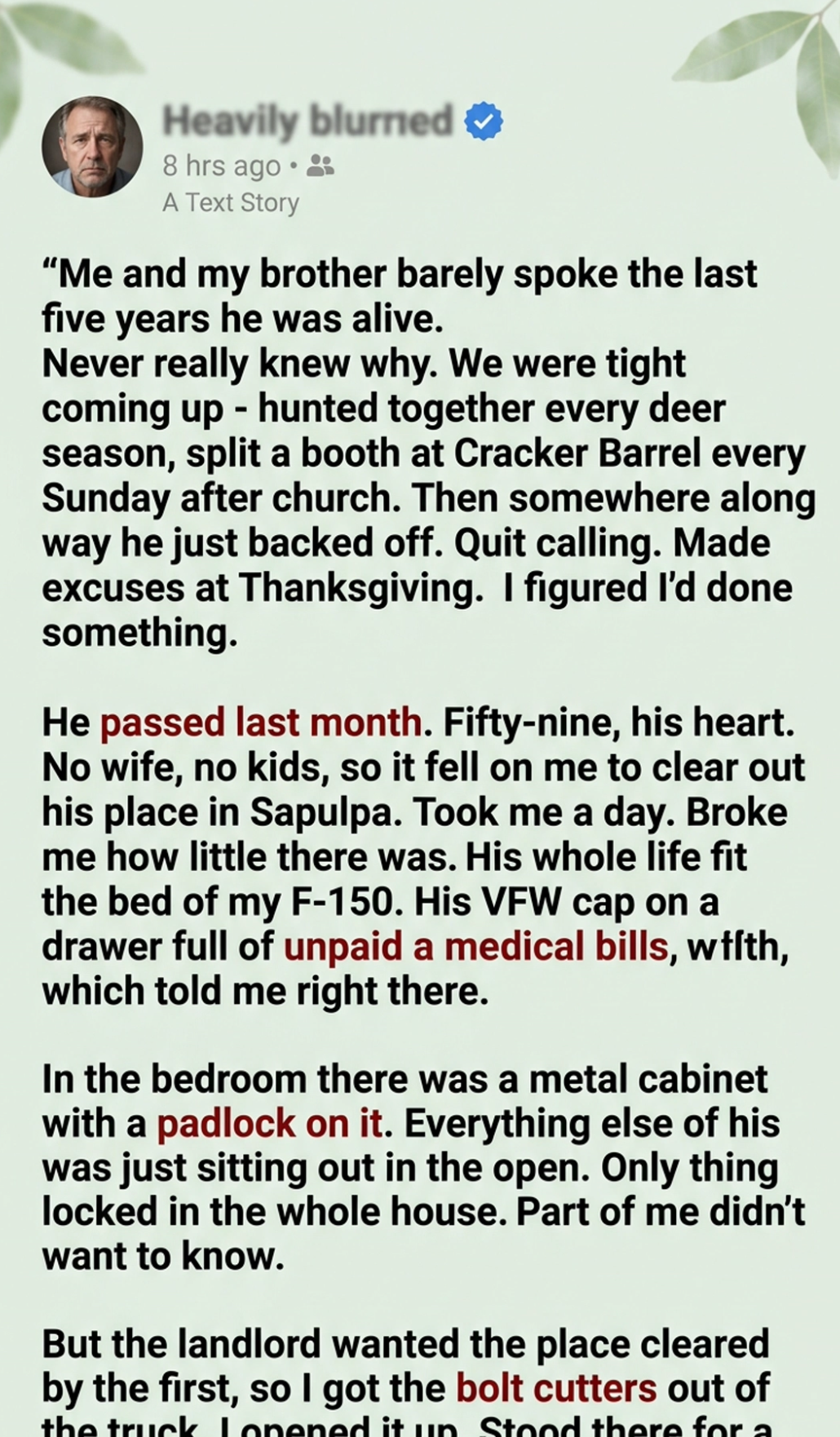
My brother and I barely spoke during the last five years of his life.
I never really understood why.
We had been inseparable growing up. Every deer season, we hunted together. Every Sunday after church, we split a booth at Cracker Barrel, ordering more food than either of us needed and arguing about everything from football to the best way to fix an old truck.
He was my older brother, Michael. I was Daniel, three years younger, and for most of our lives, I thought there was nothing that could come between us.
Then, somewhere along the way, he began to pull away.
At first, it was small things. He stopped calling on Wednesday evenings, when we usually talked about the weekend hunt. He started making excuses at Thanksgiving. When I invited him over for Sunday dinner, he would say he was tired or had something to do.
Eventually, the excuses became silence.
I called him more than he called me. I sent messages that sometimes went unanswered for days. When I asked whether I had done something to upset him, he always gave me the same answer.
“No, Danny. I’m fine. Just busy.”
But I knew my brother.
He had never been good at pretending everything was fine. When we were boys, I could tell he was angry just by the way he closed a cabinet door. When our father died, I knew Michael was hurting because he spent three weeks fixing a fence that didn’t need fixing.
I could read his silences better than anyone.
At least, I used to think I could.
The last time we hunted together was five years before he died. We sat in a deer blind before sunrise, listening to the wind move through the bare trees. He had brought a thermos of coffee, and I had brought the biscuits our mother used to make before she passed away.
We didn’t see a deer that morning.
We didn’t talk much, either.
When we packed up, I asked him whether he wanted to stop for breakfast.
He shook his head.
“Got things to do.”
I watched him walk toward his old Ford, shoulders hunched against the cold.
I wanted to ask him what was wrong. I wanted to tell him that whatever had happened between us, we could work through it.
Instead, I said, “All right. I’ll call you later.”
He nodded without looking back.
I never went hunting with him again.
For five years, I carried a quiet resentment mixed with worry. I told myself that if Michael wanted to shut me out, I would give him the space he seemed to want. But every holiday, I checked my phone more often than I admitted. Every time I drove past his neighborhood in Sapulpa, Oklahoma, I wondered whether I should stop.
I always found a reason not to.
Maybe he needed time.
Maybe he was dealing with something he didn’t want to discuss.
Maybe he would call when he was ready.
That last possibility kept me waiting longer than it should have.
Then, last month, my phone rang while I was eating lunch at my kitchen table.
It was a woman from the hospital.
She asked whether I was Daniel Mercer, Michael’s younger brother.
I told her I was.
There was a pause.
Then she said, “I’m very sorry, sir. Your brother passed away this morning.”
Michael was fifty-nine.
His heart had failed.
He had lived alone, had never married, and had no children. As far as the hospital knew, I was his closest relative.
I sat at the table with the phone pressed against my ear long after the woman finished speaking.
I remember staring at the salt shaker. I remember a truck passing outside. I remember thinking that I needed to call Michael and tell him what had happened.
Then I remembered.
There would be no more calls.
No more Sunday breakfasts.
No more hunting seasons.
My brother was gone, and the last meaningful conversation we had was five years old.
I drove to Sapulpa the next morning.
The landlord met me outside Michael’s small rental house. He was a decent man, probably in his late sixties, wearing a work jacket and holding a clipboard.
“I’m sorry about your brother,” he said. “He was quiet, but he always paid what he could.”
That last part caught my attention.
“What do you mean, what he could?”
The landlord looked uncomfortable.
“He’d fallen behind a little on rent. I tried to work with him. He was a good man, just seemed to have a lot on his mind.”
I asked how far behind he was.
He told me.
It wasn’t an enormous amount, but it was enough to make me wonder how Michael had managed to live on his income. He had worked maintenance jobs most of his adult life, never earning much, but he had always been careful with money.
He hated owing anyone anything.
I thanked the landlord and went inside.
The house smelled faintly of old coffee, laundry detergent, and the kind of stillness that settles over a place when someone has lived alone for too long.
The living room contained a worn recliner, a television, a small bookshelf, and a coffee table with a ring from a cup that had probably sat there for years.
A VFW cap hung from a hook beside the door.
I stopped when I saw it.
Michael had been proud of his service. He didn’t talk much about those years, but he kept that cap clean and straightened it whenever he walked past.
I took it down and brushed a little dust from the brim.
“Hey, big brother,” I whispered.
My voice sounded strange in the empty room.
Clearing the house should have taken a day, and it did.
But I would remember that day for the rest of my life.
His kitchen cabinets contained a few chipped plates, two coffee mugs, canned soup, and a jar of peanut butter. His refrigerator held milk, eggs, and a container of leftovers that had gone bad.
His closet contained five work shirts, three pairs of jeans, an old winter coat, and the suit he had worn to our father’s funeral.
In the bedroom, I found a pair of hunting boots with cracked soles and a cardboard box of photographs.
There were pictures of us as boys, standing beside our father’s truck with our first fishing rods. There was one of Michael holding a deer he had shot when he was twenty-one. Another showed us at Cracker Barrel, probably thirty years earlier, laughing at something outside the frame.
I sat on the edge of his bed and held that picture for a long time.
We looked so young.
I could almost hear him telling me that my hair looked ridiculous.
I could almost hear myself telling him he looked like a man who had been dragged backward through a hayfield.
Then I noticed the drawer beneath his bedside table.
It was full of medical bills.
Hospital statements. Prescription receipts. Letters from insurance companies. Notices about overdue balances.
I spread them across the bed and started sorting them.
The more I read, the heavier my chest became.
There were bills for cardiology appointments, diagnostic tests, emergency visits, medications, and follow-up care. Some had been paid in small installments. Others had been marked overdue.
Michael had been sick for a long time.
And he had never told me.
I remembered the last few years of our conversations. When I asked how he was doing, he always said he was fine. When I asked whether he needed anything, he said he had everything under control.
I had believed him because I wanted to believe him.
Now I wondered how many times he had sat alone at that kitchen table, trying to figure out which bill he could afford to pay.
I wondered whether he had ever wanted to call me.
I wondered why he hadn’t.
By midafternoon, I had filled the bed of my F-150 with almost everything he owned. His clothes were in boxes. His dishes were wrapped in old towels. His recliner sat near the tailgate, secured with straps.
His entire life fit in the back of my truck.
That thought hurt more than I expected.
I was about to check the bedroom one last time when I noticed something I had missed.
A metal cabinet stood in the corner beside the closet.
It wasn’t large, perhaps three feet high, with two narrow doors and a thick padlock. The paint had chipped along the bottom, and a small patch of rust had formed near one hinge.
Everything else in the house had been left in plain sight.
The cabinet was the only thing locked.
I stared at it.
I had never known Michael to keep secrets in a locked cabinet. He barely owned anything valuable enough to protect. His tools were stacked in the garage. His documents sat in an unlocked drawer. His wallet and keys had been on the kitchen counter.
Whatever was inside that cabinet, he had wanted to keep it private.
For a moment, I considered leaving it alone.
I could tell the landlord that I had cleared the house, load the last of the trash into my truck, and go home. Michael was gone. I had no right to pry into something he had deliberately locked away.
Then I remembered the medical bills.
I remembered the rent he couldn’t keep up with.
I remembered how he had pushed me away, year after year, without ever telling me why.
I wanted answers.
Maybe that was selfish.
Maybe grief makes you believe that if you can uncover one last secret, you can somehow recover the person who took it with him.
But I couldn’t leave without knowing.
I walked out to the truck, opened the toolbox, and took out the bolt cutters.
The lock snapped on the second attempt.
The sound echoed through the empty bedroom.
I set the cutters down, gripped the cabinet doors, and pulled.
They opened with a long metallic groan.
I stood there without moving.
Inside were dozens of manila envelopes, a thick stack of documents, several small notebooks, and a battered wooden box. Everything had been arranged carefully, with dates written on the envelopes in Michael’s blocky handwriting.
On the top envelope were two words.
FOR DANNY.
My legs weakened.
I sat down on the floor and opened it.
Inside was a letter.
The first line was enough to make my hands shake.
Danny, if you’re reading this, then I ran out of time to tell you the truth.
I had to stop.
I put the letter down, pressed both palms against my eyes, and tried to steady my breathing.
For five years, I had wondered what I had done to make my brother stop loving me.
Now I was holding the answer in my hands.
I began reading again.
I know you think I stopped caring about you. I know you probably think I was angry about something you did. I wish I could tell you that you were wrong and leave it at that, but you deserve better than another half-truth from me.
The truth is, Danny, I was ashamed.
I read the sentence twice.
Ashamed of what?
The letter continued.
Five years ago, when I started pulling away, I had just received the results from the cardiologist. My heart was in worse shape than I had admitted to anybody. The doctor told me I needed further treatment, more tests, and changes I couldn’t afford to ignore.
I was scared, little brother. More scared than I’ve ever been.
I felt a chill move through me.
Michael had always been the strong one. When our father died, he handled the funeral arrangements. When our mother became ill, he spent evenings at her house fixing things and making sure she had groceries. When I lost my first job, he quietly paid two months of my rent and told me not to mention it to anybody.
He was the brother who solved problems.
He was never the brother who admitted he had one.
The letter continued.
I had medical bills piling up, and my job was cutting hours. I was behind on rent. I had a truck that needed repairs, and I was trying to decide whether to pay for medication or keep the electricity on.
I know you would have helped me if I’d asked.
That’s what made it so hard to ask.
I lowered the letter into my lap.
For years, I had interpreted his silence as rejection.
I had never considered that he might have been hiding because he couldn’t bear for me to see him struggling.
I continued reading.
You were doing well. You had your house, your job, and a family that depended on you. I used to look at you and feel proud. Then, little by little, I started feeling like the brother who had fallen behind.
I didn’t want you looking at me like I was a charity case. I didn’t want you worrying about me every time your phone rang. I didn’t want to become another responsibility on your shoulders.
So I did the stupidest thing a man can do when he’s afraid. I made the decision for you. I convinced myself that if I stayed away, I wouldn’t have to ask for help.
I stopped reading and looked around the bedroom.
The empty closet.
The cracked hunting boots.
The unpaid bills.
The locked cabinet.
My brother had spent years trying to protect his pride, and in doing so, he had cut himself off from the person who would have helped him without thinking twice.
I wiped my eyes and returned to the letter.
There’s something else you need to know. It started the week after our last hunt.
I remembered that morning vividly.
The cold air. The thermos of coffee. The biscuits. Michael refusing breakfast.
The letter explained that after the hunt, he had driven home and received a call from the hospital about another test. That afternoon, he had sat in his truck outside the clinic for nearly an hour, trying to work up the courage to call me.
He had even written my number on the back of an envelope.
Then he saw a photograph on his phone of me with my wife and children at a family gathering.
I was smiling. My children were laughing. The house behind us was decorated for Christmas.
Michael wrote that he looked at that photograph and thought about all the things I had to take care of.
He decided not to call.
I told myself I was doing you a favor. I told myself you had enough on your plate. But if I’m honest, I was afraid you’d hear my voice and know how bad things were.
I was afraid you’d offer to help, and I’d have to admit I needed it.
And I was afraid you’d say no.
That last sentence broke something open inside me.
Michael had been afraid I would refuse him.
Me.
The brother who had once driven through a snowstorm because Michael’s truck had broken down on a country road.
The brother who had sat beside his hospital bed after he injured his shoulder at work.
The brother who had never once asked him to repay the money he borrowed when we were younger.
I had never given him a reason to believe I would abandon him.
But somehow, he had convinced himself that asking for help would destroy the little dignity he had left.
I folded the letter carefully and placed it beside me.
Then I opened the wooden box.
Inside were photographs, old hunting licenses, a few military keepsakes, and a small pocketknife our father had given Michael on his eighteenth birthday.
Beneath those items lay another envelope.
This one was addressed to me in a different way.
For Danny, if you ever start blaming yourself.
I stared at the words.
I opened it.
Danny, if you’re reading this, I know you’ll be asking yourself why you didn’t see what was happening. You’ll wonder why you didn’t push harder, why you let me get away with saying I was fine, why you didn’t drive over and make me talk.
Don’t do that to yourself.
I spent five years making sure you couldn’t see me clearly. I avoided your calls. I turned down invitations. I gave you excuses. When you asked whether something was wrong, I told you nothing was wrong.
You believed me because you trusted me.
That isn’t your failure. It’s mine.
I began to cry so hard that I had to put the letter down.
There was more.
I know you may be angry with me. You have every right to be. I missed birthdays. I missed holidays. I missed chances to sit across from you at that booth and argue about whether the coffee had gotten worse.
I missed my own brother while he was still alive.
And the worst part is that I did it because I thought I was protecting you.
I wish I’d understood that being loved doesn’t mean you have to be useful. I wish I’d understood that you weren’t waiting for me to become successful or strong or healthy enough to deserve your time.
You were waiting for your brother.
I pressed the paper against my chest.
For five years, I had wanted Michael to call me.
He had wanted the same thing.
And somehow, neither of us had been able to bridge the distance between us.
I sat on the floor until the afternoon light faded.
When I finally had the strength to continue, I returned to the cabinet and examined the envelopes more carefully.
There were medical records, insurance statements, and a notebook containing a detailed list of his expenses. He had tracked every dollar he spent. Some pages showed small deposits from his paychecks. Others showed payments to the hospital, the pharmacy, and the landlord.
He had been trying to keep his life together with a precision that bordered on desperation.
But there was something else.
A thick envelope marked PAID — FAMILY DEBT.
I opened it.
Inside were copies of old receipts and a letter from a bank.
I recognized the date immediately.
It was from the year I had lost my job and nearly lost my house.
I had been thirty-four, with two young children and a mortgage payment I couldn’t make. My wife had been working part-time, and I had spent weeks searching for work while pretending to everyone that I wasn’t worried.
Michael had shown up one evening with a grocery bag and a check.
He had told me the money was a loan from a friend.
I had protested, but he had shoved the check into my hand.
“Pay me back when you’re on your feet,” he had said.
I had accepted it, promising to repay him as soon as I could.
A year later, I had paid him back in full.
At least, I thought I had.
The documents in the envelope showed that Michael had borrowed money himself to help me during that period. He had taken out a small personal loan, used part of it to cover my mortgage and groceries, and spent the next several years paying it off.
I remembered how often he had told me not to worry about it.
I remembered thinking that he must have had more savings than I knew.
He hadn’t.
He had helped me when I was at my lowest, even though he had been struggling himself.
And he had never told me.
My hands shook as I turned to the last page.
It was a handwritten note.
Danny, I never regretted helping you. Not for one day. You were my brother, and you needed me.
I just wish I’d remembered that the same was true when I was the one who needed help.
I sat there in the empty house, surrounded by the evidence of my brother’s private life, and understood something I had never seen before.
Michael had not pulled away because he stopped loving me.
He had pulled away because he believed his problems made him less worthy of that love.
And I had let his silence convince me that I was no longer wanted.
Neither of us had known how to say the thing that mattered most.
I opened the remaining envelopes one by one.
Some contained old photographs. Others held letters he had started writing to me but never sent. One was dated Thanksgiving four years earlier. Another was dated the following Christmas.
There were seven letters in all.
Every one began with my name.
Every one ended with a promise that he would call me soon.
He never did.
The final envelope contained a small black notebook and a letter dated three months before his death.
The notebook was full of practical information: account numbers, insurance details, contact names, and instructions about his belongings. Michael had apparently been preparing for the possibility that his health would worsen.
The letter was shorter than the others.
Danny,
The doctors say my heart is getting weaker. They haven’t told me exactly how much time I have, and maybe they can’t. I am tired in a way that sleep doesn’t fix.
I still think about calling you.
Sometimes I pick up the phone and stare at your number. I tell myself I’ll call tomorrow, when I feel better, when I have something good to report, when I can talk without you hearing the fear in my voice.
Tomorrow keeps turning into another day.
I don’t know whether I’ll ever have the courage to tell you all of this in person. If I don’t, I want you to know that I never stopped loving you.
I was proud of you when you were a boy who couldn’t hit the broad side of a barn with a rifle. I was proud of you when you became a father. I was proud of you when you got back on your feet after losing your job.
I was proud of you even when I was too ashamed of myself to sit across from you at breakfast.
I hope you remember the good years. I hope you remember the deer we never found, the coffee that tasted like mud, and Dad laughing at us when we came home empty-handed.
And I hope, someday, you’ll forgive me for leaving so much unsaid.
Your brother,
Michael.
I read the letter until I knew every word.
Then I folded it, placed it inside the envelope, and sat quietly until the house became dark.
I had gone there to empty a house.
Instead, I had discovered the last five years of my brother’s life.
The next morning, I returned to Sapulpa with a plan.
I spoke to the landlord and arranged a little more time to clear the property. I took Michael’s medical bills to a local legal-aid office, where someone helped me understand which debts might need to be handled through his estate and which did not automatically become mine simply because I was his brother.
I contacted the hospital and the appropriate offices to obtain the documents needed to settle his affairs. I made sure his landlord was paid what was legitimately owed from the estate, according to the proper process, and arranged for his belongings to be stored until I could decide what to keep.
I also called the VFW post he had belonged to.
The man who answered knew Michael.
He told me my brother had been quiet in recent years, but he had always been generous with his time. He had helped repair a veteran’s porch one summer and delivered groceries to an older member who could no longer drive.
“He never talked much about himself,” the man said. “But if someone needed a hand, Mike was there.”
I thanked him and hung up.
That sounded like my brother.
Even when he was struggling, he had found ways to help other people.
I arranged a memorial service for him at the VFW hall. I invited a few relatives, some old hunting friends, and people from the neighborhood. I brought the photographs I had found in the cabinet and placed them on a table beside his cap.
I had expected a small gathering.
Instead, people kept coming.
A man in a work uniform told me Michael had once stayed late to help him repair a broken machine, even though it wasn’t his job. A neighbor said Michael had shoveled her driveway every winter without asking for anything in return. One of his old coworkers told me that Michael had spent his lunch breaks helping a younger employee learn the trade.
Then an elderly veteran approached me.
He held Michael’s VFW cap in his hands and looked down at it.
“Your brother helped me through a rough patch a few years back,” he said. “I was too proud to ask anybody for help. Mike figured it out anyway. He brought food to my place and told me he’d bought too much at the store.”
I almost smiled.
That was exactly the sort of excuse Michael would have used.
The veteran looked at me.
“Did he ever tell you he was struggling?”
I shook my head.
“No.”
He nodded slowly.
“That’s Mike. He could see everybody else’s trouble. Just couldn’t stand to let anybody see his.”
I looked across the room at the photographs.
For years, I had thought my brother had become a stranger.
Now I was learning that he had spent his last years being the same man he had always been: proud, generous, stubborn, and frightened of becoming a burden.
At the end of the service, I stood in front of the people who had come to remember him.
I hadn’t prepared a speech. I had thought I would simply thank everyone and tell them how much Michael had meant to me.
But when I looked at his photograph, I realized I had something else to say.
“My brother and I weren’t close at the end,” I began. “For five years, we barely spoke. I thought he was angry with me. I thought maybe I had done something that made him want to stay away.”
I paused.
“I was wrong about that. He was sick, and he was scared. He didn’t know how to ask for help, and I didn’t know how to get past the walls he had built around himself.”
The room was quiet.
“I wish I’d tried harder. I wish I’d driven over when he stopped answering. I wish I’d sat on his porch and refused to leave until he told me what was wrong.”
I took a breath.
“But I’ve also learned that you can love someone and still misunderstand them. You can spend years waiting for them to call while they’re spending those same years trying to find the courage to pick up the phone.”
I looked at Michael’s cap on the table.
“My brother helped me when I had nothing. He did it without asking for recognition, and he never made me feel like I owed him my dignity in exchange. I wish he had understood that I would have done the same for him.”
My voice cracked.
“I wish he’d known that he didn’t have to be strong for me to love him.”
I couldn’t say anything more.
I stepped away from the microphone, and one of Michael’s old hunting friends put a hand on my shoulder.
No one tried to tell me not to cry.
I was grateful for that.
After the service, I drove home with Michael’s cap on the passenger seat and the letters secured in a folder beside me.
For several weeks, I struggled with what to do with them.
Part of me wanted to put everything in a box and leave it untouched. Another part wanted to read the letters every night, as if doing so might somehow let me continue the conversations we had missed.
Eventually, I realized that I didn’t want his last five years to become a story only about regret.
Michael had made mistakes. He had shut me out, hidden his illness, and convinced himself that accepting help would make him less of a man. But he had also loved people deeply, and he had spent much of his life giving more than he ever admitted.
I wanted to remember all of him.
So I framed one of our old photographs.
It showed us sitting in the Cracker Barrel booth, both of us laughing. I was holding a coffee mug, and Michael had his arm stretched along the back of the seat. We looked like two brothers who believed there would always be another Sunday.
I placed the photograph on a shelf in my living room beside his VFW cap.
Then I started calling people more often.
I called our cousins instead of waiting for them to call me. I checked in with an old friend who had recently lost his wife. I began visiting my children without needing a special occasion.
When someone asked how I was doing, I tried to answer honestly.
Sometimes I said I was fine.
Other times, I admitted that I was lonely or worried or simply having a hard day.
It wasn’t easy. I had grown up in the same world as Michael, where men were expected to fix things, keep their word, and handle their troubles without making them anybody else’s problem.
But I had learned what that kind of pride could cost.
One Sunday morning, a few months after Michael died, I drove to Sapulpa.
I passed the old hunting supply store where we used to buy ammunition. I drove past the road that led to the field where we had spent so many cold mornings waiting for deer that never appeared.
Then I stopped at Cracker Barrel.
I asked for a booth near the window.
The waitress brought me coffee and a menu. I ordered the breakfast Michael used to get, including the extra biscuits he always claimed he didn’t want and then ate anyway.
When the food arrived, I sat there for a while without touching it.
I imagined him sliding into the booth across from me, complaining that the coffee was weak and asking whether I had finally learned how to shoot straight.
I imagined telling him about the letters.
I imagined telling him that I understood now.
Most of all, I imagined saying the words I should have said five years earlier.
“You don’t have to do this alone, Mike.”
My eyes filled with tears.
I lowered my head and let them fall.
I wasn’t ashamed of crying in that restaurant. For once, I didn’t care whether anyone saw me.
When I finished eating, I paid the bill and left a generous tip. Outside, I stood beside my truck and looked up at the pale Oklahoma sky.
I couldn’t change what had happened.
I couldn’t give Michael another chance to call me. I couldn’t go back to that last hunt and ask the question I had been too afraid to ask.
But I could change what happened next.
I could stop treating silence as proof that someone didn’t want me around. I could stop assuming that people who said they were fine had nothing to hide. I could make room for the possibility that the strongest person in the room might be the one who most needed someone to sit beside him.
And I could ask for help myself when I needed it.
That was the lesson my brother had left me, though I wished he could have taught it to me while he was still alive.
A few weeks later, I took Michael’s old hunting boots to a local outdoor program that helped young people learn to hunt safely and responsibly. They were too worn to be useful for much else, but I couldn’t bring myself to throw them away. I donated some of his other outdoor equipment and kept his pocketknife, his cap, and the letters.
I also made a small donation to a local organization that helped people navigate medical bills and find assistance before their debts became overwhelming. I did it in Michael’s name, not because money could make up for the years we had lost, but because I knew how many people sat alone at kitchen tables trying to figure out how to pay for the next prescription.
I wanted someone to reach them before shame convinced them to stop answering the phone.
The last letter from Michael remains in the drawer beside my bed.
Sometimes, when the house is quiet, I take it out and read it.
I no longer read it to find out why he left me out of his life.
I know why now.
I read it to remember the brother who loved me, the boy who taught me to fish, the young man who helped me keep my house, and the stubborn old friend who could spend an entire Sunday arguing over breakfast without ever realizing that those ordinary mornings were the richest part of our lives.
I still miss him.
I miss him when the first cold wind comes through in October. I miss him when I see a deer standing at the edge of a field. I miss him when I drive past Cracker Barrel and remember how he always reached for the last biscuit while pretending he wasn’t hungry.
But I no longer tell myself that he stopped loving me.
His letters taught me otherwise.
They also taught me that love doesn’t always know how to speak. Sometimes it hides behind excuses. Sometimes it wears a proud face and insists everything is fine. Sometimes it waits for tomorrow until there are no tomorrows left.
I wish Michael had trusted me enough to let me help him.
I wish I had understood sooner that his silence wasn’t a door I should simply leave closed.
But I have learned to live with those wishes without letting them become the only things I remember.
My brother was more than the years we lost.
He was the years we had.
And if I could speak to him one last time, I wouldn’t ask him why he pushed me away. I wouldn’t ask him why he didn’t call or why he let his pride get between us.
I’d tell him that I found the letters.
I’d tell him that I finally understood.
And I’d tell him the one thing I hope he knew, even when he couldn’t believe it himself.
“You were never a burden, Mike. You were my brother. You could have called me in the middle of the night, with nothing in your pocket and no idea what to do next, and I would have come. I would have sat beside you until morning. You didn’t have to earn that from me.”
I would tell him that I forgive him.
And then I would thank him.
For the years we spent hunting together. For every Sunday breakfast. For the money he gave me when I was desperate. For the kindness he showed people who had no way to repay him. And for leaving me the truth, even if he couldn’t bring himself to say it out loud.
I would tell him that I love him.
I hope he knew.
And I hope that somewhere, in the quiet place where all our unanswered questions finally rest, my brother understands that he never needed to be ashamed of needing someone.
Not with me.
Not ever.
Because the hardest lesson of losing Michael wasn’t learning why he had gone quiet.
It was learning how many people suffer in silence because they believe their struggles make them less worthy of love.
If there is someone in your life who has been distant, someone who keeps saying they’re fine when you suspect they aren’t, don’t assume you know what their silence means.
Call them.
Drive over.
Sit with them, even if neither of you knows what to say.
Ask again, gently, if they’re sure they’re all right.
And if you’re the one struggling, let somebody know. You don’t have to wait until you have good news, a solution, or enough money to feel proud of yourself.
You are allowed to need help.
You are allowed to be afraid.
You are allowed to be loved before you have everything figured out.
I learned that too late to save the relationship I had with my brother in those final years.
But I learned it in time to live differently for the years I have left.
Sometimes I still picture Michael in that old hunting blind, holding his thermos between his hands and staring out into the woods.
I imagine sitting beside him again.
This time, I would put my hand on his shoulder and ask him what was really going on.
And this time, I wouldn’t let him convince me that he was fine just because he was too proud to tell me otherwise.
We would talk.
We would argue.
We would probably miss the deer.
And when the sun came up, we’d drive into town, take our usual booth at Cracker Barrel, and split a plate of biscuits.
I would let him complain about the coffee.
I would let him reach for the last biscuit.
And I would never again mistake his silence for a lack of love.
Because my brother spent five years believing he had to face his troubles alone.
And I spent five years believing he no longer wanted me beside him.
We were both wrong.
And that is the part I will carry with me for the rest of my life: sometimes the people we love most are waiting for us to reach across a distance neither of us knows how to cross.
Don’t wait for a locked cabinet to tell you what someone couldn’t say.
Don’t wait for a funeral to learn how much someone was hurting.
And don’t wait until the house is empty to remind your brother, your sister, your friend, or your parent that they will never have to earn their place in your life.
I wish I had told Michael that while he was still here.
I can’t give him those words now.
But I can live them.
And every Sunday morning, whenever I find myself sitting alone with a cup of coffee, I remember my brother and leave room at the table for the people who might need to know they are not alone.