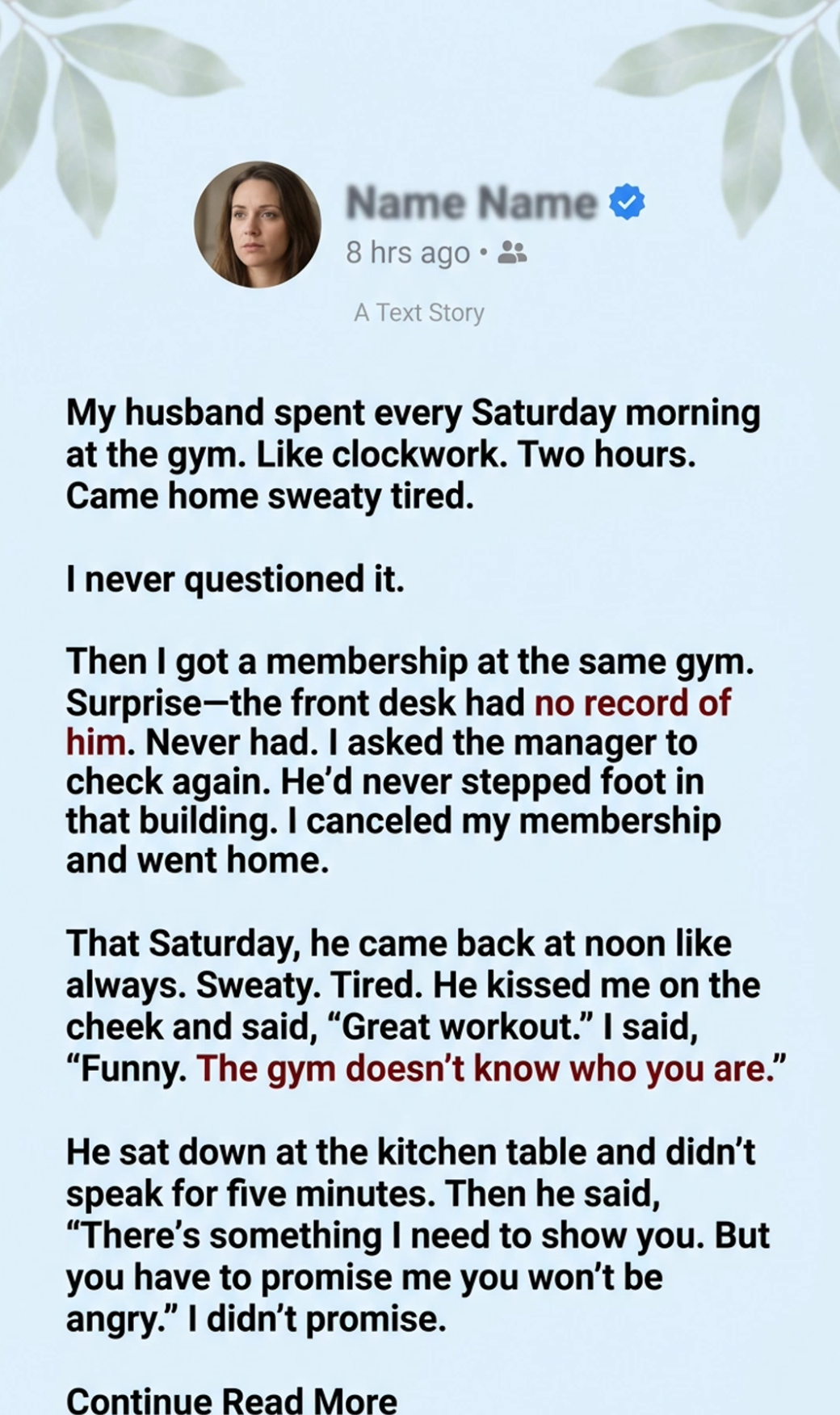
For eleven years, I believed my husband had a Saturday morning routine that was as ordinary as brushing his teeth.
Every Saturday at precisely ten o’clock, Daniel grabbed his black gym bag, kissed me on the cheek, and announced that he was heading out for his workout.
He always returned around noon.
His hair was damp, his shirt clung to his back, and he carried the same exhausted expression that people wear after pushing themselves too hard on a treadmill.
“Great workout,” he would say, dropping his bag beside the stairs.
Then he would shower, make himself a sandwich, and spend the rest of the afternoon watching football or working on little projects around the house.
I never questioned him.
Why would I?
We had been married for eleven years. We had a comfortable home, a grown-up understanding of each other’s habits, and a life that seemed stable enough that neither of us needed to account for every minute of the day.
I was forty-two, and Daniel was forty-five. Our daughter, Sophie, was seventeen and preparing for college. We had the usual disagreements about money, chores, and whose turn it was to call the plumber, but we rarely fought about anything serious.
Daniel was not a particularly talkative man, but he was dependable. He paid the bills on time, remembered our anniversary, and always called if he was going to be late.
At least, that was what I believed.
The first crack in that belief appeared on a rainy Thursday afternoon.
I had been working from home when an advertisement appeared on my phone for a fitness center two miles from our house. The membership price was reasonable, and the facility offered early morning classes, swimming, and a small indoor track.
For months, I had been telling myself I needed to exercise more. My doctor had encouraged me to become more active, and I had been feeling sluggish after spending too many evenings on the couch.
I showed Daniel the advertisement that night.
“I’m thinking about joining a gym,” I said.
He glanced at the screen.
“That one looks decent.”
“You think so?”
“Sure. It’s close to home.”
“Maybe I could go on Saturdays. We could even go together.”
His expression changed so quickly that I almost missed it.
Only a flicker.
A brief tightening around his eyes.
Then he smiled.
“Saturday mornings are pretty crowded. You’d probably enjoy going during the week.”
“I don’t mind crowds.”
“I’m just saying. You work hard all week. Maybe Saturday should be your day to relax.”
It sounded thoughtful.
Still, something about the way he said it bothered me.
“Daniel, I’m not asking you to change your schedule. I thought it might be nice to exercise together.”
He picked up his glass.
“Of course. Do whatever you want, sweetheart.”
The conversation ended there.
Two days later, I signed up for a membership.
I told myself I was doing it for my health, not because of Daniel’s strange reaction. I downloaded the gym’s app, completed the paperwork, and arranged to visit the following Saturday morning.
I even bought a new pair of trainers.
For the first time in months, I felt excited about making a change for myself.
Then Saturday arrived.
At 9:57 a.m., Daniel stood near the front door with his familiar black bag.
“Heading out?” I asked.
“Yep. Leg day.”
He kissed my cheek.
“See you at noon.”
I watched him walk to the car.
Then I picked up my gym bag and drove to the same fitness center.
I wasn’t planning to surprise him. I simply wanted to familiarize myself with the equipment, ask about the beginner classes, and perhaps spend twenty minutes walking on a treadmill.
The building was bright and modern, with glass doors, a smoothie counter, and a reception desk facing the entrance.
A young woman named Kayla greeted me.
“Good morning! Are you checking in?”
“Actually, I just joined. I’m here for my first visit.”
She looked up my account and handed me a temporary access card.
I hesitated, then asked a question that seemed perfectly reasonable at the time.
“My husband is a member here, too. His name is Daniel Bennett. Could you tell me whether his membership is linked to mine?”
Kayla typed something into the computer.
“I’m not seeing another account under that name.”
“That’s strange. He comes here every Saturday morning.”
She checked the spelling.
Then she searched again.
“I’m sorry, ma’am. I don’t have anyone by that name in our membership system.”
I laughed awkwardly.
“Maybe he signed up under his middle name.”
“Do you know what it is?”
“Michael.”
She searched again.
Nothing.
“Could he be using a corporate membership?” I asked.
“Possibly, but I would need to check with my manager.”
By then, I was beginning to feel embarrassed.
I imagined Daniel having signed up years ago under an old email address. Perhaps the account had expired, or perhaps I had misunderstood which location he used.
I asked Kayla to check the full membership records.
She called the manager, a man named Robert, who came out of a nearby office.
I explained the situation.
Robert listened carefully, then searched the database himself.
He checked active memberships, expired accounts, and the facility’s available check-in records.
Finally, he turned the monitor slightly toward himself and frowned.
“I’m afraid we don’t have a record of your husband ever being a member at this location.”
I stared at him.
“Ever?”
“Not under either name you’ve given me.”
“Could he be using another location?”
“It’s possible, but you said he comes here every Saturday?”
“Yes.”
Robert gave me an apologetic smile.
“I can only speak for this facility. But I can tell you that he hasn’t checked in here.”
I stood at the reception desk, holding my new access card.
Around me, people entered and left, laughing and chatting as if the world were perfectly ordinary.
I felt as though I had stepped outside my own life and was watching someone else’s.
Daniel had told me he came here every Saturday.
He had described his workouts.
He had complained about the crowded weight room.
He had even once told me that a man on the treadmill beside him had been watching videos without headphones.
All those details had sounded so ordinary that I had never thought to question them.
Now I couldn’t understand why he would invent something so simple.
I thanked Robert, returned my temporary card, and asked how to cancel my membership before the first payment was processed.
Kayla looked surprised.
“Are you sure? You haven’t even tried the equipment.”
“I’m sure.”
I drove home slowly.
I did not call Daniel.
I did not send him a message.
I did not tell him that I knew.
Instead, I parked in our driveway, walked into the house, and sat at the kitchen table.
I placed my phone in front of me and waited.
For the first time in eleven years, I was afraid of what my husband might say when he came home.
At exactly 12:04 p.m., I heard the garage door open.
Daniel entered through the kitchen, carrying his black gym bag.
His shirt was damp. His hair was wet around the temples. His face looked tired.
“Hey, sweetheart,” he said, leaning down to kiss my cheek. “Great workout.”
I looked at him.
“Funny.”
He stopped.
“What?”
“The gym doesn’t know who you are.”
His smile disappeared.
For a moment, he seemed unable to understand the sentence.
Then he slowly placed his bag on the floor.
“What did you say?”
“I joined the gym. I went there this morning. I asked them to look up your membership.”
He stared at me.
“They couldn’t find you, Daniel. Not under your name. Not under your middle name. Not in their expired records. The manager checked, too.”
He pulled out a chair and sat at the kitchen table.
Then he said nothing.
One minute passed.
Then another.
I watched him stare at his hands.
Five minutes went by before he finally looked up.
“There is something I need to show you,” he said. “But you have to promise me you won’t be angry.”
I felt something cold move through my chest.
“I’m not promising anything.”
He nodded slowly.
“I understand.”
“No, I don’t think you do. You’ve been lying to me every Saturday for who knows how long. I want an explanation, not another condition.”
He rubbed his face.
“You’re right.”
That answer surprised me.
I had expected him to deny everything, accuse me of invading his privacy, or insist there had been a misunderstanding.
Instead, he stood, walked toward the stairs, and returned several minutes later carrying a large brown envelope.
He placed it on the table between us.
My name was written across the front in Daniel’s handwriting.
I didn’t touch it.
“What is that?”
“Something I’ve been trying to find the courage to tell you about.”
“Is there another woman?”
His eyes widened.
“No.”
“Are you gambling?”
“No.”
“Are you in debt?”
He hesitated.
That hesitation frightened me more than any answer could have.
“Daniel.”
“I’m not in debt the way you’re thinking.”
“What does that mean?”
He sat down again and pushed the envelope toward me.
“Please read it first.”
I opened it.
Inside were bank statements, old photographs, copies of legal documents, and a handwritten letter.
The first document was a bank transfer record.
Every Saturday morning for nearly three years, Daniel had withdrawn or transferred money from our joint account.
The amounts varied.
Sometimes it was two hundred dollars.
Sometimes five hundred.
Once, it was nearly two thousand.
I flipped through the pages, trying to understand what I was seeing.
The total was far higher than I expected.
More than forty thousand dollars.
My hands began to tremble.
“Where did this money go?”
Daniel stared at the table.
“To someone I should have told you about a long time ago.”
I looked at the photographs.
The first showed a small brick house with a white front door and a garden full of overgrown flowers.
The second showed Daniel standing beside an elderly woman in a hospital bed.
He looked younger in the photograph, perhaps in his late twenties.
The woman was thin, with silver hair and tired eyes.
I recognized her immediately.
It was Margaret Bennett.
Daniel’s mother.
My mother-in-law had died eleven years earlier, only six months after our wedding.
I looked at the photograph again.
“Why do you have these?”
Daniel’s voice was barely audible.
“Because I’ve been going to see her.”
I stared at him.
“Your mother is dead.”
He closed his eyes.
“I know how that sounds.”
I pushed the photograph away.
“Then explain it.”
He took a long breath.
“The woman in the picture isn’t my mother.”
I looked at him.
“Who is she?”
“My sister.”
I stopped breathing for a moment.
Daniel had always told me he was an only child.
When we first met, he said his parents had never been able to have another baby after him. He spoke about his childhood as a lonely one, with parents who were loving but overprotective.
I had never met any siblings.
I had never seen childhood photographs of another child in his family.
“Your sister?” I repeated.
He nodded.
“Her name is Rachel.”
I stared at him for several seconds.
“You have a sister.”
“Yes.”
“And you’ve never told me.”
“No.”
“Why?”
He opened his mouth, but no words came out.
I stood and walked to the sink, needing something solid beneath my hands.
When I turned around, he was crying.
Not loudly.
Not dramatically.
Just silently, with his head bowed and his shoulders shaking.
I had seen Daniel cry only twice in eleven years: when his mother died and when our daughter was born.
Now he was crying over a secret he had kept from me for our entire marriage.
“Start talking,” I said.
He wiped his face.
“Rachel is my half-sister. We have the same father.”
I slowly returned to my chair.
“My father had an affair before I was born. Rachel was born two years after me. My mother knew about her, but she refused to acknowledge her. When my father left our family, Rachel’s mother raised her alone.”
“Your father left your family?”
Daniel nodded.
“You told me he died when you were twenty.”
“He did die when I was twenty. But before that, he left us for several years. I didn’t tell you because I was ashamed of what happened.”
I tried to absorb the information.
“Daniel, that was before we met. You were a child. Why would you be ashamed?”
He looked at me with an expression I had never seen before.
“Because I spent my entire life being told that our family had to look perfect. My mother couldn’t stand the thought of people knowing my father had another child. When he died, she made me promise never to contact Rachel or her mother.”
I glanced at the photograph.
“What happened to your sister?”
He took another breath.
“Rachel developed a serious kidney condition when she was in her thirties. She needed treatment for years, and eventually her health deteriorated. Her mother died when Rachel was still relatively young, and she didn’t have much family support.”
“How did you find her?”
“About three years ago, I received a letter from her. She had found my name through an old family document. She didn’t ask for money. She just wanted to know whether I was willing to meet her.”
I stared at the envelope.
“And you started visiting her every Saturday?”
“Yes.”
“Why the gym story?”
He looked down.
“Because I didn’t know how to tell you.”
I felt anger rise in my chest.
“You could have said, ‘I have a sister.’ You could have said, ‘My father had another child.’ You could have told me the truth.”
“I know.”
“You could have trusted me.”
“I know.”
“Instead, you let me believe you were somewhere else every single Saturday.”
He nodded.
“I was afraid you’d think I was hiding something worse.”
“So you hid something worse.”
He flinched.
I didn’t apologize.
For the first time in our marriage, I felt no desire to soften the truth for his comfort.
Then I picked up the handwritten letter.
The paper was old and creased, and the writing was shaky.
It was addressed to Daniel.
Dear Daniel,
I don’t know whether you will ever read this, but I wanted you to understand something before I lose the courage to say it.
I spent most of my life believing that being someone’s secret meant I was not worth loving openly. When I learned about you, I was angry. When I learned that you had grown up knowing nothing about me, I was hurt.
But when you came to see me, I realized that you had spent your life carrying a secret that was never yours to carry.
You don’t owe me a relationship because we share a father. You don’t owe me money because your life turned out differently from mine. I only wanted the chance to know my brother.
Thank you for coming.
Love,
Rachel.
I read the letter twice.
Then I looked at Daniel.
“How long has she been sick?”
He swallowed.
“Several years.”
“And the money?”
“It paid for transportation, medical appointments, medications that weren’t fully covered, and some household expenses. I helped her repair the house, too.”
I looked at the bank statements again.
“Forty thousand dollars, Daniel.”
“I know.”
“From our joint account.”
“I know.”
“Without asking me.”
He nodded.
I pushed the papers away.
“You didn’t just lie about going to the gym. You made financial decisions that affected both of us without telling me. You denied me the chance to know your sister, and you made me feel foolish for trusting you.”
“I know.”
I hated that he kept saying it.
Because he did know.
He knew what he had done.
He simply hadn’t believed I deserved to know why.
I left the kitchen and went upstairs.
Daniel did not follow me.
I sat on the edge of our bed and stared at the wall for nearly an hour.
My first instinct had been to think of betrayal in its most familiar form: another woman, secret messages, hotel rooms, a second life.
But the truth was more complicated.
Daniel had not been cheating on me.
He had been visiting his sick sister.
He had been helping someone who had been abandoned by the same family that raised him.
That was a good thing.
The way he had done it was not.
I loved my husband. I knew he had a kind heart. I had seen him help neighbors, care for our daughter, and spend long evenings with my father when his health declined.
I could understand why he had wanted to help Rachel.
What I could not understand was why he believed he had to lie to me.
At around two o’clock, I heard a knock on the bedroom door.
“Can I come in?” he asked.
I didn’t answer immediately.
Then I said, “Yes.”
He stood in the doorway.
“I called Rachel.”
I looked up.
“Why?”
“Because I told her I was going to tell you the truth today. She wanted me to give you something.”
He held out a small envelope.
I took it.
Inside was a photograph of Daniel and Rachel sitting on a park bench. She looked frail but happy, her hand resting on his arm.
On the back, she had written:
To the woman who has loved my brother all these years: I hope someday I can meet you. I know I entered his life in a complicated way, and I’m sorry for the hurt my existence has caused you. I never wanted to come between a husband and wife. I only wanted a family connection before it was too late.
I read the message slowly.
Then I put the photograph on the bed.
“Is she still alive?”
Daniel’s face changed.
“Yes.”
“Is she getting worse?”
He nodded.
“Her kidneys are failing. She’s receiving treatment, but she has other health problems, too. The doctors are trying to manage everything.”
I looked away.
“How much time does she have?”
“They haven’t given us a definite answer.”
I sat in silence.
Part of me wanted to be angry with Rachel, even though I knew she had done nothing to me. It was easier to direct my anger at someone I didn’t know than to face the fact that my husband had kept such an enormous secret.
But then I looked at her handwriting again.
I only wanted a family connection before it was too late.
I knew what it felt like to watch time become precious.
My father had died suddenly after a short illness. There were things I had never asked him, conversations I had postponed because I assumed there would always be another Sunday dinner.
There had not been.
I looked at Daniel.
“Why didn’t you tell me when you first met her?”
He sat beside me.
“Because I thought you would ask why I had kept her a secret for so long. I thought you’d judge my mother. I thought you’d wonder whether there were other things I hadn’t told you.”
“Were there?”
“No.”
I studied his face.
“Are you sure?”
“Yes.”
“Because I need you to understand something. I can handle a difficult truth. I cannot build a marriage around a person who decides what I am allowed to know.”
He nodded.
“I understand.”
“Do you? Because I have spent eleven years believing that we were partners. I thought we made decisions together. Now I find out you’ve been secretly transferring money from our account and disappearing every Saturday.”
“I was wrong.”
“You were.”
He wiped his eyes.
“I didn’t know how to bring Rachel into my life without hurting everyone. My mother spent years teaching me that acknowledging her meant betraying the family. Even after my mother died, I couldn’t shake that feeling.”
“Your mother is gone, Daniel. You don’t have to keep protecting her secret.”
He looked at me.
“I know that now.”
I shook my head.
“You should have known it before.”
He didn’t argue.
For a long time, we sat without speaking.
Then I asked the question that had been bothering me since I read Rachel’s letter.
“Does she know you’re lying to me?”
Daniel nodded.
“She knew I hadn’t told you everything. She asked me to tell you more than once. She said she didn’t want to be the reason I damaged my marriage.”
“And you kept visiting her anyway?”
“Yes.”
“Did she ask you to lie about the gym?”
“No. That was my decision.”
I appreciated the distinction.
It didn’t excuse him, but it mattered.
Rachel had not demanded secrecy. Daniel had chosen it because he was afraid.
Finally, I stood.
“I need time to think.”
He looked frightened.
“Are you going to leave me?”
“I don’t know.”
His face crumpled.
I hated seeing him hurt, but I refused to offer reassurance I didn’t feel.
“I love you,” I said. “But I need to understand whether I can trust you again. And I need you to stop asking me to make this easier for you.”
He nodded.
“I won’t ask.”
That evening, Daniel slept in the guest room.
I lay awake beside an empty pillow, thinking about a woman named Rachel who had spent most of her life being treated as a secret.
I thought about my husband, who had been so determined to avoid hurting anyone that he had ended up hurting the person who trusted him most.
And I wondered how many marriages were damaged not by a lack of love, but by the fear of telling the truth.
The following Monday, I asked Daniel to sit with me at the kitchen table.
I had spent the weekend thinking about what I needed in order to move forward.
I wasn’t ready to pretend everything was fine.
I also wasn’t willing to make a decision about our marriage while emotions were still running high.
“I want to meet Rachel,” I said.
Daniel stared at me.
“You do?”
“Yes. If she’s willing.”
His eyes filled.
“She will be.”
“But I have conditions.”
He nodded immediately.
“Anything.”
“First, the money. We need to review every transfer and agree on what we can reasonably afford going forward. I am not saying you can’t help your sister. I’m saying our joint finances are not yours to manage alone.”
“Agreed.”
“Second, no more lies about where you’re going. If you visit her, tell me. If something happens, tell me. If you’re frightened, tell me that, too.”
“I will.”
“Third, I want us to see a marriage counselor. Not because I think our marriage is over, but because I don’t want us to repeat this pattern.”
He looked relieved.
“I’d like that.”
“And finally, Daniel, I need you to understand that meeting Rachel doesn’t automatically fix what happened between us.”
“I understand.”
I studied him.
“Do you really?”
He took my hands.
“I was so afraid of losing the family I had that I never considered I could build a bigger one. I kept thinking that if I told you the truth, everything would fall apart. But by hiding it, I made you question everything we have.”
His voice broke.
“You deserved better from me.”
I squeezed his fingers once, then let go.
“Yes. I did.”
It was not a dramatic reconciliation.
There were no tears of relief, no sweeping declarations, and no promise that everything would return to normal.
But it was the first honest conversation we had had about the secret.
That mattered.
Rachel lived in a modest brick house about forty minutes from our home.
When we arrived the following Saturday, I felt nervous enough to consider turning around.
Daniel parked beside a small garden where several rose bushes had been neglected. A wheelchair ramp led to the front porch, and a blue wind chime hung beside the door.
He looked at me.
“Are you sure you’re ready?”
“No,” I said honestly. “But I’m here.”
He smiled faintly.
We knocked.
A woman in her early forties opened the door.
She was thinner than I expected, with short brown hair and a soft face. She wore a pale cardigan and leaned slightly on a walking stick.
When she saw Daniel, her expression brightened.
Then she looked at me.
“You must be Emma.”
I nodded.
“And you must be Rachel.”
She smiled.
“I’m glad you came.”
There was no awkward speech, no dramatic apology, and no attempt to pretend we were already family.
She simply stepped aside and invited us in.
Her living room was tidy but crowded with books, photographs, and small pieces of furniture that looked as though they had been repaired more than once.
On the mantel stood a photograph of a young man I recognized as Daniel’s father.
Beside it was a picture of Rachel as a little girl.
She had his eyes.
I sat on the sofa while Daniel helped Rachel into her armchair.
For a few minutes, we talked about ordinary things: the weather, the garden, the roadworks near our neighborhood.
Then Rachel turned toward me.
“I want you to know that I never asked Daniel to hide me.”
“I believe you.”
“I knew he was frightened. He told me about his mother and how she had made him feel responsible for protecting the family name. I thought if I gave him time, he would eventually find a way to tell you.”
She looked down.
“I didn’t realize how much time had passed until I saw the bank statements he brought me one day. I told him that helping me shouldn’t require hurting you.”
I appreciated her honesty.
“Did you ever feel angry with him?”
“Of course.”
She gave a small smile.
“I spent years feeling angry at people who weren’t there. My father. My mother. Daniel. Sometimes even myself. But anger doesn’t give you back the years you’ve lost.”
She looked toward the photograph on the mantel.
“I wanted to know my brother. I wanted to hear stories about our father from someone who had known him differently. I didn’t want to take anything away from you.”
I felt a knot loosen inside my chest.
“I was angry when I first found out,” I admitted. “Not because you existed, but because Daniel decided I couldn’t be trusted with the truth.”
Rachel nodded.
“You have every right to feel that way.”
She didn’t tell me to forgive him.
She didn’t ask me to understand.
She simply acknowledged the hurt.
That made it easier to breathe.
We spent two hours at her house.
Daniel told me stories about their father that I had never heard. Rachel showed us photographs of her childhood and explained how she had discovered the family connection.
She had been clearing out her mother’s belongings after her death when she found a box of old letters. One contained our father’s full name and an address for Daniel’s family.
She had spent months deciding whether to reach out.
“I almost didn’t,” she admitted. “I thought you might hate me.”
I looked at her.
“You don’t have to apologize for being born.”
Her eyes filled with tears.
For the first time that afternoon, she looked truly relaxed.
When we left, she hugged Daniel, then turned to me.
“Thank you for coming.”
I hugged her back.
It felt strange, but not wrong.
As we walked toward the car, Daniel reached for my hand.
I allowed him to hold it.
I wasn’t ready to forgive everything.
But I was beginning to understand that the truth had brought another person into our lives, not stolen someone from it.
Over the next few months, our marriage changed in small, difficult ways.
Daniel continued visiting Rachel, but he told me when he planned to go. Sometimes I joined him. Other times, I stayed home or spent the morning with Sophie.
We created a separate budget for helping Rachel, reviewed our accounts together, and agreed that neither of us would make large financial commitments without discussing them first.
Daniel also began seeing a therapist individually.
He had spent years believing that family loyalty meant keeping secrets and protecting other people from uncomfortable truths. It took time for him to understand that those habits had followed him into our marriage.
Our counseling sessions were not easy.
There were days when I felt foolish for trusting him so completely.
There were other days when I wondered whether my anger was preventing me from seeing the good intentions behind his choices.
Our counselor helped us separate the two issues.
Daniel could have acted out of love and still caused real harm.
I could understand his fear without pretending his deception was acceptable.
Both things could be true.
One evening, several weeks into counseling, Daniel said something that stayed with me.
“I thought being a good husband meant keeping problems away from you.”
I looked at him.
“Being a good husband means facing problems with me.”
He nodded slowly.
“I understand that now.”
I hoped he did.
Trust did not return because he said the right words. It returned in small pieces, through the choices he made when it would have been easier to hide.
He began telling me things he had once kept to himself.
When he was worried about Rachel, he said so.
When he felt ashamed of his childhood, he admitted it.
When he disagreed with me, he stopped pretending to agree just to avoid an argument.
I did the same.
I stopped saying I was fine when I wasn’t.
I stopped accepting apologies that were really requests for me to stop talking about something painful.
We learned that honesty could be uncomfortable without being destructive.
And slowly, our marriage began to feel like a partnership again.
About eight months after I discovered the truth, Rachel’s health deteriorated.
She was hospitalized with an infection, and her doctors warned that her condition had become more difficult to manage.
Daniel called me from the hospital late one evening.
His voice sounded frightened.
“They’re keeping her overnight,” he said. “They want to monitor her closely.”
“I’m coming.”
“You don’t have to.”
“I know. I’m coming anyway.”
When I arrived, Daniel was sitting beside Rachel’s bed, holding her hand.
She looked exhausted, but she smiled when she saw me.
“Hello, Emma.”
I sat on the other side of the bed.
“How are you feeling?”
“Like I’ve been hit by a truck.”
I laughed softly.
“That sounds unpleasant.”
“It is. I wouldn’t recommend it.”
Daniel smiled, grateful for the brief moment of normality.
We stayed with her for several hours. The nurses checked her vital signs, adjusted her medication, and explained the treatment plan.
There was no miracle that night.
Rachel was not suddenly cured.
But she was stable enough to return home after several days, and she was surrounded by people who cared about her.
On the drive home, Daniel reached across the console and took my hand.
“Thank you.”
I looked at him.
“For what?”
“For coming. For giving her a chance. For not making me choose between my wife and my sister.”
I looked out the window at the passing streetlights.
“I was never asking you to choose between us, Daniel. I was asking you to stop making choices for me.”
He nodded.
“I know.”
This time, when he said it, I believed he understood the difference.
The following Saturday, Daniel woke at eight o’clock.
I was making coffee when he entered the kitchen carrying his black gym bag.
For a moment, I felt a familiar knot form in my stomach.
Then he stopped beside me.
“I’m going to see Rachel this morning,” he said. “Her home nurse is coming at eleven, and I promised I’d help her with a few things before then.”
I looked at the bag.
“What’s in there?”
“Her books. She asked me to bring some from the storage box.”
I nodded.
“Do you want me to come?”
“If you’d like to.”
I smiled faintly.
“I’d like that.”
He set the bag down and kissed my forehead.
Then he made two cups of coffee, and we sat together at the kitchen table.
No performance.
No invented workout.
No rehearsed excuse.
Just two people discussing where they were going and what they needed to do.
It was such an ordinary moment that I almost overlooked its importance.
For months, I had thought the revelation about Rachel was the central event of our story.
It wasn’t.
The real turning point had been the moment Daniel stopped asking me to promise I wouldn’t be angry and began accepting that I had a right to feel what I felt.
The secret had not destroyed our marriage by itself.
The belief that truth had to be hidden in order to preserve love had done the damage.
Once we began challenging that belief, we could finally make decisions together.
Rachel lived another year and a half.
There were good weeks and difficult ones. She spent some time in the hospital, then returned home with additional support. Her health never fully recovered, but she managed to enjoy small pleasures: tending to her garden, watching old films, and sitting on the porch when the weather was warm.
Sophie grew close to her.
At first, our daughter had been shocked to learn that her father had a sister she had never met. But Rachel had a gentle sense of humor, and she enjoyed listening to Sophie’s college plans.
She called Sophie her favorite niece.
Sophie told her she was the only aunt she had, which made Rachel laugh.
Sometimes I joined them on the porch while Daniel repaired a loose step or fixed a cabinet inside the house.
Rachel would tell me stories about Daniel as a child.
“He used to hide under the dining table whenever our father got angry,” she said once. “He thought if he couldn’t see the adults, they couldn’t see him.”
I looked toward Daniel, who was trying to make an old radio work.
“That explains a few things.”
Rachel smiled.
“He learned early that silence was safer than asking difficult questions.”
I thought about the gym lie.
“I suppose he did.”
She reached for my hand.
“I’m sorry he hurt you.”
I squeezed her fingers.
“I’m sorry he was taught that hiding was the only way to survive.”
We sat quietly for a while.
Then she said, “I think he’s learning.”
I looked at my husband through the open door.
He was frowning at the radio, muttering to himself, completely unaware that we were talking about him.
“Yes,” I said. “I think he is.”
When Rachel died, Daniel was beside her.
Her final days had been peaceful, and she had spent much of the previous week surrounded by the people who mattered most to her.
At the funeral, Daniel read a letter she had written for him.
He struggled through the first paragraph, then paused to compose himself.
Rachel had written about growing up feeling like a secret, about the years she spent wondering whether she would ever know her brother, and about how grateful she was that they had found each other before it was too late.
She had also written about me.
To Emma, thank you for opening a door that I was afraid would never open. I know the truth came into your life in a painful way, and I am sorry for the hurt it caused. You gave me something I had wanted for years: the chance to be known without having to pretend I did not exist.
I cried when Daniel read those words.
Not because I felt guilty for being angry.
I had been right to be angry.
I cried because Rachel had spent so much of her life believing she had to apologize for existing, and because, despite everything, she had found a way to make room for kindness.
After the funeral, Daniel and I sat in the car for a long time.
He stared through the windshield.
“I wish I’d told you sooner,” he said.
I took his hand.
“So do I.”
He swallowed.
“I can’t get back the years I wasted being afraid.”
“No,” I said. “But you can decide what you do with the years you have left.”
He turned toward me.
“I want to spend them being honest with you.”
I rested my head against his shoulder.
“Then keep choosing that.”
He held me tightly.
For the first time since the day I discovered his lie, I felt that the wound between us was no longer the center of our marriage.
It was part of our history, but it no longer controlled our future.
Two years after that first Saturday, I joined a gym again.
Not the one where Daniel had claimed to work out.
A smaller place near my office, with friendly instructors and a walking track that overlooked a little park.
I went twice a week.
Daniel sometimes came with me, although he preferred cycling outdoors.
On Saturday mornings, we developed a new routine.
We would have breakfast together, then decide how to spend the day. Sometimes we visited friends. Sometimes we worked in the garden. Sometimes we drove to the coast and walked along the water.
And sometimes, when I had an early class, Daniel made coffee and left me a note on the kitchen counter.
Have a good workout. I’ll see you when you get home.
Those notes meant more to me than he probably realized.
They reminded me that trust was not a permanent possession. It was something we built through ordinary actions, again and again.
One Saturday morning, while I was tying my trainers, Daniel came into the hallway.
“Do you remember the first thing you said to me when I came home from the gym that day?”
I laughed.
“’Funny. The gym doesn’t know who you are.’”
He covered his face.
“I deserved that.”
“You certainly did.”
He smiled.
Then his expression became serious.
“I’m glad you didn’t promise me you wouldn’t be angry.”
I looked at him.
“Why?”
“Because I had spent so long believing that if I could control how you reacted, I could control what happened next. I wanted you to promise not to be angry because I was still trying to protect myself from the consequences.”
I studied his face.
“And now?”
“Now I know I can’t ask you to make my choices painless. I can only tell you the truth and accept what follows.”
I kissed his cheek.
“That sounds like a good place to start.”
He smiled.
“I’m still working on it.”
“Aren’t we all?”
I picked up my bag and headed toward the door.
For a moment, I thought about the woman I had been two years earlier, sitting alone at the kitchen table with a new gym membership and a growing sense that something was wrong.
I had believed the discovery would be the end of my marriage.
Instead, it had forced us to confront the parts of our relationship we had been avoiding.
That did not make Daniel’s lie acceptable.
It did not erase the financial deception or the pain of learning that he had kept his sister hidden from me.
But it gave us a chance to build something more honest than what we had before.
And that was the difference between a secret that destroys a relationship and a truth that finally gives it room to change.
Daniel walked me to the car.
“See you at noon?” he asked.
I smiled.
“Maybe. But if you’re going somewhere, just tell me where.”
He nodded.
“I will.”
Then I drove away, not because I needed to check whether his story was true, but because I finally trusted that I would not have to investigate the person I loved to understand my own life.
For eleven years, I had believed a marriage was strong when two people avoided giving each other reasons to be upset.
I understood something different now.
A strong marriage is not one in which nobody ever feels anger, disappointment, or fear.
It is one in which neither person has to hide the truth to remain loved.
And sometimes, the most important question in a relationship is not, “What are you hiding from me?”
It is, “Can we tell each other the truth, even when we are afraid of what it might change?”
Because love cannot promise that the truth will never hurt.
But real love gives two people the courage to face it together.