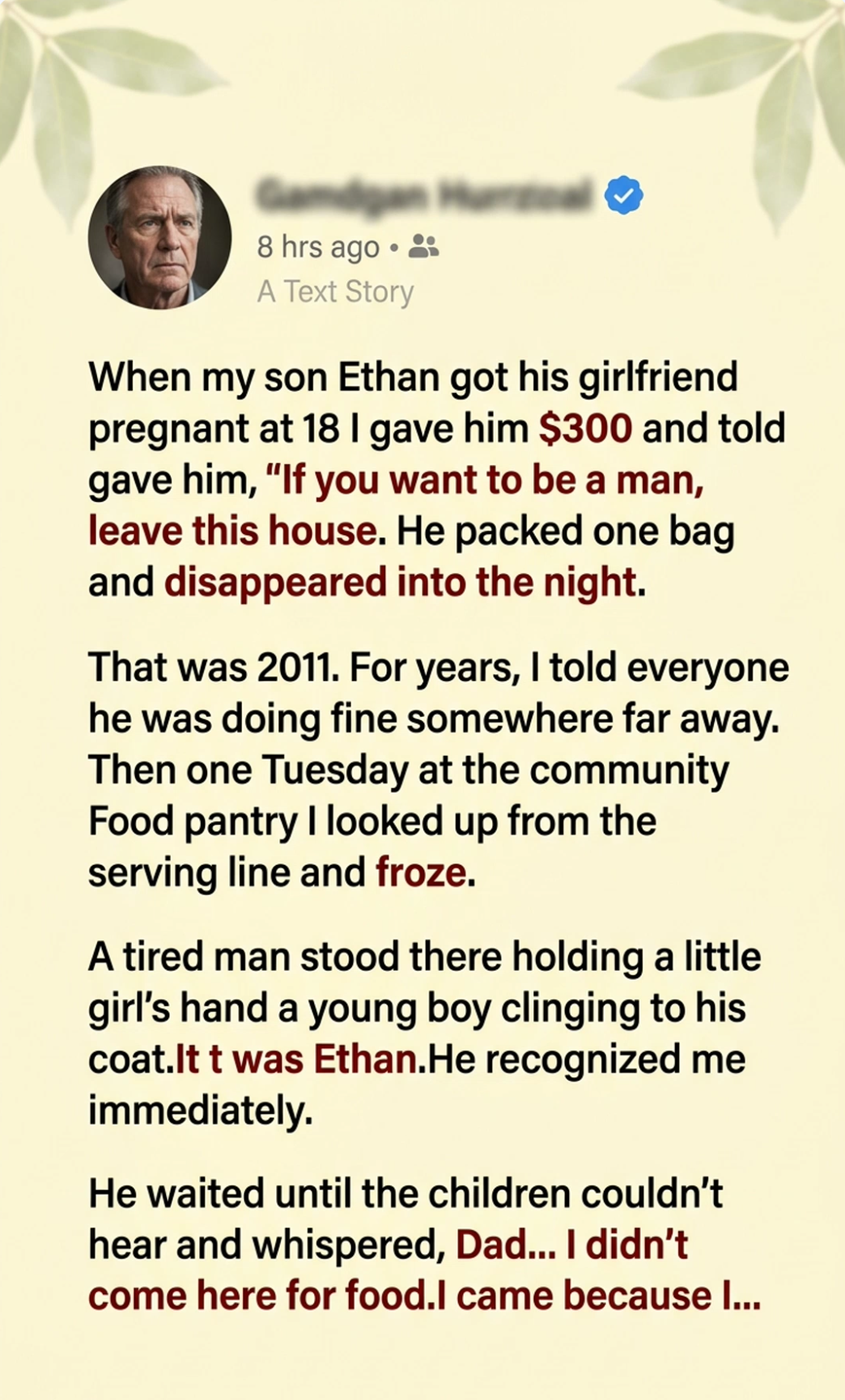
When my son Ethan got his girlfriend pregnant at eighteen, I believed I was teaching him responsibility.
I was wrong.
I didn’t understand that a lesson delivered without love can become a wound that lasts for years.
It happened in the spring of 2011. Ethan stood in our kitchen with his shoulders hunched and his hands shoved into the pockets of his jeans. His girlfriend, Melissa, had taken a pregnancy test twice. Both results were positive.
My wife, Linda, sat at the table with her hands folded tightly together. She looked frightened, but she was trying not to show it.
I was angry.
I had worked thirty years at a manufacturing plant to give my family a stable life. I had paid our mortgage on time, kept food in the refrigerator, and made sure Ethan never went without decent clothes or school supplies. I expected him to finish high school, find a job, and build a future before he started a family.
Instead, I saw my plans collapsing in front of me.
“What were you thinking?” I demanded.
Ethan stared at the floor.
“I wasn’t planning it, Dad.”
“That’s obvious.”
Linda whispered my name, warning me to calm down, but I was too proud to listen.
“You’re eighteen. You don’t have a steady job. You don’t have a house. You don’t even know what it costs to raise a child.”
“I know,” Ethan said quietly. “That’s why I came to tell you.”
His answer should have reminded me that he was still my son, frightened and searching for guidance.
Instead, I heard what I wanted to hear: an excuse.
I walked to my bedroom, opened the drawer where I kept emergency cash, and counted three hundred dollars. When I returned to the kitchen, I placed the money on the table.
Ethan looked at it, then at me.
“What’s this?”
“Three hundred dollars.”
“I can see that.”
“Then take it.”
Linda stood up. “Please don’t do this.”
I ignored her.
“If you want to be a man, leave this house. You want to have a baby? Fine. Go take care of your responsibilities. You’re old enough to make adult decisions, so you’re old enough to live with them.”
Ethan went pale.
“Dad, I wasn’t asking you to pay for everything.”
“Then stop standing there waiting for me to solve your problems.”
For a moment, I thought he would argue. I expected him to tell me I was being unfair, to raise his voice, or to storm out and return after cooling down.
Instead, he picked up the money.
He looked at his mother.
“I’m sorry, Mom.”
Linda began to cry.
Then Ethan turned toward me.
“Is that really what you want?”
I could have stopped everything with one sentence.
I could have said, “No, son. Sit down. We’ll figure this out together.”
But pride is a terrible thing when a man mistakes it for strength.
“Yes,” I said.
Ethan nodded once.
He went upstairs and packed a single bag. I heard drawers opening and closing, the scrape of a suitcase across the floor, and the quiet footsteps of a young man trying not to make his departure feel more painful than it already was.
Linda followed him to the bedroom.
I remained in the kitchen.
A few minutes later, Ethan came downstairs carrying the bag over one shoulder. He paused beside his mother and hugged her. She held him so tightly that he had to gently loosen her arms.
Then he walked to the front door.
I stood near the hallway, waiting for him to say something that would allow me to change my mind without admitting I had been wrong.
He didn’t.
He stepped outside and disappeared into the night.
That was the last time I saw my son for fifteen years.
At least, that was what I believed.
For the first few weeks, I told myself Ethan would return. He had no real plan, no savings beyond the money I had given him, and no experience supporting a family. I imagined him sleeping on a friend’s couch, eating cheap meals, and eventually realizing that I had been right.
Every time a car pulled into our driveway, I looked toward the window.
Every time the telephone rang, Linda hurried to answer it.
But Ethan never called.
I contacted two of his friends. One told me Ethan had found temporary work at a warehouse. Another said he had gone to another city with Melissa.
After that, the information dried up.
Melissa’s family had moved, and I didn’t know where to find them. Ethan’s old phone number stopped working. His social media accounts disappeared or went inactive.
I could have searched harder.
I could have asked his friends for addresses, contacted people who might know where he worked, or swallowed my pride and admitted that I wanted my son home.
Instead, I did something cowardly.
I created a story that made my decision easier to live with.
Whenever relatives asked about Ethan, I said he was doing fine somewhere far away.
“He wanted independence,” I told them. “He’s building his own life.”
When my sister asked whether I had spoken to him recently, I changed the subject.
At church, I smiled when people mentioned their grown children and pretended I had nothing to worry about.
Only Linda refused to participate in my lie.
“He’s our son,” she would say whenever I told her he had chosen to leave. “He didn’t stop being our son because he made a mistake.”
“He made an adult choice.”
“He was eighteen.”
“Old enough to get someone pregnant.”
“And young enough to need his father.”
We had that argument so often that eventually we stopped having it aloud. But the silence between us grew heavier.
On Ethan’s nineteenth birthday, Linda baked his favorite chocolate cake. She cut a slice, wrapped it in foil, and put it in the freezer.
“Why are you doing that?” I asked.
“Because he might come home.”
“He isn’t coming home.”
She looked at me with an expression I still remember.
“You don’t know that.”
She kept the cake in the freezer for months. Eventually, she threw it away, but she never stopped setting an extra place at the table on holidays.
Years passed.
I continued working at the plant until I retired. Linda volunteered at our church and helped organize donations for a community food pantry. I sometimes went with her, mostly because she asked me to and because I didn’t know what else to do with my time.
The pantry operated out of an old community center with faded yellow walls, a leaky roof, and shelves stacked with canned vegetables, rice, pasta, and cereal.
People came for different reasons. Some had lost jobs. Others were caring for sick relatives, raising children alone, or struggling with rent increases. Many apologized when they asked for help.
Linda always told them the same thing.
“You don’t have to apologize for needing a hand.”
I never understood how she could be so patient with strangers when I had been so unforgiving toward my own son.
Then came a Tuesday in October, fifteen years after Ethan left.
I was helping serve groceries because one of the regular volunteers had called in sick. The line stretched through the community center, past the folding tables and the bulletin board covered with notices about free meals and employment assistance.
I was placing cans into a cardboard box when I looked up.
A tired man stood near the serving line holding a little girl’s hand. A young boy clung to the man’s coat, his face partly hidden in the fabric.
The man wore a faded jacket with a broken zipper. His hair was longer than I remembered, and a rough beard covered his jaw. He looked thinner, older, and exhausted.
But I recognized his eyes.
The box slipped from my hands.
Cans rolled across the table and struck the floor.
“Ethan?”
He looked directly at me.
For a second, neither of us moved.
Then his expression changed. I saw recognition, followed by surprise, followed by something I couldn’t bear to name.
Pain.
He looked down at the little girl beside him.
“Come on, sweetheart,” he whispered to her. “We’re almost done.”
The boy tightened his grip on Ethan’s coat.
I wanted to cross the room, pull my son into my arms, and ask where he had been. I wanted to tell him I was sorry, that I had been waiting, that I had never stopped loving him.
Instead, I stood behind the serving table like a stranger.
Ethan guided the children through the line. When they reached me, he didn’t ask for anything special. He accepted a box of groceries, thanked the volunteer beside me, and moved toward the exit.
I watched him leave.
Then I followed.
“Ethan, wait.”
He stopped near the side entrance, where a row of old plastic chairs stood beneath a bulletin board.
The little girl turned toward me.
“Who are you?”
Ethan knelt beside her.
“Someone I knew a long time ago.”
The words hurt more than I expected.
He looked at the children.
“Can you two sit over there for a minute? I need to talk to him.”
The little girl hesitated, but her brother followed her to the chairs. Ethan watched them until they were settled, then turned back to me.
His face was close enough that I could see the small scar near his eyebrow, the one he had gotten when he fell off his bicycle at nine.
I had carried him into the emergency room that day.
I had held his hand while the doctor stitched the cut.
Now he was a grown man with children of his own, and I had no idea what their names were.
“Ethan,” I said. My voice sounded weak. “I’ve been looking for you.”
He stared at me.
“No, Dad. You haven’t.”
I opened my mouth, then closed it.
He was right.
I had asked a few questions in the beginning, but I had stopped when the answers became inconvenient. I had spent years telling people that my son was doing fine because admitting I didn’t know would have meant facing what I had done.
“I’m sorry,” I said.
Ethan looked away.
For several seconds, the only sound was the murmur of people inside the pantry.
Then he took a breath.
“Dad, I didn’t come here for food.”
I glanced toward the grocery box resting near his feet.
“I know.”
“I came because I…”
He stopped and rubbed his forehead.
For the first time, I saw the frightened eighteen-year-old standing inside the tired man before me.
“I came because I don’t know how much longer I can keep pretending I’m okay.”
My heart sank.
“What happened?”
Ethan gave a short, humorless laugh.
“Where do I start?”
“Anywhere.”
He looked toward the children.
“The little girl’s name is Lily. She’s seven. The boy is Noah. He’s four.”
I nodded, trying to absorb the information.
“And Melissa?”
His face tightened.
“She died two years ago.”
The words seemed to drain the air from the room.
“What?”
“An aggressive form of cancer. She was diagnosed, and everything happened faster than we expected. By the time we understood how serious it was, she was already very sick.”
I reached for the back of a chair.
Ethan continued, speaking quietly.
“We had been together for years. We got married when Lily was born. I worked construction, then warehouse jobs, then anything I could find that paid enough. Melissa worked at a dental office until she couldn’t anymore. We weren’t rich, but we had a little apartment, a used car, and two kids who thought their parents could fix anything.”
His voice broke.
“Then she got sick. The bills started coming. I missed work to take her to appointments. Eventually, I lost my job because I couldn’t keep up with the schedule.”
I felt a cold weight settling in my stomach.
“Why didn’t you call me?”
Ethan turned toward me so quickly that I stepped back.
“Call you?”
He laughed once, bitterly.
“What was I supposed to say? ‘Hi, Dad. Remember when you told me to leave if I wanted to be a man? Well, I’m struggling, and my wife is dying. Can you help me?'”
I lowered my eyes.
“I would have helped you.”
“Would you?”
The question hung between us.
I wanted to say yes immediately. I wanted to insist that I would have opened my door, paid the bills, and done anything for my son.
But I remembered the kitchen table. The three hundred dollars. His question about whether I really wanted him to leave.
I had answered yes.
Ethan shook his head.
“I didn’t know how to call you. I was ashamed. Every time I thought about it, I heard your voice telling me to be a man and handle my responsibilities.”
He rubbed his hands together.
“So I did. I worked. I moved us into a cheaper place. I took night shifts and slept when the kids slept. When Melissa got worse, I promised her I would keep the children safe. I promised I wouldn’t let them feel alone.”
He looked at Lily and Noah.
“I meant it. But I don’t think I understood how hard it would be.”
I felt tears gathering behind my eyes.
“What do you need, son?”
Ethan stared at me for a long time.
“I need someone to tell me that asking for help doesn’t mean I’ve failed.”
I couldn’t speak.
He continued.
“I’ve been trying to keep everything together since I was eighteen. I thought if I worked hard enough, I could prove you wrong. I thought one day I’d have a house, a good job, money in the bank, and a family that looked like the ones on television. Then you could see me and know I had become a man.”
He swallowed.
“But I never got the chance to show you any of it.”
“Ethan—”
“Please let me finish.”
I nodded.
“After Melissa died, I kept going because the children needed me. I found another job, but the hours weren’t enough. Our rent went up. I fell behind on the electric bill. Lily needed new shoes, and Noah had a cough that wouldn’t go away. I started skipping meals so they could eat.”
He looked embarrassed as he said it.
“Then I found out about this pantry. I told the kids we were going somewhere to pick up groceries, and Lily asked if it meant we were poor.”
His mouth trembled.
“I told her that sometimes families need help, and that there’s nothing shameful about it. But when she asked whether I had anyone else to call, I couldn’t answer.”
I felt something break inside me.
“I was standing in line with my children when I saw you,” Ethan said. “And I realized I had spent fifteen years being afraid of the same man who was supposed to help me learn how to live.”
He looked straight at me.
“I didn’t come here for food, Dad. I came because I needed to know whether there was still a place in this world where I could ask for help without being told to leave.”
I covered my mouth.
For fifteen years, I had imagined my son returning to prove that I had been right.
I had pictured him walking through our door with a good job, a successful life, and a confident smile. In my fantasy, I would welcome him back and pretend the years apart had been a necessary lesson.
I had never imagined him standing in a food pantry with two hungry children, afraid that his own father might reject him again.
“Ethan,” I whispered, “you never needed to prove anything to me.”
He looked down.
“That’s not what you told me.”
“I know.”
The words came out before I could defend myself.
“I know, son. I was wrong.”
He remained still.
I stepped closer, then stopped when I saw him tense.
“I was angry and frightened about your future. I thought if I made life hard enough, you’d learn responsibility. I confused punishment with guidance. I told myself I was preparing you for the world, but I was making you face it alone.”
My voice cracked.
“You were eighteen. You needed your father, and I sent you away.”
Ethan’s eyes filled with tears, but he looked toward the children as if he didn’t want them to see.
“I waited for you to call,” he said.
“I should have called.”
“I thought maybe you would show up when Lily was born. I thought maybe you’d want to meet her.”
“I should have been there.”
“When Noah was born, I stopped expecting it.”
I had no answer.
There are moments when apologies cannot reach the distance created by years. I could not give Ethan back the nights he had spent worrying about rent, the days he had worked while exhausted, or the hours he had watched his wife suffer without knowing how he would keep the family afloat.
I could only stop making excuses.
“I’m sorry,” I said again. “I am so deeply sorry.”
Ethan wiped his face with the back of his hand.
“I don’t know if I can forgive you.”
“You don’t have to do that today.”
He looked surprised.
I had spent most of my life believing forgiveness was something a person should demand once they apologized. I finally understood that my son had the right to be angry for as long as he needed.
“I don’t expect you to pretend nothing happened,” I continued. “I don’t expect you to come home and call me Dad as if we never lost those years. But I want you to know that if you’ll let me, I’ll help you now. Not to prove anything. Not to control your life. Because you’re my son, and those children are my grandchildren.”
Ethan glanced toward Lily and Noah.
“What would you do?”
“Whatever we can figure out together.”
He looked skeptical, and I couldn’t blame him.
“I have a spare room at home,” I said. “Linda is there now. She’ll want to see you. We can make arrangements for the children, work out the bills, and find out what support you qualify for. You won’t have to solve everything tonight.”
He swallowed.
“What if I mess up?”
“Then we figure it out.”
“What if I need help again?”
I felt the full weight of the question.
“Then you ask again.”
Ethan stared at me, searching my face for the condition, the warning, or the hidden price.
I gave him none.
Finally, he nodded.
“Can we just go somewhere and talk first? The kids are tired.”
“Of course.”
I called Linda from the parking lot.
She answered on the second ring.
“How is everything at the pantry?”
I looked at Ethan, who stood beside the car with Lily’s hand in his.
“Linda,” I said, “I found him.”
There was silence.
Then I heard her breath catch.
“Ethan?”
“Yes.”
“Is he there? Is he all right?”
I couldn’t answer that question honestly, so I said, “He’s here. He’s with his children. We’re coming home, if he’s ready.”
I held the phone toward him.
He hesitated, then took it.
“Mom?”
Linda began to cry.
“Oh, my baby.”
Ethan closed his eyes.
For a moment, he was eighteen again, standing in the kitchen with one bag and three hundred dollars. But this time, his mother was not saying goodbye.
She was telling him the door was open.
When we arrived home, Linda was waiting on the front porch.
She had aged in the fifteen years since Ethan left. Her hair was silver now, and she leaned slightly on the railing when she stood for long periods. But when she saw our son step out of the car, she moved down the steps faster than I had seen her move in years.
Ethan dropped his bag.
Linda wrapped her arms around him.
He stood rigid for a moment, then folded into her embrace and began to cry.
“I’m sorry, Mom,” he whispered.
She held the back of his head.
“You don’t have to apologize for coming home.”
Lily stood beside the car, watching them with wide eyes.
“Are you Grandma?” she asked.
Linda pulled back and looked at her.
“I am, sweetheart.”
Lily glanced at Ethan.
“Dad said we don’t have a grandma nearby.”
Linda’s face crumpled.
“Well, I hope I can be nearby now.”
Lily considered that carefully, then held out a small hand.
“I’m Lily.”
Linda took it as if she had been handed something priceless.
“And I’m very glad to meet you.”
Noah was shy. He hid behind Ethan’s leg until Linda offered him a cookie, then accepted it without making eye contact. By the time we entered the house, he was carrying the cookie in both hands and examining the framed photographs on the hallway wall.
He stopped in front of one taken when Ethan was twelve.
“That’s Dad,” he announced.
Ethan came to stand beside him.
“Yeah.”
“You had hair.”
Despite everything, we laughed.
It was the first easy sound in our house in years.
Dinner was simple. Linda made spaghetti, and the children ate at the kitchen table where Ethan had once sat as a frightened teenager. I kept looking at him, trying to reconcile the man before me with the boy I had sent away.
He had lines around his eyes now. His hands were rough from work. He watched the children constantly, making sure Noah had enough water and Lily had another helping of food.
When Linda offered him more spaghetti, he instinctively said, “No, thank you. The kids can have it.”
She put another serving on his plate anyway.
“There’s plenty,” she told him.
He stared at the food for a moment before taking a bite.
Later, after the children had fallen asleep in the spare room, Ethan and I sat at the kitchen table.
Linda had gone upstairs to give us privacy, though I knew she was listening for any sign that our conversation had become difficult.
I placed the old photograph of Ethan on the table.
“I kept this,” I said.
He looked at it.
“I wondered whether you threw everything away.”
“I didn’t.”
He ran a finger along the edge of the frame.
“Why didn’t you come looking for me?”
There it was again: the question I could not escape.
“I was ashamed,” I admitted. “At first, I told myself you would come home when you were ready. Then I told myself you were doing fine. Eventually, I was afraid that if I searched for you, I’d discover how badly I had failed you.”
Ethan looked at me.
“So you stayed away to protect yourself.”
“Yes.”
He nodded slowly.
“That’s what I thought.”
I wanted to tell him that I had worried about him every day, that I had imagined his life in a hundred different ways, that I had sometimes driven past the house where he grew up and wondered whether he would ever return.
But those thoughts did not change what I had done.
“I loved you,” I said. “But I didn’t love you the way you needed me to. I made you believe that my love depended on your ability to handle everything alone.”
Ethan stared at the table.
“After Melissa died, I sometimes wanted to call you so badly that I’d pick up the phone and look at your old number. Then I’d remember that you hadn’t called me in fifteen years.”
His voice grew quieter.
“I’d tell myself that if you wanted me, you would have found me.”
I closed my eyes.
“I wish I had.”
“I know.”
He didn’t say he forgave me. He didn’t say everything was all right. He simply sat with me in the kitchen, allowing the truth to exist between us.
For that night, it was enough.
Over the following weeks, we learned how to be a family again.
It wasn’t as simple as letting Ethan move back into his old bedroom. He had responsibilities, grief, and fears that had grown over fifteen years. He was protective of his children and uncomfortable accepting help. Sometimes, when I offered advice, he stiffened as if he expected me to criticize him.
I had to learn not to treat every problem as a lesson.
When he struggled to arrange childcare around his work schedule, I helped him explore local programs and adjusted my own schedule to watch the children when I could. Linda took Lily to the library and taught Noah how to water her tomato plants.
We helped Ethan contact a community support worker who knew about housing assistance, childcare resources, and benefits available to families who had lost a parent. He found steadier work with a local maintenance company, and we worked out a realistic plan for him to get back on his feet.
I did not simply hand him money and tell him to manage.
We sat down together, discussed what was needed, and made decisions as adults.
That difference mattered.
Ethan gradually began to trust that help would not come with humiliation attached.
One Saturday, he asked me to take the children to the park while he attended a job interview. When we returned, he was waiting on the porch with a paper in his hand.
“I got it,” he said.
I shook his hand.
“Congratulations.”
He laughed.
“You can hug me, you know.”
I pulled him into my arms.
It was a brief hug, but neither of us let go too quickly.
That evening, Linda found me standing in the kitchen, staring at the place where Ethan had sat during dinner.
“You seem far away,” she said.
“I keep thinking about what I missed.”
She came to stand beside me.
“We can’t change those years.”
“I know.”
“But we can stop losing the ones we have left.”
I looked at her.
For fifteen years, Linda had carried the grief of our son’s absence while I tried to bury it beneath pride. She had never stopped believing he might return. She had also never stopped resenting me for making it so difficult for him to do so.
“I’m sorry,” I told her.
She took my hand.
“I know you are. But you need to understand something, too. Ethan doesn’t owe you a happy ending just because you finally apologized. You have to keep showing him that you’re different.”
“I will.”
She squeezed my hand.
“Then start by listening.”
So I did.
I listened when Ethan spoke about Melissa. I learned that she had loved old country music, burned pancakes almost every Sunday, and made the children birthday cards covered in crooked drawings. I learned that he still kept her wedding ring in a small box beside his bed.
I asked him about the years before her death, not because I wanted him to prove that he had survived, but because I wanted to know the life I had missed.
Sometimes, he spoke easily. Other times, he stopped in the middle of a sentence and needed a break.
I learned not to push.
One night, he told me about the last conversation he had with Melissa.
She had been very weak, but she had insisted that he sit beside her bed. She told him she was afraid of leaving the children without their mother, and he promised that he would take care of them.
Then she asked him whether he had spoken to his father.
He told her no.
“What did she say?” I asked.
Ethan stared into his coffee.
“She said that people can love each other and still make terrible mistakes. She told me not to let what happened between you and me become the only story I ever told about my family.”
He paused.
“She said I should protect the kids, but not teach them that asking for help is something to be ashamed of.”
I felt a lump rise in my throat.
“She sounds like she was a wise woman.”
“She was.”
He looked at me.
“She also said that if I ever got the chance to speak to you again, I should tell you that she didn’t hate you.”
I could not speak for several seconds.
“Why would she say that?”
“Because she knew I was angry. She didn’t want me carrying it forever.”
I looked down at my hands.
I had never met Melissa as an adult. I had missed her wedding, the births of my grandchildren, and the years when she and Ethan built a home together. Now I would never have the chance to thank her for loving my son or for helping him become the father he was.
“I’m sorry I wasn’t there,” I whispered.
Ethan nodded.
“I know.”
Then he added, “I think she would have wanted you to meet the kids.”
That was when I understood that our reconciliation was not a single moment of forgiveness. It was a series of choices, made repeatedly, to tell the truth and keep showing up.
Several months later, Lily came home from school with a family-tree assignment.
She spread the paper across the kitchen table and asked Linda to help her write everyone’s names.
“Mommy Melissa goes here,” she said, pointing to one branch. “Daddy goes here. And Grandma Linda and Grandpa…”
She stopped and looked at me.
“What do I call you?”
I felt my heart tighten.
“Whatever feels comfortable to you, sweetheart.”
She considered that for a moment.
“Grandpa James?”
I smiled.
“That sounds perfect.”
She wrote my name in large, uneven letters and drew a heart beside it.
Then she looked at Ethan.
“Can I put Mommy Melissa on the tree, too? Even though she isn’t here?”
Ethan knelt beside her.
“Of course. She’ll always be part of our family.”
Lily nodded, satisfied.
I turned away for a moment because I did not want her to see me cry.
That evening, after the children were asleep, I told Ethan how much the family tree had meant to me.
He leaned against the kitchen counter.
“I think about Mom a lot,” he said. “Sometimes I worry the kids will forget her.”
“They won’t. You’ll make sure they remember.”
He nodded.
“And I think about what happened when I was eighteen. I don’t want them growing up believing that one mistake means they have to handle everything alone.”
I looked at my son.
“You won’t make that mistake.”
He was quiet for a moment.
“I hope not.”
Then he said something I have never forgotten.
“I don’t want to raise children who are afraid to come home.”
Those words followed me into my sleep.
They reminded me of the sentence I had spoken fifteen years earlier, when I told my son that if he wanted to be a man, he should leave my house.
I had believed I was teaching him to stand on his own.
Instead, I had taught him that love could be withdrawn when he needed it most.
I could not undo that lesson. But I could help him teach his children something better.
A year after Ethan returned, we gathered for a small birthday celebration for Noah. There were paper plates, a chocolate cake, and balloons that kept slipping from the tape on the wall.
Lily helped her brother open his presents. Linda took pictures, and Ethan laughed when Noah tried to blow out all the candles at once.
At one point, Ethan stood beside me near the kitchen doorway.
“Remember the three hundred dollars you gave me?” he asked.
I felt my stomach tighten.
“Yes.”
“I kept it for a long time.”
I looked at him.
“Why?”
“I don’t know. Maybe because it was the last thing you gave me before I left.”
He paused.
“After a while, I stopped seeing it as money. I saw it as proof that I was on my own.”
I swallowed hard.
“I wish I could take that night back.”
“I know.”
He watched Lily run across the room with a paper crown on her head.
“But I don’t want us to spend the rest of our lives wishing we could change the past. I want the kids to have good memories with us. I want to build something better.”
I nodded.
“Then that’s what we’ll do.”
He turned toward me.
“I’m not ready to say that everything is forgiven.”
“I understand.”
“But I’m glad I came to the pantry that day.”
I looked at him, surprised.
“So am I.”
He held out his hand.
I took it.
For a moment, we stood quietly while the children laughed around us. It wasn’t the perfect ending I might once have imagined. There were still difficult conversations ahead, and there were wounds that would never completely disappear.
But my son was standing beside me, alive and rebuilding his life.
His children knew my name.
My wife no longer had to wonder whether she would see her son again.
And I had finally learned that being a father was not about making a child strong enough to survive without you. It was about giving that child a place to turn when the world became too heavy to carry alone.
Years ago, I gave Ethan three hundred dollars and told him to leave if he wanted to be a man.
Fifteen years later, he came to a community food pantry with two children and asked me for something I should have offered him all along.
Not money.
Not a house.
Not an easy way out of his responsibilities.
He needed to know that he still belonged somewhere.
And I am grateful that, for once in my life, I understood what he was asking before it was too late.
Because the greatest mistake I made was not that I failed to prepare my son for fatherhood.
It was that I made him believe he had to face fatherhood alone.
If I could speak to the man I was that night, I would tell him to put the money away, pull out a chair, and listen to his son.
I would tell him that responsibility is not learned through rejection, that pride is a poor substitute for wisdom, and that a young man who is frightened about becoming a father needs guidance more than judgment.
Most of all, I would tell him that no matter how badly a child disappoints you, the door to your love should never become a door he is afraid to knock on.
I cannot change the night Ethan left.
But I can spend the rest of my life making sure my grandchildren never have to wonder whether they are welcome home.
And when Lily or Noah makes a mistake someday, I hope they will remember the lesson their father learned the hard way:
Being strong does not mean carrying every burden alone.
Sometimes, the bravest thing a person can do is ask for help.
And sometimes, the most important thing a father can say is not, “You’re on your own.”
It is, “Come inside, son. We’ll figure it out together.”