My name is Patricia Miller, and for fifteen years, I told everyone my son Daniel was doing just fine.
Whenever someone asked about him, I smiled and said he was working somewhere across the country. I told them he had found a good job, that he was independent, and that he was building a life for himself.
I repeated those lies so often that eventually, I almost believed them.
But every Mother’s Day, I set an extra place at the dining table without realizing I was doing it.
Every Christmas, I bought a small gift I never wrapped.
And every time the telephone rang after midnight, my heart jumped with the foolish hope that my son might finally be calling home.
Daniel was eighteen when I told him to leave.
He had always been a quiet boy, the kind who apologized when someone else bumped into him. He wasn’t a troublemaker. He didn’t drink heavily, steal money, or disappear for days with friends. He worked part-time at a hardware store while finishing high school and came home most evenings smelling of sawdust and machine oil.
His father had died when Daniel was eleven. After that, I raised him alone.
I worked long shifts as a nursing assistant at a retirement home. We didn’t have much, but I made sure he had clean clothes, school supplies, and a birthday cake every year.
Sometimes I took extra shifts to pay the electricity bill. Sometimes I skipped lunch so he could have money for a school trip.
I thought all those sacrifices had taught him how difficult life could be.
I thought I was preparing him to survive.
Then, one rainy Thursday evening in March 2010, Daniel came into the kitchen and asked me to sit down.
His hands were shaking.
“Mom, I need to tell you something.”
I turned off the stove.
“What is it, sweetheart?”
He swallowed.
“Melissa is pregnant.”
For a moment, I didn’t understand what he had said.
Then I looked at his face and saw the fear in his eyes.
Melissa was his girlfriend. She was eighteen, too, and I had met her several times. She was polite, hardworking, and always thanked me when I gave her something to eat.
They had been dating for almost a year.
I sat down slowly.
“How far along is she?”
“Almost three months.”
I pressed my fingers against my forehead.
“Does her family know?”
“Yes. Her parents are upset, but they’re helping her.”
“And what do you plan to do?”
Daniel looked at me.
“I’m going to take responsibility. I want to finish school, and I’ll find a full-time job. Melissa and I want to get married eventually, but we know we need to figure things out first.”
He spoke carefully, as though he had rehearsed every word on the bus ride home.
I should have listened.
I should have asked what he needed, what Melissa needed, and how we could make a plan together.
Instead, I saw my entire future collapsing in front of me.
I had spent years worrying about money. I had worked myself sick to keep a roof over our heads. I had imagined Daniel graduating, finding steady employment, and eventually moving into a comfortable home.
Now I imagined another child needing food, clothing, medical care, and money we didn’t have.
I imagined Daniel dropping out of school and spending the rest of his life struggling.
I imagined people whispering about the boy I had raised.
Fear took hold of me, and I mistook it for wisdom.
“You are eighteen,” I said. “You have no savings, no house, and no real job. What makes you think you can raise a baby?”
“I know it’s going to be hard, Mom.”
“Hard? You have no idea what hard means.”
His face tightened.
“I know I made a mistake, but I’m not running away from it.”
That should have been the moment I felt proud.
Instead, I stood up so quickly that my chair scraped against the floor.
“Then prove it.”
He stared at me.
“What?”
“If you want to be a man, build your own life. Don’t expect me to carry you through every mistake you make.”
“Mom, I’m not asking you to pay for everything.”
“You are asking me to support another family when I can barely support myself.”
“I’m asking you to let me stay while I finish school.”
I shook my head.
“No. You’re an adult now. You made an adult decision. You need to deal with the consequences.”
He looked at me as though he no longer recognized the woman standing in front of him.
Then he asked the question that should have stopped me.
“Are you telling me to leave?”
I wanted to say no.
I wanted to tell him that I was frightened and that we needed time to think.
I wanted to pull him into my arms and remind him that he was still my little boy.
Instead, I went to my bedroom, opened the drawer where I kept my emergency savings, and counted out $250.
I placed the money on the kitchen table.
“This is all I can give you. Find somewhere to stay. Get a job. Build your own life.”
Daniel stared at the bills.
Then he looked at me.
“You’re really doing this?”
I folded my arms because I was afraid that if I didn’t, he would see me trembling.
“You need to learn responsibility.”
He nodded slowly.
He didn’t shout.
He didn’t call me cruel.
He didn’t threaten to make me regret it.
He simply went upstairs.
That night, I heard the zipper of his duffel bag.
I stood in the hallway outside my bedroom, listening to him move around his room. I heard a drawer open, then close. I heard the soft thud of books being placed inside his bag.
At one point, he stopped moving.
I thought he might come downstairs and ask me to reconsider.
I waited.
But he didn’t.
A few minutes later, he appeared at the bottom of the stairs wearing his old brown jacket. One duffel bag hung from his shoulder.
He was holding the photograph of his father that had stood on his dresser since childhood.
“Mom,” he said quietly.
I looked at him.
For one terrible second, I saw the little boy who used to climb into my bed after thunderstorms.
I saw the teenager who had stayed awake beside me when I had the flu.
I saw the young man who had just told me he was going to become a father.
Then fear hardened my heart again.
“Good luck, Daniel.”
He stood there for another moment.
“I hope you never have to find out what this feels like.”
Then he walked out the front door.
I watched through the kitchen window as he crossed the driveway and disappeared into the rain.
I told myself he would come back.
He would find a job, realize how difficult life was, and return after a few weeks. I would make him apologize for leaving without understanding what I was trying to teach him.
But the weeks passed.
Then the months.
Daniel never called.
At first, I told myself he was embarrassed.
After three months, I called his old girlfriend’s number, but it had been disconnected.
I visited a place where Melissa’s family had lived, only to learn that they had moved to another town.
I sent one letter to Daniel’s last known address.
It came back unopened.
Eventually, I stopped looking.
Not because I stopped loving him, but because I couldn’t bear the possibility that he might have chosen to forget me.
And because admitting what I had done would have required me to face a truth I wasn’t ready to accept.
I had sent my son away at the exact moment he needed his mother most.
So I created a story.
When my sister asked about Daniel, I said he was working in another state.
When an old neighbor asked whether he had married Melissa, I said they were doing well and wanted privacy.
When relatives asked why he never came home for Christmas, I said his job kept him busy.
I never told them that I had no idea where he was.
I never told them that I hadn’t heard his voice in fifteen years.
I never told them that I still remembered the sound of his duffel bag zipper.
Life continued.
I kept working at the retirement home until my knees began to ache. Eventually, I retired and moved into a smaller house.
I volunteered at the local food pantry on Tuesdays and Thursdays. I served soup, packed grocery bags, and helped people fill out forms for assistance.
I liked the work because it made me feel useful.
I also liked that nobody there knew my story.
They knew me as Patricia, the woman who remembered everyone’s name and always put an extra roll in the grocery bags when she could.
They didn’t know that I had spent fifteen years pretending my own son didn’t need me.
Then came the Tuesday that changed everything.
It was a cold morning in November 2025. Rain tapped against the windows, and the pantry was busier than usual.
A delivery truck had brought several boxes of canned food, and volunteers were rushing to sort everything before the lunch service began.
I was standing behind the soup counter, filling bowls, when the front door opened.
A tired man stepped inside.
He looked to be in his early thirties, with a short beard, dark circles beneath his eyes, and a jacket that had seen too many winters.
A little girl, perhaps four years old, rested against his chest. Her arms were wrapped around his neck, and her small shoes were wet.
A boy of about seven stood beside him, holding tightly to the man’s coat.
The boy looked pale and exhausted.
The man paused near the entrance, scanning the room.
Then his eyes found mine.
I knew him before my mind could accept what my heart was already telling me.
The shape of his jaw.
The way he tilted his head slightly when he was trying to understand something.
The small scar above his left eyebrow from the time he fell off his bicycle at age nine.
My ladle slipped from my hand and struck the edge of the soup pot.
Daniel.
My son was standing in front of me.
For fifteen years, I had imagined this moment in a thousand different ways.
Sometimes he returned in a new car, successful and confident, to show me that he had survived without me.
Sometimes he returned angry, demanding an explanation.
Sometimes I imagined him standing at my front door with a wife and children, allowing me to meet the grandchildren I had never known.
I had never imagined him looking like this.
He was thinner than I remembered. His jacket was frayed at the cuffs. His shoes were worn, and his eyes carried the exhausted look of someone who had spent too many nights worrying about tomorrow.
The little girl lifted her head from his shoulder.
“Daddy, I’m hungry.”
He stroked her hair.
“I know, sweetheart. We’re going to get something to eat.”
The boy tugged at his coat.
“Can I have bread, Dad?”
Daniel nodded.
“Of course, Noah.”
His voice broke slightly on the child’s name.
I gripped the counter to steady myself.
A volunteer beside me asked whether I was feeling ill.
I couldn’t answer.
Daniel looked away first.
He guided the children toward the registration table, where a volunteer explained how the pantry worked. He answered the questions politely and kept one arm around his daughter.
He never looked at me again.
For several minutes, I stood frozen behind the soup counter, watching my son pretend that I was a stranger.
Then the little girl began playing with a wooden puzzle near the children’s table. Noah joined her, distracted by a volunteer who offered him a coloring book.
Daniel finally approached me.
He stood on the other side of the counter.
Up close, I could see the small lines around his eyes and the gray beginning to show near his temples.
I had missed every birthday, every difficult conversation, every moment that had turned my eighteen-year-old son into this tired man.
He stared at the floor.
I wanted to touch his face.
I wanted to ask where he had been, whether he was married, whether he had finished school, whether he had ever been happy.
Instead, I whispered, “Daniel.”
He closed his eyes briefly.
Then he opened them and looked at me.
“Hello, Mom.”
Two words.
Fifteen years of silence, and all I received were two words.
I felt tears gathering in my eyes.
“Where have you been?”
He gave a small, humorless laugh.
“Living.”
The answer cut through me.
I deserved it.
I glanced toward the children.
“Are those your children?”
He nodded.
“This is Noah. The little one is Lily.”
“They’re beautiful.”
“Thank you.”
I swallowed.
“Does their mother know you’re here?”
Daniel’s expression changed.
He looked toward the children again, checking that they were occupied.
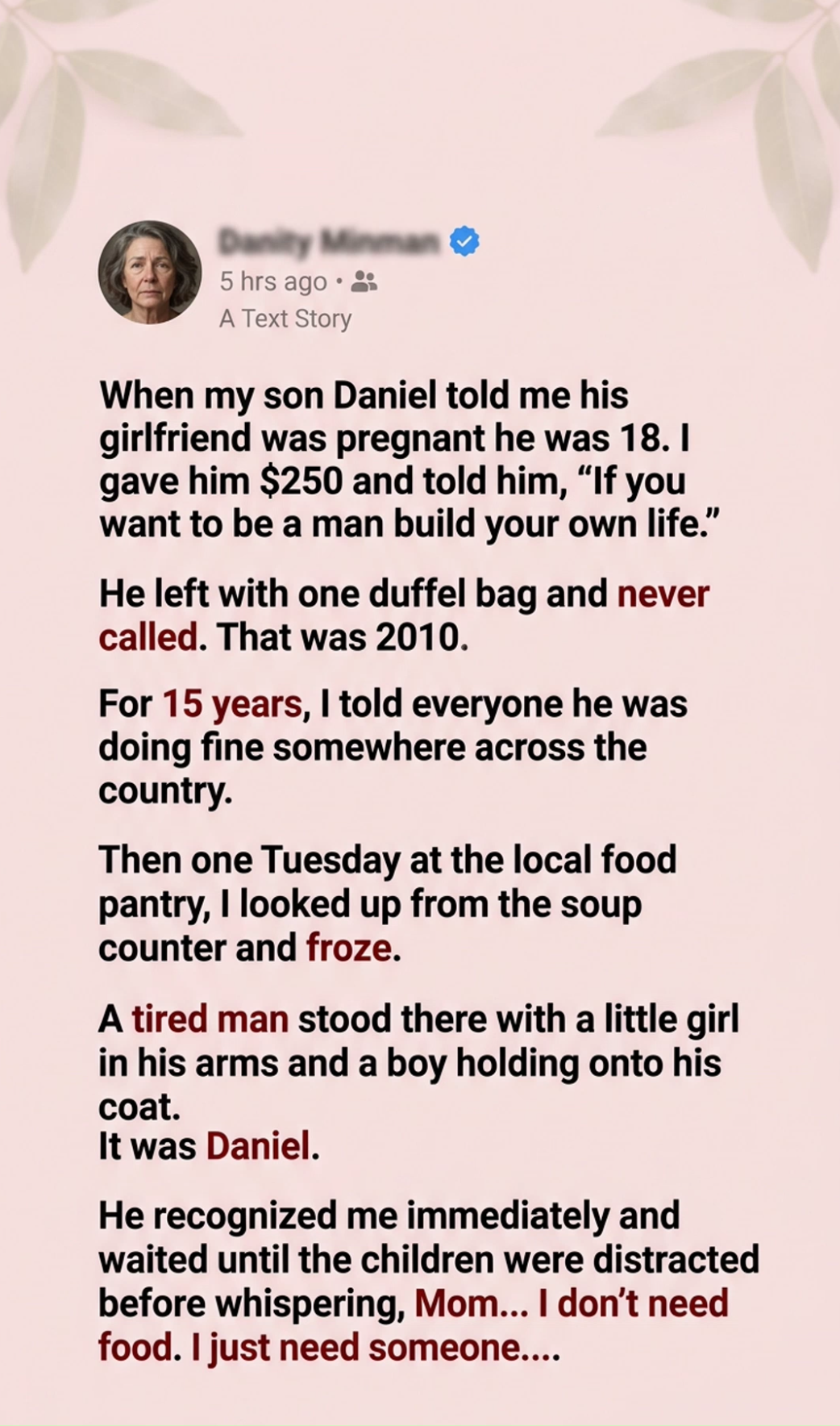
Then he leaned closer and whispered, “Mom, I don’t need food. I just need someone.”
My heart broke.
I had spent years telling myself that Daniel was doing fine. I had imagined him sitting in a warm house, earning a steady paycheck, celebrating holidays with people who loved him.
But he was standing in a food pantry, holding a little girl while his son waited for bread.
And he was asking me for something that had nothing to do with money.
He was asking whether his mother could still be someone he turned to.
I looked at him and realized I had no right to ask him to trust me.
Not after what I had done.
“Come into the office,” I said softly. “We can talk somewhere private.”
He hesitated.
“I don’t want the kids to think something’s wrong.”
“Then we’ll let them finish coloring. I’ll bring them something to eat, and we can talk for a few minutes.”
He nodded.
I served Noah a bowl of soup, a sandwich, and a small apple. Lily received a cup of warm soup with crackers, which she ate while sitting beside her brother.
Daniel watched them with an expression that mixed tenderness with exhaustion.
When they were settled, he followed me into the small office at the back of the pantry.
I closed the door.
For a moment, neither of us spoke.
Then I said the only thing that mattered.
“I’m sorry.”
Daniel stared at me.
I had rehearsed those words in my head for fifteen years, but they sounded painfully small now.
“I’m so sorry I sent you away.”
He looked down at his hands.
“You were pretty clear about what you wanted.”
“I know.”
“You gave me $250 and told me to build my own life.”
“I know, Daniel.”
“I remember counting that money on the bus.”
His voice remained calm, but his eyes had become wet.
“I kept thinking you might call. I thought maybe you’d cool down and tell me to come home.”
I pressed my hands together.
“I should have called.”
“You didn’t.”
“No.”
He looked at me then.
“Do you know what I thought after the first month?”
I shook my head.
“I thought you were waiting for me to apologize. I thought if I called, you’d tell me I had failed and that you were right about everything.”
His voice cracked.
“So I didn’t call.”
He swallowed.
“Then the months became years. And every year that passed made it harder.”
I began to cry.
He looked away.
“I don’t want you to cry because I’m here, Mom. I didn’t come to make you feel guilty.”
“Then why did you come?”
He took a long breath.
“Because I didn’t know where else to go.”
He rubbed his forehead.
“Melissa died two years ago.”
The room seemed to grow smaller.
“What?”
“Cancer. It was aggressive. By the time the doctors found it, it had already spread.”
I covered my mouth.
“I’m so sorry.”
He nodded.
“We tried everything. She was strong. She kept saying she’d get better because she wanted to watch the kids grow up.”
He stared at the floor.
“She didn’t get to.”
I reached for his hand, but stopped before touching him.
“How did you manage after she died?”
He let out a slow breath.
“Badly, at first.”
He explained that after leaving home, he and Melissa had stayed with a friend of hers for a while. Daniel took whatever work he could find, loading trucks, washing dishes, repairing fences, and working construction.
He finished his high school diploma through an adult education program while working nights.
When Noah was born, he found steadier employment at a warehouse. He and Melissa eventually rented a small apartment and married in a courthouse ceremony with two friends as witnesses.
They were never wealthy, but they built a life together.
There were birthdays, school pictures, Sunday pancakes, and long walks in the park. Daniel spoke about those years with a quiet warmth that made me ache to know I had missed them.
Then Melissa became ill.
Medical bills piled up. Daniel used his savings and took unpaid leave to care for her. When she died, he struggled to work full-time while raising two children.
He lost his warehouse job after missing too many shifts when Lily became sick with a fever and Noah’s school called about a problem.
He found temporary work, but the hours were unpredictable.
Rent fell behind.
Then the landlord gave him notice.
He had been staying with a coworker for a few weeks, sleeping on a foldout couch with the children sharing a small room. But the coworker’s family needed their space back, and Daniel had run out of places to ask.
He had applied for assistance, contacted shelters, and called several community organizations.
The food pantry was one of the places that had told him to come for groceries.
“Why didn’t you call me?” I asked, even though I knew the question was unfair.
Daniel looked at me.
“Because I was afraid.”
“Of me?”
“Of hearing the same thing again.”
He spoke slowly.
“I could handle being broke. I could handle working two jobs. I could handle people looking down on me because I was standing in line for food.”
His eyes filled with tears.
“But I couldn’t handle calling my mother and hearing that I wasn’t her problem.”
I covered my face.
For fifteen years, I had told myself that I was teaching my son independence.
I had convinced myself that refusing to help him was an act of discipline.
Now I understood that I had taught him something else.
I had taught him that asking for help could cost him the person he loved most.
Daniel continued.
“Melissa used to tell me that one day I should try to find you. She said people make terrible decisions when they’re scared, and that maybe you regretted what happened.”
He gave a sad smile.
“After she died, I promised her I’d try to give the kids a chance to know their family. I looked for you online, but I didn’t know whether you wanted anything to do with me.”
“I wanted you every day,” I whispered.
He shook his head.
“Then why didn’t you look for me?”
I had no answer.
The truth was ugly.
I had been afraid, too.
Afraid that Daniel would tell me he hated me.
Afraid that he had built a life without me and no longer needed me.
Afraid that I would have to admit to everyone that the son I claimed was doing fine had disappeared because I had sent him away.
So I did nothing.
I let my pride become a wall and called it strength.
“I was a coward,” I said finally. “I was afraid of admitting how badly I’d hurt you. So I told people you were fine, because I wanted to believe it myself.”
Daniel looked at me for a long time.
“I don’t know what to do with that.”
“You don’t have to do anything with it today.”
I wiped my cheeks.
“I won’t ask you to forgive me. I won’t ask you to pretend those years didn’t happen. I just want you to know that I’m sorry, and if you’ll let me, I want to help you and the children now.”
He looked toward the office door.
“I don’t need you to fix everything.”
“I know.”
“I don’t need a lecture about responsibility.”
“You won’t get one.”
“And I don’t want you to take the kids somewhere and then decide we’re too much trouble.”
The words were quiet, but they struck me harder than a shout.
I stood up.
Then I walked around the desk and stopped in front of him.
“I can’t promise I’ll never make another mistake,” I said. “But I can promise that I will never again tell you that you have to face everything alone just to prove you’re a man.”
His face crumpled.
For the first time since he had entered the pantry, he looked less like a stranger and more like the frightened boy who had stood at the bottom of my stairs with a duffel bag.
He covered his eyes with one hand.
I wrapped my arms around him.
At first, he stood stiffly.
Then his shoulders began to shake.
He cried against my shoulder, and I held him the way I should have held him fifteen years earlier.
“I’m sorry,” I whispered again and again.
He didn’t tell me everything was forgiven.
He didn’t say the past no longer mattered.
He simply let me hold him.
For that moment, it was enough.
When we returned to the main room, Noah was drawing a picture of a house with four stick figures in front of it. Lily had fallen asleep in a chair, her little hand wrapped around the wooden puzzle.
Daniel picked her up carefully.
Noah looked at him.
“Dad, are we going to the shelter now?”
Daniel glanced at me.
I stepped forward.
“Would you like to come home with me for a few nights?” I asked. “There’s room for all three of you. You can rest, and we can figure out the next steps together.”
Daniel looked uncertain.
“I don’t want to impose.”
“You are my son.”
I took a breath.
“And I should have said those words fifteen years ago, when you needed a place to stay.”
He looked at Noah, then at Lily.
Finally, he nodded.
“Just for a few nights.”
“Of course,” I said. “We’ll take it one day at a time.”
That evening, I drove them to my house.
I had not prepared a room for a son I hadn’t seen in fifteen years. The spare bedroom had become a storage space for old furniture, holiday decorations, and boxes I kept promising myself I would sort through.
But we cleared it together.
I found clean sheets, extra blankets, and two small pillows. Daniel arranged the children’s clothes in the dresser while I made grilled cheese sandwiches and tomato soup.
Noah sat at the kitchen table, swinging his legs beneath the chair.
“Grandma,” he said suddenly.
I stopped slicing bread.
“Yes, sweetheart?”
“Are you really our grandma?”
I looked at Daniel.
He gave me a small nod.
“Yes,” I said, kneeling beside Noah. “I’m really your grandma.”
He studied my face.
“Why haven’t we met before?”
My throat tightened.
“Because I made a mistake a long time ago. Your daddy deserved better from me, and I’m trying to make things right now.”
Noah considered that.
Then he held out his drawing.
“This is our family.”
I looked at the four stick figures in front of a crooked house.
“Can I keep it?”
He nodded.
I placed it on the refrigerator with a magnet shaped like a sunflower.
That night, after the children were asleep, Daniel and I sat at the kitchen table.
I wanted to ask him a thousand questions, but I resisted the urge to interrogate him about fifteen years of life I had missed.
Instead, I asked whether he needed help finding a place to live.
He said he had an appointment with a housing assistance worker later that week. I offered to drive him and the children, and he accepted.
We talked about practical things: his employment applications, the children’s school records, the bills that had followed him after Melissa’s death.
I didn’t offer money without asking what would actually help.
I didn’t tell him what decisions he should make.
I listened.
Before going to bed, Daniel stood in the hallway outside the spare room.
“Mom?”
I turned.
“Yes?”
“Thank you for tonight.”
I felt tears rise, but I kept my voice steady.
“You don’t have to thank me for letting you come home.”
He nodded slowly.
Then he said, “I used to dream about this.”
I waited.
“Coming home, I mean. When I was younger, I imagined walking through the door and finding you in the kitchen. I’d tell you everything was fine, and you’d tell me I could stay.”
His eyes lowered.
“Eventually, I stopped dreaming about it.”
I could barely breathe.
“I’m sorry, Daniel.”
He looked at me.
“I know.”
Then he went into the bedroom and closed the door.
Those two words gave me hope, but I understood that hope was not the same as forgiveness.
The following weeks were difficult.
Daniel found temporary work repairing equipment for a small construction company. The pay wasn’t high, but the owner offered regular hours and agreed to work around school pickup when possible.
I helped with the children while Daniel attended interviews and met with the housing worker.
We found a modest apartment not far from the school. It had two bedrooms, a small kitchen, and a balcony overlooking a parking lot.
It wasn’t much, but it was safe and affordable.
Daniel hesitated before signing the lease.
“I don’t know if I can keep up with everything,” he admitted.
I sat beside him.
“You don’t have to solve the next ten years today. Let’s work out the next month.”
He looked at me.
“That’s what you should have said when I was eighteen.”
I nodded.
“You’re right.”
I didn’t defend myself.
I didn’t explain how frightened I had been or how hard it had been to raise him alone.
Those things were true, but they didn’t change what I had done.
For once, I understood that being a mother meant listening to the pain I had caused without demanding that my child comfort me about it.
We made a simple budget together. Daniel arranged childcare with help from a local program, and I offered to watch the children two afternoons a week.
I also helped him contact a financial counselor who could negotiate payment plans for some of his outstanding bills.
Whenever I wanted to take over, I reminded myself that helping Daniel rebuild his life was not the same as controlling it.
He needed support, not another person telling him what kind of man he should be.
Slowly, the children began to trust me.
Lily liked sitting on my lap while I read picture books. She had a habit of pressing her cheek against my shoulder whenever she became sleepy.
Noah liked helping me bake. He was fascinated by the oven timer and insisted on watching the numbers count down.
One Saturday, he asked whether his mother had ever visited my house.
I felt my heart tighten.
“No, sweetheart. I never got the chance to meet her properly.”
He looked at me.
“She was nice.”
“I believe you.”
“She used to tell me that Grandma Patricia might be somewhere, and that maybe one day we’d meet.”
I swallowed.
“What else did she tell you?”
“She said you were probably sad because you missed Daddy.”
I had to turn away for a moment.
Melissa had been kinder to me in death than I had been to her when she was alive.
She had encouraged Daniel to reconnect with the mother who had rejected him.
She had protected the possibility of a relationship I had done nothing to deserve.
That evening, I asked Daniel if he would tell me more about her.
He brought out a small photo album.
There were pictures of their wedding, Noah’s first birthday, Melissa holding Lily in the hospital, and the family sitting together at a park.
Daniel smiled at some of the photographs.
At others, he became quiet.
I learned that Melissa loved gardening, sang off-key when she cooked, and wrote little notes in Daniel’s lunch bag even after they were married.
I learned that she had been afraid of dying, not because she was afraid of death itself, but because she worried about leaving her children without enough support.
“She told me not to let pride keep me from asking for help,” Daniel said. “She said the kids needed to see that being strong doesn’t mean doing everything alone.”
He paused.
“I think that’s why I finally came to the pantry.”
I reached across the table and touched his hand.
“I’m glad you did.”
He nodded.
“So am I.”
It was not an easy reconciliation.
There were days when Daniel became distant, especially around holidays. Sometimes he answered my messages with only a few words. Sometimes he canceled plans because work or the children’s needs came first.
I had to resist the urge to interpret his distance as rejection.
He was learning to trust me again, and trust does not return simply because someone has apologized.
One evening, about three months after our reunion, Daniel came to my house for dinner.
Noah was showing me a drawing from school, and Lily was trying to feed a piece of bread to my old cat.
Daniel stood in the doorway of the kitchen, watching us.
Then he said, “Mom, can I ask you something?”
I put down the dish towel.
“Of course.”
“Why did you really send me away?”
I knew the question would come eventually.
I sat down.
“Because I was frightened,” I said. “I was frightened that you would struggle, that you’d lose your chance at a good future, and that I’d end up supporting another family when I was already exhausted.”
He listened without interrupting.
“I told myself that making you leave would force you to grow up. I convinced myself that if you came back, you would have learned something important.”
I took a breath.
“But I was also ashamed. I worried about what people would say when they learned my eighteen-year-old son was going to be a father. I cared too much about appearing to have raised you correctly, and not enough about what you needed from me.”
Daniel stared at the table.
“I thought you were ashamed of me.”
“I was ashamed of my own fear, but I took it out on you.”
He was quiet for a long time.
Then he said, “I wish you had trusted me enough to let me try.”
“I wish I had, too.”
He rubbed his eyes.
“I don’t know if I can ever forget that night.”
“You don’t have to.”
I looked directly at him.
“I don’t want you to pretend it didn’t happen. I want to be the kind of mother now who deserves to be in your life.”
He nodded slowly.
“I think I can try that.”
For the first time, I felt that we were building something real—not a reunion based on guilt or obligation, but a relationship based on honesty.
A year after Daniel returned, our family celebrated Noah’s eighth birthday at my house.
There were balloons in the living room, a chocolate cake on the table, and a pile of inexpensive presents beside the sofa.
Daniel had bought Noah a bicycle using money he had saved from his new job.
I gave Noah a set of art supplies.
When he opened them, he hugged me so tightly that I nearly lost my balance.
“Thank you, Grandma!”
Daniel stood near the doorway, smiling.
Later, after the children had gone outside, he helped me clear the table.
“Mom, I need to tell you something.”
I braced myself.
“What is it?”
“I’m still angry about what happened.”
I nodded.
“I understand.”
“But I’m not afraid to call you anymore.”
I looked at him.
He continued.
“If something goes wrong, I think I could tell you. I don’t think you’d automatically tell me to handle it alone.”
Tears filled my eyes.
“I won’t.”
He gave a small smile.
“I know you can’t make up for fifteen years. But you have been showing up lately, and that matters.”
I reached for his hand.
“Thank you for giving me the chance.”
He squeezed my fingers.
“We’re not starting over, Mom. We can’t. We’re starting from where we are.”
I knew he was right.
We couldn’t recover the birthdays I had missed or the years when he had struggled without a mother to turn to. We couldn’t bring Melissa back or give Noah and Lily the childhood they might have had if our family had remained connected.
But we could build something new.
A few weeks later, I returned to the food pantry for my regular volunteer shift.
I stood behind the soup counter, filling bowls, when a young father entered carrying a toddler. His coat was wet, and he looked embarrassed as he approached the registration table.
He glanced around as though he hoped nobody would notice him.
I recognized that expression.
It was the look of someone who had convinced himself that asking for help was a personal failure.
I walked over and greeted him.
“Good morning. We’re glad you’re here.”
He looked surprised.
“I’m sorry. I don’t usually come to places like this.”
“You don’t need to apologize.”
He lowered his eyes.
“I’m just having a difficult month.”
I nodded.
“Then let’s see what would help.”
I brought him a bowl of soup, a sandwich, and a grocery bag. I showed him where to find the information about housing assistance and explained which local organizations could help with childcare and employment.
I didn’t ask him to prove he deserved the food.
I didn’t lecture him about responsibility.
And I didn’t assume that because he was young, he had made careless choices.
As he left, he thanked me.
I watched him walk through the door, holding his child’s hand.
Then I thought of Daniel.
For fifteen years, I had told people my son was doing fine somewhere across the country.
I had said it because the truth was too painful to face.
But the truth was never that Daniel had failed to build his own life.
He had built one despite me.
He had worked, loved, raised two children, buried his wife, and kept going through hardships I could barely imagine.
What he had needed was not a lecture about becoming a man.
He had needed his mother to stand beside him while he learned how.
That evening, Daniel called me.
“Hey, Mom. Are you busy Sunday?”
“No. Why?”
“The kids want to come over. Noah says he wants to make your pancakes.”
I laughed.
“Tell him I’m ready for the challenge.”
There was a pause.
Then Daniel said, “Love you, Mom.”
I closed my eyes.
For fifteen years, I had imagined hearing those words again.
Now that they had finally arrived, I understood that they were not a reward I had earned simply by apologizing.
They were a small, precious sign that my son was willing to let me back into his life.
“I love you, too, Daniel,” I whispered. “More than you know.”
After we hung up, I sat quietly at the kitchen table.
I thought about the $250 I had placed in his hand in 2010. I had believed that money would teach him independence.
Instead, it had become a symbol of the door I had closed.
I couldn’t take it back.
But I could make sure that every person who came to my door now understood something I had learned too late.
Needing help does not make someone weak.
Making a mistake does not make someone unworthy of love.
And being a parent does not mean forcing a child to prove they can survive without you.
It means making sure they know they don’t have to face the world alone.
Daniel had come to the food pantry believing he needed someone.
He had been right.
He needed a mother who could finally admit she had been wrong, a family willing to welcome him without conditions, and a place where he could ask for help without being ashamed.
I couldn’t give him back the fifteen years I had taken from him.
But I could be there for the years we still had.
And every Sunday, when Daniel and the children came through my front door, I made sure they knew they were welcome.
Not because they were struggling.
Not because I felt guilty.
But because they were family.
And this time, I would never confuse love with letting someone walk away alone.