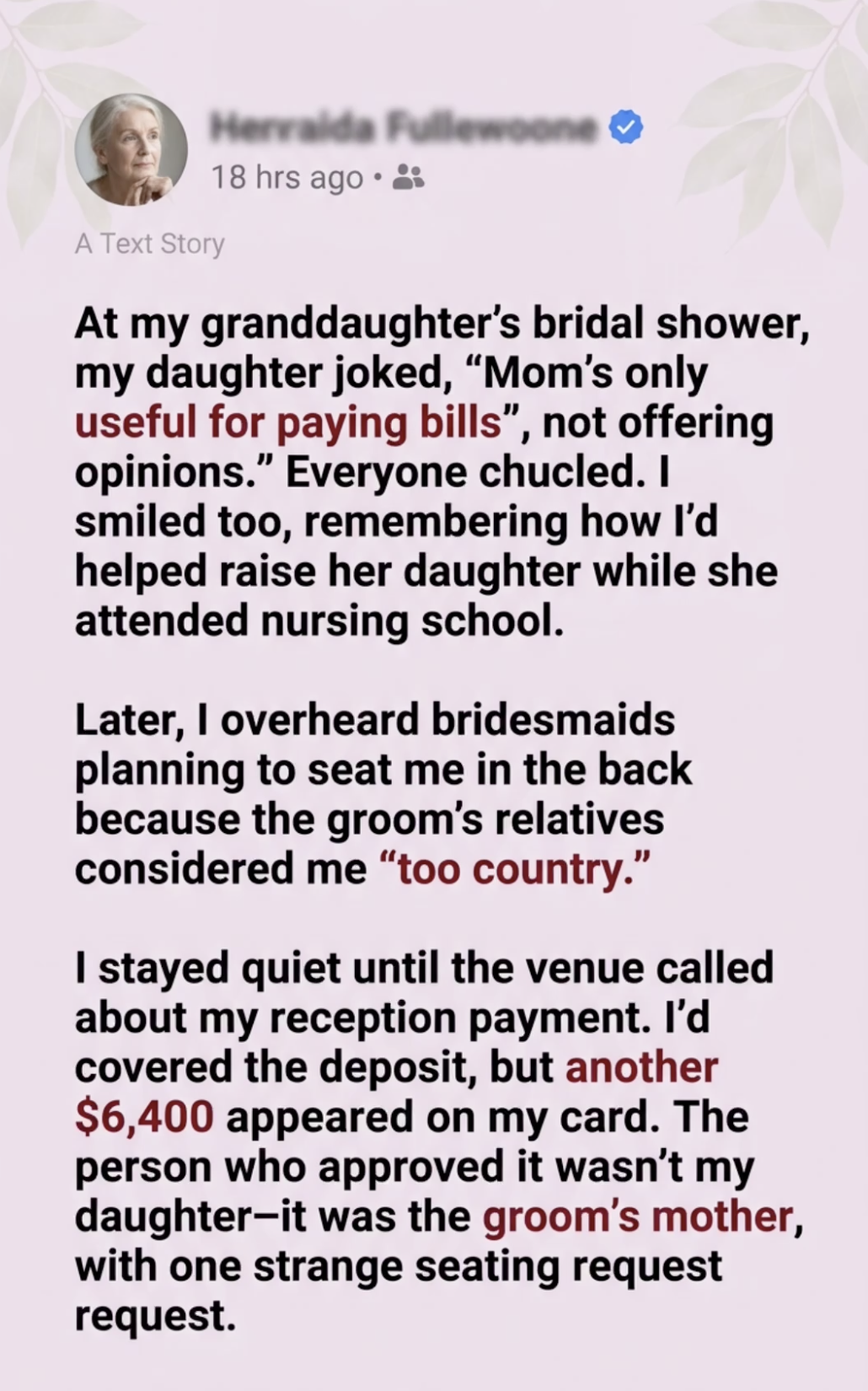
AT MY GRANDDAUGHTER’S BRIDAL SHOWER, MY DAUGHTER LAUGHED THAT I WAS ONLY GOOD FOR PAYING BILLS, NOT OFFERING OPINIONS—THEN I DISCOVERED THAT THE GROOM’S MOTHER HAD CHARGED AN EXTRA $6,400 TO MY CARD AND REQUESTED THAT I BE SEATED NEAR THE SERVICE ENTRANCE, SO I FINALLY DECIDED TO SHOW THEM THAT MY MONEY DID NOT BUY THEIR RIGHT TO HUMILIATE ME
My name is Margaret Bennett. I am sixty-eight years old, and until the afternoon of my granddaughter’s bridal shower, I believed I had finally earned a peaceful place in my family.
I was wrong.
The shower was held in a beautiful restaurant overlooking a small lake. White roses covered the tables, champagne glasses sparkled beneath the chandeliers, and a large sign behind the gift table read, “A Perfect Beginning for Emily and Jonathan.”
My granddaughter, Emily, was getting married in three weeks.
I had helped raise Emily from the time she was a little girl. When my daughter, Rachel, was attending nursing school, I was the one who picked Emily up from kindergarten, prepared her dinners, helped with her homework, and stayed beside her whenever she was sick.
I never complained.
I loved that little girl more than words could explain.
When Rachel graduated and began working at the hospital, I was already accustomed to being there whenever Emily needed someone. I paid for school supplies, dance lessons, summer camps, and eventually part of her college expenses.
I never expected repayment. I certainly never expected applause.
I only wanted my granddaughter to have opportunities that her mother and I had not always been able to afford.
So when Emily became engaged, I was genuinely happy.
I offered to contribute $5,000 toward the wedding reception. It was a generous amount for me, but I had saved carefully for years, and I wanted to help make her day special.
Rachel had thanked me at first.
Then, somehow, my contribution became something everyone felt entitled to.
At the bridal shower, I was sitting near the gift table when Rachel approached with two of her friends.
She looked at the expensive decorations and laughed.
“Mom, you really shouldn’t worry about the wedding details. You’re only useful for paying bills, not offering opinions.”
For a moment, I thought I had misunderstood her.
Then one of her friends laughed.
Another woman covered her mouth, trying not to smile.
Rachel laughed too.
I forced a small smile because I did not want to ruin Emily’s special day.
But inside, something tightened.
I remembered the nights I had stayed awake with Emily when she had a fever. I remembered driving across town after work because Rachel had called and said she couldn’t leave the hospital. I remembered buying Emily her first school uniform and holding her hand when she cried on her first day of kindergarten.
I remembered all those things.
And I wondered whether Rachel remembered any of them.
Emily noticed my expression and came over.
“Grandma, are you okay?”
“Of course, sweetheart,” I replied. “Today is about you.”
She hugged me and returned to her friends.
I told myself to let the comment go.
Unfortunately, it was not the last insult of the afternoon.
Later, I went looking for the restroom. As I walked down a hallway beside the private dining room, I heard several bridesmaids talking.
I recognized Rachel’s voice.
“We need to make sure Grandma doesn’t end up near the main family tables,” one of the bridesmaids said.
Another woman asked why.
Rachel lowered her voice, but I could still hear her.
“Jonathan’s relatives are particular about appearances. They think she’s too country. We should put her toward the back, somewhere near the service entrance. She won’t mind.”
Someone giggled.
Then another bridesmaid said, “But isn’t she paying for the reception?”
Rachel answered, “Exactly. She’s already helping. There’s no reason she needs to be involved in everything.”
I stood completely still.
The hallway suddenly felt cold.
I wanted to walk into that room and ask my daughter whether she had truly become someone who measured her own mother’s worth by the position of her dinner chair.
Instead, I quietly turned around.
I returned to the dining room, collected my handbag, and went home.
I did not tell Emily what I had heard.
I did not call Rachel.
I simply needed time to think.
Two days later, my phone rang.
It was the event coordinator from the hotel where the wedding reception would take place.
“Mrs. Bennett, I’m calling to confirm the additional payment of $6,400 that was recently authorized on your card.”
I frowned.
“Additional payment? I already paid the $5,000 deposit.”
“Yes, ma’am. The additional amount was approved yesterday. I wanted to make sure everything was correct before we finalized the arrangements.”
I sat down.
“I did not authorize another $6,400.”
There was a brief silence.
“I’m sorry, Mrs. Bennett. The authorization came through from Mrs. Eleanor Whitmore.”
Eleanor was Jonathan’s mother.
I knew her only slightly. She was a wealthy woman who spoke politely but always seemed to be evaluating everyone around her.
“Why was my card used?” I asked.
The coordinator explained that Eleanor had contacted the venue, claiming she was coordinating wedding expenses on my behalf. She had provided my payment information from the original reservation and requested that the additional charge be placed on the same card.
I felt my stomach tighten.
“Did she explain what the additional payment was for?”
“She requested an upgraded reception package, additional floral arrangements, and a private family dining area.”
I closed my eyes.
Then the coordinator added something that made my blood run cold.
“She also submitted a seating request. She asked that you be placed at a table near the service entrance, rather than with the immediate family.”
For several seconds, I could not speak.
The same woman whose family considered me too country had apparently decided that my money was welcome, but my presence at the family table was not.
I thanked the coordinator and asked her to send me the complete payment records, including the authorization details and all correspondence relating to the additional charge.
Then I called my bank.
I explained that I had not approved the transaction and requested that the disputed charge be investigated. I also asked them to block any further charges from the venue until the matter was resolved.
Next, I called Rachel.
She answered cheerfully.
“Hi, Mom! Everything okay?”
“Did you know Eleanor charged another $6,400 to my card?”
Silence.
Then she sighed.
“Mom, it’s for the wedding. Don’t make this difficult.”
“Did I authorize it?”
“Eleanor was handling the upgrades. She thought you’d be happy to help.”
“I offered $5,000. I did not offer another $6,400.”
Rachel sounded irritated.
“You always say family should help family.”
“Helping is a choice, Rachel. It is not permission for someone else to use my card.”
She lowered her voice.
“Mom, please don’t embarrass me. Jonathan’s family has certain standards. The upgrades are important.”
I stared out my kitchen window.
“Apparently, so is seating me near the service entrance.”
There was a pause.
“Who told you that?”
“The hotel called.”
Rachel exhaled sharply.
“It’s just a seating arrangement. You’re making it sound terrible.”
“Your daughter is getting married. I understand that the day is important. But I will not pay for a reception where people are discussing how to hide me.”
“Mom, that’s not what anyone meant.”
“Then tell me what they meant.”
Rachel had no answer.
I ended the call.
That evening, I received a message from Eleanor.
It read:
Margaret, I understand there has been some confusion about the reception arrangements. We simply want everything to look elegant and appropriate for the families involved. I hope you will understand that certain seating decisions are necessary to maintain the atmosphere.
I read it twice.
Then I replied:
I understand perfectly. Please do not use my card or make any further arrangements in my name. I will contact the venue directly.
I did not insult her.
I did not threaten her.
I simply made my decision.
The following morning, I visited the hotel in person.
The event coordinator, a kind woman named Susan, welcomed me into her office. She had printed every document related to the reception.
There it was.
My original $5,000 deposit.
The proposed additional $6,400 charge.
An email from Eleanor requesting the upgraded package and asking that I be seated near the service entrance.
And a note stating that I was a financial contributor rather than an immediate family host.
I read the note carefully.
Financial contributor.
Not grandmother.
Not the woman who had helped raise the bride.
Not family.
Just a source of money.
Susan looked uncomfortable.
“Mrs. Bennett, I apologize. We should have verified the additional authorization directly with you.”
“You are right,” I said. “I appreciate that you called.”
I requested that the additional charge be canceled and that no future payments be accepted without my direct written approval.
Then I asked whether my original $5,000 deposit could remain on the account.
Susan confirmed that it could.
I looked at the paperwork one last time.
“Please keep the original contribution for Emily’s reception. That was a gift I willingly offered. But I will not be responsible for anything beyond it.”
When I returned home, I found several missed calls from Rachel.
I also had a message from Emily.
Grandma, Mom says there’s a problem with the wedding payment. Please call me. I hope you’re okay.
I called her immediately.
“Grandma, what’s going on?” she asked.
I could hear the worry in her voice.
I took a deep breath.
“Sweetheart, I want you to enjoy your wedding. I don’t want you caught between your mother and me. But I need you to know that someone attempted to charge an additional $6,400 to my card without my permission.”
“What? Who?”
“Your future grandmother-in-law.”
Emily went quiet.
I explained the extra charge, the seating request, and the conversation I had overheard at the shower.
When I finished, Emily began crying.
“Grandma, I didn’t know. I swear I didn’t know they were planning that.”
“I believe you, sweetheart.”
“Why didn’t you tell me when it happened?”
“Because I didn’t want to take away your happiness. But I also cannot pretend that being treated this way doesn’t hurt.”
Emily sniffled.
“You’re supposed to sit beside me. You’re my grandmother. You helped raise me.”
Those words nearly broke my heart.
I had spent days wondering whether my granddaughter understood how much she meant to me.
Now I knew she did.
“Then I want you to make your own decision,” I told her. “Don’t choose a seat for me because you feel guilty. Choose it because you want me there.”
“I want you beside me,” she said immediately. “And I want to know why everyone thought they could treat you like that.”
I did not answer.
That was a conversation she needed to have with her mother and Jonathan.
The next afternoon, Rachel came to my house.
She did not knock gently. She rang the bell repeatedly until I opened the door.
“Mom, we need to fix this.”
I stepped aside and let her enter.
She placed her handbag on the kitchen table.
“Eleanor is furious. The hotel told her the extra charge was canceled.”
“Good.”
Rachel stared at me.
“You could have handled this privately.”
“I tried.”
“You’re making Jonathan’s family think we’re difficult.”
I looked at her.
“Rachel, did you think about what your mother would feel when you joked that she was only useful for paying bills?”
She looked away.
“Mom, I was joking.”
“And the bridesmaids discussing where to hide me?”
“That’s not what I said.”
“Then why did you tell them I wouldn’t mind sitting at the back?”
Rachel rubbed her forehead.
“You know how Eleanor is. She’s particular about appearances. She thought the family tables should be arranged a certain way.”
“And you agreed.”
Rachel did not respond.
I pulled out a chair and sat down.
“Let me ask you something. If I had never offered the $5,000, would you still have wanted me at the wedding?”
Her face changed.
“Of course.”
“Then why have I been treated as though my money matters more than my presence?”
“That’s not fair.”
“Neither was what you said at the shower.”
For the first time, Rachel looked genuinely uncomfortable.
She sat across from me.
“Mom, I know you’ve done a lot for Emily. I know you helped when I was in school. But sometimes you make me feel like I owe you everything.”
I looked at her for a long moment.
“I never asked you to owe me anything. I helped because I loved you both. But gratitude is not a debt, Rachel. And neither is respect.”
She lowered her eyes.
I continued.
“I am not asking you to put me above Jonathan’s family. I am not asking for special treatment. I am asking not to be humiliated in exchange for a wedding contribution.”
Rachel remained silent.
Then she whispered, “I didn’t think you’d take it this seriously.”
I almost laughed, but I was too tired.
“That’s the problem. You didn’t think about how it would make me feel at all.”
Before she left, I told her that my original $5,000 contribution would remain, but I would not pay any additional expenses. I also told her that I would not accept anyone using my card again.
She nodded, though she did not apologize.
Not yet.
Two days later, Jonathan called.
He sounded embarrassed.
“Mrs. Bennett, I owe you an apology.”
I listened.
He explained that he had recently learned about the extra charge and the seating request. Eleanor had told him that I had agreed to the upgrades and preferred a quieter table away from the main family area.
He had believed her.
“I should have checked with you,” he said. “I should never have assumed.”
“Thank you for saying that, Jonathan.”
He paused.
“Emily told me you helped raise her. I know how much you mean to her. I don’t want you to feel unwelcome at our wedding.”
“Then make sure she never has to feel that way either.”
“I will.”
He promised that he would speak with his mother.
The wedding day arrived three weeks later.
I wore a navy-blue dress, a pearl necklace my late husband had given me, and the small silver bracelet Emily had made for me when she was ten.
I arrived at the hotel fifteen minutes early.
The reception hall was beautiful. White flowers decorated the tables, soft music played in the background, and sunlight poured through the tall windows.
At the entrance, a staff member checked my name.
“Mrs. Bennett, your table is ready.”
I followed her inside.
My seat was not near the service entrance.
It was at the immediate family table, beside Emily’s place.
I looked toward the front.
Emily saw me and smiled so brightly that I forgot every hurtful thing that had happened.
She hurried over in her wedding dress and wrapped her arms around me.
“You came,” she whispered.
“Of course I came, sweetheart.”
She held my hands.
“I wanted you right beside me. I told them that myself.”
I kissed her forehead.
“Then that’s exactly where I belong.”
A few minutes later, Eleanor approached.
She was wearing an expensive silver dress and carrying a glass of champagne.
“Margaret,” she said, forcing a smile. “I hope we’re all past that little misunderstanding.”
I met her eyes.
“I hope so.”
She glanced toward my seat.
“I suppose the family arrangements worked out after all.”
“They did.”
Then she said something I never expected.
“I hope you understand that I was only trying to make the reception more elegant.”
I remained calm.
“Eleanor, elegance has very little to do with where someone sits. It has everything to do with how people are treated.”
Her smile disappeared.
Before she could respond, Jonathan approached.
“Mom, please. Not today.”
Eleanor turned toward him.
He continued, quietly but firmly.
“Margaret is Emily’s grandmother. She helped raise the woman I’m marrying. She belongs at this table. There should never have been any question about that.”
For the first time, Eleanor had nothing to say.
She walked away.
I did not feel victorious.
I felt relieved.
The ceremony was beautiful.
When Emily walked down the aisle, I cried. I remembered the little girl who used to fall asleep in my arms, the teenager who called me whenever she had a bad day, and the young woman who had once told me she wanted to become someone who helped others.
Now she was beginning a new chapter.
At the reception, Emily gave a short speech.
She thanked her parents, Jonathan’s family, her friends, and everyone who had helped make the wedding possible.
Then she looked directly at me.
“I also want to thank the woman who taught me what unconditional love looks like. When my mother was studying and working, my grandmother was there for me. She packed my lunches, helped with my homework, listened to my worries, and never made me feel like I was a burden.”
Her voice trembled.
“Grandma, I know I cannot repay everything you’ve done. But I hope you know that I will never forget it. You are not just someone who helped pay for this wedding. You are one of the reasons I became the person standing here today.”
The room applauded.
I covered my mouth as tears rolled down my cheeks.
Rachel was sitting nearby.
She looked at me, and for a moment I saw the little girl I had raised.
After dinner, she approached my table.
“Mom,” she said softly. “Can we talk?”
I nodded.
She sat beside me.
“I owe you an apology.”
I waited.
“I shouldn’t have said what I said at the shower. And I shouldn’t have allowed anyone to treat you as though you were less important because you didn’t come from the same background as Jonathan’s family.”
Her eyes filled with tears.
“I was trying so hard to impress Eleanor that I stopped thinking about the person who had always been there for me.”
I took her hand.
“I don’t need you to impress anyone, Rachel. I need you to remember who you are and where you came from.”
She nodded.
“I know.”
I did not pretend that one apology erased everything. Trust takes time, and respect must be demonstrated through actions.
But I accepted her apology.
That evening, I danced with Emily.
She rested her head against my shoulder, just as she used to when she was a little girl.
“Grandma,” she whispered, “thank you for never giving up on me.”
I smiled.
“That’s what grandmothers do.”
When I returned home, I placed the silver bracelet on my bedside table and sat quietly for a while.
I thought about the $5,000 I had offered, the $6,400 someone had tried to charge without permission, and the chair near the service entrance where they had planned to hide me.
But those things no longer mattered as much as they once had.
I had learned something important.
Being generous does not mean allowing people to take advantage of you. Being a loving mother does not mean accepting every insult. And being a grandmother does not mean your worth is measured by how much money you can contribute.
I had helped raise my granddaughter because I loved her.
I had paid toward her wedding because I wanted to celebrate her happiness.
But I had also learned that I could say no without becoming a bad mother, a bad grandmother, or a selfish person.
A few weeks later, Emily sent me a photograph from the wedding.
It showed the two of us dancing beneath the lights.
She had written beneath it:
My favorite person. My grandmother. My home.
I printed the photograph and placed it beside one of my late husband.
And whenever I looked at it, I remembered that afternoon at the bridal shower.
I remembered the laughter.
I remembered the humiliation.
But most importantly, I remembered the moment I stopped smiling just to make everyone else comfortable.
I had spent much of my life making sure the people I loved had everything they needed.
It was finally time to make sure I did not disappear while doing it.
Because I was never just the woman who paid the bills.
I was the woman who helped build the family sitting around that table.
And I deserved a place there—not because of what I could afford, but because of who I was.