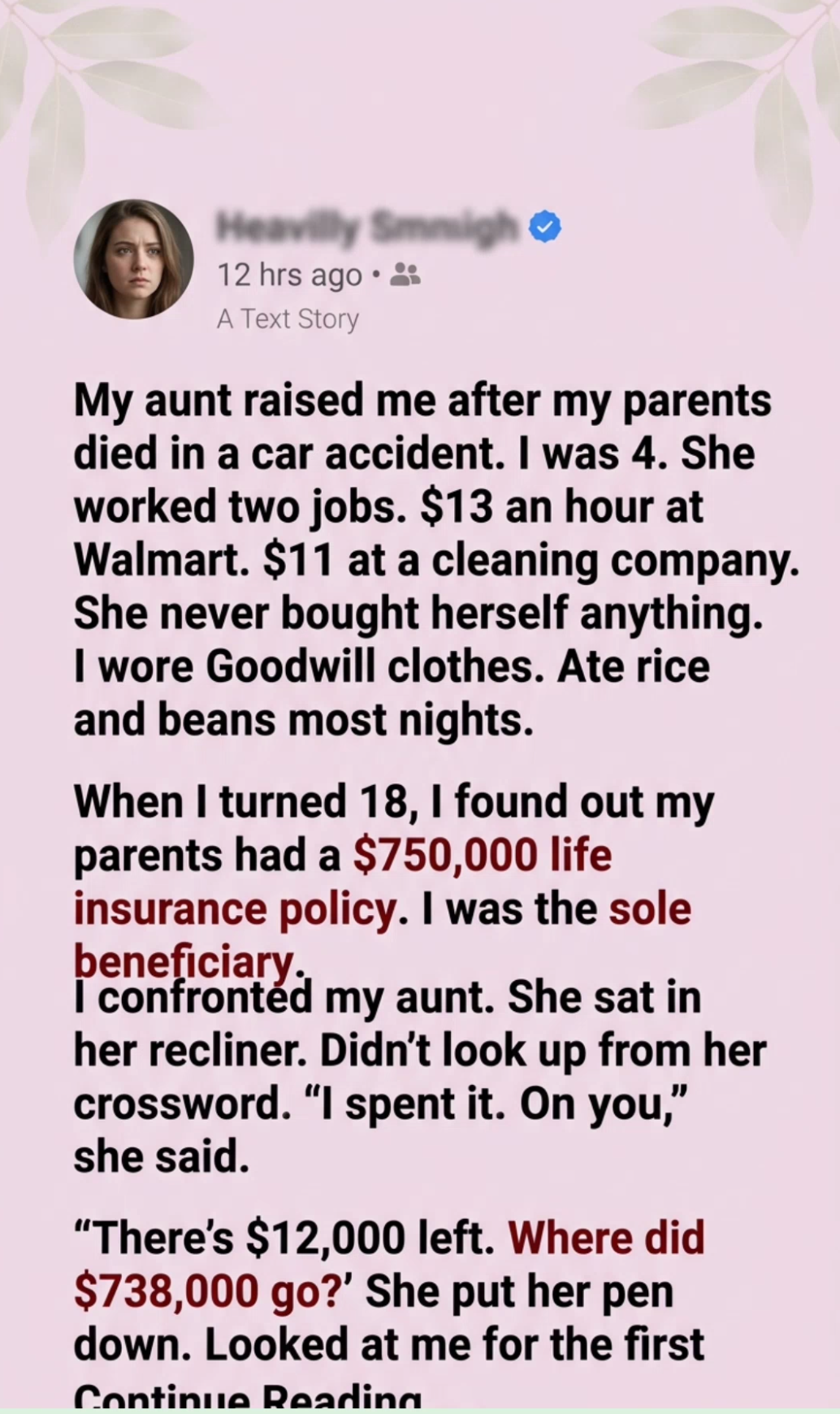
My aunt raised me after my parents died.
I was four years old when the accident happened.
One rainy evening, my mother and father were driving home from visiting my grandparents when a truck crossed the center line. The collision happened so quickly that neither of them survived.
I don’t remember the accident.
I remember the funeral.
I remember standing beside my aunt Margaret, holding two of her fingers because my little hand couldn’t wrap around her entire palm. I remember people crying, flowers everywhere, and adults speaking in whispers as though I might break if they used normal voices.
My aunt was only thirty-one.
She had no children of her own, no husband, and no savings worth mentioning. She lived in a small two-bedroom rental house and worked at Walmart.
But when the social worker asked who would take me, Aunt Margaret didn’t hesitate.
“She’s coming home with me,” she said.
That was how my childhood began.
It wasn’t an easy childhood.
My aunt worked two jobs.
During the day, she worked at Walmart for thirteen dollars an hour. In the evenings, she cleaned offices for eleven dollars an hour. Sometimes she worked weekends, too.
She left before I woke up and returned after I had gone to bed.
When I was old enough to understand money, I learned that we didn’t have much.
My clothes came from Goodwill. My shoes were usually a little too big because she wanted them to last. We ate rice and beans, pasta, canned vegetables, and whatever was on sale.
Birthdays were small.
Christmas was usually one present.
If I needed school supplies, she bought them. If I needed medicine, she found a way. If I wanted something expensive, she would smile and say, “Maybe next year, sweetheart.”
But I never felt unloved.
She attended every school meeting she could. She learned how to braid my hair by watching videos at the library. She made pancakes on Sunday mornings whenever she wasn’t working.
When I had nightmares about my parents, she sat beside my bed until I fell asleep.
She never called herself my mother.
But she was the person who raised me.
For fourteen years, I believed our financial struggles were simply the result of two people dying too young and leaving a little girl behind.
Then I turned eighteen.
And everything changed.
It happened because of a letter.
I had received a scholarship to a state university, but I still needed help paying for housing, books, and other expenses.
Aunt Margaret encouraged me to apply for every grant and financial aid program available.
One afternoon, while gathering paperwork, I found an old envelope among the documents she had kept from my parents.
It contained a letter from an insurance company.
I almost ignored it.
Then I noticed my father’s name.
The document stated that my parents had purchased a life insurance policy worth $750,000.
The sole beneficiary was me.
I read it three times.
Seven hundred and fifty thousand dollars.
I had spent my childhood wearing secondhand clothes, eating inexpensive dinners, and watching my aunt work herself exhausted.
Yet there had apparently been enough money to provide for me.
I checked the date.
The policy had been paid after my parents’ deaths.
I searched through the papers and found another document showing that the insurance company had issued payment to the designated custodian for my benefit.
The custodian was my aunt.
I couldn’t understand it.
I looked at the paperwork again.
Then I called the insurance company.
After verifying my identity and answering several security questions, I was told that the policy had been paid in full.
The representative couldn’t discuss every transaction over the phone, but she confirmed the amount and explained that the funds had been placed under an arrangement managed by my aunt while I was a minor.
I thanked her and hung up.
My hands were shaking.
That evening, Aunt Margaret was sitting in her recliner, working on her crossword puzzle.
The television was on quietly.
I walked into the living room holding the insurance documents.
“Did my parents have a life insurance policy?”
She didn’t look up.
“Yes.”
“Was it worth seven hundred and fifty thousand dollars?”
Her pen stopped.
She remained still for a moment.
Then she said, “Yes.”
I felt my throat tighten.
“Why didn’t you tell me?”
She returned to the crossword.
“I didn’t think you needed to worry about it when you were a child.”
“Where is it?”
She put the newspaper down.
“Most of it is gone.”
I stared at her.
“What do you mean, gone?”
She sat back in her recliner.
“I spent it. On you.”
I felt my face grow hot.
“There’s twelve thousand dollars left. Where did the other seven hundred and thirty-eight thousand go?”
She didn’t answer immediately.
I had expected her to become defensive. I had expected excuses. I had even prepared myself for an argument.
Instead, she looked at me with an expression I had never seen before.
It wasn’t anger.
It was exhaustion.
She put her pen down.
Then she said:
“Before you decide I stole from you, you need to hear what your parents asked me to do.”
I pulled a chair closer.
“Then explain.”
She folded her hands.
“Your parents knew they were going to have a baby. They had been talking about the future for months. Your father was worried because his job wasn’t secure, and your mother had just found out she was pregnant. They wanted to make sure you would be protected if something happened to them.”
She paused.
“They bought the policy because they wanted you to have a future. But they also made arrangements for the money to be managed by someone they trusted.”
“That was you?”
She nodded.
“Your mother asked me to promise that I would never let you feel like an obligation. She wanted you to have a home, an education, and a chance to grow up without being frightened about money.”
I looked at the papers.
“That doesn’t explain where the money went.”
“I know.”
She stood up slowly and walked to the small filing cabinet beside the television.
She opened the bottom drawer and removed a thick folder.
It was labeled with my name.
She placed it on the coffee table.
Inside were bank statements, receipts, tuition records, medical bills, housing documents, and handwritten notes.
I started looking through them.
The first major expense was the house.
My aunt had used part of the insurance money to purchase the small house where we lived.
I had always thought she rented it.
She explained that she had bought it because my parents had wanted me to have a stable home. The house had been inexpensive, needed repairs, and was located in a modest neighborhood.
She had paid for the roof, plumbing, heating system, and electrical work over the years.
Then I found the next set of records.
Medical expenses.
When I was seven, I had developed a serious infection that required hospitalization and follow-up treatment. My aunt had used the insurance funds to pay the bills and cover expenses while she took time off work.
When I was nine, I needed surgery to correct a problem that had affected my hearing.
More bills.
More payments.
More receipts.
I remembered those years.
I remembered being in a hospital bed while my aunt slept in a chair beside me.
I remembered her bringing me a stuffed rabbit.
I remembered her telling me everything would be okay.
I hadn’t known what those moments had cost.
I turned another page.
School expenses.
Tutoring.
Summer programs.
A computer for high school.
College savings.
There were also records of money placed into accounts for my education.
Some had been used when I needed them. Some had been moved into investments. Some had lost value during difficult financial years.
I looked up.
“Why did you keep working two jobs if there was all this money?”
My aunt gave a small, sad smile.
“Because I didn’t want to use your future money to pay for my everyday life.”
I didn’t understand.
She sat down across from me.
“Your parents left that money for you. I was responsible for making it last. I used it for things that protected you, but I didn’t believe I had the right to spend it on my own comfort.”
“But you could have bought better groceries. Better clothes. You could have stopped working nights.”
“I could have.”
“Then why didn’t you?”
She looked toward the window.
“Because I was afraid.”
“Of what?”
“Of making one mistake that would leave you with nothing.”
She explained that when the money first arrived, she was terrified of mishandling it.
She had never managed a large amount of money before. She was unfamiliar with investments, trusts, and estate planning.
She had sought legal advice and financial assistance, but the arrangement had not been as straightforward as she expected.
Some money had gone toward taxes, legal fees, property expenses, and medical costs. Some had been invested conservatively. Some had been used for my education and everyday care.
She admitted that she had made mistakes.
There had been years when she withdrew more than she should have because she was trying to provide everything I needed.
There had also been unexpected repairs and expenses that she hadn’t planned for.
And she had kept the entire situation from me.
“Why didn’t you tell me when I was older?” I asked.
She looked directly at me.
“Because every time I thought about telling you, I imagined you looking at me the way you’re looking at me now.”
I looked down.
She continued.
“I knew you would ask why we lived so simply. I knew you might wonder why you had worn donated clothes when there was money available. I was afraid you would think I had deprived you.”
I swallowed.
“I did have to wear donated clothes.”
“I know.”
“We ate rice and beans almost every night.”
“I know.”
“You worked yourself sick.”
Her eyes filled with tears.
“I know, sweetheart.”
For the first time, I noticed how thin her hands looked.
There were small scars across her fingers from years of cleaning chemicals and manual work. Her shoulders were rounded, and she moved more slowly than I remembered.
I had been so focused on the money that I hadn’t considered what those years had done to her.
But there was still something I needed to know.
“Is there really twelve thousand dollars left?”
She nodded.
“That’s what remains in the account I manage for you.”
“Can I see the statements?”
“Yes. Every one.”
“All of them?”
“Every one.”
I spent the next several days reviewing the records.
I didn’t want to accuse my aunt unfairly.
But I also knew that a large amount of money had been managed on my behalf, and I had a right to understand it.
I arranged a meeting with an independent financial adviser and an attorney who specialized in trusts and estates.
They reviewed the documents.
The records showed that most of the money had been used for my housing, medical care, education, and related expenses.
There were legitimate questions about the way some withdrawals had been documented, and the original arrangement had not been professionally structured as well as it should have been.
But the review did not uncover evidence that my aunt had secretly transferred hundreds of thousands of dollars into her own accounts or purchased luxury items for herself.
In fact, her own financial records showed that she had continued living on her modest wages.
The attorney explained that because I was now eighteen, I could obtain further information about the arrangement and determine how the remaining funds should be managed, subject to the original legal documents and applicable rules.
I asked for a complete accounting.
My aunt agreed.
She never argued.
She never tried to stop me.
That mattered.
A week later, I found something that made me cry harder than the financial records had.
It was a small notebook.
The pages were filled with my aunt’s handwriting.
The first entry was dated the week she brought me home.
She cried for her mother tonight. I held her until she fell asleep. I don’t know how to be a parent, but I promised her mother I would try.
Another entry, written two years later:
She asked why she doesn’t have a father like the other children. I told her that her father loved her more than anything. I hope she remembers that.
Another:
She needs new shoes. The old ones are hurting her feet. I will pick up an extra cleaning shift this weekend.
Another:
She got an A on her science project. She was so proud. I wanted to buy her the bicycle she has been asking for, but the roof repair was more important. I hope she understands someday.
I kept turning the pages.
There were entries about school concerts, birthdays, illnesses, arguments, and small victories.
One entry from when I was twelve made me stop.
She told me she wants to become a doctor because she wants to help children who are sick. I told her she could become anything she wanted. I hope the money her parents left will give her the opportunity to do it.
Then, near the end, I found an entry written when I was sixteen.
I sometimes wonder whether I made the right choices. I could have bought a better car. I could have taken a vacation. I could have made my own life easier. But when I see her sleeping safely in her room, I remember why I made those decisions. I promised her parents she would never have to wonder whether someone would come home for her.
I closed the notebook.
I cried for a long time.
Not because the money had disappeared.
Not because my childhood had been difficult.
Because I finally understood how much of my aunt’s life had been spent making sure I never felt abandoned.
But I also understood something else.
Love didn’t excuse poor financial transparency.
She should have told me.
I deserved to know about the money and the decisions made in my name.
And she deserved to be able to explain without fearing that I would immediately see her as a thief.
A few days later, I sat with her at the kitchen table.
“I want to talk about the twelve thousand dollars,” I said.
She nodded.
“I think we should put it somewhere safe for my education. I also want the remaining records organized so I know exactly what happened.”
“That’s fair.”
“And I want you to stop working two jobs.”
She looked at me.
“What?”
“You heard me.”
She shook her head.
“I can’t just stop working.”
“Why not?”
“Because I need to support myself.”
“You have supported me for fourteen years. Let me help you now.”
She started to protest, but I interrupted gently.
“I’m not asking you to take money that isn’t yours. I’m asking you to let me use part of what remains, with proper legal advice, to help cover the household expenses while I finish school. I want you to have a little breathing room.”
She stared at me.
Then she began crying.
“I never wanted you to feel like you owed me.”
“I don’t owe you because you raised me. I want to help because I love you.”
She reached across the table and held my hand.
For the first time since I discovered the policy, neither of us was talking about money.
We were talking about family.
Over the next few months, I worked with the attorney and financial adviser to organize the remaining funds and establish a clearer plan for my education and future expenses.
I enrolled in college.
I chose nursing rather than medicine because I discovered that I loved working directly with patients and families.
My aunt attended my first college orientation.
She wore the same old blue cardigan she had worn to my high school graduation.
I bought her a new one.
She refused it at first.
“Margaret,” I told her, “you are allowed to own something nice.”
She laughed.
“Don’t start spending your entire future on me.”
I smiled.
“I’m not. I’m just buying you a cardigan.”
She finally accepted it.
The following Christmas, I gave her another gift.
It was a framed photograph of my parents.
I had found it in the old family albums. They were standing together in front of a small house, smiling at the camera.
Underneath the photograph, I had placed a handwritten note.
Thank you for keeping your promise.
My aunt read it and covered her mouth.
Then she hugged me.
“I wish they could see you now,” she whispered.
I hugged her tighter.
“Me too.”
Years later, when I graduated, my aunt sat in the front row.
She cried before they even called my name.
After the ceremony, I handed her my diploma to hold while we took photographs.
She looked at it as if it were something priceless.
“You did this,” I told her.
She shook her head.
“No, sweetheart. You did.”
I smiled.
“We both did.”
And I meant it.
I never forgot the $750,000.
I never forgot that I had been entitled to know how it was managed.
But I also never forgot the woman who worked two jobs, wore the same shoes for years, and came home exhausted every night because a four-year-old girl had lost both her parents.
She hadn’t been perfect.
She had made mistakes.
She should have been more transparent.
But she had never treated me like a burden.
And that mattered more than I could explain.
Today, I still have the notebook she kept.
Sometimes I read it when I miss my parents.
Sometimes I read it when I need to remember where I came from.
And sometimes I read the entry from the night she first brought me home.
I don’t know how to be a parent, but I promised her mother I would try.
She didn’t just try.
She showed up every morning.
She worked every shift.
She made every sacrifice.
She stayed.
And when I finally understood what she had given up, I realized that the greatest thing my parents left me wasn’t the life insurance policy.
It was the sister they trusted to raise their daughter.
The money helped pay for my future, but my aunt gave me something no insurance policy could ever buy: fourteen years of being loved by someone who never once had to be my mother, but chose to be my family anyway.