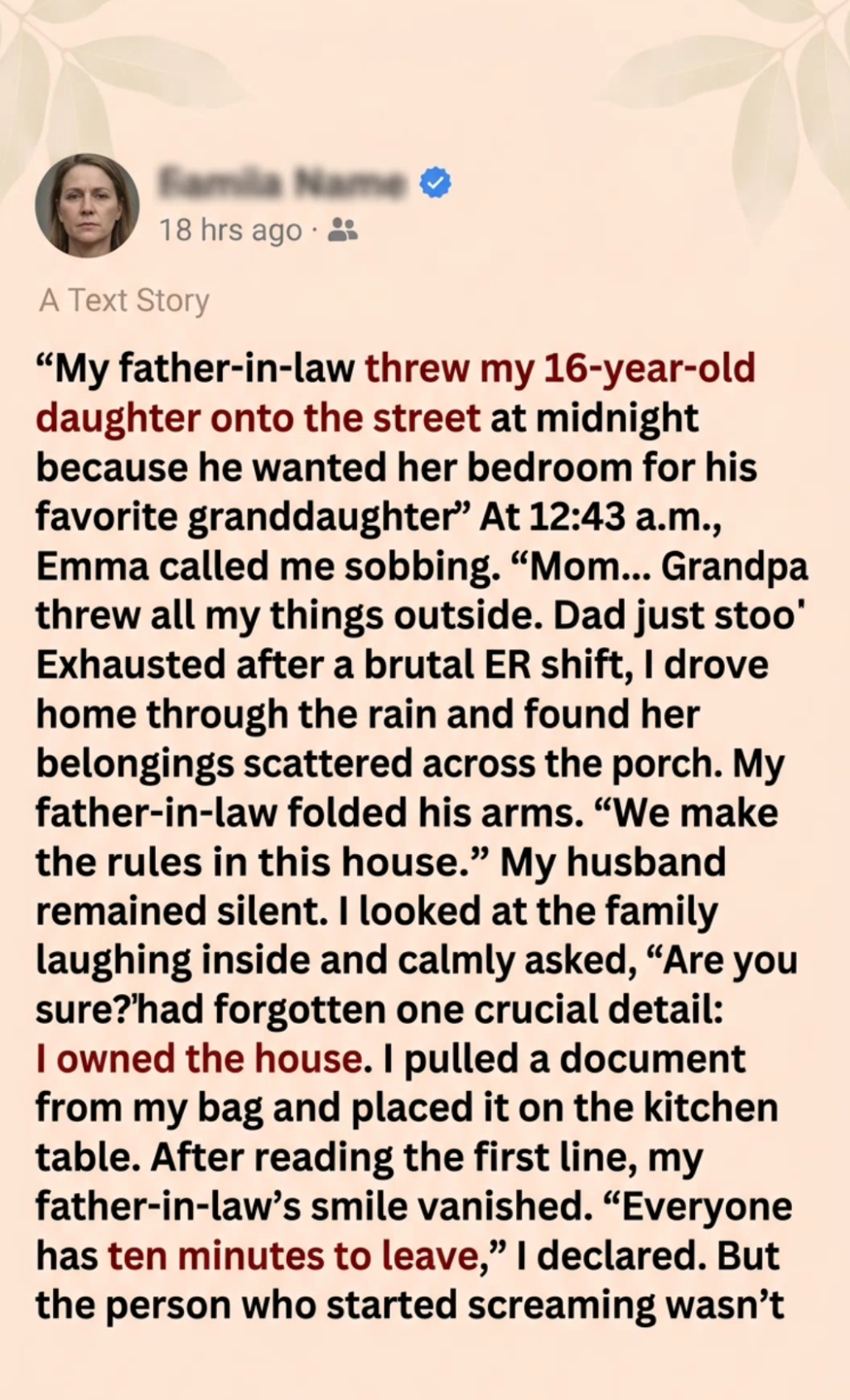
At 12:43 a.m., my sixteen-year-old daughter called me crying so hard I could barely understand her.
“Mom…” Emma whispered. “Grandpa threw all my things outside. Dad just stood there.”
For a moment, I couldn’t breathe.
I was sitting in the break room of the emergency department, still wearing my hospital scrubs after a brutal twelve-hour shift. My feet hurt, my back ached, and I had just finished documenting the final patient of the night.
But none of that mattered anymore.
“Where are you, sweetheart?”
“On the porch. It’s raining.”
“Are you hurt?”
“No. But… Mom, my school things are getting wet.”
I stood up so quickly that my chair scraped against the floor.
“Listen to me. Stay somewhere safe. Don’t argue with anyone. I’m coming home.”
Then I hung up.
My name is Rebecca Collins. I was forty-one years old, a registered emergency nurse, and the mother of one remarkable girl.
Emma was sixteen, quiet around strangers, funny around people she trusted, and determined to become a veterinarian. She loved animals, kept a collection of secondhand books beside her bed, and spent hours drawing pictures of dogs she hoped to rescue one day.
She had never been a difficult child.
She had never demanded expensive clothes or complained about sharing responsibilities.
And that night, someone had decided she no longer deserved a bedroom in her own home.
Someone had decided that my daughter could be thrown into the rain because another child wanted her room.
I drove home through the storm with both hands gripping the steering wheel.
My father-in-law, Harold Bennett, had been staying with us for nearly eight months. He was seventy-two, retired, and had recently sold his house after deciding that living alone was becoming inconvenient.
My husband, Michael, had suggested that his father move in temporarily.
“Just until he gets settled,” he had promised.
I agreed because I believed family should help one another.
At the time, I had no idea that eight months of temporary help would turn into eight months of control.
Harold had opinions about everything.
He complained when Emma played music while doing homework. He criticized the food I cooked. He rearranged the kitchen cupboards and told me I was wasting electricity if I left a light on.
At first, I ignored him.
Then he began treating Emma differently from everyone else.
His favorite granddaughter was Chloe, Michael’s older brother’s sixteen-year-old daughter.
Chloe was pretty, confident, and accustomed to getting what she wanted. Whenever she visited, Harold treated her like royalty.
He bought her expensive gifts, ordered food specifically for her, and praised everything she did.
Emma received criticism for things Chloe was praised for.
If Chloe left her shoes in the hallway, Harold laughed.
If Emma left a schoolbag near the stairs, he called her irresponsible.
If Chloe spoke loudly, she was confident.
If Emma disagreed with him, she was disrespectful.
I had confronted him several times.
“Harold, both girls deserve the same respect.”
He always gave me the same answer.
“You’re too sensitive, Rebecca. Chloe is family.”
I never understood why he said that as if Emma wasn’t.
Emma was my daughter from my first marriage. Her biological father had died when she was nine. Michael had entered her life two years later, and for a long time, he had been a loving stepfather.
He attended her school events, helped her with mathematics, and taught her how to ride a bicycle.
But after Harold moved in, Michael slowly changed.
He stopped correcting his father.
He began saying things like, “Just let it go, Emma. Grandpa is old.”
And whenever I defended her, he accused me of creating unnecessary tension.
I had hoped it was temporary.
That night proved how wrong I had been.
When I arrived home, it was 1:08 a.m.
The rain was still falling.
Emma was sitting on the porch steps, wrapped in a thin jacket. Her hair was wet, and her cheeks were swollen from crying.
Around her were pieces of her life.
Her schoolbooks lay in a puddle near the driveway. Her clothes had been shoved into plastic bags. Her desk lamp was broken. Her favorite blanket was lying on the wet grass.
A cardboard box had split open, scattering photographs across the porch.
I recognized one immediately.
It was a picture of Emma and her father at the beach, taken before he died.
I picked it up carefully.
The photograph was soaked.
Emma began crying again.
“I’m sorry, Mom.”
I turned toward her.
“Why are you apologizing?”
“I didn’t want to make Grandpa angry.”
I knelt in front of her and held her shoulders.
“Emma, listen to me. You did nothing wrong. Nothing.”
She buried her face against my shoulder.
I held her there for several seconds before helping her stand.
Then I looked through the front window.
Harold was sitting in the living room with Chloe and her father, Daniel. They were laughing over something on a phone.
Michael was standing near the fireplace.
He saw me.
He didn’t come outside.
I walked to the front door and opened it.
Harold looked up.
“Oh, Rebecca. You’re home.”
His voice was as casual as if he had simply moved a chair.
I stepped inside.
“Why is my daughter outside?”
Harold folded his arms.
“Because we needed to make some changes.”
“What changes?”
“Chloe is staying here for a while. She needs a proper room. Emma’s room is bigger, so we decided to give it to her.”
I stared at him.
“You decided?”
“Yes. We make the rules in this house.”
I looked at Michael.
He lowered his eyes.
“Michael?”
He rubbed his forehead.
“Rebecca, please. It’s late. We can talk about this tomorrow.”
I couldn’t believe what I was hearing.
“Tomorrow? Your sixteen-year-old stepdaughter is sitting outside in the rain, and you want to talk tomorrow?”
“She’s not homeless,” Harold interrupted. “She can sleep somewhere else tonight.”
“Where?”
Nobody answered.
Chloe looked uncomfortable for a moment, but Daniel quickly whispered something to her.
Harold continued.
“Emma has had that room long enough. Chloe is family, and she needs more space. Emma can use the small storage room downstairs once we clear it.”
I looked at the man.
He had just thrown a child out of her bedroom in the middle of the night, and he was explaining it as if he had rearranged furniture.
Then I noticed something.
The bedroom door was open.
Emma’s mattress had already been removed. Chloe’s luggage was sitting inside. Her new pink bedding had been spread across the bed.
This hadn’t been a sudden argument.
They had planned it.
They had waited until I was working a night shift.
They had removed my daughter’s belongings while she was home alone.
And my husband had allowed it.
I slowly turned toward Michael.
“Did you know about this?”
He hesitated.
“I knew Dad wanted to move Chloe into Emma’s room.”
“When?”
“Earlier this evening.”
“And you said nothing?”
“I thought we could work it out.”
I looked at the wet clothes visible through the open door.
“Is this what working it out looks like?”
He said nothing.
Harold gave an impatient sigh.
“Rebecca, don’t turn this into a dramatic situation. We are trying to keep the family comfortable.”
I looked at the people sitting comfortably in my living room.
Then I looked at my daughter outside.
For the first time that night, I felt completely calm.
“Are you sure?” I asked.
Harold frowned.
“Am I sure about what?”
“Are you sure you want to make rules in this house?”
He laughed.
“Don’t threaten me. I’ve been part of this family longer than you.”
I reached into my work bag and pulled out a thick document folder.
Then I walked to the kitchen table.
“Good,” I said. “Then you should have no trouble understanding this.”
I placed the folder in front of him.
Harold opened it with an irritated expression.
The first page was a certified property ownership record.
The address was ours.
The owner was Rebecca Collins.
Not Michael.
Not Harold.
Me.
Harold’s eyes moved across the page.
His smile disappeared.
He turned to the next document.
It was the purchase agreement from seven years earlier, when I had bought the house using money from the sale of the apartment I had owned before marrying Michael, together with my personal savings.
The title had been registered solely in my name.
Michael had known this from the beginning.
We had discussed it before moving in.
I had bought the house before our marriage, and I had deliberately kept the property separate. Michael had agreed that this was reasonable because Emma needed a stable home after losing her father.
The third document was a written occupancy agreement.
Harold had signed it when he moved in.
It stated that he was staying as a temporary guest, that he had no ownership interest in the property, and that he could not transfer rooms or grant occupancy rights to anyone else without my permission.
He had signed every page.
He had even initialed the paragraph explaining that his permission to stay could be withdrawn under the terms of the agreement.
Harold stared at the signature.
“What’s this supposed to mean?”
“It means you are not the owner.”
He looked at Michael.
“You told me this was your house.”
Michael’s face turned pale.
“I never said that.”
“Don’t lie to me!”
I interrupted.
“Nobody is lying. You simply never bothered to ask who legally owned the property.”
Daniel stood up.
“Rebecca, this is ridiculous. We’re all family.”
I turned toward him.
“Your daughter is welcome here when she is invited. But she is not entitled to take another child’s bedroom.”
“She’s only staying for a while.”
“Then she can stay in the guest room, which is exactly what we originally offered.”
Chloe looked at her father.
“Uncle Michael said I could have Emma’s room.”
I turned toward Michael.
He looked as if he wanted the floor to swallow him.
“Is that true?”
He finally answered.
“I thought Dad would talk to Emma.”
“Talk to her? Or wait until I was at work and put her belongings outside?”
He didn’t answer.
Harold pushed the documents away.
“These papers don’t change anything. I’m Michael’s father. I have a right to make decisions for my family.”
I looked directly at him.
“You have a right to your opinions. You do not have a right to throw my child into the rain.”
Then I opened the folder again and removed the final page.
It was a formal written notice ending his permission to occupy the property, prepared earlier that evening after I had learned from Emma’s messages that Harold was threatening to remove her from her room.
I had not expected the situation to become this extreme.
But I had already decided that his behavior could no longer continue.
The notice gave the relevant reasons and stated that he needed to leave according to the applicable legal process and the terms of his agreement.
I placed it in front of him.
“Your permission to stay here is over. You will need to make arrangements to leave.”
Harold’s face reddened.
“You can’t throw me out!”
“I can withdraw permission for you to stay, but I will follow the legal process. I won’t do anything outside the law.”
He slammed his hand against the table.
“After everything I’ve done for this family!”
I looked at the wet schoolbooks visible through the doorway.
“Tell me exactly what you’ve done for my daughter tonight.”
He had no answer.
I glanced at the clock.
“Everyone has ten minutes to stop arguing and begin making arrangements. Nobody is touching Emma’s belongings again.”
Harold jumped to his feet.
But the person who started screaming wasn’t him.
It was my husband.
“YOU CAN’T DO THIS TO MY FATHER!”
Michael’s voice echoed through the house.
I turned toward him.
He was pointing at the documents as if they had personally insulted him.
“He’s seventy-two years old! Where is he supposed to go?”
I stared at him.
“Where did you think Emma was supposed to go?”
He opened his mouth, then closed it.
I continued.
“You were standing here when your father put your stepdaughter’s belongings outside. You watched her stand in the rain. You knew she had nowhere else to go at one in the morning.”
“Rebecca, I was trying to avoid an argument.”
“You avoided an argument with your father by sacrificing your daughter.”
Michael flinched.
“She’s not my daughter.”
The room went silent.
Even Harold stopped talking.
Michael seemed to realize what he had said only after the words left his mouth.
Emma was standing in the hallway.
She had come inside when she heard the shouting.
Her face was pale.
She looked at Michael.
Then she quietly said, “I thought you were.”
My heart broke.
Michael took a step toward her.
“Emma, I didn’t mean—”
She stepped back.
“That’s okay.”
It wasn’t okay.
We all knew it.
But Emma had spent years trying not to make Michael uncomfortable.
She had learned to apologize when she was hurt, to become quiet when someone criticized her, and to pretend she didn’t care when she was treated differently.
I was done allowing that.
I took her hand.
“Go upstairs with me, sweetheart. We’ll get you warm clothes.”
Harold blocked the hallway.
“Nobody is going anywhere until we finish this discussion.”
I stopped.
“Move.”
He looked surprised.
“Excuse me?”
“Move away from my daughter.”
For a moment, I thought he might refuse.
Then Daniel pulled him aside.
Emma and I walked upstairs.
I found a dry sweatshirt and warm trousers in my bedroom. I wrapped her in a blanket and made her sit on the bed.
She stared at her hands.
“Mom, are you going to divorce Michael?”
I sat beside her.
“I don’t know yet.”
“Because of me?”
I turned her face gently toward mine.
“No. Listen carefully. If a marriage ends because one person refuses to protect a child, the child is not responsible for that marriage ending.”
Emma swallowed.
“I don’t want you to be alone.”
I hugged her.
“I’m not alone. I have you. And you have me. But you should never have to earn your place in a home by making everyone else happy.”
She began to cry again.
This time, I let her cry.
When we returned downstairs, the situation had changed.
Harold was pacing.
Daniel was on his phone.
Chloe was standing near the staircase, looking embarrassed.
Michael sat at the kitchen table with his head in his hands.
I spoke to Daniel first.
“Your daughter can stay tonight in the guest room if she wants. Emma’s room is Emma’s room. Tomorrow, we can discuss a reasonable arrangement if everyone is respectful.”
Daniel nodded slowly.
“I didn’t know your father had thrown Emma’s things outside.”
I looked at him.
“You were sitting here while she was outside.”
He lowered his eyes.
“I thought she was just moving her things.”
“At midnight? In the rain?”
He didn’t answer.
Chloe finally spoke.
“I didn’t ask Grandpa to put her things outside.”
I looked at her.
“Then you should have said something.”
She glanced at Emma.
“I’m sorry.”
Emma gave a small nod.
Chloe looked down.
“I just wanted a bigger room.”
“I understand wanting something,” I said. “But wanting something doesn’t mean someone else should lose what they already have.”
For the first time that night, Harold seemed to understand that the entire room was no longer on his side.
He picked up the notice and waved it at me.
“This is a family matter. You can’t use legal papers to settle family matters.”
I answered quietly.
“Family matters are exactly why I should never have needed legal papers to protect my child.”
He dropped the notice.
Then he started shouting about betrayal, disrespect, and how modern women had forgotten their responsibilities.
I didn’t argue.
I called a local lawyer I had consulted earlier that evening. He explained the next steps and confirmed that I needed to handle Harold’s departure through the proper legal process rather than attempting to force him out immediately.
So I did.
Harold was allowed to remain temporarily while arrangements were made, but his access to the bedrooms and his authority over Emma ended that night.
I also documented the damage to Emma’s belongings and photographed everything.
The following morning, I arranged for her books and clothes to be cleaned and replaced what could not be repaired.
Her bedroom was restored to her.
Chloe moved into the guest room for the remainder of her planned visit.
Harold refused to speak to me.
That was fine.
Silence was the first peaceful thing he had given us in months.
The next few days were difficult.
Michael tried to convince me that the situation had gone too far.
He said his father was old.
He said Chloe had been excited.
He said Emma could have handled the situation better.
Every explanation somehow ended with Emma being expected to forgive the people who had hurt her.
I finally told him that we needed to speak without his father present.
We sat at the kitchen table on Sunday morning.
“I want you to tell me why you stood there,” I said.
Michael looked exhausted.
“I didn’t know what to do.”
“You could have told your father no.”
“He gets angry.”
“And Emma doesn’t?”
He rubbed his face.
“He’s my father, Rebecca.”
“And she is a child who trusted you.”
Michael looked away.
I continued.
“When Emma was nine, she lost her biological father. She was terrified that people would leave her. When you came into her life, she slowly learned to trust you.”
“I know.”
“Do you? Because last week she told me she thought you were going to be her father forever.”
Michael’s eyes filled with tears.
“I love her.”
“Love isn’t something you announce when everything is comfortable. It’s something you demonstrate when standing up for someone costs you something.”
He began crying.
“I made a terrible mistake.”
“Yes, you did.”
“Can we fix it?”
I didn’t answer immediately.
“I don’t know. But I know we cannot go back to pretending nothing happened.”
I told him I wanted marriage counseling, and I wanted him to speak to Emma without pressuring her to forgive him.
I also told him Harold could not return to living with us.
Michael objected at first.
Then he stopped.
Perhaps he finally understood that the old arrangement was over.
Three weeks later, Harold moved into a rented apartment near Daniel.
He complained that I had humiliated him.
He told relatives that I had thrown an elderly man out of his son’s house.
Some relatives called me selfish.
One aunt said I should have been more understanding because Harold was getting older.
I asked her one question.
“If a sixteen-year-old girl had been left outside in the rain at midnight, would you still be asking everyone to protect the feelings of the adult who did it?”
She didn’t answer.
I stopped trying to convince people who had already decided that my daughter’s pain was less important than an older man’s pride.
Daniel apologized privately.
He admitted that he had allowed his father to control too much of the family because he was afraid of confronting him.
Chloe sent Emma a message.
She wrote that she hadn’t understood how much the room meant to her and that she was sorry she had accepted something that wasn’t hers.
Emma replied politely.
She didn’t suddenly become best friends with Chloe, and I didn’t expect her to.
Forgiveness doesn’t require pretending nothing happened.
Michael began counseling.
At first, he attended because I insisted.
Over time, he began to understand how his silence had damaged his relationship with Emma.
He apologized to her one evening in the living room.
He didn’t ask her to call him Dad.
He didn’t ask her to forgive him.
He simply said:
“I should have protected you. I was afraid of upsetting my father, and I made you feel like you mattered less. You never deserved that. I’m sorry.”
Emma listened.
Then she said, “I don’t know if I can trust you the same way yet.”
Michael nodded.
“I understand.”
That was the first apology I believed.
Six months passed.
Emma returned to her normal routine.
She put her books back on the shelves, replaced the damaged lamp with a small wooden one, and hung a framed photograph of her biological father above her desk.
She also adopted a rescued dog from a local shelter.
She named him Charlie.
The first night Charlie slept in her room, Emma sent me a photograph of him curled up beside her bed.
Her message said:
He likes my room. I think he knows it’s his home too.
I smiled when I read it.
Michael and I were still working through our marriage. Some days were better than others. We had not solved everything, but he was learning that being a husband and stepfather meant more than avoiding conflict.
It meant choosing to do what was right even when someone he loved became angry.
As for Harold, he eventually stopped telling relatives that the house belonged to his son.
He never apologized directly to Emma.
I don’t know whether he understood what he had done or simply disliked losing control.
Either way, I no longer allowed his opinion to determine our lives.
One afternoon, almost a year after that terrible night, Emma came into the kitchen holding a school assignment.
“Mom, I have to write about the person who taught me the most important lesson in life.”
“Who did you choose?”
She smiled.
“You.”
I laughed softly.
“What did I teach you?”
She sat beside me.
“That being kind doesn’t mean letting people hurt you. And that home isn’t just a place where people live. It’s a place where people are supposed to feel safe.”
I reached across the table and held her hand.
“That’s a pretty good lesson.”
She looked at me.
“Do you think Grandpa will ever understand?”
I considered the question.
“Maybe. But whether he understands or not, you don’t have to keep putting yourself in a position where he can hurt you.”
Emma nodded.
Then she hugged me.
That night, I stood outside her bedroom for a moment before turning off the hallway light.
Her books were neatly arranged. Charlie was asleep on his blanket. Her photograph was hanging above the desk.
Everything was where it belonged.
And so was she.
I thought about the document I had placed on the kitchen table that night.
Harold had believed it was the most powerful thing in the room.
It wasn’t.
The document only proved that I owned the house.
What truly mattered was the decision I had made when I found my daughter crying in the rain.
I had decided that no adult, no matter how old, wealthy, influential, or closely related to my husband, would ever be allowed to make my child feel unwanted in her own home.
Because a house can be owned through a legal document, but a home is built through love, respect, and protection. And no child should ever have to stand in the rain wondering whether she still belongs.
THE END.