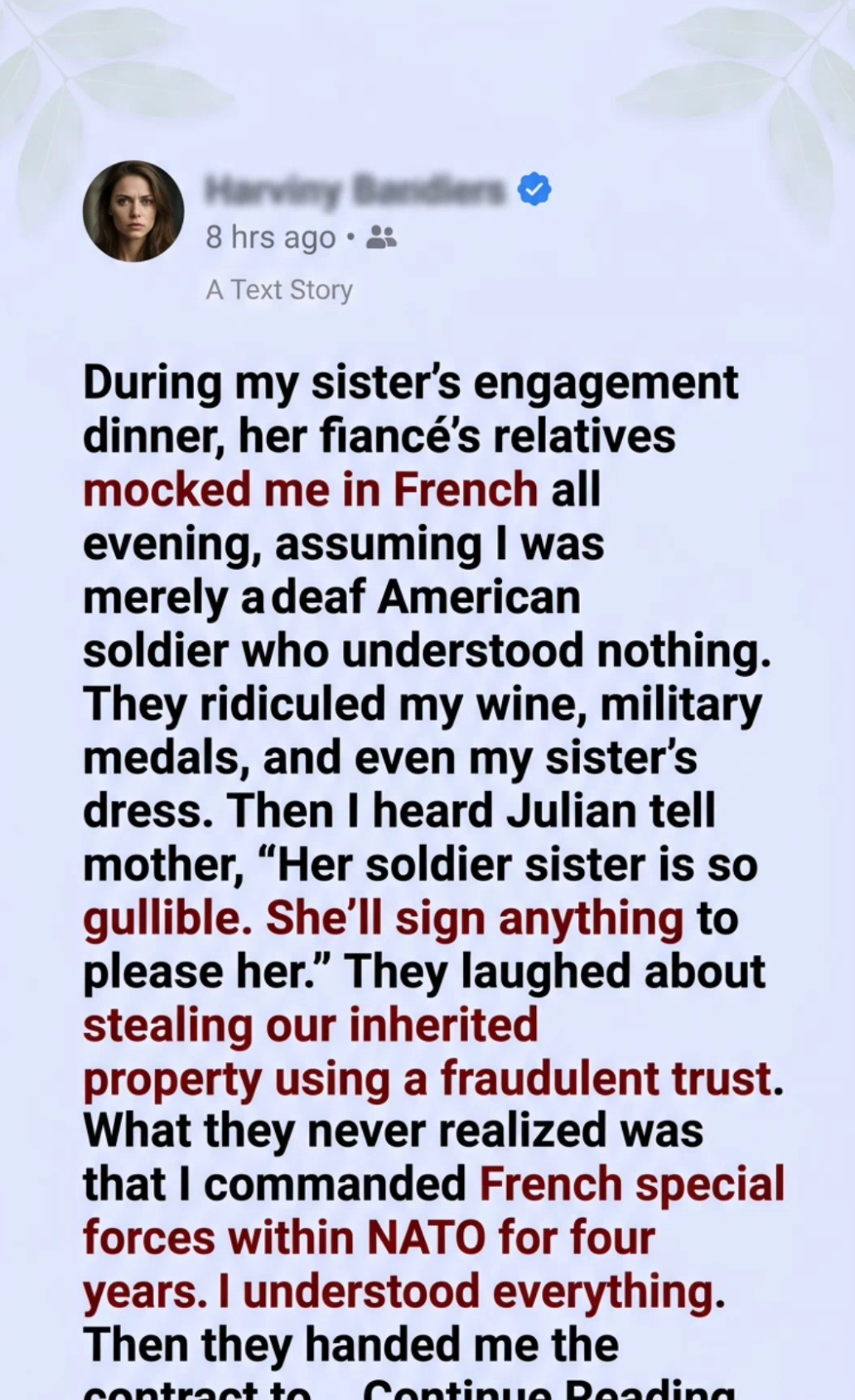
The first insult came before the appetizers.
“Elle ressemble à une gardienne de prison.”
She looks like a prison guard.
The woman speaking was wearing a diamond necklace that probably cost more than my first car.
Her name was Vivienne Laurent, my sister’s future mother-in-law.
She glanced at my dark blue military dress uniform, then whispered something to the woman beside her.
They both laughed.
I smiled politely.
That seemed to amuse them even more.
“At least she made an effort,” Vivienne continued in French. “Although I suppose you can’t expect much from someone who spends her life following orders.”
I understood every word.
I simply didn’t respond.
My name is Captain Elizabeth Carter, United States Army, retired.
I was forty years old, had served for twenty years, and had spent four of those years attached to a multinational NATO special operations command in France.
During that assignment, I had worked alongside French military units, coordinated multinational operations, and eventually commanded a French special forces task group under an authorized NATO operational structure.
I spoke French fluently.
I also spoke German and enough Arabic to understand when someone was trying to mislead me.
But that evening, at my younger sister’s engagement dinner, I allowed the Laurent family to believe I couldn’t understand a single sentence.
It was the most useful decision I had made in years.
Because the people sitting around that expensive dining table weren’t merely arrogant.
They were planning to steal my family’s inheritance.
And they had chosen the wrong sister to underestimate.
1. The engagement dinner
My younger sister, Emily, had called me three weeks earlier.
“Please come home for the engagement dinner,” she said.
“I’ll be there.”
“You promise?”
“Of course.”
She laughed.
“Julian says his family is very traditional. His mother has already started planning the wedding.”
“That sounds exhausting.”
“Elizabeth!”
I smiled.
“All right. I’ll behave.”
Emily and I had grown up in a small town in Virginia.
Our parents, Thomas and Margaret Carter, owned a beautiful piece of land outside town. It included an old farmhouse, several acres of woodland, a guest cottage, and a small commercial building near the main road.
Our father had purchased the property when he was thirty.
He spent years restoring the farmhouse, planting trees, and maintaining the land.
Our mother loved the garden.
When they died in a highway accident six years earlier, they left the property equally to Emily and me.
The estate had been handled by an independent attorney, and the ownership documents were properly recorded.
Emily and I each held a fifty-percent interest.
We agreed not to sell the property immediately.
It was the last place that still felt like our parents.
I had been away frequently because of military service, but Emily lived nearby and maintained the farmhouse.
She also met Julian Laurent.
Julian was charming, educated, and from a wealthy family.
His father, Philippe, owned several commercial properties.
His mother, Vivienne, served on charitable boards and appeared frequently at local social events.
Julian worked in his father’s property-development company.
At first, I thought he was a good match for Emily.
Then I met him.
He was polite, but there was something unsettling about the way he spoke about money.
He frequently referred to my parents’ land as an “underdeveloped asset.”
When Emily mentioned the farmhouse, he talked about its resale value.
When she described our mother’s garden, he discussed replacing it with a luxury event space.
I didn’t like it.
But I kept my opinions to myself.
Until the engagement dinner.
2. The woman they thought was deaf
The dinner was held at a private country club.
There were fourteen guests.
I arrived wearing my formal military uniform because Emily had specifically asked me to.
“You look beautiful,” she said when she saw me.
I hugged her.
She was wearing a cream-colored dress with delicate embroidered flowers.
Our mother’s engagement necklace rested against her collarbone.
For a moment, I felt as though our mother were standing beside us.
Then Julian approached.
“Elizabeth. Glad you could make it.”
He shook my hand.
His grip was unnecessarily firm.
“Julian.”
He looked at my uniform.
“Still wearing all the medals?”
“They represent important moments in my service.”
“Of course.”
His smile was thin.
He turned toward his mother.
“Maman, this is Emily’s older sister.”
Vivienne offered her hand.
“How wonderful. We have heard so much.”
I shook it.
She looked at my uniform again.
“American military?”
“Yes.”
She nodded.
Then, in French, she said:
“Je pensais qu’elle serait plus impressionnante.”
I thought she would be more impressive.
Julian laughed.
“She is rather ordinary.”
I understood.
I said nothing.
At the table, they seated me beside Philippe Laurent and across from Vivienne.
Emily sat beside Julian.
The conversation began pleasantly enough.
Then the French started.
“Elle ne comprend rien, n’est-ce pas?” Vivienne whispered.
She doesn’t understand anything, does she?
Julian shook his head.
“Emily said she has some hearing problem. She probably won’t understand us anyway.”
I took a sip of water.
Philippe leaned toward Vivienne.
“At least she’s useful for the wedding photographs. A soldier in uniform makes the family look respectable.”
Vivienne laughed.
“Just make sure she doesn’t start giving orders.”
They laughed again.
I continued eating.
I had spent years in rooms where people thought the quietest person was the least dangerous.
I knew how to listen.
And I knew when silence was more valuable than an argument.
3. The conversation about my sister’s dress
The main course arrived.
Emily had spent weeks choosing her engagement dress.
She had shown me photographs of it, asking whether the embroidery was too delicate or whether the neckline was appropriate.
I had told her she looked beautiful.
Now Vivienne examined it with an expression of exaggerated concern.
“Ce n’est pas très élégant.”
It isn’t very elegant.
Philippe nodded.
“It looks inexpensive.”
Julian smiled.
“Emily chose it herself.”
Vivienne looked at him.
“That explains it.”
Emily didn’t understand the French.
She noticed their expressions, however.
“Is something wrong?” she asked.
“Nothing, darling,” Julian replied.
Vivienne smiled.
“We were just admiring your dress.”
I looked at my sister.
She smiled nervously.
I wanted to tell her.
I wanted to stand up and explain exactly what they had said.
But something stopped me.
Their behavior was revealing something far more important than their opinions about a dress.
They believed they were entitled to humiliate someone simply because they thought she lacked the ability to understand them.
And people who behaved that way in public were often much worse in private.
I decided to keep listening.
4. The secret about the inheritance
After dessert, Philippe raised his glass.
“To family,” he announced.
Everyone lifted their glasses.
“To a wonderful future for Emily and Julian.”
We drank.
Then Philippe turned toward me.
“Elizabeth, we have something for you.”
He placed a leather folder beside my plate.
I looked at it.
“What is it?”
“Some paperwork concerning the family property.”
Julian leaned forward.
“We’ve been discussing ways to simplify the ownership arrangement. It would make everything easier once Emily and I are married.”
I opened the folder.
The first page was titled:
CARTER FAMILY PROPERTY — PRIVATE TRUST TRANSFER AGREEMENT
I read the opening paragraphs.
The agreement proposed transferring the entire inherited property into a newly created trust.
Emily and I would supposedly remain beneficiaries.
However, the document gave the proposed trustees broad authority to manage, lease, mortgage, and sell the property.
The proposed trustees were Philippe Laurent and Julian Laurent.
I turned the page.
There was a clause authorizing the trustees to transfer the property to an affiliated development company without obtaining additional approval from the original beneficiaries.
I read it again.
Then I looked at Julian.
“Why do you need my signature?”
He smiled.
“Because you’re one of the owners.”
“Would Emily have to sign too?”
“Naturally.”
“Has she seen this?”
“Not yet. We wanted to explain it to you first.”
That answer was interesting.
I looked at the final page.
My name was already typed beneath a signature line.
Emily’s name was there too.
A notary section had been completed with a date that hadn’t yet arrived.
I turned toward Philippe.
“Who prepared this?”
“Our legal team.”
“Which attorney?”
He gave me a name.
I recognized it.
The lawyer had represented one of Philippe’s companies in a commercial dispute.
I closed the folder.
“Thank you. I’ll review it.”
Vivienne smiled.
“There’s no need to make things complicated. It’s a standard family arrangement.”
Then Julian leaned toward his mother and spoke in French.
“Her soldier sister is so gullible. She’ll sign anything to please her.”
Vivienne laughed.
“Especially if we tell her it’s important for Emily.”
Philippe joined them.
“Once she signs, we control the property. The old farmhouse can be demolished before Emily realizes what we’ve done.”
My hand tightened around the folder.
Julian continued.
“We’ll use the land for the development. The trust will make it difficult for her to challenge anything.”
Then Philippe said the sentence that changed the entire evening.
“Make sure the document is signed before the wedding. After that, Emily will be part of the family, and the property will be much easier to manage.”
I finally understood.
They weren’t trying to simplify anything.
They were trying to steal our inheritance.
5. The trap they had prepared
I looked down at the agreement.
There was another problem.
The document described Emily and me as having agreed to establish the trust.
We had never discussed it.
It also included a statement that the property was free of existing restrictions.
That was false.
Our parents’ estate had established a recorded preservation covenant over part of the land.
It restricted certain types of commercial development.
The farmhouse and surrounding woodland were protected under an agreement our father had entered into with a local conservation organization.
Any transfer had to comply with those restrictions.
The Laurent family had either ignored that information or deliberately concealed it.
I looked at the signature page again.
There was a line authorizing the trustees to submit documents to the county land records office.
If the agreement were fraudulent, the consequences could be serious.
But I didn’t need to argue at the dinner table.
I needed evidence.
“Would you like me to sign tonight?” I asked.
Julian’s smile widened.
“If it’s convenient.”
I tilted my head.
“Can I take it home?”
Philippe exchanged a glance with his son.
“Of course. But we would prefer to complete it soon.”
“Why the hurry?”
Vivienne laughed softly.
“Young people have so much to organize before a wedding.”
I smiled.
“Then I’ll read it carefully.”
Julian leaned back.
“Naturally.”
They thought they had succeeded.
They believed I had accepted the arrangement.
They had no idea I had already photographed every page with my phone.
And I had noticed something else.
A handwritten note was attached to the back of the agreement.
It contained a list of financial figures and a reference to a company called Laurent Development Holdings.
Beside it was a date.
The date was the following Monday.
The same day a property transfer filing had been scheduled.
6. The call in French
After dinner, Emily and Julian went outside to greet some guests.
I remained at the table.
Philippe poured himself another glass of wine.
He turned toward Vivienne and spoke quietly.
“Once the transfer is recorded, the sisters won’t be able to stop the development.”
Vivienne smiled.
“Emily will complain, but Julian will handle her.”
“And the soldier?”
Julian returned just then.
“She won’t matter. She’ll go back to her military friends.”
Vivienne laughed.
“She probably thinks those medals make her important.”
I looked at my glass.
Then I heard Julian say:
“Did the lawyer finish the second version?”
Philippe nodded.
“Yes. The signature page is ready. We only need her to cooperate.”
“What if she refuses?”
“Then we use the first agreement and claim she approved it verbally.”
Julian frowned.
“Would that work?”
“Not if she has a good lawyer. But she doesn’t.”
They laughed.
I put my napkin on the table.
Then I stood.
“Excuse me. I need to make a call.”
I walked into the hallway.
There, I called Rebecca Hayes, the attorney who had handled our parents’ estate.
She answered on the second ring.
“Elizabeth?”
“I need you to listen carefully.”
I explained the proposed trust, the transfer date, and the fraudulent statements.
Rebecca became silent.
“Do not sign anything.”
“I wasn’t planning to.”
“Do you have a copy?”
“Photographs of every page.”
“Send them to me now.”
I did.
She reviewed them while I waited.
Then she said:
“Elizabeth, this is serious. The agreement appears to give these people authority over property they do not own. The notary section is also concerning.”
“Can we stop the filing?”
“We can move quickly. I’ll contact the county recorder and submit a formal notice disputing any unauthorized transfer. We should also notify the conservation organization.”
“Do it.”
“One more thing. Does Emily know?”
“No.”
“Then you need to tell her before she signs anything.”
I looked through the glass doors.
Emily was laughing with Julian.
“I will.”
7. The man who thought he had won
I returned to the dining room.
Julian was waiting for me.
“Everything all right?”
“Perfectly.”
“Did you decide about the paperwork?”
“Almost.”
He slid a pen toward me.
“Why don’t you sign now? It will save everyone time.”
I looked at the pen.
Then at him.
“Julian, do you speak English?”
He blinked.
“Of course.”
“Good. Then perhaps you can explain something.”
His smile disappeared.
I opened the folder and pointed to the clause granting the trustees authority to sell the property.
“Why does this agreement give your father and you the power to sell land that belongs to Emily and me?”
Philippe stopped drinking.
Julian laughed nervously.
“It’s just standard language.”
“Then why does it say the transfer can happen without additional beneficiary approval?”
“That’s how trusts work.”
“Not this one.”
Vivienne leaned forward.
“Elizabeth, perhaps this is too complicated for you.”
I looked directly at her.
“Would you prefer I explain it in French?”
Nobody moved.
I switched languages.
“Je comprends chaque mot depuis le début de ce dîner.”
I have understood every word since the beginning of this dinner.
Julian’s face went white.
Vivienne opened her mouth.
I continued.
“J’ai entendu vos commentaires sur mon uniforme, mes décorations, le vin et la robe de ma sœur. J’ai aussi entendu votre plan pour voler notre héritage.”
I heard your comments about my uniform, my decorations, the wine, and my sister’s dress. I also heard your plan to steal our inheritance.
Philippe slowly placed his glass down.
Julian stared at me.
“You speak French?”
“Fluently.”
Vivienne recovered first.
“Well, this is ridiculous. We were only joking.”
“No. You were discussing fraud.”
Julian shook his head.
“You misunderstood.”
I smiled.
“That’s an interesting argument to make when I understood every word.”
8. The military medals
Philippe stood.
“Let’s not turn a family dinner into a legal dispute.”
I closed the folder.
“You’re right. We should keep the legal dispute separate.”
Julian laughed.
“You’re making a mistake, Elizabeth. You have no idea who my father knows.”
I looked at him.
“Do you know what these medals represent?”
He glanced at my uniform.
“Military service.”
“More than that.”
I pointed to the NATO service decoration.
“Four years working with multinational forces in France. I served under a NATO operational command and led a French special operations task group during that assignment.”
Philippe’s expression changed.
I continued.
“I have worked with French officers, investigators, legal advisers, and intelligence personnel. I know how to document misconduct. I know how to preserve evidence. And I know that a document does not become legitimate because wealthy people place it inside an expensive folder.”
Julian’s voice sharpened.
“You’re threatening us?”
“No. I’m informing you that I will not sign your fraudulent agreement.”
Vivienne looked toward Emily, who had just returned to the room.
“Emily, your sister is being unnecessarily aggressive.”
Emily glanced between us.
“What happened?”
I handed her the folder.
“Read the first page. Then read the section about selling the property.”
She looked down.
Her expression changed.
“Julian, what is this?”
He stepped toward her.
“It’s just a proposal.”
“Why are your names listed as trustees?”
“We’re trying to protect the property.”
“Why does it say we agreed to this?”
Julian reached for the folder.
Emily pulled it away.
“Don’t touch it.”
The room went silent.
9. My sister finally understands
Emily read the document from beginning to end.
Then she looked at Julian.
“You told me your father wanted to help us restore the farmhouse.”
“He does.”
“Then why does this say the farmhouse can be demolished?”
Julian rubbed his forehead.
“Emily, you’re misunderstanding the legal language.”
“Why are you listed as someone who can sell our property?”
“Because we’re getting married.”
“That doesn’t answer my question.”
Vivienne stepped in.
“Emily, sweetheart, these things are complicated. Your father-in-law would be managing the property for everyone’s benefit.”
Emily looked at her.
“My father is dead.”
Vivienne blinked.
“What?”
“My father worked for forty years to protect that land. He planted every tree. He restored that house. He left it to Elizabeth and me. He didn’t leave it to your family.”
Philippe’s expression hardened.
“Careful, young lady.”
Emily straightened.
“No. You be careful.”
She turned to Julian.
“Did you tell your parents that I had agreed to this?”
He said nothing.
“Did you tell them I wanted to sell the farmhouse?”
“Emily—”
“Did you?”
Julian looked away.
And that was enough.
She took off her engagement ring.
I watched her face.
She was trying not to cry.
“Is this what you wanted?” she asked.
Julian looked at the ring.
“Don’t be dramatic.”
Emily placed it on the table.
“I’m not marrying someone who thinks my family’s home belongs to him.”
10. The documents reach the authorities
The next morning, Rebecca filed the legal notices.
She also contacted the county recorder’s office and requested that the suspicious transfer documents be flagged for review.
The county confirmed that no valid transfer had been recorded.
A formal complaint was submitted concerning the suspected fraudulent agreement.
The conservation organization reviewed the paperwork and confirmed that the proposed development would violate the property’s recorded preservation restrictions unless the proper approvals were obtained.
Then something unexpected happened.
A former employee of Laurent Development Holdings contacted Rebecca.
He had heard that the company was under investigation.
He told her that the trust agreement was not the first attempt to obtain control of the Carter property.
Several months earlier, Julian had asked him to prepare financial projections for a development project.
The employee had been given an internal document identifying the Carter property as an acquisition target.
The project assumed the land would be transferred into a trust controlled by the Laurent family.
The projected sale value was nearly $8 million.
But the most disturbing part was a line in the financial model:
Acquisition cost: nominal — family transfer.
They had planned to obtain the property for almost nothing.
Then sell or develop it for millions.
Rebecca forwarded the information to the appropriate investigators.
11. The second agreement
Two weeks later, the investigation uncovered another document.
It was a draft agreement with a forged signature attributed to me.
The signature was convincing at first glance.
But it wasn’t mine.
The document also contained an electronic certification supposedly issued by a notary.
The notary later stated that he had never witnessed me sign anything.
He had not approved the document.
His identification details had been copied without authorization.
This changed the investigation.
The matter was no longer simply an aggressive attempt to negotiate a property transfer.
There was evidence of a deliberate effort to create false legal documents.
Julian and Philippe were questioned.
Their lawyers denied wrongdoing.
But investigators recovered emails discussing the transfer, internal financial projections, and messages about getting my signature before I could consult Rebecca.
The engagement dinner had not been an isolated misunderstanding.
It had been the final step in a plan that had been developing for months.
The Laurent family had assumed Emily would trust Julian.
They had assumed I would be intimidated by their wealth.
And they had assumed that a woman in a military uniform would be too distracted by her own pride to read the paperwork carefully.
They were wrong on all three counts.
12. Emily’s decision
Emily stayed with me for several weeks.
She was devastated.
Not only because the engagement had ended, but because she had begun to question every conversation she had ever had with Julian.
One evening, we sat on the farmhouse porch.
The sun was setting behind the trees.
Emily held our mother’s old garden gloves.
“I feel stupid,” she whispered.
I turned toward her.
“Don’t.”
“I should have seen it.”
“Julian spent months making sure you didn’t.”
“But you saw it immediately.”
“I saw the paperwork. I also heard what he said when he thought nobody understood him.”
Emily wiped her eyes.
“Do you think he ever loved me?”
I thought carefully.
“I think he may have loved the person he wanted you to become. But he didn’t respect the person you actually are.”
She looked toward the farmhouse.
“Mom and Dad would have hated this.”
“They would have hated what happened. But they would be proud of you for standing up.”
Emily leaned against my shoulder.
For the first time since the dinner, she smiled.
“Can we keep the house?”
I looked at the old wooden porch.
“Absolutely.”
13. The final confrontation
Six months later, I received a message from Julian.
He wanted to meet.
I refused.
He contacted me again through his attorney, requesting a discussion about the property dispute.
Rebecca agreed to attend.
We met in her office.
Julian arrived without his father.
He looked tired.
His expensive suit was slightly wrinkled.
He sat across from us.
“I want to settle this.”
Rebecca opened her notebook.
“Then explain the forged document.”
Julian looked at me.
“I didn’t forge your signature.”
“Who did?”
“I don’t know.”
“Who prepared the false trust?”
“My father’s legal team.”
“Who sent the instructions to file it?”
He hesitated.
“My father.”
Rebecca made a note.
Julian rubbed his hands together.
“Look, I made mistakes. I was under pressure.”
“From whom?” I asked.
He looked down.
“My father. The business was struggling. We had investors waiting. The development was supposed to save everything.”
“By taking our property?”
“We thought you would eventually agree.”
“You planned to make it difficult for us to refuse.”
He didn’t answer.
Then he said something that made me understand just how little he had changed.
“Emily would have been financially secure. She wouldn’t have lost anything.”
I stared at him.
“She would have lost her home.”
“She could have bought another one.”
“That isn’t the point.”
He sighed.
“You’re a soldier. You understand strategy. Sometimes you have to make difficult decisions.”
I leaned forward.
“No, Julian. Strategy is not the same as deception. And taking something that belongs to someone else is not a difficult decision. It’s theft.”
He looked away.
Rebecca ended the meeting.
The legal proceedings continued.
Ultimately, the fraudulent transfer was never completed. The evidence was referred to the relevant authorities, and the Laurent family’s attempt to obtain control of the property resulted in serious civil and criminal consequences for those involved.
Julian later accepted responsibility for his role in the fraudulent document scheme under a negotiated legal resolution.
Philippe faced separate proceedings related to the business records and false filings.
The exact penalties were determined by the court.
But one thing was certain.
The Carter property remained ours.
14. The farmhouse
A year after the engagement dinner, Emily and I stood in the garden.
The old farmhouse had been repaired.
The roof was sound.
The windows had been restored.
We had preserved the original kitchen, including the wooden cabinets our father had built himself.
Emily planted roses beside the porch.
I repaired the fence.
We established a small charitable fund in our parents’ names to support families facing legal difficulties involving inherited homes and property disputes.
It wasn’t a large organization.
But it helped people obtain independent advice before signing documents they didn’t understand.
One afternoon, Emily came outside carrying two cups of coffee.
“Do you remember what Vivienne said about my dress?”
I laughed.
“Which insult?”
“She said it looked inexpensive.”
“She wasn’t exactly subtle.”
Emily smiled.
“Mom made the embroidery.”
I looked at the dress hanging in a protective garment bag inside the farmhouse.
Emily had kept it.
“Then it was worth more than every diamond in that room.”
She looked at me.
“Thank you for listening that night.”
I shook my head.
“You don’t have to thank me.”
“Yes, I do. You could have stood up and walked away. You could have let me discover everything after the wedding.”
I looked toward the trees.
“I wasn’t going to let them take something our parents spent their lives building.”
Emily hugged me.
For a long time, neither of us spoke.
15. What they never understood
Two years after that dinner, I was invited to speak at a military leadership event.
The organizer asked me to discuss my experience working with multinational forces.
I accepted.
During the question period, a young officer asked:
“What’s the most important lesson you learned from commanding people in different countries?”
I thought about France.
I thought about the officers who had trusted me.
I thought about the years when language, rank, and nationality had all seemed less important than the responsibility to protect the people beside you.
Then I thought about the engagement dinner.
“The most important lesson,” I said, “is never assume that silence means ignorance.”
The audience listened.
“People often reveal themselves when they believe nobody understands them. Pay attention. Preserve the evidence. And never let someone convince you that your dignity depends on their approval.”
After the event, I returned to Virginia.
Emily was waiting at the farmhouse.
She had prepared dinner.
Our mother’s garden was full of flowers.
The old house smelled like fresh bread.
We sat on the porch and watched the evening settle over the land.
Emily raised her glass.
“To Mom and Dad.”
I raised mine.
“To the people who built something worth protecting.”
We drank.
I looked at the property that had been the center of so much trouble.
The land had survived.
The farmhouse had survived.
And most importantly, my sister had survived the humiliation of discovering that someone she loved had been willing to use her trust against her.
I had spent twenty years serving my country.
I had learned that strength was not always loud.
Sometimes strength meant remaining calm while others underestimated you.
Sometimes it meant reading every line before signing.
Sometimes it meant speaking a language people assumed you didn’t understand.
And sometimes it meant standing beside your sister when the people who promised to love her tried to take everything her parents had left behind.
The Laurent family had looked at my uniform and seen a woman they could manipulate.
They had looked at my medals and seen decorations.
They had looked at my silence and mistaken it for weakness.
But I had understood every word.
I had read every clause.
And I had never signed their contract.
The farmhouse still stood beneath the Virginia trees.
My sister was free to build a future with someone who respected her.
And the people who had laughed at us that evening had learned a lesson they should have understood long before they entered that room:
You should never mistake a quiet woman for an uninformed one.
Especially when she’s already read the contract.
THE END.