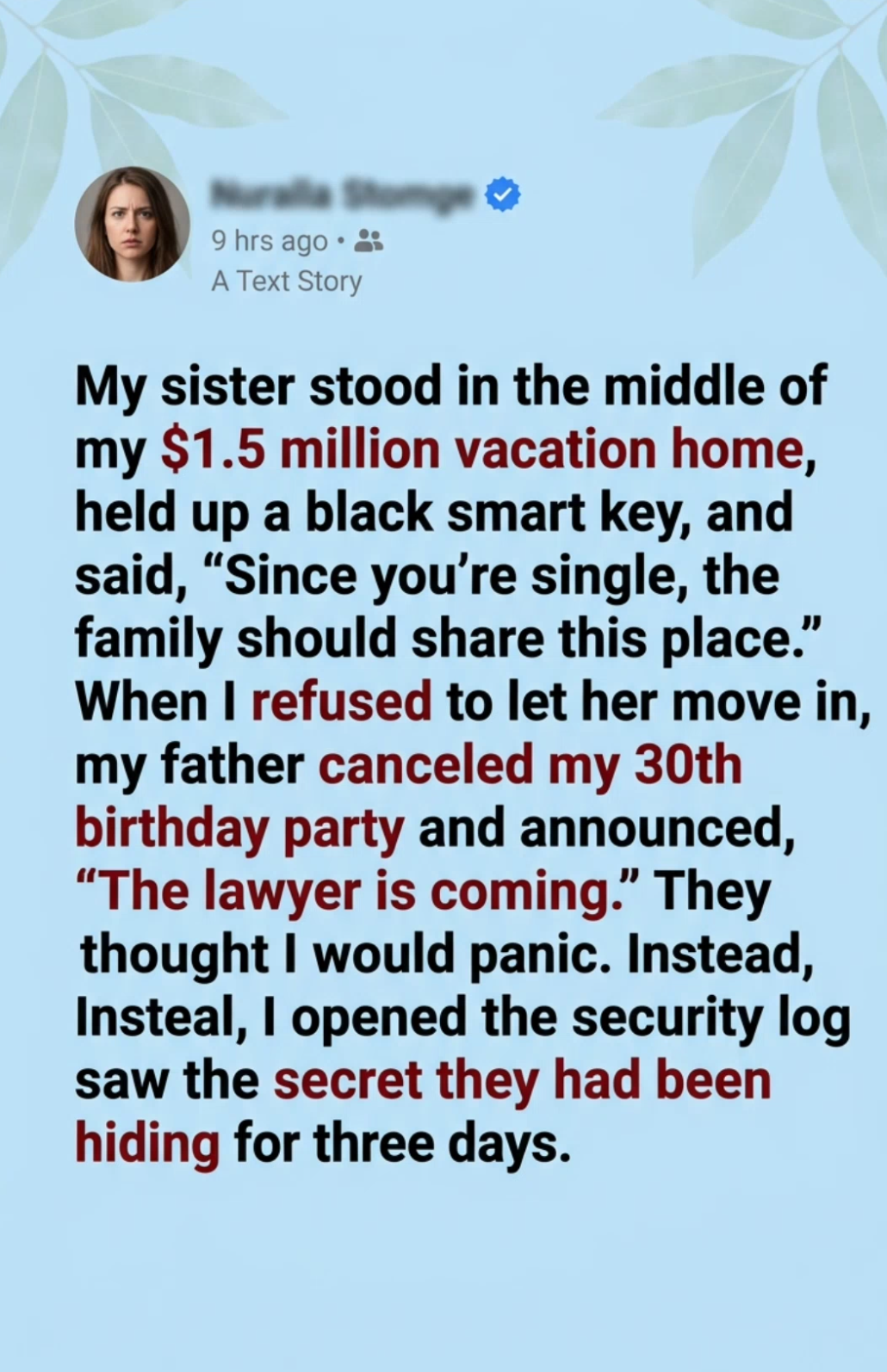
“Since you’re single, the family should share this place.”
My sister, Vanessa, stood in the middle of my living room holding up a black smart key as if she had just been handed the deed to my house.
She smiled at me.
Not a nervous smile.
Not a polite request.
It was the smile of someone who had already decided the answer was yes.
I looked at the key, then at her.
“Where did you get that?”
“Mom gave it to me.”
I turned toward my mother.
She was standing beside the kitchen island, carefully arranging a bowl of decorative lemons that didn’t need arranging.
“Mom?”
She avoided my eyes.
“Your sister needs somewhere comfortable to stay. You hardly use this house anyway.”
I stared at her.
My vacation home was a $1.5 million property overlooking the coast. It had four bedrooms, a heated swimming pool, a private garden, and windows that faced the ocean. I had spent seven years saving, investing, and working toward buying it.
I wasn’t married.
I didn’t have children.
But that didn’t mean I had bought the house for everyone else.
“I use it,” I said. “And I haven’t given Vanessa permission to move in.”
Vanessa rolled her eyes.
“Here we go again. Everything has to be about you.”
“It’s my house.”
“You’re single, Claire. You don’t need four bedrooms.”
I took a breath.
“That’s not how property ownership works.”
My father, Richard, finally looked up from his phone.
“Don’t start making this difficult.”
I turned toward him.
“What exactly am I making difficult?”
“Your sister is going through a rough time. The family should help her.”
“Helping her doesn’t mean giving her unrestricted access to my property.”
Vanessa crossed her arms.
“You’re being selfish.”
I almost laughed.
The irony was extraordinary.
For years, I had helped my family whenever I could. I had paid my mother’s medical bills when her insurance reimbursement was delayed. I had loaned Vanessa money when her boutique failed. I had covered my father’s car repairs twice.
But somehow, the one thing I had earned entirely for myself had become a family resource.
I held out my hand.
“Give me the key.”
Vanessa’s smile disappeared.
“No.”
“Vanessa.”
“Mom gave it to me. I’m keeping it.”
My father stood.
“That’s enough. Your birthday is next Saturday. We were planning a family celebration, but if this is how you’re going to behave, perhaps we should cancel it.”
I stared at him.
“You’re canceling my thirtieth birthday because I won’t let Vanessa move into my house?”
“Don’t twist my words.”
He picked up his jacket.
“Enjoy your property, Claire. The lawyer is coming.”
Then he walked out.
Vanessa followed him, still holding the smart key.
My mother remained behind for another moment.
“Please don’t make this a legal matter,” she whispered.
I looked at her.
“Then why did Dad say a lawyer was coming?”
She didn’t answer.
She simply picked up her handbag and left.
I stood alone in the living room.
For a few seconds, I wondered whether I had somehow misunderstood the entire conversation.
Then my phone vibrated.
It was a notification from my home security system.
UNUSUAL ACCESS ACTIVITY — PROPERTY ENTRY DETECTED.
I opened the application.
The first entry was timestamped three days earlier.
Then another.
And another.
My family hadn’t just been discussing moving into my house.
They had already been using it.
And the security log revealed something far worse than I expected.
1. The house I built for myself
My name is Claire Bennett.
I was twenty-nine when I bought the vacation home, and I turned thirty the following week.
I worked as a senior project manager for a construction company. My job involved coordinating budgets, contractors, suppliers, schedules, and clients who regularly changed their minds halfway through expensive projects.
It wasn’t glamorous.
But it paid well, and I was disciplined with money.
I started investing in my early twenties.
I didn’t buy expensive clothes, replace my car every few years, or spend my weekends trying to impress people.
I wanted something specific.
A place near the ocean where I could wake up without hearing traffic.
A place where I could read on the balcony, swim before breakfast, and invite friends without feeling that I had to explain myself.
After seven years, I found it.
The property was on a quiet stretch of coastline about two hours from my city.
It had originally been built as a private holiday residence. The previous owner had renovated the kitchen, added a pool, and installed modern security systems.
The asking price was $1.5 million.
I negotiated carefully, hired an independent inspector, reviewed the title, and completed the purchase through my own attorney.
My parents attended the housewarming.
My father gave a toast.
“To Claire. May this house always be a place where family comes together.”
Everyone applauded.
I believed him.
At the time, I didn’t understand that some people hear the word family and interpret it as unlimited access.
My younger sister, Vanessa, had always been different from me.
She was charming, social, and impulsive.
She could walk into a room and make everyone feel like they were her closest friends.
But she struggled with money.
She had opened a clothing boutique with a friend, borrowed money to expand it, and closed it less than two years later.
After that, she tried selling luxury skincare products online.
Then she started planning events.
Each project began with enthusiasm and ended with unpaid invoices.
My parents always rescued her.
When Vanessa needed money, they called it support.
When I needed money, they reminded me to be independent.
I didn’t resent helping her.
I resented the assumption that I was obligated to keep doing it.
2. The first warning
Six months before my birthday, Vanessa visited the vacation home with our parents.
She walked through every room, opened cupboards, inspected the guest bedrooms, and spent nearly twenty minutes taking photographs of the swimming pool.
“This would be perfect for my business,” she said.
“What business?”
“Private retreats. Wellness weekends. Small luxury events.”
I laughed.
“You want to run events here?”
“Why not? It’s just sitting empty most of the time.”
“It’s my vacation home, not an event venue.”
She shrugged.
“You could make money from it.”
“I didn’t buy it to operate a business.”
My father joined the conversation.
“Your sister has a point. A property like this should generate income.”
I looked at him.
“It does generate something. It gives me somewhere to relax.”
He shook his head.
“That’s an expensive way to use a house.”
I didn’t respond.
Later that afternoon, my mother approached me near the pool.
“Vanessa is struggling again.”
I closed my book.
“What happened?”
“Her landlord increased the rent. She might have to move.”
“I’m sorry to hear that.”
“She was thinking she could stay here temporarily.”
I looked at her.
“How temporarily?”
“Perhaps a few months.”
“Mom, no.”
My mother looked disappointed.
“She’s your sister.”
“I know. But I don’t want someone living here permanently, and I don’t want the house used for her business.”
“Nobody said permanently.”
“Then she can find another rental.”
My mother sighed.
I thought that was the end of it.
I was wrong.
3. The black smart key
The security system at my vacation home had been installed by a reputable company.
It included cameras covering the exterior entrances, smart locks, and an access history that recorded which key or code had been used.
I had chosen the system because the property was sometimes empty for several weeks.
I had also set up separate access permissions for maintenance workers.
Nobody had permanent access except me.
My father had been given a temporary guest code during the housewarming weekend, but I had disabled it months earlier.
My mother had never been issued a key.
Vanessa had never been authorized.
So when she held up that black smart key, I knew something was wrong.
I had purchased only one physical smart key.
It was in my desk drawer at home.
The device Vanessa held was an additional key.
Someone had created it.
And someone had connected it to my property without my permission.
I opened the security application.
The first suspicious entry appeared on Monday at 8:42 a.m.
ACCESS METHOD: ADMINISTRATOR CREDENTIAL
The second appeared Tuesday at 10:16 a.m.
ACCESS METHOD: NEW SMART KEY — DEVICE ID 7F29
The third appeared Wednesday at 7:51 a.m.
ACCESS METHOD: NEW SMART KEY — DEVICE ID 7F29
I stared at the screen.
Three days.
Three separate entries.
Then I noticed a fourth item.
SECURITY SETTINGS MODIFIED.
The administrator notification had been sent to an email address I didn’t recognize.
I opened the details.
A new administrator profile had been added.
The name was:
VANESSA B.
I felt my stomach tighten.
My sister hadn’t simply received a spare key.
Someone had given her administrator access to my house.
I immediately contacted the security company.
The representative verified my identity and confirmed that a new administrator profile had been created using a remote management request.
I asked who had authorized it.
She said the request had been submitted using a credential associated with an old contractor account.
“Was the request approved by the property owner?”
“According to the record, it was approved through an existing administrator session.”
“Which administrator?”
She paused.
“The account name is Richard Bennett.”
My father.
I closed my eyes.
Then I asked for the access history to be preserved.
The representative said she could freeze the account changes while the company reviewed the issue.
I instructed her to suspend every credential except mine.
Then I called my attorney.
4. The secret they had been hiding
My attorney’s name was Daniel Foster.
He had handled the purchase of my property and was familiar with the ownership documents.
When I explained what had happened, he told me to send him the security records immediately.
I did.
He called me back fifteen minutes later.
“Claire, have you signed anything recently concerning the property?”
“No.”
“Any management agreement, power of attorney, trust document, or authorization?”
“No.”
“Has anyone asked you to sign something?”
I thought about my father.
“The lawyer is coming.”
Daniel was quiet.
“That concerns me.”
“Why?”
“Because I have received an inquiry from another law office about a proposed family property arrangement.”
I sat down.
“What arrangement?”
“They claim your parents are helping you create a shared family trust. They say you have agreed in principle to transfer management authority to a family representative.”
“I haven’t agreed to anything.”
“That’s what I told them.”
I felt a chill.
“Who is the representative?”
“Your father.”
I looked at the security log again.
“Daniel, I think they’ve already given Vanessa access.”
“Then we need to move carefully.”
He asked me to forward the complete access history, the new administrator details, and any messages concerning the property.
Then he said:
“Do not sign anything your family brings you. And don’t delete any messages, even if they seem harmless.”
I agreed.
Before ending the call, he asked one more question.
“Has your father ever had access to your original property documents?”
I thought for a moment.
During the housewarming, he had helped me organize some paperwork because I was busy with contractors.
He had seen the title documents.
But I had never given him copies.
“I don’t think so.”
“Find out exactly what he has. We may need to check whether anyone has used your information to prepare unauthorized paperwork.”
I looked at the security log.
The secret was no longer simply that my family had entered my house.
They had been preparing to take control of it.
5. The three days inside my home
The next morning, I drove to the vacation house.
I had already disabled the unauthorized access, but I wanted to see what had happened.
The first thing I noticed was a delivery van parked near the entrance.
Two men were carrying boxes toward the garage.
I stopped them.
“Can I help you?”
One of them looked at a clipboard.
“Delivery for Ms. Vanessa Bennett.”
“Who ordered it?”
“Ms. Bennett.”
“What’s being delivered?”
He checked the paperwork.
“Furniture, decorative items, and storage containers.”
I stared at him.
“You’re delivering furniture to my property?”
He looked uncomfortable.
“That’s what the order says.”
I showed him the property ownership record on my phone.
“This house belongs to me. I did not authorize this delivery.”
He called his office.
After a short conversation, the men agreed to leave the items in the van until the order could be verified.
I walked inside.
The living room looked different.
A large box had been opened near the sofa.
There were decorative cushions on the floor.
A stack of catalogues sat on the kitchen island.
In the guest bedroom, I found two suitcases.
One belonged to Vanessa.
The other contained my mother’s clothes.
I opened the wardrobe.
Several hangers were occupied.
A new set of towels had been placed in the bathroom.
The house had been prepared for someone to move in.
Then I found the document.
It was sitting on the kitchen counter beneath a glass paperweight.
The title read:
FAMILY PROPERTY MANAGEMENT AND BENEFICIAL USE AGREEMENT
I read the first page.
It described the property as a shared family vacation residence.
It stated that I had voluntarily agreed to allow my parents and sister to use the home without paying rent.
But the final pages were worse.
The agreement proposed that my father would become the primary property manager.
He would have authority to arrange bookings, approve maintenance, collect rental income, and negotiate commercial use.
It also contained a clause allowing the manager to apply for financing secured against the property, subject to additional approvals.
I had never agreed to any of it.
At the bottom of the document was a signature that looked like mine.
It wasn’t.
Someone had copied my signature from an older document.
I photographed every page.
Then I noticed a handwritten note in the margin.
It read:
Get Claire to sign the final version at the birthday dinner. Don’t mention the administrator access.
I read it twice.
My birthday party.
The lawyer.
The smart key.
Everything was connected.
They weren’t planning to ask me for permission.
They were planning to pressure me into signing a document that would legitimize what they had already begun.
6. The lawyer was coming
I returned to the city that afternoon.
Daniel reviewed the photographs and told me the agreement raised serious concerns.
He advised me not to confront anyone until we had preserved the evidence and confirmed the status of any filings.
He also arranged a search of the relevant property records.
There was no completed transfer.
But a preliminary inquiry had been made about recording a management-related document.
The person who submitted it had identified my father as the authorized representative.
Daniel prepared a formal notice disputing any unauthorized authority and requested that the county recorder flag any attempted transfer or encumbrance requiring my signature.
He also contacted the security company and obtained a certified access report.
The report showed:
-
The original administrator account had been accessed from my father’s home internet connection.
-
A new smart key had been registered using that session.
-
Vanessa’s administrator profile had been created shortly afterward.
-
The property had been entered on three consecutive days.
-
The security settings had been changed to reduce certain notifications.
The last detail was particularly concerning.
Someone had deliberately tried to prevent me from noticing the activity.
I asked Daniel what would happen if my family brought the agreement to my birthday party.
He looked at me.
“Then you don’t sign it.”
“What if they threaten me?”
“Let them. Your property doesn’t become theirs because they raise their voices.”
I nodded.
Then I made a decision.
I wasn’t going to cancel my birthday.
I was going to let them come.
7. The birthday party that never happened
On Saturday morning, my father called.
“Have you calmed down?”
I looked out the window.
“About what?”
“Don’t play games, Claire. Vanessa needs a place to stay.”
“She can rent one.”
“You’re being deliberately difficult.”
I remained quiet.
“The lawyer will be there at six,” he continued. “We need to resolve this before the family starts arguing.”
“Which lawyer?”
“Mr. Collins. He handles our family’s legal matters.”
“Is he representing me?”
My father laughed.
“Why would you need your own lawyer? He’s handling the family arrangement.”
I almost smiled.
“Of course.”
“Good. Then we’ll see you tonight.”
He hung up.
At five forty-five, I arrived at the vacation home.
Daniel was already there.
He had brought copies of the property records, the security report, and the disputed agreement.
We placed them in a folder.
I also contacted the security company and asked them to keep the access restrictions in place.
At six fifteen, my family arrived.
My mother carried a cake.
Vanessa wore a new dress.
My father came in with a man in a gray suit.
“This is Mr. Collins,” he announced.
The lawyer shook my hand.
“Happy birthday, Claire.”
“Thank you.”
Vanessa looked around the living room.
“At least we can celebrate somewhere nice.”
I didn’t respond.
My father placed a folder on the table.
“Let’s get this over with.”
Daniel stood.
“Before we begin, I should introduce myself. I’m Daniel Foster, Claire’s attorney.”
My father’s smile disappeared.
“What?”
“I represent Claire in relation to the property.”
My father looked at me.
“You hired your own lawyer?”
“Yes.”
“Why would you do that?”
“Because this is my property.”
Mr. Collins opened his folder.
“Perhaps we should review the proposed agreement.”
Daniel nodded.
“Certainly. But first, we should establish whether your client has any authority to negotiate on behalf of the owner.”
Mr. Collins frowned.
“My client is her father.”
“That does not answer the question.”
Vanessa rolled her eyes.
“Can we please stop making everything so complicated?”
Daniel placed the property deed on the table.
“Claire is the sole registered owner.”
Then he placed the security report beside it.
“And these records show that someone used an administrator account to create an unauthorized smart key and grant Ms. Vanessa Bennett access to the property.”
My father stood.
“That was a family arrangement.”
“Was it authorized by Claire?”
Silence.
Daniel continued.
“Because the records indicate that the access changes were made without the owner’s consent.”
My mother looked at my father.
“Richard, you told me she had agreed.”
He didn’t answer.
Vanessa stared at the report.
“Why are you making such a big deal out of a key?”
I looked at her.
“Because you used it to enter my house without permission.”
“I was going to move in.”
“Exactly.”
8. The document with my fake signature
Daniel opened the second folder.
“There’s another issue.”
He placed the proposed management agreement on the table.
My father looked at it.
“That’s a draft.”
“It contains a signature attributed to Claire.”
“She was going to sign it.”
“She has not.”
Mr. Collins examined the signature page.
“Where did you obtain this copy?”
“Inside the property,” I answered.
My father looked at me sharply.
“You went through the documents?”
“They were sitting on my kitchen counter.”
“That’s private family business.”
I stared at him.
“It’s my kitchen.”
Daniel placed a copy of the original signed property documents beside the disputed agreement.
“The signatures are not identical. We have requested a forensic review if necessary.”
Mr. Collins turned toward my father.
“Richard, you told me Claire had authorized the arrangement.”
My father shifted in his chair.
“She was going to.”
“That isn’t the same thing.”
Vanessa interrupted.
“Why are you all acting like we’re criminals? We were trying to help the family.”
Daniel spoke calmly.
“Helping someone does not authorize you to create documents in their name.”
My mother began crying.
“Richard, what have you done?”
My father raised his voice.
“Enough! I was trying to keep the property in the family.”
I looked at him.
“It is already in the family. It’s mine.”
He pointed at me.
“You’re thirty years old, unmarried, and you spend half your life working. What are you going to do with a house that big?”
I felt the familiar anger rise.
Then I answered.
“Whatever I want. That’s why I bought it.”
9. The truth about the three days
Daniel asked my father a direct question.
“Why was Ms. Vanessa given administrator access?”
My father looked at Vanessa.
She looked away.
“She needed to prepare the house,” he said.
“For what?”
“To move in temporarily.”
“Did Claire authorize that?”
“No.”
“Did you tell her?”
My father didn’t answer.
Daniel continued.
“Why were the security notifications reduced?”
“I don’t know anything about that.”
I opened my phone.
“Would you like to see the access history?”
I placed it on the table.
The first entry appeared.
Monday, 8:42 a.m.
The second.
Tuesday, 10:16 a.m.
The third.
Wednesday, 7:51 a.m.
Then I showed them the administrator change.
The screen displayed the account name.
VANESSA B.
My sister stared at it.
“How did you get that?”
“From my security system.”
She turned toward my father.
“You said she wouldn’t know.”
Nobody moved.
I looked at her.
“What did you just say?”
Vanessa’s face went pale.
“I didn’t mean—”
“You said he told you I wouldn’t know.”
My father slammed his hand on the table.
“Vanessa, stop talking.”
But it was too late.
Daniel leaned forward.
“Perhaps you should explain what that means.”
Vanessa began crying.
She admitted that my father had told her the property was going to become a family-managed vacation home.
He said I would eventually sign the agreement.
He had arranged for her to receive the smart key so she could begin moving belongings inside.
She had already ordered furniture.
She had also contacted two friends about renting rooms during the summer.
My father had told her that the income would belong to the family.
“Did you know Claire hadn’t agreed?” Daniel asked.
Vanessa looked down.
“Yes.”
The room went silent.
My mother covered her mouth.
I looked at my sister.
“You knew.”
She whispered, “Dad said you’d come around.”
“And the fake signature?”
“I didn’t know about that.”
My father stood.
“This conversation is over.”
Daniel closed his folder.
“Not quite. We still need to address the unauthorized access, the disputed document, and the attempted management arrangement.”
My father looked at him.
“Are you threatening me?”
“No. I’m explaining the next legal steps.”
10. What my father had really planned
The investigation that followed revealed a more complicated situation than I expected.
My father had accumulated substantial personal debt.
Several investments had failed.
He had also guaranteed a loan for one of Vanessa’s business ventures.
The lender was demanding repayment.
He had begun looking at my vacation home as a potential source of financial relief.
His plan was to establish a family management arrangement, use the property for short-term rentals, and eventually negotiate a refinancing deal.
He believed the property could generate enough income to solve several family financial problems.
But he didn’t want to ask me.
He assumed I would refuse.
So he decided to create a situation in which refusing would make me appear selfish.
The birthday party was supposed to be the final pressure point.
He planned to bring a lawyer, present the agreement as an ordinary family arrangement, and persuade me to sign in front of everyone.
If I hesitated, he intended to remind me that my sister needed help and that my parents had supported me throughout my life.
The unauthorized smart key was meant to make Vanessa’s move appear already agreed upon.
The security changes were meant to prevent me from noticing the entries.
And the false signature was intended to give the agreement an appearance of prior approval.
It was a calculated plan.
Not a misunderstanding.
My father had confused his authority as a parent with ownership of my property.
11. The legal consequences
Daniel filed the necessary complaints and formal notices.
The security company provided its records.
The disputed signature was reviewed.
The lawyer who had attended the birthday meeting confirmed that he had been given inaccurate information about my consent.
He withdrew from representing my father in the matter.
The attempted management arrangement was never completed.
The unauthorized smart key was permanently disabled.
Vanessa removed her belongings from the house under an agreed timetable.
My father was required to cooperate with the investigation and provide information about the documents and access changes.
The evidence also led to a formal review of whether the false signature and unauthorized credential use violated applicable laws.
I didn’t want to exaggerate what the process would accomplish.
I wanted the facts established and my property protected.
The most important result was that the house remained legally mine, and no one could use the disputed agreement to claim authority over it.
My father later paid for the damage caused by the unauthorized changes and reimbursed the security company expenses.
He also signed a written acknowledgment that he had no right to access, manage, rent, or encumber the property without my express permission.
Vanessa signed an agreement confirming that she would not enter the property without my approval.
I changed the locks anyway.
12. The apology that came too late
Three months later, my mother came to visit me.
She arrived alone.
She looked tired.
“I brought your birthday present,” she said.
She handed me a small box.
Inside was a silver bracelet.
It was beautiful.
I thanked her.
Then she sat down.
“Your father is ashamed.”
I looked at her.
“Is he?”
“He says he was trying to help everyone.”
“He was trying to control something he didn’t own.”
She nodded.
“I know.”
I waited.
My mother looked around the living room.
“I should have stopped him.”
“Yes.”
She began crying.
“I thought if I agreed with him, he would calm down. I didn’t think he would go this far.”
I softened slightly.
“Mom, why didn’t you tell me?”
She wiped her eyes.
“Because I knew you would be angry.”
“I was entitled to be angry.”
“I know.”
We sat quietly.
Then she said, “I miss when we were all together.”
I looked toward the ocean.
“So do I. But being together doesn’t mean pretending nothing happened.”
She nodded.
Before leaving, she asked whether she could visit the house sometime.
I told her she could, but only when invited.
It was a small boundary.
But it was a real one.
13. Vanessa’s new beginning
Vanessa’s situation became more difficult after she lost access to the vacation home.
She had spent money furnishing the guest rooms and had told several people she would be hosting events there.
She had to cancel those arrangements.
At first, she blamed me.
She sent messages saying I had humiliated her and ruined her business plans.
I didn’t respond.
A month later, she called.
“I need to apologize.”
I listened.
“I knew you hadn’t agreed,” she said. “Dad told me you would eventually say yes, and I wanted somewhere to live. I thought if I moved in first, you wouldn’t make me leave.”
I took a breath.
“That’s exactly why I said no.”
“I know.”
She started crying.
“I didn’t think you’d actually change the access.”
I almost laughed.
“Vanessa, it’s my house. Of course I changed the access.”
She was quiet.
Then she said something I hadn’t expected.
“I’ve started working again.”
“Where?”
“At a property management company. Just an assistant position.”
“That’s good.”
“I need to stop expecting everyone to rescue me.”
I didn’t tell her everything was forgiven.
I didn’t tell her she could move back into my life as if nothing had happened.
But I told her I hoped the job worked out.
It was a beginning.
Not a reconciliation.
14. My thirtieth birthday, at last
I eventually celebrated my thirtieth birthday.
Not at the vacation house.
Not with a large family gathering.
I invited six close friends to a small restaurant overlooking the water.
We had dinner, laughed, and shared a chocolate cake.
Nobody brought a lawyer.
Nobody demanded a key.
Nobody asked whether I planned to share my property.
When my best friend, Hannah, raised her glass, she said:
“To Claire. Thirty years old, financially independent, and finally learning that saying no doesn’t require an explanation.”
Everyone laughed.
I smiled.
For the first time in months, I felt genuinely relaxed.
After dinner, I drove to the vacation home.
The security lights came on as I entered the driveway.
My phone displayed the usual notification.
WELCOME HOME, CLAIRE.
I unlocked the front door.
Everything was exactly where I had left it.
The sofa.
The photographs.
The kitchen table.
The view of the ocean.
I walked onto the balcony and listened to the waves.
Then I thought about the three days my family had spent entering my house without permission.
I thought about my father’s threat.
I thought about the lawyer’s folder.
And I realized something.
The house had never been the real issue.
The real issue was that my family had mistaken my independence for an invitation to use me.
They believed that because I had no husband or children, my time, money, and property were available to everyone else.
They believed that being single meant I had less right to decide how I wanted to live.
They were wrong.
15. The final security alert
Six months later, I received one last message from the security company.
The investigation had been completed.
The company confirmed that the unauthorized administrator profile had been removed, all credentials had been reset, and the original access records had been preserved.
I opened the report.
There was one detail I hadn’t noticed before.
The new smart key had been activated at 8:42 a.m. on Monday.
Exactly three days before Vanessa showed it to me.
The same morning my father had called to ask whether I would be home for the weekend.
At the time, I had thought he was simply checking my birthday plans.
Now I understood why he had asked.
He wanted to know whether I would be at the property when they began moving things inside.
I closed the report.
Then I deleted the old guest access codes.
I didn’t delete the evidence.
I saved it in a secure folder with my property records.
I had learned that peace was not the same as forgetting.
Sometimes peace meant knowing exactly what had happened and making sure it could never happen again.
16. The house remained mine
A year after the birthday incident, I invited my mother and Vanessa to visit.
My father wasn’t invited.
I wasn’t ready.
Vanessa arrived carrying a small plant.
“For the garden,” she said.
I accepted it.
We spent the afternoon talking about ordinary things.
Work.
Travel.
The weather.
Emily, a mutual friend who had recently gotten married.
Nobody mentioned the property agreement.
Nobody asked for access.
Before they left, Vanessa stopped near the front door.
“Claire?”
“Yes?”
“I really am sorry.”
I looked at her.
“I believe you regret what happened.”
She nodded.
“But I need you to understand something. Being family doesn’t give you the right to make decisions about my home.”
“I understand.”
“And if you ever need help, you can ask. But you cannot assume the answer will be yes.”
She nodded again.
“That’s fair.”
After they left, I walked through the house.
The guest bedrooms were empty.
The kitchen was clean.
The black smart key was gone.
I stood beside the window and watched the sunlight move across the ocean.
My father had canceled my thirtieth birthday because I refused to share my home.
He had threatened me with a lawyer.
My sister had entered the property without permission.
And for three days, they had quietly prepared to take control of something I had spent seven years working to own.
But the security log had told the truth.
The timestamps couldn’t be changed by family pressure.
The access records couldn’t be rewritten by a disappointed parent.
And a fake signature couldn’t turn an unauthorized agreement into a legitimate one.
I had bought the house with my own money.
I had protected it with my own decisions.
And I had finally learned that I didn’t need my family’s permission to enjoy the life I had built.
That evening, I made dinner, opened the balcony doors, and sat alone with a glass of wine.
I wasn’t lonely.
I was peaceful.
And that was worth protecting.
THE END.