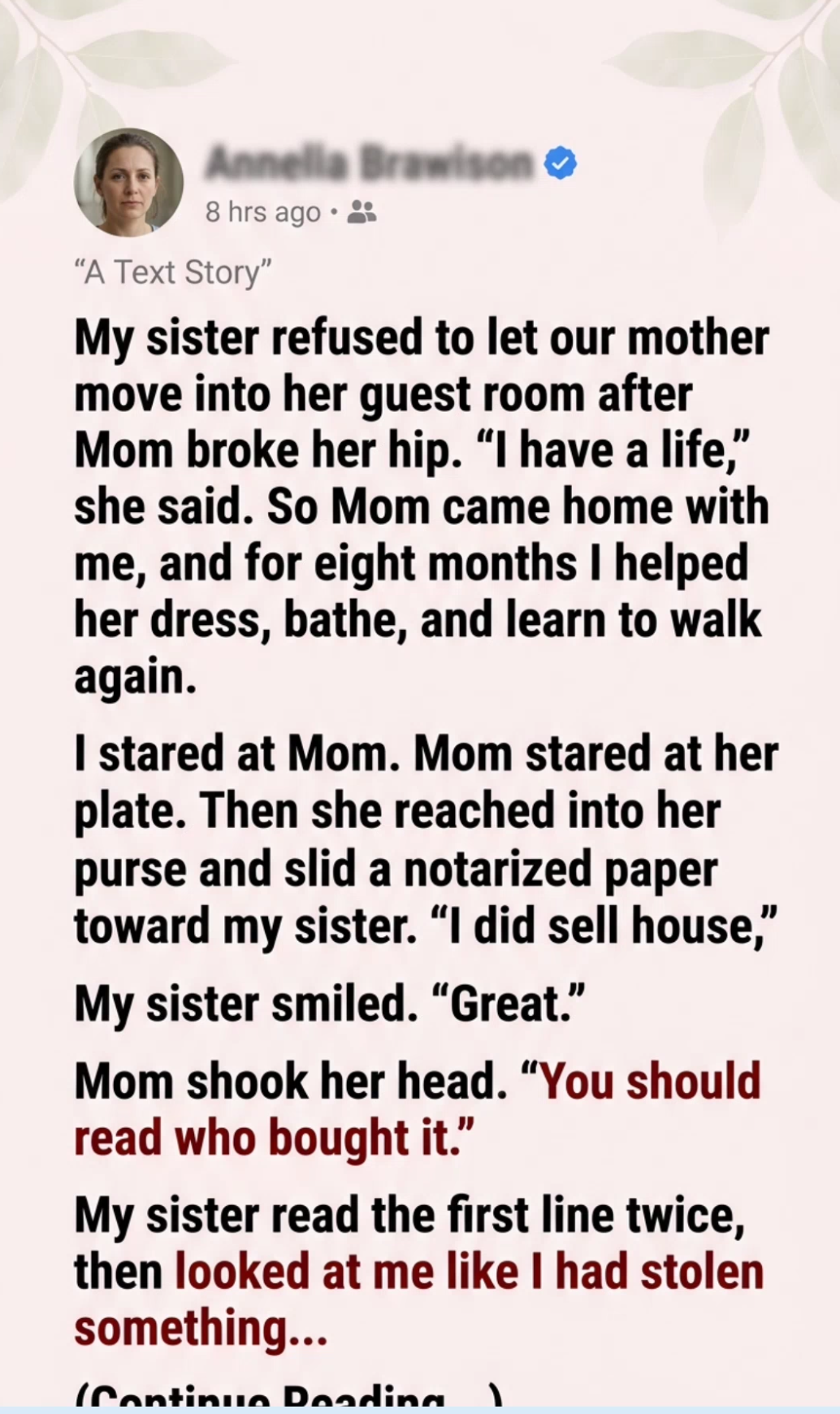
The first time my sister told our mother she couldn’t stay with her, Mom was still sitting in a hospital wheelchair.
Her right leg was supported by a padded brace, and a thin blanket covered her knees. She looked smaller than I remembered, almost swallowed by the oversized cardigan she’d worn to the hospital.
My sister, Vanessa, stood near the window, checking messages on her phone.
“It’s just not possible, Mom,” she said.
Mom looked up.
“Not even for a few weeks?”
Vanessa sighed.
“I have a life. I have work, appointments, and things I need to do. I can’t turn my guest room into a nursing facility.”
The words seemed to hang in the room.
I was standing beside the hospital bed, holding the discharge folder.
“It’s not a nursing facility,” I said. “She needs somewhere safe to recover.”
Vanessa turned toward me.
“Then take her to your house.”
I looked at her.
“I will.”
She seemed surprised that I didn’t argue.
Mom lowered her eyes.
“I don’t want either of you fighting because of me.”
Vanessa kissed her forehead, picked up her handbag, and announced that she had to leave before traffic became bad.
She didn’t offer to help carry Mom’s belongings.
She didn’t ask what medications had been prescribed.
She didn’t even ask when Mom’s next physical therapy appointment was.
She simply walked out.
I watched her disappear through the hospital doors.
Then I turned back to Mom.
“Come on,” I said gently. “Let’s get you home.”
Mom reached for my hand.
“Are you sure you can manage?”
I smiled.
“We’ll figure it out together.”
I had no idea how much those words would change both our lives.
Mom’s name was Eleanor Bennett.
She was seventy-eight years old and had lived alone in the same three-bedroom house for nearly thirty years.
Dad had died six years earlier, and since then, Mom had become increasingly independent.
She still cooked Sunday dinners, maintained a small garden, and insisted on paying her own bills.
She wasn’t wealthy, but she had something valuable: a house that was fully paid off and a modest retirement account.
Vanessa had always been interested in the house.
She never said it directly, but she frequently discussed how much it might sell for, whether the neighborhood was improving, and how much money Mom could make if she moved somewhere smaller.
Mom usually changed the subject.
I lived in a modest two-bedroom house with my husband, Daniel, and our teenage daughter, Lily.
We weren’t rich. Daniel worked as a maintenance supervisor, and I managed the office at a dental clinic.
But we had a spare bedroom.
And we had room in our lives for Mom.
The first few weeks were difficult.
Mom couldn’t stand without assistance. She needed help getting out of bed, bathing, dressing, and moving safely around the house.
At night, I slept lightly because I was afraid she might try to get up alone.
I learned how to help her transfer from the bed to her wheelchair.
I learned which medications made her sleepy and which exercises caused discomfort.
I learned to recognize the difference between the quiet frustration of someone who was tired and the silence of someone who was afraid.
Some mornings, Mom cried because she couldn’t button her blouse.
Other mornings, she became angry because she needed help reaching the bathroom.
“I used to take care of everyone,” she told me one afternoon.
I was helping her put on a pair of socks.
“Now everyone has to take care of me.”
I looked up.
“That’s what families are for.”
She turned her face toward the window.
“I don’t want to become a burden.”
“You aren’t one.”
She didn’t answer.
But I could see that she wasn’t convinced.
Vanessa visited twice during the first month.
The first time, she brought a small box of chocolates and stayed for twenty minutes.
She spent most of the visit talking about her new kitchen renovation.
The second time, she arrived with a real estate brochure.
“Mom, have you thought about selling the house?” she asked.
Mom was sitting in her wheelchair near the dining table.
“Why would I sell it?”
“It’s too much property for one person. You don’t need three bedrooms anymore.”
“I’m not ready to move.”
Vanessa smiled.
“I’m just trying to help you think ahead.”
Mom looked at me.
I kept my expression neutral.
After Vanessa left, Mom asked me to put the brochure in a drawer.
I did.
Then she asked me not to mention it again.
I respected that.
At the time, I thought Vanessa was simply being impatient.
I didn’t yet understand that she had already begun making plans around Mom’s property.
The months passed slowly.
Physical therapy became part of our daily routine.
At first, Mom could only stand for a few seconds while holding the kitchen counter.
Then she managed three steps with a walker.
After that came five.
Every small achievement felt enormous.
The first time she walked from her bedroom to the living room without stopping, Lily cheered so loudly that Mom laughed.
“Don’t make such a fuss,” she said.
“You walked across the entire hallway!” Lily replied.
“I’ve been walking for seventy-eight years.”
“Not with that walker, Grandma.”
Mom laughed again.
It was the first time in weeks that I had heard her laugh without immediately becoming tired.
Eight months after her fall, she could walk short distances with a cane.
She still needed help with certain tasks, but she was no longer dependent on a wheelchair.
Her doctor was pleased with her progress.
One afternoon, while we were having tea, Mom looked around my kitchen.
“You’ve given up so much for me.”
I shook my head.
“I haven’t given up anything.”
“You spend your evenings helping me. You take me to appointments. You hardly have time for yourself.”
“I still have time for myself.”
“Don’t lie to an old woman.”
I smiled.
“Then I’ll tell you the truth. Sometimes I’m tired. Sometimes I worry. But I would rather be tired knowing you’re safe than comfortable knowing you had nowhere to go.”
Mom’s eyes filled with tears.
She reached across the table and squeezed my hand.
“I hope you never regret this.”
“I won’t.”
She looked toward the hallway.
“Your father would have been proud of you.”
I swallowed.
“I hope so.”
That evening, after Mom went to bed, I noticed her bedroom door was slightly open.
She was sitting at the small desk beside the window, reading through a thick folder.
When I knocked, she quickly closed it.
“Everything okay?”
“Yes, sweetheart.”
“Do you need anything?”
“No. Just organizing a few papers.”
I thought nothing of it.
Mom had always been meticulous with documents.
Vanessa’s visits became less frequent.
She called occasionally, usually when she wanted to discuss something related to the house.
One afternoon, she asked whether Mom had updated her will.
I told her that was a private matter between Mom and her attorney.
She became irritated.
“I’m her daughter too.”
“I know.”
“Then why are you acting like you have some special authority?”
“I’m not. I’m helping her recover.”
Vanessa went quiet.
Then she said, “Just make sure she doesn’t sign anything without understanding it.”
I found the warning strange.
“Why would she?”
“Because people get confused when they’re old. They trust whoever is around them.”
I stared at the phone.
“Are you suggesting I’m taking advantage of Mom?”
“I’m suggesting you should be careful.”
She ended the call.
I didn’t tell Mom about it.
I didn’t want to upset her.
But I began noticing something.
Whenever Vanessa visited, she asked questions about the house, the savings, and Mom’s long-term plans.
She rarely asked about physical therapy.
She never asked whether Mom was in pain.
Her interest seemed to stop wherever the property began.
In the ninth month, Mom announced that she wanted to invite both of us to Sunday dinner.
“Something important,” she said.
I assumed she wanted to discuss whether she would eventually return to her own house.
I was nervous about that possibility.
I wanted her to be independent, but I also knew the house had stairs, a narrow bathroom, and a long driveway.
It would need modifications before she could safely live there again.
Vanessa arrived twenty minutes late.
She wore a cream-colored coat and carried a designer handbag.
“Sorry,” she said, placing the bag on a chair. “Traffic was terrible.”
She looked at the dining table.
“What’s the occasion?”
Mom smiled.
“I have something to tell you.”
Vanessa sat down.
I served dinner, and for a while we talked about ordinary things.
Lily told Mom about a school project.
Daniel discussed a repair job at work.
Vanessa talked about a holiday she was planning.
Then Mom placed her fork down.
“I’ve made a decision about the house.”
Vanessa immediately looked interested.
“What decision?”
“I sold it.”
For a moment, I thought I had misunderstood.
Vanessa’s face brightened.
“Really?”
Mom nodded.
Vanessa leaned back.
“That’s wonderful. I told you it was the right time.”
She looked at me with a small, satisfied smile.
“See? Mom finally agreed.”
I looked at Mom.
She wasn’t smiling.
“There’s something else,” Mom said.
She reached into her handbag and removed a folded document.
She placed it on the table in front of Vanessa.
“It’s the notarized sale agreement.”
Vanessa glanced at the top page.
“Great. How much did you get?”
Mom didn’t answer immediately.
“Read who bought it.”
Vanessa smiled.
“Why does that matter?”
“Just read the first page.”
My sister unfolded the document.
Her eyes moved down the page.
Then she stopped.
She read the first line again.
Her smile disappeared.
She looked at Mom.
Then she looked at me as if I had somehow stolen something from her.
“What is this?”
Mom folded her hands.
“It’s the truth.”
Vanessa pushed the document away.
“This says the buyer is—”
“Yes,” Mom interrupted. “That’s correct.”
Vanessa turned toward me.
“You bought Mom’s house?”
I looked at the document.
My name was listed as the buyer.
I had known about the sale.
But I hadn’t known Mom intended to reveal it that evening.
“Mom asked me to purchase it,” I said.
Vanessa stared at me.
“You bought her house behind my back?”
Mom’s voice became firm.
“She doesn’t need your permission.”
Vanessa looked shocked.
“But I’m your daughter too!”
“And I am the owner of my property,” Mom replied. “I am allowed to decide what happens to it.”
Vanessa stood up.
“This is ridiculous. You can’t just give her the house!”
Mom shook her head.
“I didn’t give it to her. I sold it.”
Vanessa laughed bitterly.
“With what money? She doesn’t have enough to buy this house.”
I felt Daniel’s hand touch my arm beneath the table.
I remained quiet.
Mom opened another folder.
“Your sister paid the agreed price through a bank transfer. The sale was independently valued, reviewed by my attorney, and completed through a licensed conveyancer.”
Vanessa’s expression changed.
“How much?”
Mom told her.
The amount was based on an independent valuation, with a reasonable adjustment for the repairs the property needed.
It was not a gift.
It was a genuine sale.
Vanessa looked at me again.
“You had this planned.”
“No,” I said. “Mom approached me.”
“When?”
“Several weeks ago.”
“And you didn’t tell me?”
“Mom didn’t ask me to.”
Vanessa turned back toward Mom.
“Why would you do this?”
Mom took a slow breath.
“Because I finally understood something.”
She looked at my sister.
“When I broke my hip, I asked whether I could stay in your guest room for a few weeks.”
Vanessa looked away.
“You know how busy I was.”
“I know.”
“I had responsibilities.”
“I know.”
“You make it sound like I abandoned you.”
Mom’s voice softened.
“You did abandon me. But that isn’t why I sold the house.”
Vanessa frowned.
“Then what is?”
Mom reached into the folder again.
She removed a second document.
This one was a printed email.
“I received a message from you last year.”
Vanessa’s face changed.
“What message?”
Mom placed it beside the sale agreement.
It was an email Vanessa had sent to a property agent.
She had asked for an estimated selling price for Mom’s house.
That alone wasn’t especially surprising.
But the next paragraph was different.
Vanessa had written that she expected her mother to move into assisted living eventually and that she wanted to understand whether the property could be sold before the market changed.
She had also asked whether a family member could arrange a sale if the owner became unable to manage her affairs.
Mom looked at her.
“Why were you asking about selling my house while I was still recovering from surgery?”
Vanessa’s cheeks turned red.
“I was trying to plan.”
“Without asking me?”
“I was concerned about your future.”
“Then why did you tell the agent that you expected to handle the sale?”
Vanessa opened her mouth.
Nothing came out.
I looked at the email again.
There was another message attached.
The agent had asked whether Mom had authorized Vanessa to act on her behalf.
Vanessa had replied that she had power of attorney.
But that was not true.
Mom had never given her power of attorney.
Martin—no, this was Vanessa. She had no legal authority over the house.
Mom looked at her quietly.
“You didn’t have permission to sell my home.”
“I wasn’t selling it!”
“You were asking how to do it.”
“I was exploring options.”
“Options for my house, without my knowledge.”
Vanessa sat down slowly.
The room became silent.
Then Mom said something I hadn’t expected.
“I also know about the money you asked me for.”
Vanessa looked up.
“What money?”
“Last spring. You called and said your business needed help.”
Vanessa had been running a small event-planning company for several years.
She had told Mom she was struggling with rent, supplier payments, and an unexpected tax bill.
Mom had given her $18,000.
She had described it as a temporary loan.
Vanessa had promised to repay it within six months.
It had been almost a year.
“Mom, I told you I’d pay you back.”
“You did.”
“I’ve had a difficult year.”
“I understand.”
“Then why bring this up now?”
Mom removed another sheet of paper.
It was a bank statement.
“I asked my attorney to review my finances. I wanted to understand exactly where my money had gone.”
Vanessa’s face tightened.
“What does that have to do with the house?”
Mom looked at her.
“Nothing. But it has something to do with why I no longer trust you with decisions about my future.”
She explained that the $18,000 had never been repaid.
Mom wasn’t demanding that Vanessa return it that evening.
She simply wanted her to understand that the money had been a loan, not an inheritance.
Vanessa began crying.
“You’re treating me like a criminal.”
Mom’s expression remained calm.
“I’m treating you like an adult who made promises and didn’t keep them.”
I looked down at my plate.
I hadn’t known about the loan.
I hadn’t known about the email.
And I certainly hadn’t known Mom had been quietly investigating her own financial situation.
For eight months, I had thought I was simply helping my mother recover.
Meanwhile, she had been putting together the truth about her own family.
Then Mom turned toward me.
“There’s something I need to explain to you too.”
I looked up.
“When you agreed to buy the house, I told you I wanted a clean sale. But I didn’t tell you why I wanted to sell it to you.”
I waited.
Mom smiled faintly.
“I don’t want to live alone anymore.”
My chest tightened.
“Mom, you don’t have to buy or sell anything to stay with us.”
“I know.”
“You could have stayed without doing all this.”
“I know that too.”
She reached for my hand.
“But I want to contribute. I don’t want you carrying all the responsibility while I simply receive help.”
She explained that she had sold the house at its independently established market value and would use the proceeds to secure her own future.
She planned to keep a substantial amount in her own accounts for medical expenses, living costs, and emergencies.
The sale did not make her financially dependent on me.
It gave her a way to live closer to the people she trusted while retaining control of her money.
She had also arranged a separate living agreement with an attorney.
It clearly stated that she would contribute a fair amount toward household expenses, while I would have no authority to access her personal accounts.
Her will remained unchanged.
I was not receiving her savings.
Vanessa was not being disinherited.
Mom had simply chosen where to live and what to do with her property.
“I’m not buying love,” Mom said. “And I’m not rewarding one daughter while punishing the other. I’m making a decision about my own life.”
I felt tears forming.
“Mom, you don’t owe us anything.”
She smiled.
“Neither do you. But you gave me something when I needed it.”
She squeezed my hand.
“You gave me a home where I never had to apologize for being unable to walk.”
Vanessa left dinner early.
She said she needed time to think.
Before leaving, she picked up the sale agreement again.
“I still think this is unfair,” she said.
Mom looked at her.
“You’re entitled to your feelings.”
“Are you really going to let her have the house?”
Mom corrected her gently.
“Your sister purchased the house. I sold it. Those are different things.”
Vanessa shook her head.
Then she walked out.
I expected Mom to cry.
Instead, she calmly asked Daniel whether he wanted another serving of vegetables.
That surprised me more than anything.
“Are you okay?” I whispered.
Mom nodded.
“I’ve been thinking about this for a long time.”
“Did you want her to react differently?”
“Of course.”
She looked toward the empty chair.
“But I can’t spend the rest of my life making decisions based on whether your sister approves of them.”
I leaned over and hugged her.
For the first time, I realized how much courage it had taken for her to say no to someone she had spent a lifetime trying to please.
The following weeks were uncomfortable.
Vanessa sent several messages.
Some were angry.
Others were emotional.
She accused me of manipulating Mom, taking advantage of her disability, and arranging the sale while she was vulnerable.
Helen, Mom’s attorney, provided a written confirmation that the transaction had been independently valued, properly documented, and completed while Mom had the legal capacity to make her own decisions.
Mom also attended an independent meeting with her attorney without me present.
She confirmed that she understood the sale, the price, and the consequences.
There was no evidence of coercion.
The sale stood.
Eventually, Vanessa stopped sending accusations.
She still didn’t apologize.
But she began calling Mom more regularly.
At first, the conversations were brief.
Then, one afternoon, she came over with a bag of groceries.
Mom thanked her.
Vanessa sat at the kitchen table.
“Do you still have the old recipe for Dad’s apple cake?” she asked.
Mom smiled.
“Of course.”
They spent an hour discussing ingredients and cooking temperatures.
It wasn’t reconciliation.
Not yet.
But it was a beginning.
Six months later, Mom was walking around the garden with a cane.
The house had been modified for her needs.
We installed a walk-in shower, added grab bars, improved the lighting, and removed the loose rugs that could cause her to fall.
She insisted on choosing the flowers for the front porch.
She also insisted on paying her agreed share of household expenses.
Sometimes, she helped Lily with homework.
Sometimes, she sat with Daniel while he watched television.
And every Sunday, she cooked something for all of us.
One evening, I found her looking at an old photograph of Dad.
“Do you think he would have agreed with what I did?” she asked.
I sat beside her.
“I think he would have wanted you to be happy.”
She nodded.
“He always said a house was only a house. The people inside mattered more.”
I smiled.
“He was right.”
Mom placed the photograph back on the shelf.
Then she looked at me.
“There’s one thing I want you to remember.”
“What?”
“Don’t confuse loving someone with giving them control over your life.”
I thought about Vanessa’s refusal to let her stay.
I thought about the months of physical therapy, the sleepless nights, and the difficult conversations.
I thought about the notarized document on the dinner table.
“I won’t,” I said.
Mom reached for my hand.
“Good. Because I didn’t sell my house to choose a favorite daughter.”
She smiled.
“I sold it because I wanted to choose my future.”
And that was the truth.
My sister had once believed that Mom’s house was an inheritance waiting to be divided.
I had believed that helping Mom meant simply giving her a place to recover.
But Mom had taught both of us something neither of us had fully understood.
A parent’s home is not a reward for the child who expects it.
A parent’s money is not a prize for the child who asks first.
And a parent’s love should never be measured by the property they leave behind.
Mom had lost her husband, broken her hip, and spent months learning how to walk again.
But she had not lost her right to decide how she wanted to live.
That evening, she walked slowly down the hallway with her cane.
She stopped at the kitchen doorway, turned toward me, and smiled.
“I’m glad I came home.”
I smiled back.
“So am I, Mom.”
THE END.